


12,99 €
Mehr erfahren.
- Herausgeber: John Wiley & Sons
- Kategorie: Fachliteratur
- Serie: Harvard Health Publications
- Sprache: Englisch
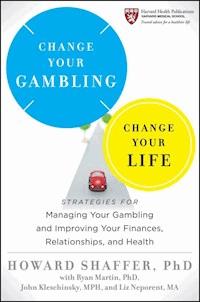
A research-based guide to controlling the destructive urge to gamble From Howard Shaffer, PhD, a noted expert on gambling addiction, and Harvard Health Publications comes Change Your Gambling, Change your Life, a landmark new book which explains how gambling problems are related to other underlying issues: such as anxiety, mood fluctuation, difficulty with impulse control, and substance abuse problems. Dr. Shaffer offers a series of self-tests to help evaluate the degree of gambling problem and analyze the psychological and social context of the behavior, with specific strategies and approaches for ending the problems with simple tools that anyone can do. * Explains why many people have a problem controlling their urge to gamble and how that can be corrected * Includes a toolbox of resources for anyone who wants to stop the vicious cycle of gambling * Offers advice for avoiding slips and preventing backslides and how to deal with the consequences With candor and expert advice, Change Your Gambling, Change Your Life provides proven techniques for controlling the urge to gamble.
Sie lesen das E-Book in den Legimi-Apps auf:
Seitenzahl: 313
Veröffentlichungsjahr: 2012
Ähnliche



















Table of Contents
Cover
Endorsements
Title page
Copyright page
Dedication
Preface
WHAT IS PATHOLOGICAL GAMBLING?
SELF-DIRECTED RECOVERY FROM GAMBLING
Acknowledgments
Introduction: How to Use This Book
THERE ARE NO RULES
HOW THIS BOOK IS ORGANIZED
WHERE TO START
WHERE DO YOU GO FROM HERE?
Part 1: How to Begin
1 Assessing Your Problems
WHAT DOES IT MEAN TO BE ADDICTED TO GAMBLING?
THE STAGES OF ADDICTION
ARE YOU STRUGGLING WITH GAMBLING ADDICTION?
WHAT OTHER PROBLEMS ARE YOU EXPERIENCING?
WHERE DO YOU GO FROM HERE?
2 Connecting the Dots
THE NINE DOT PROBLEM
WHAT YOU CAN LEARN FROM THE NINE DOT PROBLEM
WHERE DO YOU GO FROM HERE?
3 Setting Goals to Help You Change
WHAT YOU NEED TO KNOW ABOUT GOAL SETTING
GOAL SETTING, STEP-BY-STEP
SUMMING UP GOAL SETTING
WHERE DO YOU GO FROM HERE?
Part 2: How to Change
4 Getting Your Gambling Under Control
WHAT IS PROBLEM GAMBLING?
MODERATION VERSUS ABSTINENCE
MAKING CHANGES
WHERE DO YOU GO FROM HERE?
5 Anxiety and Gambling
TYPES OF ANXIETY
THE ANXIETY-GAMBLING CONNECTION
MAKING CHANGES
WHERE DO YOU GO FROM HERE?
6 Mood Disorders and Gambling
TYPES OF MOOD PROBLEMS
GAMBLING AND MOOD
MAKING CHANGES
WHERE DO YOU GO FROM HERE?
7 Impulse Control and Gambling
DIFFERENT FORMS OF IMPULSE CONTROL PROBLEMS
MAKING CHANGES
WHERE DO YOU GO FROM HERE?
8 Substance Abuse and Gambling
SUBSTANCE ABUSE
SUBSTANCE DEPENDENCE
GAMBLING AND SUBSTANCE ABUSE
MAKING CHANGES
WHERE DO YOU GO FROM HERE?
Part 3: How to Stay the Course
9 Preventing Relapses
UNDERSTANDING TRIGGERS
WHAT ARE YOUR TRIGGERS?
UNDERSTANDING SLIPUPS
DEALING WITH A SLIPUP
WHERE DO YOU GO FROM HERE?
Resources and Further Reading
References
About the Authors
About Harvard Medical School
Index
More Praise for Change Your Gambling, Change Your Life
“From recognizing the problem to changing your daily patterns to living a life beyond the dream of hitting it big, this book will transform your thinking about gambling and put you on the path to real change and long-term recovery.”—Christopher Kennedy Lawford, author, Symptoms of Withdrawal and Moments of Clarity
“This is a well-written and easily accessible book that provides the tools for individuals to take control of their gambling problem. In an era where professional addiction treatments are common and yet frequently unsuccessful, it is exciting to see a comprehensive, self-directed approach to addiction recovery.”—Jon E. Grant, MD, JD, MPH, professor of psychiatry, University of Minnesota School of Medicine, Minneapolis, Minnesota; coauthor, Pathological Gambling
“The self-directed approach to addiction recovery is getting the attention it deserves with this must-read book for people who want to work through a gambling problem on their own. Kudos to Dr. Shaffer and his coauthors for meaningfully advancing the problem gambling treatment field with this book.”—Ken C. Winters, professor, Department of Psychiatry, University of Minnesota Medical School
“The topics of gambling and gambling problems often lead to politically and emotionally charged discussions that ignore the needs of the small percentage of people who need help. Dr. Shaffer and his colleagues have removed the value judgments and provided a thoughtful, authoritative manual for those in need.”—Frank J. Fahrenkopf, Jr., president and CEO, American Gaming Association
“At the Dunes, our clients have seen profound results from using the exercises in the chapters on anxiety and relapse prevention. Dr. Shaffer and his colleagues have come up with a practical way to combat addiction, one thought at a time. Valuable for clients, clinicians, and anyone with an addiction problem.”—Madeleine Narvilas, Esq., LMSW, executive director, The Dunes East Hampton
“The authors have devoted decades of time and energy to the study and treatment of people whose gambling has caused them problems. They have condensed and translated this wealth of experience into a book that is state-of-the-science and accessible to all people who want to change their patterns of gambling, whether on their own or with the aid of a professional or self-help group.”—Stephen A. Maisto, PhD, ABPP, editor, Psychology of Addictive Behaviors; Department of Psychology, Syracuse University
“Bravo! This groundbreaking self-help resource is a boon to millions of excessive gamblers who would do best as captain of their own ship. It is a prototype that will be replicated many times across the broad spectrum of addictive disorders. Change Your Gambling, Change Your Life reads like a good friend offering a helping hand, asking for nothing in return. It whets your appetite, then invites you to enjoy any or all of its sumptuous menu.” —Harvey B. Milkman, PhD, professor of psychology; director, Center for Interdisciplinary Studies, Metropolitan State College of Denver
“This book is an excellent resource for individuals who struggle with gambling regardless of the severity of their problem. Written clearly and with compassion, it offers various self-help tools to help people find their own pathway to change, always taking into account each person’s unique characteristics and preferences.”—Michael Levy, PhD, vice president clinical services, CAB Health and Recovery Services and Health and Education Services, Peabody, Massachusetts
“In the summer of 2011, the American Society of Addiction Medicine introduced a revolutionary new definition of addiction that, for the first time, includes the behavioral addictions. Finally, after more than thirty years of research, pathological gambling has come out of the closet! Dr. Shaffer and his colleagues eloquently discuss ‘intemperate gambling as a disorder of excess’ and provide an invaluable practical roadmap for clinicians, patients, and their loved ones on the road to recovery from gambling addiction.”—Petros Levounis, MD, MA, director, The Addiction Institute of New York; associate clinical professor of psychiatry, Columbia University College of Physicians and Surgeons
“If you are struggling with problem gambling, Dr. Shaffer’s approach to coping with addictive disorders is based on sound principles and workable solutions. This book will help you if you follow his course of action.”—Kitty S. Harris, PhD, LCDC, LMFT, director, Center for the Study of Addiction and Recovery, Texas Tech University
Copyright © 2012 by Harvard University. All rights reserved.
Published by Jossey-Bass
A Wiley Imprint
One Montgomery Street, Suite 1200, San Francisco, CA 94104-4594—www.josseybass.com
No part of this publication may be reproduced, stored in a retrieval system, or transmitted in any form or by any means, electronic, mechanical, photocopying, recording, scanning, or otherwise, except as permitted under Section 107 or 108 of the 1976 United States Copyright Act, without either the prior written permission of the publisher, or authorization through payment of the appropriate per-copy fee to the Copyright Clearance Center, Inc., 222 Rosewood Drive, Danvers, MA 01923, 978-750-8400, fax 978-646-8600, or on the Web at www.copyright.com. Requests to the publisher for permission should be addressed to the Permissions Department, John Wiley & Sons, Inc., 111 River Street, Hoboken, NJ 07030, 201-748-6011, fax 201-748-6008, or online at www.wiley.com/go/permissions.
Limit of Liability/Disclaimer of Warranty: While the publisher and author have used their best efforts in preparing this book, they make no representations or warranties with respect to the accuracy or completeness of the contents of this book and specifically disclaim any implied warranties of merchantability or fitness for a particular purpose. No warranty may be created or extended by sales representatives or written sales materials. The advice and strategies contained herein may not be suitable for your situation. You should consult with a professional where appropriate. Neither the publisher nor author shall be liable for any loss of profit or any other commercial damages, including but not limited to special, incidental, consequential, or other damages. Readers should be aware that Internet Web sites offered as citations and/or sources for further information may have changed or disappeared between the time this was written and when it is read.
Jossey-Bass books and products are available through most bookstores. To contact Jossey-Bass directly call our Customer Care Department within the U.S. at 800-956-7739, outside the U.S. at 317-572-3986, or fax 317-572-4002.
Wiley also publishes its books in a variety of electronic formats and by print-on-demand. Some material included with standard print versions of this book may not be included in e-books or in print-on-demand. If the version of this book that you purchased references media such as CD or DVD that was not included in your purchase, you may download this material at http://booksupport.wiley.com. For more information about Wiley products, visit www.wiley.com.
Library of Congress Cataloging-in-Publication Data
Shaffer, Howard.
Change your gambling, change your life : strategies for managing your gambling and improving your finances, relationships, and health / Howard Shaffer ; with Ryan Martin, John Kleschinsky, and Liz Neporent. – 1st ed.
p. cm.
Includes bibliographical references and index.
ISBN 978-0-470-93307-7 (pbk.); ISBN 978-1-118-17103-5 (ebk.); ISBN 978-1-118-17104-2 (ebk.); ISBN 978-1-118-17105-9 (ebk.)
1. Compulsive gambling–Treatment. 2. Compulsive gambling–Psychological aspects. 3. Compulsive gambling–Social aspects. I. Martin, Ryan. II. Kleschinsky, John. III. Neporent, Liz. IV. Title.
RC569.5.G35S53 2012
616.85′84106–dc23
2011042388
To Linda, who continues to teach me to do things on my own; in addition to her loving support, she sacrificed her time to afford me the opportunity to work on this project
—HJS
To my parents and my mentors
—RM
To my wife, Melissa, for her limitless love, patience, and support; to my mother for teaching me the value of service to others; and to those who seek to change, may you find your path
—JHK
To my wonderful husband, Jay, the love of my life
—LN
Preface
We wrote this book as a way to support anyone looking to take a self-help approach to recovery from gambling addiction. We also want to provide support for loved ones and clinicians encouraging such efforts. Our aim is to provide a variety of tried-and-true self-directed tools to help control problem gambling.
Unfortunately, most people with addiction receive a specific kind of help that’s primarily determined by the door they knock on to get help rather than by the problem they have. This is particularly common for an expression of addiction like pathological gambling. Even as there are many popular treatments with little or no empirical evidence to support their use, there are many effective and legitimate treatments that are overlooked. Influenced by the assortment of ideas that influence treatment, a help-seeking gambler can sometimes feel like a rudderless ship adrift on an ocean of indifference and misinformation.
We believe that self-directed change is one approach to addiction recovery that is underrated and underutilized. There seems to be a deeply rooted belief in this society, even among some clinicians, that people with addiction can make improvements only with professional help.
In fact, people recover from addiction in many different ways. Some people are comfortable getting help; others prefer to work things out on their own. Across a wide variety of problems, there are more people who want to try to make changes without help compared to those who seek assistance. As the scientific evidence regarding addiction mounts, it’s more apparent than ever that behavior change can occur with or without treatment. In fact, the majority of individuals recover via self-directed change.
WHAT IS PATHOLOGICAL GAMBLING?
The American Psychiatric Association (APA) defines pathological gambling as an urge to gamble despite harmful negative consequences or a desire to stop. We prefer to view intemperate gambling as a disorder of excess; that is, as an addiction. The APA’s introduction of pathological gambling as a diagnosis in 1980 sparked a new interest in its causes and treatments. Now, more than thirty years later, the study and treatment of gambling problems remains a nascent field with new ideas and approaches emerging all the time.
Although high-quality research is shedding light on gambling and gambling-related conduct all the time, strange beliefs still persist about why someone becomes a problem gambler. For example, some experts, and even some gamblers, tend to think that inanimate objects, such as slot machines, dice, and cards, are the cause of gambling disorders. If these were the necessary and sufficient catalysts for the problem, people wouldn’t develop gambling disorders without using them.
However, the opposite is true. The vast majority of people who play slot machines, dice, or cards don’t develop a gambling problem, whereas many people who do develop gambling issues never touch any of these objects. For example, some people who struggle to limit their out-of-control bets on sporting events might never succumb to the flashing lights of the slot machines or the lure of a card game.
You might presume that exposure to gambling opportunities is sufficient to jump-start addictive behavior. Research tells us that this isn’t always the case either. People tend to adapt relatively quickly after exposure to gambling opportunities, and the prevalence of pathological activity increases only during the short term—as a novelty effect—after the introduction to new gambling opportunities. In other words, there seems to be something about the gambler—as opposed to particular games played or exposure to gambling—that is central to the development of gambling-related problems.
The idea of adaptation to changes in the social setting emerged from the work of Norman Zinberg, a highly influential addiction treatment specialist who recognized the importance of understanding the interactive biological (drug), psychological (set), and social (setting) influences that determine the subjective effects of intoxicant use. Over time, these factors interact to regulate substance use and to limit adverse consequences; simply put, given time, many people with addiction tend to improve even if they do nothing to control their addiction. Zinberg and one of the authors of this book, Howard Shaffer, were the first to generalize these theories about adaptation to gambling, even though most experts were predicting a spike in the rate of pathological gambling as legalized gambling expanded.
In reality, the prevalence of pathological gambling among adults has remained remarkably steady during the past thirty-five years despite an unprecedented increase in access to lotteries, casinos, Internet gambling, and other gambling opportunities. New research even shows a decline in the rate of gambling among young people in recent years. Gambling disorders are far from being relentlessly progressive; rather, research reveals that many individuals move in and out of gambling disorders.
If exposure to gambling opportunities doesn’t necessarily contribute to the development of gambling problems, what does? Co-occurring mental health disorders seem to have a significant impact. Research indicates that pathological gamblers are approximately seventeen times more likely than people without gambling problems to have mental disorders, substance use disorders, or both.
SELF-DIRECTED RECOVERY FROM GAMBLING
People with a gambling disorder are often hesitant to enter treatment, but research shows that they still can manage to improve their situation even without any sort of outside help. The National Epidemiologic Survey on Alcohol and Related Conditions and the National Gambling Impact Study Commission found that, among individuals who previously have experienced pathological gambling during their lifetime, 36 to 39 percent have not experienced any gambling-related problems in the past year, but only 5.5 percent of them received professional treatment for their gambling problems, and only 7.3 percent attended one of the popular self-help group meetings held by Gamblers Anonymous. None of the participants in the National Comorbidity Survey Replication with a pathological gambling diagnosis had received treatment for their problem, even though nearly half had received treatment for other mental disorders.
We recognize that there are many different factors that might make you hesitate to seek help: you may be ashamed of your circumstances; you may be unaware that help is available; you may not have insurance or the financial resources to enter treatment; or you may simply feel that you want to try working things out on your own. Whatever the reason, there should be nothing stopping you from trying to take control and to assume responsibility for your own recovery. We strongly believe that with a few life-threatening exceptions, people deserve the opportunity at least to try to recover on their own if they so choose.
We are not saying that all people with addiction under every circumstance can or should change without having some help. What we do want to emphasize is that the idea that you can’t recover and change addiction on your own defies current scientific evidence and magnifies our desire to bring the truth, through first-rate resources and sound advice, to as many people as we can who are suffering with addiction, as well as to their families and the clinicians who try to help them. We believe that simply knowing that you can change on your own permits and even creates new and different opportunities for change.
At the same time, we also want you to know that if you aren’t immediately ready to change your addiction, this doesn’t mean you won’t ever be ready. Similarly, if you do decide you need professional treatment of some kind, or decide you’d do best with a mix of self-help and professionally guided strategies, that’s OK too.
Our main premise is that self-directed change is preferable and often successful for many people in recovery from gambling problems. Someone struggling with unrelenting excessive gambling also might be experiencing other mental health problems, such as depression, anxiety, or drug abuse; for this reason, we’ve devoted a number of chapters to co-occurring problems that are typical for pathological gamblers. Our belief is that success can come from tackling more than one problem at once, or at least having the tools to tackle accompanying issues when you are ready to face them. No one is a helpless victim to excessive gambling.
The bottom line is that there is no “right” way to recover from addiction. We do hope that this book encourages you to accept self-directed change for your gambling problems. We also hope that we’ve provided more ways to recover than you might have realized were available before you picked up this book.
Acknowledgments
This book was a long time in the making. As a result, a number of people participated in various aspects of manuscript preparation. We acknowledge our colleagues who made central contributions to the development of this book. Sara Kaplan, Ingrid Maurice, Leslie Bosworth, and Erica Marshall were instrumental research assistants who helped organize and prepare early manuscript versions. We appreciate the many gifts they brought to this project and are very proud of their accomplishments since they left the Division on Addiction for greener pastures. We also recognize our colleagues at the Division on Addiction. Tasha Chandler, Debi LaPlante, Sarah Nelson, Richard LaBrie, and Christine Thurmond provided encouragement, support, curiosity, and assistance as we developed this project. For these gifts, we extend our special thanks. We also thank Julie Silver and Linda Konner for their guidance and encouragement as we prepared and revised this book. We thank the late Thomas Cummings for collaborating with Dr. Shaffer for so many years; he enlightened us all about the nature of gambling addiction and how people recover from it. We extend special thanks to Kathy Scanlan and Marlene Warner for their support and collaboration as we worked together to learn from, teach, and treat people struggling with gambling-related problems. Finally, we thank the many gamblers and their families who shared the most intimate details of their lives as they were coping with their gambling-related problems. They taught us well, and for this we are forever grateful.
Introduction: How to Use This Book
There are two major ways to change behavior: change the world around you or change the way you see it. Without our making any assumptions about you, the information in this book is aimed at helping you change both.
Lesen Sie weiter in der vollständigen Ausgabe!
Lesen Sie weiter in der vollständigen Ausgabe!
Lesen Sie weiter in der vollständigen Ausgabe!
Lesen Sie weiter in der vollständigen Ausgabe!
Lesen Sie weiter in der vollständigen Ausgabe!
Lesen Sie weiter in der vollständigen Ausgabe!
Lesen Sie weiter in der vollständigen Ausgabe!
Lesen Sie weiter in der vollständigen Ausgabe!
Lesen Sie weiter in der vollständigen Ausgabe!
Lesen Sie weiter in der vollständigen Ausgabe!
Lesen Sie weiter in der vollständigen Ausgabe!
Lesen Sie weiter in der vollständigen Ausgabe!
Lesen Sie weiter in der vollständigen Ausgabe!
Lesen Sie weiter in der vollständigen Ausgabe!




