


7,19 €
Mehr erfahren.
- Herausgeber: Dolman Scott Publishing
- Kategorie: Geisteswissenschaft
- Sprache: Englisch
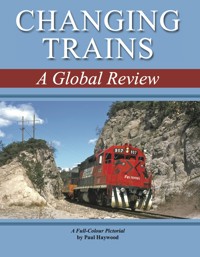
"Changing Trains - a Global Review" by Paul Haywood. Railways are always changing and "Changing Trains" gives a truly "Global Review". The author has always tried to use rail as his preferred mode of travel for work and leisure whenever possible and these are scenes taken by him before, during or after a scheduled train journey over a forty-year period from 1973. This all-colour pictorial features more than two hundred photographs of trains and railways in no fewer than forty-three countries presented alphabetically - from Australia to the USA by way of such diverse countries as Burma, Croatia, Mexico and Taiwan. Each photograph in this 104-page book has an interesting and informative caption which will appeal not only to hardened rail enthusiasts but also to those who simply like travelling by train and wish to know more about railways beyond their own shores.
Das E-Book können Sie in Legimi-Apps oder einer beliebigen App lesen, die das folgende Format unterstützen:
Seitenzahl: 94
Veröffentlichungsjahr: 2014
Ähnliche




















CHANGING TRAINSA Global Review
by Paul Haywood
Published By - Paul Haywood Publishing
an imprint of Dolman Scott
Copyright ©Paul Haywood, 2014
This book is sold subject to the condition that it shall not, by way of trade or otherwise, be lent, resold, hired out, or otherwise circulated without the publisher’s prior consent in any form of binding or cover other than that in which it is published and without a similar condition, including this condition, being imposed on the subsequent purchaser.
All rights reserved; no part of this publication may be reproduced or transmitted by any mean, electronic, mechanical, photocopying or otherwise, without the prior permission of the publisher.
ISBN 978-1-909204-32-4
Ebook ISBN 978-1-909204-43-0
Kindle ISBN 978-1-909204-44-7
Dedication
I am indebted to my late wife, Susan, and my new wife, Yvonne, for their tolerance and shared enjoyment of train travel (subject to having a comfortable seat and being fed at regular intervals). I also dedicate this book to my late sister, Judith, whose chosen residency in Montana gave me the chance to explore their railroads at an early age. Finally, I dedicate this book to my son, Peter, who inherited my love of railways freely and without undue coercion.
All the photographs within this book were taken by the author. They are not to be reproduced in any way without the permission of the author. All views expressed in this book are solely those of the author.
• British Rail (Midland Region) Inter-City 125 High Speed Train 43066 stands at London St Pancras in 1984.
• When Barlow’s magnificent train shed at St Pancras opened in 1868 it had the world’s largest single span roof. It has now been beautifully restored to become the St Pancras International terminal for Eurostar services from London to Paris and Brussels. This view was taken on the first day in its new role, 14 November 2007.
• Front cover - Construction of the Copper Canyon (Chihuahua - Los Mochis) line in Mexico began in 1907, but shortages of finance and the difficult terrain through which the route had to be built meant that a through service could not commence until 1961. Ferromex 907, a General Motors GP35M, leaves Posada with a westbound service in 2000.
• Rear cover - Deutsche Reichsbahn (East Germany) diesel-hydraulic 118 567-7, was one of a batch built in the 1970s by Lokomotivbau “Karl Marx” Babelsberg. It is seen propelling its push-pull train out of Potsdam’s former Hauptbahnhof Low Level (now Pirschheide) in October 1990. Note the distinctive profile of the East German double-deck rolling stock.
This simple and effective method of coal refueling of Transnet Heritage Beyer-Peacock Garratt steam locomotive 4122 is demonstrated at George, Western Cape, South Africa in 1998.
Introduction
Welcome to Changing Trains, a Global Review - a selection of railway photographs taken by me in forty three countries over a forty year period from 1973.
Like many British boys of my generation (as a postwar “baby boomer”), I developed an interest in railways in the 1950s. Then, steam was the dominant motive power and train spotters in my home town of Leeds had the pleasure of ‘copping’ former LMS and LNER locomotives, each having their own stations (City and Central respectively).
Early diesel multiple units were starting to appear on the scene in those days, and I often travelled with fellow-enthusiasts on AEC/Park Royal units from Bramley station each Saturday morning for a day of train spotting. Six old pennies, equal to today’s two and a half pence, bought me a Child’s Day Return, a platform ticket and a small packet of chewing gum. Leeds also then had the distinction of having a tramway and a magnificent selection of municipal, company and independent buses to add to the spotting and riding experience.
Also, within an easy train or bus ride, were trolleybuses in Bradford, Huddersfield, Mexborough, Rotherham and Doncaster and more trams in Sheffield. Unlike today, an interest in trams, buses and railways was then considered normal because most people still used public transport for school, work and leisure, with much of Britain’s population living within walking distance of a bus stop or station. Most importantly, the essential Ian Allan ABC train and bus spotters books made our interest legitimate.
By the late 1960s, the attractions of the opposite sex and my need to earn a living took priority. This, combined with my now being a proud car-owner (albeit of the “banger” variety), meant that my use of public transport diminished, and my spotter’s books were consigned to the bin.
Even my early (and not very good) black and white photographs were considered obsolete and, to my lifelong regret, I threw many negatives away. This, together with the fading colours of my slides and an early and continuing mistrust of digital storage are the reasons why this book exists - to act as a permanent reminder of scenes that can never be repeated.
In the early 1970s I started to venture abroad, primarily to rekindle my love of trams, but also to visit my sister in Montana which led to an early solo adventure. In the days before cheap airlines, and because my car was not sufficiently reliable, rail was the logical and economical choice of transport. I worked in the motor coaching industry for a time in the 1960s, but I found coaches to be claustrophobic and uncomfortable for long distances. I still do.
A continental rail trip in those days first involved a journey to London - often pulled by a magnificent Deltic, then a cross-London tube ride to Waterloo, Victoria or Liverpool Street stations to catch a boat train to Dover, Folkestone, Harwich or Newhaven where we transfered to a ferry boat or, for a brief period, a hovercraft or jetfoil. These sometimes nauseous Channel or North Sea crossings took us to Boulogne, Calais, Dieppe, Dunkirk, the Hook of Holland or Ostend. What choices we had.
For me, this outward journey was an adventure in itself. The excitement of arriving at a continental port and seeing rakes of French, Belgian or Dutch railway carriages patiently waiting in the harbour platforms is etched in my memory, and the blue TEN (Trans Euro Night) sleepers destined for exotic faraway places made me long to have the time and money to use them.
There were (and still are) two other ferry options available for those wishing to avoid London - namely the overnight services from Hull to Rotterdam Europoort or Zeebrugge which are a pleasant way to access the Continent with plenty of time to eat and sleep en-route. However, these ferries are aimed at car and freight traffic, so the onward rail options require lengthy bus connections.
In the 1980s, as personal finances improved and business travel opportunities increased, I continued to use the railways for longer distance travel whenever possible, as they offered a comparatively cheap and convenient mode of travel compared to the then very expensive national airlines. Equally, the alternative of a long and tedious car journey was rarely considered, as traffic jams were the same on a German autobahn as they were on a UK motorway, and the ability to work, read, eat and sleep on a train was, and still is, a major factor in rail’s favour (in spite of the mobile phone).
With the arrival of budget airlines, the wealth of European cities available by air from the UK has extended the onward rail travel options significantly. Unless you live in or near London and can use the Eurostar services to Paris or Brussels, it is almost always cheaper and quicker to fly to a European city from a regional airport then make an onward train connection. This goes against the perceived environmental wisdom of not flying but, until a connecting high-speed rail line is built north of London there is little alternative, particularly as the “classic” rail-sea-rail options have diminished considerably.
Beyond Europe, rail can still be a very economical mode of travel compared to air. On a number of occasions I earned praise from my expenses manager for the cheapness of an intercity or cross-border journey compared to the equivalent cost of a flight plus expensive taxi rides to and from the airport. Things can go wrong, of course, and trains are always susceptible to delays, but the fable of the “Tortoise and the Hare” often comes to mind, particularly in bad weather. I’d far rather be slow on a train than stationary in an airport or on a motorway.
Many aspects of railways have changed considerably since 1973, not always for the better. In the UK - gone are many sleeper services, proper restaurant cars, sensibly priced and easily calculated fares, and any concept of a network. The tradition of holding trains for connections seems to have disappeared; something which would cause a riot in Germany or Switzerland. Instead, we have a hotchpotch of private companies each defending their performance targets, often to the detriment of passengers (sorry – customers).
The ethos of privatising state-owned railways has spread worldwide, but generally in a far less haphazard manner than in the UK. In Europe, rail continues to be given a high investment profile with the provision of modern rolling stock and the creation of high-speed domestic and international networks.
Although many traditional international sleeper services have disappeared during the past forty years, there has been a welcome introduction of “hotel trains” with en-suite berths and proper restaurant cars to compete with the air or car + hotel market. Sadly, the optimistic early days of Amtrak in the USA and VIA Rail in Canada proved to be something of a false dawn, but rail is once again becoming a realistic travel option for some inter-city journeys in North America.




