


20,99 €
Mehr erfahren.
- Herausgeber: John Wiley & Sons
- Kategorie: Geisteswissenschaft
- Serie: Key Contemporary Thinkers
- Sprache: Englisch
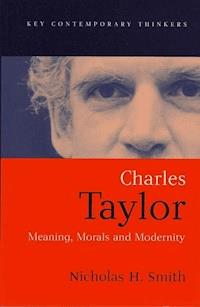
The Canadian philosopher Charles Taylor is a key figure in contemporary debates about the self and the problems of modernity.
This book provides a comprehensive, critical account of Taylor's work. It succinctly reconstructs the ambitious philosophical project that unifies Taylor's diverse writings. And it examines in detail Taylor's specific claims about the structure of the human sciences; the link between identity, language, and moral values; democracy and multiculturalism; and the conflict between secular and non-secular spirituality. The book also includes the first sustained account of Taylor's career as a social critic and political activist.
Clearly written and authoritative, this book will be welcomed by students and researchers in a wide range of disciplines, including philosophy, psychology, politics, sociology, anthropology, cultural studies and theology.
Sie lesen das E-Book in den Legimi-Apps auf:
Seitenzahl: 586
Veröffentlichungsjahr: 2013
Ähnliche




















Table of Contents
Cover
Dedication
Title page
Copyright page
Key Contemporary Thinkers
Acknowledgements
List of Abbreviations
Introduction
The Project
Style
Life in Politics
1 Linguistic Philosophy and Phenomenology
Linguistic Philosophy
Merleau-Ponty’s Phenomenology
2 Science, Action and the Mind
Explaining Behaviour
The Reification of Mind
3 The Romantic Legacy
Transcendental Arguments
Hegel’s Vision
The Non-metaphysical Hegel
The Expressivist Theory of Language
4 The Self and the Good
Strong Value
Narrative Identity
Practical Reason
The Right and the Good
Moral Sources
5 Interpretation and the Social Sciences
Interpretation and Validity
Ethnocentrism and Relativism
6 Individual and Community
Liberal Holism
Particularity and Recognition
Democratic Exclusion
7 Politics and Social Criticism
Socialist Humanism and the British New Left
Democracy in Canada
The Dialogue Society and Deep Diversity
8 Modernity, Art and Religion
The Sources of Enlightenment Naturalism
Art and Authenticity
Beyond Secularism
Conclusion
Bibliography
Index
For Sue
Copyright © Nicholas H. Smith 2002
The right of Nicholas H. Smith to be identified as author of this work has been asserted in accordance with the Copyright, Designs and Patents Act 1988.
First published in 2002 by Polity Press in association with Blackwell Publishers Ltd
Editorial office:
Polity Press
65 Bridge Street
Cambridge CB2 1UR, UK
Marketing and production:
Blackwell Publishers Ltd
108 Cowley Road
Oxford OX4 1JF, UK
Published in the USA by
Blackwell Publishers Inc.
350 Main Street
Malden MA 02148, USA
All rights reserved. Except for the quotation of short passages for the purposes of criticism and review, no part of this publication may be reproduced, stored in a retrieval system, or transmitted, in any form or by any means, electronic, mechanical, photocopying, recording or otherwise, without the prior permission of the publisher.
Except in the United States of America, this book is sold subject to the condition that it shall not, by way of trade or otherwise, be lent, re-sold, hired out, or otherwise circulated without the publisher’s prior consent in any form of binding or cover other than that in which it is published and without a similar condition including this condition being imposed on the subsequent purchaser.
ISBN 0-7456-1575-9
ISBN 0-7456-1576-7 (pbk)
ISBN 9780745668598 (epub)
ISBN 9780745668581 (mobi)
ISBN 9780745678122 (epdf)
A catalogue record for this book is available from the British Library and has been applied for from the Library of Congress.
Key Contemporary Thinkers
Published
Jeremy Ahearne, Michel de Certeau: Interpretation and its Other
Peter Burke, The French Historical Revolution: The Annales School 1929–1989
M. J. Cain, Fodor: Language, Mind and Philosophy
Michael Caesar, Umberto Eco: Philosophy, Semiotics and the Work of Fiction
Colin Davis, Levinas: An Introduction
Simon Evnine, Donald Davidson
Edward Fullbrook and Kate Fullbrook, Simone de Beauvoir: A Critical Introduction
Andrew Gamble, Hayek: The Iron Cage of Liberty
Graeme Gilloch, Walter Benjamin: Critical Constellations
Karen Green, Dummett: Philosophy of Language
Phillip Hansen, Hannah Arendt: Politics, History and Citizenship
Sean Homer, Fredric Jameson: Marxism, Hermeneutics, Postmodernism
Christopher Hookway, Quine: Language, Experience and Reality
Christina Howells, Derrida: Deconstruction from Phenomenology to Ethics
Fred Inglis, Clifford Geertz: Culture, Custom and Ethics
Simon Jarvis, Adorno: A Critical Introduction
Douglas Kellner, Jean Baudrillard: From Marxism to Post-Modernism and Beyond
Valerie Kennedy, Edward Said: A Critical Introduction
Chandran Kukathas and Philip Pettit, Rawls: A Theory of Justice and its Critics
James McGilvray, Chomsky: Language, Mind, and Politics
Lois McNay, Foucault: A Critical Introduction
Philip Manning, Erving Goffman and Modern Sociology
Michael Moriarty, Roland Barthes
Harold W. Noonan, Frege: A Critical Introduction
William Outhwaite, Habermas: A Critical Introduction
John Preston, Feyerabend: Philosophy, Science and Society
Susan Sellers, Hélène Cixous: Authorship, Autobiography and Love
David Silverman, Harvey Sacks: Social Science and Conversation Analysis
Dennis Smith, Zygmunt Bauman: Prophet of Postmodernity
Nicholas H. Smith, Charles Taylor: Meaning, Morals and Modernity
Geoffrey Stokes, Popper: Philosophy, Politics and Scientific Method
Georgia Warnke, Gadamer: Hermeneutics, Tradition and Reason
James Williams, Lyotard: Towards a Postmodern Philosophy
Jonathan Wolff, Robert Nozick: Property, Justice and the Minimal State
Forthcoming
Maria Baghramian, Hilary Putnam
Sara Beardsworth, Kristeva
James Carey, Innis and McLuhan
Rosemary Cowan, Cornell West: The Politics of Redemption
George Crowder, Isaiah Berlin: Liberty, Pluralism and Liberalism
Thomas D’Andrea, Alasdair MacIntyre
Eric Dunning, Norbert Elias
Jocelyn Dunphy, Paul Ricoeur
Matthew Elton, Daniel Dennett
Nigel Gibson, Frantz Fanon
Espen Hammer, Stanley Cavell
Keith Hart, C. L. R. James
Sarah Kay, Žižek: A Critical Introduction
Paul Kelly, Ronald Dworkin
Carl Levy, Antonio Gramsci
Moya Lloyd, Judith Butler
Dermot Moran, Edmund Husserl
Steve Redhead, Paul Virilio: Theorist for an Accelerated Culture
Chris Rojek, Stuart Hall and Cultural Studies
Wes Sharrock and Rupert Read, Kuhn
Nicholas Walker, Heidegger
Acknowledgements
I am grateful to the Humanities Board of the British Academy and to the Research Office at Macquarie University for help in funding the research for this book. My research took me to many libraries, and it is a pleasure to thank the librarians at Middlesex University, McGill University, London School of Economics, Macquarie University, the British Library and the excellent National Library of Canada for their help. The research leave granted me by the Division of Society, Culture, Media and Philosophy at Macquarie University in the second semester of 2000 was invaluable in allowing me to complete the manuscript. Jay Bernstein offered me useful advice at the beginning of the project; I also thank Michael Kenny, Guy Laforest, Rüdiger Bubner and Matthew Smith for various acts of generosity related to the book. I have learned much from discussions of Taylor’s work with Shane O’Neill, Hartmut Rosa, Paulo Costa, Jonathan Rée, Neil Levy, Nigel DeSouza, Irma Levomaki, and others I do not have space to mention. I am particularly grateful to Arto Laitinen, David Macarthur and Shane O’Neill for invaluable comments on draft chapters. Damion Buterin helped me format the bibliography. Thanks are due to Rebecca Harkin and Gill Motley at Polity for their great patience, and to Charles Taylor for his cooperation. Most of all, I would like to thank Susan Best for her love and support, as well as for suggesting all sorts of improvements to the text. The book is dedicated to her.
List of Abbreviations
Citations from the works listed below are referenced in the text. As a rule, when I cite a work included in Taylor’s collections of philosophical papers for the first time, I give the original place and date of publication in the notes.
CMA Catholic Modernity? ed. James L. Heft (Oxford: Oxford University Press, 1999).EBThe Explanation of Behaviour (London: Routledge and Kegan Paul, 1964).HHegel (Cambridge: Cambridge University Press, 1975).HALHuman Agency and Language. Philosophical Papers, 1 (Cambridge: Cambridge University Press, 1985).HMS Hegel and Modern Society (Cambridge: Cambridge University Press, 1979).MMThe Malaise of Modernity (Toronto: Anansi Press, 1991). Republished as The Ethics of Authenticity (Cambridge, Mass.: Harvard University Press, 1992).MPRMulticulturalism and ‘The Politics of Recognition’ (Princeton: Princeton University Press, 1992).PAPhilosophical Arguments (Cambridge, Mass.: Harvard University Press, 1995).PHSPhilosophy and the Human Sciences. Philosophical Papers, 2 (Cambridge: Cambridge University Press, 1985).PPThe Pattern of Politics (Toronto: McClelland and Stewart, 1970).RSReconciling the Solitudes: Essays on Canadian Federalism and Nationalism (Montreal: McGill-Queens University Press, 1993).SSSources of the Self: The Making of the Modern Identity (Cambridge: Cambridge University Press, 1989).Introduction
Charles Taylor’s reputation as a leading philosopher of his generation is based on his contributions to a wide range of fields. He has written influentially on the limits of mechanistic approaches to the study of human behaviour, on the role of interpretation and cross-cultural judgement in social science, on the contemporary relevance of German Romantic philosophy, and on the connection between the self and broadly speaking ‘moral’ concerns. Taylor is also a chief protagonist in the debate between liberals and communitarians in political theory, he is an influential figure in contemporary discussions of multiculturalism and democracy, and he has developed an original and provocative diagnosis of the maladies of the modern age. In the course of this book I shall consider Taylor’s contributions to each of these areas. But I shall also present them as strands of a unified philosophical project. The project turns on an idea formulated by Maurice Merleau-Ponty, one of the philosophers most admired by Taylor, as follows: ‘because we are in the world, we are condemned to meaning’.1 We are condemned to meaning in the sense that human life generally, and modern life in particular, is structured by inescapable layers of meaning or significance. While in essence a simple thought, it is of enormous consequence for philosophy and the human sciences. Let me begin by spelling out how Taylor’s complex project germinates from this simple core idea.
The Project
To understand Taylor’s project we must first distinguish various levels at which the world appears meaningful or significant to human beings. Perhaps the most rudimentary level at which meaning appears is through perception. Like other animals, human beings have perceptual fields in which certain items stand out from the background. Generally, this happens when something relates to the desires and purposes of the perceiver. So, for instance, when the prey of an animal enters its sensory field, it stands out, it is significant to the predator as a potential source of satisfaction for its hunger. Human perception seems to have a similar structure. The mere fact that our perceptions are bound up with desires and purposes means that we perceive a world that is ‘non-indifferent’ for us,2 and we refer to features of the world to which we are non-indifferent as bearing meaning or significance. Again like other animals, we act in ways that are directed by some desire or purpose, and we think we understand the meaning of an action when we grasp the desire or purpose it serves. But rather than ‘perceiving’ the meaning of an action, we often have to interpret it. Typically, we resort to interpretation when the purpose or desire directing an action strikes us as complex, opaque, strange or elusive. If we are to grasp the meaning, we must reflect and interpret creatively, perhaps under the guidance of a theory, or another person’s point of view.
When we do submit a course of action to creative interpretation, we may find that it contains more (or perhaps less) significance than we initially supposed. But desires and purposes seem to have more or less significance in another way: some matter more, are deemed to be more worth having or more worth acting upon (or less worth having and less worth acting upon) than others. A fulfilling desire is more worth having, an enduring purpose more worth living by, than a superficial or whimsical one. Moreover, some desires and purposes also seem to function as moral standards. For example, if a close friend tells me something in confidence, I want to be true to my word, though I may well have a burning desire to tell someone else. I do not want to let my friend down, but I also do not want to let myself down by succumbing to the temptation. The thought that I would be letting myself down if I broke the confidence, like the thought that I would be wasting my life if my dominant desires and purposes were unfulfilling, suggests that something about my very identity is at stake here: the desires and purposes I seek to cultivate and act upon, and the standards that I recognize, reflect something about the kind of person I am and the person I aspire to be. In such cases we seem to be dealing with a qualitative difference between desires, purposes and ways of life: one kind of purpose or desire stands ‘above’ the other, it has its place in a ‘higher’, or more fully human, or more fully way of life. In comparison to this higher mode, other, incompatible ways of living may seem empty, futile and shallow, or perhaps fraudulent, pious and hypocritical. Otherwise put, there seems to be an important class of desires and purposes that also serve as ideals: we seek them out – we are really motivated by them in our lives – but they are also normative for us, they set standards for us to live by. And in playing this joint role they help define our identity.
Lesen Sie weiter in der vollständigen Ausgabe!
Lesen Sie weiter in der vollständigen Ausgabe!
Lesen Sie weiter in der vollständigen Ausgabe!
Lesen Sie weiter in der vollständigen Ausgabe!
Lesen Sie weiter in der vollständigen Ausgabe!
Lesen Sie weiter in der vollständigen Ausgabe!
Lesen Sie weiter in der vollständigen Ausgabe!
Lesen Sie weiter in der vollständigen Ausgabe!
Lesen Sie weiter in der vollständigen Ausgabe!
Lesen Sie weiter in der vollständigen Ausgabe!
Lesen Sie weiter in der vollständigen Ausgabe!




