



Erhalten Sie Zugang zu diesem und mehr als 300000 Büchern ab EUR 5,99 monatlich.
- Herausgeber: Paraclete Press
- Kategorie: Religion und Spiritualität
- Sprache: Englisch
"It takes both courage and a very clear head for a Catholic theologian to take on any issue regarding sexuality today. Ron Rolheiser succeeds here in a very positive, honest, and helpful way! His approach is brilliantly not sin-centered but value-centered. Bravo!" —Richard Rohr, O.F.M. Celibacy isn't for everyone, but Chastity is! With infinite wisdom and compassion, Ron Rolheiser gives us a fresh understanding of chastity, not based on repressions, prudishness, or even just sex, but on reverence, patience, and respect for ourselves and others in every area of life, that leads to true love, joy, community, and union with God These days, it's hard to say the word "chastity" without a cringe. But in this book, beloved teacher Fr. Ronald Rolheiser boldly champions the notion of chastity in its fullest meaning: respect, patience, reverence, and a God-given gift of propriety in every area of life—not just in the area of sex. In twenty-four power packed chapters, Fr. Ron compassionately and eloquently elaborates on how we can reclaim the lost virtue of chastity. He spells out the reasons for the death of chastity in our culture, the negative consequences of that has had on our souls and in our lives, the need for a healthy chastity in all areas of our lives, what constitutes that healthy chastity, and its positive consequences—so that we can say the word chastity without a cringe. This is a book not just for those believers seeking to live a holier life, but for all those who seek to live the fullest, most authentic life possible. Chastity and the Soul is the guide we all need to come to the realization that in God's eyes, each one of us is holy ground.
Sie lesen das E-Book in den Legimi-Apps auf:
Seitenzahl: 115
Veröffentlichungsjahr: 2024
Das E-Book (TTS) können Sie hören im Abo „Legimi Premium” in Legimi-Apps auf:
Ähnliche











PRAISE FOR CHASTITY AND THE SOUL
“This book is a welcome addition to the body of work seeking to clarify a stronger and more fruitful connection between our sexuality and our spirituality. I am not sure how chastity got such a bad rap but I am grateful Fr. Ron has initiated the work of reclaiming it as an attitude and a practice that fosters a spirituality wholesome enough to celebrate sexuality as a beautiful gift from God intended to be linked to exuberance, spirituality and delight. What a blessing!”
—RUTH HALEY BARTON, Founder, Transforming Center, and author of Sacred Rhythms
“Fr. Ron Rolheiser, in this daring and holy book, defines sexual longing in the context of love and patient reserve as we seek within ourselves what is truly meant by the chastity of our souls in the presence of those we love. This is a book for young people seeking a way to the marriage bed, and a celebration for those who have already discovered in their relationships the meaning of commitment, compassion, sexual joy, and spiritual ecstasy.”
—CHRISTOPHER DE VINCK, author of Things That Matter Most: Essays on Home, Friendship, and Love
“It takes both courage and a very clear head for a Catholic theologian to take on any issue regarding sexuality today. Ron Rolheiser succeeds here in a very positive, honest, and helpful way! His approach is brilliantly not sin-centered but value-centered. Bravo!”
—RICHARD ROHR, O.F.M.
“Ron Rolheiser has a rare gift of discerning and expressing the deepest movements of our souls. In this courageous and prophetic book he presents chastity – defined as respect, reverence and patience – as the pathway to joy and the fullness of life. In one way or another you’ll hear your own story told as you read this book, and you’ll experience yourself as being wisely and compassionately guided to your heart’s home.”
—MICHELLE JONES, author of The Gospel Mysticism of Ruth Burrows: Going to God with Empty Hands
“Ronald Rolheiser’s new book offers a rich, beautifully written and reflective reinterpretation of the theme of ‘chastity.’ He expresses his spiritual vision through insightful images that present an honest way forward accessible to all of us. He asks us in challenging ways to radically rethink how we conventionally understand the word ‘chastity’ and limit its scope to a narrow view of sexuality. Ronald Rolheiser’s alternative perspective promotes ‘healthy’ chastity in all our lives as a value that focuses on proper reverence and respect for other people. This includes sexuality as a way of affirming other people rather than exploiting them.”
—PHILIP SHELDRAKE, Professor, Senior Fellow, and Research Director, Institute for the Study of Contemporary Spirituality at Oblate School of Theology
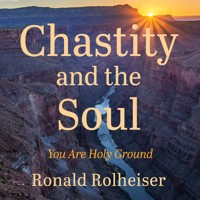
Chastity and the Soul
You Are Holy Ground
Ronald Rolheiser
To my mother and father, George and Mathilda Rolheiser, who modeled a healthy chastity.
2024 First Printing
Chastity and the Soul: You Are Holy Ground
Copyright © 2024 by Ronald Rolheiser
ISBN 978-1-64060-947-1
Scripture quotations marked (NRSVCE) are taken from the New Revised Standard Version Updated Edition. Copyright © 2021 National Council of Churches of Christ in the United States of America. Used by permission. All rights reserved worldwide.
Scripture quotations marked (NLT) are taken from the Holy Bible, New Living Translation, copyright ©1996, 2004, 2015 by Tyndale House Foundation. Used by permission of Tyndale House Publishers, Carol Stream, Illinois 60188. All rights reserved.
The Paraclete Press name and logo (dove on cross) are trademarks of Paraclete Press.
Library of Congress Cataloging-in-Publication Data
Names: Rolheiser, Ronald, author.
Title: Chastity and the soul : you are holy ground / Ronald Rolheiser.
Description: Brewster, Massachusetts : Paraclete Press, 2024. | Summary: “Rolheiser champions the notion of chastity in its fullest meaning: respect, patience, reverence, and a God-given gift of propriety in every area of life-not just in the area of sex”-- Provided by publisher.
Identifiers: LCCN 2023045571 (print) | LCCN 2023045572 (ebook) | ISBN 9781640609471 | ISBN 9781640609488 (epub)
Subjects: LCSH: Chastity. | Christian life. | BISAC: RELIGION / Christian Living / Personal Growth | RELIGION / Christian Living / Social Issues
Classification: LCC BJ1533.C4 .R654 2024 (print) | LCC BJ1533.C4 (ebook) | DDC 241/.664--dc23/eng/20231130
LC record available at https://lccn.loc.gov/2023045571
LC ebook record available at https://lccn.loc.gov/2023045572
10 9 8 7 6 5 4 3 2 1
All rights reserved. No portion of this book may be reproduced, stored in an electronic retrieval system, or transmitted in any form or by any means—electronic, mechanical, photocopy, recording, or any other—except for brief quotations in printed reviews, without the prior permission of the publisher.
Published by Paraclete Press
Brewster, Massachusetts
www.paracletepress.com
Digitally Printed
CONTENTS
PREFACE
PART ONE
Chastity as Proper Reverence, Respect, and Patience
1 What is Chastity?
2 Chastity as Purity of Heart
3 Chastity, Love, and Sex
4 Chastity and Innocence
5 Sublimation and the Sublime
6 The Goddess of Chastity
7 Chastity as Blessing Others
PART TWO
Chastity, Sex, and the Soul
8 A Plea for the Soul
9 Our Dark Memory of Our Soul
10 Sex and the Soul
11 Chastity as Soulful and Taking Us Home
12 Santa, the Easter Bunny, Soul, and Chastity
13 Sex, Our Private Lives, and the Evening News
14 The Original Sin as a Failure in Chastity
15 Chastity and Pornography
PART THREE
Carrying and Mourning Our Unfinished Symphony
16 The Torment of the Insufficiency of Everything Attainable
17 Mourning Our Inconsummation
18 Carrying Tension as a Gift to Others
19 An Invitation to Metanoia
PART FOUR
Some Personal Reflections
20 Chastity and Celibacy–A Personal Apologia
21 Sex, Chastity, and My Mother’s Little Pamphlets
22 Celibacy in a Post-Modern World
PART FIVE
Chastity Without a Cringe
23 Wonder Has Left the Building
24 Chastity without a Cringe
ACKNOWLEDGEMENTS
NOTES
PREFACE
Can purity be a word that is ever used without a cringe?” Lisbeth During asks this question at the end of her book, The Chastity Plot, though she asks it as a sincere probe, not as a cynical judgment on those who still defend sexual purity. The same question might be asked about the word chastity, one of the long-time guardians of purity. Can the word be used without a cringe? The concept of chastity has fallen on hard times.
Several years ago, I was invited to speak to a group of students at a Catholic university. The invitation came with a request and a caveat. I was to speak on chastity, but ideally, I was to avoid using the word. The Dean of Theology, who had invited me, had appraised the situation this way: perhaps more than anything else, the students need a challenge to chastity, but they are so turned off by the word that if we mention it in the title, very few will show up.
His hunch was right on both scores: the need for chastity in their lives and their aversion to the word. That’s also true for our culture.
For many today, the word chastity has negative connotations. Outside of a constantly shrinking number of select church circles, the word chastity sets off mostly negative alarms. Within our highly secularized and sophisticated world, for the most part chastity is identified with naïveté, sexual timidity, religious fundamentalism, a toxic overemphasis on sexual purity, a lack of sophistication, and something that made more sense in another age. Commonly, the notion is ridiculed, even in some religious circles. Very few people today dare talk about saving sex for marriage or about chastity as virtue.
What’s behind this? Why this negativity and disdain toward chastity?
Partly this is based on a number of popular perceptions. Chastity is often seen as grounded in a religious fundamentalism, which our culture today either disdains or pities (“Chastity for Jesus”). As well, the notion of chastity is seen as a product of the Roman Catholic church’s long-standing, one-sided emphasis on virginity and celibacy and its failure to articulate a healthy, robust spirituality of sex. It’s hard to argue with perceptions, except to say that the reasons for the demise of the concept of chastity in our culture are much more complex than this.
Admittedly, the church’s catechesis about chastity is part of the problem. My suspicion is that a good number of people are negative vis-à-vis the notion because of how the concept has been presented to them. Our churches and moral teachers have to assume some of the blame and admit that far too often the concept of chastity has been presented, however unintentionally, precisely as a naïveté, a repression, and as an overemphasis on sexual purity. There’s a parallel here to how atheism finds its ground. Just as so much atheism is a parasite feeding off bad religion, so too much of the negativity towards the concept of chastity is a parasite feeding off unhealthy religious teaching.
However, our culture’s negativity toward the notion of chastity feeds off more than a less-than-healthy catechesis. The culprit? Sophistication as a virtue that is an end in itself. In short, our culture prizes personal sophistication above most everything else, and when sophistication is so highly prized, chastity easily looks like naïveté and ignorance. Is it?
At the end of the day, is chastity a sexual repression, an unhealthy timidity, a toxic overemphasis on sexual purity, a religious fundamentalism, a pitiable pre-sophistication? Admittedly, that can sometimes be the case. However, there’s a strong case too for chastity.
In 2013, Donna Freitas, the author of a number of books on sexuality and consent, published a study entitled The End of Sex: How Hookup Culture is Leaving a Generation Unhappy, Sexually Unfulfilled, and Confused about Intimacy. That title is the book in caption. Nowhere in the book (and for this she has been unjustly criticized by some church groups) does she ever say that what is happening in our culture today in terms of soulless sex is wrong or sinful. She doesn’t have to. She simply spells out the consequences—unhappiness, confusion, sexual depression.
A generation earlier, the renowned educator Allan Bloom, writing from a purely secular perspective, came to the same conclusion. Looking at the bright, highly sophisticated young students he was teaching, he concluded that the very unbridled sophistication they so prided themselves in (which he termed “the absence of chastity in their lives”) had this effect in their lives: it left them “erotically lame.”
And so, I suggest that chastity merits another look. There’s childishness and there’s childlikeness. There’s hook-up sex and there’s soul-sex. There’s religious fundamentalism and there’s the wisdom of divine revelation. There’s the overemphasis on sexual purity and there’s the dehumanizing disrespect for others (that the #MeToo movement is standing up to). There’s a certain ennui and fatigue in an ultra-sophistication that believes all taboos may be broken, and there’s a vibrancy and happiness that’s felt in keeping your shoes off before the burning bush. In every one of these dualisms, chastity speaks for soul, for wisdom, for respect, and for happiness.
This book will elaborate on this, namely, the death of chastity in our culture, the negative consequences of that on our souls and in our lives, the need for a healthy chastity in our lives, what constitutes that healthy chastity, and the positive consequences that this can have in our lives—so that we can say the word chastity without a cringe.
PARTONE
Chastity as Proper Reverence, Respect, and Patience
“Do not come any closer,” God said. “Take off your sandals, for the place where you are standing is holy ground.”
—Exodus 3:5, NLT
CHAPTER1
What is Chastity?
The notion of chastity has fallen on hard times today, both in our culture and often also inside our churches. It is associated either with a certain childish naïveté (like believing in Santa and the Easter Bunny, nice for the kids) or with sexual repression. It is more mocked than admired. Sadly, this is based on a misunderstanding, and equally sad are the consequences we pay for this.
What is chastity? Chastity is about proper reverence in every area of life, not just in the area of sex. In his book Zorba the Greek, Nikos Kazantzakis shares this story: He had been watching a moth come out of its cocoon. The process was fascinating but painstakingly slow. After watching this interminably slow metamorphosis, he eventually lost patience and applied some heat to the moth. It sped up the process, and the moth emerged more quickly…. But because the process had been pressured to come to its culmination earlier than nature intended, the moth emerged with damaged wings. It could not fly.
That is a poignant image for chastity. Chastity is not first of all about premature or illicit sex. At its root, it is not primarily even a sexual concept, though given the power and urgency of sex, faults in chastity often are within the area of sexuality. Chastity is about the way we experience, about the appropriateness and maturity of any experience, sex included.
In essence, chastity is proper reverence, respect, and patience. And, in a culture that is often characterized by irreverence, disrespect, and impatience, it is much needed. To be chaste is to experience people, things, places, entertainment, the phases of life, life’s opportunities, and sex, in a way that does not violate them or us. In brief, I am chaste when I relate to others in a way that does not violate their moral, psychological, emotional, sexual, or aesthetic contours. I am chaste when I do not let irreverence or impatience denigrate or cheapen what is gift, and when I let life, others, and sex, unfold according to their own proper dictates.




