


154,99 €
Mehr erfahren.
- Herausgeber: John Wiley & Sons
- Kategorie: Fachliteratur
- Sprache: Englisch
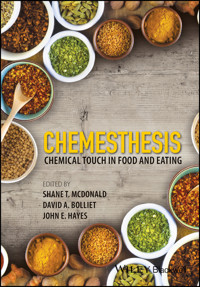
Chemesthesis are the chemically initiated sensations that occur via the touch system. Examples in the mouth include the burn of capsaicinoids in chilies, the cooling of menthol in peppermint, and the tingle of carbonation. It is physiologically distinct from taste and smell, but is increasingly understood to be just as important as these senses for their contribution to flavor, especially with the sustained growth in interest in spicy foods from around the world.
Chemesthesis: Chemical Touch in Food and Eating surveys the modern body of work on chemesthesis, with a variety of contributors who are well known for their expertise on the topic. After a forward by John Prescott and an introduction by Barry Green (who originally coined the term chemesthesis 25 years ago), the book moves on to survey chemesthetic spices and address the psychology and physiology of chemesthesis; practical sensory and instrumental analysis; the interaction of chemesthesis with other chemical senses; health ramifications; and the application of chemesthesis in food. The major types of chemesthesis, including pungency/burning, cooling, tingling, nasal irritation, and numbing, are each covered in their own chapter. The book concludes with a look to the future.
This is the first comprehensive book on chemesthesis since 1990, when Barry Green and his colleagues edited a volume on the perception of chemical irritants, including those in food. This new book is intended to be a vital resource for anyone interested in the sensory impact of the food we eat, including food scientists, sensory professionals, analytical chemists, physiologists, culinary scientists, and others.
Sie lesen das E-Book in den Legimi-Apps auf:
Seitenzahl: 741
Veröffentlichungsjahr: 2016
Ähnliche



















Chemesthesis
Chemical Touch in Food and Eating
EDITED BY
Shane T. McDonald PhD
Kalsec©, Inc.Kalamazoo, MI
David A. Bolliet MS
Kalsec©, Inc.Kalamazoo, MI
John E. Hayes PhD
Sensory Evaluation Center and Department of Food ScienceCollege of Agricultural SciencesThe Pennsylvania State UniversityUniversity Park, PA, USA
FOREWORD BY JOHN PRESCOTT
This edition first published 2016 © 2016 by John Wiley & Sons, Ltd.
Registered OfficeJohn Wiley & Sons, Ltd, The Atrium, Southern Gate, Chichester, West Sussex, PO19 8SQ, UK
Editorial Offices9600 Garsington Road, Oxford, OX4 2DQ, UKThe Atrium, Southern Gate, Chichester, West Sussex, PO19 8SQ, UK111 River Street, Hoboken, NJ 07030-5774, USA
For details of our global editorial offices, for customer services and for information about how to apply for permission to reuse the copyright material in this book please see our website at www.wiley.com/wiley-blackwell.
The right of the author to be identified as the author of this work has been asserted in accordance with the UK Copyright, Designs and Patents Act 1988.
All rights reserved. No part of this publication may be reproduced, stored in a retrieval system, or transmitted, in any form or by any means, electronic, mechanical, photocopying, recording or otherwise, except as permitted by the UK Copyright, Designs and Patents Act 1988, without the prior permission of the publisher.
Designations used by companies to distinguish their products are often claimed as trademarks. All brand names and product names used in this book are trade names, service marks, trademarks or registered trademarks of their respective owners. The publisher is not associated with any product or vendor mentioned in this book.
Limit of Liability/Disclaimer of Warranty: While the publisher and author(s) have used their best efforts in preparing this book, they make no representations or warranties with respect to the accuracy or completeness of the contents of this book and specifically disclaim any implied warranties of merchantability or fitness for a particular purpose. It is sold on the understanding that the publisher is not engaged in rendering professional services and neither the publisher nor the author shall be liable for damages arising herefrom. If professional advice or other expert assistance is required, the services of a competent professional should be sought.
Library of Congress Cataloging-in-Publication data applied for
ISBN: 9781118951736
A catalogue record for this book is available from the British Library.
Wiley also publishes its books in a variety of electronic formats. Some content that appears in print may not be available in electronic books.
Cover image: © Steve Allen (PhotoDisc)
List of contributors
Yeranddy A. Alpizar PhDDepartment of Cellular and Molecular Medicine, Laboratory of Ion Channel Research and TRP Research Platform Leuven (TRPLe), Leuven, Belgium
David A. Bolliet MSSenior Manager Analytical R&D, Kalsec®, Inc., Kalamazoo, MI, USA
Ali Bouzari PhDCo-Founder, CSO, Pilot R+D, Healdsburg, CA, USA
Brian Byrne PhDCEO, Natural Advantage LLC, Oakdale, LA, USA
Nadia Byrnes PhDPostdoctoral Fellow, Department of Viticulture and Enology, University of California Davis, Davis, CA, USA
E. Carstens PhDDepartment of Neurobiology, Physiology and Behavior, University of California Davis, Davis, CA, USA
Pamela Dalton PhD, MPHMember, Monell Chemical Senses Center, Philadelphia, PA, USA
Barry G. Green PhDDirector and Fellow, The John B. Pierce Laboratory, Professor, Department of Surgery (Otolaryngology), Yale School of Medicine, New Haven, CT, USA
Howard Haley BSFellow, Kalsec®, Inc., Kalamazoo, MI, USA
John E. Hayes PhDSensory Evaluation Center and Department of Food Science, College of Agricultural Sciences, The Pennsylvania State University, University Park, PA, USA
Christopher R. Loss PhD, AOSDirector of Academic Research, The Culinary Institute of America, Hyde Park, NY, USA
Mary-Jon Ludy PhD, RDAssistant Professor of Clinical Nutrition, Department of Public and Allied Health, Bowling Green State University, Bowling Green, OH, USA
Richard D. Mattes MPH, PhD, RDDistinguished Professor, Department of Nutrition Science, Purdue University, West Lafayette, IN, USA
Shane T. McDonald PhDPrincipal Flavor Chemist, Kalsec®, Inc., Kalamazoo, MI, USA
Steven Pringle PhDCorporate VP Sales & Marketing, Aroma Chemical Services International, Gmbh, Höxter-Stahle, Germany
Cecil J. Saunders PhDDepartment of Otorhinolaryngology, Perelman School of Medicine, University of Pennsylvania, Philadelphia, PA, USA
Christopher T. Simons PhDAssistant Professor of Sensory Science, Department of Food Science and Technology, The Ohio State University, Columbus, OH, USA
Wayne L. Silver PhDProfessor, Department of Biology, Wake Forest University, Winston-Salem, NC, USA
Karel Talavera PhDDepartment of Cellular and Molecular Medicine, Laboratory of Ion Channel Research and TRP Research Platform Leuven (TRPLe), Leuven, Belgium
Thomas Voets PhDDepartment of Cellular and Molecular Medicine, Laboratory of Ion Channel Research and TRP Research Platform Leuven (TRPLe), Leuven, Belgium
Cindy Ward PhDSensation Research, Maineville, OH, USA
Foreword
Unless my reading list has a major gap, “Chemesthesis: Chemical Touch in Food and Eating” is the first book to focus entirely on the topic of chemesthesis since the 1990s Irritation (Green et al., 1990). At that time, the study of oral and nasal somatosensory stimuli was commonly termed the common chemical sense or pungency or irritation or the trigeminal sense. Since none of these terms were entirely satisfactory (see Chapter 1 in the present book), in their Preface the Editors of Irritation proposed the term chemesthesis, meaning a general chemical sensibility, and the name has stuck.
At the time Irritation (the proceedings of a conference hosted by Monell Chemical Senses Center) was published, chemesthesis was talked about as the “forgotten flavor sense”. It was clear that stimulation of various branches of the trigeminal nerves was crucial to food flavors – chili, containing the powerful irritant capsaicin, is consumed by a substantial proportion of the world’s population every day, for example. At the same time, we knew very little about how irritant stimuli contributed to food flavor, and it was this knowledge gap that sparked my own interest in this area. Having recently entered the chemical senses field within the context of a food research laboratory, as an experimental psychologist, I saw immediately that key questions regarding food “spiciness” had not yet been answered. Moreover, I began to see just how pervasive these chemesthetic qualities were in everyday foods. I prepared a slide at the time for talks on this topic by going to my own kitchen and selecting items for which flavor was characterized by irritation. I had no trouble assembling for the photograph a dozen such examples: onion, ginger, soda water, rum, vodka, mustard, pepper, vinegar, and so on.
I was also fortunate in being able at that time to visit “irritation central”, namely the laboratory of Barry Green at Monell. Psychophysicists are rare enough in the chemical senses generally, so having a psychophysicist specializing on questions about chemesthesis was a key reason that the field was able to progress.1 As an important synergy, Green’s colleagues Bruce Bryant, also at Monell, Tom Finger, and Wayne Silver were at the same time addressing questions regarding the physiology and anatomy of what became known as chemesthesis.
Another major influence was the Irritation book itself.2 Here were chapters by the key researchers in the area, across a range of disciplines, producing an effective “state of the art” document. My own copy still has tucked inside it a drinks napkin (complete with wine stain) from my 1991 visit to Monell on which is sketched the design for a study to ask if the reason why chili appears to suppress other flavors (and actually does suppress sweetness) in foods is because it more effectively garners attention. I still haven’t done this study, and the question still hasn’t been properly answered. A review chapter on chemesthesis by Green and Lawless (1991) at around the same time also became an important resource for those of us in this area.
Irritation also alerted me to an entirely different field of chemesthesis, namely the study of nasal and eye irritation. Studies in this area have been important for the understanding of the impact of air pollution, industrial chemical irritants, and responses to indoor air quality. In contrast, there were also investigations of the potential of irritant compounds for pest control. Such studies were, incidentally, a good indication of just how broadly applicable research into the chemical senses could be.
Since the early 1990s, research on chemesthesis has moved on substantially, and this is reflected in many chapters of this current volume. Our understanding of the mechanisms of chemesthesis has advanced over the past decade or so through discoveries in molecular biology, particularly with regard to transduction processes. A number of transient receptor potential (TRP) nerve channels are known to be activated by capsaicin, menthol, and other irritant compounds (see Chapters 4, 5 and 14). These TRPs are also temperature sensitive, thus justifying the use of the term “hot food” for food that is spicy, as well as for food to which heat has been applied. Even prior to this, we knew that spiciness and temperature enhanced one another, and our understanding of this and other psychophysical behaviors of irritant compounds have also increasingly been characterized (see Chapter 6). Two interesting phenomena in particular – sensitization and desensitization – have received much attention. If you think spicy food gets hotter as you consume it, you are probably very often right (sensitization); if it leaves your mouth feeling insensitive once you finish eating, again that’s probably an accurate description (desensitization).
Knowledge of chemesthetic psychophysics has had some important practical consequences. Because spicy foods have become increasingly popular in the West, properties such as sensitization and desensitization have presented particular challenges for product developers. How is it possible to evaluate the sensory properties of, or consumer responses to, different versions of a spicy food when the heat builds up over different samples? Food sensory evaluation specialists have increasingly had to develop techniques to adapt standard ways of testing to such products (see Chapter 10).
To evaluate the impact of chemesthesis, especially in the context of foods, also requires some understanding of the qualities that stimulation of the various TRPs evokes. It is clear that chemesthesis is not only about heat, and there has been much debate about chemesthetic qualities. Are feelings of warmth merely low intensity heat? Is stinging the same as bite? Without yet having a clear consensus on a chemesthetic lexicon or a complete understanding of the underlying mechanisms of qualitatively different sensations, we do recognize that sensations of cooling produced by compounds such as menthol (see Chapter 7) are included within the definition of chemesthesis, as are sensations of numbing or tingling produced by compounds such as eugenol or carbon dioxide, respectively (see Chapter 8).
Where Irritation was clearly academic in intent, in that it pulled together different disciplinary approaches to the study of oral somatosensory sensations, in this current volume we have an additional emphasis on applying what is known to the sciences of eating. A wide variety of plant species have been used historically to add pungent sensations to foods (see Chapters 3 and 13). Chili with its powerful pungent compound capsaicin is the “flag bearer” for chemesthesis in food, yet it is clear that, wherever possible, almost all food cultures have used some form of chemesthetic spices or herbs to enliven food flavor, whether it is pepper, mustard, cinnamon, clove, ginger, and so on. There is clearly something very appealing about the addition of irritation to food flavors. Even monkeys on the Japanese island of Koshima have been observed “spicing” their food with salt by dipping it in sea water (Kawai, 1962).
But why? The widespread affection for high intensity burn in foods remains a mystery. There is no conundrum involving ice cream or chocolate preferences. Chili, in contrast, contains compounds that, when they aren’t being added to foods, are being sprayed into the faces of felons, students, and other less desirable members of society. Indeed, the effects in both cases are not entirely dissimilar: tearing, pain, facial flushing, and excessive salivation. In neither case does our body seem to be welcoming a dose of capsaicin. So liking chili presents a problem. In Irritation, Paul Rozin addressed this question from multiple perspectives (Rozin, 1990) but the issue remains alive today. In particular, what determines the person to person differences that we see in liking for spicy food? It is clear that we must learn to like oral irritation, but in addition variations in genetics, personality and sensitivity to sensory stimulation generally may all be important (see Chapter 2).
Many of those who refuse the pleasures of pungency in food feel that hot spices overly dominate other tastes or flavors, reducing the pleasure of the latter. With the exception of sweetness, which does seem to decrease in the presence of chili heat, this complaint has been difficult to demonstrate (Prescott and Stevenson, 1995). But there is clearly a need to determine how chemesthesis interacts with other food sensory properties (see Chapter 9), if for no other reason than it will assist in optimizing foods that appeal to consumers.
Understanding the determinants of food palatability and food choices is, of course, essential in ensuring that diets promote health. In this regard, the recent report that regular consumption of chili actually seems to increase longevity (Lv et al., 2015) has sparked predictable public interest. It has been known for some time that chili is a valuable source of vitamins C and D, and may also have anti-microbial properties within foods. Along with other pungent spices, it also promotes salivation, aiding digestion, and it is increasingly evident that such spices exert an impact on appetite, energy intake, blood sugar regulation, and metabolism generally, including thermogenesis (see Chapter 12).
So, a generation after Irritation, comes Chemesthesis: Chemical Touch in Food and Eating, which is timely not just for the continued relevance of chemesthesis to understanding food flavor, but also to hopefully inspire more food scientists, psychophysicists, and neuroscientists to continue to address the important questions that remain unanswered.
John Prescott
TasteMatters Research & Consulting
August, 2015
References
Green, B.G. and Lawless, H.T. 1991. The psychophysics of somatosensory chemoreception in the nose and mouth, in
Smell and Taste in Health and Disease
, (eds. T.V. Getchell
et al
.). New York: Raven Press, pp. 235–253.
Green, B.G., Mason, J.R., and Kare, M.R. (eds.) 1990.
Irritation
, New York: Marcel Dekker.
Kawai, M. 1962.
On the newly-acquired behaviors of the natural troop of Japanese monkeys on Koshima Island
, Seventh Annual Meeting of the Society for Primate Researches, Inuyama, Japan.
Lv, J., Qi, L., Yu, C.
et al
. 2015. Consumption of spicy foods and total and cause specific mortality: population based cohort study.
British Medical Journal
,
351
, h3942.
Prescott, J. and Stevenson, R.J. 1995. The effects of oral chemical irritation on tastes and flavors in frequent and infrequent users of chili.
Physiology & Behavior
,
58
(6), 1117–1127.
Rozin, P. 1990.
Getting to like the burn of chili pepper. Biological, psychological, and cultural perspectives
, in
Irritation
, (eds. B.G. Green, J.R. Mason, and M.R. Kare), New York: Marcel Dekker, pp. 231–269.
Notes
1
Other psychophysicists such as Harry Lawless, Dave Stevens, and Beverly Cowart were also making important contributions to understanding chemesthesis at this time.
2
My copy has joint editor Russ Mason’s name written in pen on the inside cover. Did he give it to me? If I stole it, I hope that he feels that it went to a good home.
Preface
This edited volume began with a symposium at the 2013 Institute of Food Technologists (IFT) meeting in Chicago, although our collective interest in the topic is much older. The three of us, a flavor chemist (Shane), an analytical chemist (David), and a biopsychologist (John), bring three distinct perspectives to the study of chemesthesis, and we have recruited additional content area experts to produce the first comprehensive book on chemesthesis since the original book coining the term was published in 1990. In the last quarter century, our understanding of both chemesthetic stimuli and the biology underlying these sensations has exploded.
Shane, a flavor chemist, first became interested in chemesthesis when he began working at Kalsec® in 2007. One of the earliest extracts sold by Kalsec® was chili pepper oleoresin, and the company had performed some of the early work on quantifying the capsaicinoid content in oleoresins via analytical instrumentation, as opposed to human sensory panels. Later, Shane published an article in the trade journal Perfumer & Flavorist on the differences between the pungent expression of several common spice extracts such as capsicum, ginger, black pepper, and mustard extracts. With this in mind, Shane started making blends of pungent spice extracts to customize a pungent expression. In doing so, he became interested in another spice with chemesthetic properties, Szechuan (or Sichuan) pepper. Shane and David ended up working with the Flavor and Extracts Manufacturing Association (FEMA) to obtain Generally Recognized as Safe (GRAS) status on Szechuan Pepper Extract, which made the FEMA GRAS List 26 as FEMA #4754.
David suggested that we take advantage of this GRAS status by proposing a symposium on chemesthesis for the 2013 IFT Annual Meeting. We wanted to explore the cultivation, physiology, and psychology of chemesthesis. This resulted in a symposium entitled “Chemesthesis, Capsicum, Szechuan: It's a Spicy World!” In this session, chaired by Shane and David, Shane spoke about the tingling and buzzing sensations from Szechuan pepper, jambu oleoresin, and carbonation. The session also included three other presenters: Michael Mazourek from Cornell University, and John Hayes and Nadia Byrnes from Penn State. Michael spoke about selective plant breeding, while Nadia, who at the time of the symposium was a PhD candidate in John’s research group, spoke about the psychology of the enjoyment and intake of spicy food. John rounded out the session with a talk on the biology behind chemesthesis.
At IFT, Shane was then approached by David McDade of Wiley who asked if we would be interested in editing a book on chemesthesis. At first, Shane was hesitant, having never edited a book before. Further, he did not consider himself expert enough. However, after thinking about it a bit more, Shane decided such a book should have a logical format exploring the various attributes of chemesthesis, such as physiology, raw materials, sensory evaluation, instrumental analysis, and food science aspects, as well as in depth discussion of the various types of chemesthesis (heating, cooling, tingling, etc.). In other words, we were interested in exploring the theme of chemesthesis in greater depth, with a goal of providing an updated reference text to the field. Shane eventually agreed to edit the book, with the assistance of David, both as someone to bounce ideas off of and for his excellent editorial skills. We also reached out to John again to be a co-editor, prizing his knowledge of the basic research on chemesthesis as well as his strong passion for the subject.
With our editorial team in place, the three of us began the hard work of finding the best contributors for the various chapters, and working with them, as well as Wiley, over the course of a couple of years to eventually produce the book you are now holding.
As is only appropriate, the book opens with a foreword by John Prescott and an introduction and brief history of chemesthesis by Barry Green. The next chapter is by Drs. Pam Dalton of Monell Chemical Senses Center and Nadia Byrnes, now a postdoctoral scholar at UC Davis. In their chapter, they discuss the psychology of chemesthesis – why do some of us come to enjoy what is classically considered a painful, defensive sensation?
Most chemesthetic agents used in food understandably come from natural spices and herbs. These materials are covered in Chapter 3 by Howard Haley and Shane McDonald. In Chapter 4, Yeranddy Alpizar, Thomas Voets, and Karel Talavera Pérez, biophysicists at KU-Leuven in Belgium, review the structural aspects of Transient Receptor Potential (TRP) channels and their role in chemesthesis.
The anatomy and physiology of chemesthesis is covered by Wayne Silver and Cecil Saunders. The next three chapters cover diverse types of chemesthesis including pungency and heat by John Hayes, cooling by Steve Pringle, and tingling and numbing by Chris Simons.
In the context of food, chemesthesis does not operate by itself – it interacts with other senses. These interactions are covered in Chapter 9 by Brian Byrne. How do we measure chemesthesis behaviorally and the stimuli that give rise to these sensations? Cindy Ward describes human sensory analysis in Chapter 10, while David Bolliet presents a review on instrumental analytical techniques in Chapter 11.
Chemesthesis and health are covered by Rick Mattes and Mary-Jon Ludy in Chapter 12. Food Science and culinary science aspects of chemesthesis are reviewed in Chapter 13 by Chris Loss and Ali Bouzari. The final chapter is an overview of the topic and a brief look to the future by neurobiologist Earl Carstens.
We feel this book provides a comprehensive review of various aspects of chemesthesis, and we hope it successfully balances in-depth nuanced discussions with a wide breadth of work from different disciplines that all relate back to chemesthesis. It is the product of hundreds of hours of work by many of the most talented people in the field, and we sincerely thank the contributors for all their efforts, as well as David McDade and the rest of the Wiley staff for encouraging us to both start, and complete, this project.
Shane T. McDonaldDavid A. BollietJohn E. Hayes
CHAPTER 1Introduction: what is chemesthesis?
Barry G. Green
The John B. Pierce Laboratory, Department of Surgery (Otolaryngology), Yale School of Medicine, New Haven, CT, USA
1.1 A brief history
The coolness of peppermint, the warmth of cinnamon, the heat of chilis, the tingling of carbonated beverages, the sting from a bee, the itch from a mosquito bite, the pungency of sniffed ammonia, the pain from an inflamed joint – these diverse sensations all share a common basis in chemesthesis. Not limited to the nose and mouth but experienced throughout much of the body, chemesthesis might simply be described as the chemical sensitivity of the body that is served by the senses of taste or smell. But such a definition would not convey either the neurobiological complexity or the varied and important functions of chemesthesis. These and the concept of chemesthesis can be better appreciated by first considering the venerable concept that it replaced: “the common chemical sense”.
Lesen Sie weiter in der vollständigen Ausgabe!
Lesen Sie weiter in der vollständigen Ausgabe!
Lesen Sie weiter in der vollständigen Ausgabe!
Lesen Sie weiter in der vollständigen Ausgabe!
Lesen Sie weiter in der vollständigen Ausgabe!
Lesen Sie weiter in der vollständigen Ausgabe!
Lesen Sie weiter in der vollständigen Ausgabe!
Lesen Sie weiter in der vollständigen Ausgabe!
Lesen Sie weiter in der vollständigen Ausgabe!
Lesen Sie weiter in der vollständigen Ausgabe!
Lesen Sie weiter in der vollständigen Ausgabe!
Lesen Sie weiter in der vollständigen Ausgabe!
Lesen Sie weiter in der vollständigen Ausgabe!
Lesen Sie weiter in der vollständigen Ausgabe!
Lesen Sie weiter in der vollständigen Ausgabe!




