


204,99 €
Mehr erfahren.
- Herausgeber: John Wiley & Sons
- Kategorie: Fachliteratur
- Sprache: Englisch
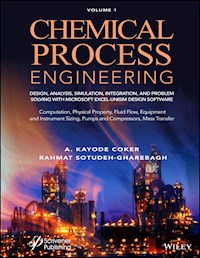
Written by two of the most prolific and respected chemical engineers in the world, this groundbreaking two-volume set is the "new standard" in the industry, offering engineers and students alike the most up-do-date, comprehensive, and state-of-the-art coverage of processes and best practices in the field today. This first new volume in a two-volume set explores and describes integrating new tools for engineering education and practice for better utilization of the existing knowledge on process design. Useful not only for students, professors, scientists and practitioners, especially process, chemical, mechanical and metallurgical engineers, it is also a valuable reference for other engineers, consultants, technicians and scientists concerned about various aspects of industrial design. The text can be considered as a complementary text to process design for senior and graduate students as well as a hands-on reference work or refresher for engineers at entry level. The contents of the book can also be taught in intensive workshops in the oil, gas, petrochemical, biochemical and process industries. The book provides a detailed description and hands-on experience on process design in chemical engineering, and it is an integrated text that focuses on practical design with new tools, such as Excel spreadsheets and UniSim simulation software. Written by two industry and university's most trustworthy and well-known authors, this book is the new standard in chemical, biochemical, pharmaceutical, petrochemical and petroleum refining. Covering design, analysis, simulation, integration, and, perhaps most importantly, the practical application of Microsoft Excel-UniSim software, this is the most comprehensive and up-to-date coverage of all of the latest developments in the industry. It is a must-have for any engineer or student's library.
Sie lesen das E-Book in den Legimi-Apps auf:
Seitenzahl: 686
Veröffentlichungsjahr: 2022
Ähnliche



















Table of Contents
Cover
Title Page
Copyright
Companion Web Page
Gratitude
Preface
Acknowledgments
About the Authors
1 Computations with Excel Spreadsheet-UniSim Design Simulation
SECTION I - NUMERICAL ANALYSIS
INTRODUCTION
SOLVER
LINEAR REGRESSION
MULTIPLE REGRESSION
POLYNOMIAL REGRESSION
SIMULTANEOUS LINEAR EQUATIONS
NONLINEAR EQUATIONS
INTERPOLATIONS
INTEGRATIONS
DIFFERENTIAL EQUATIONS
EXAMPLES AND SOLUTIONS
SECTION II – PROCESS SIMULATION
INTRODUCTION
EXAMPLES AND SOLUTIONS
References
2 Physical Property of Pure Components and Mixtures
PURE COMPONENTS
MIXTURES
DIFFUSION COEFFICIENTS
COMPRESSIBILITY Z-FACTOR
SOLUBILITY AND ADSORPTION
References
3 Fluid Flow
INTRODUCTION
EQUIVALENT LENGTH OF VARIOUS FITTINGS AND VALVES
PRESSURE DROP CALCULATIONS FOR SINGLE-PHASE INCOMPRESSIBLE FLUIDS
COMPRESSIBLE FLUID FLOW IN PIPES
TWO-PHASE FLOW IN PROCESS PIPING
VAPOR-LIQUID TWO-PHASE VERTICAL DOWNFLOW
LINE SIZES FOR FLASHING STEAM CONDENSATE
FLOW THROUGH PACKED BEDS
EXAMPLES AND SOLUTIONS
References
4 Equipment Sizing
INTRODUCTION
SIZING OF VERTICAL AND HORIZONTAL SEPARATORS
SIZING OF PARTLY FILLED VESSELS AND TANKS
PRELIMINARY VESSEL DESIGN
CYCLONE DESIGN
GAS DRYER DESIGN
EXAMPLES AND SOLUTIONS
References
5 Instrument Sizing
INTRODUCTION
CONTROL VALVE SIZING
References
6 Pumps and Compressors Sizing
PUMPS
Pump Design Standardization
Basic Parts of a Centrifugal Pump
Impellers
Casing
Shaft
CENTRIFUGAL PUMP SELECTION
Single-Stage (Single Impeller) Pumps
Hydraulic Characteristics for Centrifugal Pumps
Friction Losses Due to Flow
Velocity Head
Friction
NET POSITIVE SUCTION HEAD (NPSH) AND PUMP SUCTION
General Suction System
Reductions in NPSHR
Charting NPSHR Values of Pumps
Net Positive Suction Head (NPSH)
Specific Speed
Rotative Speed
Pumping Systems and Performance
POWER REQUIREMENTS FOR PUMPING THROUGH PROCESS LINES
Hydraulic Power
AFFINITY LAWS
CENTRIFUGAL PUMP EFFICIENCY
Centrifugal Pump Specifications
Pump Specifications (Figures 6.43a and b)
Steps in Pump Sizing
Reciprocating Pumps
Significant Features in Reciprocating Pump Arrangements
Application
Performance
Discharge Flow Patterns
HORSEPOWER
Pump Selection
Selection Rules-of-Thumb
A CASE STUDY
Variables Descriptions
SIMULATION ALGORITHM
Problem
Discussion
Pump Cavitation
Factors in Pump Selection
COMPRESSORS
General Application Guide
Specification Guides
GENERAL CONSIDERATIONS FOR ANY TYPE OF COMPRESSOR FLOW CONDITIONS
Fluid Properties
Compressibility
Corrosive Nature
Moisture
Special Conditions
Specification Sheet
PERFORMANCE CONSIDERATIONS
Heat Rejected to Water
Drivers
Ideal Pressure – Volume Relationship
Actual Compressor Diagram
DEVIATIONS FROM IDEAL GAS LAWS: COMPRESSIBILITY
Adiabatic Calculations
Charles’ Law at Constant Pressure [9]
Amonton’s Law at Constant Volume [9]
Combined Boyle’s and Charles’ Laws
Entropy Balance Method [7]
Isentropic Exponent Method [7]
COMPRESSION RATIO
Horsepower
Single Stage
Actual Brake Horsepower, Bhp
Actual Brake Horsepower, Bhp (Alternate Correction for Compressibility)
Temperature Rise – Adiabatic
Temperature Rise – Polytropic
A CASE STUDY USING UNISIM DESIGN R460.1 SOFTWARE FOR A TWO–STAGE COMPRESSION
Solution
Accidentally Closing the PFD
Object Palette
Specifications
COMPRESSION PROCESS
ADIABATIC HEAD DEVELOPED PER SINGLE-STAGE WHEEL
Polytropic Head
Polytropic
Brake Horsepower
Speed of Rotation
TEMPERATURE RISE DURING COMPRESSION
Sonic or Acoustic Velocity
MACH NUMBER [35]
Specific Speed
COMPRESSOR EQUATIONS IN SI UNITS
Polytropic Compressor
Adiabatic Compressor
Efficiency
Mass Flow Rate, w
Mechanical Losses
Estimating Compressor Horsepower
Multistage Compressors
Multicomponent Gas Streams
AFFINITY LAWS
Speed
Impeller Diameters (Similar)
Impeller Diameter (Changed)
Effect of Temperature
AFFINITY LAW PERFORMANCE
TROUBLESHOOTING OF CENTRIFUGAL AND RECIPROCATING COMPRESSORS
NOMENCLATURE
Greek Symbols
Subscripts
Nomenclature
Subscripts
Greek Symbols
References
Pumps
Bibliography
References
Bibliography
7 Mass Transfer
INTRODUCTION
VAPOR LIQUID EQUILIBRIUM
BUBBLE POINT CALCULATION
DEW POINT CALCULATION
EQUILIBRIUM FLASH COMPOSITION
Nomenclature
TOWER SIZING FOR VALVE TRAYS
PACKED TOWER DESIGN
DETERMINATION OF PLATES IN FRACTIONATING COLUMNS BY THE SMOKER EQUATIONS
MULTICOMPONENT DISTRIBUTION AND MINIMUM TRAYS IN DISTILLATION COLUMNS
EXAMPLES AND SOLUTIONS
References
Index
Also of Interest
End User License Agreement
List of Tables
Chapter 1
Table 1.1 Selected basic functions of Excel spreadsheet [2, 5].
Table 1.2 Selected applied functions of Excel spreadsheet for design and simulat...
Table 1.3 Syntax for finding trendline coefficients [7].
Table 1.4 Input data for liquid mixing experiment.
Table 1.5 Input data for fluid flow experiments.
Table 1.6 xy data for polynomial approximation.
Table 1.7 Blend specifications.
Table 1.8 Design and reaction data for continuous stirred tanks.
Table 1.9 Flow gas data at various temperatures.
Table 1.10 Kinetic and concentration data for the batch reactor.
Table 1.11 Benefits of using process simulators for engineers and scientists.
Table 1.12 List of mostly used chemical process simulators.
Table 1.13 Good simulation practice.
Chapter 2
Table 2.1 The temperature range for the surface tension.
Table 2.2 Calculation of specific gravity of natural gas.
Chapter 3
Table 3.1 Values of K1 and K∞ for the two-K method for pipe fittings. Source: H...
Table 3.2 Excess head loss “K” correlation due to changes in pipe size [1].
Table 3.3 Equivalent roughness of various surfaces (Source [6]).
Table 3.4 Recommended fluid velocity and maximum ΔP for carbon steel vapor lines...
Table 3.5 Approximate k values for some common gases (68°F, 14.7 psia).
Table 3.6 Friction factors for total turbulence in new commercial steel pipes.
Table 3.7 Characteristic linear Velocities of two-phase flow regimes.
Table 3.8 Characteristic linear velocities of two-phase flow regimes [26].
Chapter 4
Table 4.1 Design criteria for Reflux Distillate Accumulators.
Table 4.2 Operator factors for external units.
Table 4.3 Head blank diameter factor (H.Fac).
Table 4.4 Effect of variables on Cyclone Performance.
Table 4.5 Cyclone operational and design data.
Table 4.6 Dryer operational data.
Chapter 5
Table 5.1 Flow coefficients for control valves.
Table 5.2 Correction factors for control valve flow coefficient.
Table 5.3 Cv table for quick opening trim.
Table 5.4 Cv table for linear trim.
Chapter 6
Table 6.1 General types or classification of pumps.
Table 6.2 Approximate capacity-head ranges for centrifugal pumps.
Table 6.3 Effects of fluid density on head.
Table 6.4 Basic parts of a centrifugal pump.
Table 6.5 Pump selection guide.
Table 6.6 Troubleshooting centrifugal pumps.
Table 6.7 Pump installation check list [30].
Table 6.8 General compression and vacuum limits.
Table 6.9 Comparison of performance for propane.
Table 6.10 Compressibility Factors, Z.
Table 6.11 Approximate ratio of specific heats (“k” values) for various gases.
Table 6.11a Constants for molal heat capacity.
Table 6.12 Properties of the gas mixture.
Table 6.13 Polytropic efficiencies for various types of machines.
Table 6.14 Approximate mechanical losses as a percentage of a gas power requirem...
Table 6.15 Properties of the gas mixture.
Table 6.16 Probable causes of reciprocating compressor trouble.
Table 6.17 Probable causes of centrifugal compressor trouble.
Chapter 7
Table 7.1 Ways to produce two-phase mixture [1].
Table 7.2 Equilibrium flash criteria.
Table 7.3 Values of G and H for each tray spacing.
Table 7.4 Recommended values for foam factor and residence time.
Table 7.5 Tower diameter versus cross sectional areas.
Table 7.6 Downcomer dimensions.
Table 7.7 Downcomer dimensions.
Table 7.8 Downcomer dimensions.
Table 7.9 Tower diameter versus cross sectional areas.
Table 7.10 Determining number of passes.
Table 7.11 Pressure-drop correlations for packed towers. Source: van Winkle [17]...
Table 7.12 Generalized pressure drop rules. Source: Branan [25].
Table 7.13 Packing factors (Source: Eckert [26]).
Table 7.14 Constants for each pressure drop correlation. Source: Blackwell [13].
Table 7.15 Composition of feed.
Table 7.16 Feed composition to a natural gas liquefaction plant.
Table 7.17 Bubble and dew point temperatures.
Table 7.18 Constants for each pressure drop correlation.
Guide
Cover
Table of Contents
Title Page
Copyright
Companion Web Page
Gratitude
Preface
Acknowledgments
About the Authors
Begin Reading
Index
Also of Interest
End User License Agreement
Pages
ix
ii
iii
iv
v
vii
xvii
xviii
xix
xxi
1
2
3
4
5
6
7
8
9
10
11
12
13
14
15
16
17
18
19
20
21
22
23
24
25
26
27
28
29
30
31
32
33
34
35
36
37
38
39
40
41
42
43
44
45
46
47
48
49
50
51
52
53
54
55
56
57
58
59
60
61
62
63
64
65
66
67
68
69
70
71
72
73
74
75
76
77
78
79
81
82
83
84
85
86
87
88
89
90
91
92
93
94
95
96
97
98
99
100
101
102
103
104
105
106
107
108
109
110
111
112
113
114
115
116
117
118
119
120
121
122
123
124
125
126
127
128
129
130
131
132
133
134
135
136
137
138
139
140
141
142
143
144
145
146
147
148
149
150
151
152
153
154
155
156
157
158
159
160
161
162
163
165
166
167
168
169
170
171
172
173
174
175
176
177
178
179
180
181
182
183
184
185
186
187
188
189
190
191
192
193
194
195
196
197
198
199
200
201
202
203
204
205
206
207
208
209
210
211
212
213
214
215
216
217
218
219
220
221
222
223
224
225
226
227
228
229
230
231
232
233
234
235
236
237
238
239
240
241
242
243
244
245
246
247
249
250
251
252
253
254
255
256
257
258
259
260
261
262
263
264
265
266
267
268
269
270
271
272
273
274
275
276
277
278
279
280
281
282
283
284
285
286
287
288
289
290
291
292
293
294
295
296
297
298
299
300
301
302
303
304
305
306
307
308
309
310
311
312
313
314
315
316
317
318
319
320
321
322
323
324
325
326
327
328
329
330
331
332
333
334
335
336
337
338
339
340
341
342
343
344
345
346
347
348
349
350
351
352
353
354
355
356
357
358
359
360
361
362
363
364
365
366
367
368
369
370
371
372
373
374
375
376
377
378
379
380
381
382
383
384
385
386
387
388
389
390
391
392
393
394
395
396
397
398
399
400
401
402
403
404
405
406
407
408
409
410
411
412
413
414
415
416
417
418
419
420
421
422
423
424
425
426
427
428
429
430
431
432
433
434
435
436
437
438
439
440
441
442
443
444
445
446
447
448
449
450
451
452
453
454
455
456
457
458
459
460
461
462
463
464
465
466
467
468
469
470
471
472
473
474
475
476
477
478
479
480
481
482
483
484
485
486
487
488
489
490
491
492
493
494
495
496
497
498
499
500
501
502
503
505
506
507
508
Scrivener Publishing
100 Cummings Center, Suite 541J
Beverly, MA 01915-6106
Publishers at Scrivener
Martin Scrivener ([email protected])
Phillip Carmical ([email protected])
Volume 1
Chemical Process Engineering
Design, Analysis, Simulation and Integration, and Problem Solving With Microsoft Excel – UniSim Design Software
Computation, Physical Property, Fluid Flow, Equipment & Instrument Sizing, Pumps & Compressors, Mass Transfer
A. Kayode Coker
and
Rahmat Sotudeh-Gharebagh
This edition first published 2022 by John Wiley & Sons, Inc., 111 River Street, Hoboken, NJ 07030, USA and Scrivener Publishing LLC, 100 Cummings Center, Suite 541J, Beverly, MA 01915, USA
© 2022 Scrivener Publishing LLC
For more information about Scrivener publications please visit www.scrivenerpublishing.com.
All rights reserved. No part of this publication may be reproduced, stored in a retrieval system, or transmitted, in any form or by any means, electronic, mechanical, photocopying, recording, or otherwise, except as permitted by law. Advice on how to obtain permission to reuse material from this title is available at http://www.wiley.com/go/permissions.
Wiley Global Headquarters
111 River Street, Hoboken, NJ 07030, USA
For details of our global editorial offices, customer services, and more information about Wiley products visit us at www.wiley.com.
Limit of Liability/Disclaimer of Warranty
While the publisher and authors have used their best efforts in preparing this work, they make no representations or warranties with respect to the accuracy or completeness of the contents of this work and specifically disclaim all warranties, including without limitation any implied warranties of merchant-ability or fitness for a particular purpose. No warranty may be created or extended by sales representatives, written sales materials, or promotional statements for this work. The fact that an organization, website, or product is referred to in this work as a citation and/or potential source of further information does not mean that the publisher and authors endorse the information or services the organization, website, or product may provide or recommendations it may make. This work is sold with the understanding that the publisher is not engaged in rendering professional services. The advice and strategies contained herein may not be suitable for your situation. You should consult with a specialist where appropriate. Neither the publisher nor authors shall be liable for any loss of profit or any other commercial damages, including but not limited to special, incidental, consequential, or other damages. Further, readers should be aware that websites listed in this work may have changed or disappeared between when this work was written and when it is read.
Library of Congress Cataloging-in-Publication Data
ISBN 9781119510185
Cover image: Chemical Plant - Slidezero | Dreamstime.com
Cover background: Flowing Image - Mikhail Sheleh | Dreamstime.com
Cover design by Kris Hackerott
Set in size of 11pt and Minion Pro by Manila Typesetting Company, Makati, Philippines
Printed in the USA
10 9 8 7 6 5 4 3 2 1
Companion Web Page
This 2-volume set includes access to its companion web page, from which can be downloaded useful software, spreadsheets, and other value-added products related to the books. To access it, follow the instructions below:
Go to
https://scrivenerpublishing.com/coker_volume_one/
Enter your email in the username field
Enter “Refining” in the password field
Gratitude
To the Almighty father for providing us with the abundance of nature, so that human beings can further develop and make use of the many things in nature for our well-being and for the world.
To all process/chemical engineers worldwide utilizing this abundance of nature for the good of mankind.
Keep the heart of your thoughts pure, by so doing you will bring peace and be happy
To honour God in all things and to perform everything solely to the glory of God
Abd-ru-shin (In the Light of Truth)
A. Kayode Coker
Dedication
“I am always obliged to a person who has taught me a single word.”
In memory of my late father and to my respected family for their endless support
To engineers and scientists for their commitment to inclusion and sustainability
R. Sotudeh-Gharebagh
Preface
An increased use of computational resources by engineers has greatly expedited the design of equipment and process plants in refining, and the chemical process industries. In addition, the availability of commercial and open source process simulation packages, and spreadsheets has drastically reduced the requirement of programming with high-level languages, such as BASIC, C, C++, COBOL, Java, FORTRAN and Pascal. Situations may arise where a simulation package is not readily available, too expensive or of a limited scope, in this case, hands-on tools; e.g. spreadsheets could be used to review other alternatives or develop specific programs. Furthermore, the simulation packages can be integrated with spreadsheets to enlarge their scope to equipment and process design due to the infrastructure they provide on component databases, physical property estimations and unit operations.
A text-book, including the theory with equations, tables, and figures and the use of advanced tools is not readily available to the process designer. Our aim in preparing this text is to present theory, along with Excel spreadsheet and UniSim Design software programs for solving a wide range of design problems. The book will, therefore, benefit chemical/process engineers, students, technologists and practitioners in the petroleum, petrochemical, pharmaceutical, biochemical and fine chemical industries. The structured approaches are provided that can be used to solve a wide range of process engineering problems and thus analyze and simulate process equipment regularly.
The process design concepts, guidelines; codes and standards are clearly important, and several excellent books and references are available to address these issues and will be cited in the book where applicable. However, these two volume-sets are unique in that to date no textbook on chemical process design and simulation has been published, which provides adequate information (theory, equations, figures, tables and programs) to enable the reader to perform robust calculations using Excel spreadsheet - UniSim Design software program. The better use of these tools in the special format shapes the core of the book as:
– Microsoft Excel
®
is part of the Microsoft Office. It is widely recognized as the most versatile spreadsheet for problem solving, which enables a chemical engineer to make computation and visualizations in an easiest way possible. Process engineers can use Excel spreadsheet for equipment and process design, modeling, simulation and optimization. Data bases and pivot tables can be easily designed with Excel spreadsheet to ease making calculations, understanding technical reports, and preparing charts and figures.
– The new improved UniSim R480 Design of Honeywell, is a smart and intuitive software; it creates thermodynamics and unit operation steady-state and dynamic models. Process simulation is a tool used to design a new process, an existing process or debottleneck, monitor process conditions, troubleshoot current operations to compare theoretical results, optimize process conditions for enhanced throughput, and to reduce energy yields, and emissions.
The contents of this book have been formed over many years through the concentrated research and industrial efforts of the authors. Furthermore, to assist the user and to demonstrate the validity of the methods, worked examples and case studies of practical relevance using the Excel spreadsheet and UniSim Design software programs are provided throughout the text, and the source files are provided at the publisher website. In this way, the students, and engineers can save time by using hands-on tools to ease the calculation and concentrate in understanding the fundamentals of the phenomena occurring in the process design sequences. These two volumes are fully extended version of the original title: Fortran Programs for Chemical Process Design, Analysis and Simulation by A. Kayode Coker. In these volumes, we have provided examples in both Imperial and SI units, but we have intentionally kept most examples in Imperial units based on the following reasons:
a) All problems solved in UniSim Design can be easily converted to any units of measurement and it makes no difference which unit is used.
b) The use of both units is very useful from instructional viewpoint as students need to have some sort of practice with both units as the Imperial unit is still used in some countries.
However, since all problems are carefully solved in Excel, the conversion is then easy, and we have also provided a conversion table to assist readers in their calculations.
The book is primarily intended to serve senior students, early career engineers, university professors and practitioners, especially in the process, chemical, petrochemical, biochemical, mechanical, mining and metallurgical industries. However, other engineers, consultants, technicians and scientists concerned with various aspects of industrial design, and scale-up may also find it useful. It can be considered as a textbook to process design for senior and graduate students as well as a hands-on document for engineers at the entry level and practitioners. The content of this book can also be taught in intensive workshops in process industries.
Acknowledgments
RSG wishes to express his profound gratitude to his students for reading the chapters and checking the programs. Further, he wishes to thank his current and former graduate students, Ms. Aghasi, Ms. Bakhshi and Messrs. Jabbari, Ahmadi, Moshiri, Khodabendehlou for checking the chapters and programs. Special credits are also extended to Professor Jamal Chaouki from Polytechnique de Montreal for hosting RSG for his sabbatical leave upon the completion of the book beside the main activity planned for sababtical. AKC expresses his gratitude to Ahmed Mutawa, formerly of SASREF for developing the conversion table software for the book. Thank you, Ahmed.
Wherever it is required, permissions have been obtained to reproduce the works published by some organizations and companies. We acknowledge and thank the American Institute of Chemical Engineers, the Institution of Chemical Engineers (U.K.), Chemical Engineering (Mc-Graw Hill), Oil & Gas Journal, Tubular Exchanger Manufacturers’ Association, American Petroleum Institute, John Wiley & Sons, Nutter Engineering, and many other organizations that provided materials for this book. We express our gratitude to Honeywell Process Solutions for granting permission to incorporate the use of UniSim Design software simulation and many suites of software programs in the book.
We wish to express our thanks to the Wiley-Scrivener team: Kris Hackerott- Graphics Designer, Bryan Aubrey – Copy editor, Myrna Ting – Typesetter and her colleagues. We are truly grateful for your professionalism, assistance and help in the production of this volume. Finally, very special thanks to Phil Carmical of Scrivener publishing company for his advice and helpful suggestions during the production of this volume.
Finally, we should emphasize that process design is a creative, dynamic and challenging activity and for this reason, the design books like this one need continuous improvement with current digitalization outlook and abundant access to computation resources. We would appreciate and welcome any comments, suggestions, or feedback that you may have on this volume.
A. Kayode Coker (www.akctechnology.com)
A. K.C. TECHNOLOGY, U.K.
Rahmat Sotudeh-Gharebagh ([email protected]) College of Engineering, University of Tehran, Iran
About the Authors
A. Kayode Coker PhD




