


177,99 €
Mehr erfahren.
- Herausgeber: John Wiley & Sons
- Kategorie: Fachliteratur
- Sprache: Englisch
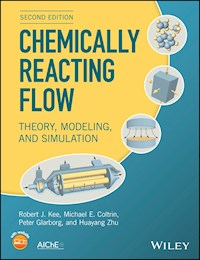
A guide to the theoretical underpinnings and practical applications of chemically reacting flow
Chemically Reacting Flow: Theory, Modeling, and Simulation, Second Edition combines fundamental concepts in fluid mechanics and physical chemistry while helping students and professionals to develop the analytical and simulation skills needed to solve real-world engineering problems. The authors clearly explain the theoretical and computational building blocks enabling readers to extend the approaches described to related or entirely new applications. New to this Second Edition are substantially revised and reorganized coverage of topics treated in the first edition. New material in the book includes two important areas of active research: reactive porous-media flows and electrochemical kinetics. These topics create bridges between traditional fluid-flow simulation approaches and transport within porous-media electrochemical systems.
The first half of the book is devoted to multicomponent fluid-mechanical fundamentals. In the second half the authors provide the necessary fundamental background needed to couple reaction chemistry into complex reacting-flow models. Coverage of such topics is presented in self-contained chapters, allowing a great deal of flexibility in course curriculum design.
• Features new chapters on reactive porous-media flow, electrochemistry, chemical thermodynamics, transport properties, and solving differential equations in MATLAB
• Provides the theoretical underpinnings and practical applications of chemically reacting flow
• Emphasizes fundamentals, allowing the analyst to understand fundamental theory underlying reacting-flow simulations
• Helps readers to acquire greater facility in the derivation and solution of conservation equations in new or unusual circumstances
• Reorganized to facilitate use as a class text and now including a solutions manual for academic adopters
Computer simulation of reactive systems is highly efficient and cost-effective in the development, enhancement, and optimization of chemical processes. Chemically Reacting Flow: Theory, Modeling, and Simulation, Second Edition helps prepare graduate students in mechanical or chemical engineering, as well as research professionals in those fields take utmost advantage of that powerful capability.
Sie lesen das E-Book in den Legimi-Apps auf:
Seitenzahl: 1241
Veröffentlichungsjahr: 2017
Ähnliche



















CHEMICALLY REACTING FLOW
Theory, Modeling, and Simulation
Second Edition
Robert J. Kee
Colorado School of Mines
Michael E. Coltrin
Sandia National Laboratories
Peter Glarborg
Technical University of Denmark
Huayang Zhu
Colorado School of Mines
This edition first published 2018 © 2018 by John Wiley & Sons, Inc
All rights reserved. No part of this publication may be reproduced, stored in a retrieval system, or transmitted, in any form or by any means, electronic, mechanical, photocopying, recording or otherwise, except as permitted by law. Advice on how to obtain permission to reuse material from this title is available at http://www.wiley.com/go/permissions.
The right of Robert J. Kee, Michael E. Coltrin, Peter Glarborg, Huayang Zhu to be identified as the authors of this work has been asserted in accordance with law.
Registered OfficeJohn Wiley & Sons, Inc., 111 River Street, Hoboken, NJ 07030, USA
Editorial Office111 River Street, Hoboken, NJ 07030, USA
For details of our global editorial offices, customer services, and more information about Wiley products visit us at www.wiley.com.
Wiley also publishes its books in a variety of electronic formats and by print-on-demand. Some content that appears in standard print versions of this book may not be available in other formats.
Limit of Liability/Disclaimer of WarrantyIn view of ongoing research, equipment modifications, changes in governmental regulations, and the constant flow of information relating to the use of experimental reagents, equipment, and devices, the reader is urged to review and evaluate the information provided in the package insert or instructions for each chemical, piece of equipment, reagent, or device for, among other things, any changes in the instructions or indication of usage and for added warnings and precautions. While the publisher and authors have used their best efforts in preparing this work, they make no representations or warranties with respect to the accuracy or completeness of the contents of this work and specifically disclaim all warranties, including without limitation any implied warranties of merchantability or fitness for a particular purpose. No warranty may be created or extended by sales representatives, written sales materials or promotional statements for this work. The fact that an organization, website, or product is referred to in this work as a citation and/or potential source of further information does not mean that the publisher and authors endorse the information or services the organization, website, or product may provide or recommendations it may make. This work is sold with the understanding that the publisher is not engaged in rendering professional services. The advice and strategies contained herein may not be suitable for your situation. You should consult with a specialist where appropriate. Further, readers should be aware that websites listed in this work may have changed or disappeared between when this work was written and when it is read. Neither the publisher nor authors shall be liable for any loss of profit or any other commercial damages, including but not limited to special, incidental, consequential, or other damages.
Library of Congress Cataloging-in-Publication Data
Names: Kee, R. J., author. | Coltrin, Michael Elliott, 1953- author. | Glarborg, Peter, author. | Zhu, Huayang, author. Title: Chemically reacting flow : theory, modeling, and simulation / Robert J. Kee, Michael E. Coltrin, Peter Glarborg, Huayang Zhu. Description: Second edition. | Hoboken, NJ : John Wiley & Sons, 2017. | Includes index. | Identifiers: LCCN 2017011676 (print) | LCCN 2017018820 (ebook) | ISBN 9781119186281 (pdf) | ISBN 9781119186298 (epub) | ISBN 9781119184874 (cloth) Subjects: LCSH: Transport theory. | Fluid dynamics. | Thermodynamics. Classification: LCC TP156.T7 (ebook) | LCC TP156.T7 K44 2017 (print) | DDC 660/.299–dc23 LC record available at https://lccn.loc.gov/2017011676
Cover Design and Images: Courtesy of Robert and Judy Kee
We dedicate this book to aclose friend and highlyvalued colleague, Prof.David G. Goodwin(1957-2012) of Caltech.
CONTENTS
PREFACE
ACKNOWLEDGMENTS
NOMENCLATURE
Greek Symbols
CHAPTER 1 INTRODUCTION
1.1 Foregoing Texts
1.2 Objectives and Approach
1.3 What is a Fluid?
1.4 Chemically Reacting Fluid Flow
1.5 Physical Chemistry
1.6 Illustrative Examples
References
CHAPTER 2 FLUID PROPERTIES
2.1 Equations of State
2.2 Thermodynamics
2.3 Transport Properties
References
CHAPTER 3 FLUID KINEMATICS
3.1 Path to Conservation Equations
3.2 System and Control Volume
3.3 Stress and Strain Rate
3.4 Fluid Strain Rate
3.5 Vorticity
3.6 Dilatation
3.7 Stress Tensor
3.8 Stokes Postulates
3.9 Transformation from Principal Coordinates
3.10 Stokes Hypothesis
3.11 Summary
Notes
CHAPTER 4 CONSERVATION EQUATIONS
4.1 Mass Continuity
4.2 Navier-Stokes Equations
4.3 Species Diffusion
4.4 Species Conservation
4.5 Conservation of Energy
4.6 Mechanical Energy
4.7 Thermal Energy
4.8 Ideal Gas and Incompressible Fluid
4.9 Conservation Equation Summary
4.10 Pressure Filtering
4.11 Helmholtz Decomposition
4.12 Potential Flow
4.13 Vorticity Transport
4.14 Mathematical Characteristics
4.15. Summary
References
CHAPTER 5 PARALLEL FLOWS
5.1 Nondimensionalization
5.2 Couette and Poiseuille Flows
5.3 Hagen–Poiseuille Flow in a Circular Duct
5.4 Ducts of Noncircular Cross Section
5.5 Hydrodynamic Entry Length
5.6 Transient Flow in a Duct
5.7 Richardson Annular Overshoot
5.8 Stokes Problems
5.9 Rotating Shaft in Infinite Media
5.10 Graetz Problem
References
CHAPTER 6 SIMILARITY AND LOCAL SIMILARITY
6.1 Jeffery–Hamel Flow
6.2 Planar Wedge Channel
6.3 Radial-Flow Reactors
6.4 Spherical Flow between Inclined Disks
6.5 Radial Flow between Parallel Disks
6.6 Flow between Plates with Wall Injection
References
CHAPTER 7 STAGNATION FLOWS
7.1 Similarity in Axisymmetric Stagnation Flow
7.2 Generalized Steady Axisymmetric Stagnation Flow
7.3 Semi-Infinite Domain
7.4 Finite-Gap Stagnation Flow
7.5 Finite-Gap Numerical Solution
7.6 Rotating Disk
7.7 Rotating Disk in a Finite Gap
7.8 Unified View of Axisymmetric Stagnation Flow
7.9 Planar Stagnation Flows
7.10 Opposed Flow
7.11 Tubular Flows
7.12 Stagnation-Flow Chemical Vapor Deposition
7.13 Boundary-Layer Bypass
References
CHAPTER 8 BOUNDARY-LAYER CHANNEL FLOW
8.1 Scaling Arguments for Boundary Layers
8.2 General Setting Boundary-Layer Equations
8.3 Boundary Conditions
8.4 Computational Solution
8.5 Introduction to the Method of Lines
8.6 Method-of-Lines Boundary-Layer Algorithm
8.7 Von Mises Transformation
8.8 Von Mises Formulation as DAEs
8.9 Hydrodynamic Entry Length
8.10 Physical and von Mises Coordinates
8.11 General von Mises Boundary Layer
8.12 Limitations
8.13 Chemically Reacting Channel Flow
References
CHAPTER 9 LOW-DIMENSIONAL REACTORS
9.1 Batch Reactors (Homogeneous Mass-Action Kinetics)
9.2 Plug-Flow Reactor
9.3 Plug Flow with Porous Walls
9.4 Plug Flow with Variable Area and Surface Chemistry
9.5 Perfectly Stirred Reactors
9.6 Transient Stirred Reactors
9.7 Stagnation-Flow Catalytic Reactor
Notes
References
CHAPTER 10 THERMOCHEMICAL PROPERTIES
10.1 Kinetic Theory of Gases
10.2 Molecular Energy Levels
10.3 Partition Function
10.4 Statistical Thermodynamics
10.5 Example Calculations
References
CHAPTER 11 MOLECULAR TRANSPORT
11.1 Introduction to Transport Coefficients
11.2 Molecular Interactions
11.3 Kinetic Gas Theory of Transport Properties
11.4 Rigorous Theory of Transport Properties
11.5 Evaluation of Transport Coefficients
11.6 Momentum and Energy Fluxes
11.7 Species Fluxes
11.8 Diffusive Transport Example
Notes
References
CHAPTER 12 MASS-ACTION KINETICS
12.1 Gibbs Free Energy
12.2 Equilibrium Constant
12.3 Mass-Action Kinetics
12.4 Pressure-Dependent Unimolecular Reactions
12.5 Bimolecular Chemical Activation Reactions
Notes
References
CHAPTER 13 REACTION RATE THEORIES
13.1 Molecular Collisions
13.2 Collision Theory Reaction Rate Expression
13.3 Transition-State Theory
13.4 Unimolecular Reactions
13.5 Bimolecular Chemical Activation Reactions
References
CHAPTER 14 REACTION MECHANISMS
14.1 Models for Chemistry
14.2 Characteristics of Complex Reactions
14.3 Mechanism Development
14.4 Combustion Chemistry
Notes
References
CHAPTER 15 LAMINAR FLAMES
15.1 Premixed Flat Flame
15.2 Premixed Flame Structure
15.3 Methane-Air Premixed Flame
15.4 Stagnation Flames
15.5 Opposed-Flow Diffusion Flames
15.6 Premixed Counterflow Flames
15.7 Arc-Length Continuation
Note
References
CHAPTER 16 HETEROGENEOUS CHEMISTRY
16.1 Taxonomy
16.2 Surface Species Naming Conventions
16.3 Concentrations within Phases
16.4 Surface Reaction Rate Expressions
16.5 Thermodynamic Considerations
16.6 General Surface Kinetics Formalism
16.7 Surface-Coverage Modification of the Rate Expression
16.8 Sticking Coefficients
16.9 Flux-Matching Conditions at a Surface
16.10 Surface Species Governing Equations
16.11 Developing Surface Reaction Mechanisms
16.12 Example Reaction Mechanism
Notes
References
CHAPTER 17 REACTIVE POROUS MEDIA
17.1 Introduction
17.2 Pore Characterization
17.3 Multicomponent Transport
17.4 Mass Conservation Equations
17.5 Energy Conservation Equations
17.6 Tubular Packed-Bed Reactor
17.7 Reconstructed Microstructures
17.8 Intra-Particle Pore Diffusion
References
CHAPTER 18 ELECTROCHEMISTRY
18.1 Electrochemical Reactions
18.2 Electrochemical Potentials
18.3 Electrochemical Thermodynamics and Reversible Potentials
18.4 Electrochemical Kinetics
18.5 Electronic and Ionic Species Transport
18.6 Modeling Electrochemical Unit Cells
18.7 Principles of Composite SOFC Electrodes
18.8 SOFC Button-Cell Example
18.9 Chemistry and Model Development
References
APPENDIX A VECTOR AND TENSOR OPERATIONS
A.1 Vector Algebra
A.2 Unit Vector Algebra
A.3 Unit Vector Derivatives
A.4 Scalar Product
A.5 Vector Product
A.6 Vector Differentiation
A.7 Gradient
A.8 Gradient of a Vector
A.9 Curl of a Vector
A.10 Divergence of a Vector
A.11 Divergence of a Tensor
A.12 Laplacian
A.13 Laplacian of a Vector
A.14 Vector Derivative Identities
A.15 Gauss Divergence Theorem
A.16 Substantial Derivative
A.16.1 Substantial Derivative of a Vector
A.17 Symmetric Tensors
A.18 Stress Tensor and Stress Vector
A.19 Direction Cosines
A.20 Coordinate Transformations
A.21 Principal Axes
A.22 Tensor Invariants
A.23 Matrix Diagonalization
APPENDIX B NAVIER–STOKES EQUATIONS
B.1 General Vector Form
B.2 Stress Components
B.3 Cartesian Navier–Stokes Equations
B.4 Cartesian Navier–Stokes, Constant Viscosity
B.5 Cylindrical Navier–Stokes Equations
B.6 Cylindrical Navier–Stokes, Constant Viscosity
B.7 Spherical Navier–Stokes Equations
B.8 Spherical Navier–Stokes, Constant viscosity
B.9 Orthogonal Curvilinear Navier–Stokes
APPENDIX C EXAMPLE IN GENERAL CURVILINEAR COORDINATES
C.1 Governing Equations
APPENDIX D SMALL PARAMETER EXPANSION
APPENDIX E BOUNDARY-LAYER ASYMPTOTIC BEHAVIOR
E.1 Boundary-Layer Approximation
E.2 A Prototype for Boundary-Layer Behavior
APPENDIX F COMPUTATIONAL ALGORITHMS
F.1 Differential Equations from Chemical Kinetics
F.2 Stiff Model Problem
F.3 Solution Methods
F.4 Differential-Algebraic Equations
F.5 Solution of Nonlinear Algebraic Equations
F.6 Continuation Procedures
F.7 Transient Sensitivity Analysis
F.8 Transient Ignition Example
References
APPENDIX G MATLAB EXAMPLES
G.1 Steady-State Couette–Poiseuille Flow
G.2 Steady Semi-Infinite Stagnation Flow
G.3 Steady Finite-Gap Stagnation Flow
G.4 Transient Stokes Problem
G.5 Graetz Problem
G.6 Channel Boundary Layer Entrance
G.7 Rectangular Channel Friction Factor
INDEX
EULA
List of Tables
Chapter 2
Table 2.1
Chapter 7
Table 7.1
Table 7.2
Chapter 10
Table 10.1
Chapter 11
Table 11.1
Table 11.2
Chapter 12
Table 12.1
Chapter 14
Table 14.1
Table 14.2
Chapter 16
Table 16.1
Chapter 17
Table 17.1
Chapter 18
Table 18.1
Guide
Cover
Table of Contents
Preface
Pages
xxi
xxii
xxiii
xxv
xxvi
xxvii
xxviii
xxix
xxxvii
1
2
3
4
5
6
7
8
9
10
11
12
13
14
15
16
17
18
19
21
22
23
24
25
26
27
28
29
30
31
32
33
34
35
36
37
38
39
40
41
42
43
45
46
47
48
49
50
51
52
53
54
55
56
57
58
59
60
61
62
63
64
65
66
67
68
69
70
71
72
73
74
75
76
77
78
79
80
81
82
83
84
85
86
87
88
89
91
92
93
94
95
96
97
98
99
100
101
102
103
104
105
106
107
108
109
110
111
112
113
114
115
116
117
118
119
120
121
122
123
124
125
126
127
128
129
130
131
132
133
134
135
136
137
138
139
140
141
142
143
144
145
146
147
148
149
151
152
153
154
155
156
157
158
159
160
161
162
163
164
165
166
167
168
169
170
171
172
173
174
175
176
177
178
179
180
181
182
183
184
185
186
187
188
189
190
191
192
193
195
196
196
197
198
199
200
201
202
203
204
205
206
207
208
209
210
211
212
213
214
215
216
217
218
219
220
221
222
223
224
225
226
227
228
229
230
231
232
233
234
235
236
237
238
239
240
241
242
243
244
246
247
248
249
250
251
252
253
254
255
256
257
258
259
260
261
262
263
264
265
266
267
268
269
270
271
272
273
274
275
276
277
278
279
280
281
282
283
284
285
286
287
288
289
291
292
293
294
295
296
297
298
299
300
301
302
303
304
305
306
307
308
309
310
311
312
313
314
315
316
317
318
319
320
321
323
324
325
326
327
328
329
330
331
332
333
334
335
336
337
338
339
340
341
342
343
344
345
346
347
348
349
350
351
352
353
354
355
356
357
358
359
360
361
362
363
364
365
366
367
368
369
371
372
373
374
375
376
377
378
379
380
381
382
383
384
385
386
387
388
389
390
391
392
393
394
395
396
397
398
399
400
401
402
403
404
405
406
407
408
409
410
411
412
413
414
415
416
418
419
420
421
422
423
424
425
426
427
428
429
430
431
432
433
434
435
436
437
438
439
440
441
442
443
445
446
447
448
449
450
451
452
453
454
455
456
457
458
459
460
461
462
463
464
465
466
467
468
469
470
471
472
473
474
475
476
477
478
479
480
481
482
483
484
485
486
487
488
489
490
491
492
493
494
495
496
497
498
499
500
501
502
503
504
505
506
507
508
509
510
511
512
513
514
515
516
517
518
519
520
521
522
523
524
525
526
527
528
529
530
531
532
533
534
535
536
537
538
539
540
541
542
543
544
545
546
547
549
550
551
552
553
554
555
556
557
558




