


6,99 €
Mehr erfahren.
- Herausgeber: John Wiley & Sons
- Kategorie: Wissenschaft und neue Technologien
- Sprache: Englisch
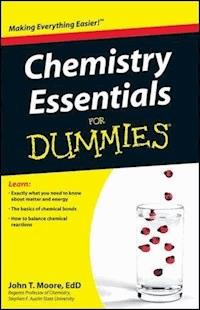
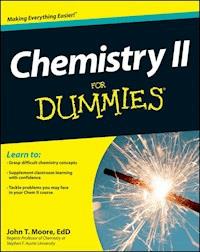
Whether studying chemistry as part of a degree requirement or aspart of a core curriculum, students will find ChemistryEssentials For Dummies to be an invaluable quick referenceguide to the fundamentals of this often challenging course.Chemistry Essentials For Dummies contains content focused onkey topics only, with discrete explanations of critical conceptstaught in a typical two-semester high school chemistry class or acollege level Chemistry I course, from bonds and reactions toacids, bases, and the mole. This guide is also a perfect referencefor parents who need to review critical chemistry concepts as theyhelp high school students with homework assignments, as well as foradult learners headed back into the classroom who just need to arefresher of the core concepts. The Essentials For Dummies Series Dummies is proud to present our new series, The Essentials ForDummies. Now students who are prepping for exams, preparing tostudy new material, or who just need a refresher can have aconcise, easy-to-understand review guide that covers an entirecourse by concentrating solely on the most important concepts. Fromalgebra and chemistry to grammar and Spanish, our expert authorsfocus on the skills students most need to succeed in a subject.
Sie lesen das E-Book in den Legimi-Apps auf:
Seitenzahl: 238
Veröffentlichungsjahr: 2010
Ähnliche










Chemistry Essentials For Dummies®
Chemistry Essentials For Dummies®
by John T. Moore, EdD
Chemistry Essentials For Dummies®
Published byWiley Publishing, Inc.111 River St.Hoboken, NJ 07030-5774www.wiley.com
Copyright © 2010 by Wiley Publishing, Inc., Indianapolis, Indiana
Published simultaneously in Canada
No part of this publication may be reproduced, stored in a retrieval system, or transmitted in any form or by any means, electronic, mechanical, photocopying, recording, scanning, or otherwise, except as permitted under Sections 107 or 108 of the 1976 United States Copyright Act, without either the prior written permission of the Publisher, or authorization through payment of the appropriate per-copy fee to the Copyright Clearance Center, 222 Rosewood Drive, Danvers, MA 01923, 978-750-8400, fax 978-646-8600. Requests to the Publisher for permission should be addressed to the Permissions Department, John Wiley & Sons, Inc., 111 River Street, Hoboken, NJ 07030, (201) 748-6011, fax (201) 748-6008, or online at http://www.wiley.com/go/permissions.
Trademarks: Wiley, the Wiley Publishing logo, For Dummies, the Dummies Man logo, A Reference for the Rest of Us!, The Dummies Way, Dummies Daily, The Fun and Easy Way, Dummies.com, Making Everything Easier, and related trade dress are trademarks or registered trademarks of John Wiley & Sons, Inc. and/or its affiliates in the United States and other countries, and may not be used without written permission. All other trademarks are the property of their respective owners. Wiley Publishing, Inc., is not associated with any product or vendor mentioned in this book.
Limit of Liability/Disclaimer of Warranty: The publisher and the author make no representations or warranties with respect to the accuracy or completeness of the contents of this work and specifically disclaim all warranties, including without limitation warranties of fitness for a particular purpose. No warranty may be created or extended by sales or promotional materials. The advice and strategies contained herein may not be suitable for every situation. This work is sold with the understanding that the publisher is not engaged in rendering legal, accounting, or other professional services. If professional assistance is required, the services of a competent professional person should be sought. Neither the publisher nor the author shall be liable for damages arising herefrom. The fact that an organization or Website is referred to in this work as a citation and/or a potential source of further information does not mean that the author or the publisher endorses the information the organization or Website may provide or recommendations it may make. Further, readers should be aware that Internet Websites listed in this work may have changed or disappeared between when this work was written and when it is read.
For general information on our other products and services, please contact our Customer Care Department within the U.S. at 877-762-2974, outside the U.S. at 317-572-3993, or fax 317-572-4002.
For technical support, please visit www.wiley.com/techsupport.
Wiley also publishes its books in a variety of electronic formats. Some content that appears in print may not be available in electronic books.
Library of Congress Control Number: 2010925163
ISBN: 978-0-470-61836-3
Manufactured in the United States of America
10 9 8 7 6 5 4 3 2 1
About the Author
John T. Moore grew up in the foothills of Western North Carolina. He attended the University of North Carolina-Asheville where he received his bachelor’s degree in chemistry. He earned his Master’s degree in chemistry from Furman University in Greenville, South Carolina. After a stint in the United States Army, he decided to try his hand at teaching. In 1971, he joined the chemistry faculty of Stephen F. Austin State University in Nacogdoches, Texas where he still teaches chemistry. In 1985, he started back to school part time and in 1991 received his Doctorate in Education from Texas A&M University.
John’s area of specialty is chemical education, especially at the pre-high school level. For the last several years, he has been the co-editor (along with one of his former students) of the Chemistry for Kids feature of The Journal of Chemical Education. He has authored Chemistry For Dummies and Chemistry Made Simple, and he’s co-authored 5 Steps To A Five: AP Chemistry, Chemistry for the Utterly Confused, and Biochemistry For Dummies.
John lives in Nacogdoches, Texas with his wife Robin and their two dogs. He enjoys brewing his own beer and mead and creating custom knife handles from exotic woods. And he loves to cook. His two boys, Jason and Matt, remain in the mountains of North Carolina along with his twin grandbabies, Sadie and Zane.
Publisher’s Acknowledgments
We’re proud of this book; please send us your comments through our online registration form located at http://dummies.custhelp.com. For other comments, please contact our Customer Care Department within the U.S. at 877-762-2974, outside the U.S. at 317-572-3993, or fax 317-572-4002.
Some of the people who helped bring this book to market include the following:
Acquisitions, Editorial, and Media Development
Senior Project Editor: Tim Gallan
Acquisitions Editor: Lindsay Lefevere
Senior Copy Editor: Danielle Voirol
Technical Reviewer: Medhane Cumbay, Patti Smykal
Editorial Program Coordinator: Joe Niesen
Editorial Manager: Michelle Hacker
Editorial Assistants: Jennette ElNaggar, David Lutton, Rachelle Amick
Cover Photo: © iStock/bratan007
Cartoons: Rich Tennant (www.the5thwave.com)
Composition Services
Project Coordinator: Patrick Redmond
Layout and Graphics: Carrie A. Cesavice, Joyce Haughey
Proofreaders: Rebecca Denoncour, Sossity R. Smith
Indexer: Potomac Indexing, LLC
Publishing and Editorial for Consumer Dummies
Diane Graves Steele, Vice President and Publisher, Consumer Dummies
Kristin Ferguson-Wagstaffe, Product Development Director, Consumer Dummies
Ensley Eikenburg, Associate Publisher, Travel
Kelly Regan, Editorial Director, Travel
Publishing for Technology Dummies
Andy Cummings, Vice President and Publisher, Dummies Technology/General User
Composition Services
Debbie Stailey, Director of Composition Services
Introduction
Congratulations on making a step toward discovering more about what I consider a fascinating subject: chemistry. For more than 40 years, I’ve been a student of chemistry. This includes the time I’ve been teaching chemistry, but I still consider myself a student because I’m constantly finding out new facts and concepts about this important and far-reaching subject.
Hardly any human endeavor doesn’t involve chemistry in some fashion. People use chemical products in their homes — cleaners, medicines, cosmetics, and so on. And they use chemistry in school, from the little girl mixing vinegar and baking soda in her volcano to the Ivy League grad student working on chemical research.
Chemistry has brought people new products and processes. Many times this has been for the good of humankind, but sometimes it’s been for the detriment. Even in those cases, people used chemistry to correct the situations. Chemistry is, as has been said many times, the central science.
About This Book
My goal with this book is to give you the really essential information and concepts that you would face in a first semester chemistry class in high school or college. I’ve omitted a lot of topics found in a typical chemistry textbook. This book is designed to give you the bare essentials.
Remember, this is a light treatment. If you want more, many other books are available. My favorite, naturally, is Chemistry For Dummies. I understand the author is really a great guy.
Conventions Used in This Book
Here are a couple of conventions you find in For Dummies books:
I use italics to emphasize new words and technical terms, which I follow with easy-to-understand definitions.
Bold text marks keywords in bulleted lists and highlights the general steps to follow in a numbered list.
In addition, I’ve tried to organize this book in approximately the same order of topics found in a one-semester general chemistry course. I’ve included some figures for you to look at; refer to them as you read along. Also, pay particular attention to the reactions that I use. I’ve attempted to use reactions that you may be familiar with or ones that are extremely important industrially.
Foolish Assumptions
I don’t know your exact reasons for picking up this guide, but I assume you want to know something about chemistry. Here are some reasons for reading:
You may be taking (or retaking) a chemistry class. This book offers a nice, quick review for your final exam. It can also give you a refresher before you plunge into a new course, such as biochemistry or organic chemistry.
You may be preparing for some type of professional exam in which a little chemistry appears. This book gives you the essentials, not the fluff.
You may be a parent trying to help a student with his or her homework or assignment. Pay attention to what your child is currently studying and try to stay a little ahead.
Finally, you may be what people call a “nontraditional student.” You knew most of this material once upon a time, but now you need a quick review.
Whatever the reason, I hope that I’m able to give you what you need in order to succeed. Good luck!
Icons Used in This Book
If you’ve read any other For Dummies books (such as the great Chemistry For Dummies), you’ll recognize the two icons used in this book. Here are their meanings:
This icon alerts you to those really important things you shouldn’t forget. These are ideas that you most probably need to memorize for an exam.
This icon points out the easiest or quickest way to understand a particular concept. These are the tricks of the trade that I’ve picked up in my 40+ years learning chemistry.
Where to Go from Here
Where you go next really depends on you and your reason for using this book. If you’re having difficulty with a particular topic, go right to that chapter and section. If you’re a real novice, start at Chapter 1 and go from there. If you’re using the book for review, skim quickly starting at the beginning and read in more depth those topics that seem a little fuzzy to you. You can even use this book as a fat bookmark in your regular chemistry textbook.
Whatever way you use this book, I hope that it helps and you grow to appreciate the wonderful world of chemistry.
Chapter 1
Matter and Energy: Exploring the Stuff of Chemistry
In This Chapter
Understanding the states of matter
Differentiating between pure substances and mixtures
Measuring matter with the metric system
Examining the properties of chemical substances
Discovering the different types of energy
Simply put, chemistry is a whole branch of science about matter, which is anything that has mass and occupies space. Chemistry is the study of the composition and properties of matter and the changes it undergoes.
Matter and energy are the two basic components of the universe. Scientists used to believe that these two things were separate and distinct, but now they realize that matter and energy are linked. In an atomic bomb or nuclear reactor, for instance, matter is converted into energy. (Perhaps someday science fiction will become a reality and converting the human body into energy and back in a transporter will be commonplace.)
Lesen Sie weiter in der vollständigen Ausgabe!
Lesen Sie weiter in der vollständigen Ausgabe!
Lesen Sie weiter in der vollständigen Ausgabe!
Lesen Sie weiter in der vollständigen Ausgabe!
Lesen Sie weiter in der vollständigen Ausgabe!
Lesen Sie weiter in der vollständigen Ausgabe!
Lesen Sie weiter in der vollständigen Ausgabe!
Lesen Sie weiter in der vollständigen Ausgabe!
Lesen Sie weiter in der vollständigen Ausgabe!
Lesen Sie weiter in der vollständigen Ausgabe!
Lesen Sie weiter in der vollständigen Ausgabe!
Lesen Sie weiter in der vollständigen Ausgabe!




