


12,99 €
Mehr erfahren.
- Herausgeber: Atlantic Books
- Kategorie: Geisteswissenschaft
- Sprache: Englisch
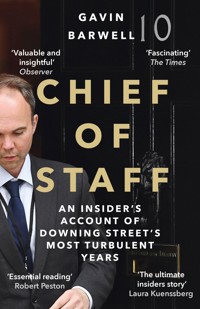
BOOK OF THE YEAR, The Times, Guardian and Prospect 'Fascinating and instructive... his decency and pragmatism shine through.' The Times 'Candid, valuable and insightful.' Observer Since the EU referendum of 2016, British politics has witnessed a barrage of crises, resignations and general elections. Theresa May's premiership was perhaps the most turbulent of all. In her darkest hour, following the disastrous 2017 election, she turned to Gavin Barwell to help restore her battered authority. He would become her chief of staff for the next two years - a period punctuated by Brexit negotiations, domestic tragedy, and intense political drama. In this gripping insider memoir, Barwell reveals what really went on in the corridors of power - and sheds a vital light on May, the most inscrutable of modern prime ministers. He was by her side when she met Donald Trump, heard about the poisoning of the Skripals in Salisbury, and responded to the Grenfell Tower fire. He was also at the centre of Brexit talks with foreign leaders and MPs from across the house, including Boris Johnson, Jeremy Corbyn and Keir Starmer. Revealing how government operates during times of crisis, this is the definitive record of a momentous episode in Britain's recent political history.
Das E-Book können Sie in Legimi-Apps oder einer beliebigen App lesen, die das folgende Format unterstützen:
Veröffentlichungsjahr: 2021
Ähnliche



















CHIEF OF STAFF
About the Author
Gavin Barwell was appointed Downing Street chief of staff to former prime minister Theresa May in the immediate aftermath of the general election in June 2017. He remained in post until she stood down as prime minister in July 2019. Now sitting in the House of Lords, he was the MP for Croydon Central from 2010 until 2017 and served as a government minister from 2013 to 2017.
GAVIN BARWELL
CHIEFOFSTAFF
AN INSIDER’S ACCOUNTOF DOWNING STREET’SMOST TURBULENT YEARS
First published in hardback in Great Britain in 2021 by
Atlantic Books, an imprint of Atlantic Books Ltd.
This paperback edition published in 2022.
Copyright © Gavin Barwell, 2021
The moral right of Gavin Barwell to be identified as the author of this work has been asserted by him in accordance with the Copyright, Designs and Patents Act of 1988.
All rights reserved. No part of this publication may be reproduced, stored in a retrieval system, or transmitted in any form or by any means, electronic, mechanical, photocopying, recording, or otherwise, without the prior permission of both the copyright owner and the above publisher of this book.
1 3 5 7 9 10 8 6 4 2
A CIP catalogue record for this book
is available from the British Library.
Paperback ISBN: 978 1 83895 414 7
E-book ISBN: 978 1 83895 413 0
Printed in Great Britain
Atlantic Books
An imprint of Atlantic Books Ltd
Ormond House
26–27 Boswell Street
London
WC1N 3JZ
www.atlantic-books.co.uk
To Mum and Dad, for giving me the best start in lifeany child could ask for. I miss you every day, Dad,and wish you could have seen where the journey ended.
And to Karen, for all the sacrifices and supportevery step of the way. You complete me.
CONTENTS
Preface to the Paperback Edition
Introduction
1 Appointment
2 Steadying the Ship
3 Building a Team
4 Working with Sir Humphrey
5 Crisis Management
6 Strategy
7 The Brexit Challenge
8 A Place with No Government
9 Dealing with the Cabinet
10 Shuffling the Pack
11 Media Relations
12 A Tale of Two Conference Speeches
13 Dealing with The Donald
14 National Security
15 Authorising the Use of Force
16 Negotiating with Brussels
17 Chequers and Doing the Deal
18 A Lucky Break
19 Parliamentary Shenanigans
20 Talking to the Opposition
21 Time’s Up
22 What Can You Achieve in Two Months?
23 Leaving Narnia
Epilogue
Acknowledgements
Index
‘The real proof of whether you understand something is whether you can explain it to someone else clearly and simply.’
BILL GATES
PREFACE TO THEPAPERBACK EDITION
If reliving difficult memories when writing this book was as painful as I feared, looking back a year later I am glad people persuaded me to do it.
Having put my heart and soul into it, I have been relieved by the reception. Critics have been almost universally kind. So too have members of the public who have messaged me on social media, spoken to me at various literary festivals and on a couple of occasions found themselves on a train sitting next to the author of the book they were reading. Most gratifying of all has been the reaction of some of the people who play a leading role in the story and with whom I didn’t always see eye to eye. One of my chief ambitions was to write something that people who didn’t agree with me would still be able to enjoy (not easy when it comes to Brexit!). Based on the feedback I have received, it feels like I succeeded in that aim. So with the exception of this preface and a small change to chapter 16 (where the original wording unfairly implied DExEU officials were somehow responsible for the duplication of effort in the run-up to Chequers), I haven’t changed a word.
There have been some criticisms, of course, and, at the risk of appearing thin skinned, this seems like an appropriate place to respond to them. Tim Shipman, doyen of the lobby (the journalists embedded in Westminster) was kind enough to say the book is ‘far better and more important’ than another memoir of the same period and that it ‘throws genuine light on how governments are run and might operate better’. He made two criticisms, however: first, that I am ‘too partisan’ in my defence of Theresa; and second, that I could have been more ruthless (‘the impression left is of a good man who, like his boss, lacked the killer instinct’). On the first charge, I am clearly guilty: I saw at first hand Theresa’s commitment to public service, her work ethic and her resilience under extraordinary pressure, and in addition to the respect I have for her, I owe her loyalty for the faith she put in me. So while you will find in these pages some reflection on things she could have done differently, I cannot pretend to be objective: I think the country and our politics would be in a far better place if Theresa’s Brexit deal had been approved and she, not Boris Johnson, had led us through the last couple of years.
Tim may have a point on the second charge too, although sometimes what he and others perceive as a reluctance to spill all the gory details because I am too nice is actually a reflection of gaps in the notes on which the book is based. Experience has taught me that memory is an unreliable friend, so I have only quoted people where I made a note of exactly what they said at the time. But fundamentally Tim is right – I wrote the book to provide a first-hand account of what happened in this crucial period, not to put the boot into those who brought Theresa down. I believe people can disagree about what is in the national interest without it having to become personal. If that makes me too nice for modern politics, so be it.
To my surprise, the most common criticism I have received from lay readers has been that the book is too short. They tell me they would have liked to hear more about domestic policy and Theresa’s interaction with other world leaders beyond Donald Trump and the Brexit negotiations. This is another valid critique. The explanation lies in the fact that I spent most of my time on Brexit and key domestic announcements (budgets, conference speeches and so on), so I didn’t accompany the prime minister to G7 or G20 summits or get involved in much of the day-to-day domestic policy work.
If gratification at the book’s reception is one reason for being glad I put pen to paper, subsequent events are another. When I started writing, Boris Johnson had just won his landslide election victory. There was every prospect that Brexit would soon be ‘done’ and he and his Downing Street operation would be in place for years. The book would be an insight into a fascinating period of history and the role of chief of staff, but not particularly relevant to the politics of the 2020s.
Even during the course of writing the first edition, however, it became clear that Boris’s Brexit deal was leading to all the problems that Theresa had predicted and that he wanted to renegotiate the Northern Ireland Protocol, a key element of it, despite heralding it as a great deal in the run-up to the 2019 election a few months earlier. Brexit was not yet ‘done’. As I write this preface to the second edition, the problems with his deal are even clearer and the negotiations on the Protocol drag on with no end in sight.
Economically the impact of his deal was initially obscured by the pandemic, but it is now clear that the introduction of customs and regulatory checks at the UK/EU border has had a significant impact on trade (trade with the rest of the world has recovered to pre-pandemic levels; trade with the EU has not). And that’s before the full impact has been seen – checks on the UK side were only introduced in January 2022 and the full set won’t be introduced until July 2022. The independent Office for Budget Responsibility estimates that in the long term UK productivity will be 4 per cent lower than it would have been without Brexit. To put that in context, that is twice as damaging as the COVID-19 pandemic (the latter obviously had a much bigger short-term impact, but the economy bounced back pretty quickly once restrictions were lifted). Theresa’s deal would not have avoided all of this damage, but by maintaining frictionless borders it would have significantly reduced it.
For many in the Conservative Party the economic harm that Boris’s deal has done is a truth that dare not speak its name. It is dismissed as more Project Fear from Remoaners – after all, they say, our economy was the fastest growing in the G7 in 2021. And so it was. But they neglect to say that it was also the fastest shrinking in 2020 – when you look at the pandemic as a whole, we sit somewhere in the middle of the pack. And more worryingly, if you look at the Bank of England’s medium-term forecasts, once the economy has rebounded from the pandemic we are forecast to grow at an anaemic 1 per cent a year.
My former colleagues may not want to acknowledge this, but it has consequences for something they certainly do want to acknowledge: the tax burden, which will be approaching a post-war high by the end of this parliament. Why is the tax burden so high? Partly because the pandemic did lasting damage to the economy, creating a structural deficit that had to be filled by tax rises in the March 2021 budget. Partly because this government believes in higher spending than previous Conservative governments. But partly because as a result of Boris’s deal the economy is smaller than it would have been, so to pay for a given standard of public services the state has to take a bigger slice of it.
There is a grave danger that this flawed deal will leave us with a low growth, high tax economy. I would like the government to improve the deal, but if it refuses to do that it must make use of the regulatory autonomy that it prioritised over all else in the negotiations. It is one of the few things that David Frost and I agree on: if we are going to stick with this deal, regulatory divergence is a national necessity. We have taken a significant economic hit by introducing trade barriers with the EU, and trade deals like the recent one with Australia are, even on the government’s own projections, not going to get anywhere near repairing the damage. The only real upside to Boris’s deal is the ability to gain economic advantage through a more competitive regulatory regime (particularly in services and emerging technologies – changing our regulations on food standards and industrial products is likely to be politically unpopular and make the Northern Ireland Protocol even more painful), but the government is barely using it. One of the most remarkable things about Brexit is that those who championed it had no plan whatsoever for what they were going to do with the regulatory freedom for which they were prepared to sacrifice so much.
If the economic harm is denied even though the impact on trade is clear, the political damage to the peace process in Northern Ireland is undeniable. At the time of writing, the DUP has withdrawn from North/South Ministerial Council meetings set up under Strand 2 of the Good Friday Agreement and partially collapsed the Northern Ireland Executive. I can understand why they are so upset about the customs and regulatory border between Great Britain and Northern Ireland that Boris Johnson signed up to and why they feel the need to shore up their vote before May’s election, but undermining devolved government is likely to do long-term harm to the wider unionist cause. As they have done time and time again, they are putting short term tactics before long term strategy.
They and the ERG need to come to terms with three painful truths: first, the EU is not going to give in on the need for some checks on goods moving from Great Britain to Northern Ireland; second, the more Great Britain diverges from EU rules, the more extensive the checks; and third (and most painful), even this government, led by conviction Brexiteers, is very unlikely to trigger Article 16 of the Northern Ireland Protocol because doing so would damage relations with the US and probably lead to the EU terminating our trade deal, which would do even further harm to our economy. At the end of 2021, David Frost became the latest in a growing list of Brexit negotiators who, when they realised they couldn’t get what they wanted, walked away rather than accept reality (Boris Johnson’s decision to replace him with Liz Truss was a good one – she has changed the tone of the negotiations overnight, even if the substance remains difficult).
But if the DUP and ERG need to come to terms with painful truth, so do others. I fear that any Brexit deal that tries to impose a border either between Northern Ireland and Ireland, or between Northern Ireland and Great Britain, is not going to work and for a similar reason – the former doesn’t respect Nationalist identity and the latter doesn’t respect Unionist identity. Both would breach the spirit of the Good Friday Agreement and therefore pose a risk to the peace process. If, as looks likely, Sinn Féin win this May’s elections, I fear the DUP will refuse to serve under a Sinn Féin first minister – even if the UK and EU reach a deal, there might be no devolved government to implement it. As Theresa argued, the best solution is one that avoids the need for any new border, but it is anathema to both the Johnson government and the EU. For the former, it would involve agreeing to stay aligned with EU rules in some areas and customs co-operation; and for the latter, it would involve conceding free movement of goods without the other three freedoms. A friend recently told me my continued adherence to this idea reminded him of a Japanese solider still holding out in the jungle in the 1950s not realising the war was lost. Maybe, but if both sides prioritise stability in Northern Ireland – as they should – it is the only solution I can see enduring.
It is not just in relation to Brexit that this book is very much relevant to what is happening now. It isn’t just an account of the last two years of the May government, it is also about the role of chief of staff and how this country is run behind that famous black door. When I was writing the first edition, Dan Rosenfield had just been appointed chief of staff following the implosion of Boris’s original Downing Street operation with the departure of Dominic Cummings. A year later, Rosenfield was gone too, as well as the three other most senior officials and advisers in Number 10. Dan’s replacement, Steve Barclay, is a good man – smart, always across the detail, insistent on high standards – but as a sitting MP and cabinet minister he won’t be able to do the job on the same basis as Nick Timothy and Fiona Hill, Ed Llewellyn, Jonathan Powell and I did it, and in any case it doesn’t matter how good the adviser is if the boss won’t listen.
What we witnessed over the winter of 2021–22 is unprecedented in my lifetime. Normally a prime minister gets into political trouble because they pursue a policy which the British people don’t support (think Thatcher and the poll tax, Blair and Iraq or Cameron and remaining in the EU), because they are the victim of events beyond their control (think Brown and the global financial crisis) or – as in Theresa’s case – because they fall out with a significant chunk of their own party about a key issue. But Boris’s problems are entirely the result of his personal behaviour. The character flaws that Number 10 has so cruelly magnified were all apparent during his time as foreign secretary and are detailed in this book: a lack of seriousness, a belief that the rules don’t apply to him, a lack of honesty when challenged about his behaviour and a preference for courtiers over people who would tell him what he needs to hear.
I am often asked whether partygate would have happened if I had been chief of staff. I like to think that on the day the prime minister announced the first lockdown I would have sent a memo to ministers and special advisers pointing out that he had just introduced unprecedented restrictions on the freedom of everyone in the country, that the media would be watching closely to see if we abided by those rules and that if anyone was in any doubt about whether something was allowed they should err on the side of caution because the prime minister would have to sack anyone caught breaching them. But ultimately the character of Number 10 comes from the top. If Dominic Cummings is to be believed, plenty of people warned Boris Johnson that the parties were against the rules and he ignored them. Advisers advise, ministers decide as the adage goes.
At the time of writing, it is not clear how long Boris has left in Number 10. It looks like Conservative MPs have decided to wait until the local elections and/or the police have concluded their investigation and Sue Gray’s full report is published before deciding whether to remove him, although further leaks may yet change that. But I think it highly unlikely that he will lead the Conservative Party into the next election for the simple reason that I don’t believe he can recover his standing with the electorate. We all remember what our lives were like in lockdown, so this story touches us all personally. People have made up their mind about him, and history tells us that once they do that about a politician it is very difficult to change them. His personal approval rating is currently about the same as Jeremy Corbyn’s before the last election, and if he can’t reverse that then sooner or later Conservative MPs will remove him.
If partygate does end up bringing him down, what will his political obituary be? The Conservative Party was in a terrible hole when he took over in the summer of 2019. Some would say he was partially responsible for that hole; others would blame Theresa and myself. Whoever was responsible, by sheer force of personality he managed to break the Brexit deadlock and defeat Jeremy Corbyn. Even if I don’t like his Brexit deal, these were impressive achievements. He has taken forward Theresa’s work on net zero and geographic inequality and he can be proud too of the vaccine rollout and the judgements he made to roll back restrictions in July 2021 and not to lock down again in December.
But set against that, he drove some of the Conservative Party’s most talented ministers out of Parliament (and in some cases out of the party) and left others languishing on the backbenches. Their experience was sadly missed during the pandemic. I have already covered the damage his Brexit deal has done, both to our economy and to the peace process in Northern Ireland. If he can be proud of his decisions towards the end of the pandemic, he was too slow to lockdown in both March and late 2020 (in the former case, the system as a whole was behind the curve, but in the latter case he ignored clear advice). But most of all he will be remembered for a decline in standards in public life — a failure to take action against ministers who broke the ministerial code, a disregard for the international agreements he signed, a refusal to correct the record when he got something wrong, an attempt to overturn the standards procedures of the House of Commons to get a friend off the hook, a disregard for the draconian rules he imposed on everyone else during the pandemic, lies when he was caught out and a disgraceful smear of the Leader of the Opposition to distract attention from his own problems. It is tragic that a man with such political gifts should have frittered away the opportunity to transform our country.
On social media, I am sometimes accused by Boris’s supporters of taking pleasure in his current problems. It always amuses me when people who have never met you claim to understand your motivation. Why should I feel happy? The reputations of Number 10 and the Conservative Party, two institutions I care deeply about, have been trashed. If Boris is forced out, it won’t bring Theresa back, nor will it lead to the more sensible relationship with the EU that I would like to see.
The best word to describe how I feel is homeless. Though I respect some of its ministers and agree with some of its policies, this is not a government I can be proud of. Having given my life to the Conservative Party, that is not a nice feeling. I am sometimes challenged by people on the other side of the political spectrum over why I haven’t resigned the whip or my party membership. The answer is complex. It is partly emotional attachment – I am bound by ties of friendship to many of the MPs, advisers and activists I have worked with over the years. I still think of myself as a Conservative – it is the party that has changed, not me. But there’s a rational element to it too: the country need a moderate, one nation centre-right party and if people like me give up, how is it to get one back?
However things turn out, there is an urgent need to restore the standing of Number 10 and to resolve our relationship with the EU. I hope this book will continue to offer lessons on both these crucial questions.
GAVIN BARWELL,February 2022
INTRODUCTION
I agonised over whether to write this book for over a year, because I knew that doing so would bring back painful memories. If it is, in part, the story of Theresa May’s inability to secure support for her Brexit deal, it is also the story of my failure, because – whatever other roles the chief of staff to the prime minister may have – their primary responsibility is to keep their boss in office. Whenever I’ve said this to friends and colleagues, they have sought to console me with some variant of ‘no one could have done more’. But kind words cannot disguise the truth: it was my job to keep Theresa May in Number 10 and help her ‘get Brexit done’, and I couldn’t find a way to do it. Revisiting that failure was not an inviting prospect. I also thought it would be unfair to Boris Johnson to publish anything until he had negotiated and ratified his Brexit deal. And finally, I was conscious that there was no point writing something unless I was prepared to be honest about what I think, even if that risks upsetting people who I admire and enjoyed working with.
I eventually concluded that the case for telling my story outweighs those considerations. The last two years of the May government were among the most turbulent and important in modern British political history. The existing accounts are second-hand, at best partial and at worst get important details wrong. As Theresa May’s chief of staff, I was with her when she negotiated her Brexit deal, met Donald Trump, learned about the poisoning of Sergei and Yulia Skripal in Salisbury, made the decision to authorise the use of military force in Syria, took the call from Boris Johnson in which he told her that he was resigning from her cabinet, met Jeremy Corbyn to try to break the Brexit logjam and made the decision to stand down as leader of the Conservative Party. Apart from Theresa herself – and, at the moment, at least, she has no plans to write her own memoirs – there is no one better qualified to describe what went on behind the scenes and to give an insight into what motivated this most private of prime ministers. Subsequent events – Boris Johnson’s decision to withdraw the whip from a number of his senior colleagues, his attempts to prorogue parliament, his willingness to break international law, the slow realisation of what his Brexit deal means for trade both with the EU and between Great Britain and Northern Ireland – and potentially for the future of the United Kingdom – have prompted a reassessment of Theresa and what she was trying to achieve, reinforcing the case for telling my story.
However, this book is not just an account of those two years. There has been huge interest in Dominic Cummings, the person who was effectively my successor, and the dysfunctionality of the Number 10 operation Boris Johnson has put in place. I am uniquely placed to give an insight into how the country is run from behind that famous black door.
I have only censored myself in four regards. First, there are things that it would be damaging to national security for me to reveal. Second, people sometimes told me things in confidence or agreed to meet me on the condition that I would keep the fact of our meeting confidential; I have respected those confidences. Third, I have not revealed what was agreed at meetings of the cabinet or its committees except where those decisions have subsequently been made public, nor have I quoted what ministers said at those meetings except in relation to discussions on Brexit, which were extensively leaked by many of the participants. I have drawn on such coverage, giving a particularly full account of two crucial meetings, the meeting in July 2018 that agreed the Chequers proposals and the meeting in November 2018 that agreed the deal. Details of both were leaked and dissected in the press. And fourth, when I’ve quoted other heads of government, I’ve been more relaxed about revealing what those who have since stood down from public office said than those who are except still in post.
* * *
Theresa’s key job as prime minister was to deliver Brexit, and she failed. However much time passes, that will always be the first line in any judgement on her premiership. But subsequent events have led to a reappraisal of what she was trying to achieve. The disagreement between her and Boris Johnson over Brexit boiled down to a philosophical difference and four arguments on which we can now reach a conclusion.
The philosophical difference concerned compromise. Theresa’s view was that the referendum result was clear but close and that two of the four nations of the UK had voted to remain, so while we should leave, we should have a close relationship with the EU after we had left. Boris rejected any idea of compromise – if you didn’t break completely free of the EU, he said, there was no point leaving.
The first argument was about whether leaving the European Union without a deal was a good outcome. Boris thought it was, or at least claimed to. Theresa’s position was that while you have to be prepared to walk away from any negotiation if the proposed deal isn’t good enough, leaving without a deal would not be a good outcome economically. But of greater concern to her was the risk that it could lead to the break-up of the UK, given the opposition to it in Scotland and Northern Ireland.
Second, setting aside the argument about whether no deal was a good policy, was it a viable one? If the government tried to leave without a deal, would parliament block it? Boris believed that if the party was led by someone who supported leaving without a deal, those in cabinet and on the backbenches who opposed it would fall into line. You could unite the parliamentary party and, with support from the DUP and a few ‘Labour Leavers’, win a vote. However, Theresa thought that those who opposed no deal felt just as strongly on one side of the argument as Boris did on the other.
Third, would the threat of leaving without a deal force the EU to shift its position? Boris believed that it would. Theresa was much more sceptical, in part because the EU had less to lose from no deal than the UK but mainly because they didn’t regard it as a credible threat, given the parliamentary arithmetic and the Speaker John Bercow’s willingness to bend parliamentary conventions.
Fourth, if parliament remained gridlocked, was going back to the country a credible strategy? Could the Conservative Party win a general election without having delivered Brexit? Boris was confident that he could. Theresa, coloured by her experience in 2017, was more sceptical.
We now know who was right on at least three of these questions. Boris Johnson was unable to force through no deal, thanks to the opposition of twenty-one Conservative MPs, including five members of Theresa’s cabinet (Philip Hammond, David Gauke, Greg Clark, Rory Stewart and Caroline Nokes). In retaliation, he withdrew the whip from them and prevented some of them from standing as Conservative candidates at the election he was forced to call, effectively ending their political careers. Their ministerial experience – and that of others such as Sajid Javid, Jeremy Hunt and Julian Smith, who he has exiled to the backbenches – was sadly missed as the government struggled to respond to the COVID-19 pandemic.
The threat of leaving without a deal when Boris became prime minister did not extract any meaningful concession from the EU. Despite all the talk from his chief negotiator David Frost about how the May government had blinked at key moments, the truth is that the deal Boris agreed was 95 per cent Theresa’s deal, with the 5 per cent that was new involving a concession by the UK. Boris went back to what the EU had wanted all along: special arrangements for Northern Ireland that created a partial border within our own country.
At the time, Boris hailed his deal as a triumph and denied that it meant a partial border down the Irish Sea, but the government was subsequently forced to admit that it would mean increased checks when goods move from Great Britain to Northern Ireland. Indeed, it turned out that what had been a great deal in the run-up to the December 2019 election was so problematic the following September that the government attempted to pass legislation to override parts of it in domestic law, doing grave damage to the UK’s international reputation in the process. And now that the protocol is in partial operation, the effect is clear, both in terms of the difficulties it is causing businesses and the political unrest it has provoked. Things will be even worse if it is ever fully applied.
But if Boris was proved wrong about his ability to force through no deal and whether the threat of it would extract concession from the EU, he was proved right about his ability to win an election. The coalition he built, holding on to Conservative seats in the South and gaining Leave-supporting Labour seats in the Midlands, the North and in Wales, was the coalition Theresa was trying to assemble in 2017, but he ran a better campaign and benefited from the fact that in the intervening two years, Leave-supporting voters had witnessed parliament doing everything it could to block Brexit. The need for a large Conservative majority to get Brexit done was self-evident.
On the fourth question, we will never know what a no-deal exit would have meant for the future of our United Kingdom, but over the next few years we will discover the consequences of Boris Johnson’s hard Brexit, and the omens are not good. Support for Scottish independence rose from the moment he became prime minister, driven by antipathy to him, opposition to his government’s Brexit policy and the perceived relative handling of the COVID-19 pandemic by the UK and Scottish governments. Seventy-two of the 129 members of the Scottish parliament elected in May 2021 stood on a manifesto promising a second independence referendum. If the Scottish parliament was elected using the Westminster system, the SNP would have won sixty-two of the seventy-three seats. The UK government is on strong ground arguing that it is not the right time for a second independence referendum – polls show Scottish voters want the immediate focus to be on recovery from the pandemic – but the democratic mandate for the question to be asked again at some point is clear.
A clear majority of MPs in the 2017–19 parliament would have preferred Theresa’s compromise to the deal Boris negotiated – indeed, some have publicly said they regret not voting for it (most notably former Labour MP Gloria De Piero, who tweeted, ‘I was an idiot for not voting for May’s deal’). I will try to explain why things turned out the way they did and consider whether there is anything we could have done differently (spoiler alert: it’s not all Gloria’s fault).
* * *
With the exception of my first few days and last few weeks as chief of staff, I’ve chosen to tell this story thematically rather than chronologically. Such an approach obscures the constant jumping between issues that is a fundamental of the job, but breaking the role down gives a clearer sense of what it involves. Furthermore, it is easier to understand why the government struggled to agree a Brexit policy, negotiate a deal and secure parliamentary approval for that deal if Brexit is told as a single narrative without budgets, party conferences and various crises intervening.
With the exception of the first few months, the book is based on my contemporaneous notes. I started taking these in November 2017 and they eventually amounted to nine bound volumes. The entries are of varying detail. For some key meetings, they are a near-verbatim account of who said what. At the other end of the spectrum, I sometimes wrote something like ‘Shit meeting on customs’ with no explanation. For my first few months as chief of staff, and in relation to any key meetings that I didn’t attend, I have spoken to former colleagues to ensure that my account is as accurate as possible. I am hugely grateful for their assistance, but will spare their blushes because some of them still work in government.
As any GCSE history student knows, it’s important to understand the provenance of a source in order to interpret their account. But before I tell you about myself, here’s an anecdote that should serve as a warning. When I was an MP, one of the things I most enjoyed was visiting schools to speak about being an MP. One of the questions I was frequently asked was a variant of ‘Are you like us?’ At first, I struggled to answer the question. I didn’t want to insult the students’ intelligence by pretending that I’d had as tough a childhood as some of them, but nor did I want them to think that I was so different from them that they couldn’t aspire to be an MP. In the end, I found a way of answering the question that grabbed their attention and made them think. I gave them two answers and said that at the end of the session they could vote on which one they thought was true. The first was that I had gone to a private school then Cambridge University and had worked in politics all my adult life. The second was that I’d lived in Croydon all my life, both my parents had left school at sixteen and I was the first person in my family to go to university. At the end I would reveal that both stories were true. I’d tell them that while very few politicians will tell outright lies, most will bend the truth to give their audience a favourable impression of them. I’d add that the question they should ask was not ‘Are you like us?’ but ‘Do you understand what it is like to be us?’ That is a much tougher thing to judge.
So with the warning that I’m trying to paint the best picture of myself out of the way, what should you know about me? When I was eleven, I did very well in an exam and it changed my life, allowing me to go to a private school in Croydon called Trinity on a full scholarship. It gave me an outstanding education, but just as importantly, I met seven boys who remain my best friends thirty-seven years later. That close friendship group was crucial in helping me cope with the pressure during my two years in Number 10.
It was at school that I developed a love of debating that fostered an interest in politics. Many people make the mistake of thinking that being good at debating is all about public speaking. That’s a part of it, of course, but it’s just as important to be good at listening. In order to rebut an opponent’s argument, you need to work out where the weaknesses are. I’d argue that an ability to listen is equally important in politics. Politicians need to understand the perspectives of those with different life experiences to them and to adjust their views accordingly. You might think there isn’t much racism in Britain today, but if you’re not from an ethnic minority background, are you able to judge? You might think people in London have life easy, but how do you know if you’ve never lived there? In this age of social media when too many people only hear from people like themselves, we’re losing the ability to listen.
From Trinity, I got into Cambridge, where I studied natural sciences, specialising in theoretical physics. That scientific background has shaped my approach to politics. I have a distaste for blind faith in ideology, preferring to base my views on evidence. Several people in Number 10 commented that you could tell I was a scientist by training because my interventions in meetings tended to be logically structured (‘I think we should go with option A for the following reasons . . .’).
After I’d graduated, I had no idea what to do next. My roommate, worried that I’d drift into unemployment without his intervention, came back from the careers library with a bundle of random job adverts. The only one I didn’t reject out of hand was a job in the Conservative Party’s research department. He dragged me down to the computer room to write a CV and covering letter, and a couple of months later I’d been offered a job.
So began a career in politics. I did two years in CRD (working alongside one George Osborne), followed by two years as a political adviser in what was then the Department of the Environment and another year back in CRD, before switching over to the campaigning department, whose job it was to help Conservative candidates get elected. I ended up as the Conservative Party’s chief operating officer, the most senior position at Conservative HQ. In 2010, I was elected as an MP and in 2013 I was appointed as a minister.
Finally, you need to understand my views on Brexit. I was never a rose-tinted supporter of the European project. In particular, I disliked the increasing extent to which power sat with unelected officials in the commission and with MEPs, who in the UK were largely anonymous in a way that MPs and councillors are not. But I always believed that whatever the EU’s flaws, we were better off being part of the club, so when the referendum was called, I campaigned for Remain. I was upset at the outcome, which led to an ill-judged tweet the next morning, when I said that I was proud that my hometown had rejected the politics of hate and division. The comment was aimed at some of the disgraceful things Nigel Farage had said during the campaign, but when I looked back at it a couple of years later, after people started raising it with me as evidence of my hostility to Brexit, it read like it was directed at everyone who voted Leave and I could understand why people had taken offence. I might have been upset, but the referendum result was clear-cut, so from that moment I’ve believed that we should leave. However, given it was close and that two of the four nations of our United Kingdom had voted Remain, I thought we should do so in a way that brought people back together, delivering the key things Leave supporters voted for but maintaining a close relationship with the EU.
I am conscious that lots of people will disagree with my views about the May government and why things turned out the way they did. I cannot claim to be neutral, particularly on the topic of Theresa May, whose sense of duty, work ethic and resilience under the most extraordinary pressure I witnessed at first hand. But I have tried to give every side of the story, explaining why those who disagreed with her thought as they did as well as describing what motivated her. I hope that even those who disagree with my views will find my account of this turbulent period interesting. Above all, my aim is to give a unique insight into what is involved in being chief of staff to the prime minister, which I hope will be illuminating to everyone who cares about how our country is governed.
* * *
The role of chief of staff is a relatively recent innovation in British politics, an import from the US. The first person to do the job in the UK was Jonathan Powell, who became Tony Blair’s chief of staff when Blair was leader of the opposition and held the role for the whole of his premiership. During his time in the job, Jonathan played a crucial role in the Northern Ireland peace talks that led to the Good Friday Agreement.
Gordon Brown, perhaps to differentiate himself from his predecessor, combined the role with that of principal private secretary (Bernard, for fans of Yes, Prime Minister). He appointed a civil servant, Tom Scholar, but that only lasted for six months, at which point a political adviser, Stephen Carter, took over the role. He lasted for less than a year, and no one held the title for the remainder of Brown’s premiership.
Ed Llewellyn had the job for the whole of the Cameron premiership, having taken it on when David Cameron was leader of the opposition. During his time as chief of staff, Ed played a crucial role in the renegotiation of the terms of our membership of the EU which preceded the referendum. He was our ambassador in Paris while I was chief of staff and so the one predecessor I could easily turn to for advice.
When Theresa May became prime minister, she appointed Fiona Hill and Nick Timothy as co-chiefs of staff. They had both worked for her in opposition and at the Home Office, and, thanks in part to their work, she was in a strong political position when she called the 2017 general election. However, Fi and Nick were widely blamed for the disastrous 2017 campaign and, as I was to discover, they had fallen out with a number of senior cabinet ministers. They resigned two days after polling day and I was appointed shortly afterwards.
No one had the title for the first period of Boris Johnson’s government, but Dominic Cummings was clearly carrying out many of the functions of the role. In the aftermath of his departure, Boris appointed Dan Rosenfield, a former civil servant who had had been principal private secretary to both Alistair Darling and George Osborne. After his appointment, there was a noticeable improvement in the effectiveness of the Number 10 operation.
As I discovered, there is no job description – what you do depends on what the prime minister wants, what the political situation demands and your skill set. A few weeks into the job, the prime minister asked me which of two outfits she should wear to a particular event. Like most husbands, I knew to say ‘Yes’ when asked ‘Does this look nice on me?’, but being asked to choose between two options was outside my comfort zone. In essence, a chief of staff is a human Swiss Army knife, but for those chiefs of staff who are political appointments rather than career civil servants, the core of the role is to be the prime minister’s most senior political adviser and to manage the rest of the political team in Number 10 and, to a degree, political advisers across the government. Another key role is to tell truth to power. Very few people are prepared to say no to the prime minister or tell them something they don’t want to hear. I can remember one occasion in Brussels where the European Council overran and a discussion on protecting the steel industry from dumping was postponed to the next morning. The prime minister had kept the morning free to spend some rare time with her husband Philip, so had arranged for one of the other heads of government to represent her views. As we prepared to leave, James Slack said to me that he thought it was a mistake for the prime minister to miss the discussion, and it turned out that everyone else agreed with him. ‘Right,’ I said, ‘someone needs to tell the prime minister.’ Everyone looked at me. It’s fair to say that she wasn’t best pleased, but once she’d calmed down, she thanked me for saying something.
I am, so far, the only chief of staff who had previously served as a minister. That prior experience was certainly useful, but there are two big differences between the two jobs. First, as chief of staff you have to be across everything the British state is doing, rather than one particular area of policy. You have to help the prime minister make decisions based on a précis of the issue and options available. There’s no time to dig into the detail on every decision, which I often found uncomfortable. Second, as chief of staff you’re not there to argue for your own views. You have no democratic mandate – your job is to advise the prime minister and then get the government machine to do whatever he or she decides. A few months into the job, I was given a wonderful history of the office of White House chief of staff called The Gatekeepers. It was full of great advice, but a particular quote from James Baker, who served as chief of staff to both Ronald Reagan and George H. W. Bush, has stuck with me:
You are extraordinarily powerful when you are White House chief of staff. You may be the second most powerful person in Washington. But the minute you forget that your power is all vicarious from the president then you’re in trouble.
The key word in the job title is ‘staff’, not ‘chief’. To reinforce that point in my own and others’ minds, I always addressed Theresa as ‘prime minister’ rather than by her first name during my time in Number 10, even when we were the only two people in the room. It was several months after she had stopped being prime minister before I finally got out of the habit, much to her amusement.
* * *
For two and a bit years, this incredible job took up virtually every waking hour of my life. I arrived at work before 6 a.m. and often stayed so late that it didn’t make sense to commute home to Croydon. Sometimes I would stay with George Hollingbery, then an MP and the prime minister’s parliamentary private secretary but now British ambassador to Cuba, who lived just off Parliament Square. Sometimes I would find somewhere else to crash for a few hours. Even when I wasn’t at work, I spent much of the time glued to my mobile phone. While ministers are reasonably respectful about not disturbing the prime minister late at night or over the weekend, they’re less bothered about disturbing the chief of staff.
During those two years, I saw pretty much every submission the prime minister saw. I could attend whichever of her meetings I wanted to, and I got to know the leaders of the opposition parties and a number of world leaders on a first-name basis (at least, they called me by my first name). It was exhausting and at times very stressful, but it was also the most amazing job I’ll ever have. I hope this account gives a feel of what it was like.
CHAPTER 1
APPOINTMENT
On the morning of 18 April 2017, Clare Brunton, the civil servant who ran my ministerial office, told me that the prime minister had just announced that she was calling an early general election.
I had served as the member of parliament for Croydon Central for seven years and had been a government minister for three and a half years, first in a succession of roles in the whips’ office and then as minister for housing and planning and minister for London at the Department for Communities and Local Government. I loved both being an MP and being minister for housing. Some people become MPs because they want to be ministers, but I would have been happy just representing the town where I’ve lived for almost all my life. And some ministers get appointed to a role for which they lack any relevant experience or passion – often, a prime minister will know who they want to promote and fit them in, rather than thinking about the gaps and identifying the best people to fill them. Perhaps Theresa May knew that I had worked in the old Department of the Environment on housing policy and that housing was a key issue in my constituency. Or perhaps I was just – not for the first or last time – incredibly lucky. Either way, there can’t have been many people in the country who loved their job more than me.
I had a great relationship with my boss, Sajid Javid, the secretary of state for communities and local government. I worked with a fantastic team of civil servants, who shared our passion for transforming housing policy. The prime minister and her two chiefs of staff were supportive. The department had recently published a seminal white paper, Fixing Our Broken Housing Market, which for the first time acknowledged that we have a housing crisis and made the case that we needed to build more homes to buy and more homes to rent and to reform the planning system and the housing market. If things had turned out differently and I had held my seat, I would have been very happy to be kept in that job, ending the merry-go-round of housing ministers that so frustrates the sector.
The news that the prime minister was calling an early election was a hammer blow. At the 2015 election, I had managed to cling on to my seat by a wafer-thin majority of 165 votes, while similar London seats like Brentford and Isleworth, Ealing Central and Acton, Enfield North and Ilford North were lost to Labour. It was a gruelling campaign that had taken its toll. I was privately resigned to the fact that I was highly likely to lose next time because, like much of outer London, Croydon was changing demographically in a way that favoured Labour. The government’s benefit cap was leading poorer families to move from inner to outer London, the area was becoming more ethnically diverse and home ownership was in decline. Nevertheless, I had hoped that having held on by my fingertips in 2015, I would have five more years as an MP and as a minister. The prime minister’s announcement shattered that illusion. I had supported Theresa May in the leadership election, in part because I thought she was the best candidate to bring the party back together after the bitter experience of the referendum, but also because she had given a clear assurance that she would not call an early election.
I thought briefly about whether I wanted to put myself through another campaign, but at least this would be a short one. In any case, it is not in my nature to quit. I had clung on in 2015 with the help of an incredible group of Conservative councillors and activists in Croydon, who gave up hundreds of hours of their time to help get me re-elected. It was time to ‘get the band back together’. I got on the phone and we assembled at my house that evening.
At first, things went well. We were miles ahead in the national polls. A small number of former Conservatives were staunch Remainers and unwilling to vote for us, but the majority of the Conservative vote was rock-solid and lots of lifelong Labour voters were also saying they intended to switch to us. Privately, senior Labour activists in Croydon told us they expected us to win by about 5,000 votes.
Normally, the national campaign in the weeks before polling day makes little difference – the polls when the election is called tend to be a pretty good predictor of the final result. But in 2017, the publication of the Conservative manifesto transformed the election. Among the proposals were plans to make people with assets of more than £100,000 pay for any care they required in old age, including that provided in their own home. It was quickly branded a ‘dementia tax’ by opponents. The manifesto also proposed scrapping the planned cap on care costs, abolishing the triple lock on the state pension, means-testing winter fuel payments and having a free vote on legalising fox hunting. These plans simultaneously unnerved our elderly supporters and put off many of those lifelong Labour supporters who had planned to vote for us. Theresa was right to want to address inter-generational unfairness. She was also right to think that people with significant assets should contribute more to the cost of their care. But whatever the merits of these policies, announcing detailed proposals in the middle of an election campaign, without any preparatory work to explain the problem she was trying to solve, was a terrible mistake.
It is also the starting point of this story, because Theresa’s struggles over the next two years can be traced back to this manifesto. If these unpopular policies hadn’t been included, she would have won a comfortable majority, leaving her in a stronger position within the Conservative Party and in the Brexit negotiations. Nick Timothy and Fiona Hill would have continued as her co-chiefs of staff, while I would probably have continued as the MP for Croydon Central and, I subsequently learned, would have been made a cabinet minister.
But from the moment the manifesto was published, I was in trouble. I knew I had lost when the exit poll was published at 10 p.m. on polling day. I was driving home after nearly twelve hours knocking on the doors of floating voters. The response had been as good as I could have hoped for – it felt like more people were voting for me than in 2015 – but everything rested on whether the Labour vote increased by even more. The exit poll was far better for Labour than anyone expected, predicting they would gain thirty-four seats and deprive the Conservatives of an overall majority.
When I got home, my wife and my mum tried to cheer me up, suggesting that the exit poll could be wrong or that Croydon Central could buck the national trend. But I knew they were clutching at straws – in recent elections, the exit polls had been very accurate. And if Labour were doing that well nationally, they had to be doing very well in London – no matter how good a local campaign we had run, Croydon Central would be a Labour gain. A little later, a call from my campaign manager and friend Jason Cummings, who was at the count, confirmed my fears. It was obvious as soon as the ballot boxes were opened that we were going to lose by a significant margin. In the end, we got 1,500 more votes than in 2015, but Labour increased their total by 7,000.
I went to the count shortly before the result was due to be declared and delivered a concession speech, congratulating the new MP Sarah Jones and thanking the people of Croydon for giving me the chance to serve them for seven years. I ended by saying that there was only one silver lining, which was that ‘my wife Karen and my three boys will get more of my time that they so richly deserve’. How wrong I was.
I got home at about 6.30 a.m., physically shattered and emotionally drained. I had lost the job I loved in the most public way possible, rejected by the people in my home town. As a result, I would also lose the other job I loved: my role as housing minister. I had no idea what I would do next. All I knew was I really needed some sleep.
I woke up on Friday afternoon to hundreds of messages, some from friends saying how sorry they were and others from journalists asking me to comment on the Conservative campaign. I agreed to do three interviews the next day – BBC Breakfast, Today and an interview with Nick Robinson for an edition of Panorama that would go out a couple of days later.
When I emerged from New Broadcasting House, it was a lovely sunny day and central London was looking its glorious best. I decided to walk back to Victoria and reflect on what to do next, but I’d only gone a short way when my mobile rang. It was Gavin Williamson, the chief whip. After offering his sympathies, he started talking nineteen to the dozen about what a mess the party was in. I wasn’t paying much attention – it didn’t feel like my problem anymore – but then I heard him say something about me becoming chief of staff to the prime minister.
‘What did you just say?’
‘I’ve told her she should make you her chief of staff, but don’t worry – it probably won’t happen.’
After he rang off, I got a call from Julian Smith, one of my best friends in parliament and one of Gavin’s key lieutenants in the whips’ office. When he found out I was in central London, he suggested I come over to his flat near the City. We sat on his terrace and it became clear that, far from being some madcap idea of Gavin’s, making me chief of staff was being actively considered. I then got a text message from the Number 10 switchboard saying that the prime minister wanted to speak to me.
I called my wife first. It was, after all, barely twenty-four hours since I’d stood on stage and promised Karen and the boys that they would see a lot more of me now that I was no longer an MP (when my appointment as chief of staff was announced, some wag tweeted the footage with the message ‘#politicians #promises’). I decided to introduce the idea gently:
‘I’ve got some good news and some bad news.’
‘What’s the good news?’
‘I think somebody is about to offer me a job.’
‘And the bad news?’




