


57,99 €
Mehr erfahren.
- Herausgeber: John Wiley & Sons
- Kategorie: Fachliteratur
- Sprache: Englisch
SECOND EDITION
Children's Speech Sound Disorders
Speaking directly to experienced and novice clinicians, educators and students in speech-language pathology/speech and language therapy via an informative essay-based approach, Children's Speech Sound Disorders provides concise, easy-to-understand explanations of key aspects of the classification, assessment, diagnosis and treatment of articulation disorders, phonological disorders and childhood apraxia of speech. It also includes a range of searching questions to international experts on their work in the child speech field.
This new edition of Children's Speech Sound Disorders is meticulously updated and expanded. It includes new material on Apps, assessing and treating two-year-olds, children acquiring languages other than English and working with multilingual children, communities of practice in communication sciences and disorders, distinguishing delay from disorder, linguistic sciences, counselling and managing difficult behaviour, and the neural underpinnings of and new approaches to treating CAS.
This bestselling guide includes:
- Case vignettes and real-world examples to place topics in context
- Expert essays by sixty distinguished contributors
- A companion website for instructors at www.wiley.com/go/bowen/ speechlanguagetherapy and a range of supporting materials on the author's own site at speech-language-therapy.com
Drawing on a range of theoretical, research and clinical perspectives and emphasising quality client care and evidence-based practice, Children's Speech Sound Disorders is a comprehensive collection of clinical nuggets, hands-on strategies, and inspiration.
Sie lesen das E-Book in den Legimi-Apps auf:
Seitenzahl: 1330
Veröffentlichungsjahr: 2014
Ähnliche



















Dedication
Children's Speech Sound Disorders
SECOND EDITION
Caroline Bowen, PhD CPSP
Speech-Language Pathologist Honorary Associate in Linguistics, Macquarie University, Sydney, Australia Honorary Research Fellow, School of Health Sciences, Speech-Language Pathology, University of KwaZulu-Natal, Durban, South Africa
This edition first published 2015 © 2015 by John Wiley & Sons, Ltd.
Registered office:John Wiley & Sons, Ltd, The Atrium, Southern Gate, Chichester, West Sussex, PO19 8SQ, UK
Editorial offices:9600 Garsington Road, Oxford, OX4 2DQ, UK The Atrium, Southern Gate, Chichester, West Sussex, PO19 8SQ, UK 111 River Street, Hoboken, NJ 07030-5774, USA
For details of our global editorial offices, for customer services and for information about how to apply for permission to reuse the copyright material in this book please see our website at www.wiley.com/wiley-blackwell
The right of the author to be identified as the author of this work has been asserted in accordance with the UK Copyright, Designs and Patents Act 1988.
All rights reserved. No part of this publication may be reproduced, stored in a retrieval system, or transmitted, in any form or by any means, electronic, mechanical, photocopying, recording or otherwise, except as permitted by the UK Copyright, Designs and Patents Act 1988, without the prior permission of the publisher.
Designations used by companies to distinguish their products are often claimed as trademarks. All brand names and product names used in this book are trade names, service marks, trademarks or registered trademarks of their respective owners. The publisher is not associated with any product or vendor mentioned in this book. It is sold on the understanding that the publisher is not engaged in rendering professional services. If professional advice or other expert assistance is required, the services of a competent professional should be sought.
The contents of this work are intended to further general scientific research, understanding, and discussion only and are not intended and should not be relied upon as recommending or promoting a specific method, diagnosis, or treatment by health science practitioners for any particular patient. The publisher and the author make no representations or warranties with respect to the accuracy or completeness of the contents of this work and specifically disclaim all warranties, including without limitation any implied warranties of fitness for a particular purpose. In view of ongoing research, equipment modifications, changes in governmental regulations, and the constant flow of information relating to the use of medicines, equipment, and devices, the reader is urged to review and evaluate the information provided in the package insert or instructions for each medicine, equipment, or device for, among other things, any changes in the instructions or indication of usage and for added warnings and precautions. Readers should consult with a specialist where appropriate. The fact that an organization or Website is referred to in this work as a citation and/or a potential source of further information does not mean that the author or the publisher endorses the information the organization or Website may provide or recommendations it may make. Further, readers should be aware that Internet Websites listed in this work may have changed or disappeared between when this work was written and when it is read. No warranty may be created or extended by any promotional statements for this work. Neither the publisher nor the author shall be liable for any damages arising herefrom.
Library of Congress Cataloging-in-Publication Data
Bowen, Caroline, author. Children's speech sound disorders / Caroline Bowen. – Second edition. p. ; cm. Includes bibliographical references and indexes. ISBN 978-1-118-63402-8 (pbk.) I. Title. [DNLM: 1. Speech Disorders–therapy. 2. Child. 3. Speech-Language Pathology–methods. WL 340.2] RJ496.S7 618.92′855–dc23
2014014238
A catalogue record for this book is available from the British Library.
Wiley also publishes its books in a variety of electronic formats. Some content that appears in print may not be available in electronic books.
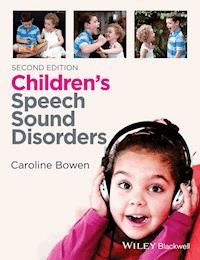
Cover image: Three panel photography by Rachael Moore. Girl with headphones © iStock.
Contents
Contributors
About the companion website
Part I: A practical update
Introduction to Part I
Children with SSD
World Health Organization
Evidence, belief and practice
A plethora of gaps and questions
References
Chapter 1: The evolution of current practices
Early understandings of ‘normal’ and ‘deviant’ speech
Disparities between theory, therapy and practice
Dyslalia and functional articulation disorder
Linguistic theory and sound patterns
Clinical phonology
Articulation development
Revolution?
Models of phonological acquisition
Theories of development, theories of disorder, and theories of intervention
References
Chapter 2: Terminology, classification, description, measurement, assessment and targets
Where does ‘functional’ fit?
Subtypes
Clinicians' use of classification terms
Terms related to intervention
Three phonological principles
Characteristics of phonological disorder
Misuse of terms
Four easily confused ‘phonological terms’
Web questions
Two major sub-groups
Speech assessment: Screening
Diagnostic evaluation
The case history interview and ‘red flags’
Video observations of early characteristics of CAS
Independent and relational analysis
Summarising these assessment data
Intervening early
Severity measures
Parents' concerns and questions
Questions parents ask
Questions families ask: Severity
Questions families ask: Prevalence
Questions families ask: Aetiology
Questions families ask: Delay or disorder
The questions families ask: Prognosis
The questions families ask: Which method do you use?
Question families seldom ask: Target selection, goal setting and generalisation
Communicating with clients
References
Chapter 3: Special populations of children
Parents' initial perceptions of their child's SSD
Three special populations
Children with co-occurring speech and language disorders
Children with difficult behaviour
An SLP/SLT view of counselling
Children with cleft palate, craniofacial anomalies and velopharyngeal dysfunction
Children who have been internationally adopted
Children learning more than one language
Non-English-speaking children
Children with speech impairments in culturally and linguistically diverse settings
Children with speech and literacy difficulties
Special issues and concerns
References
Chapter 4: Intervention approaches
Phonetic approaches
Children with limited stimulability
Auditory input
Auditory Input Therapy (AIT)
Perceptually based interventions
Phonemic intervention
References
Chapter 5: ‘Common’, ‘best’ and evidence-based practice
Speech acquisition and the family
A Canadian survey
SLT and education in New Zealand
Technology, tablet computers and Apps
Child speech assessment and intervention practices in UK
Non-speech oral motor exercises
The student experience
Clinical problem solving
Embracing change
A model for ethical practices
The last say
References
Part II: Speech intervention in everyday practice
Introduction
SLPs/SLTs as counsellors
New and potentially better ideas
References
Chapter 6: Phonological disorder and CAS: Characteristics, goals and treatment
Treat the symptoms, not the label
Six characteristics CAS and phonological disorder may have in common
Intervention goals that are common to phonological disorder and CAS
Motor speech examination worksheet
Reading and reviewing the literature
Neurophysiological investigations
Characteristics and general observations of CAS
Rating speech characteristics
Overlapping symptoms and treatments
Symptomatic treatment techniques
Additional techniques
References
Chapter 7: Childhood apraxia of speech
Principles of motor learning
Repetitive practice (motor drill)
A comparison of practice schedules
KP and KR feedback to the child
Rate of production trials
Finding the right level of intervention
Integral stimulation
Dynamic temporal and tactile cueing
NDP3
Early days
Taking responsibility
Homework and the homework habit
Brag book
Ten tips for intervention for young children with severe CAS
Controversial interventions for CAS
References
Chapter 8: Treatment targets and strategies for speech sound disorders
Phonological disorder signs
Individualised education programs: IEPs
Targeting speech perception
Targeting compensatory errors in the cleft palate population
Competence, focus and motivation
Intrinsic motivation
Words and pictures
Alliterative stories and activities
Inspiration online
References
Chapter 9: Parents and children together in phonological intervention
Assessment
Intervention
PACT components
Case study
Therapy planning for Josie
Josie's therapy
Acknowledgement
References
Chapter 10: Directions and reflections
Sociophonetics
A view from audiology
Choices
Survival and progress
Two conclusions
References
Contributor Index
Subject index
End User License Agreement
List of Tables
Chapter 1
Table 1.1
Table 1.2
Table A5.3
Table A5.2
Table 1.3
Chapter 2
Table 2.1
Table 2.2
Table 2.3
Table 2.4
Table 2.5
Chapter 3
Table A15.1
Chapter 4
Table A23.1
Table A26.1
Chapter 5
Table A37.1
Table A37.2
Chapter 6
Table 6.1
Table 6.2
Table 6.3
Table A43.1
Table A43.2
Table 6.4
Table 6.5
Table 6.6
Chapter 7
Table A44.1
Chapter 8
Table 8.1
Table 8.2
Table 8.3
Table 8.4
Table 8.5
Table 8.6a
Table 8.6b
Chapter 9
Table A50.1
Part I
Table i1.1
Guide
Cover
Table of Contents
Part
Pages
vi
vii
viii
ix
x
xi
xiii
1
2
3
4
5
6
7
8
9
10
11
12
13
14
15
16
17
18
19
20
21
22
23
24
25
26
27
28
29
30
31
32
33
34
35
36
37
38
39
40
41
42
43
44
45
46
47
48
49
50
51
52
53
54
55
56
57
58
59
60
61
62
63
64
65
66
67
68
69
70
71
72
73
74
75
76
77
78
79
80
81
82
83
84
85
86
87
88
89
90
91
92
93
94
95
96
97
98
99
100
101
102
103
104
105
106
107
108
109
110
111
112
113
114
115
116
117
118
119
120
121
122
123
124
125
126
127
128
129
130
131
132
133
134
135
136
137
138
139
140
141
142
143
144
145
146
147
148
149
150
151
152
153
154
155
156
157
158
159
160
161
162
163
164
165
166
167
168
169
170
171
172
173
174
175
176
177
178
179
180
181
182
183
184
185
186
187
188
189
190
191
192
193
194
195
196
197
198
199
200
201
202
203
204
205
206
207
208
209
210
211
212
213
214
215
216
217
218
219
220
221
222
223
224
225
226
227
228
229
230
231
232
233
234
235
236
237
238
239
240
241
242
243
244
245
246
247
248
249
250
251
252
253
254
255
256
257
258
259
260
261
262
263
264
265
266
267
268
269
270
271
272
273
274
275
276
277
278
279
280
281
282
283
284
285
286
287
288
289
290
291
292
293
294
295
296
297
298
299
300
301
302
303
304
305
306
307
308
309
310
311
312
313
314
315
316
317
318
319
320
321
322
323
324
325
326
327
328
329
330
329
330
331
332
333
334
335
336
337
338
339
340
341
342
343
344
345
346
347
348
349
350
351
352
353
354
355
356
357
358
359
360
361
362
363
364
365
366
367
368
372
373
374
375
376
377
378
379
380
381
382
383
384
385
386
387
388
389
390
391
392
393
394
395
396
397
398
399
400
401
402
403
404
405
406
407
408
409
410
411
412
413
414
415
416
417
418
419
420
421
422
423
424
425
426
427
428
429
430
431
432
433
434
435
436
437
438
439
440
441
442
443
444
445
446
447
448
449
450
451
452
453
454
455
456
457
458
459
462
463
464
465
466
467
468
469
470
471
472
473
474
475
476
477
478
479
480
481
Contributors
Areej Asad, MScSpeech Language Therapist Doctoral Candidate Discipline of Speech Science School of Psychology The University of Auckland Auckland New Zealand
Elise Baker, PhDLecturer Discipline of Speech Pathology Faculty of Health Sciences The University of Sydney Sydney, New South Wales Australia
Martin J. Ball, PhDProfessor of Speech and Language Pathology Linköpings Universitet Institutionen för Klinisk och Experimentell Medicin Logopedi Linköping Sweden
Kirrie Ballard, PhDAssociate Professor Discipline of Speech Pathology Faculty of Health Sciences The University of Sydney Sydney, New South Wales Australia
B. May Bernhardt, PhDProfessor School of Audiology and Speech Sciences University of British Columbia Vancouver, British Columbia Canada
John E. Bernthal, PhDProfessor Emeritus University of Nebraska-Lincoln Lincoln, Nebraska USA
James Robert Bitter, EdDProfessor Department of Counseling and Human Services East Tennessee State University Johnson City, Tennessee USA
Kenneth M. Bleile, PhDProfessor Department of Communication Sciences and Disorders University of Northern Iowa Cedar Falls, Iowa USA
Barbara Dodd, PhDHonorary Professorial Fellow Department Audiology and Speech Pathology The University of Melbourne Melbourne, Victoria Australia
Liz Fairgray, MScSpeech-Language Therapist Listening and Language Clinic Discipline of Speech Science School of Psychology The University of Auckland Auckland New Zealand
Peter Flipsen Jr., PhDProfessor of Speech Pathology School of Communication Sciences and Disorders Pacific University Forest Grove, Oregon USA
Karen Froud, PhDAssociate Professor of Speech-Language Pathology Director Neurocognition of Language Laboratory Department of Biobehavioral Sciences Teachers College Columbia University New York USA
Hilary Gardner, DPhilSpeech and Language Therapist Senior Lecturer Department of Human Communication Sciences The University of Sheffield Sheffield UK
Fiona Gibbon, PhDProfessor and Head of Speech and Hearing Sciences Department Speech and Hearing Sciences University College Cork Cork Ireland
Gail T. Gillon, PhDProfessor in Speech-Language Therapy Pro-Vice-Chancellor, College of Education University of Canterbury Christchurch New Zealand
Karen J. Golding-Kushner, PhDGolding-Kushner Speech Center, LLC East Brunswick, New Jersey and The Virtual Center for Velo-Cardio-Facial Syndrome New York USA
Brian A. Goldstein, PhDDean and Professor, School of Nursing and Health Sciences La Salle University Philadelphia, Pennsylvania USA
Sharon Gretz, MEdFounder and Executive Director Childhood Apraxia of Speech Association of North America Pittsburgh, Pennsylvania USA
Anne Hesketh, PhDClinical Senior Lecturer in Speech and Language Therapy School of Psychological Sciences The University of Manchester Manchester UK
Chantelle Highman, PhDSpeech Pathologist Bentley Child Development Service Department of Health Perth, Western Australia Australia
Megan M. Hodge, PhDProfessor Emerita Director, Children's Speech Intelligibility Research and Education Laboratory Department of Communication Sciences and Disorders University of Alberta Edmonton, Alberta Canada
Barbara W. Hodson, PhDProfessor Communication Sciences and Disorders Wichita State University Wichita, Kansas USA
David Ingram, PhDProfessor in Speech and Hearing Department of Speech and Hearing Science Arizona State University Tempe, Arizona USA
Deborah G. H. James, PhDLecturer, Speech Pathology School of Health and Human Sciences, Southern Cross University Gold Coast Campus, Bilinga, Queensland Australia
Victoria Joffe, DPhilProfessor in the Enhancement of Child and Adolescent Language and Learning Associate Dean for Taught Postgraduate Studies and Internationalisation Department of Language and Communication Science School of Health Sciences City University London London UK
Reem Khamis-Dakwar, PhDAssistant Professor Director Neurophysiology in Speech Language Pathology Lab Department of Communication Sciences and Disorders Adelphi University New York USA
Gwen Lancaster, MScSpeech and Language Therapist Language and Learning Team London Borough of Merton UK
Suze Leitão, PhDSenior Lecturer School of Psychology and Speech Pathology Curtin University Perth, Western Australia Australia
Gregory L. Lof, PhDProfessor and Chair Department of Communication Sciences and Disorders School of Health and Rehabilitation Sciences MGH Institute of Health Professions Boston, Massachusetts USA
Robert J. Lowe, PhDRetired Formerly Professor, Communication Disorders Bloomsburg University of Pennsylvania Bloomsburg, Pennsylvania USA
Patricia McCabe, PhDAssociate Professor Discipline of Speech Pathology Faculty of Health Sciences The University of Sydney Sydney, New South Wales Australia
Rebecca J. McCauley, PhDProfessor Department of Speech and Hearing Science The Ohio State University Columbus, Ohio USA
Karen Leigh McComas, EdDProfessor of Communication Disorders Assistant Director Center for Teaching and Learning Marshall University Huntington, West Virginia USA
Sharynne McLeod, PhDProfessor of Speech and Language Acquisition Charles Sturt University Bathurst, New South Wales Australia
Adele W. Miccio, PhD (1959–2009)Associate Professor of Communication Sciences and Disorders and Applied Linguistics Co-Director of the Center for Language Science Pennsylvania State University University Park, Pennsylvania USA
Nicole Müller, DPhilProfessor of Speech and Language Pathology Linköpings Universitet Institutionen för Klinisk och Experimentell Medicin Logopedi Linköping Sweden
Benjamin Munson, PhDProfessor in Speech Language Hearing Sciences University of Minnesota Minneapolis, Minnesota USA
Roslyn Neilson, PhDSpeech-Language Pathologist Language, Speech and Literacy Services Jamberoo, New South Wales Australia
Megan Overby, PhDAssociate Professor Department of Speech-Language Pathology Duquesne University Pittsburgh, Pennsylvania USA
Michelle Pascoe, PhDSenior Lecturer in Speech Pathology Division of Communication Sciences and Disorders University of Cape Town South Africa
Karen E. Pollock, PhDProfessor and Chair Department of Communication Sciences and Disorders University of Alberta Edmonton, Alberta Canada
Thomas W. Powell, PhDProfessor in Speech-Language Pathology Department of Rehabilitation Sciences Louisiana State University Health Sciences Center Shreveport, Louisiana USA
Suzanne C. Purdy, PhDProfessor and Head Discipline of Speech Science School of Psychology The University of Auckland, Auckland New Zealand
Mirla G. Raz, MEdSpeech-Language Pathologist Communication Skills Center GerstenWeitz Publishers Scottsdale, Arizona USA
Joan B. Rosenthal, MARetired University of Sydney Sydney, New South Wales Australia
Susan Roulstone, PhDEmeritus Professor of Speech and Language Therapy Co-Director Bristol Speech and Language Therapy Research Unit University of the West of England Bristol UK
Dennis M. Ruscello, PhDProfessor of Communication Sciences and Disorders Adjunct Professor of Otolaryngology West Virginia University Morgantown, West Virginia USA
Susan Rvachew, PhDProfessor School of Communication Sciences and Disorders McGill University Montréal, Québec Canada
Amy E. Skinder-Meredith, PhDClinical Associate Professor Department of Speech and Hearing Sciences Washington State University Spokane, Washington USA
Hilary Stephens, BScPrincipal Speech and Language Therapist Nuffield Hearing and Speech Centre Royal National Throat Nose and Ear Hospital University College London Hospitals NHS Foundation Trust London UK
Ruth Stoeckel, PhDClinical Speech-Language Pathologist Mayo Clinic Rochester, Minnesota USA
Carol Stoel-Gammon, PhDProfessor Emerita Department of Speech and Hearing Sciences University of Washington Seattle, Washington USA
Judith Stone-Goldman, PhDEmeritus Senior Lecturer Department of Speech and Hearing Sciences University of Washington Seattle, Washington USA
Edythe A. Strand, PhDProfessor of Speech Pathology Consultant, Department of Neurology Mayo Clinic Rochester, Minnesota USA
Kylie Toynton, BSpPath, MGerontologySpeech Pathologist Language for Life Rocky Glen, New South Wales Australia
Angela Ullrich, PhDSpeech-Language Pathologist Independent Scholar Siegen Germany
Nicole Watts Pappas, PhDQueensland Health Children's Developmental Service Mt Gravatt, Queensland Australia
A. Lynn Williams, PhDProfessor Department of Audiology and Speech-Language Pathology Associate Director Center of Excellence in Early Childhood Learning and Development East Tennessee State University Johnson City, Tennessee USA
Pamela Williams, MScConsultant Speech and Language Therapist/Team Manager (Developmental Disorders) Nuffield Hearing and Speech Centre Royal National Throat Nose and Ear Hospital
University College London Hospitals NHS Foundation Trust London UK
Krisztina Zajdó, PhDAssociate Professor Department of Special Education/Speech-Language Pathology University of West Hungary Győr Hungary
Note: See the Contributor Index for the list of questions answered by each contributor.
About the companion website
This book is accompanied by a companion website:
www.wiley.com/go/bowen/speechlanguagetherapy
The website includes:
For instructors: Powerpoint and PDF of author's notes for downloading
For students/readers: Links to the author's personal website (
http://www.speech-language-therapy.com/
) for web references and resources
Part IA practical update
Introduction to Part I
Followers of the literature on children's speech sound disorders (SSD) know that much has happened in the 6 years since the first edition of Children's Speech Sound Disorders appeared. As with its predecessor, the aim of this work is to provide an accessible, contemporary book on child speech for a readership of clinicians, clinical educators and students in speech–language pathology/speech and language therapy (SLP/SLT).
The uniqueness of this text lies in the inclusion of 54-bite-sized expert essays by 60 internationally respected academicians, clinicians and researchers, representing the fields of audiology, clinical phonology (Grunwell, 1987; Müller & Ball, 2013b), family therapy (Bitter, 2013) and SLP/SLT. The essays, A1–A54 are responses to my questions Q1–Q54, about primary areas in the contributors' own work and how they relate to evidence-based SLP/SLT practice. The questions are not necessarily my own. In fact, most are built on frequently asked questions put to me by colleagues in continuing professional development or ‘training’ events, private correspondence and postings to the children's SSD (‘phonologicaltherapy’) online discussion (Bowen, 2001, 2013). The first two essays are here in the introduction to Part 1. In A1, Sharynne McLeod writes about the international classification of functioning, disability and health – children and youth (ICF-CY) (WHO, 2007), and in A2, taking an international perspective, Michelle Pascoe shares her view of the differences and similarities in child speech practice in different parts of the world.
Lesen Sie weiter in der vollständigen Ausgabe!
Lesen Sie weiter in der vollständigen Ausgabe!
Lesen Sie weiter in der vollständigen Ausgabe!
Lesen Sie weiter in der vollständigen Ausgabe!
Lesen Sie weiter in der vollständigen Ausgabe!
Lesen Sie weiter in der vollständigen Ausgabe!
Lesen Sie weiter in der vollständigen Ausgabe!
Lesen Sie weiter in der vollständigen Ausgabe!
Lesen Sie weiter in der vollständigen Ausgabe!
Lesen Sie weiter in der vollständigen Ausgabe!
Lesen Sie weiter in der vollständigen Ausgabe!
Lesen Sie weiter in der vollständigen Ausgabe!
Lesen Sie weiter in der vollständigen Ausgabe!
Lesen Sie weiter in der vollständigen Ausgabe!




