


35,99 €
Mehr erfahren.
- Herausgeber: John Wiley & Sons
- Kategorie: Fachliteratur
- Sprache: Englisch
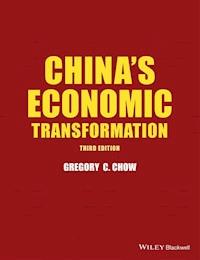
Now available in a fully-revised and updated third edition, this established textbook provides a penetrating and comprehensive analysis of the historical, institutional, and theoretical factors that have contributed to China’s economic success.
- Includes coverage of China’s foreign investments, trade with regional partners, Chinese human capital, and bureaucratic economic institutions
- Covers a diverse set of important issues, including environmental restraints, income distribution, rural poverty, the education system, healthcare, exchange rate policies, monetary policies, and financial regulation
- Accessibly written and intelligently organized to offer a straightforward guide to China’s economic evolution
- Written by a lauded economist, researcher, and advisor to government officials in mainland China and Taiwan
Sie lesen das E-Book in den Legimi-Apps auf:
Seitenzahl: 1085
Veröffentlichungsjahr: 2014
Ähnliche



















CONTENTS
Cover
Title page
Copyright page
Preface to the Third Edition
Part I: Historical Background and General Survey
1 Economic Lessons from History
1.1 Introduction
1.2 Significant Events in Major Historical Dynasties
1.3 The Republic of China, 1911–
1.4 Summary of Historical Lessons
1.5 What History Can Reveal about the Chinese Economy
References and Further Reading
Questions
2 Experiments with Planning and Economic Disruptions
2.1 The Communist Party Rises to Power
2.2 Historical Review: 1949–78
2.3 A Model of the Chinese Planned Economy
2.4 The Behavior of Economic Units in a Planned Economy
2.5 Output Planning in Theory and Practice
2.6 Organization and Administration of Economic Planning
References and Further Reading
Questions
3 Economic Reform up to the Mid-1990s
3.1 Why Economic Reform Started in 1978
3.2 Agriculture
3.3 Reform of State-Owned Enterprises
3.4 Price Reform
3.5 The Banking System
3.6 Foreign Trade and Investment
3.7 The Nonstate Sectors
3.8 Institutional Infrastructure
3.9 Reform Policies Similar to Those of Taiwan
3.10 Reasons for the Success of China’s Economic Reform
3.11 Summary
Appendix: China’s Geography
References and Further Reading
Questions
4 Further Reform up to the 2010s
4.1 Introduction
4.2 Enterprise Reform
4.3 Banking Reform
4.4 Foreign Trade and Investment during the Asian Financial Crisis
4.5 The Impact of WTO Membership
4.6 Reform in Agriculture
4.7 Rural Poverty
4.8 Prospects for Reform
References and Further Reading
Questions
Part II: Analysis of the Macroeconomy
5 Economic Growth
5.1 The Neoclassical Model of Economic Growth
5.2 Data on Output, Capital, and Labor
5.3 A Review of Regression Analysis
5.4 Estimating Production Functions for China
5.5 Use of the Neoclassical Growth Model to Forecast GDP
5.6 How Large Will the Chinese Economy Be in 2020?
5.7 Lessons from Forecasting
References and Further Reading
Questions
6 Economic Fluctuations
6.1 The Multiplier–Accelerator Model of Economic Fluctuations
6.2 Dynamic Properties of the Multiplier–Accelerator Model
6.3 An Econometric Method for Estimating Parameters of Linear Stochastic Equations
6.4 Estimating a Multiplier–Accelerator Model of the Chinese Economy
6.5 A Vector Autoregression (VAR) System
6.6 Econometric Models of the Chinese Economy
References and Further Reading
Questions
7 Macroeconomic Policies
7.1 Introduction
7.2 Monetary Policy
7.3 An Econometric Analysis of Inflation and of Monetary Policy in China
7.4 Basic Facts about Government Revenue and Expenditure
7.5 Fiscal Policy
References and Further Reading
Questions
8 The Effects of Political Movements on the Macroeconomy
8.1 Specification of a Dynamic Optimization Model of the Chinese Economy
8.2 The Solution of the Dynamic Optimization Problem
8.3 Statistical Estimation
8.4 Measuring the Effects of Two Political Events
8.5 Conclusions
References and Further Reading
Questions
Part III: Topics in Economic Development
9 Consumption
9.1 Trends in Per Capita Consumption
9.2 Household Expenditure Patterns
9.3 Rural Per Capita Consumption Expenditures in 1998 by Province
9.4 Consumption of Housing in Rural and Urban Areas
9.5 Demand and Supply of Urban Housing
References and Further Reading
Questions
10 Energy and Environmental Problems and Policies
Lesen Sie weiter in der vollständigen Ausgabe!
Lesen Sie weiter in der vollständigen Ausgabe!
Lesen Sie weiter in der vollständigen Ausgabe!
Lesen Sie weiter in der vollständigen Ausgabe!
Lesen Sie weiter in der vollständigen Ausgabe!
Lesen Sie weiter in der vollständigen Ausgabe!
Lesen Sie weiter in der vollständigen Ausgabe!
Lesen Sie weiter in der vollständigen Ausgabe!
Lesen Sie weiter in der vollständigen Ausgabe!
Lesen Sie weiter in der vollständigen Ausgabe!
Lesen Sie weiter in der vollständigen Ausgabe!
Lesen Sie weiter in der vollständigen Ausgabe!
Lesen Sie weiter in der vollständigen Ausgabe!
Lesen Sie weiter in der vollständigen Ausgabe!
Lesen Sie weiter in der vollständigen Ausgabe!
Lesen Sie weiter in der vollständigen Ausgabe!
Lesen Sie weiter in der vollständigen Ausgabe!
Lesen Sie weiter in der vollständigen Ausgabe!
Lesen Sie weiter in der vollständigen Ausgabe!
Lesen Sie weiter in der vollständigen Ausgabe!
Lesen Sie weiter in der vollständigen Ausgabe!
Lesen Sie weiter in der vollständigen Ausgabe!
Lesen Sie weiter in der vollständigen Ausgabe!
Lesen Sie weiter in der vollständigen Ausgabe!
Lesen Sie weiter in der vollständigen Ausgabe!
Lesen Sie weiter in der vollständigen Ausgabe!
Lesen Sie weiter in der vollständigen Ausgabe!
Lesen Sie weiter in der vollständigen Ausgabe!
Lesen Sie weiter in der vollständigen Ausgabe!
Lesen Sie weiter in der vollständigen Ausgabe!
Lesen Sie weiter in der vollständigen Ausgabe!
Lesen Sie weiter in der vollständigen Ausgabe!




