


16,99 €
Mehr erfahren.
- Herausgeber: John Wiley & Sons
- Kategorie: Geisteswissenschaft
- Serie: China Today
- Sprache: Englisch
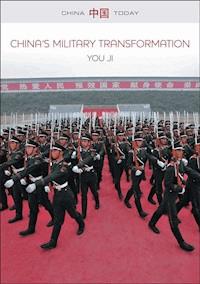
China s military transformation is one of the major geo-strategic developments of the 21st Century. Billions of dollars are being spent modernizing The People s Liberation Army (PLA) as China seeks to upgrade and expand its military capabilities to rival the US. In this cutting-edge analysis, You Ji, a leading expert on China s military affairs, explores the changes taking places within the PLA today, covering its ground, aerospace and maritime forces, its ability to meet asymmetric threats, and the growing role played by the People s Armed Police in quelling dissent in China. He shows how these transformations in personnel, technology and strategic goals are slowly driving a wedge between China s two most powerful institutions. Until recently, relations between the CCP and PLA were harmonious, but as the PLA becomes increasingly professionalized and autonomous so its unconditional loyalty to the ruling Party may weaken. The changing relationship between the CCP and PLA, he argues, is likely to have profound implications for China s own political development and the balance of power in the Asia-Pacific region. Comprehensive and incisive, this timely book is a valuable resource for anyone interested in the nature and consequences of China s military rise.
Sie lesen das E-Book in den Legimi-Apps auf:
Seitenzahl: 446
Veröffentlichungsjahr: 2016
Ähnliche




















China Today series
Greg Austin,
Cyber Policy in China
Steven M. Goldstein,
China and Taiwan
David S. G. Goodman,
Class in Contemporary China
Stuart Harris,
China's Foreign Policy
Elaine Jeffreys with Haiqing Yu,
Sex in China
Michael Keane,
Creative Industries in China
Joe C. B. Leung and Yuebin Xu,
China's Social Welfare
Pitman B. Potter,
China's Legal System
Xuefei Ren,
Urban China
Judith Shapiro,
China's Environmental Challenges
Alvin Y. So and Yin-wah Chu,
The Global Rise of China
Teresa Wright,
Party and State in Post-Mao China
LiAnne Yu,
Consumption in China
Xiaowei Zang,
Ethnicity in China
Copyright page
Copyright © You Ji 2016
The right of You Ji to be identified as Author of this Work has been asserted in accordance with the UK Copyright, Designs and Patents Act 1988.
First published in 2016 by Polity Press
Polity Press
65 Bridge Street
Cambridge CB2 1UR, UK
Polity Press
350 Main Street
Malden, MA 02148, USA
All rights reserved. Except for the quotation of short passages for the purpose of criticism and review, no part of this publication may be reproduced, stored in a retrieval system, or transmitted, in any form or by any means, electronic, mechanical, photocopying, recording or otherwise, without the prior permission of the publisher.
ISBN-13: 978-0-7456-7078-2
ISBN-13: 978-0-7456-7079-9(pb)
A catalogue record for this book is available from the British Library.
Typeset in 11.5 on 15 pt Adobe Jenson Pro
by Toppan Best-set Premedia Limited
Printed and bound in the United Kingdom by Clays Ltd, St Ives PLC
The publisher has used its best endeavours to ensure that the URLs for external websites referred to in this book are correct and active at the time of going to press. However, the publisher has no responsibility for the websites and can make no guarantee that a site will remain live or that the content is or will remain appropriate.
Every effort has been made to trace all copyright holders, but if any have been inadvertently overlooked the publisher will be pleased to include any necessary credits in any subsequent reprint or edition.
For further information on Polity, visit our website:
politybooks.com
Tables and Figures
Table 1 China's Five/Six National Defense Strategies
Table 2 Stages of the PLA's IT Transformation 2002–2050
Figures
Figure 1 Comparison of the PLA Operational Command Structures (Industrial Age vs IT Age)
Figure 2 The Transformed Navy Command Structure
Figure 3 Military NS/Foreign Policy Decision System
Figure 4 Military Intelligence System
Figure 5 The PAP Force Structure
Figure 6 The Civil-Military Command Chain over the PAP
Chronology
1911
Chinese Republican Revolution and Fall of the Qing dynasty
1921
Founding of the Chinese Communist Party
1927
Founding of the Chinese Worker-Peasant Red Army
1935
Completion of the Red Army's long march
1937
The Chinese Worker-Peasant Red Army renamed the 8th Route Army
1936–45
Anti-Japanese War
1945–49
Chinese Civil War between the Nationalists (KMT) and Communists (CCP)
1947
The 8th Route Army formally renamed the People's Liberation Army (PLA)
1949
Founding of the People's Republic of China (PRC)
1949
Founding of the PLA Air Force (PLAAF)
1949
Founding of the PLA Navy (PLAN)
1950–1953
Korean War
1953–1957
First Five-Year Plan: PRC adopts Soviet-style economic planning
1954
Constitution of the PRC implemented: First meeting of the National People's Congress
1955
The first PLA National Defense Strategy formulated (active defense)
1957
Hundred Flowers Movement: Brief period of political debate followed by repressive Anti-Rightist Movement
1958–1960
Great Leap Forward: Chinese Communist Party aims to transform agrarian economy through rapid industrialization and collectivization
1958
PLA bombardment of Kinmen Island (a major post-1949 Taiwan crisis and attributed to Sino–Soviet alliance breakdown)
1959
Tibetan Uprising and the departure of the Dalai Lama for India
1959–1961
Three Years of Natural Disasters, widespread famine with millions of deaths
1960
Sino–Soviet split
1962
Sino–Indian Border War
1964
First PRC atom bomb detonation
1966–1976
Great Proletarian Cultural Revolution: Ultra-Leftist upheaval
February 1972
“Shanghai Communiqué”, issued during Richard Nixon's visit to China, pledges that neither the US nor China will “seek hegemony in the Asia-Pacific region”; the PLA's take-over of administration at various levels of government and state institutions
1971
China's first satellite in orbit, the Lin Biao Incident, and the first satellite in space
July 1976
The Great Tangshan Earthquake: Largest earthquake of the twentieth century by death toll
September 1976
Death of Mao Zedong
October 1976
Ultra-Leftist Gang of Four removed from leadership
1978–1989
Democracy Wall Movement
1978
Beginning of Chinese economic reform and openness
1978
Introduction of one-child policy restricting married, urban couples to one child
1978
Full diplomatic relations established between the US and the PRC
1979
PRC invades Vietnam
1980
Deng Xiaoping assumes chair of the Central Military Commission
1982
The PLA's internal arm – the People's Armed Police – restored
December 1984
Margaret Thatcher co-signs Sino–British Joint Declaration agreeing to transfer sovereignty over Hong Kong to the PRC in 1997
1984
The PLA one-million men reduction, new military region arrangement (seven), and a major Army restructure (group armies)
1987
Liu Huaqing's offshore naval strategy approved by the CMC
1988
The successful launch of the first intercontinental ballistic missiles
1989
Tian'anmen Square Movement and Crackdown. Double-digital military budgetary growth begins
1989–2002
Jiang Zemin, General Secretary of the Chinese Communist Party, chair of the Central Military Commission and President PRC
1992
Deng Xiaoping's Southern Inspection Tour restarts process of economic reform and development
1993
First post-Deng National Defense Strategy adopted (the hi-tech strategy)
1996
PLA war drills and missile launches near the Taiwan Strait
1998
The PLA renounces its business empire
May 1999
US bombing of Chinese embassy in Belgrade, PLA post-Deng preparation for “military struggle” begins
1999
Falungong demonstrations in Beijing, China joins World Trade Organization
2002–2005
The current PLA Informatized Defense Strategy promulgated; a new army restructuring removed three GAs and downgraded 20 sum divisions to brigades
2002–12
Hu Jintao, General Secretary of the Chinese Communist Party and President PRC
2003
SARS outbreak
2004
Hu Jintao assumes chair of the Central Military Commission
2007
China overtakes the US as the world's biggest emitter of CO
2
2008
The PLAN's first combat expeditionary mission in the Aden Gulf
2008
Sichuan earthquake
2008
Summer Olympic Games held in Beijing
2010
Shanghai World Exposition
2012
Xi Jinping appointed General Secretary of the CCP and chair of the Central Military Commission (and President of PRC from 2013)
2013
The new round of PLA restructuring of its central and MR/service command chains
2013
PLA announcement of the East China Sea Air Identification Zone, a move capable of changing the regional security status quo
2013–
Comprehensive PLA training reform along the lines of integrated joint informatized war games. Following the decision on deepening military reform by the 3
rd
Plenum of the 18
th
CC in November 2013, the CMC established a leadership group to design and implement a thorough reform program in the years to come.
2014–
Anti-corruption deepened to implicate senior commanders, e.g., Xu Caihou
2015
PLA parade to mark the 70th anniversary of the end of World War II
Preface
Since my first single-authored book The Armed Forces of China was published 16 years ago, I have received many inquiries about when I was going to write my second comprehensive book on the People's Liberation Army. Well, here it is! What is new about this book compared with my previous book is that it is wider in coverage of PLA affairs, incorporating major areas of China's evolving civil-military relations, the PLA's internal and external roles and functions, as well as the transformation of the PLA analyzed from the military angle. As a political scientist rather than defense analyst, I have always been interested in the political aspects of the modernization of the PLA, as I consider that China's ultimate direction of development is heavily dependent on the PLA's social and political choices and responsibilities. A non-political, academic, and objective evaluation of its long-term change with respect to the ruling Party and the population is of crucial importance for our understanding of China's overall trend of transformation. There is no doubt that the PLA will continue to be a decisive professional force far beyond the current socio-political system. This is my primary interest in PLA studies. Born in a PLA family and growing up in a PLA barrack, I have great affection and respect for this great military and I always hope that it will continue to contribute to the well-being of the Chinese people. Due to space limitations, I was not able to cover this aspect of PLA research in my first book, so I am glad that I can do it with my second book on the PLA. I am most grateful for the opportunity to publish this book as part of Polity's China Today series.
This research project is the result of many years of study of the PLA for which I have collected an enormous amount of primary and secondary sources. It is my sincere hope to share them with anyone interested in PLA affairs, although due to the limited space in any book, only a tiny proportion of the collected data eventually appears in the manuscript. For instance, this book does not really cover the Xi Jinping era. It does not elaborate on the ongoing PLA reforms, such as the altered central and MR command and control structure. The PLA is my ongoing research interest and I have gathered substantial material for a thorough analysis. However, the fact that it is impossible to include all of this material in this book offers me a perfect reason to plan for my next book project.
As I am completing this book, I am more conscious of the external impact of the modernization of the PLA, which is transforming the global military balance and security environment. One of the objectives of this book is to enhance our awareness of this modernization. My generation of PLA specialists is still at the forefront of PLA studies, but I am happy to see that many more young scholars have joined us as international interest grows as the overseas reach of the PLA expands. This book is a humble contribution to the existing PLA research literature and I hope that my goal is fulfilled in this sense.
Acknowledgements
Any book, long or short, is a collective effort. Therefore the author inevitably has many people to thank. First, I'd like to express my gratitude to Louise Knight from Polity Press, who encouraged me to pick up my pen and write a book on the PLA for her series. In fact, I had decided long ago not to write any more books. I am glad that I took the initiative and wrote this book for a general readership. I am grateful to Pascal Porcheron, also from Polity Press, for his help in arranging specific editorial and revision matters. Both Louise and Pascal have given me valuable comments, which have been crucial in improving the quality of the manuscript. Secondly, I'd like to acknowledge a research grant from the University of Macau (SRG2015-00010-FSS) and a publication grant from the University of New South Wales.
During the process of completing this book I have received support from many family members, my mother and You Xu, colleagues, friends, and interviewees. I apologize that the list of people I should thank is long but my acknowledgement has to be relatively short. First, I would like to thank Jessica Loon Mann Ha for her editing work on the manuscript, which greatly improved the linguistic side of the writing. My colleagues in the East Asian Institute, where I spent the year 2014, gave me enormous professional advice and logistical help while I was writing the draft. I would like to mention the names of Professor Zheng Yongnian, Chen Gang, Guo Liangping, Lam Peng Er, Lian Wee Li, and James Tan. I also want to convey my thanks to Professors Jonathan Unger, Stuart Harris, and David Goodman for their moral and expert support. During the process of writing, my friend Dr Eiichi Katahara invited me to a number of NIDS conferences (the National Institute of Defense Studies, Japan Ministry of National Defense) and the views expressed by the participants sharpened my understanding of the regional perception of the transformation of the PLA. I am grateful. My colleagues at the University of Macau have also provided me with enormous help and encouragement in the process of writing this book, from Professor Hao Yufan, Dean of Faculty of Social Sciences, to all my co-workers in the Department of Government and Public Administration. Finally, I'd like to express my gratitude to the reviewers of the three rounds of proposals and drafts. I have benefited tremendously from their insightful comments and valuable suggestions.
Abbreviations
Introduction
China is undergoing a comprehensive transformation with change within the military as a key component engineered by post-Deng PLA reforms. Generally speaking the transformation of the People's Liberation Army (PLA) is taking place simultaneously in three major areas: changing civil-military relations between the Chinese Communist Party (CCP) and the PLA; organizational overhaul in terms of its personnel composition and structure; and force modernization driven by doctrinal innovation, capability enhancement, and war game plans. These changes have accelerated since Xi Jinping became the commander-in-chief in November 2012. One of his first public statements was to urge the PLA to sharpen its combat readiness to fight and win the next war.
Lesen Sie weiter in der vollständigen Ausgabe!
Lesen Sie weiter in der vollständigen Ausgabe!
Lesen Sie weiter in der vollständigen Ausgabe!
Lesen Sie weiter in der vollständigen Ausgabe!
Lesen Sie weiter in der vollständigen Ausgabe!
Lesen Sie weiter in der vollständigen Ausgabe!
Lesen Sie weiter in der vollständigen Ausgabe!
Lesen Sie weiter in der vollständigen Ausgabe!
Lesen Sie weiter in der vollständigen Ausgabe!
Lesen Sie weiter in der vollständigen Ausgabe!
Lesen Sie weiter in der vollständigen Ausgabe!




