


37,99 €
Mehr erfahren.
- Herausgeber: John Wiley & Sons
- Kategorie: Fachliteratur
- Serie: Bloomberg
- Sprache: Englisch
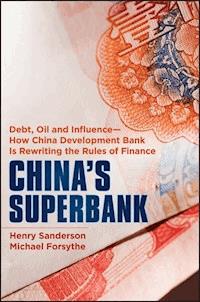
Inside the engine-room of China's economic growth--the China Development Bank Anyone wanting a primer on the secret of China's economic success need look no further than China Development Bank (CDB)--which has displaced the World Bank as the world's biggest development bank, lending billions to countries around the globe to further Chinese policy goals. In China's Superbank, Bloomberg authors Michael Forsythe and Henry Sanderson outline how the bank is at the center of China's domestic economic growth and how it is helping to expand China's influence in strategically important overseas markets. 100 percent owned by the Chinese government, the CDB holds the key to understanding the inner workings of China's state-led economic development model, and its most glaring flaws. The bank is at the center of the country's efforts to build a world-class network of highways, railroads, and power grids, pioneering a lending scheme to local governments that threatens to spawn trillions of yuan in bad loans. It is doling out credit lines by the billions to Chinese solar and wind power makers, threatening to bury global competitors with a flood of cheap products. Another $45 billion in credit has been given to the country's two biggest telecom equipment makers who are using the money to win contracts around the globe, helping fulfill the goal of China's leaders for its leading companies to "go global." Bringing the story of China Development Bank to life by crisscrossing China to investigate the quality of its loans, China's Superbank travels the globe, from Africa, where its China-Africa fund is displacing Western lenders in a battle for influence, to the oil fields of Venezuela. * Offers a fascinating insight into the China Development Bank (CDB), the driver of China's rapid economic development * Travels the globe to show how the CDB is helping Chinese businesses "go global" * Written by two respected reporters at Bloomberg News As China's influence continues to grow around the world, many people are asking how far it will extend. China's Superbank addresses these vital questions, looking at the institution at the heart of this growth.
Sie lesen das E-Book in den Legimi-Apps auf:
Seitenzahl: 394
Veröffentlichungsjahr: 2012
Ähnliche



















Contents
Preface
Acknowledgments
Chapter 1: Let 10,000 Projects Bloom
The Wuhu Model
The Chongqing Model
Global Financial Crisis
A Town Called Loudi
Li’s Story
“Manhattan” in China
Credit Risk in a One-Party State
Cracks in the System
Chapter 2: Turning a Zombie Bank into a Global Bank
A Life in the Party
The Princeling Party: The Beginning of State Capitalism
Taking Over a Basket Case
Transforming CDB from an ATM Machine
Developing a Slogan
Beating the Commercial Banks
Gao Jian: Creating a Market for “Risk-Free” Bonds
The West Self-Destructs: The Financial Crisis
Moving Beyond Wall Street
Chapter 3: Nothing to Lose but Our Chains
Made in Ethiopia
Ethiopia’s Zone: Exporting to the West
China–Africa Development Fund: The State’s Private Equity Arm
Rising Role of China in Africa
Fixed Capital: Western-Style Lending
African Tiger: Can Ghana Escape the Resource Curse?
Fresh Capital
Chapter 4: Risk versus Reward
Default in Bolívar’s Country
China’s Venezuelan Adventure
Loans for Oil
Cars, Housing, and Gold: Good Business for China
Ecuador
Russia
China in the Backyard of the United States
Chapter 5: Funding the New Economy
Obama’s Dream
Default-Free Bond Market
Financing China’s Global Company: Huawei
The Final Frontier: Private Equity
Acting as a Gatekeeper
Imprint of the State
Chapter 6: The Future
About the Authors
Index
Since 1996, Bloomberg Press has published books for financial professionals as well as books of general interest in investing, economics, current affairs, and policy affecting investors and business people. Titles are written by well-known practitioners, BLOOMBERG NEWS® reporters and columnists, and other leading authorities and journalists. Bloomberg Press books have been translated into more than 20 languages.
For a list of available titles, please visit our Web site at www.wiley.com/go/bloombergpress.
Copyright © 2013 by Henry Sanderson, Michael Forsythe.
Published by John Wiley & Sons Singapore Pte. Ltd.
1 Fusionopolis Walk, #07-01, Solaris South Tower, Singapore 138628
All rights reserved.
No part of this publication may be reproduced, stored in a retrieval system, or transmitted in any form or by any means, electronic, mechanical, photocopying, recording, scanning, or otherwise, except as expressly permitted by law, without either the prior written permission of the Publisher, or authorization through payment of the appropriate photocopy fee to the Copyright Clearance Center. Requests for permission should be addressed to the Publisher, John Wiley & Sons Singapore Pte. Ltd., 1 Fusionopolis Walk, #07-01, Solaris South Tower, Singapore 138628, tel: 65–6643–8000, fax: 65–6643–8008, e-mail: [email protected].
Limit of Liability/Disclaimer of Warranty: While the publisher and author have used their best efforts in preparing this book, they make no representations or warranties with respect to the accuracy or completeness of the contents of this book and specifically disclaim any implied warranties of merchantability or fitness for a particular purpose. No warranty may be created or extended by sales representatives or written sales materials. The advice and strategies contained herein may not be suitable for your situation. You should consult with a professional where appropriate. Neither the publisher nor the author shall be liable for any damages arising herefrom.
Other Wiley Editorial Offices
John Wiley & Sons, 111 River Street, Hoboken, NJ 07030, USA
John Wiley & Sons, The Atrium, Southern Gate, Chichester, West Sussex, P019 8SQ, United Kingdom
John Wiley & Sons (Canada) Ltd., 5353 Dundas Street West, Suite 400, Toronto, Ontario, M9B 6HB, Canada
John Wiley & Sons Australia Ltd., 42 McDougall Street, Milton, Queensland 4064, Australia
Wiley-VCH, Boschstrasse 12, D-69469 Weinheim, Germany
ISBN 978-1-118-17636-8 (Cloth)
ISBN 978-1-118-17639-9 (ePDF)
ISBN 978-1-118-17637-5 (Mobi)
ISBN 978-1-118-17638-2 (ePub)
Typeset in 11.5/14pt, Bembo by MPS Limited, Chennai, India
Preface
Hugo Chávez, resplendent in crisply pressed fatigues and paratrooper boots with red shoelaces, had a very special guest. Meeting him that mid-September day in Caracas was the world’s most powerful banker, who had lent Chávez’s government at least $40 billion over four years, or about $1,400 for every man, woman, and child in Venezuela.
The guest, stooped and looking older than his 66 years, drank chrysanthemum tea, staring across the table at Chávez, bald from his chemotherapy treatments. He handed the president of the Bolivarian Republic of Venezuela a 600-page book filled with recommendations on how Chávez should run, manage, and build ports, roads, and railroads.
What bank in this day and age can lend so much money to one of the world’s riskiest regimes, a nation with two centuries of credit defaults, and then tell its debtor how to spend the proceeds of the loan?
Not Goldman Sachs. Chávez’s banker had governmental ties that the legendary New York firm, incubator to US Treasury Secretaries Hank Paulson and Robert Rubin, could only dream of. The man sitting across from Chávez was the Chinese equivalent of royalty. His father was one of the founding fathers of the People’s Republic of China. His company was banker to China Inc.
Not the World Bank. That Washington-based product of Pax Americana had a loan book only a fraction of the size of this man’s company, the world’s biggest policy bank. Chávez’s Chinese bank had bragging rights over the World Bank as well, having been front and center in crafting the biggest and arguably most successful poverty-reduction program in history that saw hundreds of millions of Chinese peasants become city dwellers. In Africa, the bank has funneled billions of dollars into the continent, stoking Ethiopian exports and reviving Ghana’s railroad network after decades of neglect.
Not the Fed. The Federal Reserve Bank might have trillions of dollars at its disposal, and it might rightly be credited with staving off a depression in the wake of the 2008 financial meltdown. But when it comes to results, Chávez’s bank arguably has an even more impressive record. The bank devised a system to fund local infrastructure projects that is credited with helping China sail through the global financial crisis while the United States and Europe stumbled.
Chávez’s guest was Chen Yuan, chairman of China Development Bank (CDB), the world’s most powerful banker.
You can’t buy shares in CDB: It is wholly owned by the Chinese government. But it would be a mistake to call it a government bureaucracy that is at the state’s beck and call. It is a bank, claiming the lowest nonperforming loan rate of any major Chinese lender and a reputation for hardball negotiations with both domestic and foreign clients. While other countries have long formed development banks to help fund their national companies and bolster economic growth to catch up to more advanced powers, the scale of CDB and the amount it can lend makes it a different animal.
But the world’s most powerful bank? Yes. Let us count the ways.
Exhibit 1: China. The bank wrote the manual for the biggest economic and urbanization boom in history, pioneering a system of lending to local government-backed companies that funneled more than $2 trillion across China to build roads, bridges, subways, and stadiums and was later used to stimulate growth when the world economy was crippled by the global financial crisis. The turnkey system it set up, beginning in 1998 in Anhui Province, meant that Chinese growth barely registered a hiccup while the United States went into the deepest economic crisis since the Great Depression. CDB’s recently retired vice president, Gao Jian, is regarded as the father of China’s bond market. CDB in one year sold more bonds than China’s Ministry of Finance.
Exhibit 2: Africa. CDB lending is starting to move ahead of that of the World Bank and other international organizations, focused on building industry and infrastructure for the next stage of Africa’s growth and harnessing its biggest clients, China’s elite state-owned companies, to do much of the work. While much of Chinese lending in Africa is focused on the extraction of oil and metals to fuel China’s insatiable thirst for raw materials, in part driven by the bank’s funding of the nation’s urbanization, that is only part of the story. The bank’s private equity arm, the China-Africa Development Fund, is spurring the continent’s manufacturing as labor costs rise at home, helping transform Ethiopia into an exporter of leather and Chinese companies such as Chery Auto to open factories. In Ghana, CDB is financing roads, railroads, and an oil terminal and pipeline network with a $3 billion loan, the biggest in that country’s history, and guaranteeing Chinese companies will win most of the contracts.
Exhibit 3: Latin America. CDB’s massive and unprecedented lending to Chávez’s government has helped secure access for its state-owned oil companies to long-term supply in the competitive global oil market as China’s demand continues to rise. It has also been good business for a host of Chinese companies. Chen’s point man for Venezuela, a buzzcut and rail-thin man named Liu Kegu, with the booming voice of a Marine Corps gunnery sergeant, is affectionately called “brother” by Chávez. The opposition frets that Chinese influence is eroding the country’s sovereignty and drawing it into a risky alliance of dependence. The bogeymen of twentieth-century Yanqui imperialism often were US companies. Is CDB taking that role for China?
Exhibit 4: Clean Energy and Telecommunications. CDB has funneled more than $92.4 billion in lines of credit to China’s leading wind, solar, and telecommunications companies, which have used the cash to overwhelm global competitors, securing loans because lenders know the companies have the backing of the world’s most powerful bank. Huawei Technologies, the biggest single recipient of the credit lines, has transformed itself into the world’s second-largest telecommunications equipment maker over the past decade, using CDB credit to help its vendors in Latin America, Africa, Asia, and Europe buy its gear. Chinese solar companies continue to ramp up production even as losses mount, backed by CDB lines of credit that dwarf the US government loans to the bankrupt Solyndra LLC, which became a campaign issue in 2012. The CDB loans are helping cement Chinese domination in an industry of the future and helping to drive US and European companies to insolvency. Many Chinese companies have debt loads and quarterly losses that should have driven them to bankruptcy as well, but for the CDB loans and, in one case, a local government bailout. CDB financing has helped spark US and European Union trade action against China.
In one decade, CDB has become the financial enabler of both China’s global expansion and domestic boom. This book tries to explain that importance. It is a book about that bank.
But it is not a book about a bank.
It is a book about China. China’s rise as a global economic superpower and the success of its top companies is intricately tied to CDB, run since 1998 by Chen Yuan, the son of Chen Yun, one of the “eight immortals” of the Communist Party. Understand CDB and you understand the core of China’s state capitalism, a system of government-controlled banks and companies that many developing countries see as an alternative to a more free market–focused system.
A few fundamental themes shape this book and the bank. Like other development banks in history, CDB has helped create markets and offers financing where no other banks would be willing to lend, allowing China to catch up in its economic development despite a backward financial system. The bank believes in combining the functions of the market with government strategic priorities. This can be seen in its efforts to help local governments set up companies to raise funds and in the progress of the Three Gorges, the world’s largest hydroelectric dam, from a project that most Chinese and international banks refused to lend to, to a company that would in 2011 sell bonds and buy a stake in Portugal’s biggest utility, EDP (Energias de Portugal). Second is Chen Yuan’s belief in urbanization. Over the past decade, China has seen an expansion of infrastructure like never before, from expressways linking mountainous provinces, to hundreds of new airports, as well as mammoth engineering projects such as the east–west gas pipeline and the south–north water diversion that will bring water to the parched North. Infrastructure created the need for long-term funds that CDB in many cases learned to secure against proceeds from land sales, a model it would use with oil sales in Latin America and Africa. The bank prides itself on working closely with borrowers to improve their ability to pay back loans, enabling it to lend to countries the West considers extremely risky by selecting projects that will provide a return. In many cases, the money goes straight to Chinese contractors and does not enter the host government. Lastly, the vast sums that CDB can raise from China’s bond market, where interest rates are controlled, means it can offer attractive financing in the form of equity or loans that few banks can match.
This book charts CDB’s rise on the world stage. As European and American banks have faced government bailouts and downgrades to their debt ratings, the world’s locus of financial power has shifted. Now China, led by CDB, has the capital to spend in developing countries in Africa and Latin America, much like foreign banks in the 1980s, as well as in the developed markets of Europe and the United States. China’s outbound investment is expected to reach hundreds of billions of dollars this decade as its industries move up the value chain and consumer demand for raw materials continues to rise. While its international lending in most cases is at commercial interest rates and follows the oil-for-loans deals that Western banks like Standard Chartered have pioneered in the past, it is the ability of CDB to lend long term and the amount that makes it an important and different player rather than the common notion that it provides “cheap loans.” So is the way it can bring Chinese contractors and oil firms together into one deal. The same is true of sectors from telecommunications to renewable energy. Development banks in other countries just do not have the same scale of funds. CDB’s combination of government backing and commercial principles is a powerful one. It will have a lasting impact on China’s ability to source supply in the global commodity markets and help Chinese firms to grow by tying access to the money to contracts.
China’s financial landscape remains state dominated. While economists in the West before the financial crisis believed that the best way to prosperity is to reduce government involvement in the economy and let the private sector do the work, CDB and its chairman grew up in a different world, where there were no markets, no stocks or bonds, and an almost nonexistent private sector. There were shortages of goods and inadequate pricing mechanisms. CDB later went on to create markets and funds where there were none. At the same time as CDB has grown to be the world’s largest policy bank, the Chinese state has not only kept full ownership but also continues to set the lending rates banks have to base their loans on. It is no different in the oil, power, or commercial banking sector, where the state has kept a controlling share of China’s largest firms in an effort to build over 100 so-called national champions. Memory of the failure of free markets on such a massive and costly scale in 2008 offers little incentive for China to reduce state ownership in the banking system, at the same time as its banks have expanded onto the world stage. As CDB competes head-on with Western banks for global lending in overseas markets in Hong Kong and elsewhere, many will have to come to terms with a competitive bank that serves both sovereign wishes as well as those of the market.
But this is not a book only about China’s triumphs. The good-news story also comes with a dark side. What CDB has wrought also has potentially disastrous consequences. The system of local-government financing—triumphant as it was in boosting Chinese growth in recent years—has led China’s heretofore quickly commercializing financial system back into the twentieth century, saddling the banking system with potentially bad debt from trillions of yuan in projects with questionable economic value, such as an Olympic stadium complex in farmer Li Liguang’s hometown of Loudi, a place that will never play host to the quadrennial event, to bronze statues of winged-warrior princesses sitting atop faux Corinthian columns guarding a mountain forest on the Russian border.
CDB’s local-debt finance system is also, in the words of political scientist Victor Shih, an “engine of inequality,” depending on the exploitation of poor villagers and farmers to generate revenue from land sales. It has upended the lives of millions of people like farmer Li, who lost his land to a local government-funded stadium project and got inadequate compensation. The system has helped to send China’s income-inequality level so high that the government has stopped publishing the globally recognized income-inequality index. No less an authority than former premier Zhu Rongji, speaking at Beijing’s elite Tsinghua University in April 2011—the shared alma mater of Zhu, Chinese leaders Hu Jintao and Xi Jinping, and Chen Yuan—said: “The money is like plundering people and has lifted up land prices by so much.”
This book combines on-the-scene reporting and interviews from across the world with number-crunching from Chinese bond prospectuses to tell the story of the world’s most powerful bank. The bank is not an easy nut to crack, with lack of transparency one of the main concerns about its increasing dominance across the globe. CDB often works with international organizations, foreign governments, and foreign banks, yet it is not keen to answer questions: Despite annual performance and sustainability reports, it officially has no public relations department. So at times we adopted a Maoist method to get access: We used guerrilla tactics.
We are both Chinese-speaking accredited journalists working in Beijing. As such, we have access to conferences and political events. That includes the annual meeting every March of China’s legislature, the National People’s Congress, at the Great Hall of the People on Tiananmen Square. CDB officials who also took part in that meeting were prime targets. There we had impromptu interviews. Sometimes, as in the case of Liu Kegu, we secured long sit-downs to talk about everything from Venezuela to the origins of local government financing. Beijing must have more conferences than any city save Las Vegas, and when CDB officials showed up, we were there.
And Chen Yuan has scores of acquaintances the world over. Many of them, including J.P. Morgan’s Jacob Frenkel, were happy to talk to us, as were former CDB employees, who gave candid accounts of their time at the bank. Scholars, including Erica Downs at the Brookings Institution in Washington, are also starting to focus on CDB. We drew heavily on her research on CDB’s oil-for-loans program.
We did this without taking any time off from our daily routines, attempting to integrate our daily reporting with our book project. It was not easy, but it was worth it, because when we say CDB is the world’s most influential bank, we mean it. If you want to understand China both at home and how it is influencing the world, examining China Development Bank is a good place to start.
We organized the book into six chapters.
Chapter 1 explores CDB’s hallmark innovation, the system of local government finance that has transformed China’s landscape in just over a decade, pumping trillions of yuan into projects as varied as the world’s newest expressway system and China’s answer to Manhattan, a city complete with a Lincoln Center and Twin Towers rising on the shores of the Bohai Gulf. Starting in the Yangtze River city of Wuhu in 1998, CDB bankers devised a way to unlock China’s household savings to feed the model, and leverage the rising price of state-owned land. Money to cities fueled a surge in urbanization as millions moved from the countryside. China’s GDP shot up, fueled by investment and the resulting gains in productivity. The system was in place nationwide by 2008 and took in the lion’s share of more than 4 trillion yuan in stimulus money and new bank lending that allowed China to continue its growth spurt through the global financial crisis.
Chapter 2 profiles Chen Yuan, chairman of the bank since 1998. Chen has been instrumental at reasserting the party in China’s economy through its lending to state-owned companies and to the country’s most successful firms. Chen’s lineage as son of one of China’s founding revolutionaries makes him a princeling, prominent among a class of leaders, including incoming leader Xi Jinping and former Politburo member Bo Xilai, whose fathers helped unite China under the Communist banner in 1949. Studying economics in the 1980s as the country was caught up in heated debates on how best to reform its ailing Soviet-style system after decades of poverty, he began to develop his unique views that called for a strong role for the state at the same time as the market expanded. Taking the helm at CDB, he created a theory of development finance to guide the bank, determined to make it both profitable and serve the government’s goals. He managed to reduce its nonperforming loan ratio from over 40 percent to less than 1 percent in the space of a decade, and turn it into the largest overseas lender.
Chapter 3 looks at CDB’s China-Africa Development Fund, China’s largest private equity fund investing in Africa, and its attempts to stimulate manufacturing in Ethiopia as well as CDB’s lending to Ghana just after it had discovered oil for the first time. We travel to leather, shoe, and glass factories in Addis Ababa, learning the mixed success of China’s attempts to seed manufacturing projects on the continent. Africa’s poor transportation network has meant difficulties for a CDB-funded glass factory. Yet a Chinese state-owned company is helping to build a railway to the nearest port in Djibouti on the Red Sea that promises to turbocharge exports. China is reviving an infrastructure and manufacturing-focused approach to development finance that is creating jobs across the continent, helping stoke its economic upturn after decades of war, kleptocracy, and failed international development programs and philosophies.
Chapter 4 focuses on the company’s work to secure a steady flow of oil and gas to China through loans-for-energy deals around the world. It particularly focuses on Venezuela, destination of almost half of these loans. The goal: Support the state’s mission to ensure access to a steady supply of oil to feed a growing economy. In Venezuela, which passed Saudi Arabia at the end of 2011 as the country with the largest proven oil reserves, China wins twice: securing oil though its loans and then winning business for its state-owned companies from the Venezuelan government. Across the world, CDB drives a hard bargain, wrestling for years with Russian negotiators over a $25 billion oil-and-pipeline deal and hiring scores of international lawyers from such firms as New York’s White & Case and Washington’s Hogan Lovells. By all indications, it is a model that works, allowing China to expand its financial presence in countries where Westerners, from a young Benjamin Disraeli in the 1820s to Citigroup in the 1980s, have lost fortunes. After Ecuador defaulted on $3.2 billion of international debt in 2008 and 2009, CDB moved in, lending $1 billion backed by oil. The danger for China is that local resentment over Chinese loans, such as in a post–Chávez Venezuela, will lead to demands for renegotiation or even default. If that happens, it will be an expensive lesson for a rising financial power.
Chapter 5 looks at CDB’s lines of credit to Chinese new energy and telecom firms. CDB has provided China’s top telecom firms Huawei and ZTE with a combined $45 billion line of credit to help the companies’ customers finance purchases. The chief financial officers of telecom makers América Móvil in Mexico and Brazil’s Tele Norte Leste Participacoes say that international competitors just could not beat CDB’s terms to buy Huawei network equipment. The loans have helped propel Huawei, a Shenzhen-based company run by a former People’s Liberation Army officer, to second place in the world in the telecom gear market behind Sweden’s Ericsson AB.
CDB is also providing lines of credit to China’s biggest alternative energy companies, including solar panel makers Yingli, Trina Solar, and LDK. The Chinese companies ramped up capacity in 2010–2011 even as the global solar and wind industries experienced a slump, leading German and US companies to file for bankruptcy. Chinese companies, thanks to the overwhelming backing of CDB, may do what Nikita Khrushchev could only dream of and truly “bury” their Western competitors.
The chapter also looks at how China Development Bank, the handmaiden of state capitalism, is developing a new form of private-equity financing. Call it public equity. CDB Capital, funded by 35 billion yuan in seed money from the bank, is investing in an array of projects around the country. Armed with a monopoly among banks for direct investments, CDB is attracting an array of global partners, including TPG Capital, whose cofounder Jim Coulter passed by the bronze busts of Chen Yun, Mao Zedong, and the late paramount leader Deng Xiaoping at CDB Capital’s Beijing headquarters in May 2011 before inking a cooperative deal.
And that is China Development Bank in a nutshell. If the Communist Party is God, CDB is its prophet, extending the power of the Chinese state across the globe and cementing its power at home.
Acknowledgments
Henry Sanderson
Thanks to my parents, my sister Vanessa, and Gu Bo for their support and encouragement during this project as well as for reading drafts. To Jenny Xu for helping with translations throughout, pointing me in the right direction, and finding new source material on CDB. In Ethiopia, many thanks to Fannie Gong. I’ve learned a lot from discussions with Victor Shih, Carl Walter, Fraser Howie, and Deborah Brautigam, whose own books were an inspiration. The excellent work of Zhang Yuzhe at Caixin magazine was also helpful. At Bloomberg, thanks to Ken Kohn, Chris Collins, and Shelley Smith for allowing me to do this project, as well as to Neil Western for supporting the local government stories. The Beijing bureau colleagues and bureau chief John Liu have also provided many stimulating discussions on the world of Chinese finance. At Wiley, many thanks to Nick Wallwork for taking on this project. In Beijing, thanks too to Matt Weitz and Lauren Johnston.
Mike Forsythe
Thanks to my wife, Leta, for being the source of inspiration and encouragement. To my supervisors at Bloomberg, Peter Hirschberg, Chris Anstey, and Dan Moss, for being so understanding in giving me some time during busy workdays to focus on this project. A big hat-tip to Neil Western and John Liu as well. Thanks also to the many Bloomberg News reporters around the world who contributed to this story. Charlie Devereux in Caracas provided invaluable color to the story, including the opening anecdote. Edmond Lococo in Beijing and Crayton Harrison in Mexico City were invaluable in putting together the story of Huawei and ZTE. Thanks to scholars such as Erica Downs at Brookings and Douglas Paal at Carnegie for their research and insights. Fred Hu and Victor Shih also lent us their wise insight.
Chapter 1
Let 10,000 Projects Bloom
While our national government enjoys virtually unlimited credit, the initiators of urbanization projects, local governments, have little. Public faith in the economic success of governmental undertakings in the area of urban renewal and revitalization is not yet to the point that significant securities issues of pending or completed projects can be floated on capital markets.
—Chen Yuan, governor of China Development Bank, on CDB Web site, 2005
Loudi is one of countless cities with millions of inhabitants that few outside of China have ever heard of. Its economic mainstay is a state-owned steel mill that lost 2 billion yuan (about $300 million) in 2010. (One dollar is around 6.38 yuan.) Of course, it’s booming. A two-hour drive west of the Hunan capital, Changsha, via a new expressway, its streets are lined with karaoke parlors and new apartment complexes featuring palm trees and pastel tones. One complex, called “Wealthy City,” is surrounded by billboards showing pictures of Caucasian women strolling through shopping malls featuring brands like KFC and Microsoft. At the edge of the city on what used to be farmland is a brand-new, shiny 30,000-seat steel stadium and an aquatic center, where workers chisel out the Olympic rings by night years after the Beijing Olympics has ended more than 800 miles to the north. Loudi has had its own party: Land prices tripled in the city from 2007 to 2010, and a high-speed rail line will soon stop here. China Railway Construction Corp. mixes cement day and night to make that a reality. Sitting on top of it all and somehow mysteriously controlling the trigger, local government officials come and go in black Audis from an imposing compound that is complete with white-colonnaded façades and domed arches, nicknamed “the White House” by locals. The tinted windows don’t reveal whether they’re proud or worried: The whole country is on the move, and growth is the mantra.
Lesen Sie weiter in der vollständigen Ausgabe!
Lesen Sie weiter in der vollständigen Ausgabe!
Lesen Sie weiter in der vollständigen Ausgabe!
Lesen Sie weiter in der vollständigen Ausgabe!
Lesen Sie weiter in der vollständigen Ausgabe!
Lesen Sie weiter in der vollständigen Ausgabe!
Lesen Sie weiter in der vollständigen Ausgabe!




