


18,49 €
Mehr erfahren.
- Herausgeber: The History Press
- Kategorie: Geisteswissenschaft
- Sprache: Englisch
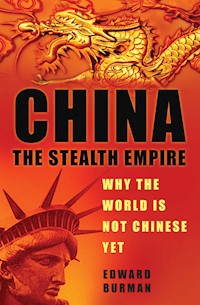
China: The Stealth Empire asks why it is that China despite its size and once advanced culture and technology did not become a world power centuries ago? Burman traces the answer through Chinese innate sense of superiority which made foreign conquest and trade an irrelevance. This is about to change with the evolution of what is termed the Stealth Empire characterised by world dominance in the production of consumer goods, a growing share of world manufacturing and a strong sense of nationalism. The Chinese believe that they need to do nothing as they evolve by the middle of the century into the dominant world power. Burman's book opens a window onto this history and growing sense of national destiny. It will be essential reading for anyone wanting to understand what is going on in the Stealth Empire.
Das E-Book können Sie in Legimi-Apps oder einer beliebigen App lesen, die das folgende Format unterstützen:
Veröffentlichungsjahr: 2008
Ähnliche



















CHINA
THE STEALTH EMPIRE
CHINA
THE STEALTH EMPIRE
EDWARD BURMAN
First published in 2008
The History Press The Mill, Brimscombe Port Stroud, Gloucestershire, GL5 2QGwww.thehistorypress.co.uk
This ebook edition first published in 2013
All rights reserved © Edward Burman, 2008, 2013
The right of Edward Burman to be identified as the Author of this work has been asserted in accordance with the Copyrights, Designs and Patents Act 1988.
This ebook is copyright material and must not be copied, reproduced, transferred, distributed, leased, licensed or publicly performed or used in any way except as specifically permitted in writing by the publishers, as allowed under the terms and conditions under which it was purchased or as strictly permitted by applicable copyright law. Any unauthorised distribution or use of this text may be a direct infringement of the author’s and publisher’s rights, and those responsible may be liable in law accordingly.
EPUB ISBN 978 0 7524 9619 1
Original typesetting by The History Press
Contents
A Brief Word of Explanation
Introduction: Meanings of Empire
Part I: Empires of Conquest and Empires of Mind
Chapter 1
Empire as Permanent Tribute
Chapter 2
Chinese Emperors and Western-Style Conquest
Chapter 3
The Persistence of Empire
Chapter 4
Apparent Closure: the Ming Paradox
Part II: The Invisible Chinese Empire
Chapter 5
The Invisible Chinese Empire
Chapter 6
The Overseas Chinese
Chapter 7
Why Chinese Culture Stops at the Border
Part III: The Stealth Empire: Positioning China for the Twenty-First Century
Chapter 8
Finance, Brand and Sport: Fundamentals and Image
Chapter 9
Nationalism, Militarism and Technology
Chapter 10
Stealth Foreign Policy
Chapter 11
The Stealth Business Empire
Chapter 12
The New Chinese Mindset and the Stealth Empire
Appendices
Appendix 1: Maps of China
Appendix 2: Figures
Acknowledgements
Notes
Bibliography
A Brief Word of Explanation
This book is based on the personal experience of living and working in China for five years, travelling extensively in the many large cities and also in remote areas, and reading about China in several languages. It seeks to avoid the common obsession amongst journalists and political commentators with Taiwan, Tibet and Xinjiang, simply because they do not loom large in the minds of ordinary Chinese people. For most of them live in the broad swathe of coastal plain that stretches from Beijing to Shenzhen, where, for better or for worse, other things matter (not to mention the millions of rural Chinese who live at one remove further, sometimes even unaware that Mao has died). It also seeks to avoid clichés about the numbers of cranes and building sites, forced eviction and demolition of old buildings, and of the exploitation of young women in textile factories, because that too is not how most Chinese see it. They need the new buildings, justly crave decent sanitary conditions after decades of deprivation, and are content, as is usually the case, that their extended family’s overall situation is improving. Above all, it seeks to avoid the fashions inherent in praise and criticism of China: before 2002, for example, the emphasis in Western reporting was on human rights and political dissidents; from 2003 to 2006 it was on stunning economic growth; since the beginning of 2007 it is all about the environment. Meanwhile, Chinese life goes on. The focus here is on China going out, as the country seeks to assume the economic and political global roles and responsibilties that its newly recovered status entails.
It has always been dangerous to write about China. A few years ago, Philip Stephens noted in the Financial Times that all a writer needs is a ‘rush of statistics, an occasional nod to history, a Confucian aphorism or two’ to write about the country’s re-emergence as a global power.1 Indeed, there are dozens of books about China that adopt this formula and, as Robert Skidelsky noticed, many of them have ‘the same touristic flavor: a trip down the Huangpu River in Shanghai reveals the garish skyscrapers and low nightlife of the new moneyed metropolis.’2 A century ago, Jay Denby was far harsher in his admonitions: ‘I find that it is only after years of patient study of the native character that the student fully realizes that he knows nothing whatever about his subject, and never will. It is only the more intelligent who are able to reach this advanced stage; the remainder write books …’3 A counter-example to such pessimism is provided by Paul Claudel, who as a diplomat spent fifteen years in China at the turn of the twentieth century. His book of prose poems Connaissance de L’Est (1900) begins with evocative poems about Chinese scenes and legends, for example ‘Rêves’, and ends in poems that have little connection with China, such as ‘Dissolution’, when the China experience has simply become an integral and nearly invisible part of his life – which indeed ‘dissolves’ into the sea. This seems to me a better model.
There’s a fair bit of history in the first half of the book. For I firmly believe that it is necessary to go deeper than most business and travel books, and broader than works by sinologists with whom the general reader and general author can never compete on their chosen terrain. History permeates the Chinese mind in a curious way, since it is led by the language into thinking of the past as something in front of it, while in European languages the past is thought of as being behind us. Moreover, in its tenseless verbs, their language itself renders past and present as indivisible. Thus, even when an individual has little historical knowledge, the past, and especially past ‘injustices’, inform his or her being. If nothing else, going a little deeper might protect a neophyte from the attractions of what one author calls the ‘manipulative political pageantry’4 which comes from China’s propagandistic use of its past, a subject we will deal with later. The best defence is to acquire a better knowledge of the historical processes behind this change from their point of view.5
Thus Part I of this book seeks to explain what China is, and how it came to be the way it is, both in its strengths and in its rejection of imperial expansion in the past. Part II analyses the way in which China has come to possess a global empire of sorts almost in spite of itself. Finally, Part III looks at the ways in which these pasts will inform the future as China reclaims her ancient role on the world stage after a century of false starts.
Names are given in the standard contemporary form of romanisation known as Pinyin, but older names are given in their earlier Wade-Giles version in brackets at the first occurrence to avoid ambiguity.
Introduction: Meanings of Empire
Most Western definitions of empire run something like this, from the Concise Oxford Dictionary: ‘an extensive group of states ruled over by a single monarch or ruling authority’. The monarch might be Queen Victoria or King Charles V of Spain, and the ruling authority might be Augustus or Suleiman the Magnificent, but the meaning is clear to us. As is the nature of the associated empires. For those we are familiar with have usually taken one of two main forms: land-based empires, which extend across a contiguous territory, such as the Russian Empire; and seaborne empires, where naval strength is of paramount strategic importance, such as the British Empire. The problem is that we are so conditioned by this approach, and have recognised and used this sense of the word ‘empire’ since schooldays, that this is what most of us have in mind when we read the phrase ‘Chinese Empire’. But the Chinese themselves understand the concept of empire – if indeed they have one at all – in a very different way, usually in the negative sense of a Western imperial power that encroached upon their country’s sovereignty in the nineteenth century. So before going on to examine the ‘Chinese Empire’, whether past, present or future, it will be useful to clarify our starting point by asking the apparently innocuous question, what is China? For interpretations of the past and predictions about the future will be different if we consider it to be a Western-style empire, a nation-state, a party-state, a civilisation, a cultural construct, a self-perpetuating bureaucratic organisation, a ‘civilization pretending to be a state’,6 or what has been described more elaborately as a ‘state defined by a culture claiming to exemplify the correct universal ethical system’7 and a ‘civilization-state with a variety of autonomous regions or even a loosely structured Chinese federation of different political entities.’8 Given their historical and contemporary importance, the absence of agreement about the exact nature of China and the Chinese Empire is on the face of things very odd. Certainly the latter doesn’t sound much like the empires we are used to; moreover, to the best of my knowledge, the ‘Chinese Empire’ is rarely defined or described as a ‘group of states’.
Imperial expansionism in the nineteenth century – the pressures of Russia in the north and west,9 Japan in the northeast, Britain, France and Germany in the east and southeast – showed up the weaknesses of the last Chinese dynasty’s particular form of imperialism. It has been argued that China’s recent past can be read as a ‘palimpsest of imperialisms’,10 but it might also be said that China itself was never an empire in the European sense, certainly before the eighteenth-century conquests of the Qing, which we shall examine later. But that depends on how we define empire.
Since the English word ‘empire’ itself derives from the Latin imperium, perhaps the best example of the Western concept is that of the Roman Empire, although there were of course earlier empires based on Mesopotamia, Persia and Greece. Most of them came into being as the result of a militarily strong state conquering other states with force, and then incorporating them into a larger political union with varying degrees of control. The Roman Empire is the exemplar of people moving out from a limited territorial base to occupy new land, and then recreating their own world in a foreign setting as the British were later to do in India, with forum, basilicas, temples, baths and the other physical accoutrements of citizenship. The mind-set was outgoing from the beginning. The Roman orator Cicero, quoting a king who had been banished from Troy by his father, asserted that ‘wherever I am happy is my country’ (patria est ubicumque est bene);11 Seneca the Younger, born in Cordoba and thus a scion of empire, echoed these sentiments in a moving letter to his mother about adapting to exile in Corsica: ‘wherever the Roman conquers, he inhabits’ (ubicumque vicit Romanus, habitat).12
Of course things were not quite that simple. In a paper on the economics of empire building, two researchers found three distinctive types of imperial strategy, which I believe will be useful here.13 Using their terminology, in the early stage of Roman history, from the fifth to the beginning of the third century BC, the strategy employed was one of attempted conquest, which entailed attacking neighbouring ‘barbarian’ countries (in this case, Etruria and the Latin League). This was always a risky strategy, since conquest can fail for many reasons, but it was also relatively cheap since it required a small number of legions devoted to a specific task over a short period of time. Then, in the third and second centuries BC, the Romans employed a strategy of coerced annexation (for example, that of the Greek states) or intimidation by a display of superior military force. This required them to deploy legions of such overwhelming strength that the target would decide to capitulate rather than seek to defend themselves in a series of extenuating battles (whose effects the Greeks knew from memories of the Peloponnesian Wars). It was a long-term and expensive strategy. Finally, as the Empire expanded far from its origins into Germany, Britain, Asia Minor and Judaea, the Romans adopted a more sophisticated strategy, which can be described as uncoerced annexation. This implies that the benefits of annexation were appealing enough to induce the barbarians to agree to the submission of their country to Rome, which from the Roman point of view saved enormous military expense and the problem of maintaining supply lines. It also enabled the creation of various new forms of relationships ranging from direct rule to alliance with Rome under local Roman leadership. The states that the central power gained in this way could be looked upon as ‘client states’.
The British Empire, to take a more recent example, annexed countries that had been unknown or scarcely inhabited before its navy arrived, and at the same time conquered a country like India for reasons of commercial or political expediency. Over the centuries, it gradually shifted in emphasis from coerced annexation to uncoerced annexation, and transformed itself from an empire held together by military power to the less aggressive form of Commonwealth. Another form of uncoerced annexation derived from a strong religious impulse in late nineteenth-century imperalism, the will to convert and ‘improve’ the native population. New imperial powers such as the United States sent missionaries throughout the world (including China, after the Treat of Wanghia in 1844) and sought to convert the rulers they met, from the Congo to Tonga, so much so that European states ‘often promoted religion as their badge of identity even when they spoke of liberalism and science.’14
Missionary zeal was linked to contemporary notions of progress and the individual, as may be seen in the closing words of an otherwise perceptive book about China written by Arthur H. Smith, a Doctor of Divinity and graduate of Andover Theological Seminary, after twenty-two years working as a missionary in the northern village of Panjiazhuang in Hebei Province.15 The only way that China could achieve the ‘righteousness’ essential for its future, he concluded, was for the Chinese to discover the Christian god and develop a new concept of man both as an individual soul and as a member of his family and society: ‘The manifold needs of China we find, then, to be a single imperative need. It will be met permanently, completely, only by Christian civilization.’16 The most striking aspect of the journals of Sir Robert Hart (1835–1911), the celebrated Inspector General of the Imperial Maritime Custom Service in China for nearly fifty years, is his fierce devotion to the Wesleyan beliefs and virtues of his childhood and education, especially in his difficult early years in Ningbo and Guangzhou (Canton).17 Sundays were given almost entirely to religious speculations. Such firm beliefs helped to create a negative image of imperialism, entailing features unacceptable to the Chinese then and most people today such as a notion of cultural superiority, racial superiority or the idea that the imperial power is in some way spreading the benefits of a superior civilisation to the less fortunate. For the Chinese this was an insult, and for Westerners today with the benefit of hindsight and better knowledge of Chinese culture at best ironic.
These examples will suffice to show that we have a tradition of empire in various forms which could lead, in the words of a critic of imperialism such as Lenin, to ‘annexationist, predatory, plunderous war’, or war for ‘the division of the world, for the partition and repartition of colonies, “spheres of influence” and finance capital.’18 But for the Chinese, none of this means much, except in the negative sense of having suffered it. They simply don’t think this way.
Even when there was effectively a period of large-scale colonisation under the Western Han at the turn of the first century BC, when China ‘emerged for the first time as an imperialist power on the Asian continent’,19 the Chinese refuse to describe it as ‘colonisation’. Despite the fact that by an astute combination of attempted conquest and coerced annexation, the area of Han influence was extended far to the West and added over quarter of a million square miles to their territory, providing the model for planned colonisation by Han peoples in the Western regions still in use today. Moreover, although the world’s largest contiguous land empire in history was that created on the attempted conquest model by the Mongols under Genghis Khan and his grandson Qubilai Khan, the modern Chinese does not consider the domains of Genghis Khan to be part of his empire as, say, he or she considers Taiwan to be (fortunately, we might add). Indeed, Qubilai practised a form of what we might almost call ‘reverse uncoerced annexation’. For, as we will see below in more detail, he changed the official name of the Mongol dynasty to Yuan and not only decreed that the capital should be renamed Ta-Tu, the ‘Great Capital’, but that its plan should be drawn up on the basis of the capital city outlined in an ancient Chinese classic of government. Yet for all this acceptance and integration of their civilisational values, modern Chinese do not consider the realms dominated by Genghis Khan as part of their cultural heritage, as they do those of the Tang in the west or the Song in the south. I have heard the Yuan period described by a Chinese intellectual as ‘a historical accident’ – something remote from essential Chineseness. The great Arab traveller Ibn Battuta wrote in the mid-fourteenth century, during the reign of the last Mongol Emperor Toghon Temur (Shundi, 1333–68), that on leaving Hangzhou he left ‘the last of the provinces of China [proper], and entered the land of Cathay [Khitá].’20 Clearly, he, and his local informants, are referring here to ‘China Proper’ as the land of the Southern Song dynasty, which maintained its capital in Hangzhou until it was taken by Qubilai in 1279. The territory of the Yuan, and their world, were beyond China even then.
The tradition outlined above leads us to describe the ‘Chinese Empire’ as if it were a kind of Roman Empire transported a few thousand miles east. For example, Hugh Murray’s popular Encyclopedia of Geography,21 published in Philadelphia in 1839, described it in these terms:
The Chinese empire, stretching from 18° to 56° of north latitude, and from 70° to 140° of east longitude, covers an area of about 5,350,000 square miles, or one-tenth of the whole land-surface of the earth. The population of this vast region, according to the most probable modern computation, is about 183,000,000, as follows:
China Proper :148,897,000
Corea: 8,463,000
Thibet and Boutan: 6,800,000
Mandshuria, Mongolia, Zungaria, Chinese Turkestan &c: 9,000,000 Colonies: 10,000,000
Of this vast expanse of territory, the China Proper of our maps, Mandshuria, and the eastern part of Little Bucharia, form the political China of the imperial administration.
The other regions are merely tributaries or protected states.22
The status of Manchuria is ambiguous here (outside China Proper, but within ‘political China of the imperial administration’), and the presence of Korea even more so, but the layout and the use of terms like ‘colonies’ and ‘protected states’ make it sound very much like a European empire or at least an oriental equivalent of the British Empire of the time.23
Indeed, for a while the People’s Republic of China seemed to think so too. For in a moment of nationalist pride following the creation of the Republic, an intriguing map was published in 1952 in a Brief History of Modern China, which was used as a school textbook for at least a decade. The map, which shows ‘the Chinese territories taken by the Imperialists in the Old Democratic Revolutionary Era (1840–1912)’, lists among the ‘lost’ territories that purportedly once belonged to China such places as Nepal, Bhutan, Assam, Burma, the Andaman Islands, Malaya, Singapore, Thailand, Korea, Annam (French Indochina), the Ryukyu Islands and the ‘Great North-East’ of Russia beyond the Amur River.24 The purpose behind the publishing of this list remained ambiguous, but at least implicitly there is a claim of direct imperial control in the non-Communist past. The idea behind this map was to take the ‘empire’ at its greatest ever extent, however short-lived, and however slim the claim to effective control through tribute or other forms of relationship, and then claim that such a land-mass (together with a few strategically important islands) had always constituted China. This is the only time at which China attempted to portray itself as a Western-style empire.
The Concept of Decline and Fall
From these examples, and in general from a Western perspective, it seems evident that there is a direct connection between an empire’s economic rise and fall and its growth and decline as an important military power. The notion of decline and fall is intrinsic to our concept of empire, and provides us with a ready-made vocabulary of words like ‘waning’, ‘twilight’ and ‘eclipse’, which signal immediate reference to authors of classical cyclical theories of history such as Edward Gibbon, Oswald Spengler and Arnold Toynbee.25
Gibbon (1737–94), whose Decline and Fall of the Roman Empire remains in print 200 years after publication, argued that over thirteen centuries a series of revolutions ‘gradually undermined, and at length destroyed, the solid fabric of human greatness’,26 which was Rome at the end of the first century after Christ. This long process of decline went through three main periods, first a gentle decline that ended with the conquest of the Empire by the Goths, second the period of Lombard invasion of Italy and the loss of the eastern provinces to Islam, and third a longer period that leads to the time of a ‘degenerate race of princes, who continued to assume the titles of Caesar and Augustus, after their dominions were contracted to the limits of a single city.’27 It is easy to understand how this model can be prejudicially applied to the ‘decline’ of the Qing and the ‘Last Emperor’, the boy Puyi. Just as the Romans became indolent and pleasure-loving, so effeminate and unmilitary that they left the business of defending the empire to others, the last Qing emperors are said to have succumbed to similar temptations and through their weakness and apathy to have allowed their lands to be occupied by foreign powers. Thus Qianlong (reigned 1735–1799), a hard-working and constantly campaigning emperor who ruled over what was then the most successful economy on earth, can be described as enjoying ‘a corrupt life of self-indulgence as usual’28 in the face of substantial evidence to the contrary.
As we shall see, things are not really that simple, and today a historian could not get away with phrases like ‘sheer conservatism of the Confucian bureaucracy’.29 This is partly because the current Chinese leadership is acutely aware of its own history and the lessons to be learned from that of other countries. A few years ago, Zbigniew Brzezinski, formerly National Security Advisor to President Jimmy Carter, provided a rare glimpse into their thinking when he remarked that ‘not long ago’ the Politburo had invited two distinguished, Western-trained professors to a special meeting. According to Brzezinski, these unnamed professors were asked to ‘analyse nine major powers since the fifteenth century to see why they rose and fell’.30 This was a clear indication not only of the Chinese leadership’s understanding of the importance of history but also why we should look deeper into history to understand their country.
At the same time, however, in their view, from 221 BC, when the first generally accepted version of a single Chinese polity came into being with the Qin dynasty, to at least the beginning of the twentieth century, some form of empire-like polity remained a constant presence in terms of political and economic power. Athough there were fluctuations in this constancy, so that the last ruler of each dynasty tended to be portrayed by his successors as a self-indulgent and licentious tyrant in order to justify his overthrow, such cycles did not go beyond a break in dynasty. There were also, in late Qing times, theories such as that of the ‘three ages’ of Gong Zizhen (1792–1841), which began with an age of orderly rule, followed by an age of disorder and finally an age of decay.31 But, as we shall see, the Mandate of Heaven, which preserved ‘empire’ as an immanent entity transcending the temporal ruler, remained constant.
The Chinese in their own view
Behind the problem of defining the empire, there is also the difficulty of defining what it means to be Chinese and what exactly China is. This is not as simple as it might seem, for in ancient China there was no racial or blood definition. It was possible to become Chinese, as many Turkic peoples, Mongols and Manchus did: one definition of a ‘Chinese’ was a person who could read Chinese characters, who lived in a city administered by officials appointed by the emperor, and had his name registered in the emperor’s census register. Since on this view ‘biological extraction had nothing to do with his identity,’32 the so-called ‘barbarous’ populations, known as yi, were simply people who did not speak Chinese and did not act like Chinese. But if they were prepared to adopt the customs and language, it was possible for them to be integrated into society and become to all intents and purposes Chinese (a schematic rendering of the relationship between the Chinese in all their manifestations and Outsiders is set out in Figures 1 and 2 (see Appendix 2); it will be clear that while it is possible from the inner core of China in Figure 1 to move outwards, the Outsider in Figure 2 will never be able to reach the centre).
This in fact occurred with entire dynasties such as the Tang (618–907), who were of partly Turkic origin, and the Qing (1644–1911), who were of Manchu – and ultimately Mongolian – origin. The first case is especially interesting, since the Tang are considered by many Chinese today to be the quintessentially Chinese dynasty, which is odd, since such markers of Chinese culture as silk and porcelain have little to do with the Tang, or indeed the north. Although Chinese history books write of the northerners as ‘sinicised’, it is also possible to argue that on the contrary the Chinese aristocracy was ‘Turkicised’. One scholarly description of life in Tang times sounds as if it were written of another country:
many members of the Tang court displayed many Central Asian and steppe influences: riding horses, speaking Turkic in preference to Chinese, and playing polo (even women). Tang elites also indulged in a passion for Kuchean music, for Soghdian whirling dance and for exotic western goods brought by Soghdian merchants. One Tang prince chose to live in a yurt, and would offer guests chunks of roast mutton carved off with his own dagger. Tang music was played on the lutes, viols and percussion instruments of Central Asia and India; Tang poets sang of infatuation with western dancing girls.33
It is for this reason that the Tang were considered cosmopolitan and so influenced Chinese culture, and also explains in part their success in pushing the western frontiers of China as far as Bokhara, Samarkand and even Iran.
For it was not until notions of the modern nation-state in Europe reached China in the mid-nineteenth century that a real awareness of being Chinese developed. This feeling arose in contraposition to the invading imperial powers: concepts that had never troubled the Chinese in their isolated certainty such as racism and nationalism drove them to similar constructs of their own. Being Chinese came to mean being substantially different to these other people, or in other words a ‘non-Westerner’, which was new for them since they had always considered themselves as being at the centre of the universe – with no pressing need to contrast themselves with others. Now the foreigner was no longer simply a yi, an unfortunate by birth without the benefits of club membership who could nonetheless apply, but a waiguórén, an ‘outside the country person’ who was irremediably distanced by birth and race and had no chance of joining the club.
In effect, it was their mutual distaste for Western imperial encroachment that unified Manchu and Han. For until the mid-nineteenth century, ‘China Proper’ was as much a Manchu colonial territory as Qingdao was a German concession. It has recently been emphasised how there were strong resemblances between Qing and Western conquests: ‘Even more important, [the Qing’s] successful rule over Chinese society was heavily dependent upon native collaboration, in return for which, as in India and other more “typical” colonial situations, the collaborators were given substantial political power.’34 It was very successful, as was the revival of ‘traditional Chinese’ costume in the past decade or so. Nowadays, a young man or woman will often refer to such ‘Chinese’ costumes as the qipao (the long, short-sleeved dress with thigh-length slit) without being aware that it is actually a Manchu costume. Such confusion is something that would have been impossible just over a century ago.
There is also another level of difficulty, for Chinese culture is far from unified. Questions of ethnicity, local identity, minority languages and cultural background all create problems and ambiguity in the idea of being Chinese. A single example will suffice to illustrate the various ‘origins’, each one nesting in another like Russian dolls:
A native of Taishan, for instance, is simultaneously a belonger to Siyi (the so-called ‘four districts’ of which Taishan is one), and a man of Guangdong, the province which encompasses Siyi. He is also a denizen of the Siyi speech area, which is encapsulated within Yue, the language known in English as Cantonese.35
To the average Westerner, of course, he is simply Chinese. But his language, his loyalties when he emigrates (as many of the people from Taishan did and do), and the food he eats, differ fundamentally from those of a ‘denizen’ of any other province of China. The first identity is that of family, followed by that of the home village (in the case of extended clans this is often the same thing) or hometown. The defining information on a Chinese tombstone is the person’s place of origin, which indicates his or her ultimate identity.
Nation and Empire of Mind
Thus for the Chinese the concept of ‘empire’ has very different connotations. Indeed the language distinguishes between dì guó, meaning ‘empire’ but with negative connotations of ‘strong’ and ‘bad’ and used of the British Empire in the past or the American Empire more recently, and dà zhōng huá quān, or ‘extended nation’, which is what we perceive as the Chinese Empire. Although in Chinese the name of the country is now the abbreviated form Zhōngguó, until 1949 it was referred to as zhōng huá min guó, which contains the idea of extended nation. This usage still survives in the words used to express the concept of a Chinese person, huá rén.
There is also an ideological problem of a historical Chinese empire or empires, since one of the central tenets of the Chinese myth of itself is that the country has always been more or less as it is now. Thus it was initially a series of smaller disparate states and principalities that were ‘united’ by the first emperor, with later ‘unifications’ of larger provinces. The paradox is that ‘China’ in the past was never considered as a territorial state, and therefore could not conquer its neighbour to create an empire.36 In a vague way, the empire was already formed in itself. Moreover, to accept the notion of conquest would be to deny the myth of peaceful unification. It is typical of the many ambiguities of Chinese history, which are so complex and so much overlain by centuries of myth-making by various factions and parties for multifarious motives, that any truth – in the Western, empirical sense – is difficult to discern. What, for example, would a visitor from Mars make of this paragraph in a Chinese book of business history, about the events of June 1989:
After suffering through a summer of intense heat and tremendous anxiety, oppression, and violent resistance, most Chinese seemed immobilized, sunk in a deep fog. Over twenty Western countries united in refusing to invite Chinese leaders to their countries. They obstructed the investments of businessmen who wanted to come to China. Foreign-invested projects that had already started work were either cancelled or delayed. Even the World Bank stopped making loans to China.37
Had this all happened because of the heat, our Martian might ask, and why were Western governments being so nasty? Chinese history is full of such ambiguities and deliberate conceptual fog. In this case, it is easy to penetrate the fog because the events are well-known to us; in other cases further in the past it is difficult to discern the truth, for instance as we read the dynastic history of the Han.
The idea of nation did not exist in the Chinese language at all, and had to be imported from Japanese minzoku as minzu, in 1899, with the related construct of minzu zhuyi, or nationalism, appearing two years later.38 In an interesting article on sport in the late nineteenth century, Andrew Morris translated minzu as ‘nation-race’, arguing that it is a complicated term heavily laced with both national and racial meanings, and possesses an ‘etymological vagueness’ somewhere between ‘ideas of a modern citizenry and a primeval race of descendants of the Yellow Emperor, in between Western scientific ideas of race and a Chinese community covering the realm “All Under Heaven”.’39 It was only with the revolution of 1911 that the minzu became part of Chinese political discourse. But the conditions that were necessary for the creation of a nation, for building what Renan called ‘a large-scale solidarity’, were amply present. For he wrote of the nation in 1882 as a ‘soul, a spiritual principle’, which was constituted by two key elements: ‘… a rich legacy of memories; the other is present-day consent, the desire to live together, the will to perpetuate the value of the heritage that one has received in an undivided form.’40 Perhaps no empire or country possessed these elements in greater degree than China around 1900.
A name was needed for the new entity. The two characters that form the name Zhōngguó (… where the first one can be seen to represent ‘middle’) are usually translated as Middle Kingdom, although it would be more accurate to say Central State. The Chinese historian Xu Guoqi has performed the unenviable task of counting the occurrence of the expression zhōngguó in the histories of the twenty-five major dynasties and discovered that it occurs 2,259 times; it apparently occurs in the Confucian ‘Thirteen Classics’ no less than 613 times.41 It is therefore a very ancient and respectable word. But it was always used in the past in a geographical or cultural sense, never as the name of the country. One Chinese historian explains that in the Warring States period the expression refers to ‘the cultural area of the central plain’ and not to any middle state or kingdom.42
China had been a civilisation, but had no name.
As the Jesuit priest Matteo Ricci (1552–1610), who spent nearly thirty years in China and died in Beijing, explains in his remarkable journal, whose wealth of detail about China opened up a new world to Europeans when it was published in 1615:
It is a custom of immemorial age in this country, that as often as the right to govern passes from one family to another, the country itself must be given a new name by the sovereign whose rule is about to begin. This the new ruler does by imposing some appropriate name according to his own good pleasure.43
He explains that during his time in Beijing the country was known as ‘Ta-Min’, or ‘great brilliance’. At the turn of the twentieth century matters were even more complicated. The Chinese often called their own country Shi ba sheng, the ‘Eighteen Provinces’. But they also used many other expressions, such as the literary terms Zhōnghua, the ‘Central Cultural Flowering’; Shenzhou, ‘the Spiritual region’; Zhōngtu, ‘the Central Land’; Jiuzhou, ‘the Nine Regions’; and Hwa-kwo, the ‘Flowery Kingdom’. The country was also often referred to by the name of the current dynasty, so that for the Ming it was Da Ming Guo (Ricci’s ‘Ta-Min’), ‘the Great Ming State’, and for the Qing dynasty it was Da Qing Guo, or ‘the Great Qing State’. The name China and its variants is only used in other languages, and is thought to derive from Sanskrit cina used in India from about the first century BC to refer to the already extinct Qin dynasty, and by extension to the entire country.
One reason there was no word for China as a nation is therefore that until the beginning of the twentieth century there was no nation, no strong sense of belonging to what we might term a ‘han nation’. In 1898, Huang Zunxian (1848–1905), a poet and reformer from Guangdong whose works were admired by the last emperor, made the extraordinary observation (for us, in its banality) that ‘research indicates that the diverse countries in the world all boast of their own state names, such as England or France, the only exception being the Central States.’44 Huang had seen diplomatic service in Tokyo, in London (as counsellor to the Legation in 1890) and also in Singapore,45 and therefore had personal knowledge of international practice. The use of Zhōngguó was designed to remediate this situation. Yet there were objections even to this name when it was initially proposed; Huang himself suggested Hua Xia.
Another significant change, marking the transition from the old empire to a modern nation, came with the formal adoption of the solar calendar on 21 December 1911, so that for the first time China measured its years together with the rest of the world instead of according to the years of the current emperor’s reign.46 The modern Chinese nation-state made a tentative beginning with a new name, a republican president and a new calendar – with, for the Chinese, such striking innovations as Sundays and a seven-day week. The queues, or pigtails, which had created problems since Ming officials were forced to wear them in sign of submission to their Manchu conquerors, could now be cut off, often publicly or in large groups as a sign of agreement with the new order. Ironically, many resisted because after so many centuries of indoctrination they believed it was a ‘Chinese’ custom, and some even committed suicide in shame at something so manifestly ‘foreign’ as cutting their hair short.47 In Guangdong, 200,000 queues were cut off in a single day, while in some places soldiers forcibly cut off queues at road-blocks.48 The other, this time native Chinese, custom to be abolished was foot-binding. At the same time, high-level officials and diplomats began to use Western-style clothing, the ties and bowler hats that we see in old photographs, after the introduction of government rules on formal dress. Out of the conflict between traditional Chinese dress and modern Western dress came the compromise adopted by Sun Yat-sen, which we know wrongly today as the ‘Mao suit’, still worn by some elderly men. On 12 February of the New Year, the Qing dynasty came to an end with a formal declaration of abdication, although this first Republic was short-lived since the President, Yuan Shikai, soon succumbed to the weight of his new nation’s past and reinvented himself as Emperor with the name Hongxian.
As for a truly national identity, that came with the 4 May protest in 1919 against the provisions of the Treaty of Versailles, which stipulated that the German colonies in China – which the Chinese had hoped to recover – were to be transferred to Japan. The ‘May Fourth Movement’, which was born on that day, was the great catalyst of twentieth-century Chinese revolution and nationalism, spawning both the Communist Party in 1921 and a 1924 coalition between Communists and the Nationalist Party, which adopted the ‘Three People’s Principles’ of nationalism, democracy, and the people’s livelihood (the student protests that culminated in the event which the Chinese refer to as ‘June 4th’ in 1989 actually began on 4 May).
The Burden of History
History weighs heavily in China, as Mao understood when he attempted to eliminate its trappings. The word itself, shi or lishi, in Chinese has a different meaning. In ancient China, shi referred first to an official responsible for holding records of events, so the practice of history primarily meant preserving records of the past. In its most reductive form this entailed little more than compiling the detailed genealogies of the emperors and their families in standard format and in formal language, what has been described as ‘the accumulation of administrative experience’.49 This could be a useful resource for an official who could discover how a problem such as a natural disaster had been resolved in the past. But imperial censorship and interference lessened the usefulness even here. In one outstanding case, the eighteenth-century emperor Qianlong played a very active role in the writing of history. His approval of the Ming History, which had taken ninety years to complete, was by no means a formality, since he believed that the purpose of history was to make judgement on the rights and wrongs of the past and to lay blame or praise on its actors when appropriate. He personally issued instructions for the compilation of historical works, edited the results and even made changes to already finished works. He himself compiled a work called the ‘Edited Views of the Comprehensive Mirrors of the Successive Ages with Imperial Critiques’, which included thousands of his personal interpretations and opinions. He made an anthology of his own contributions, with the ‘explicit intention that his works serve as guides to reading and studying the long history of China.’50 Such official compilations were intended to create an impression of legitimacy and continuity of rule since the first recorded events in the ninth century BC. Today this leads to confused perceptions and beliefs about the past, that the territory of the PRC is no different from that of 2,000 years ago, for example. As one contemporary historian has written, ‘the Chinese refer to the Han (206 BC–220 AD) and Tang dynasties as if their greatness still provides practicable standards for contemporary Chinese culture and politics.’51
In fact it was only a century ago that Chinese historians began to conceive of a linear history in Western terms, and define the modern ‘nation’ in terms of its past. But even then traditional scholars did not see the need to adopt modern or Western ways. There were two main defences: a retreat into Confucian conservatism, and a form of Luddism; or, to express it in another way, an opposition between the perfection of classical theory as honed over the centuries and the pragmatic needs of the incipient nation. An intelligent and perceptive man like the high court official Liu Xi Hun (Liu Hsi Hun), who in 1876 travelled with the first Chinese embassy to London, embraced both extremes. In the Journal he kept of his experiences in Europe, he observed on the one hand that ‘we Chinese base our culture on the pursuit of righteousness rather than the pursuit of profit, preferring to suit the taste of the people rather than to disturb them,’ but then a few pages later complained that if railways were introduced to China ‘the people who bare their thighs and forearms, who hold to the whip and the cord, who row the boats, who pull the carriages, to carry people or cargo, would all lose their jobs.’52
This dichotomy or paradox influenced many fine scholars. It was essential to remember, in the words of the political theorist and reformer Kang Youwei (K’ang Yu-Wei, 1858–1927), China’s past greatness with ‘principles, institutions, and culture’, which were the ‘most elevated in the world’. But also the fact that due to unenlightened customs and ‘a dearth of men of ability, she is passively taking aggression and insult.’53
The challenge of resolving the paradox was taken up by one of the most renowned scholars, Zhang Zhidong (Chang Chih-Tung, 1837–1900), a man whose life and career by themselves demolish the prejudice against a decadent official hierarchy incapable of understanding the modern world. Zhang was famed for his phenomenal memory and knowledge of the Confucian classics, and was also known in traditional scholarly fashion for his total honesty and frugal lifestyle. But already in 1863, placed third in the imperial palace exams, having previously been first in the provincial level exams in his home province of Chili, he was criticised for paying too much attention to current affairs rather than classical learning. Then, during the 1880s he wrote memorials on a Sino-Russian dispute over the Ili Valley in north-western Xinjiang, which the Russians had seized in 1871, and against French influence in Vietnam. As a leading scholar and politician, and promoter of printing and the dissemination of books, he was governor of Guangdong for many years and extremely pragmatic in following his duties – creating an arsenal for manufacturing shells, establishing a school for training naval officers, and purchasing new warships. He also brought German military instructors to train a modern military force. Later, as Governor of Wuchang, he sponsored a project for a railway from Peking to Hankow,54 and from his action in founding an important iron and steel works evidently understood very well the importance of industrial development.55 Zhang was a vigorous supporter of the reform movement of the late 1890s, and in his book Exhortation to Study (1898) he coined the slogan ‘Chinese learning for the fundamental principles (ti), Western learning for practical applications (yong).’ This meant that scholars should ‘… glance over the philosophical works and belles-lettres and exquisite writings. And then they can select and make use of that Western knowledge which can make up our shortcoming.’56 Zhang’s book was an immense success, and the emperor himself ordered its distribution to all officials and students.57 The slogan is still used today, and informs more recent slogans like ‘socialism with Chinese characteristics’, since the latter refer to the historical values of Chinese culture. As we will see later, it also informs President Hu Jintao’s theory of a ‘harmonious society’ for the future China.
These ideas were reflected a few years later in the historiographical revolution (shijie geming) launched by Liang Qichao (1873–1929),58 who was sponsored by Zhang. Frustrated by his failure at political reform, Liang embarked upon cultural reform instead and made intensive study of Western works on history. In 1902, while in exile in Japan, he launched an attack on traditional historiography in his Xin shixue (New History). For Liang, the major flaw in the traditional historical practice, he called it that of the old historians (jiu shijia), was its failure to foster the national awareness necessary for a strong, modern nation. Following the ideas of progressive thinkers in nineteenth-century Europe, he argued that history must show human progress and its causes, rather than just be an ‘essentially primitive synthesis’59 of the activities of the imperial family. For the first time in China, history was not perceived as a way simply to preserve and present the past, and provide dynastic legitimacy, but as an attempt to exploit historical knowledge in order to define a new future. He knew the problem was that China had no concept of itself as a nation, and that this demanded a new way of looking at Chinese history.
In his book A Systematic Discussion of Chinese History (Zhongguoshi xulun), published in 1901, Liang sought to resolve the problem. He divided Chinese history into three phases on the Western model corresponding to the ancient, medieval and modern: a first phase that was the ‘China of China … when [the Chinese] were victorious over the barbarian races’,60 which lasted until the ‘unification’ in 221 BC; a second phase which was that of China in Asia, which lasted until 1796 and encompassed the expansion of ancient China into the Greater China of the nineteenth century; and a third phase, the modern, in which China would enter the world in competition with the Western powers. He also provided an interesting gloss on how it was possible to be patriotic without having a country: ‘We Chinese do not lack patriotic character. As for those who do not know to love their country, it is because they do not know what a country is. China has been unified since ancient times … it was called the Earthly Realm and was not called a country.’61
Four years later, Wang Jingwei (1883–1944), a complex revolutionary figure who later rose to prominence as a polemicist for Sun Yat-sen but died as Governor of a Japanese-sponsored puppet government in Nanjing, produced one of the fundamental documents of Chinese nationalism, a short essay entitled ‘Citizens of a Nation’ (Minzudi Guomin). Here the young idealist defined a nation in terms of common blood, language, territory, religion and history, but in particular he argued that the strongest nation-state is one which consists of people of a single race. Hence the new importance of the word hanrén, ‘han people’ and the reduction of ethnic minorities to little more than folklore and dances in traditional costumes, as they are often portrayed today, especially on television. Wang observed that, unlike China, the powerful countries of Europe were not ruled by people of a different race. In terms that prefigure the definitions of empire used above, he creates an interesting typology of historical situations in the formation of new nations: first, races of equal strength merge to form a new nation; second, a majority conquering race absorbs the conquered minority; third, a minority conquering race assimilates a majority race; and, fourth, a conquering minority is assimilated by a conquered majority.62 It is clear from this schema that since early times China had belonged to the second type, beginning from unification under the First Emperor in 221 BC, but that from 1644 the assimilation of the Manchus fell into the fourth type. But the most interesting point is that this essay placed history, race and the concept of nation in a single doctrine, which enabled China to emerge from its past as a minzu known as Zhōngguó, as the nation is called today.
But to imagine a nation required a huge creative effort as well as historical studies. A National Products Movement which mandated the use of Chinese materials in clothing was coterminous with the Republic and culminated in the Chinese National Products Exhibition of 1928 in Shanghai, attended by over 5 million visitors; there was even a shop on Nanjing Road in Shanghai that sold exclusively Chinese products. There was also a flourishing of ‘national medicine’, a ‘national language’, a national flag and anthem, the national opera and even a ‘national father’ in Sun Yat-sen and talk of ‘national blood’.63 One celebrated business success story of the period was that of Wu Yunchu, who managed to copy and produce the notorious MSG that the Chinese use so much, which had previously been imported from Japan, and founded the Tianchu Weijing Factory, or ‘The Heart of Flavour from Heaven’s Kitchen factory’, in the early 1920s. Wu continues to be called a ‘patriotic businessman’ and was lauded by Zhou Enlai after the foundation of the PRC. In 1933–4, he even bought aircraft for the Nationalist Government, and had one bomber with the company’s name painted on the fuselage.64 His company was the predecessor of the State-Owned Enterprises designated ‘national champions’ by the present government.
Sometimes in literature it was easier to cast off the shackles of tradition. In his book One World Philosophy (Datong shu, 1902), Kang Youwei presents himself as alone in the world and seeking his true self in the midst of the society that is disintegrating around him. Rather like Descartes in discarding his previous knowledge, Kang slakes off his literary persona and begins his life again as a naked body: ‘I myself am a body,’ he writes, ‘another body suffers; it has no connection with me, and yet I sympathize very minutely.’65 In his fantasy, he reaches out to the galaxies and heavens before coming back to consider himself as a ‘gentleman from a family with a tradition of literary studies for thirteen generations’66 in a country with a millennial history of civilisation. In this way he discovers a new life-force that enables him to achieve an ethical awakening. Starting from new premises, Kang is then able to connect again with Chinese tradition, and seek a new way forward. In a similar vein, Liang Qichao, before asking the fundamental question ‘What is a nation?’, once imagined the nation, here in almost Kafkaesque fashion, as a huge first-person pronoun. For him, there was a ‘small me’, xiaowo, and a collective ‘big me’, dawo, so that both an individual and the society as a whole was a kind of ‘me’, which however would have a longer duration.67 In both cases, the author begins from a fresh, new ‘me’, unhindered by historical baggage, and imagined a nation composed of such individuals.
Another literary approach to the problem was that of the greatest Chinese author of the time, Lu Xun (1880–1934), who asked another fundamental question: what does it mean to be Chinese? His narrative strategy, in the story ‘Death of a Madman’ (1918), was to write a brief, one-page introduction in classical Chinese (representing the old order) and then to allow the purported diary entries to be written in the colloquial language of the present day. The diary begins (the entire first section):
Moonlight’s really nice tonight. Haven’t seen it in over thirty years. Seeing it today, I feel like a new man. I know that I’ve been completely out of things for the last three decades or more. But I’ve still got to be very careful. Otherwise, how do you explain those dirty looks the Zhao family’s dog gave me? I’ve got good reasons for my fears.68
Here, Lu Xun brilliantly captures the fears of the time and removes the past from the narrator’s consciousness. As a madman – now, fortunately, healed – the diarist is given literary license to write whatever he wishes (a device similar to the distancing effect achieved by Montesquieu in his Persian Letters). He becomes convinced that everyone wants to eat him, that his own Younger Sister was eaten by his Elder Brother, and that this has been going on for thousands of years. In the end he imagines that he himself has eaten other people, and realises that as ‘someone with four thousand years’ experience of cannibalism behind me, how hard it is to look real human beings in the eye!’69 But, in the hope of creating a new identity and sloughing off the past, the story finishes on a note of optimism that there might be some children around who have not yet eaten human flesh. This was Lu Xun’s censor-proof way of emphasising the importance of creating a new, honest Chinese identity from scratch.
Thus each writer and each citizen constructed his own private image of the nation, a ‘big me’. Indeed, given the importance of the recently conquered provinces at the end of the nineteenth century, one eminent scholar has written of a ‘federated nation’, which in an extreme form could simply be a federation of ‘big me’s. The corollary of such a definition is that if there was no Nation there could of course not be, in the Western imperial sense, an Empire. In fact China was always, as we shall see, and is today in a sense, predominantly an Empire of Mind.
PART I
Empires of Conquest and Empires of Mind
Within the six directions, the domain of the August Emperor, West to the flowing sands, south all the way to Beihu, East to the eastern sea, north beyond Daxia, Wherever human tracks may reach, there are none who are not his subjects.
(Sima Qian, Records of the Grand Historian, c. 100 BC)
1
Empire as Permanent Tribute
For two millennia the Chinese people have cultivated the myth of a single, geographically constant, centralised empire governed within the equally potent construct of Confucian ideology. They lived, as one author has expressed it, ‘in a dream of their country being the eternal center of world civilization, the only place where everything was in harmony.’70 All other people were barbarians, who could be dealt with in two ways: they could be ‘benevolently transformed’ and incorporated into the myth as Chinese, as happened with the ethnic minorities; or they could be expelled and kept out, as occsionally happened with foreign traders and missionaries. What we might describe as the ‘Middle Kingdom syndrome’ functioned as a logic gate. China was either open or closed, and could not be both at once. Another consequence was that the Middle Kingdom could not seek equal status, or enter into bilateral relations with other states, because in its own view there were no equals in the entire universe.
The ‘syndrome’ still functions today and impacts on foreign visitors. Whereas Westerners might think of themselves as travelling to China out of curiosity, to make money from a business deal, or as a backpacker performing a rite of passage, the average Chinese sees the visit as a form of tribute paid to the superiority of Chinese culture and to the country’s rediscovered place in the world. Each photograph of a historical monument taken by us is a badge of merit for them. In a sense, the visit is due.




