


21,99 €
Mehr erfahren.
- Herausgeber: John Wiley & Sons
- Kategorie: Fachliteratur
- Sprache: Englisch
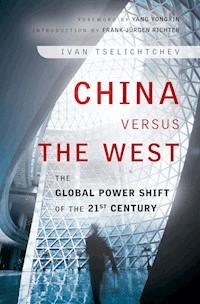
China Versus the West is an innovative book. The author, a leading specialist on the international and Asian economy and business, presents the most comprehensive picture of the changing power balance between the emerging superpower China and the "old" developed economies of the West: mainly the US, Europe and Japan. The reader can clearly see in what areas and to what extent China has become the world leader, in what areas it is catching up and in what areas the West retains its superiority and has a chance to strengthen it further. At the same time, I. Tselichtchev unveils a breath-taking story of the global economy and business in the brave new world which is non-"West-led" and where major growth dynamics are coming from large emerging economies. A radically changing economic environment requires new government policies and business strategies. The book contains many valuable suggestions and ideas. Using his own analytical framework, the author presents a set of options and alternatives for Western businesses in the wake of China's production and export offensive. The book provides a uniquely sharp and thought-provoking analysis of the factors behind the global crisis of 2008-2009, largely different from what we see in other publications, and examines its implications for the global power balance. I. Tselichtchev vividly shows that it was not global, but Western crisis of a structural character which drastically changed the China-West power balance in the former's favor. He provides strong arguments showing that today's China is structurally and macro-economically stronger than most countries of the West. This leads him to rethinking the very essence of the Chinese model of capitalism and to its new definition. He expresses unconventional, sometimes controversial, but well-founded views about China's problems and weaknesses and the prospects for its political evolution. The book ends with invaluable insights into China's unique role in the world economic history, the essence of the non-"West-led" multipolar world and the positions of its major players. Arguing that from now on no single country will be ever able to "rule the world", it shows new opportunities dynamic China is opening for the West. Thoroughly analyzing and discussing a wide range of the key, often complicated issues which are now in the focus of the world's attention, the book remains very reader-friendly. It is written in the form of an unconstrained dialogue with the reader, containing a lot of the author's on-the-spot impressions, interesting facts, remarks and quotations. China Versus the West is a must reading for everyone who wants to know more about the global developments, China and the West, and also, perhaps, to get valuable inputs and hints to find his or her own place in today's new world. It is highly recommended for policy-makers, business people, academics, analysts and journalists. It is a valuable source for professors and students of the universities and business schools.
Sie lesen das E-Book in den Legimi-Apps auf:
Seitenzahl: 335
Veröffentlichungsjahr: 2012
Ähnliche


















Contents
Foreword by Yang Yongxin
Preface
Acknowledgments
Introduction by Frank-Jürgen Richter
Part One: China as the World’s Leading Producing, Exporting, and Financial Power: To What Extent, Where, and Why?
Chapter 1: GDP: Toward the U.S.-China Duopoly
Notes
Chapter 2: Manufacturing Output: China Is Already the Number One
Note
Chapter 3: Merchandise Exports: From China’s Lead to China’s Dominance?
Chapter 4: Where China Is Leading and Where It Is Not
Group One Industries: China Is the Top Producer and the Top Exporter
Group Two Industries: China Is the Top Producer, but Not the Top Exporter
Group Three Industries: China Is Neither the Top Producer Nor a Major Exporter
Key Features of China’s Manufacturing Lead
Anatomy of China’s Merchandise Trade Surplus
Net Exporter and Net Importer Sectors
Domestic Private Companies Have Become the Major Surplus Creators
Note
Chapter 5: Chinese Domestic Manufacturers versus Western Manufacturers
The Four Segments Analytical Framework
Chinese Manufacturers’ Global Offensive: Four Stages
Western Manufacturers: A New Way of Thinking Is Required
Option One: Stay at Home and Differentiate the Product
Option Two: Move to China
Western Governments Have to Initiate an Export Counteroffensive
Chapter 6: A Big Battle for the Chinese Market
China-Bound Exports of Capital Goods: East Asia Is Leading
China-Bound Exports of Consumer Goods: Opportunities Are There, but You Have to Work Hard Not to Miss Them
China Trap
At-Home Chinese Companies Are Active in the High-End Niche
Competition with Domestic Capital Goods Makers Is Getting Really Tough
Chapter 7: Global Services Market: The West’s Edge and China as Number Five
China Joins the Ranks of Leading Services Exporters, but the United States Is Far Ahead
China’s Trade Deficit
China Has a Structural Weakness in Services That Is Difficult to Overcome
The U.S. and EU Surpluses in the Services Trade with China Are Meager
The Right Time to Capture the Chinese Market
Note
Chapter 8: Is China a New Financial Superpower?
China’s Overseas Assets
$3 Trillion-Plus Foreign Reserves: Implications for China and for the West
China Has Become the Largest International Lender for Developing Countries
China’s Outbound Foreign Investment: Accelerating, but the Lag Remains
Chinese Households’ Financial Assets: Still Tiny
Is China a New Financial Superpower? Yes and No
Conclusions
Part Two: The Global Downturn and Beyond: Western Capitalism and Chinese Capitalism
Chapter 9: The Global Crisis Was Not Really Global
Chapter 10: Western Crisis: Three Major Factors
Unaffordable Consumption and Households Deeper in Debt
Gambling Capitalism
The Failure of State Regulation, Corporate Governance, and Business Morality
Chapter 11: Still, Western Capitalism Is Alive, But. . . .
Calm Down: No End of Capitalism
Soaring Public Debts as the Biggest Crocodile
The Welfare State Has to Be Trimmed More and Faster
Chapter 12: Is China Structurally Stronger Than the West?
Improvement of Lending Practices and Persistent Fight with Overheating
Enhancing Regulatory Standards for Banks
Healthy Public Finance
Chapter 13: The Chinese Model of Capitalism
The Need for a New Conceptual Framework
The Chinese System Is Not State Capitalism: A Great Shift to Private Property
Creating Market-Style State-Owned Companies
Fierce Competition and the Culture of Self-Responsibility
Chinese Capitalism: Definition
A Digression about China’s Structural Weaknesses and Political Evolution
Chapter 14: Global Rebalancing Will Not Be Easy
Can the Idea Work?
Private Consumption in China Is Already Growing Fast
Yet Expansion of China’s Domestic Demand Is One Thing, and Rebalancing Is Another
Too Rapid Increase of China’s Consumption May Have Dire Side Effects
Present Position: Imbalance or Equilibrium?
Conclusions
Part Three: The China-West Economic Wars: And the Winner Is. . . .
Chapter 15: China’s Choice Is to Further Expand Trade Surpluses and Keep the Yuan Weak
The Rationale for Not Appreciating the Yuan Faster
The Rationale for Increasing Savings and Exports Rather than Consumption
Chapter 16: Environment: China Going Its Own Way
Global Climate Talks: Doubts Remain If Not Increase
Concern about the Impact on Growth
A Wider Angle Is Needed
China’s Pro-Environmental Drive
China-West Environmental Cooperation
China As a New World Leader in Green Business?
Chapter 17: A Fight for Natural Resources: China Sets New Rules of the Game
Changes in the Global Markets
Chinese Model of Tapping Resources
African Saga
He Acts While Other Men Just Talk
China Has Become a Major Source of Development Aid
Chapter 18: Indigenous Innovation: Seeking to Command Advanced Technologies by All Means
The West is Creating China as a New Technological Superpower
Soaring Foreign Investment in R&D Centers and Production Upgrading
China’s Technological Strategy
Technology Transfer Enforcement
Chapter 19: Company Acquisitions: Chinese Are More Active than Westerners
Acquisitions Asymmetry
The Chinese Government Is Tightening Regulations
Western Governments Are Blocking Chinese Acquisitions of Technology and Resource Firms
Chinese Acquirers Are Backed by the State
Conclusion: The West Needs a Cohesive China Policy and Unconventional Responses to China-Posed Challenges
Epilogue: China, the West, and the World
References
About the Author
Index
Copyright © 2012 John Wiley & Sons Singapore Pte. Ltd.
Published in 2012 by John Wiley & Sons Singapore Pte. Ltd., 1 Fusionopolis Walk, #07-01, Solaris South Tower, Singapore 138628
All rights reserved.
No part of this publication may be reproduced, stored in a retrieval system, or transmitted in any form or by any means, electronic, mechanical, photocopying, recording, scanning, or otherwise, except as expressly permitted by law, without either the prior written permission of the Publisher, or authorization through payment of the appropriate photocopy fee to the Copyright Clearance Center. Requests for permission should be addressed to the Publisher, John Wiley & Sons (Asia) Pte. Ltd., 1 Fusionopolis Walk, #07-01, Solaris South Tower, Singapore 138628, tel: 65–6643–8000, fax: 65–6643–8008, e-mail: [email protected].
This publication is designed to provide accurate and authoritative information in regard to the subject matter covered. It is sold with the understanding that the Publisher is not engaged in rendering professional services. If professional advice or other expert assistance is required, the services of a competent professional person should be sought. Neither the author nor the Publisher is liable for any actions prompted or caused by the information presented in this book. Any views expressed herein are those of the author and do not represent the views of the organizations he works for.
Other Wiley Editorial Offices
John Wiley & Sons, 111 River Street, Hoboken, NJ 07030, USA
John Wiley & Sons, The Atrium, Southern Gate, Chichester, West Sussex, P019 8SQ, United Kingdom
John Wiley & Sons (Canada) Ltd., 5353 Dundas Street West, Suite 400, Toronto, Ontario, M9B 6HB, Canada
John Wiley & Sons Australia Ltd., 42 McDougall Street, Milton, Queensland 4064, Australia
Wiley-VCH, Boschstrasse 12, D-69469 Weinheim, Germany
Library of Congress Cataloging-in-Publication Data
ISBN 978-0-470-82972-1 (Hardback)
ISBN 978-0-470-82974-5 (ePDF)
ISBN 978-0-470-82973-8 (Mobi)
ISBN 978-0-470-82975-2 (ePub)
To Maxim and Olga
Foreword
My good friend Ivan Tselichtchev is an internationally renowned economist and scholar who enjoys great respect and a good reputation as a researcher, especially in the area of world economics and business. The author of the masterpiece Asia’s Turning Point, Tselichtchev has taken a new step with China versus the West, a book presenting a comprehensive and accurate look at the subtle changes in the balance of power between emerging economies like China and the developed Western economies of the United States, Europe, and Japan.
In this new multilevel competitive world, global economic growth is driven by the emerging entities, rather than Western economies.
Through Tselichtchev’s precise analysis, the reader sees the areas in which China has been leading the world or catching up with the developed states, as well as the areas where the traditional West still maintains its advantage and is likely to further strengthen its position. Along with articulating many valuable suggestions and ideas, Tselichtchev vividly shows how wise government policies and business strategies are needed to address the fundamental changes in the global economic environment. He articulates a unique series of proposals to and options for Western business communities on how to deal with China’s emergence as a leading manufacturer and exporter.
This book offers systematic, unique, incisive, and thought-provoking analysis of the various factors that led to the global economic crisis of 2008–2009 and provides a deep insight into the impact of the crisis on the balance of economic power between China and the West, with their different institutional structures. Tselichtchev finds strong arguments to vividly illustrate how the structural dimension of the Western economic crisis dramatically shifted the balance of power in China’s favor, vividly showing that China proved to be stronger both structurally and macroeconomically than most Western countries. This helps readers to rethink the essence of the Chinese model and define it in a new way. The author also brings to light China’s problems, weaknesses, and prospects for political development.
Tselichtchev’s book provides a very human and in-depth analysis and discussion of the complex issues as he shares his Chinese impressions and experiences, and summarizes the trends and changes in the Western economies impacted by their business relations with China. The author provides unique suggestions and convincing arguments from different perspectives, addressing the key issues. He shows the uniqueness of China’s role in the global economic history and the essence of its status in today’s multipolar global system where no country alone can “dominate the world.” From now on, a vigorous and open China is creating a historic opportunity for the West.
For all those who want to learn more about the current economic developments and economic structures of China and the West, and about the world economy as a whole, as well for those who are searching for their place and role in this world, this book is a must. In particular, it is a valuable resource for policy makers, businesspeople, and experts and scholars in the economic fields, as well as for educational institutions and for mass media people.
Ivan Tselichtchev’s extensive international experience, combined with his great writing ability, makes for a spectacular read.
Yang Yongxin
Senior Advisor, China Chemical Energy Saving Committee
Council Member, Shanghai Economic Management Consulting Association
Executive Director, China Hao Hua Plastics City
Chairman, Haobo International Logistics Management Committee, Shanghai
Preface
China’s emergence as a new superpower and an undisputed economic leader of the non-Western world is one of the most important global developments of the early twenty-first century.
There are many books and articles on China’s rise. Their authors have vividly shown its remarkable scale and breathtaking speed. In this regard, perhaps, there is nothing left to argue about.
Our book is not about China’s rise. We will not even use the term.
It is time to make a step forward. The purpose of this book is to present a comprehensive picture of the economic power balance between China and the West in today’s world, to show how and why it has been changing over time, especially since the beginning of the new century, and, where possible, to articulate the directions of change expected in this decade and beyond.
Both China and the West are our main heroes. Other heroes, especially a cohort of large emerging market countries starting from India, are also present.
The term West is not geographical: It includes all old industrially developed economies: North America, Western Europe, Japan, Australia, and New Zealand (the new industrially developed economies are four Asian tigers: Singapore, Hong Kong, South Korea, and Taiwan). In this book, due to inevitable space constraints, the Western part of the analysis is concentrated mostly on the United States, Japan, Germany, France, the United Kingdom, and Italy.
In Part One we explore the West-China balance of power in manufacturing production, merchandise trade, commercial services, and finance. There is an endless torrent of information about China’s rushing ahead and occupying top positions in one sector of the global economy after another. Our aim is to let readers clearly see in what particular areas and product segments China has increased its power significantly and is now leading, in what areas and segments it is rapidly catching up, and the areas where, in spite of China’s progress, the West retains superiority and has a chance to enhance it further.
In particular, we explore how China widens the scope of its merchandise export offensive and what options this offensive leaves for Western manufacturers.
We argue that the West, both businesses and governments, is not doing enough to take advantage of the business opportunities provided by China’s growth, especially regarding China-bound exports of both goods and services. A big battle for the Chinese market is just starting, and the Western side has to move fast not to be left out.
The global economic and financial crisis of 2008–2009 exerted enormous influence on the balance of power in the world economy, making China, in relative terms, much stronger and weakening the West. This is the major theme of Part Two. We argue that the crisis was not global but Western, and manifested a failure (though, of course, not the end) of the Western, first of all the American (or Anglo-Saxon) model of capitalism. We define the major dimensions and reasons for the failure, the latter starting from unsustainable consumption patterns and ending with the inability to contain potentially disruptive financial transactions. In our view, the problem was also Western capitalism’s moral failure.
Now that the crisis is over, major Western economies are changing a lot to address the issues it posed. Yet, unfortunately, they will be suffering from the crisis aftershocks for years to come—exacerbating public debts and worsening employment conditions being a clear warning. The point we are making is that the crisis resulted from the structural weaknesses of Western capitalism, while China’s resilience was rooted in its structural strength, which is now providing a springboard for further growth.
This assumption naturally brings us to investigate the Chinese model of capitalism and to compare it with the Western one in broader terms. We propose a new definition of Chinese capitalism. In our view, it is not Western capitalism’s opposite. We trace its evolution toward more markets, competition, and freedom for enterprises, state-owned companies included. On the other hand, we argue that the Chinese state not only actively supports domestic enterprises and industries, but also plays the role of a demanding company owner and a tough supervisor, resolutely containing financial risks.
Can China lead global growth in the 2010s through the expansion of its domestic market, in line with a currently popular concept of global rebalancing? This is one more hot issue to be discussed in depth.
Part Three looks at five major areas where the West’s and China’s economic interests clash: trade and the exchange rate of the yuan, environment, natural resources, technologies, and company acquisitions. Tracing and analyzing the major developments, we arrive at the conclusion that in most of those areas China is on the offensive and that more often than not it succeeds in making things change in the directions it wants them to. We try to explain the reasons and to explore various options for the West’s response.
In short, in this book we try to diagnose the West-China economic power shift, answering the four key questions: In what areas? How big and how fast? Why? and What to do?
We also kindly ask the reader not to skip the “Epilogue: China, the West, and the World” where we discuss the global context and global implications of the West-China economic power shift and articulate a number of key conclusions. We show why, in spite of its dramatic rise, China will not become a world ruler and there will be no new Pax Sinica.
We did our best to make the book lively and reader-friendly, selecting really interesting and important facts and storylines. It contains many specific examples, which, we hope, will make it easier to understand and to feel both Western and Chinese realities. Some of them reflect our own on-the-spot experiences. We have also added to it a little bit of Japanese flavor, because Japan is the country where we have been living for more than 20 years and a very good and relevant place to research many of the issues we raise.
We hope that China versus the West will be useful and pleasant reading for everyone seeking to understand the major global developments of our time, including businesspeople and policy makers, scholars, analysts and journalists, professors, and university or business school students.
Acknowledgments
This book will see the world thanks to cooperation and support from many colleagues and friends.
Frank-Jurgen Richter, chairman of Horasis and the host of Global China Business Meetings, provided valuable intellectual input and much assistance in my research in Europe, offering a wonderful opportunity to participate in Horasis projects.
In Asia, I am always happy to work at INSEAD, Singapore. I am grateful to Professors Hellmut Schutte and Michael Witt, as well as the Tanoto Library staff who provided such opportunities.
Here in Japan, I am especially grateful to Mr. Shin’ichi Suzuki, president of the Ad Post Company, and a person with remarkable experience in regard to working in China, for supporting and encouraging my research and writing activities and providing invaluable advice.
Ken’ichi Imai, a Senior Fellow Emeritus of the Stanford University and Professor Emeritus of the Hitotsubashi University, has been one of the most important economists in Japan and beyond, since the start of my modest career. His writings and all our discussions provided a unique intellectual stimulus.
I’d like to say thank you to the Chuo University and especially to Professor Kenji Takita for inviting me to take part in research projects and international conferences on Asia that helped to solidify the concept of this book.
Many thanks for sharing thoughts and encouraging me to write on Asian and global issues to my old friend Hideaki Yamakawa, currently professor at the Kanazawa Gakuin University.
I always learn from Mr. Keisuke Uemura, president of the ITAC company, the R&D arm of Nagata Seiki, a leading player among Japanese producers and developers of new materials.
I am grateful to many other Japanese colleagues and friends in Tokyo, Niigata, and beyond who shared their views and encouraged my research effort.
A very important person for me, be it in Japan, Belgium, or anywhere else, is Philippe Debroux, professor at the Soka University and my co-author for my previous book, Asia’s Turning Point. He is a wise man with deep knowledge, rich professional experience, and a beautiful sense of humor. Some parts of the book were written under the impetus of our lively discussions.
I value all the contacts, discussions, and debates I have had with Chinese scholars, businesspeople, managers of state-owned companies, journalists, and politicians I met during my China trips, here in Japan, and at the Global China Business Meetings and other international gatherings.
Thank-you, Yang Yongxin—a major manager in Shanghai, the largest industrial center in the world.
Thank-you, my friend, Yuan Pei Zhe.
And now, back to Russia—with love. Special thanks to Alexander Drozdov, the director of the Eltzin Fund and a very good journalist, for showing strong interest in my research concepts and plans, sharing his ideas, and encouraging my international research activities.
Wherever I am, I will be an “IMEMO man.” IMEMO is the Russian abbreviation for the Institute of World Economy and Economic Relations of the Russian Academy of Sciences, where I started my career as a researcher.
I am grateful to academician Evgeny Primakov, the prime minister of Russia in the late 1990s, who played a very important role in setting the direction for my professional activities in the mid-1980s, when they were still at an early stage.
Thank you, my old colleagues and friends: director Alexander Dynkin, Vyacheslav Amirov, and Sergey Chughrov, who is now the editor-in-chief of Political Studies magazine in Moscow. Gratitude and special tribute also go to the late Vladlen Martynov and Yakov Pevzner. Apologies to many other colleagues and friends whose names cannot be mentioned due to space constraints.
Finally, last but not least, I thank my son Maxim Tselichtchev, for providing assorted kinds of technical and information support.
Introduction
Globalization has entered a critical stage, as the ongoing economic disruptions have prompted many of us to reexamine its promises. The world today is characterized by pronounced fragility and heightened uncertainty, fed by external shocks and multiple crises that are dangerously reinforcing. Against the backdrop of these unprecedented challenges we are witnessing an economic and geopolitical power shift from the developed to the emerging world.
Lesen Sie weiter in der vollständigen Ausgabe!
Lesen Sie weiter in der vollständigen Ausgabe!
Lesen Sie weiter in der vollständigen Ausgabe!
Lesen Sie weiter in der vollständigen Ausgabe!
Lesen Sie weiter in der vollständigen Ausgabe!
Lesen Sie weiter in der vollständigen Ausgabe!
Lesen Sie weiter in der vollständigen Ausgabe!
Lesen Sie weiter in der vollständigen Ausgabe!
Lesen Sie weiter in der vollständigen Ausgabe!
Lesen Sie weiter in der vollständigen Ausgabe!
Lesen Sie weiter in der vollständigen Ausgabe!
Lesen Sie weiter in der vollständigen Ausgabe!
Lesen Sie weiter in der vollständigen Ausgabe!
Lesen Sie weiter in der vollständigen Ausgabe!
Lesen Sie weiter in der vollständigen Ausgabe!
Lesen Sie weiter in der vollständigen Ausgabe!
Lesen Sie weiter in der vollständigen Ausgabe!
Lesen Sie weiter in der vollständigen Ausgabe!
Lesen Sie weiter in der vollständigen Ausgabe!
Lesen Sie weiter in der vollständigen Ausgabe!
Lesen Sie weiter in der vollständigen Ausgabe!
Lesen Sie weiter in der vollständigen Ausgabe!
Lesen Sie weiter in der vollständigen Ausgabe!
Lesen Sie weiter in der vollständigen Ausgabe!
Lesen Sie weiter in der vollständigen Ausgabe!
Lesen Sie weiter in der vollständigen Ausgabe!
Lesen Sie weiter in der vollständigen Ausgabe!




