


Erhalten Sie Zugang zu diesem und mehr als 300000 Büchern ab EUR 5,99 monatlich.
- Herausgeber: Nick Hern Books
- Kategorie: Geisteswissenschaft
- Serie: Shakespeare On Stage
- Sprache: Englisch
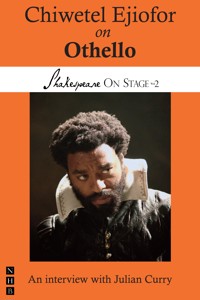
Chiwetel Ejiofor discusses playing Othello, in this ebook taken from Shakespeare On Stage: Volume 2 - Twelve Leading Actors on Twelve Key Roles. In each volume of the Shakespeare On Stage series, a leading actor takes us behind the scenes of a landmark Shakespearean production, recreating in detail their memorable performance in a major role. They lead us through the choices they made in rehearsal, and how the character works in performance, shedding new light on some of the most challenging roles in the canon. The result is a series of individual masterclasses that will be invaluable for other actors and directors, as well as students of Shakespeare – and fascinating for audiences of the plays. In this volume, Chiwetel Ejiofor discusses playing Othello in Michael Grandage's production at the Donmar Warehouse, London, in 2007. This interview, together with the others in the series (with actors such as Simon Russell Beale, Ian McKellen, Patrick Stewart and Harriet Walter), is also available in the collection Shakespeare On Stage: Volume 2 - Twelve Leading Actors on Twelve Key Roles by Julian Curry, with a foreword by Nicholas Hytner.
Sie lesen das E-Book in den Legimi-Apps auf:
Seitenzahl: 68
Veröffentlichungsjahr: 2017
Das E-Book (TTS) können Sie hören im Abo „Legimi Premium” in Legimi-Apps auf:
Ähnliche




















Chiwetel Ejiofor
on
Othello
Taken from
SHAKESPEARE ON STAGEVolume 2
Twelve Leading Actors on Twelve Key Roles
by Julian Curry
Contents
Dedication
Introduction
Acknowledgements
Chiwetel Ejiofor on Othello
Synopsis of the Play
About the Author
Other Titles in the Series
Copyright Information
For Alex and Torrenhoping their lives will be enriched by Shakespeare as mine is
Introduction
Julian Curry
Much of the brilliance of Shakespeare lies in the openness, or ambiguity, of his texts. Whereas a novelist will often describe a character, an action or a scene in the most minute detail, Shakespeare knew that his scenarios would only be fully fleshed out when actors perform them. He was the first writer to create character out of language. Falstaff has an idiosyncratic way of speaking that is quite distinct from Juliet, as she does from Shylock, and he from Lady Macbeth. An actor receives subliminal clues about their character, merely by the way they express themselves.
George Bernard Shaw wrote long prefaces and elaborate stage directions; his texts are littered with instructions to actors and directors as to how his plays should be done. This can be helpful, but as often as not it’s limiting, even annoying. Shakespeare, conversely, wrote hardly any stage directions. The best known is ‘Exit, pursued by a bear’ in The Winter’s Tale – which incidentally is far from proscriptive: is some unfortunate actor bundled into a bear costume? Or is the bear surreal, an effect of sound and lighting? Directors have carte blanche. The only solution rarely adopted is to put a live bear on stage. On occasion Shakespeare does give a precise indication of stage business. In the courtroom scene of The Merchant of Venice, Gratiano says: ‘Not on thy sole but on thy soul, harsh Jew, / Thou mak’st thy knife keen’ [4.1]. Then the actor playing Shylock understands that he should take out his knife and sharpen it on the sole of his shoe. Other stage directions take the form of implicit but less precise suggestions. When Hamlet says to Osric, ‘Put your bonnet to his right use; ’tis for the head’ [5.2], the actor playing Osric knows one thing for sure: his hat is not on his head. How else he is using it is up to him.
There are times when the actor may decide to do the opposite of what the text seems to indicate. For instance, when King Lear exits saying to Goneril and Regan, ‘You think I’ll weep? No, I’ll not weep... this heart / Shall break into a hundred thousand flaws / Or ere I’ll weep’ [2.4], the suggestion appears to be that the actor will remain dry-eyed. Ian McKellen immediately burst into convulsive sobs. I found this very moving.
Shakespeare doesn’t tell his actors how to play their parts; he gives hints but leaves the decisions up to them. My interest in writing this book, and the companion volume that preceded it, is the myriad options available to performers of Shakespeare’s texts, and the choices they make. Theatre is written on the wind. Even the most brilliant performances exist only in the moment, and will endure nowhere but in the memories of those present. Actors are notoriously reluctant to define and discuss how they act, but luckily they are often willing to talk about their past performances.
In 2011, the first volume of Shakespeare On Stage found itself on a shortlist of nominees for the annual Theatre Book Prize. It focuses on thirteen of Shakespeare’s leading roles, therefore covering roughly a third of his plays. This left plenty of uncharted territory. I was delighted when Nick Hern Books agreed that we should continue the voyage of discovery.
As with the earlier volume, my guiding principle was to approach excellent actors who had played leading roles in memorable Shakespearean productions, and to ask them if they’d be willing to reveal if not how they acted, at least what they did. I also wanted to know how the show was set, what they wore, and what went on around them. Having been lifelong in the business, many of my intended targets were friends who were easily accessible, and most generous with their time.
Preparing for each encounter was a labour of love. Of necessity it involved a thorough refresher course, going back to the plays and spending long hours with nose in text. I also read critical studies and pestered archivists for back copies of reviews. I was determined to approach the interviews as well briefed as possible, in order to frame productive questions. At times it felt like the work of a barrister. The difference is that whereas a barrister’s questions are designed to steer the witness towards a desired answer, mine were simply intended to get juices flowing and tongues wagging. I concentrated on mechanics rather than theory. As far possible I made the question ‘What did you do?’ rather than ‘How did you do it?’
The conversations were tape-recorded, usually at the actor’s home. I followed, as closely as was practicable, the following sequence: (1) Put the performance in the context of its time and place, director and designer. (2) General questions about the production and the character. (3) Specific questions about the performance, working through the play from start to finish. (4) Summing up.
Shakespeare on Stage: Volume 2 is an account of twelve performances, by the actors who gave them. Each interview focuses on a single performance, and the production in which it featured. They span fifty years, from Eileen Atkins’s Viola in 1961 to Patrick Stewart’s Shylock in 2011. What they have in common is a uniquely personal account of a creative process. I’ve been delighted by the frequent departures from lazy assumption. For instance, Sara Kestelman describes A Midsummer Night’s Dream set in an immaculate white box, devoid of all vegetation, and of infants with wings pretending to be fairies. Simon Russell Beale, who looks anything but lean and hungry, was triumphantly cast as Cassius. Patrick Stewart’s Shylock ruled over a business empire set in Las Vegas. Ian McKellen repeatedly questions the assumption that King Lear goes mad, just as Alan Rickman finds the adjective ‘melancholy’ inadequate to describe Jaques. I’m not aware of any other continuities or recurring themes. On the contrary, each one quite naturally occupies its own territory, and I’m happy with that. It also seems that, as a by-product, the actors have in fact revealed a great deal about themselves and their own working methods. As such, I hope the reader will enjoy the range and diversity of responses, and that it will be of interest to other actors, students and theatregoers alike.
This is the introduction to Shakespeare on Stage: Volume 2; the volume in which this interview first appears.
Acknowledgements
Many thanks to the Society of Authors for a very generous grant which bought me time to interview the subjects, and to write this book; and to Sue Webb, Mary Chater, Matt Applewhite and Nick Hern for their invaluable support and encouragement. Finally, and most especially, thanks to all of the actors who kindly gave their time to be interviewed.
Chiwetel Ejiofor
on
Othello
Othello (1604)
Opened at the Donmar Warehouse, London on 4 December 2007
Directed by Michael Grandage
Designed by Christopher Oram With Michelle Fairley as Emilia, Tom Hiddleston as Cassio, Ewan McGregor as Iago, and Kelly Reilly as Desdemona
Othello was first performed in the very early 1600s. For the next 350 years the character was played almost exclusively by white actors who blacked up. When the famous African American actor Ira Aldridge played London’s first ever black Othello in 1825, The Times critic wrote: ‘Owing to the shape of his lips it is utterly impossible for him to pronounce English.’ Another objected to Desdemona being ‘pawed about on the stage by a black man’. Yet another described him as an ‘unseemly nigger’. Imagine those critics’ astonishment if a time machine could have whisked them forward to read the Guardian




