


17,99 €
Mehr erfahren.
- Herausgeber: John Wiley & Sons
- Kategorie: Geisteswissenschaft
- Sprache: Englisch
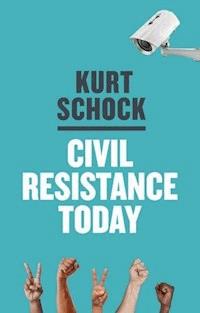
From Gandhi's salt march to the US civil rights movement and Occupy Wall Street, nonviolent campaigns to promote democracy, human rights and social justice have long played an important transformative role in local, national and global politics. Some have succeeded, some have failed; but nonviolent action remains a very effective means of achieving significant social and political change.
In this authoritative book Kurt Schock expertly guides readers through the changing terrain of nonviolent struggle, exploring the historical roots and development of modern civil resistance and its proliferation in recent decades. Discussing movements against economic and social injustice as well as political oppression, he explains how resistance happens and unpacks the complex interactions between state and non-state actors that affect the trajectories and outcomes of nonviolent campaigns. Drawing on a wealth of empirical data and comparative research, Civil Resistance Today will be an essential "one stop shop" for anyone keen to learn more about the methods, objectives and outcomes of civil resistance in the contemporary world.
Sie lesen das E-Book in den Legimi-Apps auf:
Seitenzahl: 379
Veröffentlichungsjahr: 2015
Ähnliche




















Dedication
For Meg, Dylan and Lukas
Copyright page
Copyright © Kurt Schock 2015
The right of Kurt Schock to be identified as Author of this Work has been asserted in accordance with the UK Copyright, Designs and Patents Act 1988.
First published in 2015 by Polity Press
Polity Press
65 Bridge Street
Cambridge CB2 1UR, UK
Polity Press
350 Main Street
Malden, MA 02148, USA
All rights reserved. Except for the quotation of short passages for the purpose of criticism and review, no part of this publication may be reproduced, stored in a retrieval system, or transmitted, in any form or by any means, electronic, mechanical, photocopying, recording or otherwise, without the prior permission of the publisher.
ISBN-13: 978-0-7456-8266-2
ISBN-13: 978-0-7456-8267-9(pb)
A catalogue record for this book is available from the British Library.
Library of Congress Cataloging-in-Publication Data
Schock, Kurt, 1963–
Civil resistance today / Kurt Schock.
pages cm
Includes bibliographical references and index.
ISBN 978-0-7456-8266-2 (hardcover : alkaline paper) – ISBN 0-7456-8266-9 (hardcover : alkaline paper) – ISBN 978-0-7456-8267-9 (paperback : alkaline paper) – ISBN 0-7456-8267-7 (paperback : alkaline paper) 1. Civil disobedience. 2. Nonviolence. I. Title.
JC328.3.S375 2015
303.6′1–dc23
2014040643
Typeset in 10.5 on 12 pt Sabon
by Toppan Best-set Premedia Limited
Printed and bound in the UK by CPI Group (UK) Ltd, Croydon, CR0 4YY
The publisher has used its best endeavours to ensure that the URLs for external websites referred to in this book are correct and active at the time of going to press. However, the publisher has no responsibility for the websites and can make no guarantee that a site will remain live or that the content is or will remain appropriate.
Every effort has been made to trace all copyright holders, but if any have been inadvertently overlooked the publisher will be pleased to include any necessary credits in any subsequent reprint or edition.
For further information on Polity, visit our website:
politybooks.com
Tables and Figures
Tables
1.1 Common Distinctions between Pragmatic and Principled Nonviolence 25
2.1 Comparison of Social Movement/Revolution and Civil Resistance Research 48
2.2 Contrasting Assumptions about Political Action, Strategy, Context, and Relation between Means and Ends 49
Figures
5.1 Possible Responses by Authorities to Civil Resistance Campaigns 117
7.1 Spectrum of Allies 165
Preface
There has been a substantial revival of popular and scholarly interest in civil resistance since the Arab Spring, Occupy Wall Street, and anti-austerity protests in Europe. Scholarly journals such as Journal of Peace Research, Research in Social Movements, Conflicts and Change, and Mobilization have recently devoted special issues to civil resistance and several important books on civil resistance have been published in recent years, including Civil Resistance and Power Politics: The Experience of Non-Violent Action from Gandhi to the Present, edited by Adam Roberts and Timothy Garton Ash (2009, Oxford University Press), Nonviolent Revolutions: Civil Resistance in the Late 20th Century, by Sharon Erickson Nepstad (2011, Oxford University Press), Gandhi in the West: The Mahatma and the Rise of Radical Protest, by Sean Scalmer (2011, Cambridge University Press), Violence, Nonviolence and the Palestinian Movement, by Wendy Pearlman (2011, Cambridge University Press), Nonviolence in Political Theory, by Iain Atack (2012, Edinburgh University Press), People Power and Political Change: Key Issues and Concepts, by April Carter (2013, Routledge), Rediscovering Nonviolent History: Civil Resistance in Liberation Struggles, edited by Maciej J. Bartkowski (2013, Lynne Rienner Publishers), Curtailing Corruption: People Power for Accountability & Justice, by Shaazka Beyerle (2014, Lynne Rienner Publishers), Civil Resistance and Conflict Transformation: Transitions from Armed to Nonviolent Struggle, edited by Véronique Dudouet (2015, Routledge), Understanding Nonviolence: Contours and Contexts, edited by Maia Carter Hallward and Julie M. Norman (2015, Polity), Nonviolent Resistance: A Philosophical Introduction, by Todd May (2015, Polity), A Theory of Nonviolent Action: How Civil Resistance Works, by Stellan Vinthagen (2015, Zed), and most significantly, Erica Chenoweth and Maria J. Stephan's How Civil Resistance Works: The Strategic Logic of Nonviolent Conflict (2011, Columbia University Press), a path-breaking empirical study that compares the efficacy and consequences of campaigns of violent and nonviolent resistance.
Despite the surge in interest and publications, we lack an introduction to this growing field of study, especially for those new to the field. In order to understand recent and contemporary phenomena like pro-democracy movements in the Middle East, land reform movements in the Global South, and anti-austerity movements in developed countries, we need some sort of historical, theoretical, and conceptual grounding. In the book I attempt to trace the development of modern civil resistance and major issues and debates in the field and provide readers with conceptual tools necessary for understanding and explaining campaigns of civil resistance. I have fastened the discussions to an array of cases, comparatively and historically, rather than focusing in detail on one or a few cases. I have sought to provide an account that is clearly written and jargon free so that it is useful for courses in Sociology, Political Science, Peace and Conflict Studies, and Resistance Studies, as well as having sufficient conceptual, theoretical, and illustrative breadth and depth to be useful as an overview to scholars interested in civil resistance. It is hoped that the book will also appeal to activists and the general public. The intent is to provide a grounding that provokes interest and provides a basis for further explorations of civil resistance.
Acknowledgments
Thanks go to my editors at Polity, Louise Knight and Pascal Porcheron. As with anyone who works with me, an ocean of patience is needed and theirs is greatly appreciated. Special thanks to Louise for approaching me with this project and shepherding me along the path to completion. Thanks also to those who provided valuable comments on drafts of the manuscript, including Erica Chenoweth, David Hardiman, Brian Martin and the anonymous Polity reviewers. I also thank the many stimulating guest speakers who shared their thoughts on civil resistance with my students and me at Rutgers University, Newark over the past few years including Tim Aye Hardy, Maciej Bartkowski, Daryn Cambridge, Jill Carr-Harris, Erica Chenoweth, Véronique Dudouet, Jack DuVall, Mary King, Lester Kurtz, Srdja Popovic, Nathan Schneider, U Gawasita, U Pyinya Zawta, Stellan Vinthagen, and Stephen Zunes. Thanks also go to my colleague Forest Whitaker for sharing his inspiring work on peace building with the students and faculty in the Peace and Conflict Studies program at Rutgers University, Newark. Most importantly, thanks go to Meg, Dylan and Lukas.
1Conceptualization and Debates
Collective civilian-based campaigns and movements to promote group rights and social justice have occurred throughout history. When these challenges are waged outside of conventional political channels and without violence or the threat of violence, they fall within the realm of civil resistance. From the eighteenth century onward the frequency of civil resistance increased and propelled waves of democratization and struggles for labor rights, national liberation, and racial equality. Profound political transformations in the last quarter century were driven in part by civil resistance such as the demise of Communist Party rule in Eastern Europe in 1989–91, the end of the Cold War, and the Color Revolutions in the early twenty-first century. Along with these more recent challenges, such as the Arab Spring and widespread protests against austerity programs, privatization, corruption, land alienation, and increasing inequalities have generated widespread interest in civil resistance. Although the impact of civil resistance on domestic and international politics across the globe is often pivotal, we know relatively little about the dynamics of nonviolent struggle. This is due in part to the great attention paid by scholars and the media to violent resistance, terrorism, and war, as well as hegemonic ideas and myths about the power and utility of violence. In the introductory chapter civil resistance is defined and major questions and debates are introduced. In subsequent chapters various campaigns and movements implementing civil resistance and dynamics of civil resistance are explored.
What is Civil Resistance?
Civil resistance is resistance in the sense that it involves widespread activities that challenge a particular power, regime, or policy, and it is civil in the sense that it is implemented by groups whose goals are widely shared throughout civil society and involves nonviolent action rather than violent (uncivil) action (Roberts 2009: 2). Civil resistance avoids any systematic recourse to violence and it is as opposed to individual dissent (Randle 1994: 10). Civil resistance, while abstaining from violence, involves in resisting oppression or injustice (Dudouet 2008: 3). Civil resistance is carried out by rather than by armed groups, although members of the state's armed forces and security apparatus may engage in civil resistance by disobeying orders of superiors and refusing to use their arms. Civil resistance is a form of in the sense that there is a large power disparity between opponents (Arreguin-Toft 2005; Mack 1975). In the case of civil resistance the asymmetry is between marginalized or oppressed challenging groups and authorities that may use violence to maintain their privilege and power (Dudouet 2008: 4). Civil resistance is sustained when it occurs over a period of time as opposed to one-off events or occasional protest. Sustained collective action implies organization and leadership, although the form they take varies considerably from centralized organization and leadership to decentralized networks with no identifiable leaders.
Lesen Sie weiter in der vollständigen Ausgabe!
Lesen Sie weiter in der vollständigen Ausgabe!
Lesen Sie weiter in der vollständigen Ausgabe!
Lesen Sie weiter in der vollständigen Ausgabe!
Lesen Sie weiter in der vollständigen Ausgabe!
Lesen Sie weiter in der vollständigen Ausgabe!
Lesen Sie weiter in der vollständigen Ausgabe!
Lesen Sie weiter in der vollständigen Ausgabe!
Lesen Sie weiter in der vollständigen Ausgabe!
Lesen Sie weiter in der vollständigen Ausgabe!




