


114,99 €
Mehr erfahren.
- Herausgeber: John Wiley & Sons
- Kategorie: Fachliteratur
- Serie: Clinical Cases (Dentistry)
- Sprache: Englisch
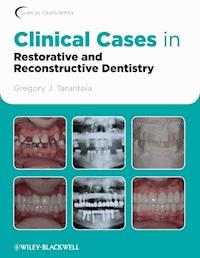
Wiley-Blackwell's "Clinical Cases" series is designed to recognize the centrality of clinical cases to the profession by providing actual cases with an academic backbone. Clinical Cases in Restorative and Reconstructive Dentistry describes the principles and demonstrates their practical, every-day application through a range of representative cases building from the simple to the complex and from the common to the rare. This unique approach supports the new trend in case-based and problem-based learning, thoroughly covering topics ranging from infant oral health to complex pulp therapy. Highly illustrated in full color, Clinical Cases in Restorative and Reconstructive Dentistry's format fosters independent learning and prepares the reader for case-based examinations. The book presents actual clinical cases, accompanied by academic commentary, that question and educate the reader about essential topics in restorative and reconstructive dentistry. The book begins by laying the groundwork of the fundamental principles that apply to all cases and outlining the ten decisions to be made with all cases. The main sections of the book cover the cases themselves, examining them both by type of restoration / solution, and by type of problem. This unique approach enables the reader to build their skills, aiding the ability to think critically and independently. Clinical Cases in Restorative and Reconstructive Dentistry's case-based format is particularly useful for pre-doctoral dental students, post-graduate residents and practitioners, both as a textbook from which to learn about the challenging and absorbing nature of restorative and reconstructive dentistry, and also as a reference tool to help with treatment planning when perplexing cases arise in the dental office.
Sie lesen das E-Book in den Legimi-Apps auf:
Seitenzahl: 670
Veröffentlichungsjahr: 2011
Ähnliche



















Contents
Author
Contributors to Appendices
Acknowledgments
Introduction
Part 1: Didactics
1: Fundamental Principles of the Comprehensive Approach
The Case for the Four-Part Comprehensive Evaluation
The Details of the Four-Part Comprehensive Evaluation
The Initial Conversation
The Clinical System–Based Masticatory System Examination
Imaging
Articulated Diagnostic Casts
2: The People Side of Dentistry
The Importance of Behavioral and Communication Skills
The All-Important 5 Questions
The Codiscovery Process
Which Approach Is Best—The 4 Quadrants
Dentistry: A Blend of Technical, Emotional, and Intellectual Skills
3: The 4 Essential Skills of the Comprehensive Dentist
Section A: Bite Splint Therapy
Section B: Definitive Occlusal Therapy: Equilibration
Section C: The Diagnostic Blueprint—Wax-Up
Section D: Provisionalization
4: The 10 Decisions
Section A: TMJ Diagnosis and Condylar Position
Section B: Vertical Dimension
Section C: Lower Incisal Edge Position
Section D: Upper Incisal Edge Position
Section E: Centric Stop Design
Section F: Anterior Guidance
Section G: Curve of Spee
Section H: Curve of Wilson
Section I: Cusp to Fossa Angle
Section J: The Aesthetic Occlusal Plane
Part 2: Case Studies
5: Nonremovable Implant Restoration with Natural Teeth
Case 1 Nonremovable maxillary implant restorations with natural teeth restorations including crowns, veneers, and fixed partial dentures
Case 2 Transitioning a maxillary tooth-supported fixed partial denture to an implant-supported fixed partial denture along with other single crowns and tooth-supported fixed partial dentures
Case 3 Lower reconstruction with lower left being implant-supported, important neutral zone consideration affecting design; upper reconstruction landmarks acceptable; temporomandibular disorder managed
Case 4 Maxillary fixed partial denture supported by both teeth and implants along with other maxillary and mandibular implant-supported crowns and tooth-supported crowns and fixed partial dentures
Case 5 Maxillary extractions, periodontal surgery, orthodontics, veneers, and fixed partial dentures on teeth; mandibular extractions, implants, fixed partial dentures on teeth and implants
Case 6 Multiple congenitally missing teeth, past orthognathics/orthodontics, tooth position inconsistencies handled restoratively, multiple implants, tooth-supported crowns and fixed partial dentures, implant-supported crowns and fixed partial dentures
See also: Chapter 6 Case 1
Chapter 7 Case 7
Chapter 14 Case 4
6: TM Disorders Followed by Reconstruction
Case 1 Osteoarthritis of the left TMJ managed with bite splint therapy followed by implant-supported restorations and tooth-supported restorations
Case 2 Intracapsular and muscular components of a temporomandibular disorder managed with bite splint therapy followed by occlusal therapy and a full reconstruction
Case 3 Intracapsular and muscle disorder resolved with bite splint therapy followed by occlusal reconstruction with maxillary lingual porcelain veneers
Case 4 Intracapsular and muscle disorder with resultant occlusal plane asymmetry resolved with bite splint therapy and followed by occlusal therapy with restoration only on the lower left
Case 5 Past condylar replacement due to avascular necrosis followed by posterior occlusal reconstruction
Case 6 Temporomandibular disorder resolved with bite splint therapy followed by definitive occlusal therapy including a maxillary reconstruction and mandibular functional changes with composite
Case 7 Past mandibular orthognathic surgery to correct maxillary to mandibular malrelationship caused by condylar degeneration; intracapsular and muscle pain resolved with bite splint therapy followed by definitive occlusal therapy with posterior reconstruction and anterior composites
See also: Chapter 15 case 1
Chapter 16 case 1
7: Restorations to Achieve Aesthetic and Functional Changes
Case 1 Restoration of anterior aesthetics and anterior guidance in a deep overbite damaged by bruxism with upper and lower anterior reconstruction
Case 2 Posterior reconstruction with severe interferences to the centric arc of closure
Case 3 Restoration of aesthetics and anterior guidance damaged by wear by increasing overbite with upper and lower anterior crowns
Case 4 Maxillary reconstruction at open vertical dimension to improve aesthetics, length, buccal profiles, and functional landmarks; mandibular restorations only recontoured
Case 5 Maxillary and mandibular aesthetic and functional reconstruction with lab-processed composite restorations to treat amelogenesis imperfecta
Case 6 Restorations maxillary bicuspid-to-bicuspid done first as part of a comprehensive plan; maxillary left central incisor implant and other functional discrepancies corrected with reshaping and equilibration
Case 7 Maxillary and mandibular dental reconstruction including 4 dental implants replacing unrestorable teeth; impaired aesthetics due to recession handled with grafts and all porcelain restorations
See also: Chapter 16 case 1
8: Complete Implant-Supported Restorations
Case 1 Complete implant-supported maxillary reconstruction—transitioning the anterior teeth from tooth-supported to implant-supported
Case 2 Complete maxillary nonremovable restoration supported by 6 implants converted from a completed removable restoration on 4 implants
Case 3 Complete implant-supported nonremovable maxillary and mandibular reconstructions; transitioning from natural teeth that were not predictably restorable
Case 4 Maxillary extractions, immediate implant placement, immediate loading, and complete nonremovable zirconia restoration with pink porcelain
Case 5 Mandibular implant bar–supported full removable denture converted to a nonremovable restoration to improve comfort of the neutral zone and phonetics
9: Orthognathics
Case 1 Severe anterior open bite corrected with maxillary-only orthognathics and occlusal therapy with upper incisor restorations
Case 2 Mandibular orthognathic surgery and chin implant; managing a temporomandibular disorder during treatment; posterior restorative dentistry including implants
Case 3 Maxillary and mandibular orthognathic surgery with chin advancement; prerestorative occlusal therapy with equilibration and composite additions
See also: Chapter 16 Case 1
10: Bruxism and Wear Reconstruction
Case 1 Restoration of worn lower anterior teeth in a deep bite without changing other restorations
Case 2 Severe wear from parafunctional habits restored with a complete reconstruction at an increased vertical dimension of occlusion
See also: Chapter 16 Case 2
11: Perioprosthesis
Case 1 Full maxillary periodontal-restorative reconstruction improving aesthetics and function; lower posterior reconstruction following conventional surgery, bone and soft tissue grafts, covering recession
Case 2 Posterior reconstruction in conjunction with conventional periodontal surgery; root resection, pocket elimination
12: Implants in the Aesthetic Zone
Case 1 Hopeless maxillary central incisor transitioned to an implant-supported restoration (delayed placement and delayed loading) with crowns on the remaining incisors along with occlusal therapy
Case 2 Extraction and immediate implant placement, delayed loading, and restoration maxillary central incisors; pink porcelain to simulate papilla
Case 3 Congenitally missing maxillary lateral incisors, orthodontics to open lateral incisor space, dental implants, and other aesthetic improvements
Case 4 Congenitally missing upper right cuspid; upper right lateral incisor lost in an accident; implant placed in cuspid position with 2-unit cantilever restoration, pink porcelain to simulate gingival
Case 5 Maxillary central incisor extracted and replaced with a dental implant, delayed placement, and delayed loading
See also Chapter 7 case 6
13: Removable Implant-Supported Restoration with Natural Teeth
Case 1 Maxillary implant-supported bar-retained removable partial denture along with tooth-supported restorations to reconstruct occlusion and vertical dimension
Case 2 Combination mandibular fixed anterior–removable posterior reconstruction with Locator attachments
See also: Chapter 14 Case 4
.14: Combination Fixed-Removable Restoration on Natural Teeth
Case 1 Maxillary bar–supported removable partial denture; lower crowns with semiprecision removable partial denture
Case 2 Maxillary fixed partial dentures with precision removable partial denture; mandibular bar–supported complete denture
Case 3 Maxillary telescope case: alumina copings on natural teeth and removable overstructure; mandibular telescope case: Galvano copings on natural teeth and nonremovable overstructures
Case 4 Mandibular anterior fixed partial denture and posterior removable partial denture with implants and Locator attachments for added support and retention; maxillary reconstruction, telescope case with 1 dental implant included along with 6 teeth
15: Implant-Supported Complete Dentures
Case 1 Maxillary extensive bone graft followed by implant-supported bars and bar-supported overdenture after managing a temporomandibular disorder; fl ange needed for lip support necessitating a removable rather than a nonremovable approach
Case 2 Severe maxillary and mandibular resorption; maxillary bone grafting; maxillary and mandibular implant-supported bar and bar-supported dentures; fl ange needed for lip and cheek support necessitating a removable rather than a nonremovable approach
16: Reconstructions on All Natural Teeth
Case 1 Severe anterior overjet handled with occlusal/restorative treatment in lieu of orthognathics; muscular component of a temporomandibular disorder also managed
Case 2 Failed multiple reconstructions; original deep overbite with current condition in provisionals with an opened vertical dimension and anterior overjet; managed with a new reconstruction harmonizing a physiologic deep overbite
Case 3 Maxillary reconstruction combined with extractions and periodontal surgery to improve periodontal architecture; landmarks of lower acceptable with minor modification
Case 4 Full mouth reconstruction utilizing crown-lengthening surgery, extractions, single crowns, veneers, and a fixed partial denture sequenced over 2 years
Case 5 Maxillary complete fixed partial denture on 9 Galvano telescopic copings; mandibular anterior fixed partial denture on 4 Galvano copings
See also: Chapter 6 Case 6
Chapter 14 Case 3
Chapter 14 Case 4
Appendix 1: Definitive Occlusal Therapy Using the T-Scan III, by Robert B. Kerstein, D.M.D.
Appendix 2: What Your Laboratory Technician Needs to Provide Excellence, by Jerry Ulaszek, C.D.T
Index
Blackwell Publishing was acquired by John Wiley & Sons in February 2007. Blackwell’s publishing program has been merged with Wiley’s global Scientific, Technical, and Medical business to form Wiley-Blackwell.
Editorial Office
2121 State Avenue, Ames, Iowa 50014-8300, USA
For details of our global editorial offices, for customer services, and for information about how to apply for permission to reuse the copyright material in this book, please see our Website at www.wiley.com/wiley-blackwell.
Authorization to photocopy items for internal or personal use, or the internal or personal use of specific clients, is granted by Blackwell Publishing, provided that the base fee is paid directly to the Copyright Clearance Center, 222 Rosewood Drive, Danvers, MA 01923. For those organizations that have been granted a photocopy license by CCC, a separate system of payments has been arranged. The fee code for users of the Transactional Reporting Service is ISBN-13: 978-0-8138-1564-0/2010.
Designations used by companies to distinguish their products are often claimed as trademarks. All brand names and product names used in this book are trade names, service marks, trademarks or registered trademarks of their respective owners. The publisher is not associated with any product or vendor mentioned in this book. This publication is designed to provide accurate and authoritative information in regard to the subject matter covered. It is sold on the understanding that the publisher is not engaged in rendering professional services. If professional advice or other expert assistance is required, the services of a competent professional should be sought.
Library of Congress Cataloging-in-Publication Data
Tarantola, Gregory J.
Clinical cases in restorative & reconstructive dentistry / Gregory J. Tarantola. p. ; cm. – (Clinical cases)
Other title: Clinical cases in restorative and reconstructive dentistry
Includes bibliographical references and index. ISBN 978-0-8138-1564-0 (pbk. : alk. paper)
1. Dentistry, Operative–Case studies. 2. Dental implants–Case studies. I. Title. II. Title: Clinical cases in restorative and reconstructive dentistry. III. Series: Clinical cases (Ames, Iowa)
[DNLM: 1. Dental Prosthesis–methods–Case Reports. 2. Oral Surgical Procedures–methods–Case Reports. 3. Reconstructive Surgical Procedures–methods–Case Reports. 4. Stomatognathic System–Case Reports. WU 500 T176c 2010]
RK501.5.T37 2010
617.6’05–dc22
2010013916
A catalog record for this book is available from the U.S. Library of Congress. Set in 10/13pt Univers Light by Toppan Best-set Premedia Limited
Author
Gregory J. Tarantola, D.D.S., is former clinical director of the Department of Education at The Pankey Institute for Advanced Dental Education in Key Biscayne, Florida. In January of 2002, he opened a full-time restorative practice and now lives and practices in Jacksonville, Florida. He also continues to lecture around the country and around the world on comprehensive, masticatory system dentistry in a relationship-based setting.
Contributors to Appendices
Robert B. Kerstein, D.M.D., maintains a private practice limited to prosthodontics and myofascial pain in Boston Massachusetts. Dr. Kerstein has taught at Tufts University School of Dental Medicine and has lectured extensively on various topics in restorative dentistry.
Jerry Ulaszek, C.D.T, is president of Artistic Dental Studio, a full-service dental laboratory in Bolingbrook, Illinois. A graduate of Southern Illinois University with a B.A. in Dental Technology, he is a certified dental technician in Crown & Bridge and Ceramics. He is also a founding member of several occlusion-related study clubs and the author of numerous articles for dental journals.
Acknowledgments
As Sir Isaac Newton has said, “If I have seen further it is only by standing on the shoulders of giants.” I have been blessed to have had many giants’ shoulders to stand on.
My two biggest influences, both professionally and personally, have been the Pankey Institute and Dr. Peter Dawson. It is from them that I learned very early in my career that dentistry is about a lot more than “fixing teeth, getting paid, and moving on.” If one’s goal is happiness and fulfillment in dentistry, we must clarify our own vision; and they helped me do that. I owe a debt of gratitude to my dental school friend, Dr. John Gordon, who in December of 1983 told me I “just had” to attend the Pankey Institute.
I would like to thank Dr. Irwin Becker, past Chairman, and Mr. Chris Sager, past Director, of the Pankey Institute for giving me the opportunity to become Clinical Director of the Pankey Institute and for bringing my career to places not possible were it not for that opportunity; Dr. Peter Dawson whose passion for masticatory system dentistry has hopefully rubbed off on me at least a bit; the dozens of Visiting Faculty of the Pankey Institute for their friendship and encouragement; the thousands of dentists from around the world whom I met at Pankey and whose lives and stories have touched and influenced me; my friend and dental consultant, Mr. Kirk Behrendt, who has helped me and scores of dentists on their journey of happiness and fulfillment in dentistry and life; my patients who have trusted me with their masticatory systems; and my parents who encouraged me to be happy no matter what I did and who, even though they had very little, made my education possible.
Most importantly, I thank my family for their love, support, and encouragement in all of my decisions.
Introduction
It is with great pleasure and honor that I embrace the opportunity to write this book. After more than 25 years of practice, clinical observation, and case documentation, you get excited about what works and what does not work. The case study format is an excellent way to share this knowledge. All the cases are presented in a systematic format illustrating examination, diagnosis, diagnostic wax-up, treatment plan, treatment sequence, provisionalization, and the finished case.
A key observation has been that there are certain universal, fundamental principles that apply to each and every case. Making the commitment to apply these principles to each situation enables you to add tremendously to the predictability of a particular case. Shortcutting these principles, even though a case might seem simple and straightforward, can diminish that predictability. Because of that diminished predictability, expectations may not be met. As the dentist, we may not get the results that we expect and, more importantly, the patient may not get the results that he or she anticipated. This can result in costly remakes, hurt feelings, loss of trust, and possibly even a tarnished reputation.
Today is truly a remarkable time in dentistry. Technology has elevated heights the goals that we are able to accomplish for our patients to amazing. We can bond with predictability and longevity to both enamel and dentin. Composite and porcelain restorations can be virtually undetectable from natural tooth structure. With modern surgical techniques we are able to put bone and soft tissue where it has been lost or perhaps never present. With the science of dental implants we are able to give our patients a tertiary nonremovable dentition. To accomplish this often requires a significant investment of time, energy, effort, and finances. Allowing us to literally take a patient’s mouth apart and put it back together again requires an incredible amount of trust. We must give that trust the respect it deserves by putting forth our best efforts in all aspects of the patient’s care and by involving the patient in every step of the process.
The failures and disappointments we all experience in dentistry at times is analogous to being hit by a train. I recall as a child growing up Kansas City; that trains were commonplace and having to cross the railroad tracks was a frequent occurrence.
Our teachers in school constantly warned us to “Stop, look, and listen” before crossing the tracks. I found that to be wise advice then and also now as a dentist. Dentists are eager to begin treatment for our patients–the treatment that we know and believe will be in their best interest. However, before we begin it would be wise to remember that early advice.
Stop. Ponder, think, and reflect prior to beginning treatment. Have we done a complete masticatory system examination? Have we thought through a reasonable diagnosis? Have we done the work on the articulated diagnostic casts? Do we have a solid rationale for the treatment we are proposing for our patient? One of my favorite quotes is from Abraham Lincoln who said, “It is indispensable to develop a habit of observation and reflection.” As dentists we are often too anxious to begin treatment for our patient. After 25 years I still firmly believe that any time we spend thinking, pondering, and reflecting will never be wasted time and can only enhance the results we’ve worked so hard to achieve.
Look. Before beginning treatment, have we taken the time to step back and “look” beyond just the area we are treating and “look” at the entire masticatory system. How does the treatment we are recommending for a particular area of the mouth fit in to the big picture? Does it complement and enhance it? Is it a step along the way toward the overall optimal treatment plan?
Listen. Have we truly listened to our patient? Have we not only listened to the words, but do we also understand our patients and their concerns, desires, and expectations? Have they heard us? Do they truly grasp and understand the nature and scope of the treatment we are proposing and the responsibility that goes along with moving forward with this treatment? The biggest fallacy about communication is simply assuming that it has been accomplished.
My desire is that this book will help the dentist use the tools that have been given to me by my teachers and mentors, and that I pass these along in a way that will result in the happiness, satisfaction, and fulfillment that is possible by helping patients in this truly wonderful profession of dentistry.
Part 1 Didactics
1 Fundamental Principles of the Comprehensive Approach
The foundation of a comprehensive practice is a four-part comprehensive evaluation. Dentists often say that they will do a comprehensive evaluation, diagnosis, and treatment plan if the patient is “having a problem” or if it appears to be “a big case.” First, how do you know whether there is a problem unless the complete exam is done? You can base it on the patient report of symptoms, or lack of symptoms, but there can be significant changes or issues with components of the masticatory system without manifestation of symptoms. These symptom-free issues, also known as signs, can have a significant impact on a treatment plan and the stability of the results. Second, how do you know whether it will be a “big case” unless a complete exam is done? Without the exam, the evaluation is usually based just on an obvious deterioration of teeth or missing teeth and the presence of crowns, bridges, or implants—and if these obvious issues are not present, it is deemed not to be a “big case.”
Part of the problem is with the term big case. It is usually synonymous with needing many units of crowns or bridges. An even bigger problem is falsely assuming that a comprehensive case implies a big case. Even a simple restorative case—that is, some simple restorations on just a few teeth, with concurrent occlusal management for predictability of the restorative result and for long-term health of the patient’s temporomandibular joints and neuromuscular system—should be a comprehensive case.
The Case for the Four-Part Comprehensive Evaluation
What is the rationale of a four-part comprehensive evaluation for patients who have healthy teeth and periodontium, are not complaining of pain or dysfunction, and are not in need of any significant restorative dentistry? Simply put, it serves as a baseline for future comparison. We may not see issues that are immediately in need of treatment, but there are often issues that are not ideal but still do not warrant treatment. These are described as observations and not problems. Examples include slight wear, gingival recession, erosion, and abrasion, etc. If we do a complete base-line examination, at some future point we can repeat this examination and compare it to the baseline. If nothing has changed, we can assure the patient. If any of these issues has gotten worse, we now have the baseline to compare to and have a more valid rationale for suggesting treatment. It is easy for the patient to see the progression especially when comparing photographs and diagnostic casts. Our role as dentists is not just to repair what is broken but to prevent future breakdown and maintain optimal health.
The Details of the Four-Part Comprehensive Evaluation
Figure 1.1 illustrates all the components of the four-part comprehensive evaluation. With the initial interview, clinical examination, necessary imaging, and articulated diagnostic casts completed, we have all the information needed to make a diagnosis and formulate an appropriate treatment plan and treatment sequence. With this complete information about our patients and their masticatory systems, they can “be in our office” even after they have left. Now we can invest some thinking time to sort through all the information. What a valuable service for our patients! This is behind-the-scenes work that we are investing on behalf of our patients. Be sure that you and your team communicate to your patients that you are investing this time on their behalf. If they do not know that you are investing the time, they cannot value and appreciate that effort. Their perception is reality, so be sure that their perception is correct.
Figure 1.1. The four part comprehensive evaluation gives us a complete picture of the patient ’ s masticatory system–the starting point for diagnosis and treatment planning.
The Initial Conversation
Figure 1.2 illustrates all components of the complete clinical masticatory system examination. After the patient calls the practice, has an initial conversation with the administrative assistant, and is appointed, the process should continue with a one-on-one conversation with the dentist. The purpose of this conversation is for the dentist to get to know the patient, and vice versa, and basically to get the process started on a personal level. The medical and dental history is reviewed and an attempt is made by the dentist to understand the patient’s concerns, desires, and expectations. It is a time for the patient to do most of the talking and for the dentist to do most of the listening. Talking on the part of the dentist should be mainly in the form of questions to help better understand what the patient is trying to convey. Many times, dentists do too much talking during this initial conversation—telling the patient about ourselves, our practices, and the services that we provide for our patients. There certainly is a need to talk about these things, but this initial conversation is not the proper time. As we listen to the patient’s conversation we need to control the urge to offer an answer or a solution; rather we should think of the right question to ask to help us better understand what the patient is trying to tell us. This initial conversation can set the tone for the entire relationship that follows. We want patients to leave this conversation feeling that it is about them and that their best interests are at the top of the list. Once we have listened and truly understand the concerns of the patient, it is a very natural transition to the complete masticatory system examination.
Lesen Sie weiter in der vollständigen Ausgabe!
Lesen Sie weiter in der vollständigen Ausgabe!
Lesen Sie weiter in der vollständigen Ausgabe!
Lesen Sie weiter in der vollständigen Ausgabe!
Lesen Sie weiter in der vollständigen Ausgabe!
Lesen Sie weiter in der vollständigen Ausgabe!
Lesen Sie weiter in der vollständigen Ausgabe!
Lesen Sie weiter in der vollständigen Ausgabe!
Lesen Sie weiter in der vollständigen Ausgabe!
Lesen Sie weiter in der vollständigen Ausgabe!
Lesen Sie weiter in der vollständigen Ausgabe!
Lesen Sie weiter in der vollständigen Ausgabe!
Lesen Sie weiter in der vollständigen Ausgabe!
Lesen Sie weiter in der vollständigen Ausgabe!
Lesen Sie weiter in der vollständigen Ausgabe!
Lesen Sie weiter in der vollständigen Ausgabe!
Lesen Sie weiter in der vollständigen Ausgabe!
Lesen Sie weiter in der vollständigen Ausgabe!
Lesen Sie weiter in der vollständigen Ausgabe!




