


90,99 €
Mehr erfahren.
- Herausgeber: John Wiley & Sons
- Kategorie: Fachliteratur
- Sprache: Englisch
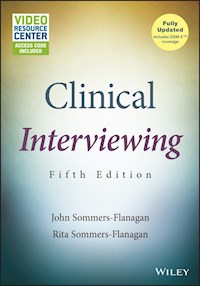
The classic guide to proven, practical strategies for conducting effective interviews Clinical Interviewing, Fifth Edition blends a personal and easy-to-read style with a unique emphasis on both the scientific basis and interpersonal aspects of mental health interviewing. It guides clinicians through elementary listening and counseling skills onward to more advanced, complex clinical assessment processes, such as intake interviewing, mental status examination, and suicide assessment. Fully revised, the fifth edition shines a brighter spotlight on the development of a multicultural orientation, the three principles of multicultural competency, collaborative goal-setting, the nature and process of working in crisis situations, and other key topics that will prepare you to enter your field with confidence, competence, and sensitivity. Included with this text is an access code for the Video Resource Center that features commentary from the authors, as well as counseling demonstrations that show what clinical interviewing skills look like in different environments and with a range of clients. Effective interviewing skills will serve to support your career for decades to come, and will help you to accurately diagnose your clients while earning their trust and creating an environment in which they feel safe and open to discussion. In Clinical Interviewing, Fifth Edition you'll find: * DSM-5(TM) content emphasizing case formulation and treatment planning * A greater emphasis on collaborative goal setting and the client as expert * New discussion on multicultural counseling, orientation, and competency * Research supporting evidence-based relationships * Coverage of assessment and interviewing via e-mail, telephone, texting, instant messaging, and online chatting * Structured protocol for conducting a face-to-face, telephone, or video conferencing/Skype mental status examination interview Clinical Interviewing, Fifth Edition is a valuable resource that will lead you through the art of interviewing diverse clients.
Sie lesen das E-Book in den Legimi-Apps auf:
Seitenzahl: 1335
Veröffentlichungsjahr: 2015
Ähnliche
















Table of Contents
Title Page
Copyright
Dedication
Video Resource Center Contents
Preface
Language Choices
What's New in the Fifth Edition?
Acknowledgments
About the Authors
Part One: Becoming a Mental Health Professional
Chapter 1: Introduction: Philosophy and Organization
Welcome to the Journey
Theoretical Orientations
Goals and Objectives of This Book
Summary
Suggested Readings and Resources
Chapter 2: Foundations and Preparations
Defining Clinical Interviewing
Self-Awareness
The Physical Setting
Professional and Ethical Issues
Summary
Suggested Readings and Resources
Part Two: Listening and Relationship Development
Chapter 3: Basic Attending, Listening, and Action Skills
Attending Behavior
Moving Beyond Attending
Nondirective Listening Behaviors
The Pull to Reassurance
Directive Listening Behaviors
Summary
Suggested Readings and Resources
Chapter 4: Directives: Questions and Action Skills
Section One: Using General and Therapeutic Questions
Section Two: Directive Interviewing Techniques (AKA Directives)
Summary
Suggested Readings and Resources
Chapter 5: Evidence-Based Relationships
Carl Rogers's Core Conditions
Evidence-Based Psychoanalytic and Interpersonal Relationship Concepts
Additional Theoretical- and Evidence-Based Concepts Related to the Therapeutic Relationship
Concluding Comments
Summary
Suggested Readings and Resources
Part Three: Structuring and Assessment
Chapter 6: An Overview of the Interview Process
Structural Models
The Introduction: First Contact
The Opening
The Body
The Closing
Termination
Summary
Suggested Readings and Resources
Chapter 7: Intake Interviewing and Report Writing
What Is an Intake Interview?
Objectives of Intake Interviewing
Factors Affecting Intake Interview Procedures
Brief Intake Interviewing
The Intake Report
Summary
Suggested Readings and Resources
Chapter 8: The Mental Status Examination
Objectivity
What Is a Mental Status Examination?
The Generic Mental Status Examination
When to Use Mental Status Examinations
Summary
Suggested Readings and Resources
Chapter 9: Suicide Assessment
Personal Reactions to Suicide
Suicide Statistics
Suicide Risk Factors
Suicide Assessment Interviewing
Suicide Intervention
Professional Issues
Summary
Suggested Readings and Resources
Chapter 10: Diagnosis and Treatment Planning
Principles of Psychiatric Diagnosis
Diagnostic Assessment: Methods and Procedures
The Science of Clinical Interviewing: Diagnostic Reliability and Validity
A Balanced Approach to Conducting Diagnostic Clinical Interviews
Treatment Planning
Summary
Suggested Readings and Resources
Part Four: Interviewing Special Populations
Chapter 11: Interviewing in a Diverse and Multicultural World
Four Large Worldviews
Other Diverse Client Populations
Cultural Complexities and Identities
Assessment and Culture-Bound Syndromes
Professional Considerations
Summary
Suggested Readings and Resources
Chapter 12: Challenging Clients and Demanding Situations
Challenging Clients
Demanding Situations: Crisis and Trauma
Summary
Suggested Readings and Resources
Chapter 13: Interviewing and Working With Young Clients
Considerations in Working With Children
The Introduction
The Opening
The Body of the Interview
The Closing
Termination
Summary
Suggested Readings and Resources
Chapter 14: Principles and Tips for Interviewing Couples and Families
Some Ironies of Interviewing Couples and Families
Interviewing Stages and Tasks
Special Considerations
Summary
Suggested Readings and Resources
Chapter 15: Interviewing in Online and Other Non–Face-to-Face (Non-FtF) Environments
Technology as an Extension of the Self
Non-FtF Assessment and Intervention Research
Ethical and Practical Issues: Problems and Solutions
Conducting Online or Non-FtF Interviews
Summary
Suggested Online Training Resources
Extended Mental Status Examination—Interview Protocol
Preparation
MSE Categories
References
Author Index
Subject Index
About the Video Resource Center
Whats available at the Video Resource Center
Customer Care
Video Resource Center
End User License Agreement
Pages
xi
xiii
xiv
xv
xvi
xvii
xix
xx
xxi
xxii
3
4
5
6
7
8
9
10
11
12
13
14
15
16
17
18
19
20
21
22
23
24
25
26
27
28
29
30
31
32
33
34
35
36
37
38
39
40
41
42
43
44
45
46
47
48
49
50
51
52
53
54
55
56
59
60
61
62
63
64
65
66
67
68
69
94
70
71
72
73
74
75
76
77
78
79
80
81
82
83
84
85
86
87
88
89
90
91
92
93
95
96
97
98
99
100
101
102
103
104
105
106
107
108
109
110
111
112
113
114
115
116
117
118
119
120
121
122
123
124
125
126
127
128
129
130
131
132
133
134
171
172
173
174
175
176
177
178
179
180
181
182
183
184
185
186
187
188
189
190
191
192
193
194
195
196
197
198
199
200
201
202
203
204
205
206
207
208
209
210
211
212
213
214
215
216
217
218
219
220
221
222
223
224
225
226
227
228
229
231
230
232
233
234
235
236
237
238
239
240
241
242
243
244
245
246
247
249
250
251
252
253
254
255
256
257
258
259
260
261
262
263
264
265
266
267
268
269
270
271
272
273
274
275
276
277
278
279
280
281
282
283
284
285
286
287
289
290
291
292
293
294
295
296
297
298
299
300
301
302
303
304
305
306
307
308
309
310
311
312
313
314
315
316
317
318
319
320
321
322
323
324
325
326
327
365
366
367
368
369
370
371
372
373
374
375
376
377
378
379
380
381
382
383
384
385
386
387
388
389
390
391
392
393
394
395
396
397
398
399
400
401
402
403
404
405
406
407
408
409
410
411
412
413
414
415
416
417
418
419
420
421
422
423
424
425
426
427
428
429
430
431
432
433
434
435
436
437
438
439
440
441
442
443
444
445
446
447
448
449
450
451
452
453
454
455
456
457
458
459
460
461
462
463
464
465
466
467
468
469
470
471
472
473
474
475
476
477
478
479
480
481
482
483
484
485
486
487
488
489
490
491
492
493
494
495
496
497
498
499
500
501
502
503
505
506
507
508
509
510
511
512
513
514
515
516
517
518
519
520
521
522
523
524
525
526
1
57
169
527
528
529
530
531
532
533
534
535
537
538
539
540
541
542
543
544
545
546
547
548
549
550
551
552
553
554
555
556
557
558
559
560
561
562
563
564
565
566
567
568
569
570
571
572
573
574
575
576
577
578
579
580
597
598
581
582
583
584
585
586
587
588
589
591
592
593
594
595
596
Guide
Cover
Table of Contents
Preface
Part One: Becoming a Mental Health Professional
Begin Reading
List of Illustrations
List of Tables
Chapter 2: Foundations and Preparations
Table 2.2 Example of SOAP Note
Chapter 3: Basic Attending, Listening, and Action Skills
Table 3.1 Summary of Nondirective Listening Behaviors and Their Usual Effects
Table 3.2 Summary of Directive Listening Behaviors and Their Usual Effects
Chapter 4: Directives: Questions and Action Skills
Table 4.1 Question Classification
Table 4.2 Potential Benefits and Liabilities of Questions
Table 4.3 Summary of Directive Techniques and Their Usual Effects
Chapter 6: An Overview of the Interview Process
Table 6.1 Checklist for Introduction Stage
Table 6.2 Checklist for Opening Stage
Table 6.3 Checklist for Body Stage
Table 6.4 Checklist for Closing Stage
Table 6.5 Checklist for Termination Stage
Chapter 7: Intake Interviewing and Report Writing
Table 7.1 Personal History Interview Sample Questions
Table 7.2 A Brief Intake Checklist
Chapter 8: The Mental Status Examination
Table 8.1 Descriptors of Client Attitude Toward the Examiner
Table 8.2 Thought Process Descriptors
Table 8.4 Mental Status Examination Checklist
Chapter 10: Diagnosis and Treatment Planning
Table 10.1 Diagnostic Criteria for Generalized Anxiety Disorder (
DSM-5
: 300.02)
Chapter 11: Interviewing in a Diverse and Multicultural World
Table 11.1 Dos and Don'ts of Initial Interviews With Multicultural Clients
Table 11.2 Culturally Specific Mental, Emotional, and Behavioral Disorders
Chapter 12: Challenging Clients and Demanding Situations
Table 12.1 Summary Checklist of Strategies and Techniques for Managing Resistance
Table 12.2 A General Guide to Violence Assessment
FIFTH EDITION
CLINICAL INTERVIEWING
John Sommers-Flanagan Rita Sommers-Flanagan
This book is printed on acid-free paper.
Copyright © 2015 by John Wiley & Sons, Inc. All rights reserved.
Published by John Wiley & Sons, Inc., Hoboken, New Jersey.
Published simultaneously in Canada.
No part of this publication may be reproduced, stored in a retrieval system, or transmitted in any form or by any means, electronic, mechanical, photocopying, recording, scanning, or otherwise, except as permitted under Section 107 or 108 of the 1976 United States Copyright Act, without either the prior written permission of the Publisher, or authorization through payment of the appropriate per-copy fee to the Copyright Clearance Center, Inc., 222 Rosewood Drive, Danvers, MA 01923, (978) 750-8400, fax (978) 646-8600, or on the web at www.copyright.com. Requests to the Publisher for permission should be addressed to the Permissions Department, John Wiley & Sons, Inc., 111 River Street, Hoboken, NJ 07030, (201) 748-6011, fax (201) 748-6008.
Limit of Liability/Disclaimer of Warranty: While the publisher and author have used their best efforts in preparing this book, they make no representations or warranties with respect to the accuracy or completeness of the contents of this book and specifically disclaim any implied warranties of merchantability or fitness for a particular purpose. No warranty may be created or extended by sales representatives or written sales materials. The advice and strategies contained herein may not be suitable for your situation. You should consult with a professional where appropriate. Neither the publisher nor author shall be liable for any loss of profit or any other commercial damages, including but not limited to special, incidental, consequential, or other damages.
This publication is designed to provide accurate and authoritative information in regard to the subject matter covered. It is sold with the understanding that the publisher is not engaged in rendering professional services. If legal, accounting, medical, psychological or any other expert assistance is required, the services of a competent professional person should be sought.
Designations used by companies to distinguish their products are often claimed as trademarks. In all instances where John Wiley & Sons, Inc. is aware of a claim, the product names appear in initial capital or all capital letters. Readers, however, should contact the appropriate companies for more complete information regarding trademarks and registration.
For general information on our other products and services please contact our Customer Care Department within the United States at (800) 762-2974, outside the United States at (317) 572-3993 or fax (317) 572-4002.
Wiley publishes in a variety of print and electronic formats and by print-on-demand. Some material included with standard print versions of this book may not be included in e-books or in print-on-demand. If this book refers to media such as a CD or DVD that is not included in the version you purchased, you may download this material at http://booksupport.wiley.com. For more information about Wiley products, visit www.wiley.com.
Library of Congress Cataloging-in-Publication Data:
Sommers-Flanagan, John, 1957–
Clinical interviewing / John Sommers-Flanagan, Rita Sommers-Flanagan— Fifth edition.
pages cm
Includes bibliographical references and index.
ISBN 978-1-119-08423-5 (pbk.)
ISBN 978-1-119-08786-1 (ePDF)
ISBN 978-1-119-08790-8 (ePub)
1. Interviewing in mental health. 2. Interviewing in psychiatry. I. Sommers-Flanagan, Rita, 1953– II. Title.
RC480.7.S66 2013
616.8900835— dc23
2013010134
To Chelsea: in honor of your excellent interviewing skills and perpetual pursuit of knowledge.
To Seth: for being able to pass Chelsea's premarital interviewing examinations and for your service to the world community.
To Rylee: for having the heart, soul, and spirit for coping with the rest of us and the ambition to become a Supreme Court justice.
To Margaret and Davis: Someday soon we'll make a video of ourselves reading you this exciting book.
We love you all and look forward to many more excellent life adventures together.
Video Resource Center Contents
VRC Sections
Introduction
Basic Listening Skills
Directive Listening Responses
Directives & Action Responses
Questions & Therapeutic Questions
Intake Interview
Mental Status Examination
Suicide Assessment Interview
VRC Counseling Demonstrations
Maegan & Jessie: Basic Listening Skills
John & Trudi: Directive Listening Responses
John & T.J.: Directive Listening Responses
John & Lisa: Directives & Action Responses
Part I
John & Lisa: Directives & Action Responses
Part II
Chris & Ümüt: Questions & Therapeutic Questions
John & T.J.: Questions & Therapeutic Questions
Rita & Michele: Intake Interview
Part I
Rita & Michele: Intake Interview
Part II
Rita & Michele: Intake Interview
Part III
John & Carl: Mental Status Examination
Part I
John & Carl: Mental Status Examination
Part II
John & Tommie: Suicide Assessment Interview
Part I
John & Tommie: Suicide Assessment Interview
Part II
John & Tommie: Suicide Assessment Interview
Part III
Preface
Clinical interviewing is the cornerstone for virtually all mental health work. It involves integrating varying degrees of psychological or psychiatric assessment and treatment. The origins of clinical interviewing long precede the first edition of this text (published in 1993).
The term interview dates back to the 1500s, originally referring to a face-to-face meeting or formal conference. The term clinical originated around 1780; it was used to describe a dispassionate, supposedly objective bedside manner in the treatment of hospital patients. Although difficult to determine precisely when clinical and interview were joined in modern use, it appears that Jean Piaget used a variant of the term clinical interview in 1920 to describe his approach to exploring the nature and richness of children's thinking. Piaget referred to his procedure as a semi-clinical interview (see Sommers-Flanagan, Zeleke, & Hood, in press).
Our initial exposure to clinical interviewing was in the early 1980s in a graduate course at the University of Montana. Our professor was highly observant and intuitive. We would huddle together around an old cassette player and listen to fresh new recordings of graduate students interviewing perfect strangers. Typically, after listening to about two sentences our professor would hit the pause button and prompt us: “Tell me about this person.”
We didn't know anything, but would offer limited descriptions like “She sounds perky” or “He says he's from West Virginia.” He would then regale us with predictions. “Listen to her voice,” he would say, “she's had rough times.” “She's depressed, she's been traumatized, and she's come to Montana to escape.”
The eerie thing about this process was that our professor was often correct in what seemed like wild predictions. These sessions taught us to respect the role of astute observations, experience, and intuition in clinical interviewing.
Good intuition is grounded on theoretical and practical knowledge, close observation, clinical experience, and scientific mindedness. Bad intuition involves personalized conclusions that typically end up being a disservice to clients. Upon reflection, perhaps one reason we ended up writing and revising this book is to provide a foundation for intuition. In fact, it's interesting that we rarely mention intuition in this text. Although one of us likes to make wild predictions of the future (including predictions of the weather on a particular day in Missoula, Montana, about three months in advance), we still recognize our limitations and encourage you to learn the science of clinical interviewing before you start practicing the art.
Language Choices
We live in a postmodern world in which language is frequently used to construct and frame arguments. The words we choose to express ourselves cannot help but influence the message. Because language can be used to manipulate (as in advertising and politics), we want to take this opportunity to explain a few of our language choices so you can have insight into our biases and perspectives.
Patient or Client or Visitor
Clinical interviewing is a cross-disciplinary phenomenon. While revising this text we sought feedback from physicians, psychologists, social workers, and professional counselors. Not surprisingly, physicians and psychologists suggested we stick with the term patient, whereas social workers and counselors expressed strong preferences for client. As a third option, in the Mandarin Chinese translation of the second edition of this text, the term used was visitor.
After briefly grappling with this dilemma, we decided to primarily use the word client in this text, except for cases in which patient is used in previously quoted material. Just as Carl Rogers drifted in his terminology from patient to client to person, we find ourselves moving away from some parts and pieces of the medical model. This doesn't mean we don't respect the medical model, but that we're intentionally choosing to use more inclusive language that emphasizes wellness. We unanimously voted against using visitor—although thinking about the challenges of translating this text to Mandarin made us smile.
Sex and Gender
Consistent with Alfred Adler, Betty Freidan, contemporary feminist theorists, and American Psychological Association (APA) style, we like to think of ourselves as promoting an egalitarian world. As a consequence, we've dealt with gender in one of two ways: (1) when appropriate, we use the plural clients and their when referring to case examples; and (2) when necessary, we alternate our use between she and he.
Interviewer, Psychotherapist, Counselor, or Therapist
While working at a psychiatric hospital in 1980, John once noticed that if you break down the word therapist it could be transformed into the-rapist. Shocked by his linguistic discovery, he pointed it out to the hospital social worker, who quipped back, “That's why I always call myself a counselor!”
This is a confusing issue and difficult choice. For the preceding four editions of this text we used the word interviewer because it fit so perfectly with the text's title, Clinical Interviewing. However, we've started getting negative feedback about the term. One reviewer noted that he “hated it.” Others complained “It's too formal” and “It's just a weird term to use in a text that's really about counseling and psychotherapy.”
Given the preceding story, you might think that we'd choose the term counselor, but instead we've decided that exclusively choosing counselor or psychotherapist might inadvertently align us with one professional discipline over another. The conclusion: Mostly we use therapist and occasionally we leave in the term interviewer and also allow ourselves the freedom to occasionally use counselor, psychotherapist, and clinician.
What's New in the Fifth Edition?
As the world changes, our understanding of the world needs to change as well. In this fifth edition, we've worked to make the content accessible, culturally tuned-in, accurate, and sometimes provocative. We've made our examples more current and relevant to the technological and diagnostic changes witnessed in recent years.
Although there are too many minor changes to list, here are the 19 biggest changes:
All chapters have been revised and updated using feedback from over 50 graduate students and professors from various disciplines throughout the United States.
Chapters 1
,
2
,
3
,
4
,
7
,
8
, and
9
now include Video Resource Center (VRC) call-outs. These call-outs provide instructors with suggestions about where material from the new accompanying Clinical Interviewing VRC might be included.
Chapter 1
includes a new section on developing a multicultural orientation and the three principles of multicultural competency.
Consistent with an evidence-based approach, there's a greater emphasis on collaborative goal setting and the client as expert beginning in
Chapter 2
and throughout the text.
Within the context of professional attire,
Chapter 2
also includes a new section on cleavage.
Chapter 3
includes a new multicultural highlight focusing on eye contact and including contrasting views on the subject between two professional Black or African American females, as well as new material on summarization and a new section on immediacy.
In response to reviewer feedback,
Chapter 4
has been reorganized into two sections. Section One is Using General and Therapeutic Questions, and Section Two is Directive Interviewing Techniques. Additional content has been added on Adler's “The Question” as well as the four main questions of reality therapy. There's also a new Putting It in Practice feature titled A General Guide to Using Stages of Change Principles in Clinical Interviewing.
Chapter 5
has been substantially reorganized to shift its emphasis from theory-based relationship factors to research-supported evidence-based relationships.
In
Chapter 6
we've added a section on personalismo and making cultural connections. A new Putting It in Practice on developing an informed consent form is included. There's also a new Multicultural Highlight focusing on a universal exclusion criterion for mental disorders and new content on developing case formulations.
Chapter 7
includes a new section on Reviewing Goals with Clients.
Chapter 8
includes a new section on the Dangers of Single Symptom Generalizations. There's also new content on flashbacks, memory, and on writing the mental status examination report.
A new Putting It in Practice on the latest acronym for suicide risk (IS PATH WARM) is featured in
Chapter 9
. The chapter is substantially updated with a greater emphasis on the interpersonal theory of suicide. A new Putting It in Practice designed to help beginning clinicians become more comfortable talking about suicide with clients is also included.
Chapter 10
has been reorganized and rewritten to correspond with
DSM-5
and now also emphasizes case formulation and treatment matching variables in addition to treatment planning.
The last several chapters were reordered, with
Chapter 11
now becoming the Multicultural Interviewing chapter.
Chapter 11
now includes a new section on professional issues.
Chapter 12
includes a new Table: A General Guide to Violence Assessment. It also has undergone a major rewrite to more completely clarify the nature and process of working in crisis situations, including a description of psychological first aid.
Chapter 13
has a new emphasis on preparation for working with youth, including a section on limit setting in the session.
Chapter 14
has a new Multicultural Highlight, focusing on helping new clinicians expand their comfort zone when working with sexuality issues.
Chapter 15
is a new chapter focusing on online and non-face-to-face interviewing formats.
All chapters have been updated to include the most recent research and practice as it pertains to clinical interviewing.
Using the Video Resource Center (VRC) That Comes With This Text
This fifth edition of Clinical Interviewing has an accompanying videos hosted online at the VRC designed to bring interviewing skills described in this text to life. If you decide to use the videos to supplement your learning, you should be aware of two things:
First, the videos are is not scripted. Instead of writing out a script to make sure we covered every possible skill in exactly the right order, we decided it would be a better learning tool for you to see us and our colleagues engaging in live and unscripted interviewing interactions. This was a judgment call, and some readers may wish for a more mechanical teaching and learning resource. However, after watching a number of other videos designed to help teach interviewing, counseling, and psychotherapy skills, we decided reality was more engaging than play acting. In the end, although volunteer clients and therapists were provided with guidelines and outlines about what to cover, the recorded interactions are spontaneous. The result: Sometimes specific techniques are illustrated out of sequence. For example, in the Basic Listening Skills demonstration featuring Maegan Hopkins as the counselor, Maegan demonstrates the use of an open question…even though basic listening skills are the focus in Chapter 3 and questions aren't covered until Chapter 4.
Second, the VRC is organized in a way that allows you to access specific content as needed.
The videos are divided into eight sections. Each section shows us discussing a topic and introducing the upcoming counseling demonstration vignette. However, if you prefer to skip our exciting discussions and introductory comments, you can watch the 15 different specific counseling demonstrations.
To help you identify places in the text that are linked to particular video content, we have two different forms of call-outs. The first type of call-out indicates where it might be beneficial to watch a specific video section in which we discuss a skill and introduce a counseling demonstration. The second type of call-out links particular text sections with specific counseling demonstrations. Access to the Clinical Interviewing DVD can also be purchased separately at www.wiley.com/go/videoresourcecenter. However you use it, we hope you find the VRC helpful to the teaching and learning process.
Using the Online Instructor's Manual and Ancillary Materials
The online instructor's manual and ancillary materials were designed to help make teaching clinical interviewing more pleasant and efficient. Through your John Wiley & Sons sales representative or via the Wiley website, adopting this text gives you access to the following instructional support:
An online Instructor's Manual, coauthored with Lindsey Nichols, Ph.D., that has supplementary lecture material, discussion questions, and classroom demonstrations and activities.
A test bank, coauthored with Emily Sidor, M.A., that has over 40 test items for each chapter.
A downloadable set of generic PowerPoint slides geared to the textbook chapters.
Acknowledgments
Like raising children, producing a textbook requires a small village. We have many people to thank.
Thanks to our editor, Rachel Livsey: Your patience and optimism—not to mention your gentle persuasive skills—have encouraged us and helped sustain our focus. Thanks to Judi Knott for 5 A.M. e-mails, your “likes” on our Facebook page, and your consistent advocacy for our work. Thanks to Sweta Gupta whose eagle eyes and positive encouragement have been essential to the publication of this textbook. Thanks also to Amanda Orenstein whose e-mail turnaround time and efficiency is breathtaking, and to Kim Nir, Eileen Gewirtzman, and Jane Domino in production. And finally, thanks to the unknown members of the John Wiley & Sons publishing team. We know you're out there and we deeply appreciate your support.
In addition to our fabulous Wiley team, we also have had substantial support from mentors, fellow professionals, graduate students, and family members. The following list includes individuals who have either provided significant inspiration, or feedback for content in one or more chapters.
Amber Bach-Gorman, MS, North Dakota State University
Carolyn A. Berger, PhD, Nova Southeastern University
Jessica Berry, MA, Idaho State University
Philip P. Bornstein, PhD, University of Montana
Mikal Crawford, EdD, Husson University
Rochelle Cade, PhD, Mississippi College
Eric S. Davis, PhD, Argosy University-Tampa
Susan Davis, PhD, Independent Practice, Buffalo, NY
Neil Duchac, PhD, Capella University
Carlos M. Del Rio, Ph.D, Southern Illinois University Carbondal
Jennifer Fearn, MA, Chicago School of Professional Psychology
Christine Fiore, PhD, University of Montana
Kerrie (Kardatzke) Fuenfhausen, PhD, Lenoir-Rhyne University
Irene Garrick, PhD, Mental Health Counseling Group
Kristopher M. Goodrich, PhD, University of New Mexico
Elizabeth Hancock, M.S., Auburn University
Jo Hittner, PhD, Winona State University
Keely J. Hope, PhD, Eastern Washington University
Dawn Hudak, EdD, Lamar University
Eric Jett, MA, Walden University
Kimberly Johnson, EdD, DeVry University Online
David Jobes, PhD, Catholic University of America
Veronica Johnson, EdD, Winona State University
Jonathan Lent PhD, Marshall University
Charles Luke, PhD, Tennessee Tech University
Melissa Mariani, PhD, Florida Atlantic University
Doreen S. Marshall, PhD, Argosy University-Atlanta
John R. Means, PhD, University of Montana
Scott T. Meier, PhD, University at Buffalo
Ryan Melton, PhD, Portland State University
Teah L. Moore, PhD, Fort Valley State University
Michelle Muenzenmeyer, PhD, Webster University
Robert Musikantow, PhD, Adler School of Professional Psychology
Charles E. Myers, PhD, Northern Illinois University
James Overholser, PhD, Case Western Reserve University
Shawn Parmanand, PhD, Walden University
Jennifer Pereira, PhD, Argosy University, Tampa
Senel Poyrazli, PhD, Pennsylvania State University-Harrisburg
Angela S. Shores, PhD, Montreat College
Carmen Stein, PhD, Independent Practice
Kendra A. Surmitis, MA, College of William & Mary
Jacqueline Swank, PhD, University of Florida
Rebecca Tadlock-Marlo, PhD, Eastern Illinois Univeristy
Anna M. Viviani, PhD, Indiana State University
John G. Watkins, PhD, University of Montana
Janet P. Wollersheim, PhD, University of Montana
Carlos Zalaquette, PhD, University of South Florida
About the Authors
Photo courtesy of Todd Johnson, University of Montana.
John Sommers-Flanagan, PhD, is a clinical psychologist and professor of counselor education at the University of Montana. He has been a columnist for the Missoulian newspaper, a local public radio show co-host of “What Is It with Men?,” and is coauthor of over 50 professional publications. John is a long-time member of both the American Counseling Association and the American Psychological Association and regularly presents professional workshops at the annual conferences of both these organizations.
Rita Sommers-Flanagan, PhD, has been a professor of counselor education at the University of Montana for the past 21 years. Her favorite teaching and research areas are ethics and women's issues, and she served as the director of Women's Studies at the University of Montana, as well as the acting director of the Practical Ethics Center. She is the author or co-author of over 40 articles and book chapters, and most recently authored a chapter entitled “Boundaries, Multiple Roles, and Professional Relationships” in the new APA Handbook on Ethics in Psychology. She is also a clinical psychologist, and has worked with youth, families, and women for many years.
John and Rita work together as the mental health consultants for Trapper Creek Job Corps. They also enjoy providing seminars and professional presentations nationally and internationally.
Together, John and Rita have coauthored nine books, including books aimed at helping mental health professionals work more effectively with their clients. These include:
How to Listen so Parents Will Talk and Talk so Parents Will Listen
(Wiley)
Tough Kids, Cool Counseling
(American Counseling Association)
Problem Child or Quirky Kid
(Free Spirit Press)
The Last Best Divorce Book
(Families First)
Don't Divorce Us!
(American Counseling Association; also available in Turkish, co-authored with Senel Poyralzi)
John and Rita have also written two other textbooks with John Wiley & Sons. They are:
Counseling and Psychotherapy Theories: In Context and Practice
,
Second Edition
Becoming an Ethical Helping Professional
John and Rita have two daughters, one son in-law, twin grandbabies, and can hardly believe their good fortune. They are deeply rooted in Montana, and in the summers, alternate writing with irrigating and haying on the family ranch. Both John and Rita enjoy professional speaking, exercising, gardening, exploring alternative energy technologies, and restoring old log cabins, old sheds, and any other old thing that crosses their path—which, given the passage of time, is now starting to include each other.
Part OneBecoming a Mental Health Professional
Chapter 1Introduction
Chapter Objectives
This chapter welcomes you to the professional field of clinical interviewing and orients you to the philosophy and organization of this book. After reading this chapter, you will understand:
The philosophy and organization of this book.
How becoming a mental health professional can be both challenging and gratifying.
The authors' teaching philosophy.
An effective learning sequence for acquiring clinical interviewing skills.
How clinicians from different theoretical orientations approach the interviewing task.
Why and how a multicultural orientation to interviewing can be useful.
Advantages and disadvantages of being nondirective in your interviewing approach.
Your potential cultural biases when interviewing.
Lesen Sie weiter in der vollständigen Ausgabe!
Lesen Sie weiter in der vollständigen Ausgabe!
Lesen Sie weiter in der vollständigen Ausgabe!
Lesen Sie weiter in der vollständigen Ausgabe!
Lesen Sie weiter in der vollständigen Ausgabe!
Lesen Sie weiter in der vollständigen Ausgabe!
Lesen Sie weiter in der vollständigen Ausgabe!
Lesen Sie weiter in der vollständigen Ausgabe!
Lesen Sie weiter in der vollständigen Ausgabe!
Lesen Sie weiter in der vollständigen Ausgabe!
Lesen Sie weiter in der vollständigen Ausgabe!
Lesen Sie weiter in der vollständigen Ausgabe!
Lesen Sie weiter in der vollständigen Ausgabe!
Lesen Sie weiter in der vollständigen Ausgabe!
Lesen Sie weiter in der vollständigen Ausgabe!
Lesen Sie weiter in der vollständigen Ausgabe!
Lesen Sie weiter in der vollständigen Ausgabe!
Lesen Sie weiter in der vollständigen Ausgabe!
Lesen Sie weiter in der vollständigen Ausgabe!
Lesen Sie weiter in der vollständigen Ausgabe!
Lesen Sie weiter in der vollständigen Ausgabe!
Lesen Sie weiter in der vollständigen Ausgabe!
Lesen Sie weiter in der vollständigen Ausgabe!
Lesen Sie weiter in der vollständigen Ausgabe!




