


0,00 €
Mehr erfahren.
- Herausgeber: Integritas Communications
- Kategorie: Fachliteratur
- Sprache: Englisch
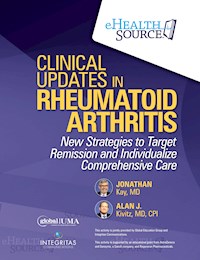
This eHealth Source™ activity has been developed as a text-based eBook with additional video clips to update clinicians on the latest evidence-based information to guide RA management, with a focus on inhibition of IL-6 signaling.
Das E-Book können Sie in Legimi-Apps oder einer beliebigen App lesen, die das folgende Format unterstützen:
Seitenzahl: 60
Veröffentlichungsjahr: 2018
Ähnliche



















CLINICAL UPDATES IN RHEUMATOID ARTHRITIS
New Strategies to Target Remission and Individualize Comprehensive Care
Jonathan Kay, MD and Alan J. Kivitz, MD, CPI

PRONOUN
© 2017-2018 Integritas Communications.
All rights reserved. No part of this syllabus may be used or reproduced in any manner whatsoever without written permission except in the case of brief quotations embedded in articles or reviews.
TABLE OF CONTENTS
Faculty: Jonathan Kay, MD
Alan J. Kivitz, MD, CPI
Preamble: Target Audience
Statement of Need/Program Overview
References
Educational Objectives
Physician Accreditation Statement
Physician Credit Designation
Global Contact Information
Instructions to Receive Credit
Fee Information & Refund/Cancellation Policy
Disclosure of Conflicts of Interest
Disclosure of Unlabeled Use
Disclaimer
Chapter 1: Rheumatoid Arthritis Pathophysiology and the Roles of IL-6
Articular and Extra-Articular Disease Manifestations
Factors Contributing to RA Development: A Focus on IL-6
Key Clinical Highlights
References
Chapter 2: Comprehensively Evaluating Patients With Rheumatoid Arthritis
Core Tenets of Treating to Target in RA
Validated Measures of Disease Activity
Additional Evaluation Considerations
Key Clinical Highlights
References
Chapter 3: Biologic Inhibitors of IL-6 Signaling
Tocilizumab
Sarilumab
Key Clinical Highlights
References
Chapter 4: Individualizing Rheumatoid Arthritis Management and the Role of IL-6 Inhibition
Shared Clinical Decision-Making in Rheumatoid Arthritis Management
Positioning Inhibitors of IL-6 Signaling in RA Treatment Algorithms
Key Clinical Highlights
References
Rheumatoid Arthritis Clinical Resource Center™: Guidelines
Patient Resources
American College of Rheumatology Disease Overview
American College of Rheumatology Patient Education Videos
Arthritis Foundation
Handout on Health: Rheumatoid Arthritis
Rheumatoid Arthritis Support Network
Suggested Reading
Effect of interleukin-6 receptor blockade on surrogates of vascular risk in rheumatoid arthritis: MEASURE, a randomised, placebo-controlled study.
Efficacy and safety of sarilumab monotherapy versus adalimumab monotherapy for the treatment of patients with active rheumatoid arthritis (MONARCH): a randomised, double-blind, parallel-group phase III trial.
IL-6 inhibitors for treatment of rheumatoid arthritis: past, present, and future.
Measures of rheumatoid arthritis disease activity.
The pathogenesis of rheumatoid arthritis.
Rheumatoid arthritis disease activity measures: American College of Rheumatology recommendations for use in clinical practice.
Sarilumab improves patient-reported outcomes in rheumatoid arthritis patients with inadequate response/intolerance to tumour necrosis factor inhibitors.
Sarilumab plus methotrexate in patients with active rheumatoid arthritis and inadequate response to methotrexate: results of a phase III study.
Sarilumab and nonbiologic disease-modifying antirheumatic drugs in patients with active rheumatoid arthritis and inadequate response or intolerance to tumor necrosis factor inhibitors.
Synovial phenotypes in rheumatoid arthritis correlate with response to biologic therapeutics.
Tocilizumab in early progressive rheumatoid arthritis: FUNCTION, a randomised controlled trial.
Tocilizumab inhibits structural joint damage in rheumatoid arthritis patients with inadequate responses to methotrexate: results from the double-blind treatment phase of a randomized placebo-controlled trial of tocilizumab safety and prevention of structural joint damage at one year.
Tocilizumab monotherapy versus adalimumab monotherapy for treatment of rheumatoid arthritis (ADACTA): a randomised, double-blind, controlled phase 4 trial.
CME Posttest
FACULTY
JONATHAN KAY, MD
Timothy S. & Elaine L. Peterson Chair in Rheumatology & Professor of Medicine
University of Massachusetts Medical School
Director of Clinical Research, Rheumatology
UMass Memorial Medical Center
Worcester, Massachusetts
Dr. Jonathan Kay is Professor of Medicine at the University of Massachusetts Medical School and a physician at UMass Memorial Medical Center in Worcester, where he directs clinical research in the Division of Rheumatology. He received his medical degree from the University of California School of Medicine in San Francisco, California. He then completed an internship and residency at the Hospital of the University of Pennsylvania in Philadelphia and fellowships in rheumatology and immunology at The Brigham and Women’s Hospital and Harvard Medical School in Boston, Massachusetts.
Dr. Kay is an ad hoc reviewer for many journals, a member of the editorial boards of Best Practice and Research Clinical Rheumatology and the Journal of Clinical Rheumatology, and a member of the Advisory Board of Arthritis Research and Therapy. Section Editor of “Systemic Disorders with Rheumatic Manifestations” for Current Opinion in Rheumatology, he has presented his work at international lectures and authored more than 100 journal articles and book chapters.
Dr. Kay is a Fellow of the American College of Rheumatology and of the American College of Physicians. His clinical interests span the spectrum of rheumatic diseases, with special interest in rheumatoid arthritis and other forms of inflammatory arthritis. He was a member of the group that developed the 2010 American College of Rheumatology/European League Against Rheumatism (ACR/EULAR) Diagnostic and Classification Criteria for Rheumatoid Arthritis. He chairs the Rheumatology Working Group and is a member of the Internal Medicine and Musculoskeletal Topic Advisory Groups for the World Health Organization in its Revision of the International Classification of Diseases (ICD)-11.
ALAN J. KIVITZ, MD, CPI
President of Altoona Arthritis and Osteoporosis Center
Medical Lab Director for Adult and Pediatric Rheumatology Lab
Duncansville, Pennsylvania
Dr. Alan J. Kivitz is the Founder and Medical Director of the Altoona (Pennsylvania) Center for Clinical Research and Altoona Arthritis and Osteoporosis Center in Duncansville, Pennsylvania. As a practicing physician, Dr. Kivitz has more than 34 years of experience treating patients with arthritis and rheumatic disorders. He received his medical degree from Albany Medical College in Albany, New York. He completed training in internal medicine at the North Shore University Hospital in Manhasset, New York, and at Memorial Sloan Kettering Cancer Center in New York, New York. He then completed his fellowship in rheumatology at Albany Medical College. He is board certified in internal medicine as well as the subspecialty of rheumatology.
Dr. Kivitz has authored and coauthored more than 200 research articles and abstracts covering osteoarthritis, osteoporosis, rheumatoid arthritis, and pain management. He has also served as a Principal Investigator or Sub Investigator in more than 900 clinical trials. In addition, his studies have been published in several prestigious medical journals including The New England Journal of Medicine, Pain Medicine, Journal of the American Medical Association, Arthritis & Rheumatology, and Journal of Clinical Rheumatology. He has served as a consultant on numerous osteoarthritis and rheumatoid arthritis clinical trials.
Dr. Kivitz is an active member of the Pennsylvania Medical Society, the American Medical Association, and the International Society for Clinical Densitometry. He holds certifications in Human Subjects Protection and HIPAA Research Training, and is deemed a Certified Principal Investigator by the Association of Clinical Research Professionals. His research has focused on the development of newer strategies for treating patients with arthritis and rheumatic disorders.
PREAMBLE
TARGET AUDIENCE
THE EDUCATIONAL DESIGN OF THIS activity addresses the needs of rheumatologists and other clinicians involved in the ongoing management of patients with rheumatoid arthritis (RA).
STATEMENT OF NEED/PROGRAM OVERVIEW
RA is a chronic, progressive inflammatory autoimmune disease producing both articular and extra-articular manifestations.1,2 Of note, studies have shown that mortality risks are 50% higher in people with RA compared with the general population.3




