


Erhalten Sie Zugang zu diesem und mehr als 300000 Büchern ab EUR 5,99 monatlich.
- Herausgeber: Jonathan Ball
- Kategorie: Lebensstil
- Sprache: Englisch
At 34, Heyneke Meyer was fired as head coach of a Super Rugby team for the second time. But when on 19 May 2007 his Bulls side became the first South African team to capture the Super title, the dark years at Loftus Versfeld were suddenly forgotten. And Meyer was regarded as the coach among coaches. Because it is there - on the playing field - that coaches and players are judged. And yet the scoreboard never tells the full story of how people achieved success overnight'. In Meyer's case it was an arduous journey of more than seven years during which he defined and changed professional rugby. This is leadership. And leadership is what Coach is about - people who have fundamentally changed a sport, an industry, a way of thinking, and, ultimately, lives. Marco Botha sat in conversation with some of South Africa's foremost sports leaders and interprets their diverse success stories in his narrative writing style. From Meyer to Brendan Venter, who helped turn Saracens into a super club and the Sharks into the 2013 Currie Cup champions. As an international hockey player, Sherylle Calder noticed something special' about her own visual abilities and researched this together with Professor Tim Noakes. The Eye Lady' was instrumental in England (2003) and South Africa (2007) winning the Rugby World Cup and Ernie Els bagging his second British Open golf title in 2012. Former Springbok Sevens coach Paul Treu advanced rugby sevens as a world sport by regularly getting his team to tower above seemingly superior sides. One innovation at a time. Gary Kirsten and Paddy Upton guided the Indian national cricket team to glory with a leadership style that empowered players and developed them as human beings - the new school' of coaching. With the same approach they helped the Proteas become the number one team in the world in all three formats of the game. These remarkable leaders have made champions out of ordinary people. And the reasons for this will certainly surprise you . . .
Sie lesen das E-Book in den Legimi-Apps auf:
Seitenzahl: 559
Veröffentlichungsjahr: 2014
Das E-Book (TTS) können Sie hören im Abo „Legimi Premium” in Legimi-Apps auf:
Ähnliche


















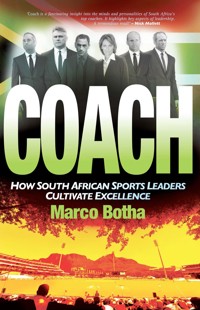
At 34, Heyneke Meyer was fired as head coach of a Super Rugby team for the second time. But when, in 2007, his Bulls side became the first South African team to win the Super title, the dark years at Loftus Versfeld were suddenly forgotten.
Coaches, like players, are judged on the playing field, but the scoreboard never tells the full story of how they achieved success. In Meyer’s case it was an arduous journey, during which he redefined professional rugby through his leadership style. And leadership is what Coach is about – people who have fundamentally changed a sport, an industry, a way of thinking and people’s lives.
Marco Botha sat in conversation with some of South Africa’s foremost sports leaders and interprets their diverse success stories.
Brendan Venter helped turn Saracens into a top club and the Sharks into the 2013 Currie Cup champions.
As an international hockey player, Sherylle Calder noticed something special about her own visual abilities and researched this together with Professor Tim Noakes. The ‘Eye Lady’ was instrumental in England and South Africa’s victories in the Rugby World Cup, and Ernie Els bagging his second British Open golf title in 2012.
Former Springbok Sevens coach Paul Treu advanced rugby sevens as a world sport by regularly getting his team to tower above seemingly superior sides.
Gary Kirsten and Paddy Upton guided the Indian national cricket team to glory with a leadership style that empowered players and developed them as human beings – the new school of coaching. With the same approach they helped the Proteas become the world-number-one cricket team in all three formats of the game.
These remarkable leaders have made champions out of ordinary people.
The reason for their success stories will surprise you …
COACH
HOW SOUTH AFRICAN SPORTS LEADERS CULTIVATE EXCELLENCE
Marco Botha
JONATHAN BALL PUBLISHERS
Johannesburg & Cape Town
I dedicate Coach to my wife, Maritza, who had to share me with the writing process for more than a year. My first book is also dedicated to Yda Coetsee (1959–2005), in whose Afrikaans class I was taught as a 14-year-old at the Oakdale Agricultural High School to love words and to use them with respect and creativity.
Marco Botha is a reporter at Die Burger. He was previously the senior national rugby writer in Pretoria for Rapport, Beeld, Die Burger and Volksblad, touring with and reporting on the Springboks, the Bulls and the Blitzbokke. He has a great appreciation for interesting leaders and good wine.
INTRODUCTION
This introduction is really a postmortem. It is written after the rest of the book has been completed and I have a final opportunity to reflect on it.
This introduction is the start of the book for you, and a way for me to encapsulate in a nutshell the experiences I have had and the insights I have gained over more than a year of writing, and to give you an early impression of what follows.
Imagine if life were like that. Imagine that, at the start of anything you embarked on, you already possessed all the knowledge and all the possible answers. In that case, I know now, I would have liked to understand love better. Not only so that I can be a better husband to my wife, but because after writing this book I now comprehend that love and leadership are really one and the same thing. From that perspective, I would have liked to do certain things differently in my life.
This was not what I initially envisaged with Coach, but that is why one writes the introduction at the end, as I know now.
This book started out as a project that Paul Treu and I embarked on together. Our plan was to focus only on sevens rugby, and to compare shared values and principles in professional sport with those in the business world. And vice versa. Both of us enjoy watching the TV programme Sakegesprek met Theo Vorster. With that as our point of departure, we went to see Theo in November 2012 at Galileo Capital’s offices in Hyde Park, Johannesburg.
It was here that Coach first began to assume the form of the end product you now hold in your hands. Theo is an ardent follower of sports and engages with some of South Africa’s top business leaders through Sakegesprek. His suggestion was that we open the doors to more sports than sevens rugby, precisely because this remarkable and colourful country of ours also has some of the world’s foremost sports leaders – people who have done pioneering work. And theirs are stories to be told.
When Ingeborg Pelser of Jonathan Ball Publishers became involved shortly afterwards – again thanks to Theo’s good offices – the book evolved further. I started doing my research, asked a number of sports leaders to participate and conducted the first interview on 26 February 2013.
At that stage, most of the people in this book were just famous coaches to me, with well-known successes under their belt. My intention was to explore and recount the background to these accomplishments. Apart from Paul Treu and Ian Schwartz, I didn’t know any of them well, nor did I know what they were like as people.
I had a prior idea of a particular goal I wanted to achieve with each interview, but during each interview, as I got to know the human being better, my approach became completely transformed, and I was personally enriched by ordinary people’s inspiring perspectives on sport, life and leadership.
When research and interviews are embarked on with a specific end result in mind, in sport you might expect to hear responses and anecdotes about good strategies, clever techniques and skills, the creation of structures, scientific advances, and leaders who are gifted with almost superhuman insight and virtues.
I know now, however, that none of the people who feature in this book owe their success primarily to any of those things because, for all of them, leadership is like love. You don’t have to be a believer to appreciate this description of love from the Bible: ‘Love is patient, love is kind. It does not envy, it does not boast, it is not proud. It does not dishonour others, it is not self-seeking, it is not easily angered, it keeps no record of wrongs. Love does not delight in evil but rejoices with the truth.’
There is surprisingly little sport in this book, although, by the end of the book, you will have gained a better understanding of the heart of sport, professional sport and what leadership entails. I know now that if you replace the word ‘love’ in the above verses from Corinthians with ‘leadership’, you will arrive at the core of our sports leaders’ success stories.
Leadership is about people. It is about sincere relationships and a passionate desire to let those around you grow and develop into even better, more well-rounded and happier people. Leadership is not defined by an order of rank, hierarchy or the number of people ‘behind’ or ‘under’ you, but by the ability to enable other people to come into their own.
And it is not an abstract idea. It is the central idea, the primary reason that each of these sports leaders emphasised in our conversations when I asked them about their tangible successes – the cups, the trophies, the championships and the breakthroughs.
This is how and why these ordinary, yet remarkable, people have been able to turn others into champions. This I know now.
Marco Botha
HEYNEKE MEYER
PROLOGUE
The DNA of blood brothers
Heyneke’s eyes are red. The tears have turned his eyelashes into tufts that resemble paintbrushes. Broad brush. Pointy brush. Coarse brush. Fine brush, small hairs glued together. He rubs his lucky Blue Bulls handkerchief to and fro beneath his nose with his right forefinger as he inhales deeply to open up the nasal passages again. He is an emotional man. The team talk he has just delivered is still pulsing below the lump in his throat. Today he has surpassed himself, he thinks. That feeling is also shared by every Bulls player, with the whole team salivating at the prospect of thrashing the Aussies after his stirring address.
Loftus Versfeld’s large dressing rooms are finished in shades of blue. Photos of successful teams, players and coaches adorn the dark brick walls: framed histories to remind each generation of Bulls of their ancestry. Empty spaces are left for the faces of those who are still to add to that legacy.
There are three minutes left before the team will run onto the field to face the Reds. Each man quickly performs a little last-minute ritual of his choice. Wynie Strydom puts away his own handkerchief and checks that his earpiece is firmly attached: on days like these, a coach has to be able to communicate with and via his team manager next to the field.
The substitutes file past every teammate before they take the containers of Powerade bottles and walk out first. Victor Matfield draws two big handfuls of water through his long, dark hair. Derick Hougaard makes sure that his laces are tied properly.
Gary Botha moves two places to the left, and sits next to the other Botha in the team. ‘Bakkies, my tjom,’ he says with a moving urgency in his voice, ‘check my goosebumps.’ He rubs his hand over his left forearm. Bakkies stands up, grabs Gary by the collar and pulls him up onto his toes, and, in a display of brotherly unity, the two butt heads. They don’t feel a thing, because the endorphins have been coursing through their veins since that speech. The adrenalin too. Heyneke sure has a way with words.
‘Cut!’ shouts Clint Eastwood. ‘Guys! Guys, that was not convincing at all! Gary, Bakkies – you’re heading into battle. Be in that space. Own it. Let’s do another take. Heyneke, go stand there again. And, Victor, just dry your hair a bit, please. Now, give it to the camera, guys. Let me feel the emotion, the adrenalin …’
The real Bakkies is standing just behind the camera. He and the real Victor have been invited to a film shoot of Blood Brothers. About half a decade has now passed since he directed Invictus, and Clint Eastwood is once again trying his hand at a ‘true’ rainbow rugby story.
‘Sorry, Mr Eastwoods. Here,’ the real Bakkies waves at the director to attract his attention. He is actually 7 cm taller than the actor playing his role, but good camerawork and direction can do wonders for an average guy portraying an above-average boerseun. ‘Mr Eastwoods, actually we only got chicken flesh, but Gary never hit me with the head. That only happens in the movies,’ Bakkies corrects the American. The Dirty Harry in Eastwood starts to emerge, but Bakkies is fearless.
He just doesn’t like the fact that ‘Mr Eastwoods’, as he calls him, is taking liberties with the story of the Bulls’ first Super Rugby crown. ‘And Coach Heyneke gave that speech a day before the match. It wasn’t just before we klapped those Rooies with 91-5.’
‘92-3,’ the real Victor corrects him with regard to the final score of the Bulls’ biggest Super Rugby winning margin, on 5 May 2007 – two games before they won the entire competition.
In principle, though, the analytical Matfield agrees with his emotional former lock partner: when facts are rearranged in retrospect or interpreted uncritically in order to explain a well-known outcome – such as Super Rugby success – one runs the very real risk of overlooking the true reasons for that success. And, at the same time, one may attribute the success to things that had no or very little influence on it – for instance, by presenting a rousing team talk as the catalyst that spurred an adrenalin-driven team on to greater heights.
American writer Michael Mauboussin explores this tendency of seeking to analyse, define and then imitate success in his book The Success Equation: Untangling Skill and Luck in Business, Sports, and Investing. The title of the book captures exactly what it is about – a fascinating study of cause and effect, but simultaneously of the undeniable influence that luck has on the success of people and organisations. In the second chapter, Mauboussin identifies a general problem regarding the way in which success is often analysed:
Our minds have an amazing ability to create a narrative that explains the world around us, an ability that works particularly well when we already know the answer. There are a couple of essential ingredients in this ability: our love of stories and our need to connect cause and effect. The blend of those two ingredients leads us to believe that the past was inevitable and to underestimate what else might have happened.1
This is a major pitfall that should be avoided in a book on leadership and success, but one that sports biographies, too, frequently stumble into. Pleasant memories and unrelated successes are arranged into an apparently logical order so as to form a nice narrative, without any light being shed on the real nature of motivation and success in professional sport. This is how misconceptions are created and fostered.
In these first chapters, I discuss Heyneke Meyer’s type of leadership and how it made possible the Blue Bulls’ decade of sustained success between 2001 and 2010. I do this by means of stories, and I also look for causes that explain the ‘answer’ – among others, the things that led to three Super Rugby titles and five Currie Cup crowns.
But even with an attempt such as mine to explain that success in a more nuanced manner than in the case of, for example, the fictitious film Blood Brothers, Mauboussin cautions one against stumbling into this pitfall.
He advances mainly three reasons. Firstly, success is often not just the product of skill and strategy, but also of luck. Secondly, an individual’s ability to make a success of something single-handedly depends on the environment in which he operates. And, thirdly, it also depends on the support an individual receives in that environment from other people, which enables him to give expression to his skill and ingenuity, and to think strategically. In the classic success narrative that Mauboussin warns against, those ‘other people’ are usually the supporting actors who don’t get the credit they actually deserve – the Alfred Pennyworths who make it possible for the Bruce Waynes to be Batman.
People like to read success stories in order to be inspired by them and/or to learn something from them, and then imitate what they have learnt. But, as Mauboussin warns, one should be wary of blind imitation:
The most common method for teaching a manager how to thrive in business is to find successful businesses, identify the common practices of those businesses, and recommend that the manager imitate them.
Perhaps the best-known book about this method is Jim Collins’s Good to Great. Collins and his team analyzed thousands of companies and isolated eleven whose performance went from good to great. They then identified the concepts that they believed had caused those companies to improve – these include leadership, people, a fact-based approach, focus, discipline, and the use of technology – and suggested that other companies adopt the same concepts to achieve the same sort of results. This formula is intuitive, includes some great narrative, and has sold millions of books for Collins.
No one questions that Collins has good intentions. He really is trying to figure out how to help executives. And if causality were clear, this approach would work. The trouble is that the performance of a company always depends on both skill and luck, which means that a given strategy will succeed only part of the time.2
Luck is therefore a factor that has to be taken into account when one analyses the success of a leader or an organisation. But it also depends on how one interprets success.
In Heyneke Meyer’s career, there was one particular stroke of luck that stands out a mile – the events that preceded Bryan Habana’s winning try for the Bulls in the final of the 2007 Super 14 competition. In brief, Habana scored the winning try in the 82nd minute and Derick Hougaard succeeded with the conversion, helping his team clinch a 20-19 victory.
Frans Steyn played on the right wing for the Sharks that day, and if he had kicked the ball into touch moments before Habana’s try, Steyn’s team, with the score at 19-13 in their favour, would have become the first South African franchise to win the Super Rugby title. Steyn booted the ball downfield, however, and the Bulls were able to capitalise on that. Therefore, the Sharks made a poor decision and the Bulls were lucky.
When the ball emerged on the Sharks’ side of a ruck a few seconds later, the Bulls’ Derick Kuün won it back in a questionable fashion. His transgression had not been spotted by the referee, Steve Walsh, or his assistant, Lyndon Bray, and the Bulls were not penalised. At that point, the final whistle should have been blown, and the Sharks would have emerged victorious.
Then, Habana scored a try and Hougaard converted it. So, in the one case, the Sharks made a poor decision and, in the other, they were unlucky, while the Bulls exploited these two windfalls skilfully and thereby recorded the single biggest success in their history.
Since luck can have a proven influence on success, as in this case, one can – if it should suit one’s narrative – view that game in isolation and attribute Meyer’s success as a coach to luck rather than to skill and good leadership. But that would be a short-sighted way of evaluating success, as the chances are that luck may have a great influence on success only in the short term. The longer success is sustained, however, the greater the chance that luck has less of an influence on it – although it may always be a factor, as when two more or less equally capable teams lock horns in a final.
While the 2007 final was the crowning achievement of Meyer’s career as head coach at Loftus Versfeld, his success should also be evaluated in the light of all that he had done in the seven years before that final to prepare the team for precisely such an occasion – without dismissing the influence of luck.
Frans Ludeke took over from Meyer as coach at the end of 2007, and guided the Bulls in 2009 and 2010 to successive Super Rugby titles. When Ludeke and I talked about 2007 and the period that followed, he admitted without hesitation that things beyond the control of a team or of people can have a proven influence on their success.
Said Ludeke: ‘If Bryan Habana hadn’t scored that try on 19 May 2007, you probably wouldn’t have had a story today. We were lucky. Think of that try: possession had been reversed. The Sharks had won the game. Frans Steyn simply had to kick the ball into touch. And that last ruck was actually the worst. The ball had come out on the other side. We had lost. That ball had been knocked on somewhere. But then you speak to Derick Kuün and he tells you he saw the ball lying there when the scrumhalf wanted to take it. Then he took back the ball. Neither the referee nor the touch judge saw it. Steve Walsh said they should play on, and then Bryan scored that brilliant try and we won the competition.
‘Things like that do help one to view success in professional sport in perspective. I often sit in the stand and see things happening on the field that I know in my heart of hearts aren’t due to our own excellence, but which happen to count in our favour. That is how sport works, and it keeps you humble and grateful.
‘Two things must be said about that 2007 final. It was the crowning game of the competition, and people remember titles and cups better than anything else. But just the Bulls’ presence in that final match was in itself the result of the visionary leadership Heyneke had by then been providing for over seven years.
‘Secondly, that victory led to a belief taking root among the players, management and supporters that undoubtedly helped pave the way for us to win the Super 14 competition in 2009 and 2010 as well. We believed that we could do it. It doesn’t mean that we wouldn’t have won those titles in any case, but 2007 certainly helped. At the same time, you need to ask yourself what might have happened to the Sharks in the subsequent years if they had won that day.’
When former Springbok captain John Smit was appointed as the Sharks’ chief executive in 2013, he was quick to refer to the Blue Bulls’ structures. Smit said that the very blueprint that had made the Bulls such a powerhouse in South African rugby in the course of a decade would also be used as a cornerstone of the Sharks’ strategy for the future. What exactly that blueprint entails will be discussed in the chapters that follow.
In 2007 Smit was a member of that losing Sharks team and, as Ludeke rightly says, the Sharks’ structures could very easily have earned the respect of the rugby world – as was the case for the Bulls – if the home team had been victorious that day. Ludeke also points out in Chapter 5 that the structures alone and the referee’s blunder cannot be given the credit for that victory.
Luck, nevertheless, has a huge influence on success and on the perceptions that develop about success. Yet it is seldom mentioned in the success narrative. When a consistently successful coach acknowledges luck as a contributing factor, he is not detracting from what he has achieved, but simply creating a more credible context within which his own contribution can be assessed. In Meyer’s case, the pioneering work will be discussed in the chapters that follow.
After luck, the second and third factors that should be taken into account in Mauboussin’s view of success are the environment within which a person leads and innovates, and the people that either support or oppose him in that environment.
Exploring the reasons for an individual’s success is generally not done merely because it is interesting, but because lessons may perhaps be learnt from it. One would also like to believe that a leader should be able to repeat his success anywhere else. However, as is the case with any universal principle of leadership, it cannot be comprehended or applied elsewhere without an understanding of the unique context within which that principle was singled out as a success factor – for instance, the influence of the organisational culture and the people with whom the leader worked. As in the case of luck, these two factors are not recognised in order to diminish a leader’s special contribution, but precisely so that his real contribution can be understood and appreciated within a credible context. Mauboussin writes in this regard:
Many organizations, including businesses and sports teams, try to improve their performance by hiring a star from another organization. They often pay a high price to do so. The premise is that a star has skill that is readily transferable to the new organization. But the people who do this type of hiring rarely consider the degree to which the star’s success was the result of either good luck or the structure and support of the organization where he or she worked before. Attributing success to an individual makes for good narrative, but it fails to take into account how much of the skill is unique to the star and is therefore portable.3
The author refers to research done on this topic by Boris Groysberg, a professor in organisational behaviour at Harvard Business School. In one study, Groysberg and his colleagues examined the performance of 20 executives from General Electric (GE) who were appointed as chairmen, CEOs or CEOs designate of other companies between 1989 and 2001. Mauboussin explains that GE is renowned as a source of talented executives, and its ‘alumni are disproportionately represented among the CEOs of the Standard & Poor’s 500’.
Ten of the companies examined by Groysberg and his colleagues showed strong similarities with GE. The skills of the executives concerned were therefore readily transferable – in other words, their skills were relevant and applicable in both companies – and their new companies thrived with them.
The other ten operated in business sectors that were totally different from that of GE. Mauboussin refers to one manager whose experience lay in selling electrical appliances, but who was then appointed in a company that sold groceries. As might be expected, these ten companies – now with their GE-trained leaders – underperformed.
Mauboussin summarises this phenomenon as follows: ‘Again, developing skill is a genuine achievement. And skill, once developed, has a real influence on what we can do and how successful we are. But skill is only one factor that contributes to the end result of our efforts. The organization or environment in which a CEO works also has an influence.’
In a sports context, Groysberg examined the performance of certain American football players who switched from one National Football League team to another between 1993 and 2002. He compared wide receivers with punters. The principal role of a punter is to punt field kicks. A wide receiver, on the other hand, is responsible for receiving and finishing passes. Mauboussin writes:
Since each team has eleven players on the field at a time, wide receivers rely heavily on the strategy of the team and on interaction with their teammates, factors that can vary widely from team to team. Punters pretty much do the same thing no matter which team they play for, and have more limited interaction with teammates. The contrast in interaction allowed the scientists to separate an individual’s skill from the influence of the organization on performance. They found that star wide receivers who switched teams suffered a decline in performance for the subsequent season compared to those who stayed with the team. Their performance then improved as they adjusted to their new team. Whether a punter changed teams or stayed put had no influence on his performance.4
Groysberg’s conclusion was that those organisations that support a star contribute materially to his success. This, too, applies to Heyneke Meyer. He started coaching residence rugby in his student days at the University of Pretoria and later became involved in club rugby. In 1997, as Phil Pretorius’s assistant coach, he moved to George, where they had to help the struggling SWD (South Western Districts) Eagles out of provincial rugby’s deepest Slough of Despond.
In 1998 Meyer took over the reins as head coach, and in 1999 the Eagles played in the semifinal of the Currie Cup competition for the first time in their history. In that same year, Meyer was also the Stormers’ forwards coach and Nick Mallett’s assistant coach at the Springboks. Since these other obligations prevented him from being with the Eagles in a full-time capacity, he appointed two people who were to have an enormous influence on his life and career in the years that followed – Ian Schwartz, chairman of the Bloemfontein police rugby club, as his personal assistant, and Frans Ludeke, at the time still head coach of the then Rand Afrikaans University (RAU), as his assistant coach.
Meyer was appointed as the Northern Bulls’ head coach for 2000, but was fired at the end of the season after his team had lost 8 of its 11 matches that year, drawn 2 and won only 1.
However, Barend van Graan, the CEO of the Blue Bulls Company (BBC), had known Meyer since his student days, and asked him to apply for the Blue Bulls’ head coach position. Those details will be discussed later, but Meyer had the support of the majority of the Blue Bulls board. He was allowed to appoint his own management team, and Schwartz, as well as his conditioning coach and team doctor at the SWD Eagles, accompanied Meyer to Pretoria.
The Northern Bulls and the Blue Bulls were separate business entities, and SA Rugby fired Meyer again in 2002 after another year in office. But at the Blue Bulls he won his first cup in 2001, and in 2002 the first of three consecutive Currie Cup titles. There was a fundamental clash between Meyer and the Bulls’ bosses, while in the Blue Bulls’ boardroom harmony mostly prevailed.
When the Blue Bulls eventually became the senior partner in the Bulls franchise, Meyer started coaching the Super Rugby team again from 2005. He used his own management team and after the Bulls had advanced to the semifinals of the Super Rugby competition in 2005 and 2006, they won it for the first time in 2007.
Ludeke took over from Meyer at the end of 2007. It took him a season to find his feet before winning two consecutive Super Rugby titles with the same support and with the core of Meyer’s management team. Before his move to the Blue Bulls, Ludeke had been with the Golden Lions, and the Johannesburg team put out feelers to Meyer in 2009 before he was reappointed by the Bulls.
It is impossible to tell, however, whether Meyer would also have reached the same heights with the Lions as he did with the Bulls – for the simple reason that support, a healthy organisational culture and the people around him all contributed to his ability to make a difference. It cannot be assumed with any certainty that Meyer would have had the same experience south of the Jukskei River.
Between his departure from Loftus Versfeld at the end of 2007 and his second arrival in 2009, Meyer coached English Premiership team the Leicester Tigers. He occupied that post from June 2008 and guided the team up to the halfway mark of the 2008/09 Premiership before resigning in January 2009 on account of family circumstances. The English club, too, had given Meyer strong support, and after finishing at the top of the Premiership table, the Tigers beat London Irish 10-9 in the final on 16 May 2009.
The support of the organisations around him, as well as Meyer’s strong management teams, undoubtedly contributed to his success as a coach. The initial support he was given in 2000 at the Blue Bulls and the permission to appoint his own people were vitally important to what happened at Loftus Versfeld in the decade that followed.
Meyer is a leader with a very strong entrepreneurial mindset, and at the same time someone who acknowledges his own faults. That is why he openly gives recognition to the people around him – people he appointed precisely because he believes that sustained success cannot be achieved single-handedly.
And yet, as we shall see in the coming chapters, Meyer’s standing as coach and leader is not diminished when strokes of luck are acknowledged and a healthy company culture is highlighted as a contributing factor to his success.
He is a trailblazer: he is the first to do things. An unyielding resistance to mediocrity is a part of his nature. He has a respect for the past but is, at the same time, uncomfortable with complacency and being content with the present. He possesses the ability to visualise the future and the ingenuity to carve out a new path towards it together with and for others. He is a pioneer.
What is pivotal in this is not his technical merits as a coach, but rather his empathy towards others, his finely attuned sense of people’s needs and of what it takes in a team environment to continuously strive to get the best from individuals. This is what distinguishes Meyer from a multitude of other sports leaders who may even be better than he is from a technical perspective, but whose conception of what structures and strategy involve lacks a true understanding of and sensitivity towards people.
As context for the later chapters, the Bulls’ 2007 Super Rugby season will be described in all its nail-biting drama. Thereafter we shall look at the strategy, vision and structures, the groundbreaking work that gave rise to that success and the first real awareness in South Africa of what professional rugby entails.
1 Michael Mauboussin, The Success Equation: Untangling Skill and Luck in Business, Sports, and Investing, Harvard Business Review Press, 2012: 34.
2 Ibid.: 70.
3 Ibid.: 44.
4 Ibid.: 45.
CHAPTER 1
Finalists believe; champions know
‘Look, Coach, I’ve brought along my umbrella!’
– Jaco van der Westhuyzen
‘Guys, this year we can’t go down the same road that we did in 2005 and 2006. It won’t work.’ Heyneke Meyer was addressing his Bulls team on the eve of the Super 14 season of 2007. They had reached the semifinals in both preceding years, and lost twice.
In 2005 the Bulls played in the semifinal in Sydney against the Waratahs. The week before, they had beaten the Stormers 75-14 to qualify for the play-offs. Therefore, there were high expectations among South Africans of a victory in Sydney. But the Bulls suffered a 13-23 defeat.
May 2006 was a similar situation. To qualify for the semifinals, the Bulls needed to beat the Stormers at the latter’s home stadium, Newlands, by 33 points. In the run-up to that match, Meyer had gone through all the permutations and possible point variations with his players.
He recalls, ‘When Victor walked into the team room, I asked him to write down on the board the points difference by which we had to win. He wrote down 32 and I told him that a victory by 32 points on that Saturday would be nothing more than a draw. So he wrote down 33. And we beat the Stormers 43-10. Our tickets to Christchurch were booked.’
But then they also lost that semifinal against the Crusaders, 15-35.
The chances of winning the Super Rugby competition are extremely slim if you don’t at least play a home semifinal. Of the 22 semifinals played from 1996 to 2006, a visiting team had won only five times. And out of the 11 final matches, 8 had been won by the home team. The exception to the rule were the Crusaders, who claimed their title in 1998, 1999 and 2000 as visiting finalists.
Although the Bulls’ envisaged final destination for 2007 was the same as it had been for the last two seasons, they needed to approach it via a different route if they were to get there. Meyer explained this to his players as follows: ‘There was a man who walked down a specific road every day between his home and his workplace. One day he fell into a hole while going to work and he decided he would simply walk around it on his way home that evening.
‘But that hole had grown deeper and wider while he was at work. When he took that same route again after sunset, this time trying to walk around the hole, he fell into it again.
‘He kept on falling into the hole until he decided to change his route and walk down another unfamiliar road. And that is what 2007 asks of us – that we have to walk down a different road this year if we want to win this competition. And that road leads to Loftus.’
That ‘different road’ became one of the Bulls’ themes for 2007.
Up to that point, most of the Bulls’ opponents had believed that you could run the seemingly excessively physical Pretoria players ragged and then pounce. But Meyer remarked: ‘I thought that was nonsense. I looked at the fitness standards of the top sports teams worldwide. I then took those standards and simply raised the bar ten times higher.
I remember how we did a bleep test [an arduous fitness test] one day and the guys stopped just this short of our goal [indicating a distance of about 30cm with his hands].
So I told them: go again. But, again, they didn’t finish. When I wanted to send them for a third bleep, the players said I was crazy and Basil Carzis, my fitness guy, said that it was impossible to do three bleeps in succession.
‘I then called the players and told them to listen carefully: ‘If other teams think they can tire us out with running, that’s fine. But not before they themselves are clapped out. This is a different road. And if we’re going to walk it, we have to be the fittest sports team in the world. When they think they can run us into the ground with two bleeps’ exertion, we’ll still have a third one in the tank. Do you get me?
‘So we did the third bleep – and we finished it. It was a mental attitude. And I believe in the mind, in the brain. There is much more power in your mind than your body sometimes wants you to believe. I knew that we were going to need that mindset if we wanted to win the Super 14.
‘But in South Africa, no team believed that they could do it. You could ask anyone what the Currie Cup looks like and every single player – even little boys – would be able to describe it in detail. But ask them what the Super Rugby trophy looks like and they stare at you blankly. So I made lots of copies of the Super trophy and put the pictures up all over Loftus.
‘We needed to know what the trophy looked like because we wanted to kiss it later that year. Fitness is important, but it means nothing if you don’t condition yourself at a deeper level to do something exceptional with it.’
The Bulls, therefore, had a gruelling pre-season. In 2007 the Super 14 season was at most 15 matches long, unlike at the time of writing this book. In the current 15-team format there may be up to 19 matches plus a break in the middle for three tests. For a top player, perhaps someone who might play in a final, the season was easily seven matches shorter in 2007.
But the short season left one with very little scope for an off day. That is why the pre-season was back-breaking – lack of time meant that one couldn’t reach one’s ideal fitness and performance levels only later in the season. One had to be in tip-top form right from the word go.
The Bulls’ season started off on a dreadful note, however, when the Sharks thrashed them 17-3 in Durban. A week later, the Cheetahs suffered a 20-24 defeat against a hurting Bulls team at Loftus. But a week after that – by about 22:00 on Saturday 16 February – it seemed as if the Bulls had already lost the directions to that ‘different road’.
Meyer explained: ‘That evening, we were beaten 27-30 at Loftus by the Western Force. Three games; two losses. It didn’t look good. The time had just about run out when we got a penalty. We could have gone for the posts, but I don’t play for a draw. We kicked for the corner and Victor called a play. But Hilton Lobberts didn’t hear it and the whole plan came to grief. We lost the ball and lost by three points.
‘We were obviously crushed because we had said at the beginning of the season that we were playing to win – and to win big. Settling for a draw would have been like walking down that old road. But people out there didn’t see it that way. Locally, they wanted to hang me. Super Rugby was a short season and we had lost one of our supposedly easier home games.’
After that defeat against the Force, the Bulls had only one game left, against the Chiefs, before they were due to depart for a gruelling overseas tour, which included facing the Brumbies, the Waratahs, the Crusaders, the Highlanders and the Hurricanes.
They had never boarded a plane after having scored a win. And to outside observers it seemed as if that trend would continue after the Chiefs game.
‘But, gee whiz, we played! We were motivated because everyone had written us off,’ the coach recalled. ‘The hooter goes. We’re behind. But we retain the ball. We retain the ball. And then Bryan dives over in the corner for a try in the last minute. By grace and with a lot of fighting spirit we won that game 30-27, and we got on the plane with a win under our belts.’
In the two weeks after the victory over the Chiefs, the Bulls defeated both the Brumbies (19-7) and the Waratahs (32-19) overseas for the first time, and then left for New Zealand with their tails up.
‘And I could see that the players had become much too clever for their own good. Totally. And the Crusaders are the last team against whom you should have too high an opinion of yourself,’ Meyer remarked.
When playing against the Crusaders, the Bulls always stay at the luxurious Peppers Clearwater Resort – a beautiful estate with chalets that overlook water and hundreds of metres of green parkland. But, despite the setting, that week was hell.
The comfort of their accommodation and the excessive complacency in the players’ minds worried Meyer. So he ‘hit them’ with a fitness session early in the week:
‘I wanted to bring them back to earth, but the main reason was to test our fitness and know where I had to cut back as far as training was concerned. That pre-season had been extremely gruelling and I thought it would become necessary to take things just a bit slower here and there.
‘But the senior players started complaining. Incessantly. Then I lost it and, when I think back now, it was the angriest I have ever been in my life.
‘I grabbed the whistle from Basil and told him that I felt like throttling the players. When Bakkies saw this, he started talking to himself: “Come on, old Bakkies, now you have to pull your weight – the coach is angry.” ’
This particular match against the Crusaders would be a huge one: the Kiwi teams were managing their players far more judiciously than usual because 2007 was a World Cup year and there were still a few unfilled places on the All Black selectors’ team list. Games such as this one against the Bulls were just the right occasion to make one’s mark.
‘If we lost against the Crusaders, our season would be done with. And I would have rested Victor on the bench for that game in any case. He needed the break and I had promised François van Schouwenburg before the tour that he would get a chance to play.
‘So that day I had quite a go at the players and they kept on complaining. I threw the whistle aside and told them, ‘You think you’re too clever. You think you’ve made it. Cheers! You’re going to lose by 50 points on Saturday. You’re too big for your boots and now you can just muddle along on your own for the rest of the week.’
Meyer is a demanding coach but, according to the players who have played under him, he is not someone who shouts at or threatens players, or is unreasonable. But on that day, a monster was released within him.
And when he looked back on it, he believed it was extremely important to shift the responsibility back to the players at that exact time. ‘You have to do it. You, as coach, cannot be solely responsible for a team. I put the responsibility back onto the team right there,’ he said.
It was raining and icily cold when the Bulls’ senior players came knocking at Meyer’s door later that day. Victor Matfield, Bakkies Botha, Gary Botha, Wikus van Heerden and Anton Leonard. Said Meyer: ‘Pote Human was my assistant coach and he has a fatherliness about him. He came into my room – just in case I was perhaps unaware of the players who were waiting for me outside my chalet.
‘I told Pote the players can just carry on on their own. They may have wanted to see me, but I planned to only see them again on the Saturday. And I left the players standing there for probably two hours – in the cold.
‘When I finally opened the door, they hadn’t moved. Just stood there waiting. I told them that I don’t do fitness because I want to punish them. But I had to know at that point in the season where we should cut back if we were to walk this road.
‘I saw how the message got through to them. And there and then, the season turned. The players accepted responsibility for themselves, for their team and teammates. They were prepared to do anything – even three bleeps.
‘I told them that I was still unhappy about their reaction and that we had come too far to throw everything away now before this game.
‘The next morning it was sleeting. The conditions were the coldest I had ever experienced on a rugby field. But when I say something, I stick to it. And the same went for the players. So I stood next to the field and watched how they coached themselves.
‘If I had facilitated that session, I would have let the guys stop long before they actually did. But there was no way I could stop the players because I had transferred the responsibility to them and they had to decide what they wanted to do with it. And they wanted to make up for what had happened the day before.’
The Crusaders still hit the Bulls hard, securing a 32-10 victory – a score similar to that of their semifinal contest the year before. But it was a lesson that the team had to learn. Matfield was sent on for the last 25 minutes and during that period the Bulls shifted into a higher gear, although not yet into fifth.
The following week, they beat the Highlanders overseas for the first time ever, but the week after that they lost to the Hurricanes by eight points. Meyer explained: ‘They were awarded a penalty towards the end of the game and kicked at goal. This was a stroke of luck for them, but I knew that we were close to something special.
‘However, for a season of 15 games at most, 5 out of 9 didn’t look very good. There were only four matches left before the play-offs: against the Stormers, the Lions, the Blues and the Reds.
‘In 2005 and 2006, the place in the play-off rounds came down to an overall points difference on the log. Hence our challenge for 2007 was enormous yet clear-cut – we needed to win all our remaining matches with a massive points difference and score at least four tries in each in order to earn five log points.
‘The previous two years, we had shown that we were indeed capable of doing that. Thrashing the Stormers by 75-14 and 43-10 is no easy feat. There has to be something within you that goes further than simply believing that you as a team are capable of achieving something exceptional. You have to know it. On our return from the tour, I sat at home one evening doing calculations and I knew that we could go all the way.
‘What happened during the next four weeks was simply incredible. For each of those matches, we wrote down a score on the white board in our team room beforehand. And in each case we recorded almost exactly those scores. Exactly!
‘We played our first match at Loftus against a very good Stormers team. I told the players that we wanted the same points difference as the previous year at Newlands. We managed to equal that, more or less. We scored five tries and won 49-12.
‘Our next game was against the Lions at Ellis Park. In 2002, when most of the players were still juniors, we had beaten the Golden Lions 31-7 in the Currie Cup final, against all expectations.
‘So I told the players that we had done this before – at a time when everyone had written us off. “Let’s go for that final-match score again. Five log points and a big points difference.”
‘We beat the Lions with the very same score of 31-7. We had talked about it the entire week. We wrote down that score. We visualised it. Believed. Knew. And did it. Because it wasn’t something new to us.
‘The second-last match was against the Blues. They were the in-form team at that point and we were competing with them for that last spot in the semifinals.
‘I asked the team for 20 points. We needed four tries and there was a points difference to make up. We ended up beating them 40-19: a difference of 21 points. We took it.
‘We had only Eddie Jones’s Reds left to deal with. And that game merits a movie of its own.’
On the Friday of the Reds weekend, the Crusaders and the Chiefs faced each other in a decisive match. Should the Crusaders win, they would keep the Bulls’ chances of a semifinal spot alive. A defeat, on the other hand, would lessen this possibility. The Crusaders lost in the end, but by less than seven points. That bonus point was enough to secure them a place in the play-offs – and probably a semifinal in Christchurch.
The Blues then played against the Western Force directly afterwards. They had the match well in control, but it seemed unlikely that they would score that vital fourth try.
In the 80th minute of that match, however, the Bulls’ prospects took a southward turn. The Blues took a quick throw-in, which led to Tony Woodcock scoring their fourth try. The Laws stipulate that a quick throw-in has to be taken with the original ball that went out. But the referee, Jonathan Kaplan, failed to notice that play was resumed with a different ball. And that moment gave the Blues a fifth log point. In addition to this, they won by a wide margin: 33-6. ‘I knew then that merely winning the last remaining match was no longer an option. We would have to score four tries and win with a helluva score.
‘I was sitting at home that morning, feeling despondent, and our captain’s run would take place that afternoon. Then a voice in my head just told me that I had asked the players for 100 per cent and that I should give the same.
‘So I phoned Johann van Graan, my technical guy. The Sharks still had to play against the Stormers, and they would probably win and finish at the top of the table, with the Crusaders in second place.
‘But this didn’t tally with what we had planned for 2007. I asked Johann how many points we needed to score to finish above the Blues – in other words, third. And he said a points difference of 45.
‘“And the Crusaders?” I asked. Johann said 72 points. I put down the phone to mull this over. We had trounced the Stormers in a similar situation at Newlands by 33 points before. So 72 points at Loftus should be possible.
‘When I phoned Johann back and told him I had decided that we’d go for 72, he said: “Coach, are you off your rocker? One doesn’t even win by that far in the Currie Cup and now you want to play cricket against the Reds.”
‘By that time, I had made up my mind and all I asked of him was to work out all the permutations for us so that I could discuss them with the players that afternoon. It’s the kind of thing you can’t say to a team right before a game. I firmly believe that the stronger your vision is, the more energy you can draw from it.
‘But that vision has to be more than an idea. It must be something tangible. Something you reflect on and get used to. That’s why I had to speak to the players on the Friday at least so that they could attune themselves mentally to it.’
Derick Hougaard remembered that day vividly. The captain’s run on a Friday generally starts with a technical overview – at that time still held in Loftus’s old auditorium.
The oak-panelled room has about a hundred blue theatre seats bolted to the floor, which slopes down towards the front of the room. At the front are a small lectern, a white screen for a projector and a board on which to write.
The captain’s run usually starts there. The specialist coaches discuss a few matters with the players for the last time, the head coach concurs and then all responsibility is transferred to the captain. Thus the coach, too, hands over his reins a day before the match.
This was also the case on Friday 4 May. ‘We stood outside and did calculations,’ Hougaard recalled. ‘Everyone – the media, our friends and family, and we ourselves – thought that the most realistic chance would be if we won narrowly against the Reds and finished fourth overall. That would give us a semifinal against the Sharks in Durban and we were reasonably sure that we could win that game. Thereafter, we would have to fly to New Zealand for the final and then anything could happen.’
These thoughts were totally at variance with the Bulls’ theme for the year – walking down a different road. And despite how remarkable the past three weeks had been, they were now, towards the end of the season, relapsing into old habits and falling back on the known.
But Meyer still believed in that different road and there was no doubt in his mind that his players would fall into a hole if they had to travel to New Zealand for a final. He related: ‘I also heard how they were doing calculations. But I knew that you can’t jump clear across a river with two jumps. You either do it in one go, or you leave it. And I decided that we would go for 76 points, not just 72.
‘When we had to beat the Stormers by 33 points, the difference at the end was exactly 33. Fourie du Preez told me afterwards that 33 was etched so deeply into their minds that they almost blocked themselves once they had reached that particular points difference.
‘Towards the end, the Stormers were awarded a penalty and they could have kicked at goal. And if they had done that, we wouldn’t have been in the semis. They tapped the ball, however, and lost it eventually. We couldn’t afford a similar scenario against the Reds, so I had added four extra points to the difference beforehand – therefore 72 plus a penalty kick and one point for safety’s sake.
‘As I walked into the auditorium, I knew what the players were thinking – they, too, had been doing calculations. In their view, a fourth place, a Durban semifinal and an overseas final were what we had worked for. If you have to play a final away from home, however, you simply don’t stand a chance. But the media were also saying that we should follow this route.’
On 5 May 2007, the lead story on the back page of the daily newspaper Beeld was this realistic, yet still brave, preview:
Victory all that is required
This will secure the Bulls a place in the semis
A victory at Loftus Versfeld tonight is all that stands between the Bulls and a place in the semifinals of the Super 14 rugby competition.
If they pull it off, it would be the third year in succession that the Bulls finish among the four best teams, and Pretoria should seriously consider erecting a monument to the coach, Heyneke Meyer.
Under his guidance, the Bulls and the Blue Bulls have been experiencing an incredible resurgence.
The last hurdle left in the Bulls’ path is the Reds.
They are at the bottom of the log and appear to be easy prey – despite their coach, Eddie Jones, having said this week that he and his team know how to knot the horns of the men in blue.
The fact that the Bulls need to secure their fourth successive victory in order to finish at least in fourth place is the only certainty Victor Matfield’s team can still count on after yesterday’s results in Christchurch and Perth.
The Crusaders’ shock defeat against the Chiefs was good news for the Sharks, who have to win against the Stormers without bonus points tomorrow to finish first.
In the unlikely event of the Sharks losing by more than seven points and without any bonus points, the Bulls would theoretically still have the chance to finish first if they beat the Reds by a points difference of 71 – a practically impossible task, even against a pushover such as the Reds.
After gaining their full complement of log points against the Western Force, the Blues are again in a strong position and they will benefit from a Stormers victory. The Blues’ more favourable points difference (120-76) may keep the Bulls out of the second spot, notwithstanding a full complement of log points against the Reds.
The advantage that the Bulls enjoy by playing in the very last group match is that they can decide who their preferred opponents would be in the semifinals.
If the Sharks finish first and the Crusaders second, finishing fourth instead of third would be better for the Bulls.
Playing the Sharks in Durban in the semifinal instead of the wounded champion in Christchurch will dramatically boost the Bulls’ chances of winning.
The Bulls’ pride is one of their great exports, but no one will blame them if they fail to beat the Reds by a difference of at least 45 points.
This is what will be required to keep the Blues out of the third place.
The most important task facing the Bulls is to keep focused and play to their full potential. In that case, they will definitely see off the Reds convincingly and, in the words of Meyer, the rest will take care of itself.
The teams are:
Reds: Clinton Schifcofske, Andrew Walker, Ben Tune, Quade Cooper, Brando Va’aulu, Berrick Barnes, Nic Berry, Tom McVerry, David Croft (c), Mitch Chapman, James Horwill, Ed O’Donoghue, David Te Moana, Stephen Moore, Tama Tuirirangi. SUBSTITUTES: Sean Hardman, Herman Hunt, Cam Treloar, Geoff Abram, AJ Gilbert, Andrew Brown, Peter Hynes.
Bulls:Johan Roets, Akona Ndungane, Wynand Olivier, Wayne Julies, Bryan Habana, Derick Hougaard, Heinie Adams; Pierre Spies, Wikus van Heerden, Pedrie Wannenburg, Victor Matfield (c), Danie Rossouw, Rayno Gerber, Gary Botha, Gurthrö Steenkamp. SUBSTITUTES: Jaco Engels, Danie Thiart, Bakkies Botha, Derick Kuün, Fourie du Preez, Morné Steyn, Jaco van der Westhuyzen. Referee: Kelvin Deaker (NZ). Kickoff: 19:10.5
The same thinking was echoed on Beeld’s front page, with an introductory paragraph that read as follows: ‘South Africa seems set to have two representatives in the Super 14 semifinals again for the first time since 2001 by 21:00 tonight, but the bad news is that the Sharks and the Bulls may face each other in the next match.’6
As sports writers, we try to understand the psyche of a sports team as far as possible so that our previews – a compulsory gambling game – are not too far removed from what the team members themselves think and feel.
Although these articles only appeared the morning after Meyer’s discussion with the team, the journalist concerned had nonetheless been spot on at the time that he wrote his two stories – because the players were still thinking along exactly the same lines as he was, at more or less the same time.
This did not apply to Meyer, however. ‘I walked into the room. Gary Botha, an emotional chap, was sitting right in front of me. I asked the players if they still remembered that game against the Force: when we went for a win, instead of the three points and a draw. Yes, said the guys. Then I told the players that we don’t play for low scores. We play to plaster other teams.




