


129,99 €
Mehr erfahren.
- Herausgeber: Wiley-VCH
- Kategorie: Fachliteratur
- Sprache: Englisch
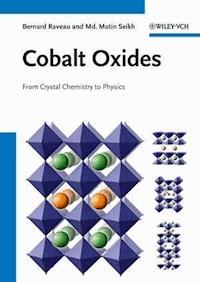
Unparalleled in the breadth and depth of its coverage of all important aspects, this book systematically treats the electronic and magnetic properties of stoichiometric and non-stoichiometric cobaltites in both ordered and disordered phases. Authored by a pioneer and a rising star in the field, the monograph summarizes, organizes and streamlines the otherwise difficult-to-obtain information on this topic. An introductory chapter sets forth the crystal chemistry of cobalt oxides to lay the groundwork for an understanding of the complex phenomena observed in this materials class. Special emphasis is placed on a comprehensive discussion of cobaltite physical properties in different structural families.
Providing a thorough introduction to cobalt oxides from a chemical and physical viewpoint as a basis for understanding their intricacies, this is a must-have for both experienced researchers as well as entrants to the field.
Sie lesen das E-Book in den Legimi-Apps auf:
Seitenzahl: 671
Veröffentlichungsjahr: 2012
Ähnliche



















Cover
Related Titles
Title Page
Copyright
Preface
Introduction
Chapter 1: Crystal Chemistry of Cobalt Oxides
1.1 Introduction
1.2 Stoichiometric Perovskites LnCoO3
1.3 Stoichiometric Ln1−x AxCoO3 Perovskites (A=Ca, Sr,Ba)
1.4 Oxygen-Deficient Perovskites: Order–Disorder Phenomena in the Distribution of Anionic Vacancies
1.5 The Ordered Double Stoichiometric Perovskite LaBaCo2O6
1.6 Hexagonal Perovskite and Derivatives
1.7 The RP-Type Cobaltites: Intergrowths of Perovskite and Rock Salt Layers and Derivatives
1.8 Cobaltites with a Triangular Lattice
1.9 Some Other Original Cobaltites
References
Chapter 2: Electronic and Magnetic Properties of Stoichiometric Perovskite Cobaltites
2.1 Stoichiometric LnCoO3 Perovskites
2.2 Stoichiometric SrCoO3: Ferromagnetism and Metallic Conductivity
2.3 Stoichiometric Ln1−xAxCoO3 Perovskites (A = Ca, Sr, and Ba)
2.4 The « Ordered » Double Stoichiometric Perovskite LaBaCo2O6
References
Chapter 3: Electronic and Magnetic Properties of Oxygen-Deficient Perovskite Cobaltites Sr1−xLnxCoO3−δ and SrCo1−xMxO3−δ
3.1 Disordered Perovskites
3.2 Ordered 112 LnBaCo2O5+δ Perovskites
References
Chapter 4: Electronic and Magnetic Properties of Ruddlesden–Poepper-Type Cobaltites
4.1 Cobalt Valence and Spin State Transitions
4.2 Magnetic Properties of RP Phases
4.3 Electrical Properties of RP Phases
4.4 Phase Separation in RP Phases
4.5 Magnetoresistance of RP Phases
4.6 Thermoelectric Properties of RP Phases
References
Chapter 5: Electronic and Magnetic Properties of Cobaltites with a 3D “Triangular Lattice”
5.1 The Co3O4 Spinel and Derivatives
5.2 The “114” LnBaCo4O7 and CaBaCo4O7 Cobaltites
References
Chapter 6: Electronic and Magnetic Properties of “Triangular” Layered Cobaltites
6.1 The Layer Sodium Cobaltites NaxCoO2
6.2 Misfit Cobaltites
References
Chapter 7: Electronic and Magnetic Properties of the “Unidimensional” Cobaltite Ca3Co2o6
7.1 Valence and Spin State of Cobalt
7.2 Magnetic Properties of 1D-Ca3Co2O6 and Related Derivatives
7.3 Electrical Resistivity of Ca3Co2O6 and Derivatives
7.4 Magnetoresistance of Ca3Co2O6
7.5 Thermoelectric Power of Ca3Co2O6 and Derivatives
References
Index
Related Titles
Bersuker, I. B.
Electronic Structure and Properties of Transition Metal Compounds
Introduction to the Theory
2010
Hardcover
ISBN: 978-0-470-18023-5
Duò, L., Finazzi, M., Ciccacci, F. (eds.)
Magnetic Properties of Antiferromagnetic Oxide Materials
Surfaces, Interfaces, and Thin Films
2010
Hardcover
ISBN: 978-3-527-40881-8
Kumar, C. S. S. R. (ed.)
Nanostructured Oxides
2009
Hardcover
ISBN: 978-3-527-32152-0
Morkoc, H., Özgür, Ü.
Zinc Oxide
Fundamentals, Materials and Device Technology
2009
Hardcover
ISBN: 978-3-527-40813-9
Jackson, S. D., Hargreaves, J. S. J. (eds.)
Metal Oxide Catalysis
2009
Hardcover
ISBN: 978-3-527-31815-5
All books published by Wiley-VCH are carefully produced. Nevertheless, authors, editors, and publisher do not warrant the information contained in these books, including this book, to be free of errors. Readers are advised to keep in mind that statements, data, illustrations, procedural details or other items may inadvertently be inaccurate.
Library of Congress Card No.: applied for
British Library Cataloguing-in-Publication Data
A catalogue record for this book is available from the British Library.
Bibliographic information published by the Deutsche Nationalbibliothek
The Deutsche Nationalbibliothek lists this publication in the Deutsche Nationalbibliografie; detailed bibliographic data are available on the Internet at http://dnb.d-nb.de.
© 2012 Wiley-VCH Verlag & Co. KGaA, Boschstr. 12, 69469 Weinheim, Germany
All rights reserved (including those of translation into other languages). No part of this book may be reproduced in any form - by photoprinting, microfilm, or any other means - nor transmitted or translated into a machine language without written permission from the publishers. Registered names, trademarks, etc. used in this book, even when not specifically marked as such, are not to be considered unprotected by law.
Print ISBN: 978-3-527-33147-5
ePDF ISBN: 978-3-527-64554-1
ePub ISBN: 978-3-527-64553-4
mobi ISBN: 978-3-527-64555-8
oBook ISBN: 978-3-527-64552-7
Cover Design Formgeber, Eppelheim
Typesetting Thomson Digital, Noida, India
Preface
Transition metal oxides represent the most fascinating class of inorganic materials that have been investigated the past 50 years, for a wide range of physical properties such as ferroelectricity in d°-type oxides, high Tc superconductivity in cuprates, or colossal magnetoresistance in manganites. Cobalt oxides belong to this family of strongly correlated electron systems, which have been the subject of numerous papers in the recent years, opening the route to new fields of research such as thermoelectricity or multiferroism, and must be regarded as potential materials for applications.
The exploration of cobalt oxides has demonstrated their extremely high complexity both from the viewpoint of their solid-state chemistry and from the viewpoint of their solid-state physics especially magnetism and transport properties. In these oxides, cobalt indeed exhibits several possible valences such as Co2+, Co3+, or Co4+, and intermediate valences, with eventual charge ordering phenomenon. Moreover, its extraordinary ability to adopt several types of coordination from tetrahedral, pyramidal, to octahedral makes it an attractive candidate for the generation of numerous structures, with various dimensionalities, 1D, 2D, or 3D, allowing a great flexibility of the oxygen framework, so that oxygen nonstoichiometry is in these compounds a very crucial parameter for the tuning of their physical properties. The electronic structure of cobalt, in its various oxidation states, is also a very complex topic, as shown from the possible spin states of cobalt – high spin, low spin, and intermediate spin – which appear in different frameworks and are often a matter of debate for the interpretation of the magnetization of these oxides. As a consequence, the physical properties of cobalt oxides, namely, magnetism and transport are extremely rich, ranging from ferro- or ferrimagnetism, to antiferromagnetism, and also magnetic frustration, superconductivity, and even multiferroism. These oxides provide an extraordinary range of magnetic and transport transitions that are often coupled with structural transitions, with a high complexity involving in some cases electronic phase separation phenomenon. All these properties can be understood only by building a bridge between solid-state chemistry, especially crystal chemistry and solid-state physics. Similar to cuprates and manganites, cobaltites provide an excellent direction of research for strongly correlated electron systems, as shown from the abundant literature in this field. This monograph provides a presentation of the different structures of cobalt oxides, followed by the electronic and magnetic properties of the main classes of cobaltites. The different structures are described in terms of polyhedral representation, and the nonstoichiometry phenomena are discussed. The electronic and magnetic and transport properties are focused on stoichiometric perovskites, nonstoichiometric perovskites, RP phases and derivatives, misfit and “114” cobaltites, and finally 1D compound Ca3Co2O6.
The objective of this book is to reach out to a broad audience from chemistry and physics community, bearing in mind that the understanding of these complex materials requires absolute knowledges in both areas. The lists of references, which are rather long, should allow both solid-state physicists and chemists working in this field to get the basic tools for their investigations. Many details can be skipped over easily by nonspecialists, which makes the book useful also for students. In summary, we trust that this book can be used easily by students, teachers, and practionners, whether directly or only indirectly involved in the field of cobalt oxides chemistry or physics.
January 2012
Caen, France
Santiniketan, India
B. RaveauM. Seikh
Introduction
Transition metal oxides have been studied for over half a century. They are shown to exhibit a wide range of fascinating physical properties. Consequently, it was realized that they could have a great potential as functional materials. However, the understanding of such amazing physical properties exhibited by transition metal oxides is rather complicated. Unlike most other solids, their properties cannot be accounted for within the context of usual one-electron band theory. This is mainly due to the strong correlation between the various degrees of freedom available in the condensed system. Such degrees of freedom are mainly charges, orbitals, spins, and lattice. The curiosity about the correlated system arises after the discovery of high-temperature superconductivity in the layered cuprates in 1986. Another remarkable achievement from the study of the first series of the transition elements is the discovery of colossal magnetoresistant (CMR) in manganese oxides with the perovskite structure, leading to possible applications in the field of magnetic energy storage and as sensors and activators. However, the discovery of these effect calls for a new physics to be explored, which requires a better knowledge of the complex solid-state chemistry of these oxides. The strongly correlated systems form a major part of the research topics in the field of modern condensed matter physics, chemistry, and materials science.
Similar to the cuprates and manganites, cobalt oxides turn into a very attractive field for the discovery of new structures and new magnetic and transport properties. The cobaltites exhibit a range of properties including superconductivity, thermoelectricity, ionic conductivity, magnetic and insulator–metal transitions (IMT), and magnetoresistivity (MR). The growing interest in cobalt oxides stems from their emerging applications as materials for solid oxide fuel cell, heterogeneous catalysis, oxygen membrane, gas sensors, magnetic data storage by their virtue of magnetoresistance effect, and superconductivity observed in NaxCoO2·yH2O. Most importantly, the fairly high thermopower generated by several layered cobalt oxides provides the ground to consider them as a viable alternative to the traditional semiconducting thermoelectric materials.
In Chapter 1 of this book, we shall examine a variety of structures of cobalt oxides, describing their polyhedral arrangement, in connection with the electronic structure of cobalt, its spin state and its valency. Then, the following chapters will be devoted to the magnetic and transport properties of the main families of cobaltites, namely, the perovskites (Chapters 2 and 3), the Ruddlesden and Poepper phases (Chapter 4), the spinel and the 114 cobaltites with a 3D triangular lattice (Chapter 5), the layered cobaltites with a triangular lattice (Chapter 6), and the 1D cobaltite Ca3Co2O6 (Chapter 7).
Lesen Sie weiter in der vollständigen Ausgabe!
Lesen Sie weiter in der vollständigen Ausgabe!
Lesen Sie weiter in der vollständigen Ausgabe!
Lesen Sie weiter in der vollständigen Ausgabe!
Lesen Sie weiter in der vollständigen Ausgabe!
Lesen Sie weiter in der vollständigen Ausgabe!
Lesen Sie weiter in der vollständigen Ausgabe!




