


5,99 €
Mehr erfahren.
- Herausgeber: The Lilliput Press
- Kategorie: Geisteswissenschaft
- Sprache: Englisch
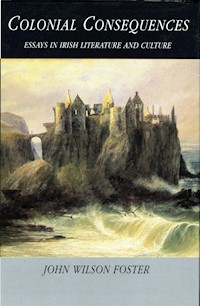
Colonial Consequences contains sixteen essays in Irish literature and culture by Belfast-born, Vancouver-based critic John Wilson Foster. The essays survey texts, genres and cultural backgrounds, from eighteenth-century landscape verse, the origins of Irish modernism, Yeats's great poem 'Easter 1916', to the literature and life-styles of Northern Ireland. They give eloquent, close readings of specific writers – Kavanagh, Hewitt, Rodgers, Montague, Murphy, Donoghue – and at the heart of the book Foster expands on his 1974 study of Seamus Heaney with a new and challenging analysis of the poet as a deeply political writer, working through cultural traditions that are questioned, while respected. The volume concludes with recent essays which have made Foster an important figure in the current debate over political meanings and cultural trends in a riven, unsettled society. An unusual, personal introduction by the author retraces the steps that led him to these combative and penetrating inquiries. Scholarly, engaged and readably written, locally rooted yet globally perceived, they provide a rich matrix of interpretation which frames the past while clarifying the future.
Das E-Book können Sie in Legimi-Apps oder einer beliebigen App lesen, die das folgende Format unterstützen:
Veröffentlichungsjahr: 2015
Ähnliche


















COLONIAL CONSEQUENCES
Essays in Irish Literature and Culture
John Wilson Foster
THE LILLIPUT PRESS
TO MY SISTER, ALLISON
CONTENTS
INTRODUCTION
These pieces, written over a period of sixteen years, begin collectively as articles in literary criticism and end as essays in cultural criticism. Although I was unaware of it until I reread them, the shift in interest, scope and method reflects a reorientation in Anglo-American critical pursuit during the same period, when the interdisciplinary, cultural and even ideological have been increasingly prized over the more modest quarry of prior criticism. My graduate instruction during the second half of the 1960s at the University of Oregon, which I attended at the invitation of the Milton scholar Kester Svendsen, was conducted during the fag-end of New Criticism – the form prior criticism largely took – and I watched it being locally stubbed out and made seem irrelevant (when everything had to be ‘relevant’ or perish) amid the headier activities of anti-Vietnam War protesters, Black Panthers, draft-dodgers, and Ken Kesey and his Merry Pranksters, all of whom made Eugene a counter-culture staging post on Highway 99 running from California to the half-legendary asylum of British Columbia.
But in fact I had already crossed the bounds of New Criticism by having studied aesthetics during the first half of the 1960s under Philip Hobsbaum, the English critic and poet then galvanizing the inert body of Ulster poetry into life from his post at Queen’s University, Belfast. Being reserved in such matters, I met the poet Michael Longley only once and merely passed in the street the distinctive figure of Stewart Parker, the playwright (at that time a poet and, like me, Hobsbaum’s research student), and I failed to meet at all Seamus Heaney or Derek Mahon: all of these writers were starting to go their own ways, fledged in a confidence that may not have come to them natively. As a postgraduate student, I studied jointly under Hobsbaum and the philosopher W. B. Gallie, and plied between two neighbouring departmental doors along University Square. American New Criticism, therefore, seemed to me, still under the influence of these two teachers when I went to Oregon, rather unadventurous, however much I admired the Chicago Aristotelians and the Southern ex-Fugitives, especially John Crowe Ransom, who gave a memorable reading at the university (as did Auden and Vozneshenski).
But just in case I should succumb to the formulas of American critical practice (useful in graduate examinations), Someone or Something decreed that I should meet the fiction writer and raconteur Benedict Kiely, who began a year-long stint as writer-in-residence as I arrived in Eugene. The greatest Revival figures aside, I had read no Irish writers, with the exceptions of Brendan Behan and Brian Moore, whose novel TheLonelyPassionofJudithHearne is set in Belfast and coupled life and literature for me in the most obvious and liberating way. (For a year or two, I was too busy reading Jack Kerouac, Lawrence Lipton and Christmas Humphreys and trying to offend the good burghers of Belfast with a struggling beard and an American war surplus combat jacket.) It was Benedict Kiely who in his infectious style and with his customary generosity of knowledge led me to the work of Irish writers as living men and women; I recall his gloom when he got word that his friend Myles na gCopaleen (Flann O’Brien) had died in Dublin. This one-man ambience set at naught the anti-intentionalist and anti-biographical approach I was being taught beyond the dim and swarming interior of Maxie’s Tavern where Kiely held court. He also showed for the culture (Protestant and Catholic alike) of the province we both came from an affection and respect surprising to me, for in my heart I had always despised it a little.
However, I had term-papers to write after Kiely went back east. In American graduate school one serves a professional apprenticeship, and I am grateful for mine. One of my papers, a redefinition of topographical poetry, I was encouraged to ‘send out’, and it appeared in the severe pages of TheJournalofEnglishandGermanicPhilology the year I left Oregon and returned to Belfast. As a run-through for a history of the genre (which I never wrote), I constructed a scale-model, published as ‘The Topographical Tradition in Anglo-Irish Poetry’ and printed below. It is not an entirely cold-blooded piece and the print of my background can be seen in my choice of Northern topographicalists to exemplify the localizing of a once-stately genre.
Before leaving Oregon, I had departed the then polished lawns of critical theory – the feminists, Lacanians, New Marxists and deconstructionists were as yet indecipherable on the horizon – for the rougher fields of folklore and Irish literature. A quarrel with J. Barre Toelken, the folklorist and balladeer, gave way to a friendship and collaboration. He had disputed the folk credentials of Woody Guthrie and Bob Dylan, but I was a fierce defender of these men and was the first in Ireland, I believe, to sing on stage the songs of Dylan (1963) and in his style (simultaneous guitar and mouth-harp, deadpan face, voice laden with premature world-weariness). I was writing my own songs, inspired by Dylan’s, some of which caught the ears of Judy Collins and the Elektra record company, but song-writing faltered as my criticism grew more confident. Toelken introduced me to academic folklore (as well as to his Navajo ex-relatives in southern Utah and the desolate, extraterrestrial formations of Monument Valley) and we published papers on its theory. This collaboration, together with the social anthropology I had learned from Rosemary Harris when I was an undergraduate at Queen’s University, stood me in good stead when I came later to engage with the Irish Cultural Revival.
In the meantime there was the Ulster literature Ben Kiely had urged me to read. My doctoral dissertation was a minimalist effort, but back in Northern Ireland I began afresh and quickly wrote ForcesandThemesinUlsterFiction (1974), the first word of that title acquiring special meaning in Belfast, in which, even in the university district, one would lie abed and hear nightly gunfire and explosions. If that was stimulation of a rather desperate kind, a quieter kind was the awareness that almost all serious criticism of Ulster literature was pioneering; for a couple of years, it seemed as if Seamus Deane, Terence Brown and I were writing all of it. Indeed, it is easy to forget that less than twenty years ago most criticism of Irish writers was written by Americans, and that ‘Irish writers’ meant almost exclusively the Big Names of the Revival. While Irish critics owe these scholars a great debt, they tended to perpetuate whatever view of Ireland their chosen writer himself versified or dramatized. (Fiction writers tended to get short shrift.) There is now a number of Irish-born critics scanning all of Irish literature and doing so with eyes properly capable of narrowing.
While I was engaged on UlsterFiction, my Canadian wife and I moved to Dublin in 1972, unaware of the events in Derry that would cause that day to be known as Bloody Sunday. Despite the tolerant and unfocused zest of Dublin (once the anger over Bloody Sunday subsided), it was hard in those days to escape one’s tribal membership or the Troubles a hundred miles north. One evening in May 1974, my wife and I had an arrangement to meet Benedict Kiely for a drink before we went on to a reading by Seamus Heaney in St Stephen’s Green. That afternoon I had stood on D’Olier Street and heard the heart-stilling stereophony of two loyalist car-bombs, one on Nassau Street, the other in Parnell Square, that killed twenty-two passers-by. We met in the Shelbourne Hotel, Heaney included, and after some hesitation he decided to go ahead with the reading. It took place amid a chorus of keening ambulances, and was what the occasion required – a ministration, an assuagement, to use a Heaney word.
By going on with the reading, Heaney redressed what he later diagnosed as a serious dereliction when he didn’t read one evening in 1972 after an IRA blitz in Belfast. In ‘The Interesting Case of Nero, Chekhov’s Cognac and a Knocker’, the first essay in TheGovernmentoftheTongue (and whose opening I have mimicked above), Heaney modestly omits mention of the evening the reading did go on.
After four years away from North America, two of them a postfacto obligation to the Fulbright Commission, I left Dublin for the University of British Columbia. This became a domicile and workplace. In Vancouver, against a backdrop of startling mountains and kettles of soaring eagles, I wrote the literary essays below, with the exceptions of the two on the subject of Heaney. I completed ‘The Poetry of Seamus Heaney’ before setting out for the Pacific Northwest and had the pleasure of giving it in person to the poet, only to have him read it in my presence, with its occasional strictures, during my visit to Glanmore, a novel and chastening experience. ‘Heaney’s Redress’ I have written specially for this volume and it takes up the ‘story’ from North (1975). In the new essay I take for granted the excellence of many individual poems in order to concentrate on the aesthetic order they compose in cumulation. Whereas in ‘Post-War Ulster Poetry’ (1985) I emphasize Heaney’s Britishness, in the new essay I return to the Irishness to which I directed English readers in 1974.
In Vancouver I also worked on the apparently neutral subject of novels of the Revival. But by the time my study was coming to a close, interpretations of this movement were being revised by Southern Irish nationalist critics, whereas FictionsoftheIrishLiteraryRevival (1987) is an obliquely Northern view of that astonishing release of literary energy. I finished the book just as my perspective on literature was becoming more broadly cultural. This was due in part to my reading the new French-inspired critical theory, in part to my acquaintance with the French art historian Serge Guilbaut, a colleague at the University of British Columbia. But it was also due to my reading the provocative, pioneering pamphlets of the Field Day Theatre Company of Derry, whose directorate includes Seamus Deane, Brian Friel, Tom Paulin and Seamus Heaney. In my talk ‘The Critical Condition of Ulster’, delivered to the International Association for the Study of Anglo-Irish Literature, at Queen’s University in 1985, I grappled with the Field Day pamphleteers, themselves inspired by international theory. This conference was a turning-point, in terms not just of my work but of the frequency of my return visits to Ireland and the degree of my involvement in a place I had once shown a clean pair of heels. In 1986 I began a year as Research Fellow at the Institute of Irish Studies, Queen’s University, during which I immersed myself in the sundry research interests of my colleagues there, one result being the essay ‘New Realism’, printed below. It was then, too, that I began to benefit from vigorous conversations in Belfast and Dublin with Edna Longley, Liam Kennedy, Liam O’Dowd, Terence Brown, Gerald Dawe and others.
From 1985, my cultural readings have been excited less by critical theory than by the changing political weather in Ireland. For several years now, a lively cultural debate has been conducted in Ireland, often within earshot of bomb-blast and variously responsive to political fall-out. The debate has seemed for a while to have been won by pluralists and revisionists, particularly among historians, who question nationalist and anglophobic readings of past and present events in Ireland. However, pluralism and revisionism are themselves being energetically contested. Meanwhile, several influential commentators have managed to carry a traditional and hostile attitude to Northern Protestant culture safely away from the swaying edifice of Irish nationalism. It has been in this context and others that I have felt the need to offer some sympathetic explanation of the peculiar pressures operating historically on that culture.
It’s as well to volunteer the tribal allegiances that may lie behind such yieldings and sympathies, to anticipate from some quarter Nietzsche’s question, ‘Who speaks?’ These allegiances press upon all Irish critics and in turn must be subjected to the circumspection of argument and print. I was reared on the prejudices and perspectives, virtues and vices, of lower middle-class loyalism and Nonconformism in east Belfast. My eldest brother, one of the first Northern Irish children to benefit from the Butler Education Act (1944, but extended to Northern Ireland only in 1947), was the first member of my connection to have daytime secondary education and to attend university. My own avoidance of Irish literature at university – made easy by a curriculum that looked east across the water – and my absorption in the ‘abstruser musings’ of aestheticians may well have been attempts to distance myself from my background. If to some degree I have recently assumed qualified, defensive pride in my ancestry, I hope of course that with all my circling I have nevertheless, to adapt John Montague, failed to return.
The peculiar challenge to cultural criticism in Ireland is to establish and hold a meeting-ground for civil conversation while both acknowledging the legitimate imperatives of difference and advancing the legitimate claims of one’s community, whose deep fears and honourable desires one is better equipped to understand and articulate than any outsider. Organized terror reinforces the challenge when it causes one to host feelings and sentiments more extreme than one would ordinarily wish, and of a different kind also: thus, for example, a belief in individuality (which in my own case, ironically, is part of a Dissenter inheritance) can be overmastered by the exigencies of group peril and held in troubling abeyance. One can even feel an immodest desire to be spokesman and apologist instead of the singular commentator one’s education has fitted one to be.
The critic in Ireland, particularly in Northern Ireland, is engaged therefore in a parley with himself as well as with his counterparts. (Out of the first parley the gifted among us have made poetry.) However burdensome, it is nevertheless the best defence against the terrorizing of argument and the misgovernment of the tongue to which we in Ireland are given. A certain strain, a weakness for ‘solutionism’, for blueprints and multiple projections, are perhaps inevitable, under the circumstances, in any mapping of contemporary Irish culture, and I see them in my own. But if conducting one’s education in public is commonly a risky thing to do, I’m not sure it is entirely a vice in a traditionally prejudgmental society.
The shared etymology of ‘crisis’ and ‘critic’ seems especially apt in Ireland, but the literary critic is concerned as much with continuity as with turning-point or climax. Much of the literature discussed below is relatively innocent of our current predicament, and I find I haven’t pursued the coincidence (or is it causality?) of twenty years of civil commotions and political rupture and twenty identical years of literary accomplishment. Place and poetry loom large in the following essays, in Ulster but elsewhere in the island too, and before as well as after the events of the late 1960s. Regionalism is a fitfully theoretical underpinning that makes counterparts of the literary and cultural pieces: the last essay, for example, returns us to the first. (My title for the volume pluralizes one given to a poem by John Hewitt, exponent of regionalism.) Regionality expresses continuity in time; but I see it as no mere contraction in figurative space: rather should it be a progressive critique of modernism as it accepts the benefits of modernity. Meanwhile, for pressing local reasons, the realistic acknowledgment of Ulster’s regionality is a necessary posture in our present difficulties.
Vancouver – Belfast 1991
1
THE TOPOGRAPHICAL TRADITION IN ANGLO-IRISH POETRY
Quintessentially an eighteenth-century form, topographical poetry nevertheless had its origin in Sir John Denham’s ‘Cooper’s Hill’ (1642/55) and panted on, long after its heyday, well into the nineteenth century. Dr Johnson’s definition of the form – under one of its several aliases – is succinct. ‘Local poetry’, says Johnson, is ‘a species of composition … of which the fundamental subject is some particular landscape, to be poetically described, with the addition of such embellishment as may be supplied by historical retrospection or incidental meditation.’1
An adequate definition, however, must account for the manner in which the description of the locality on the one hand, and the meanings attached to it through retrospection and meditation on the other, are blended. I have tried to do this elsewhere, listing five structural characteristics of the genre: the creation of three-dimensional space, the use of space as a patterning device, the use of time-projections, the use of extended metaphor, and the development of a controlling moral vision.2 These features are present throughout the long history of topographical poetry, but their substance and meaning alter, as we shall see, in response to the changing nature of society and changing conceptions of poetry from Denham’s time to the nineteenth century. Change and adaptation were slow, however, and the genre retained its basic identity, along with most of the georgic motifs and formulas uniquely combined in the founding poems: ‘Cooper’s Hill’, Waller’s ‘On St James’s Park’ (1661), Pope’s ‘Windsor Forest’ (1713) and Dyer’s ‘Grongar Hill’ (1726).3 Generic inertia thereafter ensured the steady shunting of topographical poetry, with its increasingly outmoded neoclassicism, from the main line of English poetry into local yet quaint and fascinating sidings.
Topographical poetry is a minor but intriguing strain of Anglo-Irish poetry. In the beginning it was expressly political after the manner of Denham, Waller and Pope, and in being so mirrored the political relationship of Ireland to England. Thus, to the extent that the seventeenth-and eighteenth-century ruling classes in England and Ireland were socially continuous, early topographical poetry in Ireland is indistinguishable from the genre in England. In another sense, the Irish poems are blatant imitations of the English poems, as the political and class structure in Ireland was an imitation of its English model. In yet a third sense, the parallel with English topographical poetry was quite legitimate, not only because the genre is self-imitative anyway, but also because in the parallel was the beginning of that process of ‘localization’ that characterizes the history of the topographical genre: that is, the choice of localities increasingly distant from London, and the increase in local matter at the partial expense of the capacity of the localities to symbolize larger entities such as the nation or world. Even if we choose to regard the early poems by James Ward and Henry Jones as merely Irish facsimiles of English originals, we are less likely so to regard the later poems by William Hamilton Drummond and William Drennan, even though the latter retain the formulaic structure of the genre. This is partly because later topographical poems, full of local matter, became absorbed into appropriate regional poetic traditions, of which the Ulster tradition was one.
In discussing the topographical tradition in Ireland, I have taken no account of the influence, if any, of the Gaelic topographical tradition on Anglo-Irish poetry. Research in this direction is possibly required, but Anglo-Irish topographical poems seem adequately accounted for within the English tradition. Anglo-Irish topographical poets tend to be Protestant, unionist and conservative, but this description becomes less relevant as topographical poetry replaces its political bias with aesthetic, scientific and theological biases. Keeping in mind Johnson’s definition, I want in fact to trace the changing meanings of landscape in Anglo-Irish topographical poetry. I do so roughly chronologically, but the meanings of landscape tend not to exclude one another; instead they accumulate, with emphases rather than exclusive concerns distinguishing period from period. All the forms and themes of subsequent topographical poetry can even be said to exist, embryonically or fully-fledged, in ‘Cooper’s Hill’ and ‘Windsor Forest’.
Development of these embryonic themes and forms takes place under the influence of altering poetic norms and of wider social interests and disciplines, in particular surveying and topography, landscape painting and gardening, travel and the picturesque cult, and geology. In each case, these interests and disciplines will be found to have peculiarly Irish versions: topographical poetry, despite its fluctuating imaginative value, is cultural documentation of startling inclusiveness.
I
As it happens, Ireland can lay slender claim to the first topographical poet. Denham was born in Dublin in 1615 where his father was the Chief Baron of the Exchequer and his mother the daughter of Sir Garret Moore, Baron Mellefont and Viscount Drogheda. In 1617, however, ‘before the Foggy Air of that Climate, could influence, or any way adulterate his Mind, he was brought from thence’ to England.4 Denham’s life is included in Webb’s CompendiumofIrishBiography (1878) and O’Donoghue’s ThePoetsofIreland (1912), and his poetry in Charles Read’s TheCabinetofIrishLiterature (rev. ed. 1904). It would be unhealthy, though, to claim ‘Cooper’s Hill’, a poem majestically concerned with the history of the realm, as an Irish poem. What is certain is that amidst the poem’s georgic motifs, we can discern a clear structural pattern (woven by the five characteristics I have mentioned) that became a model for subsequent topographical poems.
Denham stands on Cooper’s Hill on the Berkshire-Surrey border and contemplates the northern prospect. He focuses on three prominent points of interest: St Paul’s to the distant right, Windsor Castle (on Windsor Hill) to the closer left, and the ruins of Chertsey Abbey (on St Anne’s Hill) to his immediate right. Against the Thames Valley these compose a topographical dialectic, but more importantly they compose – when contemplated historically – a political dialectic. The Chertsey ruins and the feverish activity around St Paul’s, visible from Cooper’s Hill, summon up the imbalance of power between Crown and subjects before the signing of Magna Charta at Runnymede. Standing on the hill in 1642, at a time of renewed political unrest, Denham insists that Charles I’s reign (symbolized by Windsor Castle) represents a refinement of the spirit of Runnymede. Magna Charta and Charles’s reign were both triumphs for harmony, peace and moderation, qualities enshrined in the contemporary cosmic (and therefore political as well as topographical) ideal of concordiadiscors and embodied in the view from Cooper’s Hill considered intoto.5
In Denham’s fashion, early topographical poets create a landscapeofpolity: that is to say, they abstract from the landscape or townscape features that have political significance, or they invest natural features with political meaning. Topographically and politically, the poets are on the edge of this landscape: they give us merely a ‘prospect of power’. Like Denham, Waller in ‘On St James’s Park’ stands at a distance from, and looks towards, topographical symbols of central power that guarantee harmony and moderation. The view, like that from Cooper’s Hill, is a microcosm of the realm through history. Both poems are reservedly royalist and Tory. Pope’s ‘Windsor Forest’ also constructs a microcosm of the realm from close to its centre (in the wake of the Treaty of Utrecht, his ‘Runnymede’), but this poem in addition represents the beginning of a movement away from spare London locations of power towards more luxuriant locations of retreat and respite from affairs of Court and parliament, a movement continued in Samuel Garth’s ‘Claremont’ (1715). The same ambivalence is evidenced by the first genuinely Irish topographical poem, ‘Phoenix Park’ (1718) by James Ward.
Ward opens his poem with what looks like provincial self-consciousness:
Shall Cooper’sHill majestic rise in Rhyme,
Strong as its basis, as its Brow sublime?
Shall Windsor-Forest win immortal Praise,
It self outlasting in its Poet’s Lays;
And thou, OPhoenix-Park, remain so long
Unknown to Fame, and unadorn’d in song?6
Evidently not; but Ward is not being provincial: Pope alludes to Denham, and Garth to both Denham and Pope, a device that became standard procedure in topographical poetry. Equally standard were the invocation of the geniusloci and the poet’s assertion of the claims to Parnassus of his own neck of the woods (the ‘local pride’ motif). ‘Phoenix Park’ sports many other topographical formulas, including a division of the poet’s walk through the park into parts of the day, the exotic episode, the retirement motif, the hymn to peace and stability, and the ‘picturesque’ motif (using the Liffey as Denham and Pope used the Thames):
Deep in the Vale old Liffey rolls his Tides,
Romantic Prospects crown his rev’rend Sides;
Now thro’ wild Grotts, and pendant Woods he strays,
And ravish’d at the Sight his Course delays,
Silent, and calm – now with impetuous Shock,
Pours his swift Torrent down the steepy Rock;
The tumbling Waves thro’ airy Channels flow,
And loudly roaring, smoak, and foam below.
In the park, Ward encounters ‘A Fabrick rais’d in peaceful Charles’s Reign’, and so joins Denham and Waller in making early topographical poetry, in terms of inspiration, a Caroline form. Ward describes that part of the park ‘Where Vet’ran Bands discharg’d from War retire’ to relive past campaigns, such as the recent wars with France (1702–13) and to discuss ‘how bravely Marlbro’ fought’. For Ward, peace and stability are Tory and royalist qualities, but there is an Irish dimension to his political and Denhamesque version of concordiadiscors. Like Windsor Forest, Phoenix Park was a spacious, variegated rural area within sight of the governing city of the island (Dublin to Windsor’s London).7 Although Ward fashions the park into a microcosm, not only of Ireland but, like Pope’s Windsor Forest, of the entire realm, that he does so is due to the negative factor expressed by Edmund Curtis: ‘In the period 1714 to 1760 Ireland had little or no political history.’8 If Ward’s gaze was thus naturally directed outside Ireland for the political meaning of his park, the fact that he nevertheless chose the Dublin park to describe, that he was content to let it ‘stand in’ for Windsor Forest, was due to the extent to which the Protestant Ascendancy was, in Curtis’s words, ‘a replica on a small scale of that of England’. Therefore, though Ward explicitly celebrates the post-Civil War and post-Utrecht realm, he is implicitly celebrating Hanoverian Ireland. ‘At least in 1714,’ writes Curtis, ‘our country, after the unrest of a hundred and fifty years, reached an equilibrium which lasted for some fifty years. Unjust as was the established order, it gave peace and security for such gains as men could make or such education as their minds could take advantage of.’ The Ascendancy of the Protestants made possible the composition of topographical poetry in Ireland, even though the Irish poet (like the Ascendancy itself) sought social and political inspirations in England.
While falling far short of ‘Cooper’s Hill’ and ‘Windsor Forest’, ‘Phoenix Park’ is a better poem than Garth’s ‘Claremont’. Ward’s sense of topography is superior to Garth’s, not merely in terms of varieties of terrain but also in terms of perspective:
Here on the Mount a ruin’d Tow’r I spy,
A sweet Amusement to the distant Eye,
Forward it starts, approaching to be seen,
And cheats me of the sinking Lands between.
Written about the time poets were discovering landscape painting and gardening, ‘Phoenix Park’ is a small but distinct contribution to the development of visual composition in landscape poetry. In addition, Ward established Irish versions of the topographical motifs (e.g. praise for St Patrick, the island’s absence of ‘noxious Creatures’, and ‘Hybernia’s’ greenness) that became obligatory for Irish loco-descriptive poets.
II
Visually, ‘Phoenix Park’ is also a better poem than ‘Rath-Farnham’ (1749) by the hapless Henry Jones. Like Denham, and unlike Ward, who moves in allegorical fashion through his park, Jones is stationary on a prominence, near Rathfarnham Castle outside Dublin, letting his ‘roving Eye’ and the flight of his Muse (cf. Denham’s Muse and ‘wandring eye’) do his walking for him as he contemplates four topographical features in orderly succession. The description from a hilltop of one prospect after another (which in combination form a landscape) is the basic visual principle of topographical poetry. Even did we not know that Denham in later life became Surveyor General of the Works, nor the word ‘survey’ so frequently appear in topographical poetry, we ought still to appreciate the similarity between the methods of early surveyors and those of topographical poets. To survey is to overlook, to see the whole from the vantage-point of an elevated position: surveyor and poet alike established a ‘station’ on a hill from which they could survey the land bounded by other chosen prominences. The poet swivels his ‘Eye’ (almost always in the impersonal singular, as though it were an instrument) as the surveyor swivels his eye and the alidade on his theodolite or circumferentor. The surveyor measures angles and distances, as the poet, through a kind of ‘measurement in thought’, contemplates historical and political meanings and associations. We can even diagram early topographical poems, and the result looks remarkably like the ‘triangulations’ of early surveyors.
The rise of topographical poetry coincides with the acceleration of scientific surveying, which suggests the science’s influence on the poetry.9 There were in turn socio-economic spurs to the development of surveying: in England during the sixteenth and seventeenth centuries it was enclosure; in Ireland during the seventeenth century it was the Cromwellian Settlement, during which Sir William Petty produced, in the so-called Down Survey, the first scientific mapping out of Ireland. Practical and theoretical map-making and surveying developed apace throughout the eighteenth century, indirectly resulting in such poems as Richard Jago’s ‘Edge Hill’ (1767). Ireland contributed several texts on surveying during that century, among them Robert Gibson’s ATreatiseofPracticalSurveying (1752; 2nd ed. Dublin 1763), Peter Callan’s ADissertationonthePracticeofLand-SurveyinginIreland (Drogheda 1758) and Benjamin Noble’s GeodaesiaHibernica (Dublin 1763). Callan is unintentionally whimsical, setting out to rid Ireland of fraudulences and anomalies in surveying: his picture of the island swarming with dissembling surveyors is positively Carletonesque. It is clear from his book, however, that surveying in Ireland was closely connected with the outrageous land situation and with the incidence of confiscation, forfeiture and reapportionment. The book by Gibson (d. 1760), on the other hand, was a genuine contribution to the science and was the first English surveying text to be published in North America, where it passed through twenty-one editions.10
Using prominences like a surveyor, Jones makes four ‘eye-shifts’, which plot the poem’s narrative and structure its philosophy. Less literally, however, prominences enable him to escape the hazardous lowlands of Callanesque Ireland. The landscape is a metaphor for the harmony-in-inequality of human society:
As in the moral World we, wond’ring, see
Such diff’rent Stations, yet such just Degree;
Which all contribute wisely to sustain
The mutual Intercourse, and social Chain,
Whose Links in regular Gradation fall,
Whilst all in one, and each depends on all:
Wise Nature, thus, proportions her Degrees,
From shrubs to Cedars, and from Brooks to Seas.11
This is standard eighteenth-century fare, illustrating how Denham’s use of landscape as a metaphor for concordiadiscors and fundamental principles of government degenerated into a partisan metaphor for social class. The established highborn and the grasping lowborn both justified inequality, but the lowborn had to admit in their justification their own lowly position if they were to have a chance of improving it. When he remarks that ‘lesser Hills upon those Mountains wait’, Jones is expediently imagining himself a lesser hill and the Earl of Chesterfield (to whom his book of poems is dedicated) as a mountain. Jones was a bricklayer born near Drogheda in 1721 who came to the attention of Philip Stanhope, fourth Earl of Chesterfield, when he addressed a poem of welcome to the new Lord Lieutenant in 1745. Chesterfield (who was largely responsible for the planting of Phoenix Park) took Jones to London where his tragedy TheEarlofEssex enjoyed great success. Later, in the words of O’Donoghue, Jones ‘gave way to dissipation and drink’ and was cast off by Chesterfield after borrowing money from a servant. After a two-day binge, Jones was run over and fatally injured in St Martin’s Lane in 1770.
Jones’s social career made him exaggerate the panegyric formulas of topographical poetry. Of the four prospects in ‘Rath-Farnham’ – a view of fair Eblana (Dublin) in the distance, the Lord Chancellor’s residence to the east, the home of Mr Baron Mountney (‘My Patron, Guide, and let me add, my Friend’), and Rathfarnham Castle itself12 – two evince Jones’s self-insinuation into high society. But the deferential allusions to Mountney and the Lord Chancellor also reflect that change of emphasis in topographical poetry signalled as early as Garth’s ‘Claremont’, Ward’s ‘Phoenix Park’ and the description of Trumbull’s retirement at the close of ‘Windsor Forest’: that is, the diversion from central seats of power to gentlemen’s seats of retirement and leisure. Harmony and order remain as values but exchange their currency. Jones does declare of Dublin: ‘And Health and Peace are her’s [sic] – for Stanhope reigns’ (cf. Pope: ‘And peace and plenty tell, a STUART reigns’), but like Pope he half turns his back upon state affairs, attracted by the private estates of the powerful. The topographical locale is no longer wholly a microcosm of the often bloody realm, but a microcosm also of polite human society. The landscapeoftaste (embracing notions of art, wit and manners) succeeds the landscape of polity. Jones speaks of Rathfarnham Castle’s ‘rich Embellishments’ displaying ‘true Taste’, while ‘teeming Nature’ thrives in the valley below. He praises the warm sheltered climate and the exotic blooms in the grounds of William Palmer (to whom the poem is dedicated) and concludes: ‘Lo! Nature, here, and Art for ever vie;/And Art the Mind, and Nature charms the Eye.’ The artistic garden, set amidst a larger and more natural landscape, is the topographical poet’s new locale, and is very different from Denham’s expansive, natural prospect.
Like his contemporaries, Denham had a literary interest in wild nature (the picturesque motif), but he had little sense – literary or otherwise – of man-shaped landscape. The concern with artistic vis-à-vis natural landscape coincides with the rise half a century later of Whiggism in politics, Shaftesbury’s philosophy in aesthetics and ethics, the cult of Italian landscape painting, and an English style in landscape gardening. Sir John Vanbrugh (1664–1726), who landscaped Claremont estate in Surrey, did much to break the domination of French and Dutch formalities in the English garden and worked, as Edward Malins tells us, in a climate of opinion characterized by the Whig benevolence of the Earl of Shaftesbury (1671–1713).13 Vanbrugh demonstrated how nature, instead of having artistic will imposed upon her, could be shaped to resemble artistic conceptions. The ideal in all things became a balance between art and nature, passion and mind, reason and imagination, and gentlemen sought to reproduce this balance in their estates. Other philosophers and landscapes followed in the wake of Shaftesbury and Vanbrugh. William Kent (1684–1748) and Capability Brown (1715–83) took Vanbrugh’s development of an English or ‘Natural’ style still farther, while Shaftesbury’s Characteristics (1711) was followed in 1725 by an InquiryintotheOriginalofourIdeasofBeautyandVirtue from the pen of County Down-born Francis Hutcheson (1694–1746).14
Through the researches of Edward Malins, we know that in the theory and practice of landscaping, ‘the work of Irishmen, principally Jonathan Swift and Patrick Delany, was simultaneous with that of their English counterparts, with whom they were in close touch’.15 Rev. Patrick Delany, fellow and tutor at Trinity College, heard the views of his friend Swift, who, like Pope, desired greater freedom in landscaping, and in 1724 started to improve a small estate called Delville, at Glasnevin outside Dublin, which is now part of the Botanic Gardens. Delany is thus credited by Malins with introducing the modern style of gardening into Ireland. In accordance with the fashionable significance attached to landscape, Delville became the centre of an artistic and intellectual coterie (including, among others, Swift, Tickell and Addison), comparable with the Worcestershire estate owned by William Shenstone and lengthily versified in James Woodhouse’s ‘The Leasowes’ (1764).16 The coterie, withdrawn for self-protection from the wider public, is imaged in the garden surrounded by less cultivated landscape.
Malins claims that the natural topography of Ireland was easily adaptable to the new style of gardening: ‘In Ireland, where so much rolling, lake-begirt natural landscape was available, it was popular and cheaper to lay out a garden by making use of these natural advantages, rather than create Baroque parterres and elaborate allées …’17 Other Irish estates and gardens were landscaped after Delville in deference to the new style: they included Dangan, near Trim; Market Hill, Co. Armagh; Sir Arthur Gore’s at Killala, Co. Mayo; Lord Orrery’s at Caledon, Co. Tyrone, and, presumably, those of Henry Jones’s rich friends. Yet ‘Rath-Farnham’ itself is an old-fashioned poem, and reads more like an augury than a celebration of that pre-picturesque tradition of aesthetics that created the landscape of taste.
III
Denham, though visualizing through the filter of poetic convention rather than actually seeing, wrote in ‘Cooper’s Hill’ of the ‘steep horrid roughness of the Wood’ that ‘Strives with the gentle calmness of the flood’. Pope and Ward have similar and obligatory picturesque passages. But it was John Dyer who in ‘Grongar Hill’ and ‘The Country Walk’ (both 1726) raised the motif to the status of a pervasive tone and theme. There is something of ‘L’Allegro’ and ‘Il Penseroso’ in Dyer’s poems, with their snappy, four-beat couplets and vivid chiaroscuro, but it has been established that Dyer, who was a painter, was influenced by the seventeenth-century Italian landscape painters Claude Lorraine (1600–82) and Salvator Rosa (1615–73), whose work was then becoming popular in England. Under the influence of painting, poets and non-poets alike began to appreciate, judge, even see landscapes pictorially as well as politically and literarily. Simultaneously, an aesthetic of emotion was developed alongside an aesthetic of pictorial composition. By a species of pathetic fallacy, feelings were thought not only to be kindled by the landscape but also to reside in the landscape: hence the exaggeration in picturesqueness, as though landscape features were solidified feelings of awe, delight, melancholy and wonder.
What had been mere literary motif became a philosophy: the landscape of taste became the landscapeoffeeling. The socio-aesthetic theories of Pope, Shaftesbury and Hutcheson – with their emphases on taste, good sense and human capability – gave way to Burke’s EnquiryintotheOriginofOurIdeasoftheSublimeandBeautiful (1757) that took account of the asocial feelings of individual men and nature’s immensity independent of mankind. Burke stimulated a new generation of landscapers, including Sir Humphrey Repton (1752–1818), who sought the picturesque qualities of roughness, irregularity and surprise. The Popian balance between art and nature tilted towards nature. The picturesque-lover – busily doctoring his garden to resemble wild nature – really, however, desired the illusion of remote landscape recently touched only by the hand of time. Moreover, the feelings aroused were stylized and programmed: it came as no surprise when Sir Uvedale Price in his EssaysonthePicturesque (1794) simply added another watertight category – the picturesque – to Burke’s beauty and sublimity.
The cult of the picturesque began in what Malins calls the ‘romantic-poetic’ garden, but soon topographical poets, like other lovers of landscape, left the estates and gardens and sought their locales in fashionably ‘remote’ areas, so continuing the move away from centre that began with the landscape of taste. The demand for poems about outer locations presented opportunities for regional poets hitherto wholly at a disadvantage if they could not travel to London, as Henry Jones did. Irish poets were especially equipped to capitalize, because Ireland had the kind of landscape that not only appealed to landscapers but also evoked picturesque feelings. The picturesque hand of time, in the guise of castles and abbeys, ruined or otherwise, was evident everywhere on the island, and often these were located (originally for purposes of defence or contemplation) in picturesquely remote areas. Killarney in particular inspired poems, among them John Leslie’s ‘Killarney’ (1772), Joseph Atkinson’s ‘Killarney’ (1798) and later Charles Hoyle’s ‘Three Days at Killarney’ (1828).18
These poems retain conservative political associations, but in order, one feels, to sell copies as well as to further a certain view of society: Leslie dedicates his poem to Lord Viscount Townshend, the Lord Lieutenant, Atkinson to the Earl of Moira, while Hoyle acknowledges the Earl of Kenmare. Balance and conservatism in government are matched by these qualities in feeling, with delight carefully balanced by melancholy, awe by cosy contentment. In style, too, the heroic couplet and iambic pentameter are retained long after their heyday, in order to accommodate, in an increasingly middlebrow fashion, the familiar topographical motifs, including in Leslie and Atkinson the staghunt (a rural sport inherited from ‘Cooper’s Hill’) and the call to patriotism (British patriotism, of course). There are local versions of the ‘Commerce’ motif: Leslie bemoans the inability of Kenmare’s harbours to attract foreign shipping; less graciously, Atkinson encouraged English workers to come to Killarney so that ‘our rude peasants, by example wise,/Shall see new manufactures round them rise’.
Atkinson and Leslie are conscious of landscape poetry, painting and gardening, and see Killarney through these media. Unlike the landscapers of taste, however, they see art and nature in alternation, even in conflict:
The craggy heights and tufted hills oppose
This cultured sight, and wilder scenes disclose;
Tho’ unembellish’d by laborious art,
Their native wonders greater charms impart,
writes Atkinson when looking at a cultivated part of Killarney. And Leslie, for whom ‘Majestick Nature’s artless symmetry’ unites the ‘Wonderful, Sublime, and Fair,’ notes that ‘Nature and Art their diff’rent claims maintain,/Divide their empire, and alternate reign.’ Neither poet, of course, wants his nature too wild. Leslie asks us to behold ‘the rude masonry of rocky piles’ that forms Killarney’s islands:
Grotesque and various, from the deep they rise,
And catch by turns, new forms to mock our eyes.
But he assures us that Killarney sports no alpine horrors, ‘No massy fragments, pendant from on high/With hideous ruin strike the aching eye.’ (Cf. Denham: ‘no stupendious precipice denies/Access, no horror turns away our eyes’.)
The grotesque and various might be fully appreciated only by acquaintance with landscape poetry and painting, but first they had to be seen, and this entailed travel to relatively remote regions. ‘The awakening in England to an appreciation of landscape,’ claims Christopher Hussey, ‘was a direct result of the Grand Tour fashionable with the aristocracy after the isolation of the country from the rest of Europe during the greater part of the seventeenth century.’19 Englishmen abroad became familiar with the landscapes and paintings that were to form models for picturesque theorists and landscapers. During the middle and late eighteenth century, the connoisseur and collector of paintings, engravings and etchings became prominent, injecting the note of snobbery that sounds throughout the picturesque movement. In this burgeoning of connoisseurship and travel, the Irish Ascendancy participated, while the hapless native Irish travelled in Ireland only for the lowlier purposes of finding food and employment.
Travel abroad encouraged travel at home. It can be said that the cult of the picturesque created modern tourism, which still depends heavily on ‘selling’ picturesque scenery. It was in the eighteenth century that places such as Killarney generated their modern reputations, and they did so partly through picturesque engravings, prints and etchings. Atkinson counsels us to consult by way of compensation, should we not be able to get to Killarney, Jonathan Fisher’s prints in TheBeautiesofIreland. He may be referring here to Fisher’s SceneryofIreland (1795), more probably to APicturesqueTourofKillarney (Dublin 1789). In twenty aquatints and six engravings, Fisher seeks in the latter ‘to lead the curious (who visit the Lake) to points of view, where the sublime and beautiful are most picturesquely combined; and which often might be hastily passed by, if the Painter’s observation did not induce a more critical examination’. Fisher’s aquatints, however, are appealingly underplayed, without that overcharging common to the picturesque: like Leslie and Atkinson, he plainly eschews the wilder shores of the cult. Other favourite haunts of the painter and etcher were the Giant’s Causeway and Cashel, as we can see from Rosalind M. Elmes’s CatalogueofIrishTopographicalPrintsandOriginalDrawings (Dublin 1943).
More informative than prints were the descriptions of tours in Ireland by doughty and industrious individuals. These mushroomed during the picturesque period, and included William Rufus Chetwood’s ATourthroughIreland (1746), Richard Pococke’s TourinIreland (1752), John Bush’s HiberniaCuriosa (1767) and Arthur Young’s famous tours in Ireland in 1776, 1777 and 1778. Young bristles with practicality, but does permit himself this of Killarney (proving how standard such observations must then have been): ‘Soon entered the wildest and most romantic country I had any where seen; a region of steep rocks and mountains … There is something magnificently wild in this stupendous scenery, formed to impress the mind with a certain species of terror.’ Topographical poets, too, frequently fell into this rhetoric that had once been fresh and which afterwards became the traveloguese of tourist operators.
Travel depended on such practical affairs as the state of the roads and the existence of road-maps. Road-books and road-maps began to appear in Ireland at the time interest in the picturesque was running high. According to Sir Herbert Fordham, there were no road-books in Ireland before 1647 (coincidentally within five years of ‘Cooper’s Hill’), when a surveyor produced one.20 Few followed until 1763. In 1778, George Taylor and Andrew Skinner published their pioneering and ambitious MapsoftheRoadsofIreland, much used by subsequent topographers. It was not, however, until late in the century that road-books actually printed in Dublin began appearing, beginning with the Post-ChaiseCompanion:orTraveller’sDirectorythroughIreland (1784). William W. Seward’s directory, TopographiaHibernica (Dublin 1795), appearing a year after Price’s EssaysonthePicturesque, has a picturesque bias when treating Killarney, which he describes as ‘astonishingly sublime’ and striking ‘the timid with awe’. But Seward’s book is useful as well as rhapsodic, and topographical poets, like everyone else, plainly availed of it.
Interest in the picturesque was maintained well into the nineteenth century, and in a sense its vocabulary and mode of vision have never been totally abandoned. William Carr in ‘Rosstrevor’ (Newry 1810) writes of ivy-mantl’d piles and Gothic grandeur and of the picturesque prospect from the top of the Mournes, this last an attempt no doubt to honour both the basic and climactic situation in topographical poetry (the view from a hilltop) and the local pride motif (one senses a regionalist desire to rival Leslie’s and Atkinson’s Mangerton). Carr’s poem has many of the standard formulas, as well as a passing celebration of the recent Act of Union (his Runnymede?), without which Ireland ‘must drooping then to gradual ruin tend’. The poet’s only concession to Romanticism is in leaving his pentameters unrhymed and in including a recollection of his own childhood.
IV
All along, an aspect of ‘Cooper’s Hill’ quite different from the picturesque motif was influencing topographical poetry: the methodical and informative manner in which Denham described and contemplated features of the landscape. We have already noted the resemblance to early surveying; some poets fastened on this approach of Denham’s, importing into their poetry an increasingly scientific vision until their poems resembled versified ordnance survey maps. Moreover, topography became more widely interpreted to mean not only the physical layout, but also the history, biology and geology of a locality. In the hands of amateur scientists and poetasters, the fine symbolic balance between feature and meaning in ‘Cooper’s Hill’ was upset, and, in compensation, readers were given more topographical information and lengthier discussion of its significance; in short, the landscape became increasingly literal.
Whereas ‘Cooper’s Hill’, ‘Windsor Forest’ and ‘Phoenix Park’ had – as befits their classical origins – a strongly pagan cast, subsequent topographical poetry was largely Christian. A Christian outlook coexisted with a scientific outlook; indeed, to achieve a harmony of the two was frequently the point of the poem. It is clear that the topographical genre fell under the spell of the physico-theological movement that began with Thomas Burnet, John Ray and William Derham.21 This movement was in part an attempt to square the account of the earth’s origin in Genesis with that presented by contemporary geology. An astonishing number of topographical poets were clergymen, including, among many others, Ward, Dyer, Jago, Hoyle, William Lisle Bowles, Thomas Maurice and William Hamilton Drummond. Many later poets were also enthusiastic amateur scientists. From these twin interests was created in the poetry a landscapeofdivinephenomena, that is, a landscape that was scientifically intriguing and yet the handiwork of God.
The physico-theological debates were conducted during what Karl Alfred Von Zittel calls the second Age of Geology, i.e. from the Middle Ages until around 1790.22 However, the establishment of modern geology during the ‘Heroic Age of Geology’ (1790–1820) made the position of Christian scientists more difficult, particularly concerning the formation of the earth’s crust and the dating of fossils. One might be forgiven for imagining that contemporary Ulster, with its contentious Protestant divines, might be a hotbed for physico-theological debate.* What is certain is that during a period that coincides with both the heroic age of geology and the late flowering of the picturesque, Ulster produced a large number of topographical poems written by, among others, William Drennan, William Hamilton Drummond, James Stuart, Thomas Beggs, Samuel Thomson, William Carr and John McKinley.23 That Ulster was one of the beneficiaries of the localization of the topographical genre is not unconnected with the fact that in possessing the Antrim coast and the Giant’s Causeway, she was close to the centre of the picturesque cult and the geological debates (the picturesque and geologically interesting place occasionally being one and the same). And despite their distance in time and space from the original topographical poets, the Ulster poets remained conscious of the national genre in which they worked. Thomson (1766–1816), a Templepatrick, Co. Antrim schoolmaster, laments:
O had I Denham’s classic skill
Or Dyer’s soft descriptive quill,
The beauties of the verdant Lyle
Should echo round my native isle,
Great Pope had lofty Windsor’s groves …
And in his preface to ‘Clontarf’ (1822), Drummond repeats Johnson’s definition with which this paper opened, and credits Denham with having originated what Drummond calls ‘loco-descriptive poetry’.
Of the Ulster poets, Rev. William Hamilton Drummond (1778–1865) is with Drennan (1754–1820) the most interesting. Durling calls Drummond ‘an outstanding local poet’ in his survey of the genre. It must be said, though, that the readability of ‘The Giant’s Causeway’ (1811) is less that of an epic poem than that of a scientific thriller.24 Despite, perhaps indeed because of, the poem’s epic apparatus (it occupies an entire volume, is divided into three Books, has a long preface and a hundred pages of geological and historical notes), ‘The Giant’s Causeway’ is the versification of hard matter by a first-rate intellect and a second-rate imagination. To compare Drummond’s poem with Jago’s ‘Edge Hill’ (1767) is nevertheless to uncover successive and exciting layers of the history of geology. Jago follows slavishly Burnet’s theory of the role of the biblical Flood in the formation of the earth’s crust, a theory presented in the SacredTheoryoftheEarth (1681–9). Jago also uses the fossil theories of John Woodward (1665–1722), and ‘the most famous English representative of the religious school of geologists’, as Von Zittel calls him) and the theories of John Ray (1627–1705) regarding the action of water, both Diluvialists like Burnet.
Writing forty years after Jago, Drummond has access to post-Diluvialist thought during the heroic age of geology. The action of water was still held paramount by the Neptunists, headed by A.G. Werner (1750–1817), but the latter were now opposed by the Vulcanists, whose chief theorist was James Hutton (1726–97). According to Hutton, the strata of the earth’s present crust are the debris of an antecedent earth, worn down by the elements, carried into the oceanic abysses and there laid horizontally down, fused and consolidated by subaqueous heat, and afterwards elevated to their present altitude, and broken and dislocated into their present form.
For both factions of geology, the Giant’s Causeway was a convenient case-study, an open secret of the earth’s subterranean workings. Drummond tells us that ‘philosophers’ began to attend to the Causeway, after a fifty-year respite, when in 1740 two beautiful engravings of the phenomenon came to public attention (another instance of the geological and picturesque combining). To Drummond, as topographical poet as well as amateur geologist and clergyman, the Causeway is a microcosm of the earth’s crust and of God’s handiwork, just as for Denham the Thames valley was a microcosm of the realm. Like Denham, Drummond discusses the history and mythology of his locality in Book One, and in Book Two describes the folkways of the area (a georgic motif Durling calls ‘the genre sketch’). In Book Three, Drummond versifies three main theories of the Causeway’s origin – Neptunism, Vulcanism and the vertical-force theory of Rev. William Richardson (1740–1820), an Irish geologist and rector of Moy – ‘without having professed a decided attachment to any’. Richardson apart, Irish geologists played an eminent role in the formulation and application of Neptunism and Vulcanism. Three workers mentioned by Drummond are Richard Kirwan (1733–1812), the Galway chemist and geologist, author of ElementsofMineralogy, whose criticism of the Huttonian theory involved him in a heated controversy and whom Drummond calls ‘Neptunian KIRWAN, green Ierne’s pride’; John Templeton (1766–1825), the Belfast botanist and meteorologist; and the unfortunate William Hamilton (b. 1755), the Londonderry antiquarian and geologist whose LettersConcerningtheNorthernCoastoftheCountyofAntrim professed a volcanic theory of the basalts, and who was assassinated (as a clergyman of the Established Church and magistrate) in 1797.
Drummond’s poem was followed in 1819 by a poem of the same name from the pen of John McKinley, who assures us that despite the similarities of content and treatment, part of his poem was written before Drummond published his and that in any case he, McKinley, would not presume to emulate Drummond since he was only six months at school!25 Like Drummond’s, McKinley’s poem is got up in the garb of a classical epic, further evidence of how the topographical poem, always partial to expansiveness, paradoxically belittled itself through bloated ambition and a purely mechanical notion of epic scale. McKinley follows Drummond in combining geology with a picturesque appreciation of the embattled capes, impending cliffs, and ‘surge-scoop’d antres, thunder-splinter’d spires’ of the Antrim coast.
The Huttonian theory towards which Drummond and McKinley incline taught that geological formations succeed one another in an endless sequence of decay, upheaval and consolidation. The need for constant renewal accorded with the Christian belief that the present earth is sinful and imperfect, while the geological concept of ‘renovation’ was evidence that God’s benevolent hand was still upon the planet. Where Drummond would differ from Hutton would be over the latter’s majestically soulful claim that in the fate of the earth’s crust ‘we find no vestige of a beginning – no prospect of an end’. The Christian poets preferred the notion of Doomsday, and many of them used it as a convenient climax for their poems.
Of renovation, McKinley (though it could have been Drummond) writes:
Hail, Renovation! thou whose plastic care
Can worlds on worlds from age to age repair.
As a moral and spiritual notion, renovation was a bridge between science and Christianity. It also bridged these with political vision. Joseph Atkinson, exhorting hard-working Englishmen to come to Killarney, desires to see among the Irish, as a result, ‘in their neat cots a renovated race’. From beginning to end, topographical poetry was an ameliorist genre that promulgated the idea that things are always in the process of getting better. It was also a conservative genre that desired equilibrium and steady progress, harmony and moderation, states achievable only through vigilance (such as that of the topographical poet from the vantage-point of his elevated position) and the will to check as well as to reform. At the centre of the genre was the realization that these states paradoxically proceed from discord, excess and imbalance. The notions of amelioration, upheaval and dynamic equilibrium are all contained in the concept of renovation which one can easily imagine Denham embracing: ‘Cooper’s Hill’, like Drummond’s ‘The Giant’s Causeway’, depicts a universe in which certain climactic events propel the earth and human society forward. Throughout the genre, the abstract metaphors for the ideal of harmony and equilibrium (polity, taste, feeling, divinity and geological curiosity) alter as society changes, and along with them the kind of landscape in which these states are vested. But the states themselves, along with the genre’s structure and motifs, endure; in this way, the history of topographical poetry enacts its own philosophy.
[1974]
NOTES
1. TheWorksofSamuelJohnson (Dublin 1793), p. 55.
2. ‘A Redefinition of Topographical Poetry’, JournalofEnglishandGermanicPhilology, LXIX (1970), 394–406.
3. Dwight L. Durling, in the final chapter of his GeorgicTraditioninEnglishPoetry (New York: Columbia University Press 1935), briefly annotates a list of georgic motifs that were absorbed into topographical poetry: the didactic episode, seasons of the year, parts of the day, the genre sketch, scientific facts or theories in episode, the use of natural history, the exotic episode, the patriotic panegyric, the moral episode, the narrative episode, themes of benevolence and humanitarianism, and divine immanence in nature. Other topographical formulas, including the use of rural sports and the modesty, retirement and local pride motifs, are discussed in R.A. Aubin’s standard history of the genre, TopographicalPoetryinEighteenth-CenturyEngland (New York: MLA 1936).
4. Gerard Langbaine, EnglishDramaticPoets (1691), quoted by Theodore Howard Banks Jr in the introduction to his authoritative edition of ThePoeticalWorksofSirJohnDenham (New Haven: Yale University Press 1928), p. 3. ‘Cooper’s Hill’ first appeared in 1642, and in revised editions in 1655 and 1668. In 1969, Brendan O Hehir published a critical edition of the poem, Expans’dHieroglyphicks (Berkeley: University of California Press).
5. All students of ‘Cooper’s Hill’ are indebted to Earl R. Wasserman for his masterly explication of the political contexts and meanings of the poem and of the principle of concordiadiscors in TheSubtlerLanguage:CriticalReadingsofNeoclassicandRomanticPoems (Baltimore: Johns Hopkins Press 1959).
6. ‘Phoenix Park’ appeared in AMiscellanyofPoems (Dublin 1718). Rev. James Ward, according to O’Donoghue, was a Trinity College graduate.
7. Ward is writing long before Phoenix Park was developed and planted around 1745.
8. AHistoryofIreland (London: Methuen, sixth edn 1950), p. 292.
9. For the history of modern surveying, consult Sir Herbert Fordham, SomeNotableSurveyorsandMap-MakersoftheSixteenth,Seventeenth,andEighteenthCenturiesandtheirWork (Cambridge: University Press 1929) and A.W Richeson, EnglishLandMeasuringto1800:InstrumentsandPractices (Cambridge, Mass.: MIT Press 1966). (In ‘The Measure of Paradise: Topography in Eighteenth-Century Poetry,’ Eighteenth-CenturyStudies IX, 2 [1975–6], I have explored the relationship between surveying and topographical poetry – JWF.)
10. Richeson, p. 201. (Ireland, incidentally, also had its instrument makers; consult Thomas H. Mason, ‘Dublin Opticians and Instrument Makers,’ DublinHistoricalRecord VI [1944], 133–49. Mason speculates that the city’s instrument makers were ‘kept busy in supplying the wants of surveyors of lands during the redistribution which took place subsequent to the Williamite War in Ireland’ – JWF.)
11. ‘Rath-Farnham’ appeared in Jones’s PoemsonSeveralOccasions (Dublin 1749).
12. Richard Mountney (1707–68) was an Irish judge and classical scholar who was one of the Barons of the Exchequer. Rathfarnham Castle was built by Archbishop Loftus in 1587, but its military importance during the English Civil War interrupted its religious associations.
13. Edward Malins, EnglishLandscapingandLiterature1660–1840 (London: Oxford University Press 1966), p. 20.
14




