


72,99 €
Mehr erfahren.
- Herausgeber: John Wiley & Sons
- Kategorie: Fachliteratur
- Serie: Public Health/AAHE
- Sprache: Englisch
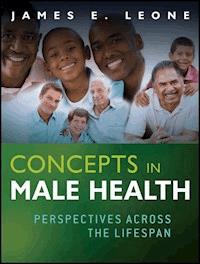
Concepts in Male Health: Perspectives Across the Lifespan
Concepts in Male Health: Perspectives Across the Lifespan offers a practical approach to understanding the health of males of all races, ethnicities, socioeconomic status, cultures, ages, and orientations. Each chapter of this book comprehensively reviews an important dimension of male health and examines the contributing historical, epidemiological, psychosocial, cultural-ethical, legal, political, and economic influences. The diverse range of topics allows for complete coverage ranging from body structures—and sexuality to aggression and occupational health. The book contains the most recent research and evidence-based science and addresses issues in male health throughout the lifespan in an easy-to-understand format. Learning objectives are presented in an accessible format and reflect real life situations. Review questions provided at the end of each chapter address health-specific content included in the chapter and span both the scope and the breadth of the information. This book is ideal for programs in health education, public health, community health nursing, gender studies, and other health sciences.
Sie lesen das E-Book in den Legimi-Apps auf:
Seitenzahl: 729
Veröffentlichungsjahr: 2011
Ähnliche



















Table of Contents
Cover
Title page
Copyright page
DEDICATION
PREFACE
PURPOSE
BOOK DEVELOPMENT
ORGANIZATION OF THE BOOK
DISCLAIMER
ACKNOWLEDGMENTS
THE AUTHOR
1 Historical Perspectives of Male Health
WHAT IS MALE HEALTH?
MALE HEALTH IN HISTORY
CULTURAL PERSPECTIVES
EPIDEMIOLOGICAL AND STATISTICAL EVIDENCE
SUMMARY
KEY TERMS
2 Birth and Infancy
MALE INFANT MORTALITY AND HEALTH RISKS
SOCIOCULTURAL IMPLICATIONS OF BEING BORN MALE
CIRCUMCISION
SUMMARY
KEY TERMS
3 Early Childhood
THE JOURNEY BEGINS
BOYS WILL BE BOYS? THE ROLE OF PARENTS
NUTRITION AND DIET
SEXUAL HEALTH
DISPARITIES IN MALE HEALTH OUTCOMES
SUMMARY
KEY TERMS
4 Toddler Years and Young Childhood
DEFINING THE TODDLER AND YOUNG CHILD
VACCINATIONS
PHYSICAL HEALTH
SOCIAL HEALTH
TEMPERAMENT, EMOTIONAL DEVELOPMENT, AND DISCIPLINE
SUMMARY
KEY TERMS
5 School Age
PHYSICAL HEALTH
NUTRITION
EMOTIONAL HEALTH
SCHOOL AND LEARNING AND SOCIAL HEALTH
HEALTH DISPARITIES AMONG SCHOOL-AGE BOYS
SUMMARY
KEY TERMS
6 Preadolescence and “Tween” Years
THE PREADOLESCENT YEARS
PHYSICAL HEALTH
EMOTIONAL HEALTH
BOYS AND “RITES OF MANHOOD”
SUMMARY
KEY TERMS
7 Adolescence
PHYSICAL CHANGES
PHYSICAL HEALTH
PSYCHOLOGICAL AND EMOTIONAL CHANGES
SEXUAL HEALTH, SEXUALITY, AND SEXUAL ORIENTATION
SEXUAL DEVIANCE
VIOLENCE, AGGRESSION, AND BULLYING
DRUG USE
JUVENILE OFFENDERS AND INCARCERATION
SUMMARY
KEY TERMS
8 Young Adulthood
PHYSICAL HEALTH
SOCIAL HEALTH
EMOTIONAL HEALTH
NUTRITIONAL SUPPLEMENTS AND ANABOLIC-ANDROGENIC STEROIDS
OCCUPATIONAL HEALTH
SUMMARY
KEY TERMS
9 Middle Adulthood
PHYSICAL HEALTH
EMOTIONAL HEALTH
FATHERS’ RIGHTS
SUMMARY
KEY TERMS
10 Older Adulthood
PHYSICAL HEALTH
EMOTIONAL HEALTH
SUMMARY
KEY TERMS
11 Elder Years
PHYSICAL HEALTH
EMOTIONAL HEALTH
SOCIAL HEALTH
SUMMARY
KEY TERMS
12 Death
THE SEVEN AGES OF MAN
GETTING ONE’S MATTERS IN ORDER
SUMMARY
KEY TERMS
13 Promoting Male Health
ADVOCACY AND RESEARCH
MALE STUDIES
ANDROLOGY
MISANDRY AND SOCIAL JUSTICE
THE FUTURE
SUMMARY
KEY TERMS
GLOSSARY
REFERENCES
Index
Copyright © 2012 by John Wiley & Sons, Inc. All rights reserved.
Published by Jossey-Bass
A Wiley Imprint
One Montgomery Street, Suite 1200, San Francisco, CA 94104-4594—www.josseybass.com
No part of this publication may be reproduced, stored in a retrieval system, or transmitted in any form or by any means, electronic, mechanical, photocopying, recording, scanning, or otherwise, except as permitted under Section 107 or 108 of the 1976 United States Copyright Act, without either the prior written permission of the publisher, or authorization through payment of the appropriate per-copy fee to the Copyright Clearance Center, Inc., 222 Rosewood Drive, Danvers, MA 01923, 978-750-8400, fax 978-646-8600, or on the web at www.copyright.com. Requests to the publisher for permission should be addressed to the Permissions Department, John Wiley & Sons, Inc., 111 River Street, Hoboken, NJ 07030, 201-748-6011, fax 201-748-6008, or online at www.wiley.com/go/permissions.
Limit of Liability/Disclaimer of Warranty: While the publisher and author have used their best efforts in preparing this book, they make no representations or warranties with respect to the accuracy or completeness of the contents of this book and specifically disclaim any implied warranties of merchantability or fitness for a particular purpose. No warranty may be created or extended by sales representatives or written sales materials. The advice and strategies contained herein may not be suitable for your situation. You should consult with a professional where appropriate. Neither the publisher nor author shall be liable for any loss of profit or any other commercial damages, including but not limited to special, incidental, consequential, or other damages. Readers should be aware that internet web sites offered as citations and/or sources for further information may have changed or disappeared between the time this was written and when it is read.
Jossey-Bass books and products are available through most bookstores. To contact Jossey-Bass directly call our Customer Care Department within the U.S. at 800-956-7739, outside the U.S. at 317-572-3986, or fax 317-572-4002.
Wiley also publishes its books in a variety of electronic formats and by print-on-demand. Not all content that is available in standard print versions of this book may appear or be packaged in all book formats. If you have purchased a version of this book that did not include media that is referenced by or accompanies a standard print version, you may request this media by visiting http://booksupport.wiley.com. For more information about Wiley products, visit us www.wiley.com.
Library of Congress Cataloging-in-Publication Data
Leone, James E., 1976-
Male health : perspectives across the lifespan / James E. Leone. – 1st ed.
p. cm. – (Public health/aahe ; 21)
Includes bibliographical references and index.
ISBN 978-0-470-48638-2 (pbk.); 978-1-118-14586-9 (ebk.); 978-1-118-14587-6 (ebk.);
978-1-118-14588-3 (ebk.)
1. Men–Health and hygiene. 2. Boys–Health and hygiene. 3. Older
men–Health and hygiene. I. Title.
RC48.5.L46 2012
613'.0423–dc23
2011034061
To my family, friends, Ruby, and to all of the health educators past, present, and future; all of you have allowed me to stand on the shoulders of “giants.”
PREFACE
I VALUE MY health. Sometimes, however, I take my health status for granted. I have had the good fortune of growing up relatively healthy and in a supportive, healthful environment. As a younger adolescent, I competed in cross-country running, track and field, and eventually marathons and road races. In my younger twenties, I happened upon weights and began aggressively pursuing strength training in addition to cardiovascular health. As I became more involved with health and fitness, I realized that many other people were not. Friends and family members did not share the same zeal for health and fitness that I did. Was I out of the ordinary? As the years progressed, I noticed that many of my male friends did not seem to be aging well in comparison to their female counterparts. Expanding waistlines, poor eating habits, little to no exercise, and a continual barrage of questions often were topics of discussion during our gatherings.
In my professional practice I felt compelled to help family, friends, and other people achieve the best health possible. People want to be healthier, but they also want to balance their lives with other aspects of health and wellness outside of gym memberships and treadmills. I changed my practice to reflect the six dimensions of health and wellness: physical, environmental, social, spiritual, intellectual, and emotional (Figure P.1).
Figure P.1 Dimensions of Health and Wellness
Source: Adapted from Hettler (1976)
Any book is a static resource or a tool. Like a wrench or any other tool, it is up to the reader to use this book by putting its concepts and suggestions into action every day. I have included the most recent research and evidence-based science to help readers along in the quest for optimal health and better health-related outcomes. Health is an ever-changing reflection of the balances and imbalances of our everyday existence. It is my sincere wish that readers use this book in good health or find good health while using it.
PURPOSE
Why a book on male health? Male health encompasses 50% of the world’s medical issues; it is an important topic to study and address in the classroom and beyond. First, let me clarify why this book refers to male health rather than men’s health. One of the primary purposes of this book is to help readers become familiar with the multitude of sociobiological aspects and influences that affect male health and quality of life across the life span. The term men connotes a specific age range. Yet health begins at the time of conception (and sometimes before) and is a process experienced until individuals die. The term male health best captures and encompasses all the life stages of the male sex rather than one particular life stage.
This book addresses issues in male health using data-driven, epidemiological information presented in an easy-to-understand format. Each stage of male health, from birth and infancy until the elder years and death, is discussed in detail. Topics range from physical health and wellness to emotional and psychological health. Others include intellectual health, environmental health, occupational health, and spiritual health. Concepts in Male Health provides a comprehensive, practical approach to teaching and learning about issues affecting male health across the life span.
BOOK DEVELOPMENT
Development of this book began like that of many others. A passing discussion with a colleague, a cup of coffee with a friend, much personal reflection on lived experiences, and many other normal life processes initiated and provided the impetus for this book. After being challenged by my former department chairperson to develop a course dedicated to issues in men’s health, I went about writing a course syllabus, finding appropriate resources and activities, and selecting course readings. The latter proved more difficult than expected. There were no adequate textbooks for the course. I set out on a mission, casing several listservs, to see if anyone could point me in the best direction. Responses to many of the discussions and questions I posed were met with a similar level of frustration. My conclusions were that men’s health was a topic embedded in gender studies or human sexuality courses and only received a passing mention. Moreover, most instructors appeared to be using a medley of articles and internet resources to facilitate their courses. I was trying to put together a course reading packet. A cohesive textbook and resource was needed for students in my classes.
ORGANIZATION OF THE BOOK
Covering important health topics as they pertain to males is the primary intent of this book. However, how the content is presented to the reader is a strong focal point. Each chapter presents a particular life stage and the health challenges many males face during this stage. The information in each chapter is practical, usable, and applicable in daily life.
Key Features
Throughout the text, you will notice the following features that will help you assimilate the chapter concepts in a more meaningful and practical way:
Chapter Learning Objectives. Each chapter includes learning objectives consistent with Bloom’s Taxonomy for each main point of the chapter. Learning objectives are presented in an easy-to-follow format and sequence.Myths/Facts. Many areas of health are surrounded by a shroud of intrigue, mystery, and simply misinformation. The Myth/Fact feature in each chapter presents common myths, misinformation, and half-truths about a topic and follows with the related facts. These features allow readers to question what they may have assumed or learned in the past and “unlearn” their assumptions based on fact-driven, evidence-based resources.Vignettes. A brief vignette in each chapter presents a real-world example of a pertinent health issue that many males face. Examples include physical issues such as heart disease and cancer; other areas address occupational and social health determinants such as job stress and relationships.Key Terms. A list of relevant terms for each chapter is provided to assist the reader in developing a comprehensive and working understanding of the chapter information. Terms are defined in the glossary at the end of the book.Discussion Questions. Review questions are provided at the end of each chapter. These questions address health-specific content included in the chapter, spanning both the scope and breath of the information.Additionally, the book’s website (www.josseybass.com/go/leone) includes instructor support materials that can be adapted to course content and instructor teaching style.
The resources included with this book will help advance not only the knowledge of male health, but also the study of it. Through the teaching resource repository and chapter PowerPoints on the book’s website, students and instructors will find it simple to integrate the main concepts pertaining to male health. Presenting the facts in an easy-to-follow format enables students to assess their knowledge of the topic so as to develop a healthier perspective of male health.
DISCLAIMER
This book is meant to serve as a textbook for students in classes that support male health. Not all diseases are presented; many are presented in the chapters on periods of the life span when the diseases are most likely to occur. Some diseases may occur during different phases of life than where detailed in this book. This book does not claim to provide information that replaces qualified medical and professional consultation.
ACKNOWLEDGMENTS
The writing of a book is never possible without the support of others. I thank the following people, groups, and organizations for their input, kindness, and continued support of my work.
I am grateful to my grandparents, parents, all of my family, good friends, and my dog Ruby for understanding why I put so much time and effort into this piece of work. Though it is never easy to sacrifice life’s other engagements, your love and support of me and my work helped me to stay focused and on task. Thank you to all of my colleagues at Bridgewater State University, Indiana State University, Southern Illinois University Carbondale, The George Washington University, and Northeastern University as well as those in academia who responded to my queries and surveys on this important topic; without your input and advice the direction of this work would have been impossible to accurately assess. Additionally, I am appreciative and indebted to the many health professionals at advocacy organizations for male health, such as the Men’s Health Network, the Men’s Health Caucus, the Men’s Health Initiative, Women Against Prostate Cancer, and the Foundation for Male Studies, Inc., for their work and insight. Thank you to Patrick Lentz of Patrick Lentz Photography in Boston, Massachusetts, for his stellar graphics and photography.
I thank the following reviewers for their many thoughtful and helpful comments: Demetrius J. Porche, Henrie M. Treadwell, and Salvatore Giorgianni. Mal Goldsmith and Becky Smith also provided valuable feedback in the early stages of the manuscript.
I recognize the support of the American Association for Health Education (AAHE) for standing behind this book and its concepts. To my editors Andy and Seth, thank you for your guidance and patience in this process. I express an immense thank-you to the students in my male health classes, specifically, my inaugural class in male health at The George Washington University in Washington, D.C., and my special topics class at Bridgewater State University. Without their unique comments and insight I would have missed quite a bit of information in the process. Last, to anyone else whom I may have interacted with during this writing journey, I sincerely thank you; without these everyday experiences I would never have been able to generate the insight this book demanded.
THE AUTHOR
JAMES E. LEONE, PhD, ATC, CSCS, *D, CHES, is an assistant professor of health in the Department of Movement Arts, Health Promotion, and Leisure Studies (MAHPLS) at Bridgewater State University in Bridgewater, Massachusetts. He earned a bachelor of science degree in physical education and athletic training from Bridgewater State University (formerly College), a master of science degree in athletic training and research methods from Indiana State University, and a doctor of philosophy in health education from Southern Illinois University Carbondale. He has an extensive background in the health sciences, teaching courses ranging from health education and health behavior to orthopedic assessment and exercise science. Leone has authored numerous scholarly publications and three book chapters, and he has presented to national and international audiences on a variety of topics in health education and public health. He is an active member of several professional organizations, including the American Association of Health Education, the American Public Health Association, the National Athletic Trainers’ Association, and the National Strength and Conditioning Association. Leone serves as an editorial associate for The Health Educator and Body Image: An International Journal of Research and is a regular reviewer for several scholarly journals and academic publications. In addition to his academic work, Leone enjoys physical activity, culinary experiences, and travel. He presently resides in Waltham, Massachusetts.




