


13,99 €
Mehr erfahren.
- Herausgeber: John Wiley & Sons
- Kategorie: Fachliteratur
- Sprache: Englisch
The business performance creates the value -- the price creates the OPPORTUNITY.
No-one likes to pay too much for something. We all like to thing that what we buy is ' good value'. It's not different when we purchase a share in company listed on the stock market.
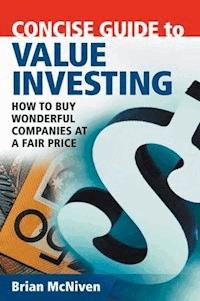
In the Concise Guide to Value Investing, Brian McNiven reveals how to calculate the true value of a company to find out whether you are paying a fair price. This fascinating book explores:
- value investing versus speculation
- the difference between price and value
- variable values of a dollar of earnings
- accounting misrepresentation
- the characteristics of a wonderful business
- the StockVal® valuation formula.
Two of the world's most successful investors, Warren Buffett and Charlie Munger, are self-confessed value investors. McNiven often draws on their wisdom to support his approach to value investing,which he defines as buying a share at a price lower than its calculated value. Only investors who have the ability to calculate value can call themselves 'value investors'.
Sie lesen das E-Book in den Legimi-Apps auf:
Seitenzahl: 260
Veröffentlichungsjahr: 2012
Ähnliche



















Contents
Preface
Chapter 1: What is Value Investing?
Value Assessment Does not Rely on Precision
So-called ‘Value’ and ‘Growth’ Stocks
EPS Growth
Chapter 2: Dividend Huggers
Chapter 3: Price and Value
The Efficient Market Hypothesis
Fundamental and Technical Analysis
Reversion to the Mean
Market Sentiment
Chapter 4: Portfolio Diversification
Chapter 5: Variable Values of a Dollar of Earnings
Numerical Literacy
ROE
Summary
Chapter 6: Stock Valuation
Is a Business Worth the Sum of its Future Cash Flows?
The Price of a Business
Measuring the Business Performance
Normalised Earnings
The Formula’s Logic
Considerations
Intangibles
Return on Funds Employed (ROFE)
Conclusion
Chapter 7: Accounting Misrepresentation
Mining Expenses
Marketing Costs
Research and Development
Economic Erosion
Alternative Methods of Determining Earnings
Chapter 8: Characteristics of a Wonderful Business
The Business Moat
Chapter 9: Sustainability of Business Performance
Competition
Change
Ethical Iinvesting
Commodity and Brand-name Businesses
Chapter 10: Growth, Acquisitions and Buybacks
Growth
Acquisitions
Buybacks
Chapter 11: Evaluating Corporate Management
Reading the Footprints
Stock-price Promotion
Dangerous Statements
Remuneration
Options
Chapter 12: Economic Impact of Interest Rates
Impact of Interest Rates on Stock Prices
Intangible Security
Chapter 13: Financial Fundamentals
Working Capital
Debt Ratios
Equity Ratio
Inventory Turnover
Debtors and Creditors Ageing Statements
Enterprise Value
Chapter 14: When to Sell
Selling Issues
Chapter 15: Strategies and Considerations
Property Trusts
The safest Investment of all
Dollar Cost Averaging
Understand the Power of Compounding
Managed Funds
A Tip for Self-protection
How Many Stocks Should you Hold?
Stocks Likely to Produce Less-than Satisfactory Long-term Results
Positive Attributes to Look for
The Capitalist Social System
List of Abbreviations
Index
Also by Brian McNiven:
A Wonderful Company at a Fair Price
Published by and available from Wrightbooks
First published 2008 by Wrightbooks
an imprint of John Wiley & Sons Australia, Ltd
42 McDougall Street, Milton Qld 4064
Office also in Melbourne
Typeset in 11.5/14.5 pt Warnock Pro
© Brian McNiven 2008
The moral rights of the author have been asserted
National Library of Australia Cataloguing-in-Publication data:
Author: McNiven, Brian.
Title: Concise Guide to Value Investing / author, Brian McNiven.
Publisher: Richmond, Vic. : John Wiley and Sons, 2008.
ISBN: 9780731407934 (pbk.)
Notes: Includes index.
Subjects: Investments. Stocks. Corporations — Valuation.
Dewey Number: 332.6
All rights reserved. Except as permitted under the Australian Copyright Act 1968 (for example, a fair dealing for the purposes of study, research, criticism or review), no part of this book may be reproduced, stored in a retrieval system, communicated or transmitted in any form or by any means without prior written permission. All inquiries should be made to the publisher at the address above.
All quotes from Warren Buffett and Charlie Munger are copyrighted and reproduced with permission.
Cover image © Photodisc
Disclaimer
The material in this publication is of the nature of general comment only, and neither purports nor intends to be advice. Readers should not act on the basis of any matter in this publication without considering (and if appropriate taking) professional advice with due regard to their own particular circumstances. The author and publisher expressly disclaim all and any liability to any person, whether a purchaser of this publication or not, in respect of anything and of the consequences of anything done or omitted to be done by any such person in reliance, whether in whole or part, upon the whole or any part of the contents of this publication.
Preface
Although ‘margin of safety’ (being the difference between price and value) is said to be the most important consideration of the world’s greatest investors, Warren Buffett and his partner Charlie Munger, what good is it to be told that with no explanation of how value is calculated? It’s not surprising that Buffett himself remarked in 1985:
I have seen no trend toward value investing in the 35 years I’ve practiced it. There seems to be some perverse human characteristic that likes to make easy things difficult.
I am more inclined to think that there is some perverse human characteristic that fails to see the connection between value investing and assessment of value. For instance: have you ever asked an investment adviser who recommends a stock on the basis that it represents good value what value he or she places on the stock and what numerical assumptions he or she used in arriving at that value? In the investment world, no other word is so often used and so little understood.
In likening stock valuation to the problem of solving the St Petersburg Paradox, even the accredited securities analyst Benjamin Graham avoided tackling the issue, favouring the more simplistic approach of considering the relation between price and book value.
Although the objective of all investors is to seek superior returns with minimal risk by acquiring stocks in wonderful businesses at a price that represents good value, if they do not know how to calculate value, the objective is achieved by chance, rather than design.
This book will help you reduce your risks and maximise your rewards by providing you with a thorough understanding of value investing and how to determine the true value of a company.
Brian McNiven
Gold Coast
February 2008
Chapter 1
What is value investing?
If we acknowledge that investing is the intention to seek a required rate of return (RR) relative to risk based on an assessment of value, then all investing is ‘value’ investing. The deployment of capital in the absence of assessment of value is called speculation.
Although the art of speculation is covered by numerous books on stock trading and technical analysis, why is it necessary to use a tautology by including the word ‘value’ in the title of a book on investing? After all, would it not be equally foolish to refer to a car as an ‘automobile car’ or an ATM (automatic teller machine) as an ‘ATM machine’?
That the market sees value investing as different from normal investing implies that the very factor on which investing is based is little understood, and therefore nearly always ignored.
Value assessment does not rely on precision
Warren Buffett once said, ‘I’d rather be approximately right than precisely wrong’. Stock valuation is subjective in that it requires a judgement of the sustainability of past profitability, and is therefore far from being an exact science. Like price, value will not increase in neat, even increments year after year, but will vary with the changing fortunes of the business.
Lesen Sie weiter in der vollständigen Ausgabe!
Lesen Sie weiter in der vollständigen Ausgabe!
Lesen Sie weiter in der vollständigen Ausgabe!
Lesen Sie weiter in der vollständigen Ausgabe!
Lesen Sie weiter in der vollständigen Ausgabe!
Lesen Sie weiter in der vollständigen Ausgabe!
Lesen Sie weiter in der vollständigen Ausgabe!
Lesen Sie weiter in der vollständigen Ausgabe!
Lesen Sie weiter in der vollständigen Ausgabe!
Lesen Sie weiter in der vollständigen Ausgabe!
Lesen Sie weiter in der vollständigen Ausgabe!
Lesen Sie weiter in der vollständigen Ausgabe!
Lesen Sie weiter in der vollständigen Ausgabe!
Lesen Sie weiter in der vollständigen Ausgabe!
Lesen Sie weiter in der vollständigen Ausgabe!
Lesen Sie weiter in der vollständigen Ausgabe!




