


18,99 €
Mehr erfahren.
- Herausgeber: John Wiley & Sons
- Kategorie: Geisteswissenschaft
- Sprache: Englisch
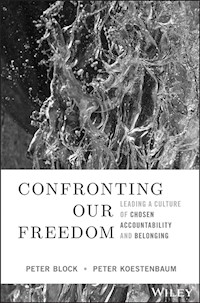
Explore the nature of modern leadership In Confronting Our Freedom, a team of dedicated leadership coaches delivers an exciting and engaging new take on management and leadership. Drawing on recent events in the market and in the world, including the Great Resignation, the COVID-19 pandemic, and widespread digital transformation, the authors invite you to reimagine ideas of freedom and accountability in the context of work. You'll explore how freedom of action--for managers and employees--is what gives rise to true accountability, both in the community and in the workplace. In the book, you'll also find: * Discussions of the power and structure of freedom, including its implications for our own choices and lives * Ways to shift the focus of your leadership and management to accountability and freedom * Strategies for shifting the illusion of clear roles and expectations to one compatible with fully human organizations A groundbreaking and incisive approach to managing and leading others in virtual, hybrid, and in-person settings, Confronting Our Freedom will be an eye opener for managers, executives, and other business leaders seeking to improve their ability to inspire others to their fullest potential.
Sie lesen das E-Book in den Legimi-Apps auf:
Seitenzahl: 228
Veröffentlichungsjahr: 2023
Ähnliche
















Table of Contents
Cover
Praise for
Confronting Our Freedom
Title Page
Copyright
Dedication
Note to Readers
Preface
Prologue: Then Was the Moment
The past is not past
What lies ahead
Introduction: The Philosophic Insight
Conversations on freedom and accountability
The view from where we are
Parenting is the origin story of management and leadership
Shifting the historical context
Philosophic insight in the world of organized effort
The existential understanding
1 The Power and Structure of Freedom
Rewards
Freedom, reality, choice, and will
Accepting our freedom
The fundamental insight
Implications: The forms of freedom
Choice, reality, and will
2 The Potential of Anxiety
The fruits of your patience
Solving anxiety
The promise of anxiety
The language of freedom: It was an inside job
Shifting the context to freedom and accountability
Implications: Anxiety as an ally of accountability both central to performance in a time of permanent uncertainty
The permanent condition
Being conscious
3 Speaking of Death and Evil
Death is an option
A storm in the shelter
Facing reality. Taking charge of our life.
A summary of usefulness of the reality of death
The presence of evil
Denying the reality of evil
Do no harm
Implications: Failure, fear, death, and evil
4 Fully Human Organizations
Guilty as chosen and guilty as charged
The sounds of freedom
Reversing the illusion of clear roles and expectations
Not enough
Our expectations
What are we to do?
Real and chosen accountability? Fully human organizations
Epilogue: Final Words from the Philosopher
References and Background Reading
Acknowledgments
About the Authors
Index
About Designed Learning
End User License Agreement
Guide
Cover Page
Praise for Confronting Our Freedom
Title Page
Copyright
Dedication
Note to Readers
Preface
Prologue: Then Was the Moment
Table of Contents
Begin Reading
Epilogue: Final Words from the Philosopher
References and Background Reading
Acknowledgments
About the Authors
Index
About Designed Learning
Wiley End User License Agreement
Pages
i
ii
iii
iv
vi
vii
iv
ix
x
xv
xvi
xvii
xix
xx
xxi
xxii
xxiii
xxiv
xxv
1
3
4
5
6
7
8
9
10
11
12
13
14
15
16
17
18
19
20
21
22
23
24
25
26
27
28
29
31
33
34
35
36
37
38
39
40
41
42
43
44
45
46
47
48
49
50
51
52
53
54
55
56
57
58
59
61
62
63
64
65
66
67
68
69
70
71
72
73
74
75
76
77
78
79
80
81
82
83
85
87
88
89
90
91
92
93
94
95
96
97
98
99
100
101
102
103
104
105
106
107
108
109
110
111
112
113
114
115
116
117
119
120
121
122
123
124
125
126
127
128
129
130
131
132
133
134
135
136
137
138
139
140
141
142
143
145
146
147
148
149
150
151
152
153
155
156
157
159
160
161
162
163
164
165
166
Praise for Confronting Our Freedom
These two authors—Peter and Peter—offer us an exposition that will burst open many of our best assumptions and categories of interpretation. They range widely into our economy; they dig deeply into our most intimate and demanding relationships; and they probe honestly into issues that divide and summon our society. The sum of this is fresh thinking about the great gift of freedom and our shared responsibility for the wellbeing of our society. These authors come at issues in fresh ways. It is not a surprise that their judgments result in a profound summons to us.
—Walter Brueggemann,Columbia Theological Seminary
Confronting Our Freedom: Leading a Culture of Chosen Accountability and Belonging is a book of its time where distributed work and post‐pandemic living have ushered in a new set of challenges and opportunities when it comes to how we want to live and work. This book is another foundational work by Peter Block that will serve a new generation of thinkers when it comes to asking the big questions about what is a company and how does it serve in the world.
—Rob Locascio,Founder and CEO Live Person, Inc
In Confronting Our Freedom, Peter provides a radical departure from organizational life as we know it. He invites us to deconstruct long‐held practices and ways of being in the workplace that prioritize control, predictability,and an unhelpful relationship between leader and employee. Many of these practices we in Human Resources have created and perpetuated with the best of intentions. After reading Confronting Our Freedom, I am inspired to reimagine how different our workplaces could be when we believe freedom is inherent in every person and accountability is chosen rather than induced. This is a must‐read for everyone practicing human resources in today’s workplace.
—Tonya Harris Cornileus,PhD, Senior Vice President, Learning & Talent Solutions, The Walt Disney Company
Peter Block has a unique gift: to invite each of us to imagine a different future and then he inspires us to do what we need to do to co‐create that future. My hope is that Confronting Our Freedom will ignite a global conversation toward a new narrative around leadership and organizations. What if we took these ideas seriously? What if we could figure out how to dismantle taken‐for‐granted and often oppressive structures, processes, and ways of working and work together to co‐create organizations with freedom at the core?I hope that many will be inspired to read this book, join the conversation, and do what they can to co‐create a more just and equitable world.
—Louise van Rhyn,DMAN Founder, Partners for Possibility
Confronting Our Freedom is the philosophic foundation from which a new social contract and architecture can emanate. It is a guide to social alchemist and architect alike. Our understanding of how to reclaim our capacity to create the world we inhabit can be found its pages.
—Peter PulaFounder, Axiom News and Convenor, Cultivating the Great Community
This is an insightful book about restructuring the world for freedom and collective accountability. It reminds us of the habits we are resigning from and a new meaning for accountability in our lives.
—John McKnightCofounder, Asset‐Based Community Development Institute, author of The Careless Society, coauthor of Building Communities from the Inside Out, The Abundant Community, and An Other Kingdom
Peter Block is the quintessential collaborator—who brings out the best in his colleagues, companions, clients, and friends. This is especially true in Confronting Our Freedom where he teams up with the existential philosopher of commerce Peter Koestenbaum to examine the ideas and practices we most need to re‐invigorate our post‐pandemic era. The result is an inspiring invitation to go deeper into the meaning of exactly what it is we do in our work lives, why and how we do it, and what it ultimately means to ourselves, our world, our posterity, and the earth.
—Robert InchaustiAuthor, The Ignorant Perfection of Ordinary People and Spitwad Sutras: Classroom Teaching as Sublime Vocation
I often ask, “What has COVID taught us about living well?” This book answered that question for me in surprising ways. There is profound wisdom in these writings and the thoughts shared. Freedom is a choice, as is belonging. A better way of living at work and in the world is possible and it starts within. Do take the time to read this book.
—Paul BornCofounder, Tamarack Institute and author of Deepening Community and Breakthrough Community Change
These are prophetic voices of freedom that humanity and the world of organizing and work need today! The Peters are serving up a provocative portion of “philosophic insight” with the intent to place us each at the center of our own lives and institutions. Confronting Our Freedom captures the essence of freedom and its natural presence in our lives, a personal freedom, as a “profound way of thinking” about us that both Peter Block and Peter Koestenbaum have called forth in their work. Both complex and elegantly simple, they share that “our will is free” and all that may mean. Through the exploration of this freedom we each hold, they ask us profoundly what are we willing to be accountable for? A question that serves as an invitation to the power and free will of our own life, and the future we choose to create.
—Gary Mangiofico, Ph.D.Executive Professor of Leadership and Management, and Academic Director, Pepperdine University, Graziadio Business School
With the powerful, philosophical, and provocative ideas in Confronting Our Freedom, Peter and Peter invite us to take what we thought was peripheral and bring it to the center of our awareness, to shift from considering freedom as an escape from fears, constraints, burdens, and limitations to understanding freedom as the opportunity to be the creator in the unfolding of our own lives, replete with the anxiety that will entail!
—Charles HolmesCE Holmes Consulting, Inc.
It is a daunting challenge to capture the brilliance and importance of what Peter has written in this latest book. He provides a way forward from being stuck personally and organizationally, but only if we have the courage and insight to take responsibility for our choices and accept the anxiety that goes along with being free. Confronting Our Freedom is a practical and at depth a spiritual call to reflection and to authenticity that we so urgently need in our lives and for the organizations we serve.
—Ward MailliardFounding Member of Mount Madonna Center
Selected Works
Also by Peter Block
An Other Kingdom: Departing the Consumer Culture, with Walter Brueggemann and John McKnight
Community: The Structure of Belonging
The Abundant Community: Awakening the Power of Families and Neighborhoods, with John McKnight
The Answer to How Is Yes: Acting on What Matters
Flawless Consulting: A Guide to Getting Your Expertise Used
Stewardship: Choosing Service over Self‐Interest
The Empowered Manager: Positive Political Skills at Work
The Flawless Consulting Fieldbook & Companion: A Guide to Understanding Your Expertise, with 30 Flawless Consultants and Andrea M. Markowitz
Also by Peter Koestenbaum
Freedom and Accountability at Work: Applying Philosophic Insight to the Real World, co‐authored with Peter Block
The Language of the Leadership Diamond® (videotape with Peter Block)
Leadership: The Inner Side of Greatness—A Philosophy for Leaders
The Heart of Business: Ethics, Power, and Philosophy
Managing Anxiety: The Power of Knowing Who You Are.
The New Image of the Person: The Theory and Practice of Clinical Philosophy
Existential Sexuality: Choosing to Love
Is There an Answer to Death?
The Vitality of Death: Essays in Existential Psychology and Philosophy
CONFRONTING OUR FREEDOM
LEADING A CULTURE OF CHOSEN ACCOUNTABILITY AND BELONGING
PETER BLOCK · PETER KOESTENBAUM
Copyright © 2023 Peter Block and Peter Koestenbaum. All rights reserved.
Published by John Wiley & Sons, Inc., Hoboken, New Jersey.
Published simultaneously in Canada.
No part of this publication may be reproduced, stored in a retrieval system, or transmitted in any form or by any means, electronic, mechanical, photocopying, recording, scanning, or otherwise, except as permitted under Section 107 or 108 of the 1976 United States Copyright Act, without either the prior written permission of the Publisher, or authorization through payment of the appropriate per‐copy fee to the Copyright Clearance Center, Inc., 222 Rosewood Drive, Danvers, MA 01923, (978) 750‐8400, fax (978) 646‐8600, or on the Web at www.copyright.com. Requests to the Publisher for permission should be addressed to the Permissions Department, John Wiley & Sons, Inc., 111 River Street, Hoboken, NJ 07030, (201) 748‐6011, fax (201) 748‐6008, or online at http://www.wiley.com/go/permissions.
Trademarks: Wiley and the Wiley logo are trademarks or registered trademarks of John Wiley & Sons, Inc. and/or its affiliates in the United States and other countries and may not be used without written permission. All other trademarks are the property of their respective owners. John Wiley & Sons, Inc. is not associated with any product or vendor mentioned in this book.
Limit of Liability/Disclaimer of Warranty: While the publisher and author have used their best efforts in preparing this book, they make no representations or warranties with respect to the accuracy or completeness of the contents of this book and specifically disclaim any implied warranties of merchantability or fitness for a particular purpose. No warranty may be created or extended by sales representatives or written sales materials. The advice and strategies contained herein may not be suitable for your situation. You should consult with a professional where appropriate. Further, readers should be aware that websites listed in this work may have changed or disappeared between when this work was written and when it is read. Neither the publisher nor authors shall be liable for any loss of profit or any other commercial damages, including but not limited to special, incidental, consequential, or other damages
For general information on our other products and services or for technical support, please contact our Customer Care Department within the United States at (800) 762‐2974, outside the United States at (317) 572‐3993 or fax (317) 572‐4002.
If you believe you’ve found a mistake in this book, please bring it to our attention by emailing our reader support team at [email protected] with the subject line “Possible Book Errata Submission.”
Wiley also publishes its books in a variety of electronic formats. Some content that appears in print may not be available in electronic formats. For more information about Wiley products, visit our web site at www.wiley.com.
Library of Congress Cataloging‐in‐Publication Data:
Names: Block, Peter, author. | Koestenbaum, Peter, 1928‐ author.
Title: Confronting our freedom : leading a culture of chosen accountability and belonging / Peter Block, Peter Koestenbaum.
Description: First edition. | Hoboken, NJ : Wiley, [2023] | Includes index.
Identifiers: LCCN 2022044710 (print) | LCCN 2022044711 (ebook) | ISBN 9781394156092 (cloth) | ISBN 9781394156115 (adobe pdf) | ISBN 9781394156108 (epub)
Subjects: LCSH: Management—Philosophy. | Leadership.
Classification: LCC HD30.19 .B57 2023 (print) | LCC HD30.19 (ebook) | DDC 658—dc23/eng/20221125
LC record available at https://lccn.loc.gov/2022044710
LC ebook record available at https://lccn.loc.gov/2022044711
Cover Design: Paul McCarthy
Cover Art: Courtesy of Jim Block
To Ari Weinzweig. An entrepreneur who understands that philosophy and enterprise are one and the same thing.
Note to Readers
About how to put the ideas in this book into practice
A more specific methodology for the path toward distributing agency and choice can be found in a series of videos and podcasts at https://www.peterblock.com/the-six-conversations/ and https://www.peterblock.com/interviews/common-good-podcast/.
About Peter Koestenbaum's quotations
Material quoted from Peter Koestenbaum throughout is taken from two previously published books. Sources for the quotations are identified in text as follows:
1978
The New Image of the Person: Theory and Practice of Clinical Philosophy
(Westport, CT: Greenwood Press, 1978).
1971
The Vitality of Death: Essays in Existential Psychology and Philosophy
(Westport, CT: Greenwood Press, 1971).
Preface
Twenty years ago, the first version of this book rested at the intersection of philosophy and leadership in a practical world. That effort was organized around the voice and thinking of Peter Koestenbaum, an existential philosopher who, after decades of teaching and writing about life and death, vision and reality, turned his attention to the business world. As his attention shifted to business leadership, “The Leadership Diamond” and its variations were published. The cornerstone of this philosophy was the idea that freedom, with its innate appeal and risks, was an essential aspect of being human. And that how we organize work and institutional life was a major player in encouraging or setting limits on our freedom.
Now the world has caught up with the philosopher. A post‐pandemic world no longer whispers about freedom. No longer thinks freedom has to be postponed, waiting to be purchased by making your number. Or waiting for the empty nest or counting the years to retirement.
The pandemic gave many more people a taste of not going to a workplace. Technology has long made working at a distance commonplace. People in notable numbers are torn about going back to their workplace. Many of those wanting to keep their jobs do not want to return to the office. Some companies, in turn, are forcing employees to return to the office. It is complicated.
This book rests on the ideas of freedom and accountability. Especially how they fit into our ideas and practices that occur in our places of work. It reframes how we think about the common practices that are the essence of most jobs. It is intended to question our management practices. And offer an alternative. It is ultimately a friendly whisper into how we might think about the common practices that are the essence of most jobs. It is in essence a friendly whisper into how we might question our assumptions about consistency, control, and predictability. Even in organizations that rate highly in employee satisfaction. Best places to work and the like.
There resides in the words that follow an invitation toward freedom. Freedom as a pathway to accountability, which is what management, in the end, is after. Words create a world. Personally, and in the work I continue to do with organizations and communities, there remains the confusion between freedom, liberty, license, revolution, and rebellion. “Freedom fighter” poses a world where someone is withholding your freedom against your will. Even more compelling is the idea that freedom, as used here, is what creates real accountability. For our children, our workplace and our community. Structuring our world for freedom is the path to a collective accountability that puts entitlement and certainty in their proper places. And it is possible as we experience the reality we hold in our hands and feel under our feet all that matters, we will shop less, care for the earth more, and extract less.
Today's conventional thinking is little changed since the industrial revolution took hold a few hundred years ago. The industrial revolution, symbolized by the linen mills of Glasgow, was a radical moment where productivity, the speed and cost of making something, became the point. It replaced independent sources of livelihood, access to common land, and a craft culture. It introduced the idea of a labor force and employment. People were driven off the land and into the cities by enclosure. The promise was a middle class where you had your own lace curtains. Management became the way of organizing human effort, and accountability became a way of holding people. It became the rationale for carrots and sticks, motivation, and rewards for compliance and performance. It introduced the idea that manager was cause and worker was effect. Before industrialization, worker was both cause and effect.
The point here is to explore this way of thinking as one construct, rather than the truth about what works. To question what freedom might bring to where we assemble. To remind us that freedom is in our nature. And that it can be put to good use. Eve knew that and she expressed her freedom through cuisine.
Same with accountability. Why isn't this the first choice each of us will make, every day of the week, on everything that matters to us? Perhaps we were born to choose accountability.
Instead of celebrating and naturalizing freedom and accountability, we live in structures and practices and solutions that are a mixture of treading water and living in the habits of monarchy and colonialism. Having endured the pandemic, which exposed our habits that we are resigning from, we are in a moment to create a shift with a central appreciation that our freedom is present and no waiting is necessary.
Prologue: Then Was the Moment
The first version of this book was called Freedom and Accountability at Work. It had its spark in an auditorium forty years ago. There have been very few times in my life where I knew at that instant that something in me was going to change. One of those moments was in 1980 during a lecture by a San Jose State professor named Peter Koestenbaum. Up to that moment in my life, I was focused on questions of how to make life work, how to make relationships work, how to make family work, how to make a business work. Questions of destiny, courage, and freedom were vague and off my field of vision. I had considered the experiences of aloneness, anxiety, and my wounded‐ness as my own unique problems. I treated these as problems to be endured or therapeutically or spiritually solved. At that moment I heard Peter name these “problems,” and he suggested that I was human, not broken. This shifted something in me that is still in motion.
In this moment of searching for meaning and connection in the midst of great uncertainty, what it means to be human might give us guidance in rethinking our conception of office, workplace, leadership, and management. This is what motivates me to bring the ideas forward again. Shorter this time. More in my own voice. But the words and philosophy and radical spirit always has Peter at its origin.
“The starting point for understanding how philosophic insights can change our lives is to explore the meaning of freedom.”
— Peter Koestenbaum (1971)
Whoever hurled the first word began civilization.
— Popularized by Sigmund Freud
The past is not past
My belief since birth was that a person could overcome their problems with hard work, professional help, and the right amount of guilt and confession. When I met Peter, I was forty and working hard to do just that. I had been in therapy, participated in personal development groups (even conducted them), worked hard on difficult relationships, and thought that at some point in life I would leave anxiety behind and in essence have it together. I was like a male Sleeping Beauty, waiting to be kissed by the prince of self‐awareness, perhaps only a short insight away from living happily ever after.
I thought that my personal family history, parents, siblings, point of view, essentially explained who I was. I knew that the key to relationships was honest and timely feedback (I gave lectures on this). I believed in problem solving and was good enough at it. On the work front, I thought organizations existed to make money, serve customers, and meet their objectives. Work, for me, was a place to build self‐esteem, pursue ambition, and try to make a living doing the best I could. With as little stress as possible. Still an issue.
In the course of this one‐hour lecture, in Stockholm by the way, all of these beliefs were seriously undermined. This professor took the position that my anxiety, isolation, feeling out of control, helplessness, and inner and outer conflicts were not so much my own unresolved psychological inadequacies, but were permanent qualities of being a human being. It is the human condition. I understood him to say that no amount of treatment, no list of accomplishments, no amount of sincere effort would resolve these experiences. What we experience as personal and individual disquiet is really a universal and collective essence of our being. We are each “wounded at the moment of birth” and rather than treat this as a problem to be solved, it is what makes us human and binds us together. In fact, working on self‐improvement and the improvement of others, knowing what is best for others, is what divides us. One force that keeps us apart.
I found those ideas deeply disturbing and compelling, and when the lecture was over, I went right to the front of the hall, found Peter, and asked him if I could come to see him in California. He said, “Yes,” and told me how to find him—and that began what is at this point a lifelong effort to reframe much of what I had been taught and had chosen to believe.
My relationship with Peter evolved from being a client of his to becoming a friend and colleague. In the early 1980s, I began to invite Peter into the consulting world where I lived and introduced him to all my clients. This supported a direction he had already started to take, and he soon left the academic world where he had lived for thirty‐five years to commit himself full time to bringing philosophy into the world of business. He is still at it.
Freedom and Accountability at Work was another step to widen the audience for Peter's ideas. It was an adaptation of foundational writings contained in two books he wrote in the 1970s. One was titled The Vitality of Death, the other called The New Image of the Person. Peter's ideas and work have moved far beyond these earlier books; he has written many others since then, the most recent ones aimed directly at leadership in the world of business. Yet as much as I continue to learn from Peter to this day, I still find myself drawn to the more fundamental ideas of philosophy that these early books defined.
What lies ahead
Today, with a pandemic on our resume, with wealth disparity at an all‐time high, with social media giving voice to our shadow with unimaginable intensity, and where you do your work up for grabs, it is the time to reach back and bring the essence of philosophical insight into our contemporary thinking about what it means to live in today's world. The conventional wisdom most of us now operate from is based on a belief system articulated by the economist, engineer, game designer, and artificial intelligence programmer. The problem is that we have spent and consumed much of the value these disciplines have to offer us, and much of what we call “new” is really a recycling through ground we have been walking on for at least one hundred years. We have experienced the promise of technology, and its convenient delivery system, to increase happiness, beauty, and customer satisfaction.




