


22,99 €
Mehr erfahren.
- Herausgeber: John Wiley & Sons
- Kategorie: Fachliteratur
- Sprache: Englisch
An engrossing and practical discussion of how to deal with contemporary challenges to democracy and civilization.
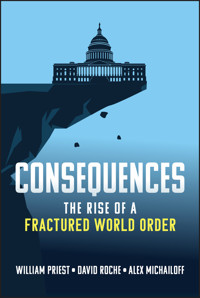
In Consequences: The Rise of a Fractured World Order, William Priest, David Roche, and Alex Michailoff deliver an engaging, timely, and insightful analysis of identifying the sources and challenges facing liberal democracies and their ability to confront autocracies and autocratic behavior. The authors identify and address structural flaws present in both democracies and autocracies.
The book explains why the creation and distribution of wealth matters in creating nations where democracy can flourish, and the populace at large can win. Strategies for the creation of wealth (broadly defined) and its equitable distribution combined with the democratic tools that voters, investors, and citizens have available make it more likely those strategies can be deployed. You'll also find:
- Detailed and accurate discussions of the end of the liberal world order, post-cold war historical shifts, and the challenges that lie ahead.
- Explorations of the threat to democracy posed by populist politics and philosophies.
- An analysis of the likelihood of contemporary political actors to reform our economics and politics, and the steps we can take if they fail to do so
A startlingly original and eye-opening read for executives, investors, policymakers, and regulators, Consequences is an essential resource for everyone interested in the interplay between politics, economics, and long-term investment outcomes.
Sie lesen das E-Book in den Legimi-Apps auf:
Seitenzahl: 257
Veröffentlichungsjahr: 2025
Ähnliche


















TABLE OF CONTENTS
COVER
TABLE OF CONTENTS
TITLE PAGE
COPYRIGHT
PREFACE
ABOUT THE AUTHORS
ACKNOWLEDGMENTS
CHAPTER ONE: EXTERNAL CHALLENGES
THE
GRAYZONE
WAR: DEMOCRACIES vs AUTOCRACIES
RUSSIA
CHINA
NORTH KOREA
IRAN
AN
AXIS
UNITED
BACK TO THE COLD WAR
GLOBALIZATION
CHAPTER TWO: INTERNAL DEMOCRATIC DECAY
POPULISM
DISCOURSE
DEGLOBALIZATION
BIG GOVERNMENT
THE END OF THE CHINESE ECONOMIC MIRACLE
CHAPTER THREE: POPULISM
HOW DID WE GET HERE?
THE GERMAN EXAMPLE
DEMOCRACY VS POPULISM
HOW POPULISM WORKS
POPULISTS IN THE REAL WORLD
CHAPTER FOUR: SOCIAL MEDIA AND THE NETWORK EFFECT
COLLECTIVE BEHAVIOR
HYPERCONNECTED AND HYPERPOLARIZED
ECHO CHAMBERS AND AMPLIFICATIONS
SOCIAL MEDIA AND POPULISM
SOCIAL MEDIA AS A WEAPON
CHAPTER FIVE: THE AI OF IT ALL
HOW AI AFFECTS DISCOURSE
HOW AI AFFECTS THE JOB MARKET
THE GLOBAL AI ARMS RACE
AI IN WARFARE
THE DOUBLE-EDGED SWORD OF AI
CHAPTER SIX: LIVING IN THE GRAYZONE
GRAYZONE
DEFINED
PICKING SIDES
OUTCOMES OF THE MULTI-POLAR WORLD
CURRENCY WARFARE
THE TRICKLE-DOWN EFFECTS OF
GRAYZONE
WARFARE
CHAPTER SEVEN: THE NOT SO MIGHTY GREENBACK
A NATION IN DEBT
A NEGATIVE FEEDBACK LOOP
LOSS OF CONFIDENCE
SHIFTING COURSE
CHAPTER EIGHT: IMMIGRATION
CHALLENGES
BACK TO TODAY
GLOBAL REACTION
IMMIGRATION’S BENEFITS
CHAPTER NINE: THE HEART OF THE MATTER
SOLUTIONS
THE CREATION AND DISTRIBUTION OF WEALTH
CHAPTER TEN: THE LAST CHAPTER
THE ISSUES RESTATED
WHAT HAPPENS IF WE CAN’T REVERSE COURSE
AN IRREVERSIBLE COURSE?
NOTES
INDEX
END USER LICENSE AGREEMENT
Guide
COVER
TABLE OF CONTENTS
TITLE PAGE
COPYRIGHT
PREFACE
ABOUT THE AUTHORS
ACKNOWLEDGMENTS
BEGIN READING
NOTES
INDEX
END USER LICENSE AGREEMENT
Pages
iii
iv
vii
ix
x
xi
xiii
xiv
xv
1
2
3
4
5
6
7
8
9
10
11
12
13
14
15
16
17
18
19
20
21
22
23
24
25
26
27
28
29
30
31
32
33
34
35
36
37
38
39
40
41
42
43
44
45
46
47
48
49
50
51
52
53
54
55
56
57
58
59
60
61
62
63
64
65
66
67
68
69
70
71
72
73
74
75
76
77
78
79
80
81
82
83
84
85
86
87
88
89
90
91
92
93
94
95
96
97
98
99
100
101
102
103
104
105
106
107
108
109
110
111
112
113
114
115
116
117
118
119
120
121
122
123
124
125
126
127
128
129
130
131
132
133
134
135
136
137
138
139
140
141
142
143
144
145
146
147
148
149
150
151
152
153
154
155
156
157
158
159
160
161
162
163
164
165
166
167
168
169
170
171
172
173
174
175
176
177
178
179
180
181
182
183
184
185
186
CONSEQUENCES
THE RISE OF A FRACTURED WORLD ORDER
WILLIAM PRIEST
DAVID ROCHE
ALEX MICHAILOFF
Copyright © 2025 by John Wiley & Sons, Inc. All rights reserved, including rights for text and data mining and training of artificial intelligence technologies or similar technologies.
Published by John Wiley & Sons, Inc., Hoboken, New Jersey.
Published simultaneously in Canada.
No part of this publication may be reproduced, stored in a retrieval system, or transmitted in any form or by any means, electronic, mechanical, photocopying, recording, scanning, or otherwise, except as permitted under Section 107 or 108 of the 1976 United States Copyright Act, without either the prior written permission of the Publisher, or authorization through payment of the appropriate per-copy fee to the Copyright Clearance Center, Inc., 222 Rosewood Drive, Danvers, MA 01923, (978) 750-8400, fax (978) 750-4470, or on the web at www.copyright.com. Requests to the Publisher for permission should be addressed to the Permissions Department, John Wiley & Sons, Inc., 111 River Street, Hoboken, NJ 07030, (201) 748-6011, fax (201) 748-6008, or online at http://www.wiley.com/go/permission.
The manufacturer’s authorized representative according to the EU General Product Safety Regulation is Wiley-VCH GmbH, Boschstr. 12, 69469 Weinheim, Germany, e-mail: [email protected].
Trademarks: Wiley and the Wiley logo are trademarks or registered trademarks of John Wiley & Sons, Inc. and/or its affiliates in the United States and other countries and may not be used without written permission. All other trademarks are the property of their respective owners. John Wiley & Sons, Inc. is not associated with any product or vendor mentioned in this book.
Limit of Liability/Disclaimer of Warranty: While the publisher and the authors have used their best efforts in preparing this work, including a review of the content of the work, neither the publisher nor the authors make any representations or warranties with respect to the accuracy or completeness of the contents of this work and specifically disclaim all warranties, including without limitation any implied warranties of merchantability or fitness for a particular purpose. Certain AI systems have been used in the creation of this work. No warranty may be created or extended by sales representatives, written sales materials or promotional statements for this work. The fact that an organization, website, or product is referred to in this work as a citation and/or potential source of further information does not mean that the publisher and authors endorse the information or services the organization, website, or product may provide or recommendations it may make. This work is sold with the understanding that the publisher is not engaged in rendering professional services. The advice and strategies contained herein may not be suitable for your situation. You should consult with a specialist where appropriate. Further, readers should be aware that websites listed in this work may have changed or disappeared between when this work was written and when it is read. Neither the publisher nor authors shall be liable for any loss of profit or any other commercial damages, including but not limited to special, incidental, consequential, or other damages.
For general information on our other products and services or for technical support, please contact our Customer Care Department within the United States at (800) 762-2974, outside the United States at (317) 572-3993 or fax (317) 572-4002.
Wiley also publishes its books in a variety of electronic formats. Some content that appears in print may not be available in electronic formats. For more information about Wiley products, visit our web site at www.wiley.com.
Library of Congress Cataloging-in-Publication Data:
Hardback ISBN: 9781394339372
ePDF ISBN: 9781394339396
ePUB ISBN: 9781394339389
Cover Image(s): © Chuhail/Getty Images, © erhui1979/Getty Images
Cover Design: Wiley
“There are decades where nothing happens; and there are weeks where decades happen.”
– Vladimir Ilyich Lenin
PREFACE
The vision of a liberal democratic world order that emerged after the Cold War, which led to a brief era of major United States global dominance, is coming to an end. The fall of the Berlin Wall left a void, in which the US became the dominant global power. This “unipolar” world was supposed to be global in scale: oriented to capitalistic markets allocating the world’s “scarce resources,” commonly referred to as “land, labor, and capital” in Economics 101 courses. At this time, democratic regimes were on the rise, and the list of countries pursuing democratic policies began to grow rapidly.
Francis Fukuyama described this phenomenon in his 1992 book The End of History and the Last Man. However, this idea of a globalized world centered upon a mix of capitalistic principles and democratic ideals never truly materialized. While that seismic shift in history is behind us, its ripple effects continue to shape the challenges we face today. Democracy and civilization now stand at a crossroads, confronted by complex and daunting obstacles.
What was once a relatively stable geopolitical landscape has been replaced by a multi-polar world of competing economic and political powers. Today, democracy is under pressure from both internal and external forces, and this book focuses on these twin challenges. What caused these challenges, and what consequences will follow?
Externally, Grayzone warfare, defined as the use of hostile measures just short of war itself, pits alliances of autocratic and democratic nations against each other, reshaping global economic and political norms. The erosion of globalization and the rise of protectionism, two hallmarks of a fragmenting world, further strain international cooperation. At the same time, China’s economic growth, once a key driver of global prosperity, faces significant challenges. Its heavy reliance on state-driven investment and structural inefficiencies may lead to a prolonged period of stagnation, disrupting global economic stability.
Internally, the rise of populism feeds on economic discontent, amplifying divisions within democratic societies. Populist policies often prioritize short-term political gains over sustainable economic reforms, undermining institutions in the process. Adding to these pressures is the expansion of the “Big State,” as governments take on an outsized role in managing economies, risking inefficiencies from arbitrary capital allocation processes and unsustainable fiscal policies. These internal dynamics weaken the resilience of democracies and hinder their ability to adapt to global challenges.
Some may view this moment in history as part of an inevitable cycle, where democracy, like past systems such as the Roman Empire, feudal monarchies, or colonial empires, will face decline and be replaced by alternative forms of governance. This perspective suggests that the current challenges we face mark the beginning of the end for democracy.
However, this book asserts otherwise; the values and institutions of democracy can endure, but only if we confront democracy’s vulnerabilities directly. To reverse democratic decline, it is essential to identify its root causes and develop cohesive strategies that address the structural issues undermining both its durability and stability.
A key to strengthening democracy lies in addressing wealth inequality by ensuring that economic gains are distributed more equitably. True wealth goes beyond simple measures like Gross Domestic Product (GDP) or national income—it represents a lasting “stock” of value rather than just a temporary “flow.” Achieving equitable distribution requires creating systems that reward effort and innovation while avoiding over-reliance on entitlement, thus striking a balance that fosters both fairness and motivation. The tools to address democracy’s challenges are already within reach, offering a reason for hope. However, significant hurdles remain, as we as a society often lack the willingness to act upon these solutions. While the potential for a stronger, more equitable future exists, achieving it will require overcoming the deep political and societal divisions that stand in the way.
ABOUT THE AUTHORS
William Priest
William Priest is a recognized professional in the asset management industry, with over five decades of experience creating and leading investment firms. He currently is Vice Chair of TD Wealth and Chair of TD Epoch, an asset management firm he founded in 2004 and sold to TD Bank in 2013.
Before founding Epoch, he was Chairman and CEO of Credit Suisse Asset Management, Americas from 1981–2001, and CEO and Portfolio Manager of its predecessor firm, BEA Associates, beginning in 1972. During his tenure at BEA and Credit Suisse Asset Management, he developed the firm into a respected investment manager with over $100 billion of assets under management.
He is the author of several published articles and papers on investing as well as three books—The Financial Reality of Pension Funding Under ERISA; Free Cash Flow and Shareholder Yield: New Priorities for the Global Investor; and Winning at Active Management – The Essential Roles of Culture, Philosophy, and Technology.
He is a graduate of Duke University (AB) and the University of Pennsylvania’s Wharton Graduate School of Business (MBA) and holds CFA and CPA designations. He is a member of the Barron’s Roundtable and the Council on Foreign Relations.
David Roche
David Roche was born in Ireland, which he left as soon as possible with ambitions to write. He studied at Trinity University, INSEAD, and also obtained a CFA and C Dip Af. He founded Quantum Strategy, a subscription based economic advisory platform which creates products designed for the needs of clients such as those managing assets, needing to forecast markets, and/or evaluate geopolitical risks. Before setting up Quantum Strategy he was a strategist at JP Morgan, Morgan Stanley, and Independent Strategy.
In David’s own words, “My inspirations are tectonic plate shifts, like the Fall of the Wall; the Russian invasion of Ukraine; and the death of liberal economics and globalization. So, my mind fires up when history is no guide but creative thinking is. Where there is discontinuity there is value in strategic thinking.”
He is the author of several microbooks:
New Monetarism
(2008)
Sovereign Discredit
(2010)
Democrisis
(2012)
Death of Democracy
(2018)
Quantum Economics
(2022)
Living in the Grayzone
(2024)
Alex Michailoff
Alex Michailoff is a 2024 graduate of Cornell University’s Undergraduate Charles H. Dyson School of Business. At the time of writing, he is working as a financial consultant in New York City.
ACKNOWLEDGMENTS
Thought leadership books are never created alone, and this book required a great deal of discussion, organization, and patience among the authors, who were almost never in the same geographic location or even the same time zone.
We would like to thank all the people who contributed to the creation of this book.
We are indebted to the publication team at Wiley: Bill Falloon for his guidance throughout the publication process, and Susan Cerra and Katherine Cording for their essential support along the way. We also extend our appreciation to Susanna Matson and Bala Shanmugasundaram from Wiley for their assistance and collaboration.
Special thanks to Jade Myers for his outstanding graphic design work, and to Matthew Michailoff for his invaluable help with organization, graphics, and overall coordination.
This book would not have been possible without your contributions. Thank you.
CHAPTER ONEEXTERNAL CHALLENGES
Why write this book? With so many books out there, why this one? What makes it worth your time? Simply put, if you are reading this, chances are you live in a democracy, and that is exactly who this book is for—people in places where open dialogue matters most. In autocracies, books like this one often do not see the light of day. Information that questions power or explores uncomfortable truths is frequently suppressed, making free access to ideas even more essential for those who can still freely engage. In a democracy, the ability to ask questions, even ones without clear answers, is more valuable than in an autocracy, where answers are given but never open to questioning. Freedom of inquiry is essential for progress, while unquestionable answers only serve to suppress it. Questions that cannot be answered are better than answers that cannot be questioned. This underscores why protecting democracy is not just important—it is necessary.
Democracies represent freedom and the rule of law. Yet, if you live in a democracy, you are part of a system struggling to compete with non-democratic nations. This struggle plays out on two main fronts: from external forces and internal challenges.
Freedom and economic prosperity go hand in hand. A great example of this connection is shown in the Freedom House Index, which is available online for everyone to explore. Just look at Taiwan—a flourishing democracy and a key player in the global economy—compared to China, where freedoms are tightly controlled.
Taiwan, a vibrant democracy, achieved a high freedom score of 94 out of 100, ranking second in Asia and seventh globally in 2025. This reflects its robust political rights and civil liberties, contributing to its status as a key player in the global economy.1
In contrast, China received a low freedom score of 9 out of 100 in 2025, categorizing it as “Not Free.” This score indicates significant restrictions on political rights and civil liberties, which can impede economic innovation and individual prosperity. It is no wonder that China is so interested in taking control over Taiwan, they would love to inherit its economic successes.2
While this example is extreme, we implore you to do your own research using Freedom House’s free resources and see how your home country stacks up against others.
With so much economic success this begs the question: Why are our democracies losing their global influence to autocratic nations where citizens are not as free?
THE GRAYZONE WAR: DEMOCRACIES VS AUTOCRACIES
The rise of successful non-democratic economies in countries like China has given their government more political power. They pose a threat to democracies, especially in trade and governance.
Autocratic leaders often view democracies as weak and corrupt. They propose their own models for how societies and the world should be organized. What was once a world inspired by the spread of democracy, with the US at the center, is now one shifting toward competing visions of governance and alternative political systems.
What about the countries that have not yet aligned themselves with the democratic or autocratic ways of life? Most of these countries belong to what many refer to as the Global South, a group of nations primarily in Asia, Africa, Latin America, and the Pacific. They are often characterized by lower income levels and histories of colonialism or economic dependency. These nations encompass a wide range of political systems and development stages. Unlike the industrialized democracies of the Global North, many Global South countries struggle with structural inequalities and governance issues. However, they are also dynamic, home to rapidly growing economies, rich cultural diversity, and youthful populations. According to the World Bank, within the next 50 years, one-third of the world’s working-age population will be African.3 Africa’s expanding working-age population is seen as a potential catalyst for accelerated economic progress, provided that investments are made in education and employment opportunities. Where African nations, along with many in Southeast Asia and Latin America, align themselves in this new conflict, might end up determining its outcome.
Many Global South governments are tempted by the Chinese autocratic model. Why? Because most Global South countries are not democracies themselves. They dislike the nations which were previously colonial powers that make up most of the democratic alliance. They also envy China’s authoritarian and meteoric rise to middle-income status. Since initiating market reforms in 1978, China has achieved remarkable economic growth, averaging 9.5% real Gross Domestic Product (GDP) growth annually through 2018, a pace the World Bank describes as “the fastest sustained expansion by a major economy in history.”4 This proof of concept has greatly aided China’s case to become the beacon of hope for emerging economies in the Global South. China believes democracy will die of its own accord, but with a little extra push, it will fall over the cliff a bit faster (see our cover), and then there will be a new world leader and way of life led by a superior autocratic system, at least in their eyes.
The most important external threat to democracy today is the Axis of Autocracies. This includes primarily China, Russia, North Korea, and Iran. Opposing it is what we might call the Alliance of Democracies, which includes all NATO countries and Asian democracies such as Japan, Korea, and Taiwan. But the leadership is really just a single nation, the US of America. The US is by far the largest contributor to NATO defense spending, accounting for the majority of the alliance’s total budget—reaching an estimated $755 billion in 2024, compared to $430 billion from all other NATO members combined. Beyond military expenditures, the US also plays a crucial role in NATO’s broader initiatives, including intelligence sharing, logistical support, and financial contributions to joint projects and operational missions.5
SOURCE: Data from IMF
The US’s leadership within the Alliance of Democracies extends beyond its military and economic influence; it also lies in its historical role as a global promoter of democratic ideals. Post–World War II, the US established frameworks and organizations like NATO, the United Nations (UN), the International Monetary Fund (IMF), and the World Bank to solidify collective security, ensuring that democracies could thrive against threats such as the Soviet Union. Other US-backed organizations further reinforced this global order, including the World Trade Organization (WTO), the Organization of American States (OAS), the International Atomic Energy Agency (IAEA), and economic alliances like the G7, G20, and Asia-Pacific Economic Cooperation (APEC), all designed to promote trade, security, and diplomatic cooperation. The US consistently leverages its diplomatic and financial might to stabilize regions, foster alliances, and counteract the growing influence of autocratic states.
The Alliance of Democracies defends the existing rule-based international order. The Axis of Autocracies has its own alternative versions.
RUSSIA
Russia’s ideology often ties its identity to historical control over territories like Ukraine, Belarus, and other Soviet-era states. This belief underpins much of its modern foreign policy and its attempts to reclaim the influence it lost after the Soviet Union’s collapse. Under President Vladimir Putin’s vision, the restoration of Russian greatness involves a return to the geopolitical dominance of its imperial and Soviet past. This includes undermining Ukraine’s sovereignty, demilitarizing former Warsaw Pact nations, and even pushing for NATO’s withdrawal from regions that were once within Moscow’s sphere of influence.
Putin’s speeches given in 2014, 2023, and 2024, along with his rambling propagandist theory of Slavic history published in his 5000-word essay at the time of the invasion of Ukraine, evidence his views. In his 2014 speech following the annexation of Crimea, President Vladimir Putin stated: “We are not simply close neighbors but, as I have said many times already, we are one people. Kiev is the mother of Russian cities. Ancient Rus is our common source, and we cannot live without each other.”6
The consequences of this ambition are far-reaching. Russia’s aggression in Ukraine—an area central to its claims of cultural and political history—not only leads to conflict but also destabilizes Europe’s eastern borders. Kremlin-backed forces target Ukraine’s critical infrastructure and civilian institutions to maintain leverage. Furthermore, Putin’s rhetoric frequently references a grand historical narrative designed to justify actions perceived by much of the global community as violations of international law.
The devastating methods used to achieve Putin’s vision are being witnessed daily in Ukraine. Russian forces have targeted civilian infrastructure, including hospitals, schools, and residential areas, leading to widespread destruction and displacement. Cities like Mariupol and Bakhmut have been reduced to rubble, and millions of Ukrainians have been forced to flee their homes, seeking refuge in neighboring countries or enduring harsh conditions in war-torn regions. These actions reflect not just a military strategy but an effort to undermine Ukraine’s identity and sovereignty, fueling immense humanitarian suffering.
Instead of fostering stability, this expansionist strategy risks creating a humanitarian and political crisis across all of Europe. If left unchecked, Russia’s actions could embolden further territorial ambitions, threatening the security of nearby democracies and undermining the post–Cold War order. While the ramifications are severe, they may not always involve overt violence; economic coercion and cyber operations are increasingly becoming tools of influence. This underscores the need for democratic alliances to counteract these moves with unified strategies. Alliances are both risk-mitigating and cost-sharing entities, something we will discuss later.
CHINA
China has a different approach than Russia. The Chinese plans for a new world order have been articulated in a trio of frameworks: the Global Development Initiative; the Global Security Initiative; and the Global Civilization Initiative. These initiatives collectively aim to redefine global governance and international relations in ways that emphasize China’s vision for the future.
The Global Development Initiative prioritizes sustainable development and economic cooperation, proposing a model where development, especially in the emerging economies of the Global South, becomes the primary focus for international collaboration. While this framework claims to promote goals such as reducing poverty, improving education, and advancing green technology, critics point out that the lack of clear benchmarks and mechanisms for implementation leave room for ambiguity in its actual impact.
The Global Security Initiative, on the other hand, proposes a concept of security that is indivisible and holistic. It encourages nations to resolve disputes through dialogue and mutual respect while opposing military alliances and unilateral sanctions. This initiative positions itself as an alternative to Western security models, particularly NATO, promoting the idea that collective security should be achieved without forming exclusive blocs. Supporters see it as a constructive effort to reduce global tensions, while skeptics argue that it is designed to shield autocratic regimes from international criticism and intervention.
Finally, the Global Civilization Initiative emphasizes cultural exchanges and the coexistence of diverse governance systems. By framing itself as a champion of cultural respect, China promotes the notion that no single political or economic system is universally applicable, highlighting the flaws it perceives in the Western emphasis on liberal democracy. Critics contend that this initiative subtly undermines human rights and democratic values by framing them as culturally specific rather than universal.
Together, these initiatives reflect China’s ambition to position itself as a global leader while offering an alternative to the US-led liberal world order. By focusing on economic development, cooperative security, and cultural plurality, China appeals particularly to nations in the Global South, many of which share historical grievances with Western colonialism. However, the inherent lack of accountability and the concentration of power within China’s own system raise questions about how these plans would manifest in practice, especially if the values they promote come at the expense of individual freedoms and established international norms.
At the same time, China’s expansive ambitions have not been confined to diplomatic initiatives. The country has pursued assertive territorial claims, including the militarization of artificial islands in the South China Sea, repeated incursions along its border with India, and a strategy of creating economic dependency through its Belt and Road Initiative. These actions often blur the line between development and geopolitical influence, leaving neighboring nations and Western powers wary of China’s intentions. While Beijing portrays these moves as steps to secure its territorial integrity and economic interests, critics argue that they represent a broader strategy of regional dominance that undermines international rules and norms.
NORTH KOREA
North Korea, the proverbial little sibling of the Axis of Autocracies, marches to its own drum—one that is nuclear-armed and eternally tuned to the praises of Kim Jong Un. Much like a younger sibling seeking approval, North Korea clings to its bigger autocratic “brothers,” China and Russia, to ensure its survival. Its survival strategy is simple yet potent: keep the world guessing about its nuclear ambitions while leveraging its alliances to deter any existential threats. Pyongyang’s security blanket is a patchwork of treaties, such as its arrangement with Russia, which promises mutual military support in the event of an attack. This dynamic might explain why rumors occasionally surface about North Korean troops showing up in unexpected places, from military exercises to foreign battlefields. In fact, North Korean troops have already been deployed to Ukraine to support Russia, marking a significant escalation in international involvement. This move aligns with North Korea’s attempt to tie itself closer to Russia amid ongoing global tensions, offering workforce in exchange for economic aid or weapons technology. Such actions further complicate the conflict, introducing another dimension to the geopolitical stakes in the region. While North Korea’s claims of nuclear fortitude often blur the line between fact and propaganda, they underscore North Korea’s reliance on these alliances to punch above its weight in global geopolitics.
In the grand chess game of international relations, North Korea is less a queen or bishop and more like a mischievous pawn that occasionally takes the spotlight. Its role as a wild card is amplified by its strategic location and its ability to create headaches for the US and its allies. The regime’s nuclear program not only serves as a shield against perceived threats but also as a bargaining chip in the high-stakes diplomacy game. Meanwhile, its cozy ties with China and Russia provide it with a semblance of economic and diplomatic backing, even as its economy struggles under international sanctions. For its part, North Korea offers its autocratic partners strategic leverage—acting as a thorn in the side of democratic alliances and a tool to destabilize regional order. Despite its small size and isolation, North Korea’s antics ensure it remains a crucial, if irksome, piece in the broader puzzle of the global autocratic bloc.
IRAN
And then there is Iran—the self-proclaimed juggernaut of the Middle East, powered by a volatile cocktail of ideology, oil, and geopolitics. As a theocratic state, it wields religious authority to maintain internal cohesion while projecting influence across the region. Its ambitions extend well beyond its borders, using a combination of ideological appeal, proxy forces, and strategic partnerships to shape the regional order in its favor. For Tehran, religious fervor is as much a tool for domestic control as it is a banner under which to champion its anti-Israel and anti-Western agenda. At home, this fervor is paired with a state-controlled economy where systemic corruption enriches the elite, a fact critics argue undermines the potential of Iran’s broader economy.
Iran’s role as a regional powerhouse is amplified by its strategic alliances and resource wealth. With the world’s second-largest natural gas reserves and fourth-largest crude oil reserves, Iran is an indispensable supplier of energy to its allies like China. Meanwhile, its partnership with Russia has evolved into a transactional alliance: Iran supplies drones and munitions that bolster Moscow’s military efforts, while Russia reciprocates with advanced fighter jets, weapons systems, and other military technologies. These exchanges cement a relationship of mutual convenience, enabling both nations to counterbalance Western influence and sanctions.




