


24,99 €
Mehr erfahren.
- Herausgeber: John Wiley & Sons
- Kategorie: Geisteswissenschaft
- Serie: Blackwell History of the Contemporary World
- Sprache: Englisch
The second edition of this comprehensive study of recent Japanese history now includes the author's expert assessment of the effects of the earthquake and tsunami, including the political and environmental consequences of the Fukushima reactor meltdown.
- Fully updated to include a detailed assessment of the aftermath of the March 2011 earthquake and tsunami
- Shows how the nuclear crisis at Fukushima was an accident waiting to happen
- Includes detailed discussion of Japan's energy policy, now in flux after the mishandling of the Fukushima crisis
- Analyzes Japan's 'Lost Decades', why jobs and families are less stable, environmental policies, immigration, the aging society, the US alliance, the imperial family, and the 'yakuza' criminal gangs
- Authoritative coverage of Japanese history over the last two decades, one of the country's most tumultuous periods
Sie lesen das E-Book in den Legimi-Apps auf:
Seitenzahl: 585
Veröffentlichungsjahr: 2012
Ähnliche


















Table of Contents
Cover
A HISTORY OF THE CONTEMPORARY WORLD
Title page
Copyright page
Map of Japan
Series Editor’s Preface
Acknowledgments
Part I: Introduction
Chapter 1 Transformations After World War II
Occupation 1945–52
Politics
Foreign Policy
Economy
Heisei Transformations
Chapter 2 The Lost Decade
Economy Implodes
Lessons from Japan
Media Awakens
Time of Reckoning
Untrustworthy
Transparency
Disparities
Japan’s Quiet Transformation
Part II: Risk and Consequences
Chapter 3 Defusing the Demographic Time Bomb
Consequences
Baby Drought
Growing Old
Managing Crisis
Caregiving
Senior Abuse
Pensions
Prospects
Chapter 4 Families at Risk
Divorce
Single Moms: Entrenched in Poverty
Domestic Violence
Child Abuse Epidemic
Suicide
Conclusion
Chapter 5 Jobs at Risk
Past as Prologue
Running Amok
Economic Crisis
Haken Mura: Village of the Damned
Anatomy of a Crisis
Big Bang?
Desperate Youth
Women Workers
Conclusion
Part III: Politics and Consequences
Chapter 6 Contemporary Politics
Political Revolution
Taming the Bureaucracy?
Japan’s Enigma
The 1955 System
LDP Factions and Structural Corruption
Demise of the Left
Voice of the Dispossessed?
Electoral Reform
Koizumi
Floundering
Prospects
Chapter 7 Security and the Peace Constitution
Normal Nation?
Unarmed?
Contesting Article 9
North Korea, Abductees, and Impasse
Futenma Dilemma
Prospects
Chapter 8 Immigration
Zainichi
Nikkeijin
Chinese Migrants
Foreign Caregivers
Rethinking Immigration: A Step Too Far
Chapter 9 War Memory and Responsibility
Awkward Talisman
Yushukan and War Memory
Paying Tribute
Koizumi Spotlight
Reconciliation Tango
Unfinished Business
Asia Women’s Fund (AWF)
Requiem for Reconciliation
Prospects
Part IV: Environment and Disaster
Chapter 10 Environmental Issues
Greenwashing
Nuclear Follies
Renewable Energy
Closure on Minamata
Whaling Wars
Construction State
Conclusion
Chapter 11 3/11: Earthquake, Tsunami, and Nuclear Crisis
Ousting Kan
Promoting Nuclear Energy
Crisis Waiting to Happen
Tsunami Risk
Culture of Safety?
Aftershocks and Fallout
Reckoning
Reconstruction
Reflections and Prospects
Part V: Institutions at Risk
Chapter 12 The Imperial Family
Relevance
Democratic Reconciler
Conservatives’ Fading Hopes
Divisive Symbols
Korean Ancestry
Guilty?
Family Discord and Succession Politics
Prospects
Chapter 13 Yakuza
Flexible Business Model
Membership
Nexus
Recession Management
Public Image
Yakuza Recession?
The Tide Turns
Citizens Fight Back
Crisis?
Prospects
Part VI: Postscript
Chapter 14 Prospects
Glossary
Further Reading
Index
A HISTORY OF THE CONTEMPORARY WORLD
General Editor: Keith Robbins
This series offers an historical perspective on the development of the contemporary world. Each of the books examines a particular region or a global theme as it has evolved in the recent past. The focus is primarily on the period since the 1980s but authors provide deeper context wherever necessary. While all the volumes offer an historical framework for analysis, the books are written for an interdisciplinary audience and assume no prior knowledge on the part of readers.
Published
In Preparation
This second edition first published 2013
© 2013 John Wiley & Sons Ltd
Edition History: Blackwell Publishing Ltd (1e, 2011)
Wiley-Blackwell is an imprint of John Wiley & Sons, formed by the merger of Wiley’s global Scientific, Technical and Medical business with Blackwell Publishing.
Registered Office
John Wiley & Sons Ltd, The Atrium, Southern Gate, Chichester, West Sussex, PO19 8SQ, UK
Editorial Offices
350 Main Street, Malden, MA 02148-5020, USA
9600 Garsington Road, Oxford, OX4 2DQ, UK
The Atrium, Southern Gate, Chichester, West Sussex, PO19 8SQ, UK
For details of our global editorial offices, for customer services, and for information about how to apply for permission to reuse the copyright material in this book please see our website at www.wiley.com/wiley-blackwell.
The right of Jeff Kingston to be identified as the author of this work has been asserted in accordance with the UK Copyright, Designs and Patents Act 1988.
All rights reserved. No part of this publication may be reproduced, stored in a retrieval system, or transmitted, in any form or by any means, electronic, mechanical, photocopying, recording or otherwise, except as permitted by the UK Copyright, Designs and Patents Act 1988, without the prior permission of the publisher.
Wiley also publishes its books in a variety of electronic formats. Some content that appears in print may not be available in electronic books.
Designations used by companies to distinguish their products are often claimed as trademarks. All brand names and product names used in this book are trade names, service marks, trademarks or registered trademarks of their respective owners. The publisher is not associated with any product or vendor mentioned in this book. This publication is designed to provide accurate and authoritative information in regard to the subject matter covered. It is sold on the understanding that the publisher is not engaged in rendering professional services. If professional advice or other expert assistance is required, the services of a competent professional should be sought.
Library of Congress Cataloging-in-Publication Data
Kingston, Jeff, 1957
Contemporary Japan : history, politics, and social change since the 1980s / Jeff Kingston. –2nd ed.
p. cm.
Includes bibliographical references and index.
ISBN 978-1-118-31507-1 (paper)
1. Japan–History–Heisei period, 1989- 2. Japan–Social conditions–1989- 3. Japan–Economic conditions–1989- I. Title.
DS891.K538 2013
952.05–dc23
2012008958
A catalogue record for this book is available from the British Library.
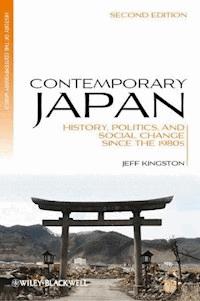
Cover image: A shrine gate stands among debris in the quake-hit town of Otsuchi, Iwate Prefecture, on April 7, 2011 © AP / Press Association.
Cover design by www.simonlevyassociates.co.uk
Series Editor’s Preface
The contemporary world frequently presents a baffling spectacle: “new world orders” come and go; “clashes of civilizations” seem imminent if not actual; “peace dividends” appear easily to vanish into thin air; terrorism and “wars on terror” occupy the headlines. “Mature” states live alongside “failed” states in mutual apprehension. The “rules” of the international game, in these circumstances, are difficult to discern. What “international law” is, or is not, remains enduringly problematic. Certainly it is a world in which there are still frontiers, borders, and boundaries, but both metaphorically and in reality they are difficult to patrol and maintain. “Asylum” occupies the headlines as populations shift across continents, driven by fear. Other migrants simply seek a better standard of living. The organs of the “international community,” though frequently invoked, look inadequate to deal with the myriad problems confronting the world. Climate change, however induced, is not susceptible to national control. Famine seems endemic in certain countries. Population pressures threaten finite resources. It is in this context that globalization, however understood, is both demonized and lauded.
Such a list of contemporary problems could be amplified in detail and almost indefinitely extended. It is a complex world, ripe for investigation in this ambitious new series of books. “Contemporary,” of course, is always difficult to define. The focus in this series is on the evolution of the world since the 1980s. As time passes, and as the volumes appear, it no longer seems sensible to equate “the world since 1945” with “contemporary history.” The legacy of the “Cold War” lingers on but it is emphatically “in the background.” The fuzziness about “the 1980s” is deliberate. No single year ever carries the same significance across the globe. Authors are therefore establishing their own precise starting points, within the overall “contemporary” framework.
The series treats the history of particular regions, countries, or continents but does so in full awareness that such histories, for all their continuing distinctiveness, can only rarely be considered apart from the history of the world as a whole. Economic, demographic, environmental, and religious issues transcend state, regional, or continental boundaries. Just as the world itself struggles to reconcile diversity and individuality with unity and common purpose, so do the authors of these volumes. The concept is challenging. Authors have been selected who sit loosely on their disciplinary identity – whether that be as historians, political scientists, or students of international relations. The task is to integrate as many aspects of contemporary life as possible in an accessible manner.
This volume on Japan rises to the challenge. The country’s history conspicuously illustrates the interactions that have been alluded to. The first half of the twentieth century saw its engagement with “the world” collapse in catastrophe. The country started thereafter on its “new beginning” under outside direction. Yet its proud and self-contained past still continued to send somewhat ambivalent messages into a Japan which proceeded to make itself a “modern miracle.” This account, however, is no bland narrative of a “success story.” It is, rather, an account of decades in which the reconciliations – economic, cultural, demographic, political – which appeared to have been solid achievements all began to unravel. The earthquake of March 2011, followed by the devastating tsunami and the impact of these natural disasters on the Fukushima nuclear reactors, brought these matters to crisis point. It is this process of renewed self-examination, visible across so many areas of both private and public life, which this book treats as an interconnected whole. There can be no better example, to begin this series, of a country seeking anxiously both to adjust and to retain its own culture and identity in a changing world.
Keith Robbins
Acknowledgments
I would like to thank the following people for their assistance, comments, advice, inspiration and encouragement with all the usual caveats about absolving them of responsibility for what I have written: Jake Adelstein, Hideaki Asahi, Michael and Marie-Therese Barrett, Tom Boardman, Mary Brinton, Roland Buerk, David Campbell, John Campbell, Christian Caryl, Kyle Cleveland, Florian Coulmas, Lucy Craft, Gerald Curtis, Greg Davis, Mure Dickie, Alexis Dudden, Robert Dujarric, Bill Emmott, Martin Fackler, Malcolm Foster, Howard French, John Glionna, Roger Goodman, Mariko Hashioka, Laura Hein, Ektarina Hertog, Steve Hesse, Peter Hill, Kaori Hitomi, Jun Honna, Andrew Horvat, Tin Tin Htun, Hiroshi Ishida, Makoto Ishida, Velisarios Kattoulas, David Leheny, Bertil Lintner, Atsushi Maki, Gavan McCormack, David McNeill, Johnny Miller, Sebastian Moffett, Jack Mosher, Mariko Nagai, Chika Nakayama, Atsushi Ogata, Akihiro Ogawa, Robert Orr, David Pilling, Lawrence Repeta, Donald Richie, Ken Ruoff, Sven Saaler, Richard Samuels, Murray and Jenny Sayle, Fritz Schmitz, Miki Seko, Mark Selden, Sawako Shirahase, David Slater, Emi Sumitomo, Ayumi Suzuki, Yuki Tanaka, Kazuhiko Togo, Henry Tricks, Gabrielle Vogt, Yoshibumi Wakamiya, Shinya Watanabe, Robert Whiting, Charles Worthen, Hyun Sook Yun, Dominique Ziegler, and many others who know who you are. Also I wish to express thanks to the people at Wiley who took on this project and ensured its smooth sailing, especially Tessa Harvey, Keith Robbins, Tom Bates, Gillian Kane, Sarah Dancy, Brian Goodale, and Isobel Bainton.
Finally, my deep gratitude to Machiko Osawa, who contributed greatly to this book and, along with our dogs Rhubarb and Goro, listened patiently and kept me in good spirits.
Please note that in Japan, Japanese names begin with the family name, but here are cited according to Western convention: given name followed by surname.
Part IIntroduction
Chapter 1
Transformations After World War II
Japan’s recovery from the war devastation that left its cities and factories in ruins was surprisingly rapid, but nobody in the late 1940s could have foreseen that its economy would one day become the second largest in the world. In the aftermath of defeat, Japanese experienced unprecedented socio-economic upheaval during what has to be regarded as one of the world’s great success stories in the second half of the twentieth century. Japan was reconstituted during the US Occupation (1945–52), generated an economic miracle in the late 1950s and 1960s, weathered the oil shocks in the 1970s, and saw an extraordinary asset bubble burst at the end of the 1980s, setting the stage for the Lost Decade of the 1990s. This was a time of what is often termed one-party democracy under the Liberal Democratic Party (LDP) that ruled Japan as a partner of the bureaucracy and big business in what is known as Japan, Inc. or the Iron Triangle. It was also a time when the long shadows of wartime deprivation and dislocation shaped a national consensus prioritizing stability, security, and policies aimed at minimizing risk.
In post-WWII Japan, there was massive migration from rural areas to the cities, pulled by the lure of jobs and pushed by the limited opportunities of small-scale farming. The ensuing growth of cities, with housing developments, train lines, and highways, created a mass commuting culture with a rhythm very distinct from traditional rural life. The salaryman lifestyle became iconic, a way of life rooted in the breadwinner model, with a work-driven husband, a full-time housewife, and at least two children, usually living with some of their grandparents. Signs of growing affluence became more conspicuous in an expanding middle class. Women were nominally freed from patriarchy with the abolition of the ie (patrilineal family) system, and gained the right to vote and other constitutional guarantees, but in the workforce they remained largely marginalized. The rapid growth of the 1960s did not generate large income disparities as was common in Western industrialized societies, and the relatively egalitarian distribution combined with job security strengthened social cohesion and a sense of shared destinies. This social capital remains one of the foundations and strengths of post-WWII Japan, but is under threat due to widening income disparities and declining opportunities for young Japanese.
The spread of mass media, especially television, helped nurture a strong sense of nation even as overt displays of nationalism remained taboo, tainted by war. Emperor Hirohito was transformed from a wartime leader into an avuncular and soft-spoken symbol of the nation. Japan was visibly welcomed back into the community of nations at the 1964 Tokyo Olympics, a sign that it had been rehabilitated under the auspices of the US.
While neighbors may have found the continuing presence of the US military reassuring, Japanese remained divided and ambivalent about this encroachment on their sovereignty. Mass demonstrations against renewal of the US–Japan Security Treaty in 1960 revealed a surprising depth of anger, not only directed against Washington. Prime Minister Nobusuke Kishi, who negotiated the renewal, was a suspected Class-A war criminal, one of those senior leaders deemed responsible for orchestrating Japan’s military rampage through Asia 1931–45. He was never indicted, and was released from prison for reasons that remain unclear given his culpable record in Manchuria and later as the wartime Minister of Commerce and Industry. Many Japanese, with the horrors of the war fresh in their memories, deeply resented Kishi’s rise to premier through backroom political maneuvering; he represented an unacceptable link to a thoroughly discredited past. In those days, nobody was trying to glorify or justify Japan’s wartime exploits, as some do now, and anyone associated with Japanese militarism was persona non grata, making it especially galling that such a key figure in the wartime cabinet was suddenly the leader of a country that was trying to reinvent itself by repudiating this past.
Occupation 1945–52
Allied in name, but an American show in practice, the Supreme Commander of the Allied Powers (SCAP, a term often used to refer more generally to the Occupation authorities) was personified in the larger-than-life, dominating presence of General Douglas MacArthur. General Headquarters (GHQ), the administration under SCAP, governed indirectly through the existing Japanese bureaucracy; this was a significant contrast to the situation in a divided Germany where the Allied powers ruled directly.
The US presided over Japan in the aftermath of war in order to demilitarize and democratize its former enemy.1 SCAP acted on the perception that the military had derailed democracy and hijacked the nation into war, and that the high concentration of political and economic power made Japan vulnerable to such a scenario. With Germany and the two world wars it precipitated in mind, the US sought to inoculate Japan from a militarist revival. Thus, SCAP focused on eliminating the military and dispersing political and economic power more widely.
Demilitarizing Japan started with demobilizing the troops, confiscating their weapons, and eliminating military institutions. This was followed up by a ban on war, and the means to wage it, in Article 9 of the Constitution authored by SCAP and adopted by Japan in 1947. Martial arts were also banned and SCAP authorities censored the media and films in clumsy efforts to stifle non-existent militaristic sentiments. People were war weary and the military was widely blamed for the destruction and suffering the Japanese people endured.
The war in the Pacific (1941–5), inflamed by racial prejudice and fears, was a “war without mercy.”2 Given the extent of excesses and atrocities committed by Japan, the US, and its allies, the mutual accommodations and relative beneficence of the Occupation are striking. The arrival of the Americans sparked fears of retribution, and soon after the surrender the Japanese authorities were already recruiting women to provide sexual services to the troops. Throughout the Occupation, American troops did commit serious crimes against the civilian population, including murder, rape, and assault, but not on the scale that many Japanese had feared, knowing as they did how the Imperial Armed Forces operated in the territories it had occupied.
In late 1945 and early 1946, the Americans helped avert a famine by bringing in food supplies. They were also importing all sorts of commodities that were illicitly diverted to the thriving black markets where almost anything was available for a price. Soldiers used their PX (Post Exchange, a store operated by the military) privileges to advantage, discovering just how valuable nylon stockings, among other sundries, could be in a barter economy. Rationing was in force, but few people survived without supplementing their diet by other means. Those without enough money for black-market purchases traveled to the countryside where they would barter kimonos or other valuables for rice and vegetables. Making their way back home on crowded trains, they took pains to evade police who often confiscated the food they were bringing back to their families.
Japan in the early postwar years was not the relatively crime-free haven it has become, and violence was common. There were bloody gang wars and turf battles between Japanese mobsters and rivals from Korea and Taiwan, a legacy of empire. Demobilized soldiers had useful skills and few options, providing the yakuza (organized crime) with a large pool of potential recruits. Prostitution flourished because many women had few other ways to support themselves and their families. Nonetheless, there were recriminations against these so-called pan-pan girls brazenly soliciting GIs, men who were attractive because they were flush with cash and had access to the prized goods available at the PX. Drug use was also at epidemic proportions as many people had addictions to amphetamines that they had developed during the war as soldiers or factory workers. In the hard scrabble for survival, theft and robbery were common crimes of desperation.
Unions flourished under SCAP because it released union organizers held in prison during the war years and because of labor reforms that made it easier to organize workers. SCAP believed that strong unions would help spread political power more widely and strengthen democracy. Harsh working and living conditions, along with wages that failed to keep up with galloping inflation, also helped unions grow increasingly powerful. When SCAP banned a general strike in early 1947, unions felt betrayed – while companies understood that the authorities would tolerate union-busting tactics. Management targeted union members with the help of mobsters, undermining the yakuza’s self-styled image as protectors of the weak and vulnerable. Workers came to understand that joining the moderate company-sponsored unions and renouncing membership of the more radical unions was their best, or at least safest, option, providing valuable context for understanding how labor relations became harmonious as Japan made the transition to high-speed economic growth in the late 1950s.
In 1946, SCAP convened the International Military Tribunal for the Far East (IMTFE), prosecuting 28 high-level leaders deemed most responsible for orchestrating the war, the so-called Class-A war criminals that were charged with crimes against peace. Emperor Hirohito was notable for his absence, disappointing US allies such as the UK and Australia who demanded he be held accountable. This also disappointed many Japanese who felt that the war was fought in his name and mourned the loss of some 2.1 million soldiers who died at his behest in addition to some 800,000 civilian wartime deaths. At the very least, some thought, Hirohito should have abdicated to show contrition and take responsibility for the devastation Japanese suffered as a result of the government’s reckless aggression.
The Imperial Household Agency, with the connivance of SCAP, reinvented Emperor Hirohito as a powerless figurehead in wartime Japan who was out of the loop, misled and manipulated by the military leaders, and fearful of a coup should he intervene.3 This was the script for the IMTFE, and the orthodox narrative that prevailed until Hirohito’s death in 1989. During the trial, the Class-A war criminals were coached to avoid implicating Hirohito. At one critical juncture when General Hideki Tojo slipped up, the court was recessed and he was reminded of his lines. When the session resumed, the court record was erased and Tojo, a loyal and willing scapegoat, insulated Hirohito from guilt by assuming all responsibility.
The US decided that Emperor Hirohito was more valuable alive promoting constitutional democracy than as a martyr for the right wing to rally around. Instead of feeling the hangman’s noose, he renounced his divinity and became a model constitutional monarch. Throughout the Occupation he lent his support to SCAP democratization efforts while also serving as a reassuring symbol of nation and continuity amidst hardship and upheaval. By not prosecuting Hirohito, however, the US complicated the issue of war responsibility. Japan has often been criticized for not assuming that burden; but if the man in whose name the war was fought was not held accountable and was depicted as a victim of militarist hotheads, why should anyone assume war responsibility?
The legal proceedings of the IMTFE were deeply flawed and the defendants did not receive a fair trial; guilty verdicts were preordained. In addition, Allied war crimes went unexamined and unpunished, leading many observers to dismiss the whole spectacle as “victor’s justice.” Since then, right-wingers in Japan have harped on the very real flaws of the trial in a bid to exonerate Japanese soldiers and their leaders of the serious war crimes that were committed.
There were profound inconsistencies in the Occupation, most prominently the decreeing of democracy without consulting the people. SCAP wrote Japan’s Constitution, one with a distinctly foreign flavor, and established the ground rules for democracy, rendering it a top-down, rather than grassroots, initiative. Potential political candidates who were blacklisted by SCAP had no recourse. The media, considered a vital element of democratization by SCAP, was routinely censored, ensuring no criticism of SCAP and no delving into the atomic bombings. SCAP also nurtured a vibrant union movement to strengthen democracy by spreading political power more widely, and then stood by and watched Japanese companies crush it through violent means.
There was a limited reckoning for war crimes, but overall there were considerable continuities bridging wartime and postwar Japan. Aside from letting Hirohito off the hook, the US made common cause with the conservative political elite who ran Japan during the war years. Most of Japan’s bureaucracy was left intact aside from some purges of top-level officials. The zaibatsu, family-owned industrial conglomerates that dominated the Japanese economy during the war years, were initially targeted for dissolution; they were blamed for aiding and abetting the government’s imperial expansion. However, they were restructured rather than dissolved. Under “new management,” these corporations remain prominent in the contemporary Japanese economy, including such familiar names as Mitsui, Mitsubishi, and Sumitomo among others.
The “reverse course” began in 1947, when the Cold War with the Soviet Union was heating up. Prior to this shift in Occupation policies, the US and SCAP sought to punish and reform Japan while cultivating democracy. After 1947, the US backtracked on many of these reform initiatives, abandoned punitive policies, and emphasized economic recovery. In the context of the Cold War, Japan was a designated showcase for the superiority of the US system and that meant, above all, reviving the Japanese economy. At the time, there was growing left-wing political influence in Japan and it was hoped that improved living standards and working conditions would stem what seemed an alarming development. Economic recovery held the added attraction of promoting Japanese self-reliance and weaning it from US subsidies. There was to be no Marshall Plan as in Europe because there was little support in the US for such largesse towards Japan.
Due to the nature of SCAP’s indirect rule through Japanese institutions, it is important to acknowledge the significant influence of Japanese officials over the pace and scope of Occupation-era reforms. They were not merely passive junior partners carrying out orders from on high; they played a key role in shaping the agenda and realizing it. There was considerable scope for stonewalling, foot-dragging, and diluting or reinterpreting initiatives, and much leeway for Japanese officials to exploit new opportunities to implement their own long-standing agendas such as land reform.
Land reform was indeed perhaps the most profound transformation unleashed under the auspices of SCAP. As with all SCAP reforms, it was implemented through the Japanese government by Japanese officials with considerable discretionary authority in translating directives into realities on the ground. This massive agrarian reform helped tenant farmers, tilling the soil under unfavorable conditions, to become owners of the land they cultivated. Land reform was aimed at breaking the monopoly over economic and political power enjoyed by the rural gentry, thereby weakening a class seen to have supported Japanese militarism. It also undercut the influence of left-wing political groups in the countryside since land reform had been one of their more appealing pledges. Farm output increased as a result of this reform, as farmers who own their land and retain the fruits of their labor work the land more intensively. Aside from boosting Japan’s food availability and self-sufficiency, this meant that many rural households that previously lived a barely subsistence lifestyle, burdened with heavy debts, were suddenly and dramatically lifted out of poverty. This created a virtuous economic cycle. The owner-farmers became a new large middle class of consumers buying the output from Japan’s reviving factories that were rapidly increasing their workforces, thereby absorbing rural surplus labor. Those remaining in the countryside were better off as small parcels of land had to support fewer people. Moreover, this growing middle class of owner-cultivators became loyal supporters of the LDP, helping to keep it in power.
Politics
In the post-WWII era, the most striking political development was extended one-party rule by the LDP since it was formed in 1955.4 The party was a merger of conservative parties responding to growing support for the Japan Socialist Party (JSP). These were the two main contenders in this era, but it was an unequal contest.
Japan’s one-party dominated democracy was called the 1955 system, one that was sustained by powerful conservative support. Big business and the bureaucracy favored the LDP and its conservative agenda. This provided the LDP with generous campaign funding and opportunities to wield its influence to cultivate and sustain loyal constituencies. LDP candidates enjoyed the advantages of incumbency and once elected usually retained their seats and often kept them in the family, passing them on to sons. Pork-barrel projects became a mainstay of party support as public works contracts were doled out to favored construction companies, a generosity that was reciprocated. Aside from ensuring a steady flow of projects to their districts, politicians relied on support organizations (koenkai) to raise money and serve as a conduit for favors and patronage.
The LDP emphasized pragmatism, downplaying ideological issues in the wake of the 1960 mass demonstrations while delivering rapid economic growth and a doubling of incomes, giving people a reason to support it despite misgivings about systemic corruption. The LDP was the junior partner to the bureaucracy in policy-making, perhaps reassuring voters that responsible and competent technocrats were in charge rather than unsavory politicians. It succeeded in convincing voters that it was more capable of managing the economy and maintaining good relations with the US vital to Japan’s security than the JSP. It also adopted the popular three non-nuclear principles and eased anxieties about Japan’s incremental rearmament by informally limiting defense spending to 1 percent of GDP. The LDP was skillful at reinventing itself, responding to political challenges by adopting opposition proposals and policies such as the ambitious environmental legislation implemented at the outset of the 1970s. In this sense, political competition pushed the LDP to adopt more socially progressive policies than it might otherwise have done. Negotiating with the US for the reversion of Okinawa in 1972 also demonstrated that it could effectively champion national interests and stand up to the US.
There have been few LDP leaders untainted by money politics, but this never seemed to matter to enough voters to make a difference. Neither did media exposés of mob ties. And it was only in the 1990s that rumors of CIA funding were proven true. Like the Christian Democrats in Italy, the LDP stayed in power so long because it was deft at co-opting, ruthless in political infighting, and savvy in the ways of channeling money. But the LDP grew increasingly sclerotic and discredited by the prolonged recession of the Lost Decade and its failed attempts to revive the economy, setting the stage for its ouster from power in 2009.
Foreign Policy
The security alliance with the US has been a divisive political issue, one that created a clear distinction between the LDP and the JSP. The JSP favored ending it, ousting the US from its bases in Japan, and embracing unilateral pacifism as outlined in Article 9 of the Constitution. It stressed that Japan should be neutral in the Cold War and that the alliance, and ongoing US military presence, exposed Japan to unnecessary risks. The mass demonstrations in 1960 against renewing the security treaty were a show of force by the left, tapping into popular misgivings about the alliance. These apprehensions grew during the Vietnam War as the US used its bases in Japan in support of the war and also purchased war-related material from Japanese producers, including napalm. The Vietnam War was embarrassing to Japan’s political elite because Japan was in the uncomfortable position of aiding a war against fellow Asians.
During the Korean War (1950–3), US bases in Japan played an important role in the conflict while the Japanese economy was revived by large-scale, war-related procurements. Prime Minister Shigeru Yoshida called the Korean War a “gift from the gods” because American purchases jolted the economy out of recession. He brushed off US demands that Japan rearm, emphasizing that Japan could not afford to do so without threatening its economic recovery. This rare instance of Japan standing up to Washington is known as the Yoshida doctrine.
In 1952 the US Occupation ended on terms negotiated in the San Francisco Peace Treaty of 1951. Japan agreed that the US could maintain bases in Japan and also retain control over Okinawa (a group of islands lying to the southwest of the Japanese archipelago) where most of its bases were located. It also negotiated reparations agreements in the 1950s with most of the Southeast Asian nations it occupied during the war (Burma, Indonesia, Vietnam, and the Philippines), involving export credits that helped Japanese firms establish markets for Japanese goods in these countries. By the mid-1950s there were signs of a deal with the Soviet Union on the disputed northern islands off the coast of Hokkaido, but Tokyo killed the deal by suddenly raising its demands. The Soviets occupied these islands in the waning days of the war and have kept them ever since. For the US, such a deal was undesirable because it would have improved the Soviet image, undermined US Cold War propaganda and lessened Moscow’s tensions with Tokyo.
Normalization of relations with South Korea in 1965 was a significant effort by Japan to overcome smoldering hostility stemming from its brutal colonial rule in Korea between 1910 and 1945. Normalization was a necessary but insufficient step to turn the page on the past; tensions between the two nations over their shared and traumatic past are never far below the surface, occasionally erupting over history textbooks or territorial disputes. Japan paid the South Korean government US$800 million in grants and soft loans as compensation and in return Seoul renounced all further individual or government claims. The South Korean government also assumed responsibility for compensating Korean victims of Japanese colonial rule from the funds Japan provided. Aside from small token payments, however, most of the money went to building infrastructure. Since the South Korean government released the original normalization documents in 2005, old wounds have reopened and the issue of compensation claims remains controversial and unresolved.
Japan normalized relations with China in 1972, following Washington’s lead. The US decision to reverse its long-standing Cold War policy of isolating China and pretending that Taiwan was the legitimate government came as a complete surprise to Japan, one of the two Nixon shocks that raised questions about Washington’s reliability. Tokyo was unhappy that it had not been consulted or informed beforehand, underscoring the fundamental inequality of the alliance.5
Normalization of ties with China led to the Treaty of Peace and Friendship in 1978. From this beginning there have been belated efforts to atone for the massive destruction Japan’s Imperial Armed Forces inflicted over wide areas of China. China renounced claims to reparations and war damages; however, beginning in 1979, Japan responded with a sustained large-scale development aid program involving US$25 billion of loans and grants (ended in 2007), technical cooperation, and training programs. Numerous infrastructure projects ranging from highways and railways to seaports, airports, and power stations were funded by the Japanese government and have played a critical role in facilitating China’s rapid economic rise. These massive amounts of economic and technical assistance are the functional equivalent of reparations without the associated political and historical baggage. They have not dissipated popular animosity in China directed towards Japan, and are only accepted with minimal gratitude as a down payment on what China is owed for Japan’s past sins. These projects, however, have cemented strong economic ties, nurturing a booming market for Japan’s exports while creating a low-cost production site.
In 1974 when Prime Minister Tanaka toured Southeast Asia, the government was shocked by anti-Japanese demonstrations. In response it unveiled what it called “heart-to-heart” diplomacy, engaging in sustained soft-power efforts to enhance cultural and student exchanges, bolstered by sharp increases in official development assistance (ODA). Japan has wielded its economic resources and technical prowess effectively since the 1970s to gain influence, heal wounds, and promote economic development throughout Asia.
Tokyo has been reluctant to use ODA as an overt political weapon to pressure foreign governments, but like other nations it has leveraged ODA to its economic benefit by tying aid to Japanese-provided goods and services. Its politically neutral approach to ODA meant that it provided crucial support to repressive regimes such as Burma under Ne Win, the Philippines under Marcos, and Indonesia under Suharto. The emphasis on loans for mega-infrastructure projects was also mortgaging poor countries’ futures even as Japan knew that officials involved were lining their pockets. However, as Washington emphasized burden sharing and ratcheted up pressure on Japan to assume greater international responsibilities commensurate with its economic status, Japan responded generously to Asia’s huge development needs. By 1989, just as the economic bubble was peaking, Japan also emerged as the world’s largest donor of ODA.
Economy
After WWII, Japan’s economic prospects were grim. Intense aerial bombing had leveled many of its factories, it was short of capital and resources, and it was an international pariah whose products were generally unwelcome in overseas markets – save one. The US played a crucial role in Japan’s recovery through emergency assistance, the land reform, taming hyperinflation, setting a low exchange rate for the yen (JPY360 = US$1) favorable for exports, and jumpstarting growth with massive Korean War procurements. More importantly it kept the wartime bureaucracy largely intact and preserved the so-called “1940 system” that conferred extraordinary discretionary powers on it. This system emerged from the exigencies of mobilizing and maximizing all resources in support of the war effort. In the post-WWII era, the new goals were recovery, development, and growth. Japan’s capitalist model, thus, was a hybrid, planned economy with considerable flexibility to respond to market signals. The Japanese government proved adept at combining its sweeping regulatory and informal powers with targeted subsidies and predatory trading policies to produce the economic miracle of sustained high growth in GDP that lasted from 1955 to 1973, a period when GDP per worker quadrupled.6 This vaunted industrial policy would not have been possible, however, without favored access to the US market and favorable terms for licensing US technologies. The US also promoted Japan’s readmission to international commerce by sponsoring its admission to the General Agreement on Tariffs and Trade (GATT) in 1963 and facilitating loans from international financial institutions.
The family-owned zaibatsu conglomerates re-emerged in the post-Occupation era as keiretsu, bank-centered industrial groups. The Bank of Japan provided these banks easy access to cheap credit, and they lent it to keiretsu family companies on favorable terms, helping them borrow beyond their means and make the investments they needed to boost productivity and capacity. The keiretsu fostered vertical and horizontal integration across a wide range of industries and sealed close ties through extensive cross-share holding of stocks, serving to block foreign penetration of the Japanese economy. Tight controls over allocation of the foreign exchange necessary to pay for imports (the yen was not used in international commerce) enabled the government to screen and prioritize imports while also insulating the domestic economy from foreign competition.
The 1960s boom resulted from massive infrastructure projects, tax cuts, low interest rates, and trade liberalization combined with growing global markets for Japan’s exports. In 1960 Prime Minister Hayato Ikeda (1960–4) promised a doubling of incomes and the government delivered, exceeding that target in less than a decade. With astonishing speed, Japan went from a manufacturer of cheap, low-quality products to an exporter of high-quality goods making significant inroads in overseas markets, sparking trade disputes by the end of the 1960s. These economic tensions flared for most of the rest of the twentieth century, generating political problems that undermined bilateral ties with the US.
In order to manage these political tensions, the US and Japan negotiated a series of agreements aimed at managing trade and lowering trade imbalances, but Japan’s trade surplus with the US grew apace. There was a strong conviction in the US and Europe that Japan was a neo-mercantilist state engaged in unfair trading practices that boosted exports while limiting imports through a combination of government regulations, subsidies, and non-tariff barriers. Essentially, Japan’s trading partners attributed its success to “cheating” and unfair advantages. In Japan, these accusations were seen as unfair and as reflecting an unwillingness to accept that Japan had become more competitive because of its innovations, superior products, and business acumen.
In 1985, in response to growing political problems associated with global trade imbalances, the G7 (Group of Seven leading industrialized nations) negotiated the Plaza Accords. As a result, the yen was allowed to appreciate dramatically, a policy aimed at raising the price of Japanese exports and lowering the price of its imports, thereby encouraging a market correction in trade imbalances. Economic theory anticipated such an outcome, but markets and consumers had other ideas. Japan’s trade surpluses continued to rise and in 1987, when stock markets around the world collapsed, it was the only economy that kept steaming along. This kept pressure on the government to maintain monetary easing policies aimed at boosting growth to pull other economies out of recession, in essence throwing fuel onto an already overheating economy.
Following the Plaza Accords, the Japanese bubble in asset prices (land and stocks) began to rise, pumped up by growing trade surpluses and the government’s decision to maintain low interest rates.7 Companies and banks were eagerly bidding up the prices of land and stocks because there were few attractive investment alternatives. Prices soared because there was too much money chasing too few assets and there was a collective hysteria that accompanies all bubbles throughout history. Reason is suspended in the face of dazzling price appreciation as everyone piles in simultaneously, more worried about missing out on the quick gains than the consequences of the inevitable downward spiral. Awash in cash, companies invested heavily in expanding capacity and speculating in land and stocks.
Japan’s bubble was extraordinary. Between 1985 and 1989 the stock market average tripled while the urban land price index quadrupled. In 1989, concerned about the inflationary impact of these frothy asset markets, the government popped the bubble by ratcheting up interest rates. The ensuing collapse ushered in the Lost Decade of the 1990s.
In order to understand why Japan’s economic malaise has lasted as long as it has, it is important to appreciate the underlying problems that were obscured by the asset bubble. The government-directed system that revived Japan’s economy and led to the economic miracle was suited to the tasks of recovery and high growth, but was less suited to the dynamics of a mature economy. Regulations and practices that revived Japan began to exact a cost on efficiency and productivity, beginning in the 1970s.
The oil shocks of the 1970s hit the Japanese economy hard because it relied extensively on imported energy and had many energy-intensive heavy industries and petroleum-processing industries built on the assumption of low oil prices. Oil prices suddenly spiked fourfold in 1974 following an oil embargo and production cuts initiated by the Organization of Petroleum Exporting Countries (OPEC) in 1973, followed by a second oil shock in 1979–80. Japan’s GDP growth abated to an average of 3 percent between 1973 and 1990, down from an average of 8.4 percent in the 1960s.
Richard Katz argues that the government’s response mitigated the immediate impact of the oil shocks but, in postponing the reckoning and delaying needed adjustments, made the remedies more painful.8 Rising wages and increased competition from South Korea and Taiwan were already undermining Japan’s competitiveness before the oil shocks. In adjusting to higher oil prices and to avoid bankruptcies and job losses, the government encouraged companies in designated “sunset” industries to form recession cartels, allowing them to set prices and allocate market share. The government also provided subsidies to these firms, part of a larger strategy of protecting jobs. Katz argues that by insulating these industries from market forces, the government stifled gains in productivity, subsidized inefficiency, raised input costs for all producers, misallocated resources into industries with dim prospects, and created an unsustainable economy.
By 1990, Japan had caught up dramatically with other global economies, and its most famous exporting firms boasted high productivity, but overall productivity remained well behind other advanced industrialized economies. By 1990, real GDP per worker in Japan had tripled since 1960, but it ranked only 17 out of the top 23 global economies, still one-third less than the US and lagging even Spain. The domestic sectors of the economy did not have the high productivity of the export sectors honed through international competition. These domestic industries, largely protected from such competition, were grossly inefficient, explaining why Japan’s overall productivity ranked only ninth among the eleven largest economies in the early 1990s.9
Thus, when we consider the reasons for prolonged economic recession in the Lost Decade, it is important to bear in mind that Japan entered the 1990s with accumulating fundamental problems separate from the asset price bubble. The response of Japan, Inc. to the twin oil shocks in the 1970s postponed and deepened the economic reckoning, lowering productivity and misallocating resources. When the economic boom at the end of the 1980s receded, the vulnerabilities and flaws of the Japanese economic model became more apparent. As we shall see, the government’s poor handling of the economic crisis in the 1990s amplified the underlying problems while prolonging the bubble-induced hangover.
Heisei Transformations
In the coming chapters we examine the changes and continuities in Japan since the Heisei era began in 1989.10 This has been a period of gradual transformation as the ways and means of Japan, Inc. have faded. Government, business, and bureaucratic actors still cling to past practices, but as these methods, inclinations, and policies have been discredited, and no longer seem adequate to the tasks at hand, they are being abandoned incrementally. Japan’s enormous problems stemming from the Lost Decade are driving this process, and here we analyze the consequences.
One major theme addressed in the coming chapters is increasing risk in a society that is risk averse and has long tried to minimize and mitigate it. In contemporary Japan, many influential advocates in the Iron Triangle believe that introducing risk through market-oriented, structural reforms involving deregulation and privatization is the cure for ongoing economic stagnation and low growth in productivity. These advocates believe Japan’s economic problems are due in significant ways to muting of market forces and minimization of risk, and argue that the nation’s prospects are dire if it fails to embrace sweeping reforms that boost productivity and change the inefficient way companies do business and the government runs the economy.
It is not obvious to many Japanese, however, that less government intervention, reduced social welfare spending, and the unshackling of businesses from regulations that protect workers’ rights will achieve these goals. Rising risk has caused a reassessment of the relationship between citizens and the state and between workers and employers. As the state and employers shift the burdens of risk increasingly onto families and individuals by emphasizing jiko sekinin (self-responsibility), they are challenging long-established patterns of trust, dependency, reciprocity, and security.11 The “outsourcing” of security, trimming of the safety net, and heightening of risks for individuals and their families have gained momentum in Heisei Japan, a trend that once enjoyed what seemed unassailable legitimacy under the ideology of self-responsibility promoted by Prime Minister Junichiro Koizumi (2001–06).
However, as we see in the coming chapters, there has been a public backlash indicting such measures and criticizing the consequences of jiko sekinin. Public discourse shifted rapidly in the first decade of the twenty-first century from lionizing the mantra of deregulation and privatization to focusing on growing disparities, poverty, marginalized youth, unstable jobs and families, and the emergence of a society of “winners” and “losers.” Several sweeping reform initiatives were introduced by the LDP, but the promised gains have not materialized. Many households suffered significant declines in income and security as wages, bonuses, and overtime pay fell and unemployment rose to 5.7 percent by mid-2009, a startling figure for a nation famous for job security. The 2008 subprime loan crisis that swept through global markets caused considerable and lingering economic dislocation, driving many firms into bankruptcy and leaving many more teetering on the brink.
In these circumstances, many of Japan’s export-oriented companies faced severe contractions in overseas demand, with overall exports dropping by a devastating 33 percent in 2009 alone. Firms took advantage of liberalized employment rules to shed more than 240,000 non-regular workers in the year following October 2008. While this may be unremarkable in the US, it was shocking in Japan where the implicit social contract is based on secure jobs and paternalistic employers. In public discourse, this mass firing of workers was viewed as heartless and unacceptable, and was depicted as such in the mass media and in political campaigning. There is a consensus among ordinary Japanese, as evident in the ouster of the LDP in the 2009 parliamentary elections, that deregulation, market-oriented reforms, and rising risk are the culprits in widening income disparities and fading job security – unwelcome trends that challenge egalitarian ideals and national identity in a risk-averse society.
The Japanese economy may have soared like a Phoenix from the ashes of war devastation, but the Japan, Inc. paradigm was shaped by the deprivation, anxieties, and uncertainties those ashes represented. This system emphasized security and minimized risk. For example, the convoy banking system embraced by the government was based on the principle that all boats go at the pace of the slowest for collective security, meaning that the efficiency and profits of industry leaders are mobilized or sacrificed to help the weakest. But the high costs of the convoy system make it a heavy burden and so now the government is backing away from it, becoming less interventionist and opening space for greater risk. The high-profile bankruptcy of Japan Airlines in 2010 is a sign of the times.
Reduced government intervention is one of many major changes in the rules of the game that many observers credit with creating a nation of winners and losers. In the first decade of the twenty-first century, growing awareness of disparities and poverty became the controversial focus of heated political debate because they are contrary to Japanese preferences and inclinations. The emphasis on group mentality, collective identity, and egalitarianism in Japan has shaped attitudes and expectations that are threatened by risk and its divisive and uneven consequences. The neo-liberal market-oriented reforms of Prime Minister Junichiro Koizumi promoting deregulation and privatization produced a powerful backlash and are blamed for increased non-regular employment and associated disparities, and an inadequate social safety net (various social welfare programs aimed at keeping households from slipping below the poverty line). For most Japanese, this is not the Japan they want or identify with.
There is no deep yearning for a return to the unviable and discredited practices of Japan, Inc., but there is a palpable longing for the safety and security conferred by that system. People understand that change is inevitable, and that revitalizing Japan entails accommodating, at least to some degree, greater risk and market forces, but they also want a transformation that provides a reassuring sense of security along with tangible benefits. As the economic crisis intensified in 2009, voters repudiated the LDP and Koizumi’s reform agenda, drawn to the Democratic Party of Japan’s (DPJ) promise of a more fraternal society and its plans to roll back many of these reforms. The LDP’s failure to revive the economy, manage risk, and deal with its consequences was its undoing.
The coming chapters assess the various risks and responses to them in contemporary Japan. It is not just Japan’s economy and companies, and not only its values and identity, which are at risk. Greater risk is transforming employment relationships, the family, and perceptions of people towards the government and employers. The risks of the past haunting Japan in the present are one factor driving attempts at reconciliation with regional neighbors over the colonial and wartime past, while risks to a national identity rooted in patriotism push in the other direction. The security risks posed by North Korea and China weigh heavily on Japan, forcing a rethink of national security policies that raise other concerns about the risks to Article 9 represented by those who seek to revise the Constitution. The economic and social issues referred to above explain voter volatility as people respond to the implications for the family, job security, and retirement. The risks of rapid aging, depopulation, and a shrinking labor force are compelling a reappraisal of pensions, medical care, and immigration. For most Japanese, the evident benefits of and need for immigration are overshadowed by the perceived risks that it generates. The growing presence of foreigners in Japan is generally unwelcome and seen as a risk not only in terms of crime rates, but also to a national identity rooted in a sense of homogeneity.
Amazingly, at the beginning of the Heisei era, before the Lost Decade suddenly shook things up, none of these risks were apparent. In a surprisingly short period Japanese have had to confront this daunting array of risks for which they were largely unprepared. The social malaise that envelops twenty-first-century Japan, thus, is not just about the economy; many people are feeling greater uncertainty and apprehension, and have little hope for the future.
Japan may be a less risky society than many others, but by its own standards, the sudden sharp rise in risk has shaken it and generated considerable anxieties. Risk is a threat to social cohesion and national identity because it appears to be spread much more unevenly than in the past, challenging egalitarian ideals that are the bond that binds. Japan has enjoyed a strong sense of social cohesion because most people thought they were in the same boat, rowing more or less at the same pace in the same direction. Now people realize more than ever that this is a myth and are unhappy that people are riding in boats of different qualities, at different speeds, heading in different directions. Managing this risk while reinvigorating the economy and restoring a sense of shared destinies are enormous challenges facing Heisei Japan.
On March 11, 2011 the Japanese witnessed a familiar risk (more than 20% of the world’s magnitude >6 earthquakes occur in Japan), but on an extraordinary scale. The magnitude 9 earthquake, the largest recorded in Japan, unleashed a massive tsunami that pulverized the coastline in the Tohoku region in northeastern Japan. Some 20,000 were killed while more than 300,000 houses and buildings were damaged or destroyed. This is the third major tsunami to devastate this region since the late nineteenth century, suggesting that lessons of the 1896 and 1933 catastrophes went unheeded. The government’s initial rescue and relief operations went relatively well under difficult circumstances, but recovery has been slow.
The earthquake and tsunami also caused a nuclear accident at the Fukushima Daiichi plant involving three reactor meltdowns. Clearly, Tokyo Electric Power Company (TEPCO) and the government mismanaged the evident risks of operating nuclear reactors in a seismically active region prone to tsunami and exacerbated the crisis through a series of errors and failures. Risk was not taken seriously enough and many residents of Fukushima have paid a high price; at the close of 2011 nearly 80,000 remain evacuated from their homes, many will probably never return, farmers and cattle ranchers have sustained huge losses while radiation exposure has cast a pall over the region, raising questions about health, food safety, compensation, clean-up, and disposal of contaminated soil and debris. The nation as a whole has suffered collateral damage to the Japan brand, as tourism from overseas declined steeply, agricultural exports were banned, and faith in Japan’s high-tech prowess ebbed.
The consequences of TEPCO’s poor risk management and lax government oversight have been enormous and will haunt Japan for decades to come. Disasters, it is often said, create policy opportunities, but it appears that this momentous, cascading catastrophe may not spark significant reforms. Debate over national energy policy, and the future of nuclear and renewable energy, remains contentious, as do proposals for rebuilding victim’s livelihoods and their communities.
Aside from risk, the other major theme that reverberates across these pages is the ongoing quiet transformation of Japan. Contemporary Japan is remarkably different from the Japan that existed at the outset of the Heisei era in 1989. All societies change, but the pace and scope of change in Japan has been staggering and deeply unsettling in many ways for its citizens. This is a time of transition from the Japan, Inc. system to an unknown destination through uncharted waters. Many of the profound changes in Japan go largely unnoticed because this transformation is gradual and incremental, being built brick by brick, law by law, through regulation and deregulation. Each initiative taken on its own seems of little import, but when placed in the larger mosaic of reform, the shape of this sweeping transformation emerges, clarified by the passage of time. Reforms involving the judiciary, government transparency, and civil society do not make for immediate and obvious change, but viewed cumulatively over two decades, the transformation has been astounding.
The coming chapters, nonetheless, paint a bleak portrait of contemporary Japan. There is no escaping the massive challenges facing the nation and the probability that some of these will remain impervious to reforms and policy initiatives. Most Japanese are pessimistic about the future for very good reasons. While not dismissing such concerns, I believe that Japan faces a difficult transition but not a catastrophic one. Reforms will not “solve” Japan’s problems, but they can mitigate their consequences. Pragmatic adjustments and compromise reforms are more likely than dramatic policy shifts, but probably will have only a limited impact on addressing the many issues raised in coming pages. Muddling through is probably the best case scenario, one in which the government plays a far more significant role in providing social services and acts to manage the consequences of higher risk. Paradoxically, the government remit in contemporary Japan extends much further into individual, family, work, and community problems than in the recent past despite jiko sekinin, and precisely at a time when there is a profound crisis in the government’s credibility. Whether the government can measure up to expectations to intervene in an intelligent, timely, and effective manner is an open question.
One of the more unexpected changes in contemporary Japan was the landslide victory of the DPJ in the 2009 elections that ended the LDP’s long-standing political dominance. Many Japanese had high hopes for the DPJ, but they are deeply disappointed due to scandals, broken promises, and policy paralysis. The DPJ failed to make much headway on its reform agenda and in the 2010 upper house elections Japan’s increasingly volatile voters gave the LDP a majority, creating a “twisted” Diet wherein different parties control the two houses of Japan’s parliament. This made it even more difficult for the DPJ to govern effectively and climb out of the deep hole dug by the LDP in its half-century of rule. Voters are frustrated with national politicians because they have made so little headway on tackling Japan’s enormous problems, symbolized by the slow post-3/11 reconstruction and the lingering nuclear crisis.
In the coming pages we focus on what has been happening in Japan since 1989 when the Cold War ended, the Japanese economic bubble burst, and Emperor Hirohito died. In the next chapter we limn the socio-economic consequences and policy lessons of the Lost Decade of the 1990s. In the second section we focus on the risks and challenges facing contemporary Japan, and what they portend, by exploring demographic trends, families in crisis, and fading job security. The third section considers political developments and the implications for governance, security policy, immigration, and regional reconciliation. The fourth section examines environmental issues and 3/11 while the fifth section focuses on two traditional institutions – the imperial family and the yakuza – and how they are evolving and responding to new risks and challenges in the twenty-first century.
Notes
1 For a detailed examination of the US Occupation and its legacies see: John Dower, Embracing Defeat, New York: Norton, 1999; Eiji Takemae, Inside GHQ, London: Continuum, 2002.
2 John Dower, War Without Mercy, New York: Pantheon, 1987.
3 Herbert Bix, Hirohito and the Making of Modern Japan, New York: Harper Collins, 2000.
4 On Japanese politics see: Gerald Curtis, The Logic of Japanese Politics, New York: Columbia University Press, 2002; J. A. A. Stockwin, Governing Japan: Divided Politics in a Resurgent Economy, 4th edn, London: Wiley, 2008; Ian Neary, The State and Politics in Japan, London: Polity, 2002.
5 The other Nixon shock was in 1971 when the US unilaterally terminated the direct convertibility of the US dollar to gold, thereby unraveling the Bretton Woods system of international financial exchange that had prevailed since WWII. This heralded the shift away from fixed currency values pegged to the US dollar to floating exchange rates.
6 Chalmers Johnson, MITI and the Japanese Miracle, Palo Alto, CA: Stanford University Press, 1982.
7 Jeff Kingston, Japan’s Quiet Transformation, London: Routledge, 2004, pp. 4–12.
8 Richard Katz, The System that Soured, Armonk, NY: Sharpe, 1998.
9 Ibid., pp. 55–60.
10 Heisei is the reign name for Emperor Akihito who succeeded his father in 1989.
11 Glenn Hook and Hiroko Takeda, “ ‘Self-Responsibility’ and the Nature of the Postwar Japanese State: Risk through the Looking Glass,” Journal of Japanese Studies, 2007, 33 (1), 93–123.




