


22,49 €
Mehr erfahren.
- Herausgeber: The Crowood Press
- Kategorie: Geisteswissenschaft
- Sprache: Englisch
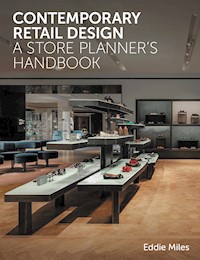
The world of retail design operates with a dynamism not often encountered in other commercial sectors. To successfully deliver a retail project, the store planner must possess a good working knowledge of a wide range of disciplines. As well as design, these include matters as diverse as store operations to materials and construction methods. Contemporary Retail Design: A Store Planner's Handbook provides a comprehensive overview of the store planning process and is an essential companion for anyone embarking on a retail design project. Written from the perspective of the designer, it contains practical guidance on every step of the design and construction process including: an introduction to store types and their history; what to consider when planning a store; the practicalities of layout versus the psychological response of the shopper; the range of materials and finishes available and how to use them successfully; what to consider when planning for building services, security and store operations. The book's practical advice is supplemented with case studies showing examples of best practice, and is illustrated with 200 drawings and photographs from a wide variety of stores around the world.
Das E-Book können Sie in Legimi-Apps oder einer beliebigen App lesen, die das folgende Format unterstützen:
Seitenzahl: 288
Veröffentlichungsjahr: 2021
Ähnliche




















CONTEMPORARYRETAIL DESIGN
A STORE PLANNER’SHANDBOOK
Lush Liverpool
Eddie Miles
CONTEMPORARYRETAIL DESIGN
A STORE PLANNER’SHANDBOOK
First published in 2021 byThe Crowood Press LtdRamsbury, MarlboroughWiltshire SN8 2HR
This e-book first published in 2021
© Eddie Miles 2021
All rights reserved. This e-book is copyright material and must not be copied, reproduced, transferred, distributed, leased, licensed or publicly performed or used in any way except as specifically permitted in writing by the publishers, as allowed under the terms and conditions under which it was purchased or as strictly permitted by applicable copyright law. Any unauthorised distribution or use of this text may be a direct infringement of the author’s and publisher’s rights, and those responsible may be liable in law accordingly.
British Library Cataloguing-in-Publication DataA catalogue record for this book is available from the British Library.
ISBN 978 1 78500 871 9
Front cover: Selfridges Women’s Shoe Galleries, London. (Photo: Olivier Hess)Cover design by Sergey Tsvetkov
Contents
Introduction
THE DESIRE TO TRADE, TO MAKE THINGS or to provide services for others to purchase sets human beings apart from the other species of our planet. The methods by which these trading transactions are carried out are bewildering in their variety and continue to evolve to meet the needs of the consumer. Retail today, meaning here the retailing of goods and services to the end-user rather than business-to-business wholesale trade, is something we encounter pretty much every day. We fill our baskets online just as we browse the shopping mall stores, sometimes still out of a need but also for reasons of entertainment, to pass the time or to counter boredom. The design of the many retail environments we encounter is as familiar to us as our home or workplace but this doesn’t lessen the challenge faced by the retail designer when planning a new store. The design of a successful store will have answered a multitude of questions in its conception: does the store’s planning allow it to function seamlessly? Are the materials used in the construction robust? Is the interior space a delight to visit? Does the design encourage shoppers to stay and spend their money? The intention of this book is to explain store design and construction so that the designer, student of design or retailer gains a thorough understanding of what it takes to make a great retail space. As an architect, I can tell you that the one certain thing a retail client will state with absolute conviction in their brief is the store opening date! To this end, the book also explains the practicalities of project planning from concept to store opening.
The busy retail environment of Westfield World Trade Center, New York.
The effect of the coronavirus on the retail landscape of 2020 was of a scale unparalleled since the Second World War. For many retailers this was the final blow from which they could not recover, having already been affected by the rising costs of maintaining physical stores and the changing habits of customers. The retail world of today can therefore be a tough place, with shoppers’ habits changing rapidly and in unforeseen ways. There seems no doubt that online retail will continue to take an increasing share of our spend, but I remain optimistic for the physical store and its unique place in our towns and cities. Whilst the pandemic has undoubtedly driven custom online, it seems it has also created an opportunity for local retailers who have built a customer base from the many people who no longer spend their working week away from home. Rapid change creates opportunity and there will be innovators emerging with new ideas that will draw us back to the mall, high street and department store. I hope that this book will offer practical guidance to the designers of such future stores that will cry out to be visited and where we will take delight in shopping.
Chapter One
Store Types and Their History
ORIGIN OF THE STORE
Market Trading
The typical high street store can trace its lineage back to the markets of the Middle Ages. The market served as a meeting place to allow producers of goods, primarily foodstuffs, to barter or sell their products. Equally, the market was where imported goods were sold by merchants who had played no part in their actual production. As trading practices were codified and regulated, so the rights of towns to hold markets were controlled through charters which sought to control which goods could be sold and by whom. By the thirteenth century, the market square was established and remains a feature today in many European towns and cities. The relationship between market buyer and market seller seems to have been an unequal one. Without the systems of distribution we know today, the effects of scarcity and local shortages would have been acutely felt by buyers and much of the control over market trade was intended to protect the consumer from sharp practice. As well as the open-air marketplace, the stalls could be organized to trade from a market hall under the control of the municipality who oversaw trading practices, rules and regulations such as the control of weights and measures. As the markets developed, so did the traders’ temporary stalls which were designed to display and to protect merchandise. These stalls became semi-permanent and by the fourteenth century examples of permanent structures are found, some of two storeys with the owners’ living quarters on the floor above.
Eighteenth-century storefront with characteristic bow-fronted oriel windows in London’s Haymarket.
John Stow’s Survey of London, published in 1598, describes this development in his recollection of how Old Fish Street in the City of London had developed in his time:
… these houses, now possessed by fishmongers, were at the first but moveable boards (or stalls), set out on market-days, to show their fish there to be sold; but procuring license to set up sheds, they grew to shops, and by little and little to tall houses, of three or four stories in height, and now are called Fish street.
By the early part of the seventeenth century, a new consumer society was emerging in London. By the mid 1600s, London’s population stood at over half a million, a five-fold increase over a hundred years. The growth in population also concentrated the wealthy in a single city which began to draw in products and consumer goods from the provinces and further afield. London thus became the focus of politics, culture and consumerism, populated and visited by gentry and nobility with the means to spend ostentatiously. Contemporary records, such as the diaries of Samuel Pepys and John Evelyn, give today’s reader a fascinating insight into the retail world of the mid 1600s. Here, for instance, is John Evelyn’s account of his visit to Paris on 3 February 1664: ‘Here is a shop called NOAH’S ARK, where are sold all curiosities, natural or artificial, Indian or European, for luxury or use, as cabinets, shells, ivory, porcelain, dried fishes, insects, birds, pictures, and a thousand exotic extravagances.’
Evelyn’s contemporary Samuel Pepys includes in his diary (1660–69) frequent references to the London shops he visits. These include a glove and ribbon shop, drapers, goldsmiths, bookshops, victuallers, a cane shop, a periwig shop and a watchmaker. Clearly, by the Restoration, the major European cities could boast an array of shops selling a wide variety of luxury goods to wealthy consumers.
On 22 September 1666, and in the aftermath of the Great Fire of London of that year, we find Pepys bemoaning the lack of availability of glaziers: ‘My glazier, indeed, is so full of worke that I cannot get him to come to perfect my house’. The window glass of this time was not the flat, clear material we know today, but rather an imperfect, greenish-tinted sheet that was made from blown glass, cut into a cylinder and then re-heated and flattened. This glass, known as broad window glass, produced only limited-sized glass sheets. Another technique was that of crown glass manufacture, where a bubble of molten glass was spun to form a circular sheet, leaving a ‘crown’ of thicker glass in the middle. In the 1660s in France, Lucas De Néhou improved the size of glass sheets through the rolling of glass on an iron table and this technique was perfected over the next century so that by 1800, glass production in Europe was industrialized, making larger, more consistent glass sheets cheaper and more widely available. The size and quality of glass in the eighteenth century no doubt influenced the storefront which typically comprised bow-fronted oriel windows on either side of the main entrance door. The bow windows were typically the only source of natural light, with the lighting supplemented with oil lamps. This no doubt limited the depth of the store, with the rear portion being given over to a ‘back shop’, divided from the ‘fore shop’ by a decorative screen. As of now, retailers occasionally went to great expense to fit out their stores, as we learn from contemporary accounts.
Daniel Defoe’s 1726 work The Complete English Tradesman was intended, in the author’s words, as ‘a collection of useful instructions for a young tradesman’ and he defined tradesmen as ‘all other shopkeepers, who do not actually work upon, make, or manufacture, the goods they sell’. Defoe offers us a fascinating insight into the business of setting up a store in London in the eighteenth century, starting by selecting the right location:
For a tradesman to open his shop in a place unresorted to, or in a place where his trade is not agreeable, and where it is not expected, it is no wonder if he has no trade. What retail trade would a milliner have among the fishmongers’ shops on Fishstreet-hill, or a toyman about Queen-hithe?
Whilst acknowledging that an attractive store attracts new customer, Defoe warns those establishing a new retail store of excessive expenditure when coming to fit out their premises. He describes the retail interior of his day as painted and gilded, with decorative wall tiles and fitted out with fine shelves, glass-fronted display cases, mirrors, wall sconces and lanterns. From his account we understand the interior to be of high quality, in the classical style and well adorned with displays to show merchandise to best advantage. This certainly appears to have been common for high-end retail in the eighteenth century; little evidence exists to confirm how far down the market such techniques were used. I shall leave the final word to Defoe, who expresses his contempt for those spending extravagantly on shop fit-out: ‘So that, in short, here was a trade which might be carried on for about £30 or £40 stock, required £300 expenses to fit up the shop, and make a show to invite customers.’
Stores or Shops?
Like any commercial sector or specialist interest group, the retail business has its own lexicon, and this can lead to confusion and misunderstanding. Most shoppers in the UK would no doubt describe their destination on a shopping trip as a ‘shop’. Amongst those who take a professional interest in retail, these shoppers are headed for a ‘store’. The use of the word ‘store’ to describe the selling space (both physical and online) has its origins in the US, but it is now so widely used across the industry as to render the noun ‘shop’ redundant. This book will therefore follow the convention of using the word ‘store’ and its derivatives: store design, store planning and so on.
The word ‘shop’ exists as a verb, as in ‘it’s fun to shop at a new store’. Further possible confusion can arise if we consider the word ‘store’ in its original meaning, meaning a place where things are stored. In the retail world, the storeroom is designated the ‘stockroom’.
Emergence of the Modern Store
By the nineteenth century, retail was booming, with many more stores opening and existing stores embracing changes in fashion. Charles Dickens, writing in the 1830s, observed this modernization of the store in one of his Sketches byBoz:
Quiet, dusty old shops in different parts of town, were pulled down; spacious premises with stuccoed fronts and gold letters, were erected instead; floors were covered with Turkey carpets; roofs supported by massive pillars; doors knocked into windows; a dozen squares of glass into one; one shopman into a dozen …
Asprey’s late nineteenth-century cast iron and plate glass storefront in London’s New Bond Street.
The Glass Excise Act was abolished in 1845, ending a century of a tax originally introduced to raise money to fund Britain’s wars in the American colonies. The affordability of glass, both through the easing of taxation and the industrialization of its manufacture, allowed engineers and architects to create new forms not hitherto seen: the best-known example of this was Joseph Paxton’s Crystal Palace, created for the Great Exhibition of 1851. Paxton’s structures relied on a framework of precast iron elements. Likewise, cast and wrought iron was indeed making its mark on the design of industrial and retail buildings, allowing for greater spans between walls and more open storefronts. Thus, by the mid-1800s we see the emergence of retail spaces that are even more recognizable as the stores we know in our own age. Other technologies that contributed to this were the widespread adoption of gas lighting in the 1820s and electric lighting from the end of the same century. By way of illustration as to how fast the modern retail store developed from this point, it was in 1909 that Harry Gordon Selfridge opened the first phase of what was to become Selfridges on London’s Oxford Street. His department store was purpose-built and fitted with electric lighting, lifts, a sprinkler system and large glazed display windows and entrance doors.
The early part of the twentieth century saw a growing middle class with the means to spend a greater part of their income on consumer goods and services than ever before. This led to an increase in the number of stores, and to their concentration in our high streets. With greater choice available to the consumer, Edwardian-era customer service became a vital part of retailing, reflected in Selfridge’s maxim ‘The customer is always right’. The early 1900s also saw the advent of the nationwide chain store, with the founding of Nordstrom, Walgreens, J.C. Penney, Neiman Marcus and Woolworth’s in the US. In Germany, the two department store groups Peek & Cloppenburg and KaDeWe were founded; the UK saw the start of Burton’s, Dorothy Perkins and Waitrose. It could be argued that retailers’ desire to have a presence in every major town or city in their home country, and in the latter decades of the twentieth century to establish a global presence, has resulted in a bland uniformity in our shopping experience. The counter-position is that the consumer now enjoys access to a global market, undreamt of in earlier eras. The establishment of nationwide and global retail brands has demanded not only a consistency of merchandise, service and price but also a standard of retail design to be applied across a brand’s estate. Store design must not only function as a space to display and sell but equally must explain the brand, tell the story of the brand and promote the values of the brand.
STORE TYPES
Before we start to dissect the store and explore store design, it is worth taking a brief survey of the distinct types of retail space that exist.
Diagrammatic mapping of retail types and locations.
High Street Stores
As we have seen, the high street store evolved as cities grew from medieval times and their basic form remains surprisingly unchanged over the centuries; that is to say, ground-floor retail space with residential or commercial use above. Occasionally, the retail areas extend to upper floors or to basements, and larger stores can be formed through the amalgamation of adjacent properties. The store’s façade is generally a single aspect with the storefront purposed to address a number of requirements, including the display of merchandise and the advertising of the store’s name and nature of business as well as ensuring that the store can be secured overnight. The storefront of the high street store therefore has a lot to do and we will explore all of these requirements in future chapters. For reasons of economy, commercialism and engineering, the high street store has tended to take the form of a long rectangle with a back of house space to the rear, with limited availability of natural light, other than from the storefront.
Malls and Shopping Centres
The shopping mall as we understand it today was first developed in the US in the 1940s, although the origins of a large building containing many individual retail units can be traced much further back to the markets of the Romans and the covered bazaars of fifteenth-century Istanbul, the latter still trading today. The first mall in the modern sense, a single building with internal retail units and offering a variety of other functions, is the Lake View Store at Morgan Park in Duluth, Minnesota. This building opened in July 1916 and was designed by Chicago architects Dean & Dean. Whilst modest by today’s standards, it was cutting edge in its day with the Duluth News Tribune reporting at the time that ‘Every business concern in Morgan Park will be housed in a commodious building about 200 ft long and 100 ft wide’. When it opened it accommodated a wide variety of retail offers, including a department store, a furniture store, a grocer, a butcher and a clothing shop. As a precursor to the malls of today, Lake View Store also offered services and entertainment, and visitors could take advantage of a barber, a dentist, a pharmacy and a bank as well as a billiard hall and an auditorium. In addition, the basement contained an ice-making plant that supplied the Morgan Park area. When constructed, these various businesses were located over three floors, with access from the building’s interior, although some businesses could also be located from the exterior, presumably those on the ground floor. Lake View Store still stands today, although the building is now much altered. The upper floor has been converted to apartments and the remaining retail is now only accessible from the front of the building, so that the original form of the building as a prototype mall is now lost.
The development of the shopping mall as an out-of-town centre, disconnected from the existing urban infrastructure and reliant on shoppers arriving by car, is also seen in Minnesota at the Southdale Center at Edina on the outskirts of Minneapolis. This mall opened in 1956 and was one of the first fully enclosed and climate-controlled malls, contemporary with similar-scale developments at Valley Fair, Appleton (Wisconsin) and Northgate Mall in Seattle. Southdale was designed by Austrian émigré architect Victor Gruen, who attempted to create a retail space where the influence of weather was removed from the shopping experience and where shoppers could enjoy the experience of browsing, socializing and shopping in a comfortable and car-free environment. Gruen’s vision was actually wider than the mall suggests as he had proposed a more far-reaching development including residential buildings, schools and other essential elements of a complete community along with parks and leisure facilities. As it was, only the mall was realized, and today Gruen’s legacy is as the father of the suburban American mall.
It took some time before the fully fledged American-style mall found its place in the European retail market, although architect Ralph Erskine’s Luleå mall, which opened in 1955, was the first fully enclosed development. Luleå is in the north of Sweden and has a sub-Arctic climate. Erskine’s concern was to protect against the weather and create spaces for social interaction throughout the year; that is to say, bringing city life indoors. Despite the city having a population of only 30,000 inhabitants, when the mall opened it did indeed succeed as a focus for social interaction. As well as stores, it included a cinema and cafés. The architecture of the mall was unlike those seen in the US at the time, however, with split-level floors connected by stairs and escalators.
Contemporary postcard of Southdale Shopping Mall in Minneapolis, Minnesota, which opened in 1956.
Dubai Mall, United Arab Emirates. The modern mall is now a vital part of today’s retail experience.
In the UK, shopping malls developed as smaller-scale shopping centres, often constructed as part of post-war city redevelopment; for example the Upper Precinct in Coventry which was completed in 1958 as part of the reconstruction of that heavily bombed city. Unlike the malls emerging in the US at this time, these shopping centres were not enclosed and therefore open to the elements, although always pedestrianised and with sheltered walkways offering a degree of protection. Often the shopping centre developments of this time, being significant contributors to a city’s reconstruction, mixed residential use with retail (as in Coventry) or with offices, a cinema and a hotel (as at the 1964 Merrion Centre, Leeds). The development of shopping centres in the UK was furthermore the continuation of a history of enclosed and multiple unit retailing, as seen in the arcades of the Georgian age, noticeably in the UK at London’s Burlington Arcade designed by the architect Samuel Ware and opened in 1819. Burlington Arcade was preceded in Europe by the arcades of Paris, Brussels and Moscow and the building form continued to develop into the Edwardian era. Today, Leeds Merrion Centre trades happily alongside the arcades of architect Frank Matcham, completed in 1904 and now part of the city’s Victoria Quarter where luxury retailers trade from small units linked by glazed arcades.
Frank Matcham’s 1904 arcades still offer stylish shopping at the Victoria Quarter in Leeds, West Yorkshire.
In the UK, the first mall to follow the American model of a fully enclosed out-of-town development was Brent Cross in North London, opened in 1976. It comprises a two-level, 200m-long main mall with anchor department stores at both ends. Side malls connect with the mall’s entrances which take advantage of the site’s topography to offer access to the different internal levels from opposite sides. Right from the start, the seventy-six stores in the mall traded into the evening, which was unusual in 1970s Britain as the norm at the time was to open stores only during regular business hours. Architecturally, Brent Cross takes its cue from American out-of-town malls, with blank external façades comprising concrete panels with ribbons of brickwork. The boxy structure, however, contains an attractive interior with top-lit natural light reaching the lower mall level thanks to the double-height central mall, with the upper level served by gallery walkways.
Thanks to town planning policies that supported urban redevelopment, shopping mall growth in the UK during the 1980s was concentrated in cities. Such was the appetite of city councils to use retail development for growth and regeneration that some eighty-five city shopping centres, each with an area of over 20,000m2, were built in the UK during the decade. However, the consensus that development be focussed in city centres, primarily to protect their economic viability, was eroded during the period as free-market thinking came to inform government policy. Planning guidance on major retail development published in 1988 stated that it was not the function of the planning system to inhibit competition or preserve existing retail interests. This period coincided with the availability of out-of-town land, particularly where former heavy industrial use had now ceased: for example, Meadowhall in South Yorkshire, which opened in September 1990, was developed on land vacated by the steel industry. That same year, Lakeside in Thurrock, Essex, opened on the site of a former chalk quarry. The size of these mall developments, supported with cinemas, restaurants and other leisure activities, allowed them to draw on vast catchment areas. Whilst the number of out-of-town enclosed malls constructed was low and no more than half a dozen were built with a floor area of over 100,000m2, their impact on traditional city centres could be very negative. Traditional retail sites in city centres, suffering from traffic congestion, limits on car parking capacity and an inhospitable British climate, were seen as second best by mall-shoppers who flocked to enclosed, safe and car-friendly malls. The balance between urban and out-of-town development was finally redressed in 1996 when Planning Policy Guidance Note 6 set out to prioritize the vitality and viability of city centres. Further legislation since has made new out-of-town mall developments unlikely in the coming years, although most are continuing to expand and to offer a better mix of high-end stores and increased leisure opportunities.
The malls that were developed subsequently are better integrated into both the architectural grain of the city and its commercial life. Architecturally, we have seen the continuation of enclosed mall building, such as Westfield London, to developments with extensive open-air shopping streets such as Liverpool One. Both developments opened in 2008 with Westfield London's sister mall at Stratford, East London, opening three years later.
Retail Parks
The development of retail parks in the UK runs alongside that of out-of-town shopping malls, as much of their growth was a consequence of changes in planning legislation. In the late 1970s, out-of-town superstores and large-format retail sheds began to be built. From a town planning perspective, it was felt that these forms of retail, dependent as they were on large floor plates and vast swathes of car parking, was better located beyond or at the edge of the city centre. Development was controlled through an assessment of calculated need based on prediction and using census data collected by the local authority. This effectively acted as a cap on development, as once the need for a store had been met, no further stores of the same type would be granted consent. The removal of this cap was lifted in the 1980s, and indeed as early as 1981 local authorities had ceased collecting commercial census data. The same 1988 planning guidance on major retail development that ignited the development of malls encouraged development that might relieve pressure on city centres, particularly where new development sites could be found on brownfield or derelict land. Today there are over 1,200 out-of-town retail parks in the UK, many comprising DIY stores, furniture warehouses and other big-box retail uses. In the US in the 1980s a new concept was developed, known as the outlet centre. These centres are fashion-led and offer discounted merchandise that is end-of-line stock or surplus. The concept arrived in the UK in 1995 when McArthur Glen opened Cheshire Oaks in the north-west of England. Outlet centres have seen an increasing slice of market share since and at the time of writing there are now around forty-eight outlet centres in the UK, of which around two-thirds are out-of-town. As the concept has developed, some outlet centres have focussed on luxury, with targeted marketing aimed at visiting tourists, such as Bicester Village, which offers over 160 designer brands. As the market has matured, operators have introduced more and better food and beverage offers to give the outlet centres greater appeal. The stores themselves do not offer the latest collections, nor charge full price, and the store interiors reflect this, often being pared-down versions of the original brand concept.
Department Stores
Bon Marché in Paris is acknowledged to have been the original department store, although some general stores and drapers’ businesses in other parts of the world pre-date Bon Marché and also evolved into what we recognize as department stores today. Bon Marché was founded by Aristide Boucicaut in 1852 and was established on the principle of large scale, allowing keen pricing, as well as a wide variety of merchandise which was, as the name suggests, organized into departments. Prices were fixed and the merchandise on offer designed to appeal to all socio-economic groups. The inspiration behind the department stores’ impressive staging of the time was undoubtedly the great exhibitions and world fairs that were held in these years. In Paris, Bon Marché was followed by the establishment of other famous names such as Printemps (1865), Galeries Lafayette (1895) and Samaritaine which moved to a purpose-built store in 1910. Paris was perhaps a natural location in which the department store could develop: not only was it a teeming commercial city of almost three million citizens, but it was also the centre of Europe’s artistic and cultural life and particularly fashion and couture during the Belle Époque.
Neiman Marcus department store interior from the short-lived Hudson Yards store, New York.
The department store as a concept took root in the US during this era, no doubt inspired by the Parisian examples. Macy’s was founded in New York in 1858 and Bloomingdale’s three years later in the same city. Wanamaker’s of Philadelphia, founded in 1876, can also lay claim to being one of America’s first true department stores, with innovations such as electric lighting and fixed and tagged pricing (in an era when haggling persisted). The industrial might of the US in the early twentieth century was reflected in the founding of new retail businesses not just in New York but across the country. Examples include Marshall Field of Chicago, Illinois (1881), J.C. Penney of Kemmerer, Wyoming (1902) and Nieman Marcus, founded in Dallas, Texas (1907). During the latter half of the twentieth century, many regional department stores were amalgamated into larger groups, which became nationwide brands. Kohl’s, America’s largest group today, comprises over 1,150 stores, most of these in suburban shopping malls, mirroring the general migration from downtown locations to the mall that began in the 1960s.
Many of London’s department stores evolved from other businesses such as drapery or dry goods that were trading in the early part of the nineteenth century. Harrods grew from a grocery business established by Charles Henry Harrod in London in 1824, but it wasn’t until 1905 and under new ownership that the famous Brompton Road store opened. London’s grandest and most famous store of this era was Whiteleys, founded in 1863 and moving to its Queensway site in 1911. Whilst Harrods and Whiteleys had evolved piecemeal until acquiring sites large enough to accommodate new bespoke stores, Selfridges was established in London as a fully fledged department store from its inception. Harry Gordon Selfridge opened the first phase of his department store on London’s Oxford Street in 1909. He knew the retail business from Marshall Field and Company in Chicago, where he had risen to the position of junior partner. On visiting London, Selfridge recognized a gap in the market, not only in terms of the grandeur and scale of the stores, but in the customer service that was offered. The speed at which Selfridge developed his store was impressive, the first phase being built and opened within three years of his London visit. The store design always envisaged the classical frontage that runs along Oxford Street between Orchard Street and Duke Street, although it took a further twenty years to acquire the remaining parcels of land and complete the architectural concept. Selfridge employed a team of architects to realize his vision, including Daniel Burnham of Chicago who had worked for Marshall Field and designed the Wanamaker store in Philadelphia. Burnham employed a steel-frame method of construction, familiar in the US but unknown in the UK in the early 1900s. Its use in Selfridge’s building led to a change in the London building regulations, such was its novelty.
1909 postcard issued by Selfridge & Co., London, showing the original department store before it was extended along Oxford Street.
In the same way that the shopping mall as a location features in much of today’s fiction, from Dawn of the Dead (1978) to Better Call Saul (2015), so the department store reflected the commerce and culture of the first half of the twentieth century, for example in the Marx Brothers’ The Big Store (1941) and Miracle on 34th Street (1947), the latter of which was filmed on location in Macy’s New York. In the UK, Norman Wisdom starred in the 1953 Trouble In Store. What is it that gave department stores this cultural significance? Whether in New York, London, Paris or Tokyo, the size of the stores and the architectural statement to which they aspired are common themes. The department store magnates of the Edwardian era built big and so their stores became landmarks. Stores with floor areas over 20,000m2 were not uncommon, with many stores occupying whole city blocks which thus allowed for long runs of display windows at street level. As we have seen in the example of Gordon Selfridge, department stores were at the forefront of technical innovation but equally they allowed a retail culture to develop which was female-friendly, providing respectable places for women to shop, socialize and be seen. It is estimated that as many as 85 per cent of the department store’s Edwardian era customers were female. At a time when public conveniences were rare and overwhelmingly male-dominated, it is particularly significant that department stores provided female toilets that were easily accessed and safe. Freed from the necessity to limit time away from the home, women were able to visit, stay and shop, while enjoying the lounges, tea rooms and music events that stores provided.
The open layout of the department store, which allowed customers to browse and to touch the merchandise, was in contrast to the proprietor-managed trade of the previous century, typified by the salesperson standing guard over a counter. Over the years department stores have sought to offer both bargain goods sold cheaply alongside luxury and exclusive goods that promote their standing. In parallel with this mix, designed to appeal to the widest market, department stores took on promotional activities of the like never before seen in the retail world. These live on to this day in the art of the window display, the in-store book signing or the celebrity product launch. In the early 1900s, however, department store visitors might have been entertained by the store’s orchestra, art exhibitions or stunts such as the landing of an aeroplane on the roof, as happened at Galeries Lafayette in Paris in 1919.
If the early years of the twentieth century represented the golden age of the department store, it does not mean that retailers have not continued to explore and develop the format. The world’s largest department store, Shinsegae in Busan, South Korea, dwarfs its Edwardian ancestors with its 300,000m2 size. Many of Europe’s leading department stores have passed the centenary of their founding and have gone on to instigate major programmes of renewal and expansion, amongst them KaDeWe in Berlin, Selfridges in London and La Samaritaine in Paris.
Store-in-Store Retail




