


Erhalten Sie Zugang zu diesem und mehr als 300000 Büchern ab EUR 5,99 monatlich.
- Herausgeber: The Lilliput Press
- Kategorie: Geisteswissenschaft
- Sprache: Englisch
'In the Dublin of my day there was the kind of desperate freedom which comes from a lack of responsibility, for the English were in governance then, so everyone said what he liked. Now I hear since the Free State came in there is less freedom. The Church has made inroads everywhere, so that we are in fact becoming a bourgeois nation, with the Church supplying our aristocracy, and I do not see much hope for us intellectually. Once the Church is in command she will devour everything.' -James Joyce in conversation with Arthur Power. This is the first paperback edition of Arthur Power's unique and fascinating account of his friendship with James Joyce during the 1920s. Power, a young Irishman working as an art critic in Paris, first met Joyce in a Montparnasse dancehall, and the two men maintained a prickly friendship for several years. Power re-creates his conversations with the master, on a remarkable range of topics, literary and otherwise. We read of Joyce's thoughts on writers past and present: Synge, Ibsen, Hardy, Turgenev, Tolstoy, Chekhov, Dostoevsky, Gide, Proust, T.S. Eliot, Tennyson and Shakespeare. Joyce also speaks of the looming might of America ('Political influence, yes, but not cultural'); of religion ('Do you believe in a next life?' 'I don't think much of this life'); and of his own work.
Sie lesen das E-Book in den Legimi-Apps auf:
Seitenzahl: 193
Veröffentlichungsjahr: 1999
Das E-Book (TTS) können Sie hören im Abo „Legimi Premium” in Legimi-Apps auf:
Ähnliche




















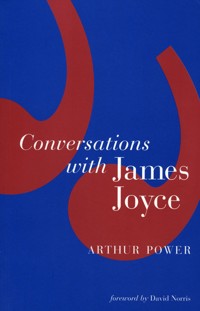
Conversations with James Joyce
Arthur Power
Foreword by David Norris
THE LILLIPUT PRESS
Contents
Title PageForewordForeword to the 1974 EditionPrefaceI: PreludeIIIIIIVVVIVIIVIIIIXXXIXIIXIIIXIVXVCopyright
Foreword
Arthur Power (1891–1984) was by any standards an extraordinary if somewhat self-effacing man: a painter, a writer, sometime art critic with TheIrishTimes and member of an international cultural world that included friendship with James Joyce, Modigliani, Ernest Hemingway, Paul Henry and Samuel Beckett. He was still painting actively until shortly before his death and I have in front of me as I write a review by Brian Fallon of an exhibition held in the Taylor Galleries in Dublin when Power was ninety. Fallon says, ‘Arthur Power is a minor genius. An original who is not like anybody else and is in competition with nobody.’
The password to Joyce’s flat in Paris in the twenties was simply to say that you were from Dublin, but few of those who called became real friends and fewer still, with the exception of Thomas Pugh, who shared his eye problems, Samuel Beckett, a fellow exile, and Constantine Curran, uniquely a survivor from Joyce’s school and university days, left any lasting trace. It is therefore a considerable pleasure to renew acquaintance, thanks to the reissuing of this little book, with one of Joyce’s genuine Irish intimates in Paris.
Despite the steady thud of trendy academics jumping on board, the Joycean bandwagon shows no immediate sign of subsiding under their weight. There was, however, a special excitement in the old days caused by the presence at international literary gatherings of those who had been fortunate enough to be friends of the Irish writer. And what a fascinating group of people they were. If the old cliché, ‘by your friends shall you be known’, is taken as true, then the evidence suggests that in addition to being a writer of global significance Joyce was a remarkable human being.
I never had the opportunity to meet Joyce, who died three years before I was born, or his wife Nora Barnacle, who died when I was seven, but I was privileged to know a number of the survivors of the Joycean circle from the days of Zurich, Trieste and Paris—figures such as Carola Giedion-Welcker, the Swiss art critic, Frank Budgen, the sculptor and painter, and Maria Jolas, who with her husband Eugene published instalments of FinnegansWake in their magazine transition in Paris in the 1930s, and also indeed Arthur Power, author of the present memoir. In 1977 I organized the International James Joyce Symposium in Dublin and as part of the festivities we arranged a banquet in the dining-hall of Trinity College. Among the special guests on that occasion were Maria Jolas, Lennie Collinge, who acted as projectionist in Dublin’s first permanent cinema, The Volta in Mary Street, opened by Joyce in 1909, and Arthur Power, then well over eighty years old. Hungry for recollections of Joyce from those who knew him, I asked Lennie Collinge for his opinion. ‘Ah poor Mr Joyce,’ replied Lennie, ‘he was a gentleman. But he wasn’t able for them Italian electricians. They ran rings round him.’ Apparently the canny Triestine sponsors of the cinema project had insisted on local Italian back-up, perhaps with a view to keeping an eye on their investment.
I was seated at the banquet between Maria Jolas and Arthur Power. At the coffee stage we had arranged for Bill Golding and Ann Makower to regale the symposiasts with music from Joyce’s works, including selections from Balfe and Wallace and some of the Victorian drawing-room ballads with which Joyce was familiar and to which there are constant references in his writings. They performed beautifully and created an atmosphere of magical nostalgia fitting for that time of the evening, but when they began to sing ‘Love’s Old Sweet Song’—‘Just a song at twilight when the lamps are low …’—some among the assorted academics thought themselves superior to this musical diet.
They began to snigger, giggle and make derogatory comments about Joyce’s musical taste. This was too much for Mme Jolas, a southern lady from Louisville, Kentucky. She shot to her feet, belted to the table with her stick, and said in a voice trembling with emotion: ‘You will not insult this beautiful music which Mr Joyce and I sang in Paris so many times together in the 1930s with affection and pleasure. You will sing it again and this time you will treat it with the respect it is due.’ She then led the assembled scholars into ‘Once in the Dear Dead Days beyond Recall’. She still had a wonderfully rich contralto voice. It was a remarkable occasion and a remarkable victory. With typical pusillanimity the very same scholars promptly did an aesthetic somersault and adopted the song as a kind of Joycean national anthem.
On my other side Arthur Power was greatly entertained. I have no doubt it reminded him of spats within the Joycean circle forty or fifty years earlier in Paris. He was a small stout man, quite bald and I think with a little moustache. He certainly also had the proverbial twinkling eyes and they found plenty to twinkle about on that occasion. I had previously known of his existence as he lived not far from me in St John’s Road in Sandymount with his wife, and was a well-known if discreet character round the village of Sandymount. But the week of that symposium was the only time I had an opportunity to get in any sense close to him.
I did not keep any notes (nor have I ever) of meetings such as that with Arthur Power. I can remember very little from our dinner conversation. I had to keep my eyes peeled for any difficulties that might arise among the delegates, and there were plenty of them. Two things I do recall, however. The first was his still keen interest in painting, and the second the memory of his quarrel with Joyce which revolved round a refusal to accord with Joyce’s view that the arrival of his grandson Stephen was an occasion of messianic proportions. There is something absurd and almost touching about Joyce’s family ‘notions’ and it is amusing to reflect that the distorted echo of genius that was the catalyst of this row between friends still enjoys an infinite capacity for sowing discord in the Joycean world.
Arthur Power, luckily unlike myself, does seem to have kept copious notes of his conversations with Joyce. This enables him to give a sharp picture of Joyce, surprised at work, looking like a dentist with his white coat, a fact confirmed by well-known photographs of the period. We get a nicely atmospheric description of the first meeting between Joyce and Power at the Bal Bullier in Paris. There is something wonderfully Joycean about the fact the Power went there in hopes of a romantic assignation with a skivvy and was disappointed to be roped in instead to the company of Joyce, definitely a second best.
He attempted to introduce Joyce to the bohemian world of Paris’s expatriate painters and sculptors but without success. There is a highly entertaining description of Joyce’s son Giorgio guarding Joyce from the temptations of alcohol as represented by Power (a comparatively abstemious man). The pathetic irony of this in the light of Giorgio’s own subsequent colourful career as an alcoholic will not be lost on Joyceans. The occasional snobbery into which the author of Ulysses allowed himself to descend is reflected in his comment about J.M. Synge being ‘bourgeois’. But then there was considerable rivalry between the two. Joyce, having been pleased to discover that RiderstotheSea disappointed his criteria for great classical tragedy, subsequently embarked on a marvellous parody of Synge’s style in the Scylla and Charybdis episode of Ulysses:
It’s what I’m telling you, Mr Honey, it’s queer and sick we were, Haines and myself, the time himself brought it in. ’Twas murmur we did for a gallus potion would rouse a friar, I’m thinking, and he limp with leching. And we one hour and two hours and three hours in Connery’s sitting civil waiting for pints apiece. And we to be there, mavrone, and you to be unbeknownst sending us your conglomerations the way we to have our tongues out a yard long like the drouthy clerics do be fainting for a pussful.
Although Joyce disdained the bohemian parties patronized by Arthur Power, he did invite Power to social occasions in his own apartment. There he met the intimates of the Joycean circle, including the remarkable Sylvia Beach, who was to publishUlysses from her bookshop Shakespeare & Company in the rue de l’Odeon in 1922. Miss Beach, whose 1962 visit to Ireland I recall well, was a spritely bird-like little thing who gave the impression of being prim, as befitted the descendant of seven generations of Presbyterian New England clergymen. However, prim she certainly was not, or she could not have either published Ulysses or conducted a life-long lesbian relationship with Adrienne Monnier. Joyce undoubtedly manipulated her as he did Harriet Weaver, but at least he gave her in return a lasting celebrity. Sadly, however, her end was rather lonely. She was found dead in her Paris flat after a bank holiday in the middle sixties when returning neighbours heard her transistor still playing, its batteries almost worn out.
Even after her death I am glad to say Sylvia Beach could cause controversy. At a fashionable wedding recently an inebriated solicitor, whose name I forget, overhearing me confirm to an enquiring literary friend that Sylvia Beach had had a lesbian relationship with Mlle Monnier, stood up and shouted, ‘Too much, too much, bad enough to sit near such a person but to be expected to listen to this filth …!’ However, his appetite for champagne prevailed over the refinements of his moral sensibility and having been ignored by the company he sat down once more to the trough. A satisfying posthumous triumph for Ms Beach.
Joyce himself of course had suffered in his own life from the restrictions of conservative social mores. He was cut dead in the street by Dublin acquaintances when he returned in 1909 because of his elopement with Nora. Arthur Power records a telling incident from his days in Trieste which Joyce recounted to him with some bitterness. He had just finished a private lesson in English with a teenage student. He started to gather his papers up and was about to leave the room when the young Miss tapped him on the shoulder and pointed to the clock above his head. It showed five minutes to the hour. She demanded her pound of flesh. There are always those who think they can buy genius like a pound of sausages.
There is no doubt that this treatment rankled with Joyce but especially in his early career he frequently encountered such attitudes. Even his friend Ettore Schmitz (Italo Svevo) could adopt a haughty tone. On one occasion, having in a spirit of bonhomie invited Joyce to dinner, he expressed shock that Joyce should have had the temerity actually to accept an invitation of which he was deemed socially unworthy.
Nora Joyce was regarded as beyond the social pale by middle-class Trieste because she took in washing to supplement her husband’s meagre income and desperate borrowings. When James Joyce acknowledged that in the portrayal of Anna Livia Plurabelle in FinnegansWake he had been inspired by the flowing locks of Svevo’s wife, she was horrified to discover that her much-admired tresses had been transmogrified into the muddy water of the river Liffey, in which a pair of washerwomen were raddling out Earwicker’s undergarments. Perhaps, however, the world of the bourgeoisie was right to suspect Joyce. There is a sharply perceptive description of Joyce by Power which would support their hesitation:
… for who would think that this slight and delicately built man with his smooth clerkly face, small pointed beard, with those strong spectacles glassing his weak eyes, was the most revolutionary character in this age of artistic revolutions? Indeed I realized that there was much of the Fenian about him—his dark suiting, his wide hat, his light carriage, and his intense expression—a literary conspirator, who was determined to destroy the oppressive and respectable cultural structures under which we had been reared, and which were then crumbling.
One of the most curious things about this memoir is the extent to which Joyce seems to have discoursed on literary topics with Power. This is surprising in view of Joyce’s comment about the literary conversation of Paris salons in the twenties: ‘I wish to God they’d talk about turnips.’ The ironic treatment of Stephen Dedalus in APortraitoftheArtist when he expatiates at some length about his aesthetic theories only to be undermined by Lynch—‘that has the true scholastic stink’—suggests that Joyce was not unaware that such conversations could lead to unsupportable longueurs. Joyce’s advocacy of André Gide is also certainly unexpected, but there are wonderful flashes of the steel of Joycean wit. It was apparently to Power that Joyce made the remark (recorded also in Ellmann’s magisterial biography), on being asked what he though of the next life, that he didn’t think much of this one. It was his way of avoiding a subject he didn’t wish to discuss conversationally. I have no doubt whatever that the question of the possibility of the human personality surviving death in some form preoccupied him increasingly in his later years and forms one of the central themes of FinnegansWake. Academic critics of course tend to avoid speculation about the spiritual. I remember well when Joyce’s old friend Frank Budgen posed this very question to a panel during a discussion in one of the early symposia, in the Moyne institute in Trinity. The psychic panic induced among the scholars was similar to the consternation occasioned by a thunderous crepitation during a Sunday sermon.
Joyce’s wit occasionally led him to be unfair to other artists. He was seduced by sound into dismissing the great Victorian poet Alfred Lord Tennyson as ‘Lawn Tennison’. He is quite simply wrong here. Tennyson is a great and sadly undervalued poet, even though he is wildly out of fashion nowadays. Similarly cruel is Joyce’s retort on hearing that the temperamental painter Patrick Tuohy, who created the superbly bilious portrait of his father John Stanislaus Joyce, but irritated Joyce with his artistic pretensions, had gassed himself in New York. When Budgen told Joyce the news he said, ‘I am not surprised. He nearly made me commit suicide too.’
The whole volume is like a series of platonic dialogues interspersed with vignettes of Joyce and the painter Modigliani. We are lucky to have this book not just for the personal recollections of Joyce it contains, which are always of biographical interest, but also for the insight into his working methods and aesthetic ideas. Joyce’s statements are caught with exactitude. It is fascinating to be permitted to listen in on the words of the master:
When I was writing Ulysses I tried to give the colour and tone of Dublin with my words; the drab, yet glistening atmosphere of Dublin, its hallucinatory vapours, its tattered confusion, the atmosphere of its bars, its social immobility.
Who better than Joyce to give this description? And thank God we have here the statement from Joyce, recorded directly from his conversations with Arthur Power, that above all
Ulysses is fundamentally a humorous work, and when all this present critical confusion about it has died down, people will see it for what it is.
When they were putting up quotations from Joyce in pink neon lights all over Dublin as part of public-art project recently it is a pity they left this one out. It should be permanently up in lights for scholars everywhere to see.
SENATOR DAVID NORRIS
Dublin,November1999
Foreword to the 1974 Edition
While patient research has clarified many of the more recondite sources on which Joyce drew for the composition of his books, it has always been far from easy to determine how much of the main stream of European literature he had absorbed or what his literary tastes and opinions were. After his earliest adult years he wrote virtually no criticism, nor was he inclined to speak openly to the journalists and casual acquaintances who repeatedly sought to discover his views. Only a few friends were privileged to know anything of the real personality behind the courteous façade, friends who, with rare exceptions (like Hemingway), were not themselves literary men. Stuart Gilbert had been a judge; Frank Budgen was a painter; Arthur Power, a man of general culture and an art critic more or less by accident, was one of the even smaller number who succeeded in engaging Joyce in repeated and sustained conversation about literature and literary values.
Except for his sporadic and always highly specialized research into works of reference and comparatively rare books (much of it, in any case, carried out for him by willing amanuenses), Joyce was not often a great reader, and it is wise to be guarded in one’s assumptions about the depth of his literary background. Arthur Power’s conversations with Joyce reveal facets of that background which were previously either veiled or almost unknown. Joyce’s interest in, and knowledge of, the great tradition of Russian prose writing can be seen to be more profound than one might have suspected, while his high opinion of Eliot (sometimes disputed) is now shown to be beyond question. Joyce’s comments on literary theory are less than exciting, and as always he seems to have avoided prolonged discussion of his own books. Special interest is nevertheless to be found in one or two remarks about Ulysses and ‘Work in Progress’, such as his response to Power’s question about what happened between Bloom and Gerty MacDowell: ‘Nothing happened between them…. It all took place in Bloom’s imagination,’ a remark which may help, by slightly altering the status of the first half of the ‘Nausikaa’ chapter, to explain the rather different roles played by the girls three hours later, in the nighttown scenes.
Joyce and Power had a number of things in common. Both had left the Church at an early age; both escaped from Ireland, in which they found much to dislike. In the first chapter of this book, Arthur Power presents a refreshingly honest portrait of himself as a young man of direct and open character, eager, like Joyce, to immerse himself in a culture more exciting than anything his native country seemed able to offer. Although less disturbed by his own developing personality than Joyce had been, Power was vividly aware of comparable tensions, and his account of the important moment of his First Communion, in which waning religious conviction confronted a growing sexual interest, presents some analogies with the adolescent experience of Stephen Dedalus. There were nevertheless strong temperamental differences which, as Power reports, occasionally led Joyce to mild displays of courteous exasperation at his young friend’s insistence on the worth of the literature which he had undertaken to defend. After a slightly insecure start (an experience shared by many of Joyce’s acquaintances), the friendship between Power and the Joyce family flourished in the twenties, for, apart from his personal attractiveness, Power had the important virtue, in Joyce’s eyes, of being not only Irish but also loquacious. The days of the composition of Ulysses were over, and Joyce no longer needed Irish friends to confirm or modify his recollection of the topography of Dublin, but during the period of ‘Work in Progress’ he took every opportunity to listen to users of his native speech rhythms. In this Power served him well, and it seems that Joyce offered oblique thanks for his frequent friendly conversation by allowing him to double, in FinnegansWake, with Frank le Poer (‘Ghazi’) Power, under the pseudonym ‘gaspower’.
It is not only about literary topics that Power has something of value to say. He offers us many small insights into Joyce’s daily habits and tastes in more mundane matters. Joyce’s intense interest in the notorious Bywaters and Thompson case of 1922 provides hints for the possibility of further meanings in parts of FinnegansWake, while the small vignettes which Power provides of Joyce and his family both at work and in more convivial circumstances are among the freshest to have been recorded. Very few of Joyce’s Irish friends have been content to give us any extended account of the Joyce they knew; we are most fortunate that Arthur Power has now chosen to join their company.
CLIVE HART
Preface
In these conversations I have tried to reconstruct some of the talks I had with Joyce at different times from notes taken when I returned home after spending an evening with him.
I realize how inadequate much of it is, for much that was said has been forgotten or is inadequately expressed, while to give an impression of a man of such talent one would have to have talent equal to his own, as deep a consciousness of the social and psychological changes of his time as he had, and the same almost agonized gift for expressing it.
Also I see that being of a different temperament and opinion I have been too occupied with expressing my own point of view. All I can say is that that is how it was, since I was very talkative, while Joyce was naturally silent.
At the time these conversations took place I was a romantically inclined young man. My point of view has changed and coincides more with his, but such was it then, and as such I have left it. In order to give the reader a clearer notion of my youthful personality and interests, I have prefaced the book with a brief account of my early life in Ireland, London and Paris.
A.P.
I
Prelude
An early love of France must have been instinctive, for when I was only fourteen I remember I persuaded my mother that we should spend our Christmas holidays at Boulogne, arguing that it would be a great opportunity to improve our French. Crossing the Channel in a paddle steamer, we stayed at a grumbling




