


Erhalten Sie Zugang zu diesem und mehr als 300000 Büchern ab EUR 5,99 monatlich.
- Herausgeber: Schott Music
- Kategorie: Fachliteratur
- Sprache: Englisch
This book is the monograph of Ukrainian-Russian Classical / Jazz composer Nikolai Kapustin. It grew out of meetings and conversations between the author and the composer. It aims to introduce the fascinating world of this modern day leading composer to a wider audience.
Sie lesen das E-Book in den Legimi-Apps auf:
Seitenzahl: 709
Veröffentlichungsjahr: 2019
Das E-Book (TTS) können Sie hören im Abo „Legimi Premium” in Legimi-Apps auf:
Ähnliche



















Tyulkova – Conversations with Nikolai Kapustin
Yana A. Tyulkova
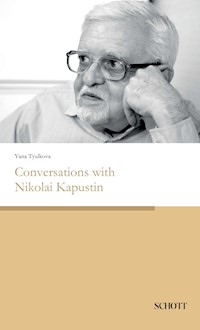
CONVERSATIONS WITHNIKOLAI KAPUSTIN
Bibliografische Information der Deutschen Nationalbibliothek Die Deutsche Nationalbibliothek verzeichnet diese Publikation in der Deutschen Nationalbibliografie; detaillierte bibliografische Daten sind im Internet unter http://dnb.d-nb.de abrufbar.
978-3-95983-590-9 (Hardcover)
978-3-95983-591-6 (Paperback)
978-3-95983-592-3 (e-Book)
© 2019 Schott Music GmbH & Co. KG, Mainz
www.schott-buch.com
Alle Rechte vorbehalten. Nachdruck in jeder Form sowie die Wiedergabe durch Fernsehen, Rundfunk, Film, Bild- und Tonträger oder Benutzung für Vorträge, auch auszugsweise, nur mit Genehmigung des Verlags.
Pictures are used by the permission of Nikolai Kapustin, Peter Andersson, Leonid Peleshev, and Pavel Korbut. Also included the pictures from Yana Tyulkova archive.
Umschlagmotiv: Nikolai Kapustin, © Leonid Peleshev
For my dearest teacher Dr. James Miltenberger
Sometimes, looking back at the decades of my life, I wish I could rewrite my past and make it perfect like the music I compose … but no, our life is like jazz improvisation, it should always be spontaneous, always in the moment, and always free.
Content
Acknowledgement
About the Author
Introduction
Prologue
Chapter One: Childhood and First Steps in Music (1937-1952)
The Beginning of World War II
Early Interest in Music
Piotr Ivanovich Vinnichenko
The End of World War II and Beginning of Study at School
Lubov’ Borisovna Frantsuzova
First Steps in Composition – Piano Sonata (1950)
Entering Exams at the Moscow Musical College
Chapter Two: Study in Moscow Musical College (1952-1956)
Avrelian Grigorievich Rubbakh
Connection to the Family and Teachers Frantsuzova and Vinnichenko
Recitals at the Musical College
Teachers and Courses at the Musical College
Self-Education
Composition
New Friends of Nikolai Kapustin
Life at the Mikhalkov House
Acquaintance with Jazz
Music in Mikhalkov’s House
The Visit of Kapustin’s Parents to Moscow
Final Exams of the Musical College and Entering the Moscow Conservatory
Chapter Three: Study at the Moscow Conservatory (1956-1961)
Alexander Goldenweiser
Study in the Class of Goldenweiser
Concerts of Goldenweiser’s Students
Kapustin’s Piano Repertoire and Interest in Atonal Music
Courses at the Conservatory
Accompanying
Kapustin’s Injury of the Right Hand
Master-Classes and Concerts at the Moscow Conservatory
Student Life at the Moscow Conservatory and Kapustin’s Friends
Composing Music at the Conservatory
The Festival of Youth and Students (Moscow, July 1957)
Jazz Quintet Experience
Last Exams at the Moscow Conservatory
A Serious Conversation
Postlude: Goldenweiser
Chapter Four: Years of Work with the Oleg Lundstrem Big Band (1961-1972)
History of the Oleg Lundstrem Big Band – The Beginning
Nikolai Kapustin Joins the Big Band
Kapustin and His Duties in the Big Band
The Musicians of the Lundstrem Big Band
On the Road with the Lundstrem Big Band: Repertoire and Performances
Other Musical Projects of Nikolai Kapustin
Jazz Environment of USSR in the 1960s-1970s
Compositions of 1961-1972 (Ops. 2-13)
Nikolai Kapustin: Connection to His Family and Old Friends
Alla
Oleg Lundstrem – Postlude
Chapter Five: Years of Work with the Boris Karamyshev »Blue Screen« Orchestra (1972-1977) and the Russian State Symphony Orchestra of Cinematography (1977-1984)
Boris Karamyshev and His »Blue Screen« Orchestra
Nikolai Kapustin – Transitional Period
Kapustin Joins the Karamyshev Orchestra
Kapustin’s Duty in the Karamyshev Orchestra/ A New Life in a New Band
Karamyshev Orchestra: Instrumentation and Repertoire
Karamyshev Orchestra: Recordings on Radio and Television, Touring
New Acquaintances of Nikolai Kapustin: Varlamov, Lyadova, and Silantiev
Disintegration of the Karamyshev Orchestra
Russian State Symphony Orchestra of Cinematography/Audition for the Open Position of Pianist
Work at the Russian State Symphony Orchestra of Cinematography (1977-1984)
Growing Family of Nikolai Kapustin/Accident in the Summer of
1980: Performance of the Piano Concerto No. 2/ Acceptance to the Union of Moscow Composers
First Publishers
Russian Jazz Scene in the 1970s-1980s / Music of Nikolai Kapustin
Compositions of 1972-1984 (Ops. 14-39)
A New Turn of Life: Decision to Resign from Orchestra of Cinematography
Chapter Six: Freelancing Composer (1984-1999)
Life in the Soviet Union in the 1980s-1990s
Musical Life of Nikolai Kapustin in the 1980s-1990s/Recording of the Vinyl Records and Compact Discs
New and Old Friends of Nikolai Kapustin: Nikolai Petrov, Alexander Zagorinsky, and Hideaki Takaoki
Beginning of Interest around the Figure of Kapustin/Back to the Life of Performing Artist
Life Complications: Worries about Alla
First Tour in Germany/ Collaboration with Alexander Korneev
A Second Trip to Germany
Compositions of 1984-1999 (Ops. 40-99)
Ruza
Chapter Seven: Years of Increasing Popularity (2000-2018)
Kapustin’s Trip to London (May 2000)
Continuation of Recording CDs
Concerts of the Music of Nikolai Kapustin in Russia after
Burst of Popularity: Publishers and Performers of the Music of Kapustin after
The 80th Birthday of Nikolai Kapustin
Presentations and the Beginning of Research on the Music of Nikolai Kapustin
Compositions of 2000-2017 (Ops. 100-161)
Family Sorrow: Loss of Fira Grigorievna Kapustina
Kapustin’s Flow of Life
Epilogue: How I met Nikolai Kapustin
Appendix A: Nikolai Kapustin – Chronology
Appendix B: Nikolai Kapustin – Discography
Appendix C: Nikolai Kapustin – Dedications
Appendix D: Catalogue of Works by Genre
Appendix E: Letters about Kapustin
Appendix F: Personalities
Appendix G: Miscellaneous
Bibliography
Acknowledgement
First, I would like to thank Nikolai Kapustin and his wife Alla Kapustina for their invaluable help for this book: our weekly Sunday skype conversations during the last four years and your warm acceptance of my visits to Moscow and Ruza. Thank you for allowing me into your lives!
This project would never have started without my teacher Dr. James Miltenberger, who introduced the music of Nikolai Kapustin to me. Thank you Doc for your creative ideas, revisions, and always wise suggestions.
It is hard to overestimate the support of my family. I would like to thank my parents Natalie Tyulkova and Anatoly Tyulkov, my brother Kirill Tyulkov, and my husband Curtis Johnson for their belief in my ability and unlimited source of help and inspiration. Curtis, thank you for correcting all my drafts a million times and being patient with the editing process. Kirill, thank you for the graphic design and all the work that you have done with the pictures. It looked like those seven chapters would never be done, but we did it!
I would like to thank also all the amazing people who were willing to correspond with me. My sincere thanks to Mark-André Hamelin, Steven Osborne, Ludmil Angelov, Oxana Yablonskaya, Carlo Levi Minzi, Vito Reibaldi, Masahiro Kawakami, Alexei Zoubov, Alexander Zagorinsky, Wim de Haan, Natsuko Samejima, Leonid Peleshev, Pavel Korbut and Cyril Moshkov.
Finally, I would like to thank Dr. Jonathan Mann, who opened the door to the world of Nikolai Kapustin to me. Thank you Jonathan! You never know how powerful a short letter can be.
About the Author
Dr. Yana Tyulkova is a Russian born classical/jazz pianist and jazz singersongwriter.
She received her Master’s Degree in Piano Performance from the Nizhny Novgorod State Conservatory (Russia) and the Doctoral Degree from West Virginia University (USA), where she studied classical and jazz piano under Dr. James Miltenberger.
As a performer, Dr. Tyulkova attended numerous educational programs and music festivals all over the world, including study at the Berklee College of Music (Boston, USA), participating in Berklee Summer Performance Program (Perugia, Italy, 2005), International Summer Jazz Academy (Krakow, Poland, 2007), International Jazz Summer Workshop (Prague, Czech Republic, 2009) and others. She became the winner of »Nizhny Novgorod State Competition of Young Composers« (1994), Russian Piano Competition (Novomoskovsk, 1995), »Nizhny Novgorod State Pop-Rock-Blues Competition« (1997), International Jazz Vocal Competition »Jazz Voices« (Klaipeda, Lithuania, 2006), and International Jazz Vocal Competition »Finsterwalde Singer« (Finsterwalde, Germany, 2006). As a classical pianist she won the Young Artist Competition and in March 2012 performed with West Virginia University Symphony Orchestra. She has performed in masterclasses with such legendary classical pianists as Leon Fleisher and Ann Shein.
In 2013 Dr. Tyulkova began research on the music of Nikolai Kapustin. In 2015 she wrote the dissertation called »Classical and Jazz Influenced in the Music of Nikolai Kapustin: Piano Sonata No. 3, Op. 55«. In June 2014 Dr. Tyulkova presented the music of Nikolai Kapustin at the International Festival and Competition »The Intersection of Jazz and Classical Music« in Morgantown, WV (USA). In March 2017 she participated in the Music Teacher National Conference (MTNA) as a part of the presentation »The Intersection of Classical and Jazz: Introduction to the Music of Nikolai Kapustin« in Baltimore, MD (USA).
In February 2015 Nikolai Kapustin composed the piece called »Curiosity« (Op.157) and dedicated it to Yana Tyulkova. She premiered this piece in June 2015 at the Festival »The Intersection of Classical and Jazz« at West Virginia University.
In July 2015 Yana Tyulkova participated in a European Tour with »James Miltenberger Jazz Quintet« as a jazz singer and classical pianist. The series of concerts took place in Belgium, the Netherlands, and Germany.
Dr. Tyulkova is currently teaching piano at California University of Pennsylvania.
Dr. Tyulkova is a member of »Who’s Who in Russia« (Ralph Hubner Edition, 2008), Vladimir Feiertag’s »Encyclopedia of World Jazz Music« (St. Petersburg, Russia, 2008), and is now the official biographer of Nikolai Kapustin.
Introduction
Nikolai Grigorievich Kapustin is a contemporary Russian-Ukrainian composer and classical/jazz pianist. During the last twenty years his music began to receive large-scale popularity through recordings, presentations, competitions, festivals, as well as Kapustin’s recordings of his own music. Kapustin is widely known in the USA, Japan, China, South Korea, United Kingdom, Germany, Italy, and Spain. Surprisingly, the Russian audience is not very familiar with the music of Kapustin.
His music fuses the idea of perfectly structured classical form with the complexity of harmonic language and rhythmic identity of jazz. Kapustin developed a highly unique and distinct style that is recognizable, fresh, and fun to play and to listen to. To this day Kapustin has written 161 opuses that includes solo piano music, chamber, and orchestral music.
My goal is to encourage a greater appreciation to the music of Nikolai Kapustin and continue developing the international recognition of this outstanding modern-day composer.
My first acquaintance with the music of Nikolai Kapustin was in 2011 when I began to study at West Virginia University (Morgantown, USA) as a doctoral student in piano performance. My teacher Dr. James Miltenberger introduced me to the music of Kapustin, and also suggested I play one of Kapustin’s piano sonatas. That’s how this story began.
The research project that I completed in May 2015 is called »Classical and Jazz Influences in the Music of Nikolai Kapustin: Piano Sonata No. 3, Op. 55«. The information gathered through the interviews with Nikolai Kapustin became an essential part of the research.
Our meetings with Nikolai Kapustin and his wife Alla Kapustina led to the idea of writing his autobiography. I truly believe that it is important to get acquainted with Kapustin not only through his music but also through his words.
This book »Conversations with Nikolai Kapustin« consists of seven chapters representing Kapustin’s memories in different periods of his life, starting from years living in the Ukraine to becoming one of the most significant composers of our time. The book also includes Kapustin’s recollections on musical life in Russia during 1950s -1970s, as well as his vision of his own works. The material that was used in the book consists of the home archive of Kapustin gratefully given to me by the composer. It includes letters to his parents and his wife, family pictures, program notes and posters from the concerts, the composer’s handwritten scores of his early unpublished works, as well as my correspondence with Kapustin’s close friends and their insight on Kapustin’s personality.
During the years that I have known Kapustin’s family, we have developed close relationships and become very good friends. It is hard to believe that in the spring of 2013 I didn’t even think about the opportunity to meet one of the best composers of our time – Nikolai Grigorievich Kapustin.
Prologue
In the morning of June 18, 2015 I woke up surprisingly early for me, just right after seven. The reason for this sudden awakening was the sound of the fireplace, a real one. The sound of burning wood was filling out the whole house, and its’ smell, so remarkably familiar to me, brought back memories from my childhood. I was a guest… I was a guest in the house of one of the most promising composers of our time – Nikolai Grigorievich Kapustin.
Every summer Nikolai Grigorievich and his wife Alla Semionovna spend their time in their summer convent, which is around sixty miles west of Moscow in the small city of Ruza. There is something unusual about this place… maybe because of the majestic old spruce, maple, and birch trees that surround the house and make the special effect on everyone who attempts to visit this place, I don’t know. Maybe because for more than fifty years this place was the summer retreat for all major Russian composers who used to come here… all in the past.
His way of saying things – this is something you want to hear to have a complete understanding of what kind of person he is. He talks very slowly, like trying to put the best possible meaning in each and every word. His speech is full of life-long rests, just like in the music. He has a special intonation in his voice, the mode of which changes depending on the direction of our conversation. Every time he is really interested in something his eyes become incredibly big and bright, as if the center of our universe. He likes to talk about music, linguistics, and physics.
It was early in the morning…
Ruza, June 18, 2015
Chapter One:Childhood and First Steps in Music (1937-1952)
Biographical Information
Kapustin, Nikolai Girshevich (Grigorievich)
Date of birth: November 22, 1937
Place of birth: Ukraine, Donetsk Region, Gorlovka, Nikitovskii district
Historical Information
The Nikitovskii district, or simply »Nikitovka« (»Mykytivka« in Ukrainian), is a small city which is situated in the southern part of Gorlovka. The history of this place goes back to the middle of the eighteenth century, when in 1776 it was named by one of its inhabitants, Nikita Deviatilov. At the beginning of the nineteenth century, as a result of the rapid growth of the coal industry, Nikitovka became a significant city in the Donetsk region becoming a part of the Kursko-Harkovsko-Azovskaya railway line. In 1869 Nikitovka became the main railway station in the city Gorlovka.1
This short historic overview allows us to understand that Nikolai Kapustin was not born in just some small city, but in the place that at the beginning of the twentieth century had an important impact on the development of both countries – Ukraine and Russia.
While Nikitovka was considered a part of Gorlovka for more than two hundred years, Nikolai Kapustin prefers to see his birthplace independently.
NK2 :I was born in Nikitovka, not in Gorlovka.
From the Russian perspective the population of Nikitovka is relatively small. For the all-union population census on January 17, 1939 Nikitovka reached the number of 14, 047 people,3 and for the last Soviet Union population census on January 19, 1989 the number reached up to 78,762.4 This could lead us to the conclusion that in the past the citizens of Nikitovka probably knew each other very well, or were even distant relatives of each other.
Kapustin’s mother Klavdia Nikolayevna Kapustina-Kozmina (1910-1993) had Russian ancestry. She worked for a period of time as a typist in the department of the People’s Commissariat of Internal Affairs (NKVD) in Glorlovka.5 She loved music and could play the piano. Klavdia Kapustina would be the person to introduce the small Nikolai to the world of music and his first and only favorite instrument – pianino.6
Klavdia Kapustina (front) and Sonia Kapustina (back), the sister of Grigory Kapustin
His father Grigory Efimovich Kapustin (1901-1983) had Belarusian ancestry7 and was a butcher by profession. Grigory Kapustin worked as a senior manager at the meat factory.
Nikolai Kapustin had a very special relationship with his parents. He loved them deeply. Even now, deceased more than twenty years, when talking about them Kapustin has intonations of warmth and tenderness in his voice. They will be forever his mama and papa.
NK: They lived in Nikitovka through their entire lifes.
Young Nikolai was named in honor of his grandfather – Nikolai Timofeyevich Kozmin, who was a musician. Nikolai Kozmin served in the military through his whole life as a member of the military band.
NK: My mother told me that he died in the trenches during the Civil War.8
As with most Russian and Ukrainian children, young Nikolai grew up in the hands of his grandmother – Pilageya Stepanovna Kozmina (1869-1972). Nikolai Kapustin says with proudness in his voice,
NK: My grandmother lived for 103 years, and her daughter, my aunt, Alexandra Nikolayevna Kozmina, exactly 100 years.
YT9: What did you do with your grandmother when you were young? What kind of activities did you share together?
NK: It is hard to tell because I don’t remember that much. One thing I do remember – I was sitting on her knees all the time. (And then, after a long pause, Nikolai Kapustin continues) She was absolutely an uneducated person. That was my upbringing.
At that pre-World War II period, music was a big part of Russian and Ukrainian life but, because Nikolai was living in a small city, the most entertaining things for him were his mother’s tales. The tales are an important part of a child’s growth through the centuries in Russian and Ukrainian cultures as they teach you about the good and bad, the basic rules of our life. The most distinctive feature of the tale is that good always triumphs over evil. Young Nikolai loved to listen to his mother’s tales. Even now he is still fascinated by them.
YT: What is your attitude now towards the tales?
NK: Very positive.
It is difficult for us to remember something from our childhood when we were around three or four years old, but there is one fact from his life that Kapustin remembers clearly – the beginning of World War II. In the summer of 1941 young Nikolai, his mother, grandmother, and sister Fira, were evacuated to the Kyrgyz Republic (Kyrgyzstan).10 Nikolai was just three years old!
The Beginning of World War II
Historical Information
At the beginning of WWII, in the summer of 1941, Ukraine was occupied by fascist Germany. It took until October 20, 1943 for the Soviet troops to organize four Ukrainian fronts to fight in the war. General casualties in the Ukraine reached the number of 14 million people. From January 1941 to January 1945 the population of the Ukraine decreased from 40.9 million to 27 million people. In addition, financial losses to the Soviet Union consisted of 40% of all countries involved in World War II, where over 40% of the Soviet Union losses belonged to the Ukraine.11
Nikolai’s family was evacuated to the city of Tokmok, which is situated in the northern part of the Kyrgyz Republic near the city of Bishkek.
Tokmok, Kyrgyzstan Republic
At the beginning of the evacuation Nakolai’s father stayed with the family in Tokmok but then was ordered to go to the West Kazakhstan territory. He was to become a part of the reserve military forces. The only possible way of communication with his family was through letters. Unfortunately, the existence of these letters is highly questionable by now as they might have been lost through time. Nikolai Kapustin remembers that those letters were an essential part of their existence during that period of time.
As with many other people at that time, Kapustin’s family tried to keep track of the hostilities through the national radio. Today it is hard to believe that the radio and letters from the front were the only opportunities to stay informed about your relatives.
Being far away from the hostilities of war, Kapustin’s family still had to go through struggles, starvation and poverty. They tried hard to maintain the basic flow of a normal life.
YT: What are your memories of the war time?
NK: We lived in the evacuation two years, 1941 through 1943. Somehow we scratched along.
Nikolai (on the left) and his cousin Vladimir (on the right), ca. 1943-1944
Kapustin’s family occupied a private house in Tokmok where they lived on the first floor. As a part of its property this house had a large garden. A lot of different bushes and trees, such as cherry and apple, grew in that garden.
NK: Our apples were large and very tasty. This garden helped us a lot.
The family used to make pickled tomatoes and cabbage to avoid poverty. In addition, Nikolai’s mother Klavdia Kapustina and his grandmother Pilageya Kozmina used to sell their apples on the market.
One interesting episode happened in the summer of 1942, when Nikolai was around four and a half years old.
AK12(joining the conversation): They (Nikolai’s mother and grandmother) went somewhere and left you at home.
NK: They went to the market and locked me at home. I became very upset about it. There were apples in the bags that were prepared for the market. I took a bite of each apple so they wouldn’t leave me by myself anymore.
YT: What happened when they got back?
NK: I didn’t want to open the door to punish them.
AK: You can see what kind of boy he was –young but already willing to get what he wanted.
Indeed, this episode, when Nikolai prepared the penalty for his »slow-witted« family, demonstrates that even at this early age Nikolai had a clear understanding of what he wants in his life and what he does not.
Early Interest in Music
Nikolai’s sister Fira, who was six years older than Nikolai, studied violin at that time. She had a private teacher in Tokmok.
NK: We did not want to interrupt her violin lessons.
»We« in this context obviously means »Nikolai’s mother«. It is fascinating that even in the evacuation Klavdia Kapustina wanted to continue the musical education of her daughter. We cannot talk about Nikolai’s musical study yet because he was too young at that point.
Nikolai and his sister Fira, Nikitovka, ca.1948-1949
Although, being a young boy, Nikolai had some advantages over Fira. Nikolai Kapustin shared with me another funny episode from his childhood memory.
NK: Fira used to practice her homework in our beautiful garden, and I was asked to help her in this process.
YT: What did you do?
NK (smiling): My task was to swat flies away from the »practicing« Fira.
YT: That’s so funny! What an interesting job you had!
NK: It was fun and helpful at the same time.
YT: Did you try to play violin?
NK: Yes, I tried but it didn’t work out. I had a complete aversion to it.
However, the music eventually began to become a part of his life.
YT: Do you remember any musical experiences from that time?
NK: For some reason I remember one of the Kyrgyz folk melodies.
Nikolai Kapustin came up to the grand piano and played a two-voiced melody.13 This melody, in lively character, sounded quite complicated to my ear. It was in D Mixolydian mode with a left hand ostinato pattern. It sounded very Eastern, almost Asian.
YT: What mode is it? (I couldn’t identify it from the first listening)
NK: That’s the thing, this is not an easy melody; tricky business.
YT: How did you remember it? You were just four or five years old.
NK: I have no idea (laughing). I remembered and that’s it.
The fact that a four or five-year-old boy remembered a two-voiced melody and carried it through his whole life tells us that Nikolai naturally had unique musical abilities. It is important to note that during the evacuation Nikolai didn’t have a piano, so he just held this melody in his head.
NK: It was my idée fixe.14It haunted me.
In 1943, when the Ukraine was freed from fascist German forces, Nikolai’s family returned to their motherland Nikitovka. They discovered a horrible consequence of the reality of the war – their house was destroyed by German forces. During the next two years the family had to live in the home of their neighbors.
Despite the fact that the war was a part of all Ukrainian people’s lives, something positive still occurred in young Nikolai’s life. One of the most significant moments happened when Nikolai was around six-seven years old. A musical instrument appeared in his life to stay forever. The name of this instrument was piano.
NK: My mother managed to get the piano. Our neighbors suggested to us. And really, it turned out to be our piano.
Here, we need to clarify his meaning of the phrase about the piano being their instrument. During the time of 1941-1942, when Nikitovka was occupied by fascists, their house was destroyed but their piano was spared. It was taken away to the place where fascists lived and used to play on as their entertainment. After Nikitovka was returned to the Ukrainian control, the piano was transferred to the local Ukrainian administration. When Kapustin’s family returned from the evacuation their neighbors suggested they try to get their instrument back, since they were the actual owners. After all these manipulations the piano was successfully returned home.
NK: And then everything began. It was impossible to tear me away from the piano.
Klavdia Kapustina, watching the enormous interest of her child in playing the piano, set up a meeting with a tuner to fix the piano. Musicians can tell what difference it makes to play on the tuned instrument instead of the unturned one. It made an even bigger effect on the young boy who was attempting to take his first steps in music.
NK (with the intonations of victory and proudness in his voice): And then I learned six Clementi Sonatinas.
YT: By yourself? Being six years old?
NK: I consulted with Fira on which line which note is situated. Fira knew the notes.
YT: In other words, you learned to play piano on your own?
NK: Basically, yes. By the way, my mother also knew the notes. I asked them both. I bothered them enormously and at the end they got tired of me.
Nikolai Kapustin was a child prodigy. He learned to play piano on his own, beginning his musical journey with Muzio Clementi Six Sonatinas, Op. 36. This sounds truly amazing for the young boy who had no understanding of music theory and just began to study music on his own. The thing he did have was his deep desire to play the piano, which moved him tremendously.
The fact that Nikolai learned all six pieces without an actual preparation in understanding of the notes on the staff makes us assume that Nikolai’s first practice on the piano was by ear, an equivalent of the Suzuki method nowadays. In reality Kapustin made a different choice.
NK: I learned to read the notes. My mother and Fira taught me where the notes are situated on the staff. Somehow gradually I learned it. I’ve always sought being self-educated.
YT: And then your mother found your first piano teacher?
NK: No, he appeared on his own.
Piotr Ivanovich Vinnichenko
Nikolai’s love for the piano, which would become an essential part of his life, led to his acquaintance with Piotr Ivanovich Vinnichenko. Nikolai’s relationship with this man would last through their entire lives.
Nikolai Kapustin and Piotr Vinnichenko, Nikitovka, 1952
Piotr Ivanovich Vinnichenko was a violin teacher who could also play piano. Through his life he lived in the different cities situated in the surrounding areas of Nikitovka. He used to travel to the houses of his students to give private violin lessons. One of his students was Fira Kapustina. Fira used to take lessons from Piotr Vinnichenko even before the beginning of the war. In 1943, when Kapustin’s family returned to Nikitovka from the evacuation, Piotr Vinnichenko came back from the war.
NK: He was wounded, that’s why he came back home before the end of the war.
Piotr Vinnichenko’s return became a good reason to renew the lessons with Fira. That’s how Piotr Vinnichenko appeared in the house of Nikolai Kapustin. He was the person who gave young Nikolai the piano scores of the Clementi Sonatinas, Op. 36.
NK: He noticed what was happening with me and decided that it was time to get me involved.
Probably, the fact that from that point Nikolai had his own piano teacher helped him not only in the study of piano but also supported him in his desire to play this instrument. Vinnichenko cared not only for Nikolai and Fira’s progress but he also cared for their instruments.
YT: Did you play on that same piano until the time when you moved to Moscow?
NK: No, the instruments changed twice after that. After the war my teacher Piotr Vinnichenko suggested we buy a better one. That was a very beautiful instrument but played very poorly. This instrument had very bad repetitions so later on we bought another one. That was a Ukrainian piano »Chernigov.« I played on that instrument until the time I moved to Moscow and later, during my visits to Nikitovka.
In other words, Nikolai had three different instruments just during the period of nine years, from 1943 until 1952. This fact demonstrates that Nikolai’s parents wanted to give whatever possible to their children in order to help them achieve their goals, especially if it was about the music.
The End of World War II and Beginning of Study at School
In September of 1944, Nikolai was almost seven years old, the age when children begin to attend school. Unfortunately, that did not happen with Nikolai Kapustin.
NK: I was so frail that they refused to take me in the first grade.
Nikolai was asked to wait one more year and begin school in September of 1945. Indeed, the years of starvation reflected on the health and growth of the young boy. In addition, the conditions of life at that time were probably still very poor since the war would not be over for almost a year.
In May 1945 a long-expected event happened in the world that put an end to suffering and loss. It was the end of World War II.
Historical Information
On May 8, 1945 in Berlin at 22:43 European time (00:43 Moscow time) the »Act of Unconditional Surrender« of Germany was signed. From the German side this act was signed by Generalfeldmarschall Wilhelm Keitel, from the Russian side by Marschall Georgy Zhukov, and from the Supreme Headquarters Allied Expeditionary Forces side by Air Chief Marshall Sir Arthur Tedder. The day of May 9th 1945 was announced in Russia as the Victory Day for the Soviet Union against fascist Germany.15
The big celebration happened in the family of Nikolai Kapustin in the summer of 1945 when Grigory Efimovich Kapustin came back home from the war. Words cannot express how much Nikolai’s family was happy and relieved about his return. Grigory Kapustin was not only the beloved father and husband; he was also the main provider of financial support for the family.
YT: Did you know the date when your father was supposed to return? Did he inform you somehow or did it happen suddenly?
NK: My mother told us about it. They wrote the letters to each other.
YT: Do you remember when your father came back home? What was your impression?
NK: For me he was a completely foreign man. I was three years old when he left for the war. I did not remember anything.
YT: So, because you were so young you just forgot him?
NK: Yes.
YT: Then how did your mother reintroduce your father to you?
NK: She said – »Kolia (a term of endearment for Nikolai), this is your father.«
At that moment Nikolai was almost eight years old. This is the age when children begin to understand life. That brought additional tension into this awkward family situation. Indeed, the story of Nikolai Kapustin’s life has real drama in it!
YT: How long did it take for you to get used to this foreign man actually being your father?
NK: I got accustomed to it very quickly.
One of the most memorable episodes from that time for young Nikolai was the fact that his father brought home a huge bag of dried apricots.
YT: Was it tasty?
NK (laughing): It was considered to be a sweet present for us. He said it was from Iran.16
From the moment when Grigory Kapustin came back from the war he immediately began to restore the normal flow of life. The first thing he did was to begin to reconstruct their house.
YT: Was the house completely destroyed by the fascists?
NK: Absolutely.
YT: Did your father have any friends to help rebuild the house?
NK: Yes, he had one friend who was working with him.
YT: What company for building the whole house! Probably, this assistant was very knowledgeable.
NK: Yes, he was.
The new house was built during a short period of time and was situated on the exact place as the old one.
Family of Nikolai Kapustin: Klavdia Kapustina (first from the right), Grigory Kapustin (second from the right), Fira Kapustina (center in the back), Mikhail Kapustin, brother of Grigory Kapustin (second from the left), Mikhail’s wife (center in the front), Mikhail’s son Vladimir Kapustin (first from the left), Nikitovka, ca. 1948
On September 1st 1945, Nikolai Kapustin entered the doors of Elementary School No. 30 as a pupil for the first time.
Historical Information
School No. 30 is one of fifty-eight schools that are located in Gorlovka today. Despite the tragic events that had happened in Gorlovka during 2014, School No. 30 is still functioning well.17
Unfortunately, today’s pupils of this school have no understanding that seventy two years ago one of them was Nikolai Kapustin, one of the best-known present day Ukrainian-Russian composers.
The first grade of September 1945 was very special in the history of the school and in the history of the country. It was the first generation of young children who began their education right after the end of the WWII. There are no doubts that there was something unique about this new generation of youth, the new growth of life at that post-war period.
YT: My first question is – how far was the school situated from your home?
NK: Not that far, within walking distance. I think something like five-ten minutes by walk.
YT: Did you used to go to the school by yourself?
NK: At the beginning I used to go there with my mother and Fira, because Fira also studied at the same school as me for a while, but later of course by myself.
YT: Do you remember how many students were in your class?
NK: These first post-war classes were large; the war was over and everybody wanted to go to study. I think there were about thirty or thirty-five pupils in our class.
YT: That’s a lot. In comparison to now we usually have no more than twenty to twenty-five pupils in a class.
NK: And they all needed to be taught.
YT: Doyou remember your first day at school?
NK: I don’t remember it very clearly; and for some reason the first few years too. I don’t know, in comparison with other pupils I could read easily by then. It was not very interesting for me at the beginning.
The truth is that the young Nikolai was an independent boy who liked to study by himself. Of course, his sister Fira and his mother Klavdia Kapustina were always around him, being ready to help, but it is obvious that the desire to study was generated from the young heart.
NK: I had good teachers in the school; it was enough.
During these first years of the post-war time the military topic was in the air surrounding Nikolai’s life. The whole generation of young people who were raised during this period was dreaming about having a military profession and looking like a military man. Even the children’s games were dedicated to war. This trend lasted very long, up to the 1980s, when children were still playing scouts and guerrillas, »shooting« and chasing around their courtyards.
Partially because of the economic difficulties and limitations of this period, Nikolai was wearing the military coat that was re-sized for a young boy.
NK: There was nothing else to wear. Also I loved to wear a tunic, like all military people did.
Nikolai was one of a few boys in school who was wearing the tunic, since it takes a lot of work to remake it to the child’s size. He was very proud about himself and the way he looked. It is important that during the war time the tunic was worn only by the people who belonged to the command staff. The tunic was made out of half-woolen material which was very comfortable and pleasant to wear. Indeed, Nikolai’s mother always wanted her children to be special and different from other pupils. She managed this goal very well.
In the late 1940s the young generation of pupils was going to school with their own inkwells. These inkwells were filled up by pupils’ parents at home and not in the school.
NK: Each student had a schoolbag plus the inkwell. The goal was to carefully transport the schoolbag with the inkwell to the school.
The risk of spilled ink was always a part of this journey. It is easy to imagine what kind of problems it may cause for the student. The spilled ink could ruin not only the whole day in school but also may be the reason for serious punishment from your parents.
NK: Although, writing with the quill was helpful for the development of your hand-writing.
This is true, the development of handwriting also affected Kapustin’s writing of the handwritten scores. Looking at these scores, you can’t stop thinking about how long it took for him to write so precise and accurate. All Kapustin’s original scores are written by hand by the composer himself.
As with many of us, talking about our first years of study in school, we would definitely remember our first teacher. Nikolai Kapustin also has something to say about it.
NK: I remember her face very clearly but I don’t remember her name. She was a very good teacher, and later in 1952 when we went to Moscow with Piotr Vinnichenko, she helped us. She gave us the address of her relatives, so we would have a place to stay overnights.
Luckily Nikolai studied with this teacher for a few years, when she was teaching all the subjects.18 At this post-war period School No. 30 experienced a lack of the teachers. That’s why she was asked to teach all the subjects for the pupils of the 4th grade and older. Nikolai and his teacher became good friends and kept warm relationships over the years.
NK (with a smile): Of course she loved me.
Nikolai Kapustin (third row, third from the left), School No. 30, 4th grade, Nikitovka, Ukraine, ca. 1947
In a standard way, Nikolai studied in the school seven years, during 1945 through 1952.
YT: What kind of memories do you have from the years of study in the school?
NK: Only the good memories. I kept receiving certificates of achievements one after another. It was interesting to study in the school.
Beginning from the 5th grade Nikolai started to learn a foreign language. The most common language that pupils used to study in the school, even now, is English. That’s why Nikolai tried to learn English by himself for some period before that. Surprisingly, in School No. 30 the foreign language turned out to be French.
NK: All my English language preparations ended up as useless material, but I was also delighted to study French.
French language was the language of nineteenth-century Russian aristocracy, the language of the high society. All well-educated people in Russia at that time spoke French. The French language would become something serious for Kapustin too. Later it would help Kapustin in his reading of the literature on physics, linguistics and music.
NK: Through my whole life I was engaged in self-education. It is a special pleasure for me.
Another of Kapustin’s passions that continued throughout his life was physics. He was a very talented pupil in this area of science.
NK: My physics teacher got upset when he found out that I was going to pursue music in my life. He thought I had serious potential in physics.
YT: Doyou remember the first physics book that impressed you?
NK: Of course I remember that. It was the bestseller written by Stephen Hawking »A Brief History of Time«.19
YT: Was the book translated into Russian?
NK: No, I read it in English.
Nikolai Kapustin (fourth row, fourth from the left), physics teacher (third row, fourth from the left), biology teacher (third row, fifth from the left), Ukrainian language teacher (third row, sixth from the left), School No. 30, 7th grade, Nikitovka, Ukraine, May 1952
This is a Student Qualification document on the student of the 7th grade, Nikolai Kapustin:
Student Qualification of Nikolai Kapustin, May 20, 1952
This pupil possesses creative abilities, is quiet, drawing very well, and active.
This student is a modest, gifted student, and plays the piano wonderfully. Nikolai had an active role in writing slogans on the wallpaper. Everybody wants to be his friend.
His upbringing came from his mother who is a house keeper. He is healthy, has great abilities not only to study with A’s and B’s, but also drawing wonderfully and playing piano.
He is studying French and English languages, the last one he studies on his own. Nikolai is organized in the fulfilment of his studies, the work that he is doing, and in his appearance. He is polite not only with the adults but also with his friends. His behaviour is perfect. He reads a lot; he actively participated in the life of the school and his class. He participated in the evening school concerts playing piano. This year he became a part of the VLKSM [Komsomol].20
Lubov’ Borisovna Frantsuzova
Coming back to Kapustin’s musical education in the late 1940s, our conversation returns to Piotr Ivanovich Vinnichenko.
YT: Can I ask you a strange question?
NK: Go ahead.
YT: Why did you and Fira choose private lessons with Piotr Vinnichenko rather than study in a music school?
NK: There was no music school in Nikitovka. If you wanted to go to a music school, you would have to go to the city of Artemovsk, which is twenty-five kilometers21away from Nikitovka, to have lessons.
YT: So to study with the private teacher was the only option for you.
NK: Yes, and I got very lucky on this matter having the best teacher I could ever imagine for myself.
That’s why during the years of 1943 to 1949 Nikolai studied piano with Piotr Ivanovich Vinnichenko. At some point, watching the enormous growth of his young student, Vinnichenko realized that Nikolai needed a serious piano teacher. Since Vinnichenko’s major instrument was violin, he probably felt not as strong in the piano area.
NK: Unfortunately, the violinist would not be able to teach a pianist.
Thus, in 1949, Piotr Vinnichenko found a new piano teacher for Nikolai. This teacher was the virtuoso pianist Lubov’ Borisovna Frantsuzova.
YT: Usually it is hard for the young child to change the teacher. In a way, the child gets attached to the teacher. How did you survive this change?
NK: Easy.
Lubov’ Frantsuzova graduated from the Saint-Petersburg Conservatory. She studied with the well-known pianist, composer, musical educator, and writer Samuel Maykapar. Maykapar’s teaching achievements and talents were in the area of working with young children. He composed a wide range of the repertoire for young pianists. Lubov’ Frantsuzova inherited Maykapar’s interest in working with children.
Nikolai used to travel on the bus to Artemovsk every Sunday in order to have lessons with Lubov’ Frantsuzova.
YT: You were just twelve years old at that time. I would be afraid to go alone to another city.
NK: I was not afraid. It was safe to travel at that time; there were no bullies. Nothing could hurt you.
Interestingly enough, his older sister Fira, watching Nikolai’s passion for playing piano, decided to switch from violin to piano. She also started piano lessons with Lubov’ Frantsuzova.
YT: What was your relationship with Lubov’ Frantsuzova? Was she a demanding teacher?
NK: She was a very kind person. I still have the gift she presented for my birthday, Chopin’s Twenty-Four Preludes, Op. 28.
Nikolai went through a wide variety of educational repertoire studying with Lubov’ Frantsuzova. Among the pieces that he learned with her were Beethoven Pathetique Sonata, Op. 13, Grieg Poetic Tone Pictures, Op. 3, Mendelssohn Rondo Capriccioso in E minor, Op. 14, and many other works.
YT: Did you take those lessons at the musical college?
NK:: No, I went to her home.
YT: What kind of atmosphere was at her house?
NK: There was a comfortable and beautiful atmosphere in her house. Her husband was a violinist and they both taught at the Artemovsk Musical College. I remember herpiano had a very special sound, although, it was an upright piano not a grand piano.
For many years Lubov’ Frantsuzova was a piano professor in Artemovsk Musical College. Her former students used to visit and play music for her. As in the past, this is still considered to be a serious gesture of respect and reverence to the teacher. Nikolai Kapustin used to listen to those performances quite often, gaining more understanding of playing piano and the importance of his teacher in the musical society of city Artemovsk.
YT: How long were your lessons with Lubov’ Frantsuzova?
NK: Around one hour.
In just three years, 1949 through 1952, Lubov’ Frantsuzova was able to prepare Nikolai Kapustin for the entering exam to the Moscow Musical College.
YT: What was the main direction in her work with you? Did she work on the development of technique, expression, or the sound concept?
NK: Generally, she worked on the sound.
YT: Yes, you can develop the good technique, but the sound is a serious thing.
NK: I have a different opinion in this question. I think the technique is a serious thing. I hear how some pianists play my pieces. Their technique is not good enough.
YT: Yes, your music is very demanding technically. The parameters are set very high.
NK: Maybe. This is because I gave serious attention to the technique myself. I learned Liszt’s Reminiscences de Don Juan. When I heard that Scriabin hurt his hand playing this piece, I decided to try it on my own.
YT: How was your hand after working on Don Juan?
NK: It was alright.
Nikolai Kapustin, Nikitovka, ca. 1952
YT: I keep looking at this picture of you in Nikitovka, sitting in front of your house. The first thingyou notice is big hands with the long fingers of a young man.
NK: This was a photo trick. It may happen when the photographer is too close to you with some angle on the camera.
YT: You wanted to be a great pianist.
NK: Yes, that was my dream at that time.
YT: And in reality your hands are absolutely normal.
NK: Absolutely.
First Steps in Composition – Piano Sonata (1950)
Starting from this period, late 1940s, Nikolai Kapustin began to compose his own music.
YT: Did Lubov’ Frantsuzova know that you were composing the music?
NK: Sure she did. She tried to prohibit my composing.
YT: Why?
NK: Because it was a distraction. It took me away from the main thing – practicing piano.
The result of these debates with Frantsuzova had the complete opposite effect. Being just twelve-thirteen years old, and without any study in composition, Nikolai composed his first piece Piano Sonata. However, knowing the character of Nikolai Kapustin and his desire to reach the goals that he sets for himself, this doesn’t sound surprising at all.
NK: I was ready for this; I didn’t need a teacher. Doyou think I asked someone about the sonata form?
YT: Did you?
NK: No, I learned it by myself. I read about it.
Nikolai Kapustin began his acquaintance with music as a self-taught pianist at the age of six. Now, being twelve years old, he became a self-taught composer. Simply reading about the sonata form was enough for Nikolai Kapustin to compose his own sonata. Does this sound impressive or it is just something that normal children do on a regular basis?
The Sonata was written in the traditional classical style and consisted of three movements (fast/slow/fast). The score of this sonata is preserved in Kapustin’s home archive. The manuscript is written by his teacher Piotr Ivanovich Vinnichenko.
YT: I noticed one interesting detail – this Piano Sonata was composed in 1950 but the manuscript is dated by May-June 1952. Why is it that way?
NK: It’s because right before my enrollment to the Moscow Musical College my teacher Piotr Vinnichenko decided to prepare a present for me – to write this sonata in a professional way so I would have something to show to people in Moscow.
YT: So, it was a present from Vinnichenko.
NK: Yes. I had my own manuscript but Vinnichenko decided to do a new version of it and he finished the work right before our trip to Moscow.
YT: I also noticed that your handwriting looks very similar to the hand of Vinnichenko.
NK (smiling): I was his student. He knew that this sonata would represent me as a composer in Moscow, that’s why he decided to do everything he could for me.
First and last pages of the Piano Sonata, May-June 1952, Nikitovka
YT: I played a couple of pages of this sonata. It is clear that the music is based on triadic harmonies and it has a very traditional Russian rooted sound.
NK: Of course. In Nikitovka I didn’t know about jazz.
YT: So, you were not interested in jazz at the beginning.
NK: I started to listen to jazz music only when I studied at the Musical College and that’s how I got involved in jazz.
YT: It is interesting that Vinnichenko put the number in the score – Piano Sonata No. 1.
NK: Yes, he believed that I would continue writing piano music.
YT: And he was right.
NK: Unfortunately, it turned out that my other piano sonata would become my Piano Sonata No. 1, which is my Op. 39.
YT: Did anyone perform this sonata?
NK: Except myself, nobody of course.
Having a different piano teacher, Nikolai did not stop his relationship with Piotr Vinnichenko. Piotr Vinnichenko used to visit Kapustin’s family from time to time and became a family friend. Developing a good relationship with Kapustin’s parents is why they let Nikolai go to Moscow with Piotr Vinnichenko.
Now, listening to Nikolai Kapustin speaking about Piotr Vinnichenko, it is impossible to miss the attitude of respect and complete adoration by Nikolai of his teacher, an attitude that was preserved through the years. After listening to these stories, one may think that at the time when Nikolai was around ten years old Vinnichenko was around middle fortes-early fifties. It was a big surprise for me when Kapustin said:
NK: He was just eight years older than me.
YT: Really? So in a way you were the same age as Piotr Vinnichenko?
NK: I am telling you – eight years older.
Entering Exams at the Moscow Musical College
The idea to study in the Moscow Musical College jointly appeared after the conversations of Poitr Vinnichenko and Nikolai about Moscow.
NK: He was a literate, well-educated musician, not just a violinist. He was a composer as well. Piotr Vinnichenko noticed that I have the talent, same as his but on a larger scale. He was the one who brought me to Moscow.
YT: Had he ever been in Moscow before, maybe worked or studied there?
NK: No. He was just curious if something like this may happen in reality. As you know, we lived deep in the village.
In August of 1952 Nikolai went to audition for the Moscow Musical College, he was just fourteen years old. A few observations arise from this fact in Nikolai’s life. First, it takes great courage from a person to make that kind of the decision at such an early age. This person should have very strong belief in his abilities. Second, living through his whole life with his parents, it was probably very hard to leave them.
YT: Why did your parents allow you to go by yourself to study in Moscow? You were so young.
NK: I am wondering myself about that too. They were afraid to let me go to the creek alone. I have no idea how they decided to let me to go to Moscow. Maybe they thought that nothing bad can happen with me there.
Piotr Vinnichenko and Nikolai Kapustin arrived to Moscow a few days early before the beginning of the auditions. They settled in the house of Nikolai’s teacher from the elementary school whose relatives lived in Moscow. Fortunately, the relatives of this teacher had a piano at their house and Nikolai used to practice every day on this instrument preparing himself for the final audition, the most important day in his life.
NK: First, we needed to know if I had a chance to be selected to study in the Musical College.
YT: How did you find out about it?
NK: Piotr Vinnichenko accidently met Alexander Nikolaev in the hallway of the college and asked him to listen to my audition. I played Bach’s Prelude and Fugue in B flat major (Book I) and something else.
YT: Did Piotr Vinnichenko know who Alexander Nikolaev was?
NK: Of course he did. His famous teaching book was known everywhere.
Biographical Information
Nikolaev, Alexander Alexandrovich (1903 - 1980) was a famous musicologist, pianist, and teacher. During the 1930s through 1970s Nikolaev was a Professor at the Moscow Musical College and the Moscow Conservatory. Nikolaev wrote a large number of essays on different topics. Among them were teaching methods of playing piano, questions about the aesthetics of Russian musical performance, performance and teaching principles of Goldenweiser and Neuhaus, piano music of Shostakovich, and much more. He was the editor of one of the most famous teaching books »The Russian School of Piano Playing« (1950).22
YT: How did you perform on your pre-audition for Nikolaev?
NK: It was a good performance, not great though. I thought that I am not going to make it. Nikolaev said that I should not worry about it and that I would undoubtedly be selected.
YT: How did you feel about Nikolaev’s comments?
NK: He strengthened my will to win.
The day of the audition came to pass for Nikolai Kapustin and he was ready for it. For some reason Piotr Vinnichenko was not able to attend the entering exam and Nikolai went to perform by himself.
YT: It sounds scary that your teacher was not there on the day of your entering exams.
NK: I was not scared about being by myself. I mostly was worried about my upcoming performance.
One of the difficulties that pianists were faced with during the entering exam is that it was not allowed to try the instrument before the actual performance. The enrollee had to adjust himself immediately to the sound of the grand piano. In addition, the stress was increased by the committee members of five-six professors, who were judging to determine the level of the enrollees. As one would expect, the level of competition in Moscow Musical College was extremely high.23
YT: How many pianists were competing for one spot?
NK: Something like eight people for one spot. Some of the performers were trying to enter the college multiple times, and didn’t make it this time either.
An important factor of the successful performance on the audition of that type is the program itself, the level of difficulty of your program. The pianist should present himself in his best shape, showing all possible facets of his talent. The pieces should not be too difficult or too easy, they must simply be the best fit for the performer. Also, the pianist should remember that the idea of taking well-known pieces has its’ pluses and minuses. Performing a well-known piece gives more responsibility to the pianist. On one hand, original interpretations may gain additional benefits to the pianist, but on the other hand it is a risk to perform the piece where every note is perfectly familiar to each member of the committee. Nikolai Kapustin never tried to find easy ways in his life, and, as it would be expected, he chose to play very famous compositions.
YT: Do you remember the pieces that you played for the entering exam?
NK: I played Mendelssohn’s Rondo Capriccioso in E minor, Op. 14, the famous Rachmaninov’s Prelude in C sharp minor, Op. 3 No. 2, J. S. Bach’s Prelude and Fugue in B flat major from the WTC (Book I), and something else.
This program looks very extensive and difficult for the pianist of fourteen years old. However, this is understandable because the level of requirements in Moscow musical institutions was always higher than in any other cities.
The atmosphere of the entering exams in different colleges feels different. In some places enrollees communicate with each other, ask questions, but in some other places the surroundings feel tense and stressful.
YT: Did you have a chance to listen to any other enrollees?
NK: Of course I did. I wasn’t impressed by any of the performers, in the same way I wasn’t impressed by my own playing either. Yes, before Rubbakh I didn’t play well.
The second part of the entering exam was solfeggio. For some pianists, this part of the exam is more difficult than the performance.
NK: From the solfeggio I was freed immediately.
YT: How did that happen?
NK: My ear was developed at a very high level.
YT: How did they determine this?
NK: By means of dictation.
Nikolai Kapustin wrote a few dictations surprisingly quickly and without any mistakes.24 After that the entering committee made a decision that Nikolai should skip the rest of the entering exam.
YT: Who prepared you for the solfeggio exam? Was it Lubov’ Frantsuzova?
NK: No, Piotr Vinnichenko helped me at the beginning and then I continued to prepare by myself. I have perfect pitch, so that was not a problem for me.
Perfect pitch is something that not many of us may have. Unfortunately, it is impossible to achieve perfect pitch through ear training; a person should be born with perfect pitch.25 From the outside this ability looks similar to magic. It is hard to believe that a person can hear any note or sound and identify its’ relationship to pitch. However, people who have perfect pitch also have things to struggle with.
YT: Because of your perfect pitch, have you experienced any problems?
NK: Yes, one big problem I have had since childhood is that our instrument was tuned lower, so I was used to hearing different tuning. I still have this from my past, plus the tuning system changes through the years. I have to adjust my hearing.
Nikolai Kapustin was accepted to the Moscow Musical College. Even more impressive, he was selected to join the class of the famous teacher Avrelian Grigorievich Rubbakh. Nikolai Kapustin could not dream for anything more. It was a moment of big victory and complete happiness.
YT: Had you ever heard about Rubbakh before?
NK: Yes, I knew Rubbakh earlier, from the time when I lived in the Ukraine. In addition to teaching he was also a famous editor.26
YT: Do you remember if anyone from Artemovsk tried to enter Moscow Musical College before you?
NK: I don’t think so.
YT: How did you find out that you were accepted to the class of Avrelian Rubbakh?
NK: After the entering exam Piotr Vinnichenko talked to him and asked if he will be willing to take me in his class. Rubbakh agreed with pleasure, especially when he found out about my interest in composition.
YT: Why do you think Rubbakh selected you for his class?
NK: I think he understood that there is something he could work on. I had a horrible sound; he taught me how to touch the piano. Actually, there was an emotional and memorable story behind my entrance exams to the Musical College.
YT: Could you tell me about it?
NK: The fact is I was not accepted to the piano performance major to begin with.
YT: Then where were you accepted?
NK: I was accepted as the theoretical-compositional major.
YT: What do you mean?




