


4,99 €
Mehr erfahren.
- Herausgeber: LiteraturPlanet
- Kategorie: Gesellschafts- und Liebesromane
- Sprache: Englisch
On Paula's small South Sea island there are no prisons and no army, no parties and no property. She looks at what we take for granted with the astonished eyes of a child. "With her wrap-around dress, on which exotic birds screamed in bright colours, her face that seemed to be carved like out of ebony, her thick black hair, in which the sunlight sparkled, and her supple feet whose smoothness formed a striking contrast to the cracked asphalt, Paula looked so alien to me that I stared at her as if she were a hallucination."
Das E-Book können Sie in Legimi-Apps oder einer beliebigen App lesen, die das folgende Format unterstützen:
Veröffentlichungsjahr: 2021
Ähnliche

















Rother Baron:
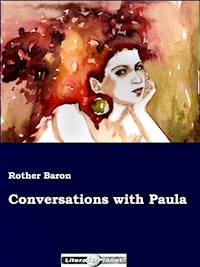
Conversations with Paula
About this book:
On Paula's small South Sea island there are no prisons and no army, no parties and no property. She looks at what we take for granted with the astonished eyes of a child.
"With her wrap-around dress, on which exotic birds screamed in bright colours, her face that seemed to be carved like out of ebony, her thick black hair, in which the sunlight sparkled, and her supple feet whose smoothness formed a striking contrast to the cracked asphalt, Paula looked so alien to me that I stared at her as if she were a hallucination."
About the author:
Rother Baron was born on the internet in 2012, where he still lives and works in his blog hut. Rumours are circulating about a twin of Rother Baron who lives in the parallel universe called "analogue world". But Rother Baron finds this thought so scary that he prefers not to delve into it. After all, everyone is free to visit him in his net world: rotherbaron.com
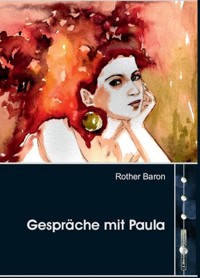
Cover picture:Kastazyna Bruniewska: Rudowłosa Pickność
Impressum
© LiteraturPlanet, 2021
LiteraturPlanet
Im Borresch 14
66606 St. Wendel
www.literaturplanet.de
How I got to know Paula
A Hallucination?
Although I am acquainted with Paula for several years now, many things about her are still a mystery to me. When she is not with me, I sometimes even wonder whether I am only dreaming up her existence – whether she is just a figment of my imagination.
That's basically how it has always been with her, from the very first moment we met. The first time I saw her, I was on my way to the kiosk on the corner to get my morning paper. All of a sudden, Paula emerged from the crowd of all the other people passing by.
With her wrap-around dress, on which exotic birds screamed in bright colours, her face that seemed to be carved like out of ebony, her thick black hair, in which the sunlight sparkled, and her supple feet whose smoothness formed a striking contrast to the cracked asphalt, Paula looked so alien to me that I stared at her as if she were a hallucination.
I couldn't take my eyes off her, her appearance captivated my gaze – and so it was no surprise that Paula addressed me. "Excuse me," she asked me in the singsong tone that flows through all her sentences, "am I in Europe here?"
I don't know how long it took me to close my mouth after that, and I don't remember what I finally answered. What is clear, however, is that I interpreted her strange words in the most obvious, probably only possible way – namely, that she was an illegal immigrant who had just been pushed out of the dark belly of a truck by a sinister gang of traffickers. Of course, this interpretation was also advantageous for me in that it helped me to overcome all my inhibitions and invite Paula to my home without further ado.
The Stealth Island
The reason Paula then gave me for her strange appearance still doesn't sound very credible to my ears. She told me that she lived on a South Sea island where no foreigner has ever set foot. But how it came about that her South Sea paradise had not yet been detected by the omnipresent satellites, Paula could not explain to me.
Maybe it's because the rugged rock that the island is made of looks like rippled waves from above. Or perhaps it emits a specific type of radiation that wraps itself around the island like a cloak of invisibility and has a similar repulsive effect on approaching ships as two identical magnetic poles have on each other.
For centuries, Paula told me, they had been self-sufficient in their little realm. Recently, however, worrying news had reached them from the other islands around them, with which they exchanged goods. These reports suggested that technological developments would make it impossible to shield their island from the outside world in the near future.
So the question arose how to deal with this: should they wait and hope that the bad premonitions would not come true? Or was it more reasonable to prepare in good time for potential contact with the rest of the world?
In the end, a middle course was chosen. On the one hand, the islanders wanted to hide the existence of their realm from the rest of the world as long as possible. Even the neighbouring islands should still be kept in the dark about the exact location of the island. The alienation and destruction caused there by contact with the adventure travellers, this vanguard of mass tourism, was too clear to see.
On the other hand, it was decided to appoint a scout who would conduct ethnological studies beyond their own borders and take a closer look at the "terra incognita". Perhaps this would take away some of the fear and help them better assess the behaviour of the strangers if they were to set foot on the shores of the island one day.
This scout – if we can believe her words – is Paula. After a period of preparation, during which she had made contact with foreign visitors on the neighbouring islands and gradually gained an idea of the unfamiliar world, she was finally sent into the very eye of the storm.
Paula's Secrets
A beautiful story – but with some questions left unanswered. For example, it remains unclear how Paula – if she really comes from a world that does not exist for others – was able to cross the borders of other countries. Since she had neither a passport nor a visa at the beginning, this could only have been done in some clandestine way.
Or did Paula perhaps assume a bogus identity for this purpose? Did she possibly pretend to the authorities of another country that she had lost her passport in order to obtain an official travel document?
I am reluctant to take this thought any further. In the final analysis, Paula thus completely dissolves into a chimera for me. Who can guarantee me that the identity she assumes for me is true? Why shouldn't she put on a mask here as well to preserve her incognito? Could it be that in the end even her island is a pure fiction that she only sustains in order to keep me as a sponsor for her travels – as I have become in the meantime?
In fact, my relationship with Paula is rather one-sided in this respect. With her story of the completely sealed-off island kingdom, this black hole gaping in the middle of the world, she forces me not to question her more closely about her origins and, as far as I know anything about them, to leave them in the dark in relation to others.
So in reality Paula's name is not Paula at all, and she does not come from the island of Palau – as some people might have guessed. Even I myself do not know where exactly Paula is travelling to when she leaves me again after her periodic visits. I just book her a flight to the city that – according to her – is closest to her island. Where and how she travels from there is beyond my knowledge.
This is precisely the imbalance in our relationship: I am Paula's object of study, the alien something she dissects with ethnological interest, while she herself only reveals as much about herself and her culture as seems opportune to her – and even with these narratives I can never know for sure that they are not pure invention.
Seeing the World through Paula's eyes
Nevertheless, I would never think of ending my relationship with Paula. On the contrary: I am almost addicted to her presence, I count the days until her next visit, I can hardly wait for the grey, Paula-less time to be over again. I admit that this is also due to Paula's exotic beauty, the South Sea sky that beams at others from her eyes, the palm tree-like grace of her body. But above all, her presence is always like a journey to another world for me.
When I see the world through Paula's eyes, I can break out of the cage of my ego in a way that otherwise would only be possible when travelling to distant countries. Like every journey into the unknown, these imaginary voyages can sometimes be quite arduous. But they often end up with a feeling of liberation, like when, on a chilly day in August, one has finally mustered the courage to take a bath in a lake warmed by the summer heat.
So I decided to write down some of my conversations with Paula to make Paula's view of our world accessible to others. In the end, it doesn't matter how much truth there is in the picture Paula paints of herself. By telling about it, I create another fiction anyway – a fiction that is based on the love for the fiction she creates of herself.
The Trap of Selfishness. Talk about Money and Property
Diving into the Belly of the Earth
Paula's visits to me always follow a certain pattern. At the beginning, she usually throws herself into the city life as if it were a never-ending party. Then she spends hours roaming the city, with me in tow, patiently watching as she talks to every dog, marvels at every colourful dress, and delights in the tanned bodies of the construction workers.
Most of all, Paula loves to rummage around in the many bric-a-brac shops. It's not that she is looking for any knick-knacks to take home to her island as souvenirs. What fascinates her about the shops – as she once explained to me – is the variety of things in which the human spirit can manifest itself.
Furthermore, Paula has a great passion for the subway. On the escalator ride into what she calls the "belly of the earth", she always makes a face as if she were on an expedition into the interior of a volcano. And when the train enters the labyrinthine tunnel system with us, she regularly acts as if this everyday trip were an exotic adventure for her.
The Tunnel of Time
Once, annoyed by the crampedness and the stuffy air in the wagons, I dared to object that there was nothing to see in the tunnels and that it would perhaps be more appealing to go on a city tour.
"But that's exactly the thrilling thing about it!" Paula had countered with joyful excitement. "I always imagine myself entering the tunnel of time that carries me away through space and time until I arrive in a completely different world."
"But isn't it terribly disappointing for you if the destination turns out to be nothing but a new underground station that is hardly any different from the start of your journey?" I had asked her.
Paula's tongue-in-cheek answer: "Actually, I'm rather relieved when there are no Martians lying in wait for me at the next station. Besides, every trip I've made so far has been worthwhile."
I knew exactly what she was alluding to. Somehow she always manages to choose the exit so that we walk straight towards one of her favourite ice cream parlours.
The Earth between the Toes
However, these joyful walks through the city are only typical of Paula's first days with me. Her euphoria usually fades away quite quickly and gives way to a kind of claustrophobic attack. Suddenly she feels as if she is suffocating between the skyscraper canyons and complains that her feet are gradually turning into two little lumps of rock themselves from walking on asphalt all the time.
"I have to feel the earth between my toes again – otherwise I no longer know who I am!" she once urged me when I told her that others also live like this every day.
The place Paula is attracted to in such situations is anything but spectacular: harvested rape fields, cow fields, a horse paddock, a narrow country lane – that's all there is to be seen. But as soon as we get off the suburban train, Paula spreads her arms like a caged bird that has been given back its freedom, throws off her sandals as if they were shackles and lets her toes sink into the thicket of grasses. When I warn her about the cow pats, she just laughs: "You know, they're warming so nicely ..."
"Can anyone possess other living beings?"
As soon as we approach the horse farm, where horse owners without property of their own can stable their animals, Paula quickens her pace. She has given names to all the horses - and because she never fails to take some carrots and apples with her, the horses actually come running as soon as she calls for them.
Once, when the horses were romping around exuberantly, Paula sighed sympathetically: "Isn't it a shame that such freedom-loving animals are not allowed to live in freedom?" She pointed to the electric fence that surrounded the pasture.
I wondered whether she might not identify too strongly with the animals. Cautiously I countered: "If the horses were not fenced in, they would probably get lost and perish. Besides, the owners of the animals would probably hold the horse farm liable for the loss in this case."
Paula looked at me in surprise: "What does that mean – the owners of the animals? How can anyone own another living being?"
Typical Paula! She had to judge everything according to the conditions on her island. Of course, they didn't need fences there – where could the animals escape to?
So I didn't let her indignation distract me and replied firmly: "Having an owner is the best life insurance for horses. It means that they always have someone to look after them!"
Paula shook her head in amazement. "That doesn't seem logical to me. After all, I don't have to own someone to take care of him!




