


3,99 €
Mehr erfahren.
- Herausgeber: Ched
- Kategorie: Geisteswissenschaft
- Sprache: Englisch
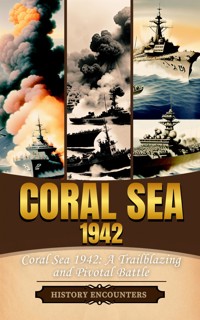
History Encounters unearths the greatest stories with the major events from Coral Sea 1942 to expand reader horizons for readers to be best informed.
Ever heard of the Battle of the Coral Sea during World War II? It's a fascinating piece of history that played a significant role in the war's outcome. The battle occurred in 1942 and was fought between the Japanese and the Allied forces, including the United States and Australia. The Battle of the Coral Sea was significant because it marked the first time the Japanese had been stopped in their advance across the Pacific, which was a major turning point in the war.
So, what can we learn from the Battle of the Coral Sea? First, it shows the importance of intelligence and technology in warfare. The Allies could use their intelligence and technology to gain the upper hand, which helped them win the battle. Another important lesson from the Battle of the Coral Sea is the importance of teamwork and cooperation. The Allies worked together to coordinate their efforts, which was a major factor in their success. Finally, the Battle of the Coral Sea showed the resilience and determination of the human spirit. Despite the difficulties and challenges of war, the people of the countries involved in the battle showed remarkable courage, and this helped to pave the way for a brighter future.
The Battle of the Coral Sea was a fascinating and important moment in history, and it provides us with a number of valuable lessons we can apply today. Whether you're a history buff or just someone who's interested in learning more about the world, the Battle of the Coral Sea is definitely worth checking out.
Learning about history will keep you perceptive and make sure to not repeat mistakes that others made in the past. The different stories in this series will show the readers that history should not just be seen from one perspective, but from the different eyes of the groups of people involved. You never know, you might finally understand their choices, their actions and their reactions.
I
n this historical series, you will discover:
- The history of different countries and cultures
- The inner workings of major historical turning points in different countries.
- Different perspectives of major events in history
- The reasons behind different wars or battles throughout history
These historical series are for anyone who wants to learn fun, exciting and influential facts of what happened years before their time. Do you want to learn history through a multitude of different eyes?
Das E-Book können Sie in Legimi-Apps oder einer beliebigen App lesen, die das folgende Format unterstützen:
Veröffentlichungsjahr: 2024
Ähnliche




















History Encounters
Coral Sea 1942
Copyright © 2024 by History Encounters
All rights reserved. No part of this publication may be reproduced, stored or transmitted in any form or by any means, electronic, mechanical, photocopying, recording, scanning, or otherwise without written permission from the publisher. It is illegal to copy this book, post it to a website, or distribute it by any other means without permission.
History Encounters asserts the moral right to be identified as the author of this work.
History Encounters has no responsibility for the persistence or accuracy of URLs for external or third-party Internet Websites referred to in this publication and does not guarantee that any content on such Websites is, or will remain, accurate or appropriate.
Designations used by companies to distinguish their products are often claimed as trademarks. All brand names and product names used in this book and on its cover are trade names, service marks, trademarks and registered trademarks of their respective owners. The publishers and the book are not associated with any product or vendor mentioned in this book. None of the companies referenced within the book have endorsed the book.
First edition
This book was professionally typeset on Reedsy Find out more at reedsy.com
Contents
Introduction
The World War Before the Battle at Coral Sea
The Different Sides of the Battle
A Pivotal Point
The Humans Lives Lost During the War
How Naval Battles are Important During War
How the Coral Sea Battle Shifted the War
The Aftermath of the Coral Sea Battle
The Effects of the War on Normal Citizens
How the Coral Sea Affected the Modern World
Discussion Questions
True or False Questions
Conclusion
Introduction
The Battle of the Coral Sea was a pivotal moment in the Pacific Theater of World War II. It was fought from May 4-8, 1942, and took place in the Coral Sea off the coast of Australia. The battle involved naval and air forces from the United States and Australia against those of the Empire of Japan. The battle’s outcome was the first strategic defeat suffered by the Japanese and marked a turning point in the Pacific War.
At the time, Japan had been on a rapid expansion in the Pacific, having conquered much of Southeast Asia and the western Pacific. They aimed to secure a base from which they could threaten Australia, and their next target was the capture of Port Moresby in New Guinea. The Battle of the Coral Sea was fought to prevent this. The outcome of the battle provided the Allies with the time they needed to prepare their defenses in the Pacific and was a significant factor in their ultimate victory in the Pacific War.
The battle was fought mainly between aircraft carriers, with both sides exchanging air raids and exchanging blows. The Japanese initially had the upper hand, sinking the American carrier Lexington and damaging Yorktown. However, the damage inflicted on the Japanese fleet was more severe, and they were forced to abandon their plans to capture Port Moresby. The Japanese lost several ships and experienced heavy casualties, and the loss of experienced pilots was a blow from which they never fully recovered.
One of the key factors in the battle’s outcome was both sides’ use of intelligence and codebreaking. The Americans could intercept and decode Japanese radio transmissions, allowing them to anticipate the movements and intentions of the Japanese fleet. On the other hand, the Japanese could not penetrate American codes, while the American codebreakers easily deciphered their opponents’ codes.
The Battle of the Coral Sea was significant not only for its outcome but also for the lessons learned. The Americans learned the importance of intelligence and codebreaking, as well as the importance of air power in naval warfare. On the other hand, the Japanese learned the dangers of overextending their supply lines and the importance of protecting their carriers.
The battle was also significant for its impact on the public consciousness. The battle’s outcome was a much-needed boost for American morale and helped galvanize public support for the war effort. In Australia, the battle was seen as a turning point in the defense of their country and helped to forge a close bond between the two nations that continues to this day.
The Battle of the Coral Sea was a significant moment in World War II and in the history of naval warfare. The battle’s outcome marked the first time the Japanese advance was stopped and provided the Allies with the time they needed to prepare their defenses in the Pacific. The battle was significant for the lessons learned, its impact on public consciousness, and the close bond it helped to forge between the United States and Australia. The Battle of the Coral Sea remains an important chapter in the history of the Pacific War and is a testament to the courage and determination of the men and women who fought in it.
The World War Before the Battle at Coral Sea
USS Lexington (CV-2) burning on 8 May 1942, as she was being abandoned.
The war before the battle at Coral Sea was characterized by a number of significant events that shaped the course of the conflict in the Pacific. One of the key battles was the attack on Pearl Harbor, which marked the entry of the United States into the war. The Japanese hoped to disable the US Pacific fleet with the surprise attack, but despite the loss of a significant number of ships and planes, the damage was not as severe as they had hoped. In response, the US launched a number of counter-attacks, including the Doolittle Raid on Tokyo in April 1942, which was a morale booster for the American public.
The Doolittle Raid was the first American bombing of the Japanese home islands during World War II. The raid was executed on April 18, 1942, by the United States Army Air Forces and was commanded by Lieutenant Colonel James “Jimmy” Doolittle. Sixteen B-25B Mitchell medium bombers were launched by USS Hornet in the Western Pacific Ocean, carrying a crew of five men. The raid caused minor damage to Tokyo and other cities, but it had a significant psychological impact, demonstrating that Japan was vulnerable to American air attacks.
The Japanese army advanced and captured Manila in the Philippines, while President Roosevelt ordered General Douglas MacArthur to leave the country. MacArthur famously declared, “I shall return,” and vowed to liberate the Philippines. However, the Japanese were not content with their gains and sought to expand their empire further. They launched a series of invasions of the Solomon Islands, New Guinea, and other territories to secure access to resources and create a buffer zone around their new territories.
The Allies, meanwhile, were struggling to mount a successful defense. The Royal Australian Navy was under pressure to protect the shipping lanes to Australia, and the British were fighting a desperate battle against the Japanese in Burma. In the United States, there was a concerted effort to boost war production and prepare the country for total war. The US Navy, in particular, was focused on building up its fleet, as it was clear that the war in the Pacific would be fought on the high seas.
In this context, the Battle of the Coral Sea was a crucial moment in the war. It was the first naval battle in which the opposing fleets did not actually engage in direct combat, as the carriers launched planes to attack each other. The battle marked a turning point in the war, as the Japanese were forced to withdraw and cancel their planned invasion of Port Moresby. It also highlighted the importance of carrier-based aviation in modern naval warfare.
One of the significant effects of the Battle of the Coral Sea was the Japanese decision to alter their strategy in the Pacific. Before the battle, Japan had planned to invade Port Moresby in Papua New Guinea, which would have given them a strategic foothold in the south Pacific. However, the defeat at the Coral Sea made this impossible, and the Japanese instead turned their attention to the Solomon Islands, which they hoped to use as a base for further operations.
The Battle of the Coral Sea also marked the first time carrier-based aircraft had been used to attack enemy ships. The battle was a tactical victory for the Japanese, who sank more Allied ships than they lost. Still, it was a strategic victory for the Allies, forcing the Japanese to change their plans and demonstrating the importance of carrier-based aviation.




