


9,99 €
Mehr erfahren.
- Herausgeber: The History Press
- Kategorie: Geisteswissenschaft
- Sprache: Englisch
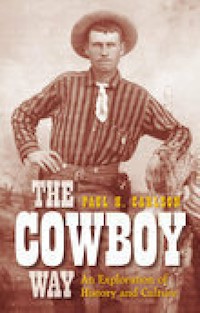
The lives of American cowboys have been both real and mythic. This work explores cowboy music dress, humour, films and literature in sixteen essays and a bibliography. These essays demonstrate that the American cowboy is a knight of the road who, with a large hat, tall boots and a big gun, rode into legend and into the history books.
Das E-Book können Sie in Legimi-Apps oder einer beliebigen App lesen, die das folgende Format unterstützen:
Veröffentlichungsjahr: 2006
Ähnliche




















THE
COWBOY
WAY
An Exploration of History and Culture
THE
PAUL H. CARLSON
COWBOY
WAY
An Exploration of History and Culture
This edition first published 2006
Published in the United States of America by Texas Tech University Press
The History Press
The Mill, Brimscombe Port
Stroud, Gloucestershire, GL5 2QG
www.thehistorypress.co.uk
This ebook edition first published in 2013
All rights reserved
© Paul H. Carlson 2000, 2006, 2013
The right of Paul H. Carlson to be identified as the Author of this work has been asserted in accordance with the Copyrights, Designs and Patents Act 1988.
This ebook is copyright material and must not be copied, reproduced, transferred, distributed, leased, licensed or publicly performed or used in any way except as specifically permitted in writing by the publishers, as allowed under the terms and conditions under which it was purchased or as strictly permitted by applicable copyright law. Any unauthorised distribution or use of this text may be a direct infringement of the author’s and publisher’s rights, and those responsible may be liable in law accordingly.
EPUB ISBN 978 0 7524 9647 4
Original typesetting by The History Press
CONTENTS
Preface
Acknowledgments
1
Myth and the Modern CowboyPAUL H. CARLSON
2
Cowboy: Origin and Early Use of the TermJAMES R. WAGNER
3
Vaqueros in the Western Cattle IndustryJORGE IBER
4
Black Cowboy: Daniel Webster “80 John” WallaceDOUGLAS HALES
5
Indian Cowboys of the Northern PlainsTHOMAS A. BRITTEN
6
English Cowboy: The Earl of Aylesford in the American WestJIM FENTON
7
The Cowboy Strike of 1883ROBERT E. ZEIGLER
8
Work Clothes of American Cowboys: The Pictorial RecordSUSAN KARINA DICKEY
9
Cowboys and SheepherdersPAUL H. CARLSON
10
Stockyards CowboysJ’NELL L. PATE
11
Cowboy HumorKENNETH W. DAVIS
12
Cowboy Songs and Nature in the Late Nineteenth CenturyROBERT G. WEINER
13
Rodeo Cowboy: “Booger Red” Privett and the Origins of RodeoJ. BOYD TROLINGER
14
French Cowboys: The Gardians of the Camargue and Buffalo BillJUDY GREAVES RAINGER
15
Reel Cowboys: Cowhands and Western MoviesALBERT B. TUCKER
16
Today’s Cowboy: Coping with a MythLAWRENCE CLAYTON
A Cowboy Bibliography
FREEDONIA PASCHALL
About the Authors
For Diane and Jon Steve and Sally Kevin and Veronica
PREFACE
This book is about a national symbol, about a leading icon of popular culture. It is about myth, about common workingmen who became American folk heroes. It is about cowboys. It is about their history, their image, and their way of life.
The title comes from the country and western song “My Heroes Have Always Been Cowboys.” In the opening line of the popular waltz Waylon Jennings sings: “I grew up a-dreamin’ of bein’ a cowboy and lovin’ the cowboy way.” Accordingly, the book treats music and dance, minorities and work, movies and myth, and other topics associated with the cowboy way.
The book is divided into sixteen essays, which can be read in any order, and there is a bibliography with comments. Four of the essays appeared previously in the West Texas Historical Association Year Book and are here revised and used with permission. The essays represent a combination of historical narrative, synthesis, and analysis. They touch on how cowboys of the late nineteenth and early twentieth centuries lived: their food, their clothing, their housing—some of the humbler, but still significant, aspects of cowboy life.
Although there is no dominant thesis, there are many themes. The themes celebrate hard work and bravery, they emphasize youth, and they reflect the excitement and danger as well as the simple living and mundane events that were all part of cowboying in the late nineteenth century. One significant theme is how an enterprise as ephemeral in nature as open range cattle raising continues to fascinate both scholars and the general reading public.
Thus, the book re-examines some older themes in light of modern scholarship, and it also presents some newer topics that reflect fresh interests and issues. The work is highly selective and in no sense all-inclusive. The aim was to offer a perspective on cowboys different from what is generally available and to provide short, readable essays that both entertain and inform. The idea was to reach a wide audience.
Cowboys, both mythic and real, have become part of an American epic that is commemorated from Denver to Dresden, from Montreal to Melbourne. Their image is burned deep into America’s collective consciousness, and annually at cowboy poetry gatherings and at national cowboy symposiums Americans celebrate the life and culture of western ranch hands.
The abiding interest has a long history. It can be seen first in the attraction of dime novels and Buffalo Bill’s Wild West Exhibition, then in the enormous popularity of Owen Wister’s The Virginian (1902), and subsequently in the success of popular western novels of the type by Zane Grey and Max Brand, in western films (made in Italy, Germany, Hollywood, and elsewhere), in television programs, in public television documentaries, and in other formats, including the highly effective use of cowboys as advertising symbols. Serious scholars—including historians, sociologists, literary critics, and others—have studied cowboys and the symbols and myths that surround them.
In the popular view cowboys were men on horseback. In fact, most of the time they spent their days on foot working at such farm-related chores as repairing fences and cutting hay. Even in Wister’s defining cowboy novel, for example, the hero of the story—the prototypal cowboy—herded neither cows nor cattle of any kind.
Nonetheless, in both his actual and his imagined life the cowboy has become a popular hallmark for defining what it means to be a “real” American male. Perceived as a tough, mobile, and independent outdoorsman, he has become a symbolic yardstick against which modern men might measure their own manhood. The most easily recognized of all western character types, the cowboy is something of a knight of the road who, with a large hat, tall boots, and a big gun, has ridden into legend and into the history books.
ACKNOWLEDGEMENTS
In putting this book together I enjoyed the support and assistance of many people. I owe much to the authors, of course, for without them there would have been no book. They willingly and thoughtfully contributed the essays, and all of them were patient with me and supportive of the work. I am thankful.
J. Boyd Trolinger, who also authored one of the essays, assisted in many ways, but especially in applying his significant computer skills to organizing and preparing the final manuscript. In addition, he offered ideas, opinions, and perspective. Christine Wyse Trolinger and Todd Walker provided related help. They made important contributions.
Staff members of the Southwest Collection at Texas Tech University provided pictures, information, and assistance. They have always aided researchers and writers enthusiastically, and indeed many of the pieces collected here were written from materials in the Collection’s archives. On this project Janet Neugebauer, Freedonia Paschall, and Southwest Collection Director William Tydeman were especially encouraging.
Professor Milada Polisenska, a visiting scholar from the Czech Republic, brought with her to America some old cowboy movies made in Europe and starring European actors. With accompanying lectures, but no subtitles, she showed the films to American students, who easily identified the conventional plots, traditional themes, and familiar errors that often make their way into such productions. Her lectures and infectious enthusiasm were both helpful and delightful.
Joan Weldon, Peggy Arias, and Robert Hall, administrative staff members in the history department at Texas Tech, aided in numerous ways, both large and small, as did Andrew Young. Their assistance speeded completion of the work.
Once again my wife Ellen provided enormous amounts of encouragement, good cheer, and inspiration. I am grateful.
1
MYTH AND THE MODERN COWBOY
Paul H. Carlson
In July 1879, thirteen-year-old W.H. Childers and his nine-year-old brother mounted their horses near Sivells Bend in North Texas and headed southwest to the family’s cattle range some twenty miles away. Their father had directed the boys to ride along the fence line, to inspect and repair it, to turn back drifting cattle if that was necessary, and to check the water holes. For the next several months the young cowhands, following their daddy’s instructions, worked alone on the empty grasslands of western Cooke County, mending fences on the thirty-six-section spread, watching some three thousand longhorn cattle, and living in a tiny line shack. The Childers brothers were “cowboys” indeed, real nineteenth-century cowboys.1
Modern-day cowboys come in a variety of guises. In part because of low wages and long hours, two-thirds of them are recent immigrants, underpaid—like the Childers brothers—overworked, and often unemployed in the winter. A few are summertime ranch hands on break from school who, when working, wear t-shirts and tennis shoes more often than they wear the traditional cowboy garb of boots and large hats. A few more are permanent ranch hands, many of whom are caught up in myths about the Old West, and, partly as a result, dress in Wrangler jeans tucked inside tall boots, long-sleeved shirts with vests, and large Stetson-style hats.2
Then, too, there are urban, rhinestone cowboys. This group frequents honky-tonks like Billy Bob’s in Fort Worth—places where they can be found dancing in pointy-toed boots and wearing tight-fitting jeans, western-cut shirts, fancy broad-brimmed hats with a feather in the band, and belt buckles the size of two-pound coffee can covers. Although probably few of them have ridden horseback seemingly endless miles to mend fences in cold and snow or to look for lost calves in wind and rain, the handsome young men there dress like the imagined cowboys of old, and by doing so make the cowboy myth a participation sport.
Clearly, it seems, there is something amiss about our modern-day perceptions of nineteenth-century cowboys. Prior to the twentieth century, cowboys—that is, real ranch hands—when they could afford it, wore dancing shoes and not boots to dances. At old-time western dances in the nineteenth century many cowboys tied bandanas around their arms to signal that they would dance the female part. The modern-day, costumed cowboys one sees at honky-tonks, at local restaurants, or in college classrooms hardly resemble real cowboys of the Old West, who removed their hats when they entered the parlor, when they sat at the dining room table, or when they went dancing. Western music singer-songwriter Mac Davis, in one of his sad pieces, complains about the modern, rhinestone cowboys and laments that he “would rather be a rodeo clown.”
Who, then, are these pretenders, these modern-day cowboy wannabes who show up at western dance halls decked out in some Hollywoodesque uniform the likes of which never existed in the Old West? Even today, many working cowboys do not dress like the modern dance hall variety. Summertime cowboys working cattle on a large Nebraska ranch a few years ago, for example, wore t-shirts from the local high school athletic department, baseball caps turned backwards on their heads, and dirty white, high-top basketball shoes with the laces untied. Where were their boots and hats and long-sleeved shirts with vests?
So, what happened to the real cowboy? How is it that the modern rhinestone cowboy became the ideal? How is it, in other words, that the myth became the reality, that the imagined cowboy became the real cowboy? Pictures dating from as early as 1918, for example, already show cowboys dancing in fancy hats and tall boots and wearing huge belt buckles. Obviously, after the close of the cowboy’s classical period the transformation came both early and quick.
The age of the classical cowboy—the western open-range cowhand—was brief, lasting just over two decades. Cowboys of the classical period, about 1865–1890 or so, were young, their average age about twenty-four. They remained cowboys on average about seven years. They seldom became prominent citizens or local pillars of society.3 They wore ill-fitting and diverse garments—“California trousers,” some were called. They wore no exaggerated belt buckles and no feather in their hats. Classical cowboys of the Old West bear little resemblance to today’s honky-tonk version or, it seems, even modern-day working cowboys influenced by the mythic cowboy of our imaginations.4
Real cowboys were dirty, overworked laborers who, writes William Forbis, “fried their brains under a hot prairie sun.”5 Often unemployed in winter, many went to town, where they took odd jobs, like painting. John Clay, who lived among them, writes: cowboys were “a devil-may-care, roistering, gambling, immoral, revolver-heeled, brazen, light-fingered lot, who usually came to no-good end.”6
Clay’s version reflects a contemporary, nineteenth-century view of cowboys. J. Frank Dobie, among the first scholars to study early American cowboys, wrote that many of the first cowboys were young cattle thieves.7 Until the mid-1880s the term cowboy in the West often meant “drunkard,” “outlaw,” “cattle thief,” or something similar. Accordingly, in the mid-1880s President of the United States Chester A. Arthur classified cowboys with cattle thieves: “The cattle were stolen,” he wrote, “by a party of outlaws, cowboys, and Indians.” Few contemporaries wanted to be cowboys. Indeed, they were “horsemen” more than they were “cowboys.”
If he worked cattle in the West, a person wanted to be known as a “waddy” or “cowhand” or simply “hand,” or in some cases “herder.” Some employees were “cowpunchers,” or in South Texas “vaqueros.” A few were called “buckaroos.” Some, mostly the youngest, were “hoss stinks.”8
Thus, during much of the classical period, respectable ranch hands were not cowboys. Consider Murdo Mackenzie. Recognized by the Food and Fiber National Institute of Achievement as making greater contributions to the western cattle industry than any other individual, Mackenzie managed the large Matador Land and Cattle Company for some thirty years.9 As manager, he sent monthly reports to the company officers in Scotland. He also wrote letters, sent memos, and requested directions. During the first twenty years that he directed the great ranch, about 1890 to 1910, Mackenzie did not call his men “cowboys”—not once. Not once in twenty years of correspondence, as far as his biographers can find, did he refer to his employees as cowboys. He wrote of his “hands,” or of his “men,” or less frequently of his “cowhands.”
From Mackenzie’s perspective cowboys were young, inexperienced, and often new to the cattle industry. They were boys—thus, “cowboys.” Cowboys were poorly paid, itinerant workers who went on trail drives. They were often kids, sixteen to twenty years old on the average. Ellis Petty, for example, noted that he made his “first cattle drive when only twelve years old.” H.P. Cook said: “I went ‘up the trail’ when I was only ten years old.”10 Here were the “cowboys.” Many trail hands, that is, more than one in three, were African American or Hispanic. Some scholars argue that forty percent of those who went “up the trail” to Kansas or elsewhere were black or Hispanic or Indian or Chinese.11 The ranch hands were too valuable to send up the trail, or they refused to go. Besides, most of the cattle-trailing was done by contractors, not by ranchers. Few cowboys went “up the trail” more than once or twice.12
The term cowboy is an old one. In America in its earliest use, according to James Wagner, who has studied its etymology, it referred to cattle thieves, to Tories who fought with the British in the American Revolution, to other people held in low esteem. According to Wagner, the first reference to “cow-boy” (as it was then spelled) in an American dictionary defined the word simply as “a boy who tends cattle.”13
Cowboy in its modern sense, its mythic sense, developed in the late 1880s. By 1887, the open-range cattle frontier was dead, killed by overextension, overgrazing, severe weather, and, when the bottom dropped out of the market, low prices. After 1887, cattlemen, as opposed to cowboys, took over the industry and changed what had been a wild adventure to a settled, stable business.
The concept of cowboys also changed. Buffalo Bill Cody’s Wild West Exhibition, which had begun in 1883, was partly responsible. It included young men herding cattle, and Cody referred to them as cowboys. Beginning in 1884, he advertised one of the men, Buck Taylor, as “King of the Cowboys.” Young, white, and virile, Taylor became a popular and featured attraction of the traveling exhibition and a hero to boys everywhere the show appeared.14
Then in 1887 Prentis Ingraham, a hack writer, produced a dime novel about Buffalo Bill’s star. Without much originality, he entitled the story Buck Taylor King of the Cowboys. The western yarn, published in Beadle’s Half Dime Library, was very popular, and the cheap little book sold well and widely. Almost overnight the cowboy image was transformed.
What Buffalo Bill and Prentis Ingraham started, Charlie Russell’s paintings, Owen Wister’s famous novel The Virginian, Western films, pulp novels, and radio shows continued until the cowboy changed from a rogue to a hero. We have, it seems, sort of corrupted him in reverse. We have made him better than he was. Cowboys were not cattlemen; they were laborers, itinerant workers, seasonal employees. They stole cattle from their employers, and some of them took off at the first sign of trouble. The real cowboy was a common, nineteenth-century working stiff who was often illiterate, often unemployed, and often on the lowest rung of the community’s socioeconomic hierarchy.15
Nonetheless, there is something about the cowboy (that is the mythic, imagined cowboy) that attracts us to him and his lifestyle—however distorted and stereotyped they have become. The mountain man hero, although there are modern rendezvous we can visit, does not claim the attention that the cowboy does. The western soldier, although there are forts to tour and Fourth Cavalry musters to attend, does not warrant such imitation. Pioneer farmers, French fur traders, Catholic missionaries, founding fathers, and even Davy Crockett-type scouts have, when compared to cowboys, little appeal to our collective sense. World War II heroes, as reflected in the G.I. Joe myth, were popular only until the Vietnam War.
But the mythic cowboy continues to appeal to us. Even people who never lived on a ranch; never rode a horse to rope a cow; never subsisted months at a time by choice on cornbread, beans, and bacon; never slept in a two-room, half dugout house—even these people make a hero out of the cowboy, the lowly cowpuncher, underpaid, poorly fed, and overworked. In part, the answer, as Lawrence Clayton has written, lies in our subconscious need for myths, including our imagined version of the cowboy.16
Also, there is a mystic and elusive vision of the cowboy as a medieval knight-errant. In the Middle Ages only the wealthy or the nobility rode horses. Miguel Cervantes’s fictional Don Quixote, with his small, round companion Sancho Panza, dreamed of dressing in armor, being mounted on horseback, and riding in combat to right the world’s wrongs. There may be a lot of Don Quixote in modern cowboys. Moreover, if you please, the horse is something of a subconscious sexual symbol—an extension of one’s body, a power between one’s legs. Mounted on horseback, the relatively small rider controls a large, beautiful, and majestic steed.
For another thing, we tend to confuse the cowboy and the cattleman of the Old West. The cowboy was a worker, a laborer. And if cattle raising was an industry, he was an industrial worker. In fact, he formed associations and went on strikes.17 (Here is a modern-day irony that apparently bothers few of us. Today most cowboy wannabes are opposed to labor unions.) How do we reconcile the cowboy of old who was a union boss with the modern-day cowboy who writes poetry and supports right-to-work laws? The cowboy was a landless wage earner. If he had the chance, he would have voted a Socialist ticket.
The cattleman was the rancher. He usually lived in a big house on the ranch, but he was often gone on business or pleasure to Fort Worth, Denver, or Chicago, or even to London or Paris. He had, if not money, at least position and power. In most parts of the West, when he voted, he voted a conservative ticket.
Texas Panhandle author John Erickson sees the differences between ranchers and modern-day cowboys. He has, in fact, been a working cowboy. He writes:
Ranchers are often prominent leaders in the community; cowboys are not. Ranchers often sit on governing boards of businesses, churches, and schools; cowboys do not. Ranchers are frequently the subject of articles in livestock journals, while cowboys are seldom mentioned. The rancher and his wife may belong to the country club, but the cowboy and his wife don’t. The rancher has his circle of friends, the cowboy has his, and they do not overlap… [T]he rancher can take the day off. . . whenever he wishes, but the cowboy can’t…. The rancher and the cowboy may dress alike, talk alike, and even think alike, but at six o’clock in the evening, one goes to the… barn while the other attends a meeting in town.18
Modern-day wannabes have so corrupted the cowboy that the nineteenth-century version comes out like a late twentieth-century cattleman: well-dressed, well-heeled, well-positioned. Such a cowboy never existed.
Looking back over the more than one hundred years since the close of the cowboy’s classical era, one must conclude that cowboys have in fact entered the realm of mythology and semi-truth. They have done it in much the same way as the assassination of Julius Caesar, the tales of a youthful George Washington, and the battle of the Alamo. The classical cowboy is no longer seen as a dirty, malnourished bore in need of a hot bath. Rather, he is seen as neatly dressed in expensive boots, a distinctively cut shirt, designer jeans, and a fancy hat that no longer serves a useful purpose.
We have made him into something he never was. We have transformed the real cowboy—that is, a thirteen-year-old Childers kid who “fried his brains under a hot prairie sun”—into a rhinestone caricature of our symbolic knight. We celebrate what was essentially a pimple-faced, hormone-crazed adolescent—or, in Winifred Kupper’s words, “the Peter Pan of the Range.”19
Clearly, we have invented the modern cowboy. He is an imagined character, one created by misconception, myth, and falsehood. He is a symbol of freedom, independence, strength, and action, and our image-building has made the myth useful to advertising executives: the continuing life of “the Marlboro Man,” for instance, suggests that the cowboy myth sells products and suits our contemporary lifeways. Today, as a result, many of us want to be cowboys. At least we dress like we want to be cowboys.
Our modern version, however, is not a thirteen-year-old kid and his younger brother alone on a Cooke County cattle range working their father’s herds without compensation. In our twentieth-century fabrication we have changed and improved waddies and hoss stinks of the late nineteenth century, turned them into modern, carefully costumed cowboys, and made them a central part of a popular national myth about the American West. In today’s complex world the cowboy—at least the mythic, idealized version of him that we have conjured up in our collective memory—appeals to our urban souls. We thrill in this enduring myth of the Old West.
Notes
1.Jim Lanning and Judy Lanning, eds., Texas Cowboys: Memories of the Early Days (College Station: Texas A & M University Press, 1984), 14-22.
2.Lubbock Avalanche-Journal, March 21, 1994.
3.William Forbis, The Cowboys (New York: Time-Life Books, Inc., 1973), 17.
4.See, for example, pictures in ibid., 16, 28, 93, 170, 205; picture no. 2341, Crosby County Historical Museum, Crosbyton, Texas.
5.Forbis, The Cowboys, 7.
6.John Clay, My Life on the Range (Chicago: privately printed, 1924), 56. See also Edward Everett Dale, Cow Country (Norman: University of Oklahoma Press, 1942, 1965), 116, 122.
7.J. Frank Dobie, The Longhorns (New York: Bramhall House, 1942), 27-28; J. Frank Dobie, A Vaquero of the Brush Country (Austin: The University of Texas Press, 1981), 43-68.
8.See, for example, Lanning and Lanning, eds., Texas Cowboys, 7, 28, 134, 142.
9.Dale, Cow Country, pp. 99-100; Paul H. Carlson, “From Farm Worker to Cattle Tycoon,” Ranch Magazine 70 (October 1988): 42.
10.Lanning and Lanning, eds., Texas Cowboys, 87, 108.
11.See Philip Durham and Everett L. Jones, The Negro Cowboys (New York: Dodd, Mead, 1965), 44-45; Dale, Cow Country, 35,45,47-48, 116.
12.Jimmy Skaggs, The Cattle-Trailing Industry: Between Supply and Demand, 1866-1890 (Lawrence: University Press of Kansas, 1973), 1-3, 51-52, 67; Lanning and Lanning, eds., Texas Cowboys, 82, 87, 101, 108.
13.James Wagner, “Cowboy—Origin and Early Use of the Term,” West Texas Historical Association Year Book 63 (1987): 91-98.
14.Richard Hine, The American West: An Interpretive History, 2d ed. (Boston: Little, Brown and Company, 1984), 144-46, 292-94.
15.Ibid. See also William S. Savage Jr., The Cowboy Hero: His Image in American History and Culture (Norman: University of Oklahoma Press, 1979), 109-112, 111, 165-66.
16.Lawrence Clayton, “Today’s Cowboy: Coping with a Myth,” West Texas Historical Association Year Book 60 (1984): 183.
17.Hine, The American West, 148; Robert E. Zeigler, “The Cowboy Strike of 1883: Its Causes and Meaning,” West Texas Historical Association Year Book 47 (1971): 32-46.
18.John R. Erickson, The Modern Cowboy (Lincoln: University of Nebraska Press, 1981), 5-6. See also Dale, Cow Country, 74-76.
19.Winifred Kupper, The Golden Hoof (New York: Alfred A. Knopf, 1945), 72.
2
COWBOY: ORIGIN AND EARLY USE OF THE TERM
James R. Wagner
People today often picture a cowboy as a hard-working but somewhat undisciplined fellow who is so fiercely independent that he will ride off into the sunset any time he becomes bored with his surroundings. It is a romantic image. Thanks first to dime novels and later to movies and television, the term cowboy has also been romanticized, at least in the United States. A study of the origin and early use of the term reveals quite another meaning, one that suggests that the first cowboys had little to do with raising or marketing of livestock.
The earliest use of the term dates to the Revolutionary War in the 1770s in New York and New England. During the Revolutionary War, when a person spoke of a cowboy, he was speaking of someone who was hated and feared not only by his enemies but also on occasion by his friends.
The first group of men called cowboys were Tories, or Loyalists, from Westchester County, New York, who fought with the British during the Revolutionary War.1 These green-coated soldiers were, perhaps, more interested in their own personal enrichment than they were in supporting Great Britain. They ravaged Westchester County, stealing and killing indiscriminately.2 James Fenimore Cooper seems to have been historically accurate when he intimated in his first novel, The Spy, that Revolutionary “cow-boys” were called “cow-boys” only because they had a penchant for stealing other people’s cattle.3
Previously published in West Texas Historical Association Year Book, 63 (1987): 91-100.
Use of the word cowboy, a derisive name for Loyalist military units, may have begun in Westchester County, but as the struggle between Loyalists and Patriots became increasingly bitter, the term was applied to all Loyalist units in the state and perhaps in other states as well.
The cowboy has become such an idolized figure in modern America that a number of regions in the United States have claimed that the first cowboys were residents there. Scholars from several different sections of the country have written monographs claiming that the word cowboy itself was a product of the livestock industry of their locality. Several parts of the country enjoyed conditions that may or may not have led to the use of the term cowboy to describe those persons actively involved in tending livestock as a profession. The fact is, however, that lack of documentary proof of the use of the term leaves the question unanswered.
Even colonial New England, at first glance, seems to have had conditions existing that would have been very conducive to coinage of the term cowboy. It is known that, as early as the 1680s in the Massachusetts Bay Colony, young boys or disabled persons were assigned the task of tending their community’s cattle kept in one common herd.4 Theoretically, conditions were ripe for coining the word to describe the youngsters who tended the herds while able-bodied men were out farming. Probably the reason the word cowboy did not appear in common usage at the time related to the fact that tending cattle was considered, at this time and place, to be a lowly jab given to those who were unskilled or handicapped.
In Massachusetts of the 1680s, the cow itself was not a very highly respected animal. The word “cow” was then, and is sometimes today, used to describe a fat, sloppy, loathsome woman or a prostitute. It is therefore not hard to imagine that boys occupied in tending cattle would not have wanted to be called cowboys. Being called cowboys in such a way would not only have identified them with an occupation they did not want to be identified with, but also it would have indicated that they were only boys and, as such, basically unskilled and/or inexperienced.




