


20,99 €
Mehr erfahren.
- Herausgeber: John Wiley & Sons
- Kategorie: Fachliteratur
- Sprache: Englisch
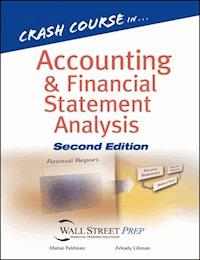
Seamlessly bridging academic accounting with real-life applications, Crash Course in Accounting and Financial Statement Analysis, Second Edition is the perfect guide to a complete understanding of accounting and financial statement analysis for those with no prior accounting background and those who seek a refresher.
Sie lesen das E-Book in den Legimi-Apps auf:
Seitenzahl: 203
Veröffentlichungsjahr: 2011
Ähnliche



















Table of Contents
Cover
Title
Copyright
About the Authors
Preface
CHAPTER 1: Introduction to Accounting
What Is Accounting?
Why Is Accounting Important?
Who Uses Accounting?
U.S. Accounting Regulations
Overview of the Securities and Exchange Commission
Overview of the Financial Accounting Standards Board
International Accounting Regulations
Convergence of U.S. GAAP and IFRS
Summary
CHAPTER 2: Basic Accounting Principles
Assumptions
Wrap-up: Assumptions
Principles
Wrap-up: Principles
Constraints
Summary
CHAPTER 3: Financial Reporting
Financial Reporting Overview
Finding Financial Reports
Form 10-K (Annual Filing)
Form 10-Q (Quarterly Filing)
Other Important Filings
Summary
CHAPTER 4: Reading the Annual Report
Introduction
Letter to Stockholders
Financial Highlights
Management’s Discussion and Analysis
Financial Statements
Notes to Consolidated Statements
Report of Management’s Responsibilities
Certification of Financial Statements
Risk Factors
Legal Proceedings
Report of Independent Auditors
Directors and Officers
Summary
CHAPTER 5: Income Statement
What Is the Income Statement?
Why Is It Important?
Revenues
Cost of Goods Sold
Gross Profit
Selling, General and Administrative
Research and Development
Stock Options Expense
Depreciation Expense
Amortization
Interest Expense
Interest Income
Other Nonoperating Income
Income Tax Expense
Equity Income in Affiliates
Minority Interest
Net Income
Shares Outstanding
Common Dividends
Preferred Dividends
Earnings per Share
Nonrecurring Items
Earnings before Interest, Taxes, Depreciation, and Amortization
EBIT
Summary
CHAPTER 6: Balance Sheet
Introduction
Double-Entry Accounting
Income Statement Revisited: Links to Balance Sheet
Retained Earnings: The Link Between Balance Sheet and Income Statement
Order of Liquidity
Assets
Summary: Assets
Liabilities
Shareholders’ Equity
Summary
CHAPTER 7: Cash Flow Statement
Introduction
Cash Flow from Operations
Summary: Cash Flow from Operations
Cash Flow from Investing Activities
Cash Flow from Financing Activities
How the Cash Flow Is Linked to the Balance Sheet
Summary
Online Exercise
CHAPTER 8: Financial Ratio Analysis
Introduction
Liquidity Ratios
Profitability Ratios
Activity Ratios
Coverage Ratios
Calculations
Appendix
Stock Options
Stock Options Expensing
Debt
Capital versus Operating Leases
Direct Method
Index
End User License Agreement
List of Illustrations
Chapter 1: Introduction to Accounting
EXHIBIT 1.1 WHO USES ACCOUNTING?
EXHIBIT 1.2 SEC ORGANIZATIONAL STRUCTURE
EXHIBIT 1.3 FASB RECEIVES INPUT FROM A VARIETY OF SOURCES
Chapter 2: Basic Accounting Principles
EXHIBIT 2.1 ASSUMPTIONS, PRINCIPLES, AND CONSTRAINTS GOVERNING U.S. GAAP
EXHIBIT 2.2 FINANCIAL STATEMENTS OF U.S. COMPANIES ARE REPORTED IN U.S. DOLLARS
EXHIBIT 2.3 SUMMARY OF ASSUMPTIONS, PRINCIPLES, AND CONSTRAINTS GOVERNING U.S. GAAP
Chapter 3: Financial Reporting
EXHIBIT 3.1 SUMMARY OF OTHER FINANCIAL REPORTS
Chapter 4: Reading the Annual Report
EXHIBIT 4.1 LETTER TO STOCKHOLDERS SUMMARIZES A COMPANY’S MAJOR ACHIEVEMENTS
Lesen Sie weiter in der vollständigen Ausgabe!
Lesen Sie weiter in der vollständigen Ausgabe!
Lesen Sie weiter in der vollständigen Ausgabe!
Lesen Sie weiter in der vollständigen Ausgabe!
Lesen Sie weiter in der vollständigen Ausgabe!
Lesen Sie weiter in der vollständigen Ausgabe!
Lesen Sie weiter in der vollständigen Ausgabe!
Lesen Sie weiter in der vollständigen Ausgabe!
Lesen Sie weiter in der vollständigen Ausgabe!
Lesen Sie weiter in der vollständigen Ausgabe!
Lesen Sie weiter in der vollständigen Ausgabe!
Lesen Sie weiter in der vollständigen Ausgabe!
Lesen Sie weiter in der vollständigen Ausgabe!
Lesen Sie weiter in der vollständigen Ausgabe!
Lesen Sie weiter in der vollständigen Ausgabe!




