


17,99 €
Mehr erfahren.
- Herausgeber: John Wiley & Sons
- Kategorie: Fachliteratur
- Sprache: Englisch
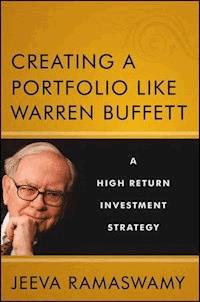
The practical guide to investing the Warren Buffett way Creating a Portfolio like Warren Buffett: A High Return Investment Strategy highlights actual trades author Jeeva Ramaswamy has successfully executed using principles established by investment guru Warren Buffet. Clearly explaining how Buffett's principles can be used to make specific investments the book, unlike other investment guides, also clearly explains how to apply Buffett's exit strategies as they pertain to holding or selling positions. Giving readers a complete overview of Buffett's methodologies and how to apply them, the book is a step-by-step stock research checklist and comprehensive guide to investing and managing a successful stock portfolio. It includes detailed instructions to: * Determine where to search for stock prospects * Thoroughly research stocks using a stock research checklist * Confidently make buy and sell decisions * Expertly manage your portfolio Packed with specific stock examples, real-life calculations, and expert tips, Creating a Portfolio like Warren Buffett is your guide to harnessing the market savvy of an investing legend.
Sie lesen das E-Book in den Legimi-Apps auf:
Seitenzahl: 370
Veröffentlichungsjahr: 2012
Ähnliche



















Table of Contents
Cover
Title page
Copyright page
Dedication
Acknowledgments
PART I: WARREN BUFFETT INVESTMENT PRINCIPLES
CHAPTER 1 Replicating Warren Buffett’s Investment Success
CHAPTER 2 Business-Like Investing
CHAPTER 3 Long-Term Investing
Capital Gains Taxes
Broker Commission
CHAPTER 4 Permanent Loss of Capital
Scenario 1
Scenario 2
PART II: STOCK RESEARCH CHECKLIST
CHAPTER 5 Stock Research Checklist—Business Characteristics
Are You Able to Understand the Business Thoroughly? Is It a Simple Business?
Does the Company Have any Moat, which Makes It Difficult for Competitors to Penetrate Its Market Share?
What Is the Nature of the Business? Does It Operate in a Non-Exciting Industry?
Is the Company Involved in a Dirty Type of Business?
With National Chain Companies, Was the Company Successful in Multiple Locations before Expanding Nationally?
Has the Company Dominated in a Particular Segment of the Market?
Is This Company Operating in a Hot Industry?
CHAPTER 6 Stock Research Checklist—Earnings
What Is the Company’s Earnings Growth over the Previous 10 Years? Does It Grow Constantly?
How Does the Company Use the Retained Earnings? Do the Retained Earnings Reflect in the Stock Price?
What Are the Company’s Owner Earnings for the Past 10 years? Does It Grow Consistently?
What Is the Company’s Recent Earning Momentum? Is It Comparable to Its Long-Term Growth Rate?
Does the Company Have Any One-Time Event That Recently Increased Earnings?
What Is the Company’s “Operating Cash Flow”? Does It Grow at a Constant Rate?
How Has the Business Performed in Previous Recessions?
If a Particular Product’s Success Attracted You to a Company, What Percentage of That Company’s Sales Come from That Product?
Does the Company Have Client Concentration?
CHAPTER 7 Stock Research Checklist—Debt
Does the Company Have Manageable Debt?
Does the Company Have Manageable Short-Term Debt?
What Is the Company’s Current Ratio?
What Is the Company’s Long-Term Debt? Is It Manageable?
Does the Company Pay Little or No Interest Expense?
Does the Company Have Preferred Stock?
CHAPTER 8 Stock Research Checklist—Equity
What Is the Company’s ROE for the Last 10 Years? Does It Trend Upward?
Does the Company Have More Equity When Compared with Long-Term Debt?
CHAPTER 9 Stock Research Checklist—Profit Margin
What Is the Company’s Net Profit Margin for the Last 10 Years? Does the Company Generate a Consistent Upward-Trend Profit Margin or at Least Maintain an Average Profit Margin?
What Is the Company’s Gross Profit Margin for the Last 10 Years? Does it Consistently Grow, or at Least Maintain an Average Rate?
Does the Company Have a High Pretax Profit Margin?
CHAPTER 10 Stock Research Checklist—Capital Investment
What Is the Company’s ROA for the Last 10 Years? Is It Growing Constantly or at Least Maintaining an Average ROA for the Last 10 Years?
Does the Company Have Consistent ROIC Numbers?
Does the Company Need to Spend Large Amounts of Money as a Capital Expenditure to Stay Competitive?
What Is the Company’s Investing Strategy? Is the Company Investing in Its Area of Expertise?
What Percentage of Revenue Is Spent on Research and Development?
CHAPTER 11 Stock Research Checklist—Management
What Is the Company’s Growth Recently? What Plans Does Management Have to Grow the Business?
Does the Company Have Related-Party Transactions with the Family Members or Relatives of the Senior Management or Board of Directors?
Are You Able to Understand the Footnotes of the Company’s Financial Statements?
Is Management Candid in its Performance Reporting?
Is Senior Management Success Oriented?
Do the Financial Numbers on the Company’s Earnings Release Match the Numbers on the Documents That Are Submitted to the SEC (Especially Income Taxes Paid)?
Does Management Deliver What It Promises?
CHAPTER 12 Stock Research Checklist—Dividend
If You Are Buying the Stock for Dividend, Make Sure the Company Pays the Dividend Without Interruption and Has a History of Raising Dividends
What Is the Percentage of Earnings Paid as a Dividend? Is It a Small Percentage of the Revenue?
CHAPTER 13 Stock Research Checklist—Assets
Does the Company Have Any Hidden Assets That Have Been Overlooked by Wall Street?
Does the Company Have a Low Percentage of Net Receivables?
Does the Company Have More Pension Assets than Vested Benefits?
Are Any Large Shareholders or Raiders Working to Uncover the Value of the Under-Valued Asset Plays?
CHAPTER 14 Stock Research Checklist—Inventory
What Is the Inventory Buildup?
CHAPTER 15 Stock Research Checklist—Share Buybacks
Are the Company’s Total Outstanding Shares Decreasing over Time?
Has the Company Bought Back Shares Recently?
Does the Company Have Any Treasury Stock on its Balance Sheet?
Does the Company Have a Retirement of Stock on Its Balance Sheet?
CHAPTER 16 Stock Research Checklist—Insiders
Did an Insider Buy the Stock Recently?
Do the Insiders Own a High Percentage of the Company?
CHAPTER 17 Stock Research Checklist—Institutional
Is the Company not Followed Closely by Wall Street Analysts?
Does the Company Have a Small Percentage of Institutional Ownership?
CHAPTER 18 Stock Research Checklist—Inflation
Is the Company Able to Raise the Price of the Product or Service According to Inflation?
CHAPTER 19 Stock Research Checklist—Cyclical Company
Do You Understand the Relationship of the Company’s Revenue Cycle in Relation to Economic Cycles in a Cyclical Company?
CHAPTER 20 Stock Research Checklist—Turnaround
Has the Company Taken the Following Steps to Turn the Business Around?
CHAPTER 21 Stock Research Checklist—Stock Price
Does the Company Trade at a P/E Ratio That Is Less than Its Growth Rate?
Does the Stock Trade at a Discount to the Company’s Intrinsic Value?
Does the Stock Trade at a Discount to Its Book Value?
Does the Company Have Any Catalysts?
CHAPTER 22 Stock Research Checklist—Infosys
Are You Able to Understand the Business Thoroughly? Is It a Simple Business?
Does the Company Have Any Moat, Which Makes it Very Difficult for Competitors to Penetrate the Company’s Market Share?
What Is the Nature of the Business? Does It Operate in a Non-Exciting Industry?
Is the Company Involved in a Dirty Type of Business?
With National Chain Companies, Was the Company Successful in a Couple of Locations before Expanding Nationally?
Has the Company Dominated in a Particular Segment of the Market?
Is This Company Operating in a Hot Industry?
What Is the Company’s Earnings Growth over the Previous 10 Years? Does It Grow Constantly?
How Does the Company Use Retained Earnings? Are Retained Earnings Reflected in the Stock Price?
What Are the Company’s Owner Earnings for the Last 10 years? Does It Grow Consistently?
What Is the Company’s Recent Earning Momentum? Is It Comparable to Its Long-Term Growth Rate?
Does the Company Have Any One-Time Event That Recently Increased Earnings?
What Is the Company’s “Operating Cash Flow”? Does It Grow at a Constant Rate?
How Has the Business Performed in Previous Recessions?
If a Particular Product’s Success Attracted You to a Company, What Percentage of That Company’s Sales Come from That Product?
Does the Company Have Client Concentration?
Does the Company Have Manageable Debt?
Does the Company Have Manageable Short-Term Debt?
What Is the Company’s Current Ratio?
What Is the Company’s Long-Term Debt? Is It Manageable?
Does the Company Pay Little or No Interest Expense?
Does the Company Have Preferred Stock?
What Is the Company’s ROE for the Last 10 Years? Does It Trend Upward?
Does the Company Have More Equity When Compared with Long-Term Debt?
What Is the Company’s Net Profit Margin for the Last 10 Years? Does the Company Generate a Consistent Upward-Trend Profit Margin or at Least Maintain an Average Profit Margin?
What Is the Company’s Gross Profit Margin for the Last 10 Years? Does It Consistently Grow or at Least Maintain an Average Rate?
Does the Company Have a High Pretax Profit Margin?
What Is the Company’s ROA for the Last 10 Years? Is It Growing Constantly or at Least Maintaining an Average ROA for the Last 10 Years?
Calculate the ROIC for the Last 10 Years. Does the Company Have Consistent ROIC Numbers?
Does the Company Need to Spend Large Amounts of Money as a Capital Expenditure to Stay Competitive?
What Is the Company’s Investing Strategy? Is the Company Investing in Its Area of Expertise?
What Percentage of Revenue Is spent on Research and Development?
What Is the Company’s Growth Recently? What Plans Does Management Have to Grow the Business?
Does the Company Have Related-Party Transactions with the Family Members or Relatives of the Senior Management or Board of Directors?
Are You Able to Understand the Footnotes of the Company’s Financial Statements?
Is Management Candid in Its Performance Reporting?
Is Senior Management Success Oriented?
Do the Financial Numbers on the Company’s Earnings Release Match the Numbers on the Documents That Are Submitted to SEC (Especially Income Taxes Paid)?
Does Management Deliver What It Promises?
If You Are Buying the Stock for Dividend, Does the Company Pay the Dividend Without Interruption and Have a History of Raising Dividends?
What Is the Percentage of Earnings Paid as a Dividend? Is It a Small Percentage of the Revenue?
Does the Company Have Any Hidden Assets That Have Been Overlooked by Wall Street?
Does the Company Have a Low Percentage of Net Receivables?
Does the Company Have More Pension Assets than Vested Benefits?
If You Are Looking at Under-Valued Asset Plays, Are Any Large Shareholders or Raiders Working to Uncover the Value of the Company?
What Is the Inventory Buildup?
Are the Company’s Total Outstanding Shares Decreasing over Time?
Has the Company Bought Back Shares Recently?
Does the Company Have Any Treasury Stock on Its Balance Sheet?
Does the Company Have a Retirement of Stock on Its Balance Sheet?
Did an Insider Buy the Stock Recently?
Do the Insiders Own a High Percentage of the Company?
Is the Company Not Followed Closely by Wall Street Analysts?
Does the Company Have a Small Percentage of Institutional Ownership?
Is the Company Able to Raise the Price of the Product or Service According to Inflation?
If You Are Looking at a Cyclical Stock, Do You Understand the Relationship of the Company’s Revenue Cycle in Relation to Economic Cycles?
If you Are Looking at a Turnaround Companies, Has the Company Taken the Necessary Steps to Turn the Business Around?
Does the Company Trade at a P/E Ratio That Is Less than Its Growth Rate?
Does the Stock Trade at a Discount to the Company’s Intrinsic Value?
Does the Stock Trade at a Discount to Its Book Value?
Does the Company Have Any Catalysts?
CHAPTER 23 Intrinsic Value
Future Earnings
Infosys (INFY)—Owner Income Projection
PART III: INVESTMENT MANAGEMENT
CHAPTER 24 Margin of Safety
CHAPTER 25 Where to Search for Stock Prospects
Value Line
Value Line Investment Survey—Standard Edition
Value Line—Small and Mid-Cap Edition
Magic Formula
The Wall Street Journal
Company Visits
Magazines
Shopping Mall Visits
CHAPTER 26 Portfolio Management
Diversification
Number of Stocks in the Portfolio
Position Sizing
Managing the Portfolio
Diversification with Different Countries
CHAPTER 27 Selling Strategy
CHAPTER 28 Mr. Market and Investor Psychology
Fear
Greed
Emotionless Investing
Media
Market Timing
CHAPTER 29 Risk Management
Systematic Risk
Unsystematic Risk
CHAPTER 30 Options
Calls
Puts
LEAPS
CHAPTER 31 Cigar-Butt
CHAPTER 32 No Shortcut Approach
Identify the Stocks
Research Stocks
Calculate Intrinsic Value
Manage the Portfolio
Monitor the Company’s Portfolio
Make Sell Decisions
CHAPTER 33 Perfect Pitch
Bibliography
About the Author
Index
Copyright © 2012 by Jeeva Ramaswamy. All rights reserved.
Published by John Wiley & Sons, Inc., Hoboken, New Jersey.
Published simultaneously in Canada.
No part of this publication may be reproduced, stored in a retrieval system, or transmitted in any form or by any means, electronic, mechanical, photocopying, recording, scanning, or otherwise, except as permitted under Section 107 or 108 of the 1976 United States Copyright Act, without either the prior written permission of the Publisher, or authorization through payment of the appropriate per-copy fee to the Copyright Clearance Center, Inc., 222 Rosewood Drive, Danvers, MA 01923, (978) 750-8400, fax (978) 646-8600, or on the Web at www.copyright.com. Requests to the Publisher for permission should be addressed to the Permissions Department, John Wiley & Sons, Inc., 111 River Street, Hoboken, NJ 07030, (201) 748-6011, fax (201) 748-6008, or online at http://www.wiley.com/go/permissions.
Limit of Liability/Disclaimer of Warranty: While the publisher and author have used their best efforts in preparing this book, they make no representations or warranties with respect to the accuracy or completeness of the contents of this book and specifically disclaim any implied warranties of merchantability or fitness for a particular purpose. No warranty may be created or extended by sales representatives or written sales materials. The advice and strategies contained herein may not be suitable for your situation. You should consult with a professional where appropriate. Neither the publisher nor author shall be liable for any loss of profit or any other commercial damages, including but not limited to special, incidental, consequential, or other damages.
For general information on our other products and services or for technical support, please contact our Customer Care Department within the United States at (800) 762-2974, outside the United States at (317) 572-3993, or fax (317) 572-4002.
Wiley also publishes its books in a variety of electronic formats. Some content that appears in print may not be available in electronic books. For more information about Wiley products, visit our web site at www.wiley.com.
Library of Congress Cataloging-in-Publication Data
Ramaswamy, Jeeva, 1972–
Creating a portfolio like Warren Buffett : a high return investment strategy / Jeeva Ramaswamy.
pages cm
Includes index.
ISBN 978-1-118-18252-9 (cloth); ISBN 978-1-118-22742-8 (ebk);
ISBN 978-1-118-24036-6 (ebk); ISBN 978-1-118-26501-7 (ebk)
1. Investments. 2. Portfolio management. 3. Buffett, Warren. I. Title.
HG4521.R276 2012
332.6–dc23
2011045521
To my mentors:
Warren Buffett and Peter Lynch
Acknowledgments
I get numerous e-mails and phone calls asking “How was the GJ investment fund able to beat the best market index with a wide margin from its inception?” and “What is the secret behind stock market success?” I wrote this book to answer those questions, and more. By simply applying well-known Warren Buffett investment techniques I have learned how to pick stocks and manage a portfolio. All of my ideas are learned from Warren Buffett’s teachings.
When I became interested in investing, I was interested in learning from the masters. I started reading Warren Buffett’s partnership letters and Berkshire Hathaway’s annual reports to uncover investment principles. After reading most of the books written about Warren Buffett, I reverse engineered his initial investment decision and learned about investing and practiced thoroughly. That knowledge gave me great returns, and that confidence led me to start investment funds similar to his partnership. Over the last two years I have been able to beat market indexes by the largest of margins and I performed in the top 5 percent of the hedge fund and mutual fund universe. Whenever I make a buy-and-sell decision, I try to think about what Warren Buffett would do and try to use his previous investment decisions as reference points.
I have to thank, specifically, Warren Buffett and his gracious teaching mentality and willingness to spread great investment principles to the investment community through annual reports, TV appearances, interviews, and annual meetings. He has truly given other investors a lot to write about and expand upon. Apart from being a great investor, he is also a great human being in terms of philanthropy and living a simple lifestyle. That makes him my mentor and hero.
Next I would like to thank Peter Lynch and his investment books, for he elaborated thoroughly on his investment experience and his research methods, and that was very useful for me.
I would like to thank John Wiley & Sons Inc. team members Debra Englander (Editorial Director), Kimberly Bernard (Development Editor), and Tula Batanchiev (Editorial Assistant).
I would like to thank my freelance book editor, Bill M. West.
I would like to thank my mom and dad, who taught me the necessity of working hard for success.
I would like to thank my wife, Girija Jothi Arumugam, for supporting all my endeavors. I am still amazed by her financial acumen, the way she handles the home finances, and her clear thinking about planning the future. My life totally changed when I held my baby Harshini. She calls Warren Buffett a “Thatha,” which means Grandpa in Tamil. She was able to pronounce Peter Lynch’s name correctly and identify stock charts correctly at the age of 18 months. It makes me happy to realize that she will one day read this book and learn successful stock market investment techniques.
PART I: WARREN BUFFETT INVESTMENT PRINCIPLES
Before you start investing in the stock market, you should have a clear understanding of investment principles so that you can profit from the stock market’s cycles. A simple investing principle is “Buy low and sell high,” but most of the investing public does the opposite.
When good news about a particular company appears in the press, the stock goes up. When that happens, people get greedy and buy at the high price thinking that stock will keep going up, and they can profit by selling at an even higher price than they already paid. After a couple of weeks or months, some bad news comes out about the particular company or a bad economic report or political event happens, and the stock starts coming down in price. When the price goes to less than the price they paid, stockholders get fearful and want to limit their loss or protect their capital and sell at a loss. Unfortunately after they sold, the stock starts to come up in price. Now they are kicking themselves, feeling that they sold too early.
So how do you behave in this market environment? How do you profit from this kind of market behavior? The answer is that you should have a clear understanding of investment principles. The following chapters explain investing principles written by Ben Graham and practiced and improved upon by Warren Buffett. Warren Buffett experienced many boom and bust cycles in his investing career. Those basic principles are guided him during those market cycles and made him one of the greatest stock market investors in the world. Let the journey begin.
Key Points
Investors should have sound investing principles, patience, and confidence in their own research and belief in themselves.Stock investing is part ownership in the company. A business-like investing approach will help you to make intelligent buying and selling decisions.Long-term investing includes buying stock at attractive prices, which are less than the intrinsic value of the business, and holding that stock as long as the company’s fundamentals are improving.Avoid permanent loss of capital. Never react to short-term price variations because of market gyrations. Analyze the underlying company fundamentals and make a rational decision.CHAPTER 1
Replicating Warren Buffett’s Investment Success
Warren Buffett learned investing from Ben Graham. Initially he practiced Ben Graham’s teachings, then his principles evolved and he finally beat his mentor’s investment successes. When Graham died, he left an estimated $3 million dollars. As I write this book, Warren Buffett’s net worth is around $45 billion dollars. Graham once told California investor Charles Brandes, “Warren has done very well.”1
Buffett started with Graham’s cigar-butt approach, buying the stocks that are trading for less than net current asset value regardless of the company. He started reading Phil Fisher and was influenced by his partner Charlie Munger. He then slowly started to recognize the successes of growth companies. So, he started buying sustainable, competitive, growing companies with fair prices and holding them for the long term.
Lesen Sie weiter in der vollständigen Ausgabe!
Lesen Sie weiter in der vollständigen Ausgabe!
Lesen Sie weiter in der vollständigen Ausgabe!
Lesen Sie weiter in der vollständigen Ausgabe!
Lesen Sie weiter in der vollständigen Ausgabe!
Lesen Sie weiter in der vollständigen Ausgabe!
Lesen Sie weiter in der vollständigen Ausgabe!
Lesen Sie weiter in der vollständigen Ausgabe!
Lesen Sie weiter in der vollständigen Ausgabe!
Lesen Sie weiter in der vollständigen Ausgabe!
Lesen Sie weiter in der vollständigen Ausgabe!
Lesen Sie weiter in der vollständigen Ausgabe!
Lesen Sie weiter in der vollständigen Ausgabe!
Lesen Sie weiter in der vollständigen Ausgabe!
Lesen Sie weiter in der vollständigen Ausgabe!
Lesen Sie weiter in der vollständigen Ausgabe!
Lesen Sie weiter in der vollständigen Ausgabe!
Lesen Sie weiter in der vollständigen Ausgabe!
Lesen Sie weiter in der vollständigen Ausgabe!
Lesen Sie weiter in der vollständigen Ausgabe!
Lesen Sie weiter in der vollständigen Ausgabe!
Lesen Sie weiter in der vollständigen Ausgabe!
Lesen Sie weiter in der vollständigen Ausgabe!
Lesen Sie weiter in der vollständigen Ausgabe!
Lesen Sie weiter in der vollständigen Ausgabe!
Lesen Sie weiter in der vollständigen Ausgabe!
Lesen Sie weiter in der vollständigen Ausgabe!
Lesen Sie weiter in der vollständigen Ausgabe!
Lesen Sie weiter in der vollständigen Ausgabe!
Lesen Sie weiter in der vollständigen Ausgabe!
Lesen Sie weiter in der vollständigen Ausgabe!
Lesen Sie weiter in der vollständigen Ausgabe!
Lesen Sie weiter in der vollständigen Ausgabe!
Lesen Sie weiter in der vollständigen Ausgabe!
Lesen Sie weiter in der vollständigen Ausgabe!
Lesen Sie weiter in der vollständigen Ausgabe!
Lesen Sie weiter in der vollständigen Ausgabe!




