


58,99 €
Mehr erfahren.
- Herausgeber: John Wiley & Sons
- Kategorie: Geisteswissenschaft
- Sprache: Englisch
“This is a must-read for the nervous novice as well as the world-weary veteran. The book guides you through every aspect of exhibit making, from concept to completion. The say the devil is in the details, but so is the divine. This carefully crafted tome helps you to avoid the pitfalls in the process, so you can have fun creating something inspirational. It perfectly supports the dictum—if you don’t have fun making an exhibit, the visitor won’t have fun using it.”
—Jeff Hoke, Senior Exhibit Designer at Monterey Bay Aquarium and Author of The Museum of Lost Wonder
Sie lesen das E-Book in den Legimi-Apps auf:
Seitenzahl: 526
Veröffentlichungsjahr: 2013
Ähnliche




















Table of Contents
Cover
Acknowledgments
Foreword
Introduction
Why Did We Write This Book?
Our Process
Book Structure
What This Book Won't Do for You
Who We Are
Chapter 1: Collaboration
Collaboration Unpacked
Why Collaborate?
Why Collaborate in Museums?
How to Collaborate
An Intrinsic Imperative
Chapter 2: Advocacies and Action Steps
Advocacy Positions as a Team Creation Strategy
Five Advocacies Needed for Every Team
Action Steps
Dangers and Pitfalls
Chapter 3: Advocacy for the Institution
Creating the Landscape for Exemplary Exhibitions
Laying the Foundation
Planning Major Change
New Exhibition Initiative
Review, Critique, and Approval
Institutional Culture and Risk
Assessing Results and Learning from Them
Chapter 4: Advocacy for the Subject Matter
It's about Something Too!
Approach and Philosophy
Object or Idea Driven
Dangers for the Subject Matter Expert
Chapter 5: Advocacy for Visitor Experiences
Developing Exhibition Content for Visitors
Getting Started: Developing the Concepts
Strategies for Organizing Information
Synthesizing and Presenting Initial Concepts
Organizing the Concepts into a Cohesive Narrative
Documentation and Presentation
Getting the Details Ironed Out: How Does This Thing Really Work?
Strategies for Ironing Out the Details
Chapter 6: Advocacy for Design
Advocating for the Physical and Sensory Experience
Design Advocacy: Working within the Collaboration
Primary Exhibition Design Principles
The Launch of Design
Spatial Planning and Visitor Flow
Gestalt—Sensory Perception Forming a Whole
The Medium Is the Message: Modes of Display
Accessible and Universal Design
Environmentally Sound Practice
Conclusion
Chapter 7: Advocacy for Project and Team
Managing the Project and Team
Creating a Schedule
Creating a Budget
Managing a Team
Chapter 8: Methods and Techniques
Getting the Most out of the Process
Process Documentation
Ways to Produce and Shape Ideas
Concept Organization and Visual Documentation
Making Decisions and Conducting Evaluation
Chapter 9: Process and Phases
How Do We Set Up Our Process?
Process Outline
Process Phases
The Postpartum: Evaluating, Maintaining, Evolving, and Documenting
Exhibition Closing
Cover Design: Wiley
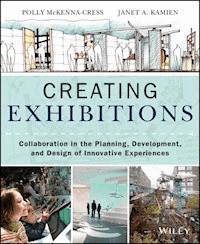
Cover Images: Illustration: RISK! Exhibition Sketches, Fort Worth Museum of Science and History, Fort Worth, TX. Illustration courtesy of Hands On! Inc. • Bottom Left: Hall of Biodiversity, American Museum of Natural History, New York, NY. Photo courtesy Richard Cress • Bottom Center: Zaha Hadid: Form in Motion, Philadelphia Museum of Art, Philadelphia, PA. Photo courtesy Polly McKenna-Cress • Bottom Right: City Museum, St. Louis, MO. Photo courtesy of Paul Martin
This book is printed on acid-free paper.
Copyright © 2013 by John Wiley & Sons, Inc. All rights reserved.
Published by John Wiley & Sons, Inc., Hoboken, New Jersey.
Published simultaneously in Canada.
No part of this publication may be reproduced, stored in a retrieval system, or transmitted in any form or by any means, electronic, mechanical, photocopying, recording, scanning, or otherwise, except as permitted under Section 107 or 108 of the 1976 United States Copyright Act, without either the prior written permission of the Publisher, or authorization through payment of the appropriate per-copy fee to the Copyright Clearance Center, 222 Rosewood Drive, Danvers, MA 01923, (978) 750-8400, fax (978) 646-8600, or on the web at www.copyright.com. Requests to the Publisher for permission should be addressed to the Permissions Department, John Wiley & Sons, Inc., 111 River Street, Hoboken, NJ 07030, (201) 748-6011, fax (201) 748-6008, or online at www.wiley.com/go/permissions.
Limit of Liability/Disclaimer of Warranty: While the publisher and author have used their best efforts in preparing this book, they make no representations or warranties with the respect to the accuracy or completeness of the contents of this book and specifically disclaim any implied warranties of merchantability or fitness for a particular purpose. No warranty may be created or extended by sales representatives or written sales materials. The advice and strategies contained herein may not be suitable for your situation. You should consult with a professional where appropriate. Neither the publisher nor the author shall be liable for damages arising herefrom.
For general information about our other products and services, please contact our Customer Care Department within the United States at (800) 762-2974, outside the United States at (317) 572-3993 or fax (317) 572-4002.
Wiley publishes in a variety of print and electronic formats and by print-on-demand. Some material included with standard print versions of this book may not be included in e-books or in print-on-demand. If this book refers to media such as a CD or DVD that is not included in the version you purchased, you may download this material at http://booksupport.wiley.com. For more information about Wiley products, visit www.wiley.com.
Library of Congress Cataloging-in-Publication Data:
McKenna-Cress, Polly. Creating exhibitions: collaboration in the planning, development, and design of innovative experiences/ Polly McKenna-Cress, Janet A. Kamien. pages cm Includes index. ISBN 978-1-118-30634-5 (pbk.); 978-1-118-41994-6 (ebk); 978-1-118-42167-3 (ebk) 1. Museum exhibits. 2. Museum exhibits--Planning. 3. Museums--Management. I. Kamien, Janet. II. Title. AM151.M42 2013 069'.5—dc23 2013004578
Printed in the United States of America
10 9 8 7 6 5 4 3 2 1
To my mentors and friends; Mike Spock, Elaine Gurian, and George Hein, my dearest friends Jeff, Paul, Polly, Sing, Kathryn, Leslie, and eLbow . . . and of course my partner, mentor and love Anibal.
—Janet
To my immediate and extended family, both personally and professionally, without whose patience and continued support we would not have been able to accomplish this feat. I love you Isabelle, Sabine, and Henry . . . and my true and dearest love Richard.
Also and forever to my mentor, confidant, girlfriend, and hero . . . Janet . . . I love you and will miss you everyday.
—Polly
“Two dyslexics walk into a museum . . . one turns to the left and the other turns to the left . . . and they find a meaningful relationship.”
—Janet & Polly
Acknowledgments
There are too many people to thank who helped enormously in this venture. To start at the beginning, however, we are indebted to Alina Wheeler without whom this book would not have come into existence. Her professional and personal support all the way through the process gave us the conviction to keep going “because the field needs this book.”
Special thanks to our diverse group of contributors who possess depth of experience and knowledge; you were crucial in enriching this book. Leslie Bedford, Lath Carlson, Richard Cress, Jeff Hayward, Lauren Helpern, Erika Kiessner, Traci Klainer Polimeni, Donna Lawrence, Richard Lewis, Paul Martin, Rachel McGarry, Dottie Miles Hemba, Jessica Neuwirth, Diane Perlov, Dana Schloss, Leslie Swartz, Charlie Walter, Shari Rosenstein Werb, and Katherine Ziff.
To the Wiley Hoboken team: launched and lead by Margaret Cummins, with Penny Makras, Mike New, Lauren Poplawski, and Doug Salvemini.
Extra thanks and love to all the amazing people who formed Team Janet: Anibal Cicardi, Aldo & Dario Cicardi, Leslie Bedford, Tatiana Falcon, Sing Hanson, Tom Harris, Jeff Hayward, Elaine Heumann Gurian, Kathryn Hill, Paul Martin, Pam Parkhurst, Michael Spock, and Leslie Swartz. Particularly Jeff Hayward and Leslie Swartz who in the darkest periods helped support the efforts to keep the book on track and to the publisher, your generosity, both intellectual and emotional, is what helped guide this book to completion. Particularly Paul Martin whose professional and personal friendship over the years has been so critical . . . you are a rock star!
Mark Dahlager and Anne Butterfield for reading the whole dang thing . . .more than once. David Kahn and Carole Charnow our quintessential Institutional Advocates who read early chapters and gave important feedback.
Alusiv, Inc. crew: Amy Hughart for giving editing support; Becky Boone for refining the design; and Richard, of course, who spent countless hours ensuring the book was professionally refined and designed.
Those professors, colleagues, and friends who covered for me while on sabbatical and offer important intellectual and moral support over the years: Keith Ragone, Dottie Miles Hemba, Aaron Goldblatt, and Lauren Duguid.
All the UArts Museum Studies students from 1990-today but particularly those who were with me on this wild ride of writing this ultimate thesis: MEPD Class of 2011: Amy, Christine, Jamie, Kelly, Kim, Maggie, Rebecca, Sarah C, Sarah (SAS), and Zach. MEPD Class of 2012: Karl, Rayna, Isabelle, Bin, Tamera, Megan, Liz, Anita, Megan, Dan, Nini, and Cat. MEPD Class of 2013: Layla, Daria, Maya, Meghann, Dan, Jihea, Jordan, Moaza, Brittany, and Renee. MEPD Class of 2014: Louise, Leah, Erin, Ksenia, Ashley, Noah, Xander, Skye, Ariel, and Breanna. Specifically the two students, now professionals, who helped us visualize the book: Isabelle Hayward and Meghann Hickson.
Kate Quinn and Craig Bruns for providing images, thoughtful input, as well as your unwavering support when things were darkest. Your words meant more than you know. Jeff Hoke and the Museum of Lost Wonder, Steve Feldman, Kathy McLean, Andy Merriell, Jim Roe, and Jim Volkert for active discussions over the years, reading chapters and giving essential feedback.
The CLR Design crew of Gary Lee, Jon Stefansson for giving open access, Nancy Worby for sorting and scanning images, John R Collins, Jr. for his incredible skill and talent, and Jon Coe for sketches, master planning, and for being an early and important mentor.
Michael John Gorman for his interview time and all the inspiring innovative collaborative work Science Gallery achieves. Lyn Wood and Kathy Gustafson-Hilton from Hands On! For sketches and illustrations plus creating great work.
The University of the Arts support: Sean Buffington, Kirk Pillow, Christopher Sharrock, and Jim Savoie particularly Dean Steve Tarantal for believing in me and supporting my sabbatical, and to Regina Barthmaier, Neil Kleinman, and Laura Hargreaves for their encouragement.
Mira Zergani for reading and being a great friend both professionally and personally. David Ucko for sitting all day in the early incubation stages asking solid and tough questions to reveal the soft spots. Jane and Ed Bedno for different conceptual foundations of this book but also for bringing Janet and me together.
To the many colleagues who contributed thoughts, provocations, writing, and images: Minda Borun, Anne El-Omami, Robert Garfinkle, Viv Golding, Victoria Jones, Sean Kelley, Jeanne Maier, Janet Marstine, Gerry Palumbo, Diane Perlov, Barbara Punt, Judy Rand, Jeff Rudolf, Helen Shannon, Steve Snyder, Leslie Stein, Beverly Serrell, Dan Spock, Doug Simpson, Beth Twiss-Houting, Robert Vosberg, and David Young.
American Alliance of Museums (AAM) for being such a strong advocate for the work we all do. National Association for Museum Exhibitors (NAME) for great journals, colleagues, conversations, and for recognizing Janet with its first Lifetime Achievement Award for all she did for the field. The Museum Group (TMG) who have been key leaders in moving our field forward as well as being indispensable colleagues. Science Museum Exhibit Collaborative (SMEC) a number of contributors and examples for this book came from this nationwide collaborative of innovative science museum professionals; thank you for being so smart and dedicated.
To my talented designer, photographer, thorough editor, and husband Richard who worked so hard to ensure this book was well conceived and designed with cohesive photographic examples of what our narrative expresses. My three wonderful and patient children, Isabelle, Sabine, and Henry who let me follow my dream to develop and write this book . . . I am forever grateful. To my whole family parents, brothers, sisters-in-law, nieces, and nephews for being supportive through my frustrations and celebrations.
To Janet's family: Her loving and passionate husband, Anibal Cicardi, who patiently supported Janet's museum obsession. Her stepsons, Aldo & Dario Cicardi, who brought her great pride and deep love. And to Tatiana Falcon, who was at her side through the toughest times.
Janet mixed her personal and professional friends and families together with the warmth and humanity she brought to her work. We are all one world—her world—in which we became better professionals and people. A mix of personal and professional thanks: Andrew Anway, Tamara Biggs, Carol Bossert, Susan Bruce Porter, Debbie Gonzalez Canada, Lynn Dierking, Richard Duggan, John Falk, Joseph Gonzales, Geoffrey Grove, Joe Gurian, Carl Hanson, George Hein, Aylette Jenness, Dorothy Merrill, Lori Mitchell, Phyllis Rabineau, Pat Steuert, Eve Wachhaus, and Lin Witte.
Janet is not here to write her gratitude so I ask forgiveness of those who were missed and should be recognized. Please know we are forever grateful for all you did and do.
And the most important acknowledgment . . . to Janet for all the mentoring, push back, compassion, stubbornness, and deep friendship you showed so many people.
The two years we spent on this book were among one of the most remarkable gifts that I have ever been given.
FOREWORD
When I was first asked to write the foreword to this book, I was flattered but skeptical. Having only just become the leader of Boston Children's Museum, I knew there had to be many museum directors more qualified than I to introduce this important work. But, as soon as I read the first chapter I understood their reasoning; for, as a newcomer to the complex and challenging art of creating museum exhibits, I found that Creating Exhibitions opened my eyes to a world of understanding and knowledge, offering many new concepts and ideas, and some that were surprisingly familiar.
As a producer of opera and theater, in Creating Exhibitions, I recognized the parallel process of production. We first decide upon an opera or play to produce, which is similar to the exhibition content or subject matter. The book then describes the advocacy positions of the creative team, each of which has a direct counterpart in operatic production: the project advocate assembles the team (the opera producer); the curator advocates for the subject matter (as does the conductor); the exhibit developer/educator advocates for the visitor/audience (just like the opera director); and both exhibits and operatic production employ designers and production managers. Both projects proceed in a similar way, navigating the turbulent shoals of creative collaboration. Being the Institutional Advocate for the theater and now for a museum, this text assured me of roles I knew well, but also opened up new clarity on the particulars of this interactive and participatory field. The heading, “No One Said Collaboration Was Easy” rang true as I know that guiding a team through a collective creative process can be exhausting. But, as McKenna-Cress and Kamien assert, it is worth the effort and can push the limits of imagination, innovation, and engagement.
In its nine chapters, Creating Exhibitions provides an essential guide to exhibit development and design. Its practical open-ended style of offering considerations vs. rules takes the novice and the experienced professional through exhibit planning from inception to post-opening; starting with the collaborative process, working through the all-important visitor experience, to design, budgets, fabrication, and evaluation. The open-ended quality allows teams the flexibility to create their own process and practice. Each chapter is beautifully illustrated and includes an invaluable collection of case studies that serve to focus and inspire. This is a book written by experts in their craft and thoughtful teachers who draw us into the mind of the visitor, urging us to connect with our passion and love of the subject matter so that we can create an experience that is educational but also emotionally engaging and deeply relevant.
For museum directors/institutional advocates every day is show time and Creating Exhibitions will help anyone who is seeking to stage the most thrilling, transformative, and engaging exhibitions for its audience. For newcomers and veterans alike, this book offers fresh inspiration and guidance from two legendary leaders in the field.
Carole Charnow
President and CEO
Boston Children's Museum
Introduction
Whatever worthiness a museum may ultimately have derives from what it does, not from what it is.
—Stephen E. Weil1
Beyond information, values, and experience, what else of social utility might museums provide to their public? Let me suggest two: stimulation and empowerment. Here we approach the museum visit not as an end in itself but as the starting point, rather, for a process intended to continue long after the visitor has left the museum's premises.
—Stephen E. Weil2
Museums are at a precipice facing a future that is unknown. It is no longer reasonable to rely solely on an old foundation that has been around since the first human placed an object on a pedestal for others to admire. It is no longer "enough" to simply keep and display things for a casual observer. Like libraries, over time the museum mission has shifted from a function of collecting and preserving to one of education, and now to one of relevancy, advocacy, and social responsibility.
The first seismic shifts in the modern museum landscape turned attentions from object to observer, with exhibitions' purpose “not only being about something but for someone.”More recent shifts have turned visitor into collaborator. A number of museum professionals not only have embraced these shifts but also are the provocateurs that had pushed such issues from the start. These risk-takers have helped reshape many museums and heritage sites from static organizations into dynamic, inclusive, and relevant institutions. But museums can do more, can be more.
How dramatically have these conditions changed the museum mission and how we achieve it?
The interconnected collaboration inherent in any exhibition initiative is complex, and many institutions have not adequately analyzed or assessed how and with whom they have engaged the creation of their exhibitions. Rather, focus has remained more on the end product, which may be lovely but is not always achieving all that is possible through this medium. If the plan is to display material culture in a beautiful setting, that is one step. However, the field, funders, community, and society have set higher expectations that public institutions must address.
Those expectations point right back to the questions of how and by whom theexhibitions are created, not only in terms of skillful execution, but also in terms of the full tactical process of assessing and creating.The authors, with many decades between them working with all forms of institutions and firms in the profession and students studying the field, have found the most important needs are to understand an underlying process, to be perpetually pursuing interesting ways to engage meaningful teamwork and to ensure that visitors are at the center of all decisions. That is the purpose of this book. Our efforts exhibit for you the collaborative processes needed for developing and designing exhibitions of any kind, addressing interesting approaches in the field, and allaying possible fear of failure that can come with new or complex practices.
Far better is it to dare mighty things, to win glorious triumphs, even though checkered by failure . . . than to rank with those poor spirits who neither enjoy nor suffer much, because they live in a gray twilight that knows not victory nor defeat.
—Theodore Roosevelt
Here is where fear comes into play—fear of change, of offending someone, of not knowing what to do, and, of course, of failure and loss of credibility. This book was developed to allay these fears. In these nine chapters, we outline approaches to best utilize existing resources, both staff and money, to create visitor-engaged, forward-thinking exhibitions (Figures I-1 and I-2). That being said, this book is not a step-by-step “how to” manual. We do not proscribe singular techniques. We have been deliberately suggestive, collecting for you a guide to best practices and various considerations that can be taken into account when creating exhibitions. In some instances, we may say “you must pay attention to this,” but mostly these are possible directions, reminders, and guides.
Figure I-1: Young awestruck visitors are bristling with questions about what they see. Many museums want to better understand those questions. This shifts the museum's stance from “what we want to tell you” to a new dynamic “what do you want to know?” as the basis of developing exhibitions.
Photo courtesy of Richard Cress
Figure I-2: Beyond basic display, how do we involve visitors in the conversation? This panel is from Imagine Africa an exhibition prototype installed by University of Pennsylvania Museum of Archeology and Anthropology. The exhibits pose questions to the audience about what they might want to know about the objects in the collection. The question, What can be learned by studying a culture's traditional techniques? sparked such answers as “You can determine its capability to deal with the future,” “How people believe in different things,” and “To show where we come from.” With this information the museum will reinstall the collection based on the community's curiosity.
Photo courtesy of Polly McKenna-Cress
Why Did We Write This Book?
Because innovation, relevancy and ultimately survival is important for our field! With the need for museums to evolve as the world evolves, and at what seems to be an increasingly more rapid pace, viable twenty-first-century institutions must understand who, what, and how they are advocating for and the critical role that collaboration plays in achieving those goals.
There are few resources that students and professionals can turn to when they need information or confirmation about certain types of museum practice. Yes, there are design books, and yes, there are process books, but ironically there is no collection of information that can help all members of an exhibition team understand each other's issues and organize their work in a collaborative fashion. This book is a reference tool for students, museum professionals, and museum stakeholders (boards, funders, community members) who want to be better informed about the practices to put together new and imaginative teams and processes to move their institutions, exhibitions, and programs forward.
We also wanted to ensure this book expressed a balance of theory and new thinking, yet always was grounded in practice and effective application of the thinking. Plus, there are so few museum-oriented books that tackle practice that we wanted this book to help build the canon for the ever-growing museum studies programs.
We hope readers will use this book to better understand their own work, to question how these ideas could be adopted and adapted for their own teams and institutions, to rethink the roles of team members and learn to become better collaborators, to realize new applications for skills and helpful techniques, to employ the design and development processes, or just simply to be reminded of a few tidbits of useful information. Most importantly, we hope you will be inspired by the thoughts collected in these pages.
Our Process
Writing this book was very much like the experience of making an exhibition:
First, we found ourselves to be like some of the subject matter specialists we speak of in the following pages—too close to our material. How will we strike the right note between too much basic information and not enough? Where are the starting points for people? What will interest them? Well, we approached this collaboratively. We engaged professionals in the field to contribute on best practice topics and critique the book's various iterations. Our contributors and “test group” of readers are composed primarily of people who have as much or more experience as we do. Additionally, we benefit from the gift of teaching graduate students and of working with a variety of clients in the field; both perspectives provided valuable insights.
Second, was maintaining all levels of organization. No matter how we looked at it, this subject was complex. We needed to find a way for readers in all manner of museum positions to recognize themselves in descriptions of roles within a team, job titles within an institution, or activities within phases of the work, but most importantly to have an immediate resource that might help solve an immediate problem. From the top down, we needed to define terms and contextualize the many facets of this field about which we are so passionate. For us, “exhibition” refers to the totality of content, context, and physicality (including the media, programming, and collateral materials) that work within the space and extend the experience beyond the walls. Therefore, an exhibition is a fully realized experience from the imprint of the external marketing to the tangible interactions the visitors have in the space to the intellectual impact that sparks lasting impressions (Figure I-3). Thumb through these pages when at you are at wits end (or maybe before), and we think you will find at least a small nugget to help you.
Finally, we sought to define and describe the process and phases of exhibition creation. Some of our most experienced readers worried that this whole process, if couched solely in the familiar steps of the architectural field (concept, schematic, design/development, and construction documentation), would be a formula for killing creativity akin to “teaching to the test.” In the end, we felt that professionals in this field do need some kind of framework that can address complex needs, but we have gone further to describe it (repeatedly) as a flexible framework that the exhibition team molds to the particular needs of the project. The bonus is that this process framework maintains language that is used widely in the field and understood by many people.
Figure I-3: Exhibitions should be considered from many different vantage points—Who is the audience? What will be the full experience? Why should anyone come? Conceptual sketch of live animal habitats and viewing/interpretation areas.
Illustration by Jon Coe, John Coe Designs, Pty Ltd. Victoria, Australia.
Book Structure
We have written an expanded table of contents to clearly delineate what each chapter covers. We have structured our content through thought and action— beginning with our philosophical underpinning that collaboration and advocacy positions are an important way to think about team structure and roles, and balancing this with practical analysis of specific skills and methods of the field, how those with advocacy positions might go about their work, an annotated discussion of process and phases, and a visual map of the overall process.
Our chapters ask three critical questions for readers' consideration as they seek to apply some of this thinking to their process. These questions are somewhat rhetorical; the answers will be conditional to readers' individual issues, and of course the investigation and inquiry are part of the process. Each chapter also sets up approaches and philosophies, which in our expert view, provides guidance for how readers might best approach the particular advocacy or process being presented.
Chapters are peppered with action steps, dangers, and potential pitfalls to look for, as well as examples and case studies demonstrating the application of the approaches and philosophies discussed. As a design-oriented book, it has substantial references to design process and problem solving. The examples, anecdotes, and other professional contributions are included to give readers additional perspectives from which to critically analyze the approaches outlined. There are additional resources and bibliographies at the end of chapters with specific references for further reading.
As you navigate through the rest of your life, be open to collaboration. Other people and other people's ideas are often better than your own. Find a group of people who challenge and inspire you, spend a lot of time with them, and it will change your life.
— Amy Poehler
What This Book Won't Do for You
It won't make you a creative genius. If we can address some of the mundane, yet thorny, issues of exhibit-making and collaborative teamwork, it will free you creatively—and you will at least have a better time doing your work!
It does not have proscriptions for the best way to work in your particular circumstance. Some readers looking for a silver bullet solution will consider this bad news. But we are all different; each of our organizations is different, and each exhibition is different. While there are general rules of thumb and tried-and-true methods for various aspects of this work to share, there is no single right way to do anything. What works well in one situation may be a poor choice in another.
The good news is that this book has collected, analyzed, discussed, and presented you with a tool that you can make your own. Readers new to the creation of exhibition might read the whole thing. More experienced readers might start with your team role and learn how other roles are engaged in this collaborative process. If you are in the middle of an exhibition process, confused about something or feeling stuck, you might thumb through for a bit of specific advice. With your colleagues and a modicum of goodwill and common sense, you can use this tool to design and implement creative exhibitions that serve both you and your audiences well.
In the end, our conclusion about the exhibition work we all do is that it's best done collaboratively. We think this work is more like making a movie or mounting a stage play than delivering a monologue. It takes many different kinds of expertise, and no one is expert at all of the parts and pieces. We must rely on and trust one another in order to get it done well.
Who We Are
Polly McKenna-Cress and Janet Kamien have been making exhibitions for many decades and in a variety of professional circumstances. They are passionate about the museum field and understand the frustrations and the joys of doing this work. They have learned a lot from each other, their own mentors, the many colleagues they have engaged here and abroad, and the inspirational students in the Museum Studies programs at the University of the Arts in Philadelphia.
1www.lukeweil.com/_pages/stevePage.html
2 Rethinking the Museum, 1990
Large photo: Liberty Science Center, Jersey City, NJ. Photo courtesy of Richard Cress.
Inset photo: Collaborative group. Photo courtesy of Polly McKenna-Cress
Chapter 1
Collaboration
Teamwork is the ability to work together toward a common vision, the ability to direct individual accomplishments toward organizational objectives. It is the fuel that allows common people to attain uncommon results.
Andrew Carnegie
Collaboration is not a naturally occurring instinct. For most people it is learned behavior. Studies are revealing that societies are actually beginning to evolve to become better collaborators, and the notion of survival of the fittest may be shifting. So why do we need to engage in this practice? As we move further into the twenty-first century, recognizing the continued need to advance from relying on a single decision maker to a more democratized approach is becoming the standard by which most organizations are run. To prepare the next generation of professionals and citizens, schools are placing emphasis on their students being able to collaborate, to work with others in a creative, innovative, and flexible environment. The twenty-first-century skill set must include critical thinking, communication, creative problem solving, and collaboration. We see this need emerging not only in the field of education but also in any field where a complex narrative is being craftedwhether film, theater, or gaming or for the more institutional narratives of mission and vision for corporations and big business. Museums have also taken up the collaboration charge, from how institutions are run to how exhibitions are developed, taking advantage of contributions from multiple sources to shape rich exhibitions for visitors.
Lesen Sie weiter in der vollständigen Ausgabe!
Lesen Sie weiter in der vollständigen Ausgabe!
Lesen Sie weiter in der vollständigen Ausgabe!
Lesen Sie weiter in der vollständigen Ausgabe!
Lesen Sie weiter in der vollständigen Ausgabe!
Lesen Sie weiter in der vollständigen Ausgabe!
Lesen Sie weiter in der vollständigen Ausgabe!
Lesen Sie weiter in der vollständigen Ausgabe!
Lesen Sie weiter in der vollständigen Ausgabe!




