


20,99 €
Mehr erfahren.
- Herausgeber: John Wiley & Sons
- Kategorie: Fachliteratur
- Sprache: Englisch
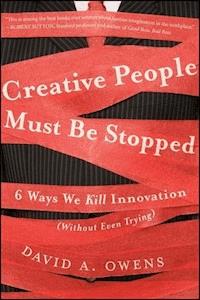
A framework for overcoming the six types of innovation killers Everybody wants innovation--or do they? Creative People Must Be Stopped shows how individuals and organizations sabotage their own best intentions to encourage "outside the box" thinking. It shows that the antidote to this self-defeating behavior is to identify which of the six major types of constraints are hindering innovation: individual, group, organizational, industry-wide, societal, or technological. Once innovators and other leaders understand exactly which constraints are working against them and how to overcome them, they can create conditions that foster innovation instead of stopping it in its tracks. The author's model of constraints on innovation integrates insights from the vast literature on innovation with his own observations of hundreds of organizations. The book is filled with assessments, tools, and real-world examples. * The author's research has been featured in the New York Times, Wall Street Journal, London Guardian and San Jose Mercury News, as well as on Fox News and on NPR's Marketplace * Includes illustrative examples from leading organizations * Offers a practical guide for bringing new ideas to fruition even within a previously rigid organizational culture This book gives people in organizations the conceptual framework and practical information they need to innovate successfully.
Sie lesen das E-Book in den Legimi-Apps auf:
Seitenzahl: 402
Veröffentlichungsjahr: 2011
Ähnliche



















Contents
Introduction: Creative People Must Be Stopped!
Chapter 1: The Context of Innovation: Why Everyone Wants Innovation but No One Wants to Change
Why Does Innovation Fail?
How to Use This Book
Summary
Chapter 2: Why Most of Us Are More Creative Than We Think: Individual Innovation Constraints
Are Innovators Born or Made?
Perception Constraints: Looking Without Seeing
Overcoming Perception Constraints
Intellection Constraints: Old Thought Patterns for New Problems
Overcoming Intellection Constraints
Expression Constraints: Difficulty Articulating Your Ideas
Overcoming Expression Constraints
Putting the Framework to Work: Individual Constraints
Summary
Chapter Reflection: Individual Constraints
Chapter 3: Why a Brainstorm Meeting Can Be Worse Than No Meeting at All: Innovation Constraints in Groups
Two Brains Are Better Than One—Except When They Aren’t
Emotion Constraints: Ego and Social Status
Overcoming Emotion Constraints
Culture Constraints: Cohesion and Meaning
Overcoming Culture Constraints
Environment Constraints: Comfort Versus Collaboration
Overcoming Environment Constraints
Process Constraints: Directing Members’ Behavior
Overcoming Process Constraints
Putting the Framework to Work: Group Constraints
Summary
Chapter Reflection: Group Constraints
Chapter 4: Why You’ll Never Be a Prophet in Your Hometown: Organizational Innovation Constraints
Do “Innovation” and “Organization” Belong in the Same Sentence?
Strategy Constraints: Knowing the Intent
Overcoming Strategy Constraints
Structural Constraints: Efficiency and Control
Overcoming Structural Constraints
Resource Constraints: Capital and Capabilities
Overcoming Resource Constraints
Putting the Framework to Work: Organizational Constraints
Summary
Chapter Reflection: Organizational Constraints
Chapter 5: If It’s Such a Great Idea, Why Isn’t Our Competitor Doing It? Industry Innovation Constraints
Driving Competition with Innovation or Innovation with Competition?
Competition Constraints: Innovation as a Last Resort
Overcoming Competition Constraints
Supplier Constraints: No Organization Is an Island
Overcoming Supplier Constraints
Market Constraints: Everybody Wants It Cheaper—and Faster and Better
Overcoming Market Constraints
Putting the Framework to Work: Industry Constraints
Summary
Chapter Reflection: Industry Constraints
Chapter 6: Why My Innovation Means You Have to Change: Societal Innovation Constraints
Can We Choose to Change Society?
Values and Identity Constraints: I Like Who I Am
Overcoming Values and Identity Constraints
Social Control Constraints: Self-Protection and Regulating Behavior
Overcoming Social Control Constraints
History Constraints: The Past Isn’t Dead—It Isn’t Even Past
Overcoming History Constraints
Putting the Framework to Work: Societal Constraints
Summary
Chapter Reflection: Societal Constraints
Chapter 7: How to Take a Really Hard Problem and Make It Completely Impossible: Technological Innovation Constraints
What’s Hard About Manipulating Matter, Time, and Space
Physical Constraints: Knowing What You Know (and What You Don’t)
Overcoming Physical Constraints
Time Constraints: Having Time and Making Time
Overcoming Time Constraints
Natural Environment Constraints: Altering Landscapes
Putting the Framework to Work: Technological Constraints
Using the Results
Summary
Chapter Reflection: Technological Constraints
Chapter 8: When Failure Is Not an Option: Leading an Innovation Strategy
Show Me the Money: Constraints on the Adoption of Innovations
Managing or Leading Innovation?
The Innovative Organization
Creative People Must Be Stopped!
Appendix A: Using the Assessment Results
Appendix B: Innovation Team Contract Guidelines
Appendix C: An Innovation Bookshelf
References
Acknowledgments
About the Author
Index
Praise for Creative People Must Be Stopped
“Read Creative People Must Be Stopped only if you are serious about making stuff, and making stuff happen. This is a survival guide for navigating a world that is dangerous for good ideas. And it is required reading for the creative people who love them!”
—Peter Durand, founder, The Center for Graphic Facilitation, and creative director, Alphachimp Studio Inc.
“This is no rarefied academic treatment on innovation as an abstract ideal, but a nuts-and-bolts handbook to dissecting our thought patterns about innovation. Owens dispels the myth that innovation is a binary trait that either exists or does not in a given product, process, or business model. Creative People Must Be Stopped addresses the myriad ways that novel ideas can fail in the marketplace. Working through a combination of thought experiments and real-world examples, the book demonstrates how failures in understanding the context for innovation can prove every bit as deadly to progress as failures of imagination.”
—Mark Rowan, president, Griffin Technology Inc., maker of iPod, iPhone, and iPad accessories
“Creative People Must Be Stopped is among the best books ever written about human imagination in the workplace. David Owens is a master innovator, having practiced his craft as a product designer, researcher, teacher, creativity coach, and executive. The breadth and depth of his experience fills every page of this little gem, which is chock-full of hundreds of big and little steps that you can take right now to do more creative work and to lead more innovative teams and organizations.”
—Robert Sutton, professor, Stanford University, and author of the New York Times bestseller Good Boss, Bad Boss
Copyright © 2012 by David A. Owens. All rights reserved.
Published by Jossey-Bass
A Wiley Imprint
989 Market Street, San Francisco, CA 94103-1741—www.josseybass.com
No part of this publication may be reproduced, stored in a retrieval system, or transmitted in any form or by any means, electronic, mechanical, photocopying, recording, scanning, or otherwise, except as permitted under Section 107 or 108 of the 1976 United States Copyright Act, without either the prior written permission of the publisher, or authorization through payment of the appropriate per-copy fee to the Copyright Clearance Center, Inc., 222 Rosewood Drive, Danvers, MA 01923, 978-750-8400, fax 978-646-8600, or on the Web at www.copyright.com. Requests to the publisher for permission should be addressed to the Permissions Department, John Wiley & Sons, Inc., 111 River Street, Hoboken, NJ 07030, 201-748-6011, fax 201-748-6008, or online at www.wiley.com/go/permissions.
Readers should be aware that Internet Web sites offered as citations and/or sources for further information may have changed or disappeared between the time this was written and when it is read.
Limit of Liability/Disclaimer of Warranty: While the publisher and author have used their best efforts in preparing this book, they make no representations or warranties with respect to the accuracy or completeness of the contents of this book and specifically disclaim any implied warranties of merchantability or fitness for a particular purpose. No warranty may be created or extended by sales representatives or written sales materials. The advice and strategies contained herein may not be suitable for your situation. You should consult with a professional where appropriate. Neither the publisher nor author shall be liable for any loss of profit or any other commercial damages, including but not limited to special, incidental, consequential, or other damages.
Jossey-Bass books and products are available through most bookstores. To contact Jossey-Bass directly call our Customer Care Department within the U.S. at 800-956-7739, outside the U.S. at 317-572-3986, or fax 317-572-4002.
Jossey-Bass also publishes its books in a variety of electronic formats. Some content that appears in print may not be available in electronic books.
Library of Congress Cataloging-in-Publication Data
Owens, David A.
Creative people must be stopped: six ways we kill innovation (without even trying) / David A. Owens.—1st ed.
p. cm.
Includes bibliographical references and index.
ISBN 978-1-118-00290-2 (hardback); ISBN 978-1-118-12900-5 (ebk); ISBN 978-1-118-12901-2 (ebk); ISBN 978-1-118-12902-9 (ebk)
1. Creative ability in business. 2. Organizational change. I. Title.
HD53.O94 2012
658.4’063—dc23 2011032504
This book is dedicated to my lovely ladies, Jennifer, Charlotte, and Adelaide
Introduction
Creative People Must Be Stopped!
Given that a search on the term “innovation” returns more than forty thousand book entries on Amazon.com, does the world really need another book on the topic? Maybe the better question is Why do so many organizations continue to kill good ideas and fail in their innovation attempts despite this wealth of research and advice?
Innovation is a natural and desirable outcome of human interaction, yet it is systematically stopped in organizations, often by the very people who say they want it and who stand to benefit from it. I term these systematic stoppages innovation constraints.
Over the course of ten years of research, teaching, and consulting, I have identified the six dominant types of constraints that can keep creative new ideas from being formulated, developed into marketable products and services, or adopted by the intended users. This book organizes these innovation killers into a conceptual framework that demystifies what innovation is, how it happens, and how we stop it without even trying. In my executive programs, workshops, talks, and consulting engagements, thousands of managers, executives, and innovators have successfully used the framework to diagnose the primary causes of innovation failure in their organizations and to develop strategies for overcoming them. My goal in this book is to bring this power of understanding, diagnosing, and removing constraints on innovation to many, many more.
Although this book relies on academic research in a variety of disciplines to help explain why things happen the way they do, it is above all a practical guide to a new way of thinking about innovation, complete with diagnostic and other tools, as well as suggestions for action. It is not, however, a laundry list of “Do this, don’t do that” advice. Rather, this book is aimed at giving aspiring innovators and managers of innovation the conceptual and practical basis they need to develop their own actionable insights and smart strategies for responding to the challenges of coming up with exciting new ideas and bringing them to fruition.
CHAPTER 1
The Context of Innovation
Why Everyone Wants Innovation but No One Wants to Change
Figure 1.1
Our firm was in a bit of a slump. We had a hugely successful product a few years ago, but now we were facing increasing pressure to come up with the follow-up product, the next big thing. One day the big boss called the team into the office and said,
“People, this is serious. It has got to be big! Look, I really need you to think outside the box—don’t constrain yourselves! Listen, I really want you to push the boundaries way out there on this one; remember, we’re talking blue-sky this time—a real breakthrough!”
So the team and I ran off, excited, and “box be damned,” we started thinking big. Just two sleepless weeks later, we had found it! We had come up with a great idea! So we set up a meeting to present it. In the meeting the boss listened for a while, asking a question or two. Then he let out a loud sigh and said,
“Hmm ... this looks expensive ... I mean, I appreciate how you people are thinking outside the box, but I hope you realize that we have a business to run here. Now remember that I do want you to keep thinking outside the box, but can you try to make sure that it’s not quite so expensive?”
So off we went to find another idea. About a week later we had come up with a less expensive idea that was even better. In the big meeting, the boss again asked just a question or two before he sighed and said,
“This looks complicated. I mean I appreciate how you people are thinking outside the box, but I hope you realize that we’ve got to be able to make this in our plant. I want you to keep thinking outside the box, but can you try to make sure that we can at least manufacture the thing in-house?!”
Next idea: “Too disruptive!”
Next idea: “Too risky!”
Next idea: “Too weird!”
After about six months of this, my team finally came up with the idea, one that we believed met every requirement the boss had given us. When we presented it to him, he didn’t even bother asking questions. Ten minutes into our spiel, he became agitated and said,
Lesen Sie weiter in der vollständigen Ausgabe!
Lesen Sie weiter in der vollständigen Ausgabe!
Lesen Sie weiter in der vollständigen Ausgabe!
Lesen Sie weiter in der vollständigen Ausgabe!
Lesen Sie weiter in der vollständigen Ausgabe!
Lesen Sie weiter in der vollständigen Ausgabe!
Lesen Sie weiter in der vollständigen Ausgabe!
Lesen Sie weiter in der vollständigen Ausgabe!
Lesen Sie weiter in der vollständigen Ausgabe!
Lesen Sie weiter in der vollständigen Ausgabe!
Lesen Sie weiter in der vollständigen Ausgabe!
Lesen Sie weiter in der vollständigen Ausgabe!
Lesen Sie weiter in der vollständigen Ausgabe!
Lesen Sie weiter in der vollständigen Ausgabe!




