


11,99 €
Mehr erfahren.
- Herausgeber: John Wiley & Sons
- Kategorie: Fachliteratur
- Sprache: Englisch
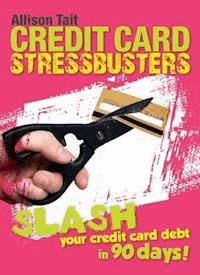
Feeling overwhelmed by your credit card debt? Struggling to pay off your card each month? Wanting to get back in the black but don't know how? Fortunately, help is now at hand with Credit Card Stressbusters. This plain-English, Q&A guide will help you to slash your credit card debt in just 90 days. Not only will you learn how to cure credit card addiction, but you'll also learn some of the best-kept stressbusting secrets for using your card responsibly. Inside you'll discover: * how to choose the right card -- credit or otherwise * how to control your spending, instead of letting it control you * how to reduce your debt -- fast * how to make your credit card work for you. Whether you're struggling with credit card chaos or just trying to stay ahead, Credit Card Stressbusters is the book for you!
Sie lesen das E-Book in den Legimi-Apps auf:
Seitenzahl: 210
Veröffentlichungsjahr: 2012
Ähnliche



















Contents
Acknowledgements
About the Author
Introduction
Part I: Addicted to Credit
Chapter 1: Isn’t Credit Card Debt Just Something We Learn to Live With?
What Does Debt Mean to you?
Robbing Peter to Ignore Paul
Chapter 2: Why Put Extra Cash Towards my Debt When it Doesn’t Make Much Difference?
Do you Need a Keeper?
Drastic Measures
Chapter 3: There’s No Way I’m Addicted to Credit ... Am I?
The Right Kind of Counselling
We of the Never-Never
Chapter 4: Why Do I Feel Like Someone Else is Controlling my Spending?
Forget Retail Therapy, this is the Psychology of Shopping
Chapter 5: It’s my Money to Spend. What’s the Big Deal?
Part II: Living With Credit Cards
Chapter 6: How Do I Live Without a Credit Card When the World is Set up That Way?
Who’s Watching you?
Less Convenience, More Cash?
Chapter 7: I Won’t Give up my Cards — What Else Have you Got?
Debit Cards
Prepaid Credit Cards
Chapter 8: How Will I Operate Without Two Cards — One to Pay Off the Other?
Sending Out an SOS
The Pollyanna Effect
Chapter 9: It’s Okay to Use Cash Advances to Get me to Payday, isn’t it?
Part III: Start Controlling your Debt
Chapter 10: My Interest Charges Aren’t That High, So Why Worry?
Chapter 11: Does it Matter if I Don’t Know my Interest Rate?
Chapter 12: If I Keep Paying the Minimum Repayments, I’ll Pay Off my Card Won’t I?
Chapter 13: Does Anyone Care if I Only Make the Minimum Repayment?
How Do I Find Out?
Uh-oh, I May Have a Problem ...
Chapter 14: Are All Credit Cards the Same?
Where to Start
Then What?
What Else Do I Need to Know?
What About Rewards?
Chapter 15: Why Should I Open my Bills if I Pay the Same Amount Each Month?
Chapter 16: The Bank Wouldn’t Offer me a Limit Increase if I Couldn’t Afford it, Right?
Why me?
Chapter 17: Are Interest Charges the Only Fees?
Annual Fee
Credit Card Surcharge
Cash Advance Fee
Payment History Surcharge
OverLimit Fee
Late Payment Fee
Periodic Payment Refusal Fee
Secondary/Subsequent Card Fee
Lost Card Replacement Fee
Foreign Currency Conversion Fee
Chapter 18: How can I Make Interest-Free Periods Work for me?
Back Away from the Card
Give me More
Part IV: Slashing your Credit Card Debt: the Plan
Chapter 19: My debt is only $1000 so I Can Pay it off Anytime. Why Do I Need a Plan?
Creeping Limits can be the Beginning of Bigger Problems
The Easy-Fix Solution
No Savings? Start Shaving
Find an Extra $100 a Week
Chapter 20: I have an Average Debt of $3000. That’s Not a Big Deal, is it?
Think Laterally
Chapter 21: My Debt is Just too Big. Is this Really Possible?
Home Sweet Home
Chapter 22: Where Do I Get the Money to Make All This Happen?
Chapter 23: How can I Find Extra Cash, Fast?
The Bank of Mum and Dad
Clean Out and Clean up
Get a Second Job
The New Black?
Chapter 24: Where Do I Start When I’ve Got Other Debts as Well?
You’re Telling me Some Debt is Good?
Chapter 25: Who can I Turn to for Help?
Part V: It Doesn’t End With Paying Off your Debt
Chapter 26: How can I Make a Credit Card Work for me?
Flying High
Chapter 27: How Do I Keep my Card Details Safe?
If it can Happen to Pam . . .
Chapter 28: Is a Chip and PIN Card More Secure Than Signing?
Chapter 29: Is it Really Safe to Use my Card Online?
Chapter 30: Will I be Liable if Someone Else Uses my Card?
Chapter 31: Do Credit Cards Have Benefits Other Than Just Credit?
Chapter 32: I Disagree With my Bank Over my Credit Card. What Can I Do?
Chapter 33: What Should I Do if I’m Slipping Back Into the Red?
Glossary
Appendices
Appendix A: Quiz: What’s your Problem?
Appendix B: Resources
Index
First published 2009 by Wrightbooks
an imprint of John Wiley & Sons Australia, Ltd
42 McDougall Street, Milton Qld 4064
Office also in Melbourne
Typeset in Gill Sans 10.5/13.5pt
© Allison Tait 2009
The moral rights of the author have been asserted
National Library of Australia Cataloguing-in-Publication data:
Author: Tait, Allison.
Title: Credit card stressbusters / Allison Tait.
ISBN: 9781742168500 (pbk.)
Notes: Includes index.
Subjects: Credit cards — Australia.
Finance, Personal — Australia.
Consumer credit — Australia — Management.
Debt — Australia.
Dewey Number: 332.02400994
All rights reserved. Except as permitted under the Australian Copyright Act 1968 (for example, a fair dealing for the purposes of study, research, criticism or review), no part of this book may be reproduced, stored in a retrieval system, communicated or transmitted in any form or by any means without prior written permission. All inquiries should be made to the publisher at the address above.
Cover images © iStockphoto/Maciej Korzekwa
Cover design by Popomo
Disclaimer
The material in this publication is of the nature of general comment only, and does not represent professional advice. It is not intended to provide specific guidance for particular circumstances and it should not be relied on as the basis for any decision to take action or not take action on any matter which it covers. Readers should obtain professional advice where appropriate, before making any such decision. To the maximum extent permitted by law, the author and publisher disclaim all responsibility and liability to any person, arising directly or indirectly from any person taking or not taking action based upon the information in this publication.
Acknowledgements
This book would not have been possible without the help of my brains trust. Heartfelt thanks for the sharing of knowledge, good humour and patience must go to Matthew Walker and Laura Menschik from WLM Financial Services, <www.wlm.com.au>; Harry Senlitonga from Cannex, <www.cannex.com.au>; Dr Paul Harrison; Dr Antony Young; Neil Stephens; Susan Stephens; Bartolo Mandile; Meredith Fuller; Jane Nash; Gary Williams at Rosenfeld, Kant & Co, Bondi Junction, NSW; and Lissanne Oliver. A big thank you also to everyone who bared their finances for the case studies in this book. And cheers to Stuart, Diana, Danielle and all the team at ninemsn who got me thinking seriously about the money stuff in the first place.
About the author
Allison Tait is a journalist and writer with more than 20 years’ experience. During that time, her byline has been seen regularly in magazines, newspapers and websites in Australia and internationally. She has written across a wide variety of subjects, from health, social trends and relationships to interiors, finance and careers. For the past three years Allison has contributed popular fortnightly articles to ninemsn’s Money website, where she has gained a reputation for writing down-to-earth finance stories that are remarkable for their non-stuffy nature. She revels in finding the most knowledgeable person she can, asking as many boring questions as they’ll answer and then presenting the resulting information in the clearest and most accessible way possible. And if it raises a smile now and then, all the better.
Introduction
How do you feel about your credit card? Whether your debt is minimal or mind-blowing, chances are you can answer that question. The thing with credit cards is that they assume an importance in our lives that takes them far beyond an innocuous piece of plastic in our wallet, directly to the heart of the way we live.
For some of us, they’re all about convenience; just another way to conduct financial transactions. These convenience-seekers use credit cards at will, pay them off each month and reap the rewards points. For these people, plastic is fantastic.
For a large proportion of us, however, credit cards are the way we fill the gap between the lifestyle we can afford and the lifestyle we actually live. To these people, a credit card is a ‘frenemy’, loved and hated in equal measure. The trouble is that once you get used to the idea of supplementing your income with someone else’s cash, it becomes a difficult habit to break. So we love the card for its access to what we think of as ‘life’, but hate it because those bills roll around with monotonous regularity, reminding us of our excesses.
Gran would have called it ‘living beyond your means’, but in today’s society, comfortable with the idea of going into debt to get what we want right now, it’s ‘just the way we live’.
Unfortunately, the way we live sometimes catches up with us, as we’ve witnessed on a global scale in recent times. No matter how much you owe, if you can’t afford to pay it back when the creditor wants it back, you’ve got a serious problem. Particularly if job security is an issue, or if you have many different debts that all require attention at once.
In times like these, you need to lose the debt. The question is: where do you start? That’s where this book comes in. Call it a crash course in living with your credit card. It’s not rocket science. Much like weight loss, the essence of which can be summed up in one sentence (‘eat less, move more’), slashing your credit card debt is about going back to basics — and breaking through some boundaries.
There are four main reasons that credit card debt gets out of control: overspending, lack of knowledge, lack of organisation and social pressures.
If you’re one of those people (and there are many) who think you’re ‘no good with money’, or that it’s ‘too hard’, it’s time to reassess. Financial literacy — understanding ‘money stuff’ — is a skill that will make your life easier in ways you never imagined.
And you don’t have to be ‘good’ at it. Getting on top of your credit card debt is about gaining control of your money. It’s about knowing what you earn, knowing what you have to spend, and knowing what’s left over. Does that sound ‘too hard’? With a bit of education, your credit card will assume its rightful role in your life. No longer will it be a ‘nightmare’ or a ‘disaster area’. No longer will it be something you push to the back of your mind and try desperately not to think about.
Depending on the size of your debt, 90 days can be enough time to lose it forever, or enough time to make a serious start. Every person’s situation is different, so it’s important to take the information and advice in this book as a general guide and get some professional help to fill in the blanks as you need them.
Part I
Addicted to credit
Hands up if you put groceries on your credit card this week ... or a few beers with your mates. In the old days (that is, 50 or so years ago), people didn’t buy a sofa if they didn’t have the cash to pay for it. These days, we think nothing of taking out a loan — that is, using our credit card — to make up a shortfall in our weekly finances.
Okay, so we’re comfortable with debt. But did you ever consider the notion that flashing your plastic has become an addiction? Here’s how to tell if you’re a little too dependent on your credit card (and what to do about it).
Chapter 1
Question: Isn’t credit card debt just something we learn to live with?
Answer: Don’t get comfortable living beyond your means.
Lesen Sie weiter in der vollständigen Ausgabe!
Lesen Sie weiter in der vollständigen Ausgabe!
Lesen Sie weiter in der vollständigen Ausgabe!
Lesen Sie weiter in der vollständigen Ausgabe!
Lesen Sie weiter in der vollständigen Ausgabe!
Lesen Sie weiter in der vollständigen Ausgabe!
Lesen Sie weiter in der vollständigen Ausgabe!
Lesen Sie weiter in der vollständigen Ausgabe!
Lesen Sie weiter in der vollständigen Ausgabe!
Lesen Sie weiter in der vollständigen Ausgabe!
Lesen Sie weiter in der vollständigen Ausgabe!
Lesen Sie weiter in der vollständigen Ausgabe!
Lesen Sie weiter in der vollständigen Ausgabe!
Lesen Sie weiter in der vollständigen Ausgabe!
Lesen Sie weiter in der vollständigen Ausgabe!
Lesen Sie weiter in der vollständigen Ausgabe!
Lesen Sie weiter in der vollständigen Ausgabe!
Lesen Sie weiter in der vollständigen Ausgabe!
Lesen Sie weiter in der vollständigen Ausgabe!
Lesen Sie weiter in der vollständigen Ausgabe!
Lesen Sie weiter in der vollständigen Ausgabe!
Lesen Sie weiter in der vollständigen Ausgabe!
Lesen Sie weiter in der vollständigen Ausgabe!
Lesen Sie weiter in der vollständigen Ausgabe!
Lesen Sie weiter in der vollständigen Ausgabe!
Lesen Sie weiter in der vollständigen Ausgabe!
Lesen Sie weiter in der vollständigen Ausgabe!
Lesen Sie weiter in der vollständigen Ausgabe!
Lesen Sie weiter in der vollständigen Ausgabe!
Lesen Sie weiter in der vollständigen Ausgabe!
Lesen Sie weiter in der vollständigen Ausgabe!
Lesen Sie weiter in der vollständigen Ausgabe!
Lesen Sie weiter in der vollständigen Ausgabe!
Lesen Sie weiter in der vollständigen Ausgabe!
Lesen Sie weiter in der vollständigen Ausgabe!
Lesen Sie weiter in der vollständigen Ausgabe!
Lesen Sie weiter in der vollständigen Ausgabe!
Lesen Sie weiter in der vollständigen Ausgabe!
Lesen Sie weiter in der vollständigen Ausgabe!
Lesen Sie weiter in der vollständigen Ausgabe!
Lesen Sie weiter in der vollständigen Ausgabe!




