


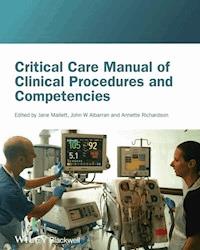
Critical Care Manual of Clinical Procedures and Competencies E-Book
38,99 €
Mehr erfahren.
- Herausgeber: John Wiley & Sons
- Kategorie: Fachliteratur
- Sprache: Englisch
This manual is aimed at all healthcare practitioners, from novice to expert, who care for the critically ill patient, recognising that different disciplines contribute to the provision of effective care and that essential knowledge and skills are shared by all practitioners. It provides evidence-based guidelines on core critical care procedures and includes a comprehensive competency framework and specific competencies to enable practitioners to assess their abilities and expertise. Each chapter provides a comprehensive overview, beginning with basic principles and progressing to more complex ideas, to support practitioners to develop their knowledge, skills and competencies in critical care.
Sie lesen das E-Book in den Legimi-Apps auf:
Seitenzahl: 1474
Veröffentlichungsjahr: 2013
Ähnliche




















Table of Contents
Title page
Copyright page
List of contributors
Foreword
Foreword
Preface
List of abbreviations
Chapter 1: Scope and delivery of evidence-based care
Chapter 2: Competency-based practice
Chapter 3: Recognizing and managing the critically ill and ‘at risk’ patient on a ward
Rapid response systems
Assessing and managing the deteriorating patient
Summary
Chapter 4: Admitting a critically ill patient
Admission of a patient to a level 2 or 3 care facility
Chapter 5: Assessment, monitoring and interventions for the respiratory system
CLINICAL ASSESSMENT
Chest auscultation
Arterial blood gas sampling
Pulse oximetry
Airway management and care with adjunct airways
MONITORING AIRWAY ADJUNCTS
Partial pressure of end tidal carbon dioxide (ETCO) monitoring
Measuring endotracheal/tracheostomy tube cuff pressure
INTERVENTIONS FOR THE RESPIRATORY SYSTEM
Ventilatory support
Non-invasive ventilation
Invasive ventilation
Weaning from mechanical ventilation
Other respiratory interventions
Intermittent positive pressure breathing (IPPB, e.g. Bird, Bennett PR2)
Suctioning via a tracheal tube (endotracheal or tracheostomy)
Humidification
Manual hyperinflation and hyperoxygenation
Prone ventilation
Chest drains
Flexible fibreoptic bronchoscopy
Summary
Chapter 6: Monitoring of the cardiovascular system: insertion and assessment
Electrocardiogram monitoring
Arterial blood pressure monitoring
Non-invasive arterial blood pressure monitoring
Invasive arterial blood pressure monitoring
Central venous pressure monitoring
Advanced haemodynamic monitoring
Haemodynamic monitoring
Summary
Chapter 7: Titration of inotropes and vasopressors
Choice of inotrope or vasopressor
Components of titration of inotropic drug therapies
Chapter 8: Assessment and support of hydration and nutrition status and care
Optimizing hydration and nutrition
Therapy
Problems with providing hydration and nutrition
Enteral feeding access in an intubated patient
Parenteral nutrition
Ethical considerations
Chapter 9: Continuous renal replacement therapies: assessment, monitoring and care
How CRRT works
Assessment and monitoring of the patient on CRRT
Chapter 10: Assessment and monitoring of analgesia, sedation, delirium and neuromuscular blockade levels and care
Pain
Sedation
Delirium
Neuromuscular blockade
Treatment
Chapter 11: Assessment and monitoring of neurological status
Assessment of neurological status
Invasive monitoring
Chapter 12: Assessment and care of tissue viability, and mouth and eye hygiene needs
Tissue viability
Pressure ulcers
Mouth care
Eye care
Chapter 13: Assessment of sleep and sleep promotion
Assessment of sleep
Factors that disrupt and promote sleep
Chapter 14: Physical mobility and exercise interventions for critically ill patients
Review of components of physical mobility and exercise
Interventions
Chapter 15: Transfer of the critically ill patient
Physiological effects of transfer
Evidence and current debates
Components of the transfer process
Competency statements
Guidelines for transfer
Chapter 16: Rehabilitation from critical illness
Review of components of rehabilitation from critical care
Rehabilitation interventions
Summary
Chapter 17: Withdrawal of treatment and end of life care for the critically ill patient
Pre-EOLC considerations: at the beginning
Prognosis
Post prognosis: EOLC in critical care environments
Care around withdrawal: care in the last days and hours
Consultation and communication of decision to withdraw treatment with patient, next of kin and significant others
Communication and breaking bad news: supporting the family
Cultural issues
Review of practical components of withdrawal of treatment and end of life care
Brainstem function measurement and death
After-death care
Competencies
Conclusion
Chapter 18: Cardiopulmonary resuscitation
Evidence for guidelines
In-hospital resuscitation
Initial management of the ‘collapsed’ patient
Index
This edition first published 2013
© 2013 by John Wiley & Sons, Ltd.
Registered office: John Wiley & Sons, Ltd, The Atrium, Southern Gate, Chichester, West Sussex, PO19 8SQ, UK
Editorial offices: 9600 Garsington Road, Oxford, OX4 2DQ, UK
The Atrium, Southern Gate, Chichester, West Sussex, PO19 8SQ, UK
2121 State Avenue, Ames, Iowa 50014-8300, USA
For details of our global editorial offices, for customer services and for information about how to apply for permission to reuse the copyright material in this book please see our website at www.wiley.com/wiley-blackwell.
The right of the author to be identified as the author of this work has been asserted in accordance with the UK Copyright, Designs and Patents Act 1988.
All rights reserved. No part of this publication may be reproduced, stored in a retrieval system, or transmitted, in any form or by any means, electronic, mechanical, photocopying, recording or otherwise, except as permitted by the UK Copyright, Designs and Patents Act 1988, without the prior permission of the publisher.
Designations used by companies to distinguish their products are often claimed as trademarks. All brand names and product names used in this book are trade names, service marks, trademarks or registered trademarks of their respective owners. The publisher is not associated with any product or vendor mentioned in this book. It is sold on the understanding that the publisher is not engaged in rendering professional services. If professional advice or other expert assistance is required, the services of a competent professional should be sought.
The contents of this work are intended to further general scientific research, understanding, and discussion only and are not intended and should not be relied upon as recommending or promoting a specific method, diagnosis, or treatment by health science practitioners for any particular patient. The publisher and the author make no representations or warranties with respect to the accuracy or completeness of the contents of this work and specifically disclaim all warranties, including without limitation any implied warranties of fitness for a particular purpose. In view of ongoing research, equipment modifications, changes in governmental regulations, and the constant flow of information relating to the use of medicines, equipment, and devices, the reader is urged to review and evaluate the information provided in the package insert or instructions for each medicine, equipment, or device for, among other things, any changes in the instructions or indication of usage and for added warnings and precautions. Readers should consult with a specialist where appropriate. The fact that an organization or Website is referred to in this work as a citation and/or a potential source of further information does not mean that the author or the publisher endorses the information the organization or Website may provide or recommendations it may make. Further, readers should be aware that Internet Websites listed in this work may have changed or disappeared between when this work was written and when it is read. No warranty may be created or extended by any promotional statements for this work. Neither the publisher nor the author shall be liable for any damages arising herefrom.
Library of Congress Cataloging-in-Publication Data
Critical care manual of clinical procedures and competencies / edited by Jane Mallett, John W. Albarran, Annette Richardson.
p. ; cm.
Includes bibliographical references and index.
ISBN 978-1-4051-2252-8 (pbk. : alk. paper)
I. Mallett, Jane, RGN. II. Albarran, John W. III. Richardson, Annette.
[DNLM: 1. Critical Care. 2. Critical Illness–therapy. 3. Monitoring, Physiologic. 4. Needs Assessment. WX 218]
616.02'8–dc23
2012044642
A catalogue record for this book is available from the British Library.
Wiley also publishes its books in a variety of electronic formats. Some content that appears in print may not be available in electronic books.
Cover image courtesy of the Editors
Cover design by Andy Meaden
List of contributors
John W. Albarran RN, DipN (Lon), BSc (Hons), PGDipEd, MSc, DPhil
Associate Professor in Cardiovascular Critical Care Nursing
Associate Head of Department for Research and Knowledge Exchange (Nursing and Midwifery)
Programme Manager for Doctorate in Health and Social Care
University of the West of England, Bristol
Micheala Allsop RN Dip, BSc (Hons)
Critical Care Research Nurse
Newcastle upon Tyne Hospitals NHS Foundation Trust
Andrew Baker MB, ChB, FRCA
Specialty Registrar, Anaesthesia and Critical Care
St James’s University Hospital, Leeds
Pauline Beldon RN, PGDip
Tissue Viability Nurse Consultant
Epsom and St Helier University Hospitals NHS Trust
Elaine Coghill BSc (Hons), PGDipEd, MSc
Quality and Effectiveness Lead
Newcastle upon Tyne Hospitals NHS Foundation Trust
Sarah Conolly MB, BS, FRCA
Consultant in Anaesthesia and Intensive Care Medicine
James Cook University Hospital, Middlesbrough
Maureen Coombs RN, PhD, MBE
Professor of Clinical Nursing (Critical Care)
Graduate School of Nursing Midwifery and Health Victoria University Wellington and Capital and Coast District Health Board, Wellington, New Zealand
Margaret A. Douglas RN, BSc (Hons), PGDip, MEd
Senior Lecturer
Northumbria University, Newcastle upon Tyne
Judy Dyos RN, PGDip, MSc
Lead Nurse Critical Care Education
University Hospital Southampton NHS Foundation Trust
Judy Elliott RN, BSc (Hons), MSc
Tissue Viability Nurse
East Kent Hospitals University NHS Foundation Trust
Vanessa Gibson RN, RNT, CertEd, PGDip, AdDip, MSc
Teaching Fellow and Principal Lecturer Critical Care
Northumbria University, Newcastle upon Tyne
Professional Advisor, National Board British Association of Critical Care Nurses
Karen Hill RN, BSc (Hons), MSc
Acuity Practice Development Matron
University Hospital Southampton NHS Foundation Trust
Lecturer in Critical Care Nursing
Southampton University
National Secretary, British Association of Critical Care Nurses
Christina Jones MPhil, PhD, CSci, MBACP, DHip
Nurse Consultant Critical Care Rehabilitation and Honorary Reader
Whiston Hospital, Liverpool
Institute of Ageing and Chronic Disease, University of Liverpool
Phil Laws MA, MRCP, FRCA, DipICM, EDIC, DipClinEd, FFICM
Consultant in Intensive Care Medicine and Anaesthesia
Newcastle upon Tyne Hospitals NHS Foundation Trust
Jane Mallett RN, BSc (Hons), MSc, PhD
Consultant in Health Care Development
Dorset
D.J. McWilliams BSc (Hons)
Clinical Specialist Physiotherapist – Critical Care
University Hospitals Birmingham NHS Foundation Trust
Ian Nesbitt MBBS, FRCA, DICM, FFICM
Consultant in Anaesthesia and Critical Care
Freeman Hospital, Newcastle upon Tyne
Mandy Odell RN, PGDip, MA, PhD
Nurse Consultant, Critical Care
The Royal Berkshire NHS Foundation Trust, Reading
Natalie A. Pattison RN, BSc (Hons), MSc, DNSc
Senior Clinical Nursing Research Fellow
The Royal Marsden NHS Foundation Trust
Alan T. Platt RN, BSc (Hons), PGDipEd, MSc
Senior Lecturer
Northumbria University, Newcastle upon Tyne
Sarah E.C. Platt MBBS, FRCA, DICM, FFICM
Consultant in Anaesthesia and Intensive Care
Royal Victoria Infirmary, Newcastle upon Tyne
Catherine I. Plowright RN, BSc, MSc, MA
Consultant Nurse Critical Care
Medway NHS Foundation Trust
Honorary Lecturer
Canterbury Christ Church University
Annette Richardson RN, BSc (Hons), MBA
Nurse Consultant Critical Care
Newcastle upon Tyne Hospitals NHS Foundation Trust
Jo Richmond RN, BSc
Corporate Nurse
Heart of England Foundation Trust
Jonathan Round MB, BS, FRCA
Specialty Registrar in Anaesthetics
Northern Deanery
Nicola Rudall BPharm (Hons), MSc, MRPharmS
Senior Lead Clinical Pharmacist, Perioperative and Critical Care
Newcastle upon Tyne Hospitals NHS Foundation Trust
Kirsty Rutledge RN, BSc (Hons)
Sister, Critical Care
Newcastle upon Tyne Hospitals NHS Foundation Trust
Julie Scholes RN, DipN, DANS, MSc, DPhil
Professor of Nursing, Director of Post Graduate Studies, Brighton Doctoral College
University of Brighton
Jasmeet Soar MA, MB, BChir, FRCA, FFICM
Consultant in Anaesthesia and Intensive Care Medicine
Southmead Hospital, Bristol
Amanda Thomas BAppSc(Phy), MAppSc(Ex&SpSc), MCSP, MACPRC
Clinical Specialist Physiotherapist
The Royal London Hospital
David Waters RN, PGDip, BA (Hons)
Senior Lecturer in Critical Care
Buckinghamshire New University, Uxbridge
Jayne Whatmore RN, Dip Health Studies
Sister, Critical Care
Newcastle upon Tyne Hospitals NHS Foundation Trust
Simon M. Whiteley MA, FRCA, FFICM
Consultant in Anaesthesia and Intensive Care
Leeds Teaching Hospitals NHS Trust
Philip Woodrow MA, RN, DipN, PGCE, MA
Practice Development Nurse, Critical Care
East Kent Hospitals University NHS Foundation Trust
Jackie S. Younker RN, PGCertEd, MSN
Senior Lecturer in Nursing
University of the West of England, Bristol
Foreword
In the last 15 years the majority of medical disciplines have adopted competency-based training as the standard approach to education. Nursing programmes were well in advance of doctors in this respect, having recognised for a long time the need to define professional practice (and hence the practitioners) in terms of knowledge, skills, attitudes and behaviours. This approach has been a powerful tool for creating a ‘product specification’ for clinicians whose abilities can so profoundly alter their patients’ lives. Moreover, competencies make clear those elements which are unique to a particular discipline, and those which are shared between disciplines. There are few specialties in which shared and complementary competencies are more important for teamworking than intensive care medicine, and this has been given visible expression through the European CoBaTrICE competencies which have been adopted by both the ICM physician programme and Advanced Critical Care practitioners in the UK.
Critical Care Manual of Clinical Procedures and Competencies takes this work forward by linking competencies to their underlying rationale and to the evidence required to demonstrate their acquisition, contained within the framework of an accessible textbook. This is a valuable method of linking knowledge acquisition to reflective learning in the workplace.
Competence alone is not enough however, particularly in the complex and fast-changing world of critical care. New scientific knowledge converted into best practice guidelines may stand the test of time or may be found to be wrong as further research evidence accumulates. The competent practitioner must therefore also be a critical and questioning professional. The first two chapters of this Manual very properly discuss the nature of evidence in practice, and how research evidence and practice experience should be integrated. If this Manual succeeds in fostering both competence and critical capacity it will have done much to improve patient care.
Julian Bion
Professor of Intensive Care Medicine
University of Birmingham
Birmingham, UK
Foreword
‘See one, do one, teach one’ as a means of passing on clinical skills and abilities from one generation to the next may sound fine in principle and indeed served the professions well for many centuries. However, in our modern world such simple concepts in the learning process have, by necessity, become much more complex.
Critically ill patients (and their families) expect and deserve competent, skilled and professional care, anything less can and will kill them. It has been unacceptable for some decades now to allow anything but skilled and qualified nurses care for critically ill patients in health facilities even in the poorest of countries.
In the UK, there are 60 million people, of whom 1% are nurses (600,000), and of this number approximately 5% are critical care nurses (30,000) caring for about 6000 critically ill patients at any given time. If we assume that the chances of a clinician failing to follow a standardized clinical procedure resulted in serious harm or death had a probability of one in a thousand cases on any given day, then six critically ill patients will be seriously harmed or killed by such failings today in the UK! The risk of error, harm and death for critically ill patients is very real and very present and the potential for such harm to occur on any given day will be escalated when staff are poorly skilled and do not follow standardized, evidence based clinical procedures and care. We have a profound and humbling duty as nurses and clinicians to ensure only correct protocols and procedures of care and treatment are followed.
Critical Care Manual of Clinical Procedures and Competencies is a detailed, thoughtful and necessary resource to inform nurses and clinicians of the correct procedure to follow when caring for the critically ill patient and their family. Evidence based, practical procedures and competencies are described in sufficient detail to assist the practising clinician to understand and apply their skills safely.
Edited by critical care nursing and practice development leaders, and informed by dozens of respected experts in their respective specialties, Critical Care Manual of Clinical Procedures and Competencies sets a necessary standard for the delivery of safe and effective care in the field of critical care. It is an essential reference for all who lead, teach and practise in critical care.
Ged Williams
Executive Director of Nursing & Midwifery, Gold Coast Hospitals & Health Service
Professor of Nursing, Griffith University, Gold Coast
Founding Chair/Past President, World Federation of Critical Care Nurses
Former Director, World Federation of Societies of Intensive Care and Critical Care Medicine
Founding President, Australian College of Critical Care Nurses
Preface
Background
The inspiration for the Critical Care Manual of Clinical Procedures and Competencies goes back many years. I edited three editions of The Royal Marsden Hospital Manual for Clinical Nursing Procedures (RMH Manual) (1992, 1996 and 2000) and was overwhelmed by the response of professionals to a text that brought together a set of evidence-based procedures concerning cancer care. The RMH Manual was (and still is) viewed as an essential text and a ‘bible’ for nursing. The Critical Care Manual of Clinical Procedures and Competencies (Critical Care Manual) has developed from this tradition.
Vision and purpose
The Critical Care Manual aims to support optimum treatment and care for patients who are critically ill. In order to develop evidence-based procedures and the elements of competency required for each area, an open-minded approach has been utilised to consider whether there is enough evidence to support new specific clinical interventions and to challenge, as appropriate, current methods. This has involved rigorous examination of research findings, expert clinical consensus and existing practice by international experts. Hopefully, the result is a Critical Care Manual that will prove to be a useful resource to underpin the advancement of critical care practice and education. The next few years will reveal readers’ views.
Scope
The Critical Care Manual differs from the RMH Manual in several ways. First, the focus is patients who are critically ill (levels 1 to 3, based on the classification devised in England [DH 2000]). The text, therefore, is aimed at a wide range of practitioners caring for critically ill patients, or those who are undertaking education in this area. Second, the patient and their requirements are seen as central to the management of critical illness. This necessitates a multidisciplinary team approach rather than individual profession-based procedures and competencies (although it is understood that a specific group of professionals is more likely to undertake some of the procedures than others). Third, to assist further with integrated governance and education, fundamental and specific competencies have been developed and incorporated into the chapters.
The emphasis of the Critical Care Manual is ‘general’ critical care. Specialist critical care, such as that provided for patients with severe burns and/or large wounds, was felt to be beyond the scope of this particular version. This has enabled the first edition of the Critical Care Manual to be detailed, in depth and to include some specific management of patients. However, the editors would welcome practitioners’ opinions on areas that it would be appropriate to include in the next edition. Organ donation may be one such topic.
Organisation and content
The Critical Care Manual has been broadly organised to guide practitioners from the tenets of critical care and the imperative for practitioner competency, through recognition of clinical deterioration, immediate critical care and care of those with multi-organ failure.
More specifically, the text first elucidates the development of the most recent concepts of critical care and its classification. The nature of evidence-based practice and, importantly, the principle of patient-centred practice is also debated (Chapter 1). In relation, Chapter 2 covers the relevance of competency-based practice to healthcare delivery and puts forward a framework for fundamental and procedure-related competencies (Fundamental Competency Statements and Specific Procedure Competency Statements respectively). The former are based on the fundamental patient needs highlighted within the Essence of Care 2010 (DH 2010) and include essential concerns such as communication, respect and dignity, pain management and safety, etc. When demonstrating competency to conduct a procedure it is important that both Fundamental and Specific Procedure competencies are met. This is because the inclusion of assessment of fundamental care facilitates a shift from evidence-based practice towards a more patient-centred approach. Every chapter includes Specific Procedure Competency Statements associated with each procedure. However, for brevity the Fundamental Competency Statements are not repeated in each chapter. The competency statements have been designed to be able to be easily used in differing organisations’ documentation.
The subsequent chapters cover the management of critical illness through a patient’s potential journey, including inter alia:
timely recognition of a deteriorating and critically ill patient on the ward (Chapter 3 provides an immediate perspective of assessment and interventions which are expanded in depth in later chapters)admission to a critical care unit (Chapter 4)clinical assessment and monitoring specific systems, such as the respiratory and cardiovascular systems, and neurological statusclinical management of particular aspects of critical illness, for instance hydration and nutrition (via oral, enteral and parental routes); tissue viability; mouth and eye hygieneclinical interventions, for example titration of inotropic and vasopressor medication; continuous renal replacement therapy; analgesia and neuromuscular blockade; sleep promotion; physical mobility and exercise interventions (Chapters 5 to 14)physiological effects of the transfer of critically ill patients (such as horizontal and vertical gravitational forces) (Chapter 15)rehabilitation from critical illness (Chapter 16)withdrawal of treatment and end of life care (Chapter 17)cardiopulmonary resuscitation using the latest guidance from the Resuscitation Council (Chapter 18).It is hoped that the Critical Care Manual will be of use to practitioners outside Europe, although it has been written from a UK perspective.
Acknowledgements
The Critical Care Manual would never have come to fruition without the expertise, understanding and guidance of my fellow editors, John Albarran and Annette Richardson, both of whom are eminent in the critical care arena. They have shown great patience as I have attempted to deconstruct the rationales for ‘this is the way it is done’.
I would also like to thank all the authors for their diligence, thoroughness and professionalism in producing an excellent and readable final manuscript – sometimes to a very short deadline. I hope they are pleased with the outcome.
In addition, I would like wholeheartedly to thank the staff at Wiley-Blackwell for their support and dedication. In particular, and throughout the whole process, Beth Knight has been an exceptional and kind guide. Also, Catriona Cooper, for her hard work, clarity and support; and Rachel Coombs and James Benefield, who provided help at the beginning of the process.
Finally I would like to thank Ruth Swan, for her serenity and unfailing assistance in the closing stages of ‘proofing’.
Jane Mallett
Consultant in Health Care Development
References
Department of Health (2000) Comprehensive Critical Care: a review of adult critical care services. London: DH.
Department of Health (2010) Essence of Care 2010. London: DH.
List of abbreviations
Chapter 1
Scope and delivery of evidence-based care
John W. Albarran1 and Annette Richardson2
1University of the West of England, Bristol, UK
2Newcastle upon Tyne Hospitals NHS Foundation Trust, Newcastle upon Tyne, UK
Importance of critical care
Healthcare around the world, to a greater or lesser degree, encompasses the treatment and care of people with a wide range of conditions. Some will be critically ill and clinical decisions and interventions will have immediate and fundamental impact on whether they live and/or their degree of recovery. It is, therefore, imperative that treatment and care of critically ill patients is the best that can be provided. Excellence, however, requires appropriate interventions with a strong evidence base and practitioners1 who are competent to deliver treatment and care. The aim of Critical Care Manual of Clinical Procedures and Competencies is to support optimum treatment and care for patients who are critically ill by detailing the latest research and rationales for evidence-based procedures and competencies in each specific area. As such, the manual is ideally placed to be used as a reference and resource for advancing critical care practice and education.
Background and classification of critically ill patients
Critical care2 has developed considerably over many years, with a number a key policies and initiatives emphasizing and escalating the pace of change. A significant transformation took place following the publication of the critical care modernisation policy document entitled ‘Comprehensive Critical Care’ (DH 2000a). This strategy document led to a restructure of the organization of critical care services by advocating that provision of care should extend beyond the walls of intensive care units and be comprehensive in meeting patients’ needs. It highlighted the provision of care within a continuum of primary, secondary and tertiary care, with the greater part of services in the secondary care setting. It set out the vision for how critical care should be delivered, replacing the division of intensive care beds and high dependency beds with a classification system focused on levels of care (). ‘Critical care’ is a global definition, and is used as an umbrella term for intensive and high dependency care and includes the care of critically ill patients on the ward ( 2000a: 7).
Lesen Sie weiter in der vollständigen Ausgabe!
Lesen Sie weiter in der vollständigen Ausgabe!
Lesen Sie weiter in der vollständigen Ausgabe!
Lesen Sie weiter in der vollständigen Ausgabe!
Lesen Sie weiter in der vollständigen Ausgabe!
Lesen Sie weiter in der vollständigen Ausgabe!
Lesen Sie weiter in der vollständigen Ausgabe!
Lesen Sie weiter in der vollständigen Ausgabe!
Lesen Sie weiter in der vollständigen Ausgabe!
Lesen Sie weiter in der vollständigen Ausgabe!
Lesen Sie weiter in der vollständigen Ausgabe!
Lesen Sie weiter in der vollständigen Ausgabe!
Lesen Sie weiter in der vollständigen Ausgabe!
Lesen Sie weiter in der vollständigen Ausgabe!
Lesen Sie weiter in der vollständigen Ausgabe!
Lesen Sie weiter in der vollständigen Ausgabe!
Lesen Sie weiter in der vollständigen Ausgabe!
Lesen Sie weiter in der vollständigen Ausgabe!




