


73,99 €
Mehr erfahren.
- Herausgeber: John Wiley & Sons
- Kategorie: Geisteswissenschaft
- Sprache: Englisch
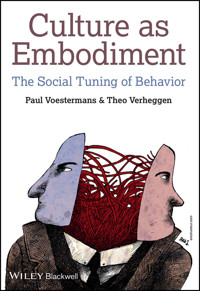
Culture as Embodiment utilizes recent insights in psychology, cognitive, and affective science to reveal the cultural patterning of behavior in group-related practices.
- Applies the best of the behavioural sciences to contemporary issues of behavioural cross-fertilization in global exchange
- Presents an original theory to be used in the gender and integration debates, about what the acceptance of newcomers from different cultural backgrounds really entails
- Presents a theory that is also applicable to youth culture and the split in modern society between underclass, modal class, and the elite
- Contains an original approach to the persistence of religion, and relates religious thought to the cognitive capacity of generic belief
Sie lesen das E-Book in den Legimi-Apps auf:
Seitenzahl: 682
Veröffentlichungsjahr: 2013
Ähnliche




















Table of Contents
Title page
Copyright page
Preface
Acknowledgments
Part One: Towards a New Psychology of Culture
1: Understanding Culture
Cultural Confrontations
Misconceptions of Culture
Beyond Homo Clausus
Five Key Domains of Patterned Behavior
Real People in Real Groups
In Search of a Psychological Perspective on Culture
2: Inventing Culture Theory
Early Cultural Confrontations
Later Developments
National Accents
Culture as Salutary Superstition
Persistent Patterns and Biology
Beyond Biologism and Culturalism: Organisms in the Plural
Biological Affordances of Meaning
3: A Psychological Perspective on Culture
Crucial Cognitive Capacities
Meaning and Normativity
Norms and Values Revisited
The Body in Two Variations
The Social Form of Feelings and Emotions
The Intrinsic Social Group
The Automaticity of Everyday Life
A Psychological Perspective on Culture
Part Two: Sex, Status, Age, Ethnicity, and Faith
4: Sex: The Shaping of Sex and Gender
Sexutopia No Go
Asymmetry and Dominance
The Problematic Public Side of Sex
Ritualization of Sex and Gender
The Science of Sex
Denial of the Flesh
The Western Marriage Arrangement
The Education of the Senses
5: Status: The Body of Class and Organized Compliance
Class Revisited
Demarcation of an Underclass
High versus Low
The Non-Debate of Structure versus Culture
Body and Language
Conclusion
6: Age: The Optimal Balance of Love and Challenge
Body and Affect
The De-particularization of the Body
Including the Young in the Order of Adults: Attachment and Stimulation
The Cultural Framing of Closeness and Distance
Talent and Motivation
7: Ethnicity: Cultural Arrests and Bicultural Competence
Integration is not an All or Nothing Process
Cultural Arrests
Bicultural Competence
Integration Policy Revisited
8: Faith: Religion as a Man-made Order
A Behavioral Scientific Approach to Religion
Why is Religion so Persistent?
Criticism and Resilience
Religion Revisited
Conclusion
Part Three: Psychology and Globalization
9: A Psychology of Globalization
Behavioral Globalization
Ecological Conditions for Civilization
A Further Head Start for Europe in Particular
Archaic and Early Modern Globalization
Appealing Applications in the Western Civilizing Offensive After 1800
The Appeal of the Western Way of Life
A Positive Agenda
The Behavioral Impact of the Enlightenment
10: Epilogue
Bibliographical Essay
Chapter 1 Understanding Culture
Chapter 2 Inventing Culture Theory
Chapter 3 A Psychological Perspective on Culture
Chapter 4 Sex: The Shaping of Sex and Gender
Chapter 5 Status: The Body of Class and Organized Compliance
Chapter 6 Age: The Optimal Balance of Love and Challenge
Chapter 7 Ethnicity: Cultural Arrests and Bicultural Competence
Chapter 8 Faith: Religion as Man-made Order
Chapter 9 A Psychology of Globalization
Chapter 10 Epilogue
Index
This edition first published 2013
© 2013 John Wiley & Sons, Ltd
Dutch edition published 2007 by Open Universiteit Nederland and Blackwell Publishing Ltd
Wiley-Blackwell is an imprint of John Wiley & Sons, formed by the merger of Wiley's global Scientific, Technical, and Medical business with Blackwell Publishing.
Registered Office
John Wiley & Sons Ltd, The Atrium, Southern Gate, Chichester, West Sussex, PO19 8SQ, UK
Editorial Offices
350 Main Street, Malden, MA 02148-5020, USA
9600 Garsington Road, Oxford, OX4 2DQ, UK
The Atrium, Southern Gate, Chichester, West Sussex, PO19 8SQ, UK
For details of our global editorial offices, for customer services, and for information about how to apply for permission to reuse the copyright material in this book please see our website at www.wiley.com/wiley-blackwell.
The right of Paul Voestermans and Theo Verheggen to be identified as the authors of this work has been asserted in accordance with the UK Copyright, Designs and Patents Act 1988.
All rights reserved. No part of this publication may be reproduced, stored in a retrieval system, or transmitted, in any form or by any means, electronic, mechanical, photocopying, recording or otherwise, except as permitted by the UK Copyright, Designs and Patents Act 1988, without the prior permission of the publisher.
Wiley also publishes its books in a variety of electronic formats. Some content that appears in print may not be available in electronic books.
Designations used by companies to distinguish their products are often claimed as trademarks. All brand names and product names used in this book are trade names, service marks, trademarks or registered trademarks of their respective owners. The publisher is not associated with any product or vendor mentioned in this book. This publication is designed to provide accurate and authoritative information in regard to the subject matter covered. It is sold on the understanding that the publisher is not engaged in rendering professional services. If professional advice or other expert assistance is required, the services of a competent professional should be sought.
Library of Congress Cataloging-in-Publication Data
Voestermans, P. (Paul), 1946–
[Cultuur & lichaam. English]
Culture as embodiment : the social tuning of behavior / Paul Voestermans and Theo Verheggen.
pages cm
“Dutch edition published 2007 by Open Universiteit Nederland and Blackwell Publishing Ltd.”
Revised edition of the author’s Cultuur & lichaam : een cultuurpsychologisch perspectief op patronen in gedrag.
Includes bibliographical references and index.
ISBN 978-1-119-96188-8 (cloth)
1. Social psychology. 2. Ethnopsychology. 3. Culture and psychology. I. Verheggen, Theo, 1972– II. Title.
HM1033.V6413 2013
302–dc23
2013011895
A catalogue record for this book is available from the British Library.
Cover image: © Ares, www.areshumour.com
Cover design by Design Deluxe
Preface
At the beginning of the new millennium, when the tension between the Islamic East and the Christian West was high on the international agenda, one topic of conversation among scientists and politicians was clashing civilizations and conflicting cultures. In New York, London, and Madrid, in Copenhagen and The Hague, and more recently in Oslo and on Utøya, terrorist attacks and threats lugubriously illustrated how heavily societies are under pressure. Culture and religion were seen almost immediately as the culprits and for many people the two appeared virtually synonymous.
In this book we will pay attention to the relationships between culture and religion. Yet, our main focus will be on “culture.” When around 2008 terrorism was no longer the most important political issue but instead the worldwide financial crises had broken, the “culture of greed” among bankers and brokers, and in the European context also the national “culture of irresponsibility and laziness” in the south, were held responsible for much of the financial misery. Once more, culture was selected as the preeminent determinant of people's behavior.
However, time and again it appears to be difficult for scientists, politicians, and social commentators alike to really make sense of culture, cultural differences, and cultural conflicts. That is remarkable in a way, because of the omnipresence of the term “culture” in speech and print, which suggests that it must have quite some explanatory power. Dissimilarities between people and problematic integration are quickly attributed to differences in culture. For instance, in the 1970s and 1980s, the multicultural Dutch society welcomed newcomers with the slogan that they could integrate while retaining their own culture. In real life, this turned out to be a highly problematic task, since it proved to be very hard to establish what the culture of the newcomers entailed. But it was just as difficult for the Dutch to concretely establish what defines their own receiving culture (and what the Dutch identity demands from the newcomer).
Symptomatic of these challenges are the cases in which the culture of newcomers needs to be taken into account in a more formal, legal way. In an ethnic murder case, for example, the cultural background of the accused might be used as a claim for mitigation when someone's family honor is violated under the new circumstances. Dutch judges have struggled with this issue. It shows that culture is thought of as the totality of practices and convictions that are so closely tied to the person that it is very hard to get rid of them, or as the case may be, to change them. Problems arise when such a representation is used to justify unwanted behavior, as we will see in this book.
There are other instances that reveal a way of thinking about integration and the acquisition of a different set of cultural behaviors that is downright simplistic. When politicians demand that newcomers take an exam before they are permitted to settle in the host country, as is for instance the case in the Netherlands or Germany, the implicit assumption seems to be that a new culture can to a large extent be acquired from reading a book. According to this reasoning, sheer knowledge of the norms and values of a society may serve as the test that successful integration has taken place. We might wish that it would be that simple. Culture is by no means something that can be subtracted or added at will. Policymakers were forced to conclude that “integrating while retaining one's own culture” calls for a paradoxical task: to try and become really Dutch, German, British, American, and so on, while leaving intact the cultural self that was acquired in one's country of origin. In North European law courts it became clear every so often that referring to local codes of law did not prevent honor killings. Becoming culturally experienced in a new country or group is not simply a matter of knowing what one should do and knowing how to do it; it is foremost a matter of engaging in new practices, while one's existing practices and feelings, acquired in the society of origin, tend to persist – even if more “knowledge” about the host society is administered.
We will give practices due attention in this book. By practices we mean the behaviors that people carry out almost automatically in a characteristic manner. Walking, looking at others, talking, wearing clothes, gesticulating, and discussing are all examples of practices that people who belong to the same group acquire and express in a comparable manner. Not only observable behavioral styles, but also feeling, taste, and preference become styled to an important extent in line with communal requirements and manners. In all these domains, the differences between members of different groups are clearly visible. A member of the upper echelons of society tends to have a distinct way of eating, handling a glass of wine, moving, talking, and so on. These behavioral patterns usually differ clearly from someone of the lower strata. It is the person's expressive body that is the preeminent indicator of the social circles in which she or he has been raised and has been living.
Based on such examples we might be tempted to surmise that the social milieu, the environment, or even the culture is responsible for the way the person moves and communicates. Yet, this is precisely the kind of suggestion we will argue against in this book. In our opinion, it is a misconception to believe that environments and cultures act upon people. It is only people who act upon other people; there are no other entities or structures that truly determine people's behavior. In this regard, we are in clear opposition to the common view in sociology that social structures organize behavior, and that thereby leaves out the acting individual. We argue that it does not suffice to say that culture is the cause of differences between people. On the contrary, it is “culture” itself that needs to be understood. The concept and its use need to be dissected, to analyze what exactly it is we talk about when we say that this or that behavior is a matter of culture.
An obvious question to be answered is how people learn to act in accordance with what is common within their group. To begin with, “acting,” “in accordance with,” “group,” and “common” are terms that need further clarification, no matter how familiar they may sound. In Part One, we will deal with these terms in detail. We will focus particularly on the crucial role of the human body. The body (oftentimes reduced to the brain) is never an isolated machine, as seems to be assumed in so many current neuropsychological approaches to human functioning. It is always related to other bodies – to other persons, that is – as the joint bearers and co-producers of all sorts of meanings. We will show that participation in the practices of the group to which one belongs is anything but noncommittal. Rather, again and again people can be observed to act naturally and authentically in accordance with what is prevalent in the group, explicitly but also implicitly. The unobtrusive learning and the self-evident expression of what is considered proper within the boundaries of one's own community are of special importance. Such implicit normativity is often overlooked in prescribing cultural exams and in establishing what is successful integration. A feeling for the situation or a sense of what is proper behavior at a given moment cannot be gained from instructions alone. In many social situations, one can only learn from experience what is considered to be right and what is not. This involves enduring practice, with all its mistakes; and by being continuously corrected by experts in the situation one may finally gain mastery. Especially in delicate situations in which a “proper” tone or a “right” attitude make all the difference, behavioral mismatches and incompatibilities of style quickly become problematic. Invoking an abstract notion of “culture” is of little use in these circumstances.
In the chapters that follow, we proceed from the assumption that the most viable way to deal with such problems is to focus on the way in which people's actions, thoughts, and feelings are mutually shaped and styled within the community they are part of. A well-trained observer learns to identify characteristic patterns, which can be found in all areas of life. That is why we will use the notion of behavioral patterns so explicitly in this book. Without most people realizing it, those patterns are the result of ongoing practice and training, which also makes these patterns (practices) so resistant to change. As an example, one might try to lose the accent typical of the group one has been raised in. It is a very tough task, surely, in the long run. Yet, we all know that such a minor thing as having an accent is hardly without social consequences. It illustrates the persistence of the behavioral patterns that we will deal with.
Part One is about the way in which persistent patterns of behavior come into being. We will show that these patterns become almost tangible when the body, the feelings, and the behaviors of individual people become mutually styled and tuned within their community. People embody, also in a literal sense of the word, what is current and common in the group. This styling results from participation in the practices that characterize a group. We have devised an analytical toolkit, a set of psychological perspectives on how people acquire styles in close relation to the behavior of their parents, peers, and important others. Our tools include, among other things, a focus on bodily practices in the intrinsic social group, with an emphasis on “automaticities” and on the social tuning of feeling. For cases where there is a mismatch between acquired routines and practices and what is demanded because of changes in one's social situation, we have created a new research perspective that focuses on so-called “cultural arrests.”
Topical issues that involve cultural patterning can be found in Part Two. It is the proof of the pudding in which our analytical perspective on “culture” is applied to five domains of human affairs that are, in our view, crucially important in any society. These domains pose fundamental problems to human interactions, and every society must find solutions for them, as it were, in terms of behavioral patterning. The five domains cover, respectively, relations between men and women, relations between people with a high social status and those with a lower social status, relations between adults and youngsters, relations between people of one's own group and outsiders, and finally relations between religious believers and people who are not. In all these domains we will demonstrate how behavioral patterns typify the interactions and how in some cases persistent patterns can lead to unpleasant intra- and intercultural confrontations.
In Part Three we present a psychological view on globalization. We argue that behavioral practices and lifestyles have begun to resemble each other worldwide, particularly in urban areas. Western patterns of behavior seem to be especially appealing to others. We investigate where this appeal comes from. At the same time, however, we contend (and we are certainly not the first to do so) that globalization or modernization is not the same as Westernization, but is the result of an already long history of continual behavioral exchanges between the West and other parts of the world. In that context, we attempt to correct ideas of Western superiority in terms of behavioral, political, and moral accomplishments. We offer a more balanced global perspective, inspired much more by Spinoza's radically enlightened views than by the standard story of Western Enlightenment.
It should be clear that this book is not about multicultural issues per se. “Culture” is always at play whenever people act together. However, the notion of “culture” itself is often applied so thoughtlessly that it has not been very helpful in understanding why and how people do what they do, within a community of others who perform things in a similar manner. An important adage of the book is that any explanation one gives for the behavior of other people ought to also clarify why one's own behavior does or does not fit that very same explanation.
Paul Voestermans and Theo Verheggen, 2013
Acknowledgments
The most agreeable task of writing a book is to thank at the end those who have inspired, stimulated, and supported us. We first mention Peter Naus, who took great pains to improve the English text and to correct our arguments where we were unclear or where we argued unconvincingly. Ruud Abma has been a close friend and has encouraged us to endure the hardships involved in writing a book in a non-native language. We also thank Erik Rietveld and Mike Lindell for critically reading large parts of our text. Numerous anonymous students from various universities in the Netherlands commented on the Dutch predecessor of this book. Their critical support inspired us to bring the book to a wider audience. Wiley-Blackwell has provided us with the editorial assistance of Michael Coultas, Jane Hammett, and Joanna Pyke. We are very grateful to all for their help in strengthening our argument and correcting our stylistic mistakes. Of course, all remaining mistakes are entirely ours.
Both Ingrid Kemperman and Anke Roijakkers endured a long process of endless enthusiasm and crippling doubt on our part. Without their faith, patience, support, and love we would have been lost in this demanding task. Luckily, they subtly redirected our attention to much more valuable matters whenever we were about to sink in what we deemed so terribly important. We cannot express how glad we are to have such loving and wise wives.
Part One
Towards a New Psychology of Culture
1
Understanding Culture
Time and again research reveals that we expose ourselves to all kinds of dangers because of our unhealthy behavior. Many people live unhealthy lives and the negative effects have been scrutinized, even up to chemical reactions in the uterus. But to no avail – people still drink too much alcohol, they eat too much, and they smoke too much. And all this happens from an early age onward. People keep taking drugs, keep gambling, continue to take too much medicine, and they fail to exercise enough while trying to maintain their body weight in a rather unhealthy fashion. There is plenty of research into the biological causes and effects of these behaviors. Eric Nestler and Jennifer Chao (2004) in the United States and Arnt Schellekens and colleagues (2012) in the Netherlands are well known for their research into the biology of addiction. They have studied the dopamine system in particular. Some drugs increase the level of the neurotransmitter dopamine, leading to extraordinarily pleasant experiences. After the peak in dopamine production there is a fall that often reaches beyond the normal level. At that point, the need for a new peak experience is high, leading to a pattern of addiction. Scientists also know a great deal about the cognitive processes behind all kinds of addiction. It is well known, for instance, that women in particular (though not all of them, of course, and including a significant number of men) are prone to eat too much because they may have difficulty controlling their emotions and seek refuge in food. Tatjana van Strien and colleagues (2012) have studied all kinds of myths regarding dieting. Her research has shown that it is time for a cognitive psychological approach to destructive eating habits. Such behavioral patterns are usually about finding a solution for depression and feelings of dissatisfaction. Eating is not the answer, then, but identifying the origins of the depression often does provide the solution.
As much as we may know about the dangers of unhealthy behavior and its biological underpinnings, when it comes to changing the behavioral patterns that have such devastating effects, often we can only admit that we just do not understand why people remain so committed to them. Consider for a moment the numerous public campaigns in the European Union and the United States against smoking. Despite all the measures to prohibit people from smoking, and despite all the knowledge that children and adolescents have of its detrimental effects, smoking continues to be a common habit for many adolescents and adults. The persistence appears not only to depend on the biological phenomenon of addiction. Otherwise far fewer people would have quit smoking in the past decades in many Western countries. But knowledge and awareness of the effects of smoking do not appear to be sufficient safeguards either. Otherwise, we might have expected many more people to have quit.
It is easily overlooked, then, that individual behavior depends to a great extent on what is common or habitual in people's social circles, and less on what a person may consciously choose or know. Behavior becomes stylized or shaped in the community that we are part of. What goes on between individuals is therefore crucial. Acquiring habits is an interactive affair and certainly not the mere result of processes going on in the single organism alone. Moreover, it is extremely difficult to detach oneself from such habits once acquired. People find it hard to change their daily routines, since these have often become largely automated practices within the community that they are part of. People believe in their ways of doing things and are committed to them. These practices grant a face to the group, as well as to its individual members.
Usually, it is not until we change our cultural environment that we realize how natural and self-evident our everyday patterns of behavior are. We become aware of the persistence of our behavioral patterns when we get cut off from the group in which this behavior became shaped in the first place. Going to university, for example, and leaving behind the group of peers we grew up with makes us aware of the patterns we have adopted in the past. Uneasy feelings arise once we notice that our customary practices no longer fit in the new environment. We then not only realize how self-evident and fully automated our learned routines are; we also become aware of the extreme difficulty of giving up established patterns, even if there is no addiction involved.
Lesen Sie weiter in der vollständigen Ausgabe!
Lesen Sie weiter in der vollständigen Ausgabe!
Lesen Sie weiter in der vollständigen Ausgabe!
Lesen Sie weiter in der vollständigen Ausgabe!
Lesen Sie weiter in der vollständigen Ausgabe!
Lesen Sie weiter in der vollständigen Ausgabe!
Lesen Sie weiter in der vollständigen Ausgabe!
Lesen Sie weiter in der vollständigen Ausgabe!
Lesen Sie weiter in der vollständigen Ausgabe!
Lesen Sie weiter in der vollständigen Ausgabe!
Lesen Sie weiter in der vollständigen Ausgabe!
Lesen Sie weiter in der vollständigen Ausgabe!
Lesen Sie weiter in der vollständigen Ausgabe!




