


9,99 €
Mehr erfahren.
- Herausgeber: Parkstone International
- Kategorie: Geisteswissenschaft
- Sprache: Englisch
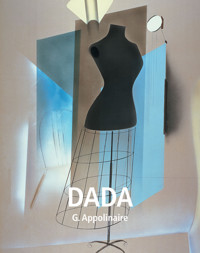
Dada shocked the world between the years 1916 and 1922. Dada was not an art movement in the normal sense. It was a storm that broke over the art scene of the time, as the war upon the peoples. They consciously staged anti-art events. According to Max Ernst, it was the 'outbreak of anger and zest for life' at the same time. The indignation about the monstrous genocide during World War I was great and equally at the 'civilization that had brought it about.' Dada was an international uprising. The war radically changed the art scene in the vibrant cities of Europe. The international links that had brought forth artistic masterpieces, primarily between France, Italy, Germany and Russia, were abruptly torn apart. The intellectual elite that had stayed at home and those who had come back from the war sobered sought new ways to express their experiences and insights. Among the contributors were Duchamp, Picabia, Taeuber-Arp, Man Ray, Schwitters and Arp.
Das E-Book können Sie in Legimi-Apps oder einer beliebigen App lesen, die das folgende Format unterstützen:
Seitenzahl: 62
Veröffentlichungsjahr: 2019
Ähnliche




















Layout:
Baseline Co. Ltd,
Vietnam
© Parkstone Press International, New York, USA
© Confidential Concepts, Worldwide, USA
© Image-Barwww.image-bar.com
All rights reserved.
No part of this publication may be reproduced or adapted without the permission of the copyright holder, throughout the world. Unless otherwise specified, copyright on the works reproduced lies with the respective photographers. Despite intensive research, it has not always been possible to establish copyright ownership. Where this is the case, we would appreciate notification.
ISBN: 978-1-64461-872-1
G. Appolinaire
CONTENTS
I. Preface: The War – The Stimulus For Dada
II. Dada – The Cradle Of Surrealism
III. Dada Outside Zürich
IV. Dada In Paris
The Artists
Marcel Duchamp (1887 Blainville – 1968 Neuilly-Sur-Seine)
Francis Picabia (Paris 1879 - Id 1953)
Sophie Taeuber-Arp (1889 Davos, Switzerland – 1943 Zürich)
Man Ray (1890 Philadelphia – 1976 Paris)
Kurt Schwitters (1887 Hanover – 1948 Kendal)
Jean Arp (1886 Strasbourg – 1966 Basel)
List Of Illustrations
I. PREFACE: THE WAR – THE STIMULUS FOR DADA
At the start of the First World War, each of the Dada artists was about twenty years old. After the monstrous crimes of the Second World War, after the extermination of millions of people in concentration camps and the destruction of Japanese cities with the atomic bomb, previous wars seemed only like distant historical episodes. It is difficult to imagine what a disaster, and in fact what a tragedy, the First World War was. The first years of the twentieth century were marked by outbreaks of conflict in various parts of the world, and there was a sense that people were living on a volcano. Nevertheless, the start of the war came as a surprise.
On June 28, 1914, in the Serbian city of Sarajevo, the student Gavrilo Princip killed the Austrian Archduke Franz Ferdinand and his wife. A war began in the Balkan; events developed swiftly. On the 1st of August, Russia joined the war against Germany, and on the 3rd and 4th of the same month, France and Britain declared war on Germany. It was only the defeat of the Germans on the Marne from September 5 to 10 that saved Paris from destruction. At the same time, this led to a drawn-out positional war which turned into a nightmare. Many thousands of young people from every country who took part in the war never returned home, but fell victim to shrapnel, died in the trenches from illnesses, or were poisoned by the gas which the Germans used in the war for the first time in 1916. Many returned as invalids and were later to die as a result of their war wounds. And it was exactly this generation that would create the art of the twentieth century and carry on from the boldest beginnings of its predecessors.
Before the war, the artistic life of Paris revelled in the most complete and entrancing freedom. The Impressionists and the masters of the period of Post-Impressionism untied artists’ hands. A sense of the barriers in art established by a tradition or a school had vanished. Young artists could permit themselves everything that was possible or impossible. The boldness of the late-nineteenth-century generation drew them into the field of the study of colour and form. In 1890, the young painter and theoretician of art, Maurice Denis, put into words for the first time what they had come to realize from the work of their predecessors: “A painting, before it is a warhorse, a nude woman or some sort of anecdote is essentially a flat surface covered with colours put together in a certain order.”
The most important thing in painting was colour, and it required special investigation. In the 1880s, Seurat and Signac had already turned to chemists and physicists with the aim of establishing a science of colour which they could use for themselves. The texture of the paint that was applied to the canvas contributed to the force of the colour. The nervous expressiveness of the colourful strokes in Van Gogh’s paintings enraptured young artists at exhibitions held after his death.
The ‘Salon des Indépendants’ was established in Paris as early as 1884, and here anyone who wanted could exhibit his creations without the usual academic jury. In 1903, those who had never taken part in the official Salon that opened in the spring founded their own ‘Salon d’Automne’. And it was there that in 1905 Matisse and his group acquired the name “Fauves” because the violence of their colours evoked an association with beasts of prey, with wild animals in the primordial jungle. In 1907, the young poet Guillaume Apollinaire, who was an admirer of Matisse’s position in art, obtained an interview with him. In his article he quoted the words of the artist: “I have paints and a canvas, and I must clearly express myself, even in a simple way, applying three or four spots of colour or drawing three or four expressive lines.”
The Cézanne exhibition of October 1906, immediately after the artist’s death, turned the eyes of all young painters towards the form of an object. They discovered abstract forms in the creations of primitive art, in the figurines of the masters of Africa and Oceania which had entered Europe in large quantities. The most striking result of these revelations was Picasso’s Cubism: in 1907 he showed his friends his first big cubist picture, The Demoiselles d’Avignon.
Raoul Hausmann,Der Kunstkritiker, 1919-1920. Photomontage. Lithography and collage hotographique on paper, 31.8 x 25.4 cm. Tate, London.
Theo Van Doesburg,What is Dada?. La Haye, De Stijl, 1923. 14 p., 15.5 x 12.3 cm. Bibliothèque Paul Destribats, Paris
Marcel Duchamp,Bicycle wheel, 1913-1964. Original made in Paris in 1913. Replica made in 1964 by Galerie Schwarz, in Milan, under the direction of Marcel Duchamp. Ready-made. Assembling a bicycle wheel on a stool, 126.5 x 31.5 x 63.5 cm. Copy: Rrose; Centre Pompidou, Musée National d’art moderne, Paris.
Jean Arp,Forest, terrestrial forms, 1916. Relief. Painted wood, 32.7 x 19.7 x 7.6 cm. National Gallery of Art, Washington. Andrew W. Mellon Fonds.




