


18,99 €
Mehr erfahren.
- Herausgeber: John Wiley & Sons
- Kategorie: Fachliteratur
- Sprache: Englisch
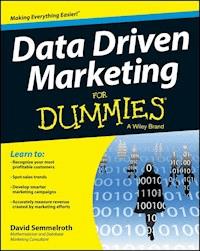
Embrace data and use it to sell and market your products Data is everywhere and it keeps growing and accumulating. Companies need to embrace big data and make it work harder to help them sell and market their products. Successful data analysis can help marketing professionals spot sales trends, develop smarter marketing campaigns, and accurately predict customer loyalty. Data Driven Marketing For Dummies helps companies use all the data at their disposal to make current customers more satisfied, reach new customers, and sell to their most important customer segments more efficiently. * Identifying the common characteristics of customers who buy the same products from your company (or who might be likely to leave you) * Tips on using data to predict customer purchasing behavior based on past performance * Using customer data and marketing analytics to predict when customers will purchase certain items * Information on how data collected can help with merchandise planning * Breaking down customers into segments for easier market targeting * Building a 360 degree view of a customer base Data Driven Marketing For Dummies assists marketing professionals at all levels of business in accelerating sales through analytical insights.
Sie lesen das E-Book in den Legimi-Apps auf:
Seitenzahl: 504
Veröffentlichungsjahr: 2013
Ähnliche



















Data Driven Marketing For Dummies®
Published by: John Wiley & Sons, Inc., 111 River Street, Hoboken, NJ 07030-5774, www.wiley.com
Copyright © 2013 by John Wiley & Sons, Inc., Hoboken, New Jersey
Published simultaneously in Canada
No part of this publication may be reproduced, stored in a retrieval system or transmitted in any form or by any means, electronic, mechanical, photocopying, recording, scanning or otherwise, except as permitted under Sections 107 or 108 of the 1976 United States Copyright Act, without the prior written permission of the Publisher. Requests to the Publisher for permission should be addressed to the Permissions Department, John Wiley & Sons, Inc., 111 River Street, Hoboken, NJ 07030, (201) 748-6011, fax (201) 748-6008, or online at http://www.wiley.com/go/permissions.
Trademarks: Wiley, For Dummies, the Dummies Man logo, Dummies.com, Making Everything Easier, and related trade dress are trademarks or registered trademarks of John Wiley & Sons, Inc., and may not be used without written permission. All other trademarks are the property of their respective owners. John Wiley & Sons, Inc., is not associated with any product or vendor mentioned in this book.
Limit of Liability/Disclaimer of Warranty: while the publisher and author have used their best efforts in preparing this book, they make no representations or warranties with respect to the accuracy or completeness of the contents of this book and specifically disclaim any implied warranties of merchantability or fitness for a particular purpose. no warranty may be created or extended by sales representatives or written sales materials. The adviCe and strategies contained herein may not be suitable for your situation. you should consult with a professional where appropriate. neither the publisher nor the author shall be liable for damages arising herefrom.
For general information on our other products and services, please contact our Customer Care Department within the U.S. at 877-762-2974, outside the U.S. at 317-572-3993, or fax 317-572-4002. For technical support, please visit www.wiley.com/techsupport.
Wiley publishes in a variety of print and electronic formats and by print-on-demand. Some material included with standard print versions of this book may not be included in e-books or in print-on-demand. If this book refers to media such as a CD or DVD that is not included in the version you purchased, you may download this material at http://booksupport.wiley.com. For more information about Wiley products, visit www.wiley.com.
Library of Congress Control Number: 2013946293
ISBN 978-1-118-61584-3 (pbk); ISBN 978-1-118-61576-8 (ebk); ISBN 978-1-118-61583-6 (ebk); ISBN 978-1-118-61601-7 (ebk)
Manufactured in the United States of America
10 9 8 7 6 5 4 3 2 1
Data Driven Marketing For Dummies®
Visit www.dummies.com/cheatsheet/datadrivenmarketing to view this book's cheat sheet.
Table of Contents
Introduction
About This Book
Foolish Assumptions
Icons Used in This Book
Beyond the Book
Where to Go from Here
Part I: Getting Started with Data Driven Marketing
Chapter 1: Data Driven Marketing 101: It’s All About the Customer
What Data Driven Marketing Is (and Isn’t) About
Database marketing versus direct marketing
Database marketing and customer relationship management
Marketing to businesses
Database marketing and small businesses
Focusing on the Customer
Getting customer data from your companies systems
Integrating data at the customer level
Managing contact information
Communicating with the household
The Database Marketing Campaign
The target audience
The offer
Your marketing message
Timing your message
Analyzing Customer Data
Grouping customers into segments
Building response models
Measuring Results
Chapter 2: Communicating Directly with Your Customers
So, What Is a Database Marketing Campaign?
Narrowing your focus to the target audience
Showcasing what you have to offer
Deciding how you will communicate
Determining when to send it
Hitting the Bull’s-eye: The Target Audience Isn’t Everyone
Understanding your customer base
Sizing your audience
Crafting Your Offer
Talking Directly to Your Customer: Using Data to Tailor Your Message
Don’t Sell Snow Shovels in July: Timing Your Message
Using Database Marketing Effectively: The Tactical Advantage
Customer-retention tactics
Cross-sell tactics
Upsell tactics
Beyond Mass Mailings: More Sophisticated Campaigns
Communication streams
Event-triggered messages
Chapter 3: The Forest for the Trees: Where Is the Customer in All That Data?
A Marketing Database Is About Your Customers
What makes a marketing database different
What’s in a marketing database
How a marketing database is organized
Some Assembly Required: Building the Customer Record
Cleaning up addresses
Updating addresses
Marketing Is a Family Affair: Understanding the Household
What is a household?
Why the household is so important
Growing Your Customer Base: Prospective Customers
Online shoppers
Call center data
Some other sources of prospects
No Trespassing! Respecting Your Customers’ Privacy
Protecting customer data
Sharing customer data
Keeping your customer informed
Some legal considerations
Chapter 4: Using and Managing Your Customer Contact Information
Contacting Your Customers
Mailing physical media
Firing off e-mails
Sending text messages
Dialing the phone
Don’t Waste Your Breath: Allowing Customers to Opt Out
Because it’s the right thing to do
Because sometimes it’s the law
Different Strokes for Different Folks: Understanding Customer Preferences
Opting in versus opting out
Other types of preferences
Chapter 5: Getting Your Message Out: Marketing Campaign Basics
Measure Twice, Cut Once: Don’t Skip These Steps
Cleaning up your mail file
Don’t contact people who don’t want to hear from you
Trust but verify: Proofing the mail piece
Planting a seed: How to spy on your mail vendor
Remembering What You Did: The Importance of Promotion History
It’s about more than just who you mailed
Documenting your mailing
Knowing When to Shut Up: Contact Management
Part II: Digging Deeper into Your Data: Analytics
Chapter 6: You’re Going to Need a Geek: Introduction to Analyzing Data
What Are Statistics, Anyway?
The Average Customer Doesn’t Exist: Understanding Variation
Growing or shrinking: Variation over time
The average car has 3 doors: Variation in groups
Misleading averages: Wide variation
Looking for Relationships in Your Data
Connections between customer traits
Campaigns Are Experiments: Using the Scientific Approach
Designing a measurable campaign: Control groups
Taking a sample: Selecting customers at random
Looking for Significant Results
Being confident in your measurements
Sizing your control group
Multitasking: Combining Customer Traits
Finding useful groupings of customers
The crystal ball: Making predictions
Chapter 7: Birds of a Feather Buy Together: Segmenting Your Customers
Understanding Demographic Data
Common types of demographic data
Where does demographic data come from?
If You Have to Ask, You Can’t Afford It: Grouping Customers Using Income Data
Fish where the fish are: Understanding affordability
Champagne taste or beer budget: Price-sensitive customers
Generation Gap: Grouping Customers by Age
Understanding generational differences
The generation gap and digital media
Grandkids? I Don’t Even Have Kids! Grouping Customers by Lifestage
What Would I Do With a Parka? Grouping Customers by Geography
Geographic groupings
Knowing where to focus
Sending your customers to the right place
Timing your communications
Staying Out of Trouble: Some Legal Considerations
Consult your attorney: Knowing your industry’s legal environment
Watching where you tread: Potential data landmines
Chapter 8: Getting the Most from Your Transaction Data
They Bought How Many? Simplifying Transaction Data
Just count ’em: Summarizing transactions at the customer level
Bucketing transactions into categories
Deriving customer attributes from transaction data
Transaction Data from the Web
Data related to e-mail campaigns
Page-use data
Grouping Customers Using Transaction Data
Finding and keeping your loyal customers
An example from the credit-card industry
Timing Is Everything: Understanding When Customers Purchase
The Christmas rush: Seasonal purchase patterns
Transactions and seasonal patterns
Responding to customer behavior
History Has a Way of Repeating Itself: RFM Models
Recency, frequency, and monetary value: The RFM framework
Building the model
Beer and Diapers: Market-Basket Analysis
Chapter 9: The Good, the Bad, and the Ugly: Understanding Customer Profitability
Revenue Isn’t Profit: Accounting for Costs
Allocating customer-specific costs
Allocating infrastructure costs based on usage
Tying cost back to the product
Not Rocket Science: Keeping It Simple
Understanding Household-Level Profitability
Retaining Your Profitable Customers
Using Profitability to Find New Customers
Dealing with Unprofitable Customers
It Takes a Lifetime: Understanding Changes in Customer Profitability
Recognizing movements in customer profitability
Calculating Customer Lifetime Value
Part III: Putting Your Data to Work
Chapter 10: The Tactical Advantage: Designing Data Driven Marketing Campaigns
Event-Triggered Campaigns: Understanding the Basics
Event-triggered campaigns versus mass mailings
Choosing a marketing channel
Campaign timing depends on data timing
An Ounce of Retention Is Worth a Pound of Lure: Holding on to Your Customers
Take it to the bank
Experience matters: Dealing with customer problems
Expiration date: Keeping the relationship alive
Sticker shock: Don’t just send them a bill
We miss you: Reactivation
If You Like That, You’re Going to Love This: Upselling to Your Customers
Why upselling works
Upselling service levels
Using bounce-back offers
Batteries Not Included: Cross-Selling to Your Customers
Cross-selling online
Back to bounce-backs
Welcome (Back) to the Neighborhood: Using Address Changes
Chapter 11: From the Window to the Counter: Getting Shoppers to Buy
Identifying Shoppers
Put me on your mailing list: Getting customers to raise their hands
Encouraging shoppers to register on your website
Not a Snap Decision: Understanding Your Customer’s Mindset
The decision-making process
Understanding the timeline for purchase decisions
So Why Didn’t They Buy? Overcoming Purchase Barriers
Identifying purchase barriers
Types of barriers
Social media and purchase barriers
Chapter 12: Crafting Your Marketing Message
Getting Your Message Heard
Getting past the recycling bin
Making sure your message is effective
Using Technology to Customize Communications
Customizing e-mail messages
Customizing offline communications: The power of digital printing
Using Images in Your Messages
Integrating your message with advertising campaigns
Using customized images in your communications
Getting the Product Right
Using Customer Profiles to Craft Messages
Speaking to the target audience
Customizing the message
Chapter 13: Using Customer Data Online
There’s More to E-mail Than You Might Think
Understanding how customers deal with spam
Collecting e-mail effectively
Tracking e-mail effectiveness
Serving Up Web Content Dynamically
Using information about browsing behavior
Using information about the customer
Recognizing Customers Online
Recognizing where they are: IP addresses
Recognizing who they are: Cookies
Customer Data and Search Engines
Part IV: The Feedback Cycle: Learning from Experience
Chapter 14: Learning Curve: Setting Up a Testing Plan
Using the Scientific Approach
Lesson Plans: Deciding Beforehand What You Want to Learn
You can’t test everything
Tracking responses
Taking a Random Sample
Selecting every nth record
Flipping a coin
Getting Significant Results: Sample Size Matters to Confidence Level
More about flipping coins
Sample size and confidence levels
Other factors that influence confidence levels
Mission Control: Using Control Groups
Control groups and measurement
Being careful: A couple of warnings
Out of Control: Reasons to Skip the Control
Small target audiences
Lost opportunities
Chapter 15: Getting to the Bottom Line: Tracking and Measuring Your Campaigns
Defining Responses Clearly: A Couple of Things to Keep in Mind
Counting responses
Closing the tracking window: How long do you wait for responses?
Getting a Handle on Costs: Some Common Metrics
Cost per thousand: CPM
Measuring Marketing Effectiveness in the Online World
Getting the customer to your website: Metrics related to e-mail campaigns
Understanding browsing behavior: Some simple web metrics
How Did You Do? Assigning Value to Your Database Marketing Campaigns
Understanding lift: Calculating your net response rate
The bottom line: Net revenue and return on investment
Chapter 16: Putting Your Geek to Work: Analyzing Campaign Results
Measurement versus Classification: Numeric Data and Categorical Data
Understanding Numeric Variables
Interval and ratio data: When averages are meaningful
Ordinal data: When averages aren’t meaningful
Analyzing Response Rates: The Simple Approach
Response distributions
Analyzing non-categorical data
Advanced Approaches to Analyzing Response Data: Statistical Modeling
The problem with cross tabs
What is a statistical model?
The model development process
Preparing your data
Building the model
Common Response Modeling Techniques
Classification trees
Creating response scores
Chapter 17: Sharing Customer Data Throughout Your Enterprise
Customer Data and Advertising
Buying traditional media
Buying “new” media
Assisting with Marketing Research
Selecting focus groups
Customer data and survey research
Customer Data and Product Development
Customer Data and Pricing
What is revenue management?
Beyond the airline industry
Customer Relationship Management
What is CRM?
Sharing data across customer touchpoints
Customer Data and Law Enforcement
Customer data and criminal investigations
Customer data and civil suits
Part V: The Part of Tens
Chapter 18: Ten (or So) Ways to Capture Customer Data
Identifying Customers with Loyalty Cards
A Variation on the Theme: Rewards Cards
Tracking Transactions with Offer Codes
Identifying Potential Customers with Newsletters
Offering Physical Information Packets
Encouraging Web Registrations
Building a More Robust Online Customer Profile
Customer Data and the Call Center
Customer Data at the Point of Sale
Purchasing Customer Lists
Purchasing Demographic Data
Chapter 19: Ten Resources for Information and Assistance
Joining the Direct Marketing Association
Subscribing to Industry Publications
Using Census Data
Getting Familiar with the Post Office
Keeping Up with the Regulatory Environment
Hiring Direct-Marketing Service Providers
Buying Creative Services
Grouping Your Customer Records into Households
Third-Party Data Providers
Analytic Software
About the Author
Cheat Sheet
Connect with Dummies
Introduction
Welcome to Data Driven Marketing For Dummies!
But … what do I mean by data driven marketing? All marketing disciplines are fundamentally concerned with attracting and retaining customers. They’re also all driven by data, in some sense. Marketers don’t just haphazardly develop communications. They take as much information into account as they have available.
Database marketing, or data driven marketing, is a discipline which takes the use of information to an extreme. Data driven marketing, as I use the term in this book, can be characterized by three things:
It’s a form of direct marketing: Database marketers develop communications that are delivered directly to consumers. This has traditionally been done through direct mail and e-mail. But the principles of direct marketing are being used with increasing sophistication to deliver marketing messages via text messages, social media, web content, and other electronic channels.
It’s fundamentally focused on individual customer information: The database in database marketing refers to a customer database which contains purchase history, demographics, and other information about each customer. This level of detail forms the basis for highly relevant, personalized, and customized messages. This relevance drives the effectiveness of database marketing campaigns.
It’s measurable: And it’s measurable in very precise financial terms. This measurability gives the database marketer the ability to create a marketing laboratory. Audiences, offers, messages, communication channels, and anything else related to a database marketing campaign can be tested to see how well they perform.
About This Book
Database marketing requires a variety of skill sets ranging from the technical to the creative. For this reason, database marketing departments tend to be made up of a diverse set of people. This makes them fun places to work. But it also poses some communication challenges.
I wrote this book partly to help fill that communication gap. I try to address the broad spectrum of work that needs to be done in the day-to-day operations of a database marketing department. In that regard, I’ve written this book with database and direct marketers in mind.
But customer information has grown and continues to grow more central to all sorts of business decisions and strategies. For this reason, this book will appeal to anyone in the business world who takes an interest in customer data and how it can be used to your advantage.
A small note: Within this book, you may see that some web addresses break across two lines of text. If you’re reading this book in print and want to visit one of these web pages, simply type in the web address exactly as it appears in the text, pretending as though the line break doesn’t exist. If you’re reading this as an e-book, you’ve got it easy — just tap or click the web address to be taken directly to the web page.
Foolish Assumptions
I assume that if you’re reading this, you have an interest in database marketing. Though I try to define marketing-specific terms as I use them, it would be helpful for you to have a passing familiarity with basic marketing terms like target audiences and marketing channels. Plenty of introductory marketing books can give you that basic level of understanding if you don’t already have it, including Alexander Hiam’s Marketing For Dummies (Wiley, 2009).
I also assume that you’re not too put off by numbers. Database marketing involves a great deal of quantitative measurement. That doesn’t mean that you need to have an accounting background, though. Being able to calculate percentages is sufficient.
Though this subject can get somewhat technical, I make no assumptions about your knowledge of either technology or advanced mathematical methods. I attempt to explain in simple terms what the basic ideas are about. My focus is on helping you to communicate with your technical teams and vice versa. If you can add up a column of numbers in a spreadsheet, then you’re more than adequately prepared to read this book.
Some of the subjects in this book, particularly those that relate to building databases, assume that you have a fairly significant technology budget. Databases, software, and even maintenance require some level of investment. But even if this is not the case, the parts of this book that relate to developing and analyzing campaigns will still be relevant.
Icons Used in This Book
Look for these symbols to help you navigate through the text.
I use this icon to highlight specific suggestions for how to deal with a given situation.
This icon is used to point out information that you need to be aware of. I use it sometimes to summarize a point that I’m making in a section. I also use it to point out information that’s fundamental to a given topic.
There are a number of common traps that you can fall into when it comes to database marketing. What you don’t know can hurt you. I use this icon to point out situations where you need to tread carefully.
Beyond the Book
In the Part of Tens, I point out a number of websites and organizations that can provide you with information and support. Because I don’t have room to cover related topics in detail, I also refer through this book to other For Dummies books that do. In particular, Marketing For Dummies, Web Marketing For Dummies, and Social Media Marketing For Dummies (all published by Wiley) contain more detailed discussions of some of the topics in this book.
There is also some juicy, free, extra material for this book online. The cheat sheet and several companion articles can be found at www.dummies.com/extras/datadrivenmarketing/.
Where to Go from Here
I’ve worked hard to make the parts and even chapters of this book self-contained. You should be able to start anywhere in the book and feel comfortable that you haven’t missed too much to grasp what’s going on. Part I provides a good introduction to the topic of database marketing from an infrastructure perspective and might be helpful for Information Technology folks who are trying to understand how to meet the needs of their database marketing group.
In Part III, I focus on tying various database marketing strategies to specific business problems. This is a good place to go if you’re looking for ideas about how to address a specific goal.
Parts II and IV are largely concerned with the analysis of data. These are useful to non-technical marketers who want to better understand what sorts of things can be achieved through data analysis. They’re also useful to technical folks who understand advance statistics but have minimal experience in database marketing applications. For the non-technical marketers, I would recommend starting with Chapter 6 to ground yourself before moving on to other chapters.
To get the full flavor of everything, and for anyone who is starting fresh with this topic, you can go old-school and head directly for Chapter 1.
Part I
Getting Started with Data Driven Marketing
For Dummies can help you get started with lots of subjects. Visit www.dummies.com to learn more.
In this part . . .
Find out how database marketing campaigns are organized.
Explore the various types of customer data that are used in marketing campaigns.
Learn how to manage and protect your customer contact information.
Get to know your responsibilities regarding opt-outs and unsubscribe requests from customers.
Understand the critical steps in database marketing campaign execution.
Chapter 1
Data Driven Marketing 101: It’s All About the Customer
In This Chapter
Understanding what data driven marketing is
Compiling, managing, and analyzing customer data
Understanding the components of database marketing campaigns
Measuring and learning from your marketing campaigns
Data driven marketing means using data about customers to drive marketing communications. The use of consumer data in advertising was pioneered back in the 1930s by Arthur Nielsen of TV ratings fame. Nielsen’s data was, and still is, largely derived from survey research. In this book, I approach the subject of data driven marketing primarily, though not exclusively, from the perspective of database marketing.
Lesen Sie weiter in der vollständigen Ausgabe!
Lesen Sie weiter in der vollständigen Ausgabe!
Lesen Sie weiter in der vollständigen Ausgabe!
Lesen Sie weiter in der vollständigen Ausgabe!
Lesen Sie weiter in der vollständigen Ausgabe!
Lesen Sie weiter in der vollständigen Ausgabe!
Lesen Sie weiter in der vollständigen Ausgabe!
Lesen Sie weiter in der vollständigen Ausgabe!
Lesen Sie weiter in der vollständigen Ausgabe!
Lesen Sie weiter in der vollständigen Ausgabe!
Lesen Sie weiter in der vollständigen Ausgabe!
Lesen Sie weiter in der vollständigen Ausgabe!
Lesen Sie weiter in der vollständigen Ausgabe!
Lesen Sie weiter in der vollständigen Ausgabe!
Lesen Sie weiter in der vollständigen Ausgabe!
Lesen Sie weiter in der vollständigen Ausgabe!
Lesen Sie weiter in der vollständigen Ausgabe!
Lesen Sie weiter in der vollständigen Ausgabe!
Lesen Sie weiter in der vollständigen Ausgabe!
Lesen Sie weiter in der vollständigen Ausgabe!
Lesen Sie weiter in der vollständigen Ausgabe!
Lesen Sie weiter in der vollständigen Ausgabe!
Lesen Sie weiter in der vollständigen Ausgabe!
Lesen Sie weiter in der vollständigen Ausgabe!
Lesen Sie weiter in der vollständigen Ausgabe!




