


36,00 €
Mehr erfahren.
- Herausgeber: John Donald
- Kategorie: Geisteswissenschaft
- Sprache: Englisch
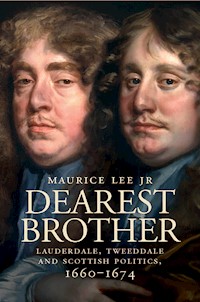
This book provides the first detailed account of the course of Scottish politics in the reign of Charles II. It focuses on the years from 1667 to 1673, when, for the only time in the Restoration era, Scottish political leaders were able to make policy for Scotland with minimal interference from London and with Scottish interests chiefly in mind. The key players were the secretary of state, John Maitland, who was earl of Lauderdale and resident at court, and his chief agent in Edinburgh, John Hay, earl of Tweeddale, his first cousin, who became his 'dearest brother' when Tweeddale's son married Lauderdale's daughter. A third indispensible member of the group was Sir Robert Moray, their cousin by marriage, King Charles's fellow chemist and close friend. Together the three inaugurated a programme of reform which had some initial success but in the end foundered on political and personal disagreements. Maurice Lee makes effective use of the unpublished correspondence of the three, among themselves and with others, in telling the melancholy tale of the regime of this triumvirate for the first time.
Das E-Book können Sie in Legimi-Apps oder einer beliebigen App lesen, die das folgende Format unterstützen:
Veröffentlichungsjahr: 2010
Ähnliche




















Lords and Men in Scotland
© Jenny Wormald 1985
All rights reserved. No part of this publication may be reproduced in any form, or by any means, without the prior permission of the publishers, John Donald Publishers Ltd., 138 St Stephen Street, Edinburgh EH3 5AA, Scotland.
ISBN 0 85976 127 4
The publishers acknowledge the financial assistance of the Scottish Arts Council in the publication of this volume.
Exclusive distribution in United States of America and Canada by Humanities Press Inc., Atlantic Highlands, NJ 07716, USA.
Typeset by Quorn Selective Repro Ltd, Loughborough, Leics.
Printed in Great Britain by Bell & Bain Ltd., Glasgow.
Acknowledgements
As Charles Prince of Wales once asked, why do the newspapers never print good news? Every society has its newspapers — or, in the past, its chronicles — which tell us, in measured or sensational tones, of violence, corruption, scandal. Fifteenth and sixteenth-century Scotland is not short of lurid tales, particularly about its aristocracy. This book is an attempt to do what has been all too rare in the history of the Scottish aristocracy: search out the other side, which did not hit the headlines. It is not in any way a comprehensive study; that lies in the future, for work on magnates’ finances, landholding, interests, lifestyle, remains to be done. It is an initial statement of the fact that there was far more to the aristocracy than the violence, bloodshed and murder with which they have been so exclusively associated; one might say that hunting, shooting, fishing, and even reading and foreign travel, came into it as well. This preliminary assessment is based on the remarkable collection of personal bonds between magnates and lairds which have come down to us from late-medieval and early-modern Scotland. This is a book about these bonds, and also a way of making readily available, at least in calendar form, the bonds themselves.
It is a book whose gestation has been inordinately slow, and birth-pangs correspondingly rapid. It began life as a thesis, completed ten years ago. It is appropriate here to thank all those who helped that thesis to completion, who include the owners of private collections who so generously allowed me to work on their archives, and particularly the Keeper of the Records and staff of the Scottish Record Office, whose unfailing kindness and helpfulness made my work there, then and since, always a pleasure. I am grateful to the Marquess of Lothian, the Marquis of Graham and Miss M. F. Piper, for their permission to print the bonds from their family papers included here in Appendix C, and to the Keeper of the Records, Scottish Record Office, for permission to print the text of the bond cited on p. 53. I single out three other people. I owe an especial debt to Professor A. A. M. Duncan, who will certainly have forgotten, as I have not, the day we banged our heads on the low metal ceilings of the old University Library, Glasgow, because he took his duties as a supervisor seriously enough to drag a bewildered research student who thought she was working on a late-medieval subject off in search of works on continental feudalism. That kind of historical lesson is to be remembered with deep gratitude. The other people who naturally loomed large in those days were the examiners, Professor G. W. S. Barrow and Dr. R. G. Cant. Despite the fact that in the intervening decade other publishing interests have come between the thesis and the book, it is because of their encouragement that the idea that one day I would come back to it has never lapsed.
Since then I have acquired other debts. If the word ‘violence’ appears more often in the book than in the thesis, that is because I have been forced to modify my originally highly pacific views by my former research student, Dr. Keith Brown; if he still finds that I overstate the pacifism, perhaps that may be understood as the need to redress a balance tipped in the other direction for far too long. I have gained a great deal, over the years, from discussions with Dr. Sandy Grant, University of Lancaster, whose own work on the early-Stewart nobility has been indispensable to me. Once the writing of the book was under way, my first piece of immense good fortune was in handing over a grisly typescript to Humaira Ahmad, of All Souls College, Oxford, who turned it into something I could be proud to hand over to the publisher, putting up with last-minute corrections with great tolerance the while. There were several people who suddenly found themselves the recipients of demands for instant advice, notably Mr. Simon Walker, University of Sheffield, who kindly read the early part of the book and made very helpful comments about what was to him unfamiliar territory. Miss Angela Galbraith, who lived through the final stages of my last book, came back for this; Miss Susan Davidson had her first experience of what was involved. Both gave me great help, in keeping the domestic scene, not to say myself, calm and ordered. Above all, I thank Dr. Norman Macdougall, whose response to my urgent request to cope with the text almost as it came off the typewriter was to read the whole book in a timescale which can only have created difficulties for him; the willingness with which he did so, and the help which he gave me, are not only a matter for historical appreciation, but also of awareness of how important ‘freindis’ are in such an enterprise. Mr. John Tuckwell, of John Donald Publishers, waited with great patience, even after the award of a British Academy readership sent me off on other pursuits for three years; after that, when he was at last presented with a manuscript, his repayment for all the delay was to put it into production with great speed. To find the enthusiasm which goes with writing matched in this way shows just how fortunate the ‘John Donald’ authors are. Finally, prefaces normally end with thanks to a wife for taking the domestic strain. I thank Patrick Wormald, who did exactly that. I also thank him for the fact that his own historical insights have greatly improved this book, from its prose style to the ideas it contains.
I end on a personal note. The first bond of manrent which I have found is dated exactly 500 years before the date of my birth. If centenaries mean anything, I cannot resist the hope that however much other scholars will improve on my work, they will not find an earlier bond of manrent …
Jenny Wormald
Abbreviations and Conventions
Aberdeen-Banff Collections
Collections for a History of the Shires of Aberdeen and Banff (Spalding Club, 1843)
Aberdeen-Banff Illustrations
Illustrations of the Topography and Antiquities of the Shires of Aberdeen and Banff (Spalding Club, 1847–69)
A.D.A.
The Acts of the Lords Auditors of Causes and Complaints, ed. T. Thomson (Edinburgh, 1839)
ADC
S.R.O., Acta Dominorum Concilii
ADC et S
S.R.O., Acta Dominorum Concilii et Sessionis
A.D.C.
The Acts of the Lords of Council in Civil Causes, ed. T. Thomson (Edinburgh, 1839)
A.D.C. (1496–1501)
Acta Dominorum Concilii: Acts of the Lords of Council in Civil Causes, vol. ii, AD 1496–1501, eds. G. Neilson and H. Paton (Edinburgh, 1918)
Acts of Council (Public Affairs)
Acts of the Lords of Council in Public Affairs: Selections from Acta Dominorum Concilii, ed. R. K. Hannay (Edinburgh, 1932)
A.P.S.
The Acts of the Parliaments of Scotland, eds. T. Thomson and C. Innes (Edinburgh, 1814–75)
A.T.
Argyll Transcripts, Inveraray Castle, Argyll
B.I.H.R.
Bulletin of the Institute of Historical Research
B.L.
British Library
C.S.P. Milan
Calendar of State Papers and Manuscripts existing in the Archives and Collections of Milan, vol. i, ed. A. B. Hinds (London, 1912)
C.S.P. Scot.
Calendar of State Papers relating to Scotland and Mary Queen of Scots, 1547–1603, eds. J. Bain and others (Edinburgh, 1898–)
E.R.
The Exchequer Rolls of Scotland, eds. J. Stuart and others (Edinburgh, 1878–1908)
Fraser, Annandale
W. Fraser, The Annandale Family Book (Edinburgh, 1894)
Fraser, Buccleuch
W. Fraser, The Scotts of Buccleuch (Edinburgh, 1878)
Fraser, Carlaverock
W. Fraser, The Book of Carlaverock (Edinburgh, 1873)
Fraser, Colquhoun
W. Fraser, The Chiefs of Colquhoun and their Country (Edinburgh, 1869)
Fraser, Douglas
W. Fraser, The Douglas Book (Edinburgh, 1885)
Fraser, Eglinton
W. Fraser, Memorials of the Montgomeries Earls of Eglinton (Edinburgh, 1859)
Fraser, Grandtully
W. Fraser, The Red Book of Grandtully (Edinburgh, 1868)
Fraser, Grant
W. Fraser, The Chiefs of Grant (Edinburgh, 1883)
Fraser, Lennox
W. Fraser, The Lennox (Edinburgh, 1874)
Fraser, Melville
W. Fraser, The Melvilles Earls of Melville and the Leslies Earls of Leven (Edinburgh, 1890)
Fraser, Menteith
W. Fraser, The Red Book of Menteith (Edinburgh, 1880)
Fraser, Pollok
W. Fraser, Memoirs of the Maxwells of Pollock (Edinburgh, 1863)
Fraser, Wemyss
W. Fraser, Memorials of the Family of Wemyss of Wemyss (Edinburgh, 1888)
H.M.C.
Reports of the Royal Commission on Historical Manuscripts (London, 1870–)
N.L.S.
National Library of Scotland
N.R.A.
National Register of Archives
R.M.S.
Registrum Magni Sigilli Regum Scotorum, eds. J. M. Thomson and others (Edinburgh, 1882–1914)
R.P.C.
The Register of the Privy Council of Scotland, eds. J. H. Burton and others (Edinburgh, 1877–)
R.S.S.
Registrum Secreti Sigilli Regum Scotorum, eds. M. Livingstone and others (Edinburgh, 1908–)
S.B.R.S.
Scottish Burgh Records Society
S.H.R.
Scottish Historical Review
S.H.S.
Scottish History Society
Spalding Misc.
Miscellany of the Spalding Club (Spalding Club, 1841–52)
S.R.O.
Scottish Record Office
S.R.S.
Scottish Record Society
S.T.S.
Scottish Text Society
T.R.H.S.
Transactions of the Royal Historical Society
In dating, the year is taken to begin on January 1. Money is given in £ Scots — about 3:1 sterling c.1450, 6:1 c.1570 and 12:1 in 1603. References in the notes to all bonds, of maintenance, manrent, friendship and political bonds, are to their name and number in Appendices A-C. Abbreviations of printed sources follow the ‘List of Abbreviated Titles of the Printed Sources of Scottish History’ (S.H.R. xlii, 1963), supplement, i-xxxi.
Contents
Acknowledgements
Abbreviations and Conventions
1. Medieval Scottish Lordship and the Historians
2. The Language of Lordship
3. The Rise of the Personal Bond
4. The Content of Bonds of Manrent
5. ‘Kin, Freindis, Allya and Parttakaris’
6. The Shape of the Affinity: Principles and Personalities
7. The Peace in the Bond
8. Uncertain Allies: Burghs and Politicians
9. The End of Bonding
Appendices
A. Bonds and Contracts of Manrent and Maintenance
B. Contracts and Bonds of Friendship
C. Political and Religious Bonds
D. Examples of Bonds of Manrent, Maintenance and Friendship
Notes
Addenda
Glossary
Sources and Bibliography
Index
CHAPTER 1
Medieval Scottish Lordship and the Historians
Medieval and early-modern Scotland was a small, remote European kingdom. Medieval and early-modern Scotsmen, and even Scotswomen, kings, nobles, merchants, scholars, clerics, laymen and women on pilgrimage or as litigants and witnesses trecking off to Rome, were determined Europeans. The Scottish Mahomets consistently battered at the European mountain; and if they were sometimes repulsed, by their English neighbours who in any case viewed themselves as superior to anyone else in Europe and particularly the Scots, or by the late-fifteenth century duke of Milan who equated sending his daughter off as a bride to far-off Scotland with parental cruelty, they were also remarkably successful, through sheer persistence, in making an impact.1 It took a lot of effort. Historians of Scotland today lament the fact that it still takes a lot of effort to attract the interest of the world beyond the Scottish border to this remarkable little kingdom, which precisely because it was both a simpler society than the great European powers among whom it ranked itself, and at the same time fully up-to-date with European fashions, socially, culturally and spiritually, offers insights into contemporary attitudes sometimes obscured by the apparently greater sophistication of the better-known parts of Europe.2 No better example can be found than lordship in Scotland in the fifteenth and sixteenth centuries. One reason for comparative historical neglect is that Scotland was a far less well documented society than its neighbours. Yet it has left us a collection of documents about lordship which are unparalleled in the extent of their survival. They are called bonds of manrent and maintenance. They are almost entirely concerned with personal lordship. They were not made because they recorded any property considerations, whether of money or land — the most obvious reason for writing something down. But there are some eight hundred of them still in existence.
And they are testimony to a problem. In the English-speaking historical world, that problem is called ‘bastard feudalism’ — or sometimes ‘decayed’ or ‘non’ or ‘new’ feudalism; Scottish historiography until very recently took a rather simpler line, and regarded them purely as a Bad Thing, a force only for lawlessness and disorder. Whatever label is attached to them, they are a spectacular source for a new phenomenon in late-medieval Europe, the resort to the written vernacular bond as a means of expressing loyalty, friendship and service. In England, France and Germany, this practice was a marked feature of the fourteenth and fifteenth centuries. Scottish evidence before the mid-fifteenth century is slight; thereafter it explodes into a wealth of documentation which lasted until the early years of the seventeenth century. The bonds do not tell us that the concept of lordship and service had changed; they tell us, with far more clarity than any earlier evidence, what the concept was. The novelty lay in the extensive recording of the intangible, the personal relationship between lords and their men, removed from or at least no longer dependent on material considerations.
For 150 years, men who wished to attach themselves to a lord came to him and gave him a bond of manrent. That in itself is a notable aspect of Scottish lordship and service. In the past, in the ‘feudal’ period, it was the lord who ‘gave’ — a charter and fief. In later-medieval England, again it was the lord who ‘gave’ — a fee. The balance in Scotland was quite different. The grant of land or money was not wholly divorced from the making of bonds of manrent; this was the inducement in some cases. But these cases are rare. What the man normally got in return for his detailed promise to serve his lord for life, to give him counsel, to accompany him when required, to avert harm from him, was a promise of maintenance and protection; and as far as we know — for the survival rate of bonds of maintenance is very much smaller — the lord’s promise was usually more briefly and generally expressed.
All over the country, men whose ancestors had been the beneficiaries of feudal lordship, at the expense of their lords, came and made their obligations of manrent. In the north-east, the major recipients of their bonds were the earls of Huntly and Errol, and prominent families of lesser rank like the Campbells of Cawdor and Grants of Freuchy. The west was dominated by the lordship of the Campbells, of Argyll and Glenorchy. On the borders, men gave bonds to the earls of Angus, to the Maxwells, and to the Kerrs, Scotts and Johnstones. From the lowlands and south-west are the bonds to the earls of Arran, Morton, Eglinton, Cassillis, Lennox and Montrose, and to the Boyds of Kilmarnock, the Oliphants and the Hays of Yester. The bonds made to the Campbells of Glenorchy, Cawdor and Barrichbyan included the purely highland custom of giving calps and, in the case of Glenorchy, fostering. Otherwise regional variations do not occur. With the proviso that in this huge collection there is no such thing as a rigid stereotyped text, a man making a bond of manrent in Aberdeenshire or Moray was doing the same thing, in the same way, as a man in Lothian or Ayrshire.
The collection as it now exists certainly leaves gaps. Only one Scottish lord is known to have had more bound to him in manrent than the 67 indentured retainers of William lord Hastings.3 Moreover the large family collections of the earls of Huntly and Argyll and the vast number of bonds made to the Campbells of Glenorchy give something of an impression that it was those semi-lowland lords who presided, perhaps uneasily, over the highland areas who particularly sought the manrent of lesser lords and lairds. By contrast, there are families who have left us no record of their lordship of men. Yet the making of manrent was clearly a Scottish practice, not merely a highland custom, as one scholar suggested, and certainly not only a lowland one, as another tried to argue.4 Patchy though the collection is, it is geographically widespread enough to suggest that it is in the highest degree unlikely that there were some families who held completely aloof from this well-known method of building up alliances, or really made so few that the exercise was futile. The omissions are much better explained by the fact that by the end of the seventeenth century bonds of manrent and maintenance were at best of antiquarian interest, at worst records of the ‘less civilised age’ which in 1677 the earl of Strathmore compared unfavourably with his own;5 when charter chests became over-full, they were the scrap paper. At Strathmore’s own castle of Glamis, for example, only one bond survives; this archive contains such a preponderance of land-titles and such an almost complete absence of personal papers from the period when bonds were commonplace that it looks as though a later Lyon with an overdeveloped sense of order cleared them out, fortunately missing one in the process. Similarly the papers of the Farquharsons of Invercauld, a fairly prominent Aberdeenshire family in the sixteenth century known to have allied themselves with the house of Huntly, survive in any quantity only after 1600; and one can only make a frustrated guess at what the nineteenth-century commissioners meant when they said that there were numerous bonds of manrent in Drum castle, in view of the paltry number of Irvine of Drum bonds now discoverable.6 Cosmo Innes’s assertion that ‘Bonds of Friendship, Bonds of Homage, Bonds of Manrent and Maintenance are found in greater or less quantity in all old Scottish charter-chests’ is not, therefore, strictly correct, but neither is it wildly far-fetched as speculation about what did exist in the sixteenth century.7
What accident of survival does not blur is the timespan in which the making of these bonds flourished. The first surviving example in which the word ‘manrent’ is used is dated 18 January 1442. Of course that may not have been in fact the first, but it is unlikely that the date can be pushed back much earlier, both on the grounds of linguistic evidence (surveyed in Chapter 2) and because there is nothing in the handful of rather different personal expressions of lordship and service to suggest that they conceal a widespread practice of making personal bonds. That practice came to an end, remarkably abruptly, at the beginning of the seventeenth century. Thereafter, individual personal bonds were exceedingly rare, outdated survivals in the Highlands of earlier custom rather than an integral part of social and political alliances — or, in the case of two twentieth-century bonds of manrent, one made in London, the other in New Zealand, presumably the kind of romantic sense of identification akin to the wearing of tartan ‘with tribal enthusiasm, by Scots and supposed Scots from Texas to Tokyo’.8 But a related kind of agreement did survive. Along with the bonds of manrent of the fifteenth and sixteenth centuries went bonds of friendship, bonds made for exactly the same purpose of assistance and protection, but by men of equal status. From that there grew the collective bond involving considerable numbers of people and made for a specific political purpose; and this was to have its apotheosis in the greatest of collective bonds, the National Covenant of 1638.
If the ratio of survival cannot be known, the survival rate in itself gives us an extraordinarily impressive and sadly neglected source for that great European historical puzzle, the nature of lordship at the close of the middle ages and the beginning of the early-modern period. But it is a source which first has to be disentangled from two things: the condemnation by three centuries of Scottish lawyers and historians, and the wider historiographical problem encapsulated in ‘feudalism’ and ‘bastard feudalism’. The first of these is the peculiar byproduct of the genetic accident which put a Scottish king on the throne of England. Late-medieval Scotland shares with other societies the experience of being scrutinised by those who see history as a linear progress, and found wanting. What was unusual was that whereas elsewhere this scrutiny was focused on the fourteenth and fifteenth centuries, in Scotland it took in the sixteenth as well. 1485 may not be regarded as quite the great divide it once was, but it retains just enough of its aura to leave the lingering impression that unruly medieval magnates rose from their English beds on 1 January 1486 as better or at least more controllable inhabitants of Tudor England, whereas in Scotland they were to rampage on for a further century until the reign of James VI, despite the efforts of James IV to emulate the successes of his contemporaries Henry VII and Ferdinand and Isabella in bringing ‘new monarchy’ and order to their kingdoms.9 Scotland did indeed remain an unusually localised society on which ‘the centre’ impinged lightly for most of the sixteenth century; the change to a more centralised kingdom, with direction and interference from the centre and local awareness of the centre, happened late and happened fast.10 The internal factors which produced this change (considered in the last chapter of this book) were to have profound effect on traditional patterns of lordship and therefore on later attitudes to lordship. But far more important was the effect of the union of the crowns in 1603. Detailed investigation of the consequences of that union, and the subtle impact it had on the thinking of the Scottish ruling élite, remains to be done; but a strong element from the beginning was the desire to counter any suggestion that Scotland was in any way — politically, legally or socially — a backward society. What the English had already been saying in the sixteenth century about lack of royal authority in Scotland and the excessive power of the nobility now struck a sensitive nerve.11 The first king of Britain was at great pains to argue to his incredulous English subjects that his two kingdoms had a great deal in common, from language to political structure.12 His Scottish subjects began to reinforce the point, and did so particularly at the expense of the Highlands, the bloodfeud and the bonds.
The poet, scholar, historian and political theorist William Drummond of Hawthornden, writing in the first half of the seventeenth century, set the scene. Drummond described how John duke of Albany, coming from France to Scotland as governor in the minority of James V with little knowledge of the country, fell particularly under the influence of John Hepburn, prior of St. Andrews; and Hepburn tried to use this influence to poison Albany’s mind against three people whom he hated. In this he was following a brief account of Hepburn’s dealings with Albany by the late sixteenth-century chronicler Robert Lindsay of Pitscottie; but whereas Pitscottie limited his account to Hepburn’s attack on certain individuals, Drummond saw a general issue:
He [Hepburn] gave him a catalogue of the whole deadly Fewds and Divisions among the Noblemen and Gentry … How in prosecuting Revenge in them, they cared not how innocent any man was, if he were of the Name and Alliance, but rather thought the more innocent any was, the more it testified their spite … He shewed them what Factions were in the kingdom, who sway’d them, and were the Heads. He told them that the Scots were a violent fierce people, mutinously Proud, and knew not whom to obey without the Sword were drawn. That they were never absolutely governed by their own kings themselves, far less would they be ruled by him who was but a Governour and half a stranger … He instructed him, how the greate Houses of Scotland were so joined and linked together by kindred, Alliances, Bonds of Service, or Man-rent, that no Gentleman of any quality, although a malefactor and a guilty Person, could be presented to justice without some stir, commotion, or Tumult of the Grandees and their factious Friends.13
This is a very succinct statement of the traditional view of fifteenth- and sixteenth-century Scotland. All the elements are there: the ungovernable Scottish magnates, the feuds, the inability of the crown to exercise effective authority and ensure that justice was done; and a prominent element is the evil of bonding. This passage shows the beginnings of the tendency to regard it as an unsavoury custom of the ‘less civilised age’; the earl of Strathmore’s comment complacently invoked the physical evidence for this, asserting that feuds and castellated houses were ‘quite out of fashion … the country being generally more civilised than it was of ancient times’. The correlation between feuding and bonding was all too easy to make; the feud, both in its bloody form and its judicial processes, will flourish in a society where the local community has more practical meaning than the national one, and where men rely on mutual help within their social groups.
Thus was created a paradox. The advent of Scottish kings reigning in London was to encourage in the English a strenuous pride in their medieval past, however much that pride was fed on dubious history and political expediency. In Scotland, the effect was exactly the opposite; because their very different medieval past was not of much help in supporting their claims to be at least as civilised and probably more godly than their recently-acquired fellow-countrymen south of the border, the Scots were busy laying the foundations of the idea that pre-Reformation Scotland was a hotbed of lawlessness, feud and overmighty magnates. Their invocations were not to their medieval past (it would, after all, have been wholly inappropriate to parallel the appeal to Magna Carta with an appeal to their most famous political statement, the Declaration of Arbroath) but to the post-Reformation one: the National Covenant, that document whose supreme irony is that its genesis lay in the late-medieval bond, acknowledged nothing, even in its secular concerns, before the reign of James VI.14 But the National Covenant itself shows a strong preoccupation with legal precedent; and it was, not surprisingly, the lawyers who had a particular vested interest in rejecting a past in which social customs had given them less place than in the present. Building on the beginnings of the systematic study of Scots law by the late sixteenth-century lawyers, they naturally reacted against the extra-curial, amateur forms of justice so different both from England and from the professional system they were themselves creating in Scotland. The process became dramatically clear in the writing of the man regarded (somewhat exaggeratedly) as the father of modern Scots law, James Viscount Stair; in a chapter dealing with liberty and freedom, he had this to say:
There was formerly a kind of bondage in Scotland called Manrent, whereby free persons became the men and followers of those who were their patrons and defenders; (and therefore these were rather in clientela than in bondage) but it is utterly abolished both by Act of Parl. 1457 c.77, and Parl. 1555 c.43, and by our custom.15
The interest of this unrealistic and historically inaccurate statement lies in its air of being a comment tossed off about a bad custom of the bad old days. Even so, it is extremely mild when compared with the much more detailed discussion of bonds of manrent by the eighteenth-century lawyer Lord Bankton. Here, the hostile approach not only gained ground but ran riot. Bankton’s wildest flight of fancy was his complete misrepresentation of the meaning of the word ‘manrent’; but his general assertions set out for the first time in extenso the critical attitude to the making of bonds which has been followed, more or less, ever since.
Bankton began by paraphrasing the sixteenth-century lawyer Thomas Craig’s Ius Feudale, using manrent and maintenance to denote feudal dependence and protection, without any qualification. From this he was led into the quite false explanation of ‘manrent’ as denoting ‘the rent or reddendo prestable by the man or vassal to the lord or superior’. Then he went on to develop his theme:
The contract of manrent, of old in use with us, had its rise probably from the foresaid feudal dependence, but it came at last to be practised without relation thereto; by this one became bound to pay a rent or yearly pension to another for protection of himself, his family and goods, from the violence and depredation of others; he that received the pension was termed the maintainer and accordingly gave his bond of maintenance and protection to the other, who granted to him a bond of manrent. These defensive alliances, as I may call them, among subjects, became justly suspected by the government, and therefore were long ago abolished by express statute, and the givers and takers of such bonds are declared punishable; however they do not, when in vigour, impose any dependence of the one upon the other, further than concerned the foresaid protection, being only contracts of association for mutual defence, when violence and rapine prevailed over law and justice.
After which splendid tirade, he tailed off into a flat comparison of this contract with the custom of giving blackmail on the borders.16
This garbled mixture of Craig, Stair and imagination certainly emphasises the defensive element in bonding, but does so in language which is highly emotive, and which leaves no doubt about the barbaric and aggressive nature of the society in which it was prevalent. It also reiterates Drummond’s theme of a government rendered weak because of the alliances of its subjects. This was given even more prominence by Bankton’s famous contemporary, William Robertson, who described ‘leagues of mutual defence’ and bonds of manrent as ‘so many alliances offensive and defensive against the throne’. He did point out that because of weak central authority, ‘self-preservation, it is probable, forced men at first into these confederacies’, but his phrase ‘offensive and defensive against the throne’ takes his subject a long way from the idea of self-preservation; the passage is, indeed, something of a conceptual muddle.17
The beginning of the professional study of history in nineteenth-century Britain included an upsurge of interest in the history of Scotland, inspired and presided over by Sir Walter Scott. Scottish scholars plunged into the writing of history and the editing of texts. Neither rescued the medieval past from its deplorable reputation. Scott himself was no enthusiast for the middle ages in Scotland; and the calmer voices of W. F. Skene and Cosmo Innes were drowned out by one of his own circle, P. F. Tytler, who unleashed his indignation against ‘these feudal covenants, named bonds of manrent, which formed one of the darkest features of the times, compelling the parties to defend each other against the effects of their mutual transgressions’. Worse: the barons, ‘trammelled by bonds of manrent among themselves … either refused to execute the commands of the sovereign, or received them only to disobey’.18 This was the highpoint of condemnation. The making of bonds was now wholly irredeemable, for it rendered civilised and ordered society impossible; it was shockingly different from the life of Tytler’s own dear queen and from a perspective which embraced Empire and the balanced constitution, the latter a blessing enjoyed as much by the ‘North Britons’ who benefited from it as by the South Britons who had created it.
Tytler’s use of the word ‘feudal’ as a general, mud-slinging word, would not have commanded general acceptance. His approach to the making of bonds would. From this point, the historiography of bonds of manrent and maintenance can no longer be confined to Scottish writers. The focus moves south, to the publication of the Paston Letters and the light they shed on English lordship. But perhaps ‘light’ is the wrong word for the nineteenth-century response. The evidence of the Paston Letters provoked a sense of outrage in one scholar, Charles Plummer, very similar to that of Tytler; and in 1885, ‘bastard feudalism’ was born.19
What Plummer meant by ‘bastard feudalism’ was a degenerate form of feudalism which produced a breakdown in fourteenth- and fifteenth-century English society. ‘God stand up for bastards’ might be the appropriate response;20 and if not God, one of the greatest and most influential of English medievalists did. The phrase was brought into current modern use in a far less harsh and censorious sense by K. B. McFarlane in an article which had a dramatic effect on fifteenth-century scholarship. Citing the Oxford English Dictionary, McFarlane pointed out that while the most obvious meaning of ‘bastard’ was that used by Plummer, it also had the less well known but rather more respectable sense of ‘having the appearance of’, and with this second meaning the phrase could be retained as a convenient description of the relationship between lords and their men in later-medieval and early-modern England.21 And not only England; it has been taken over by English-speaking historians of other societies, including Scotland.22 There is no need to rehearse here the immense impact of McFarlane’s insights into the late-medieval English nobility, which have informed the work of every historian since he first wrote; his seminal restatement of the values and nature of English society may be questioned in detail, but in essentials is unassailable. But the very dominance of McFarlane’s influence has, paradoxically, had one unfortunate effect in that it has driven the subject onto an unnecessarily narrow road. McFarlane himself used Plummer’s phrase as a peg on which to hang a revolutionary re-think. In the hands of his successors, it has become a label which no late-medieval historian can be without. Historical language shifted; historians, seeking to assess the level of lawlessness in late-medieval England, no longer asked what factors created or minimised lawlessness so much as how far ‘bastard feudalism’ was responsible for it.23 Two articles by Christine Carpenter, both published in 1980, show the conceptual problem thus created. One, assessing the fairly hair-raising career of Sir Thomas Mallory, invokes McFarlane’s own awareness that magnates must be treated as individuals and not as a stereotype. The other makes the somewhat unexpected and certainly alarming claim that ‘no study of how bastard feudalism actually worked has yet appeared in print’. What have historians been doing? The article tells us: bringing us to the point of acceptance that bastard feudalism ‘was not an aberration but the logical successor to feudalism’.24 Outside England, the need to retain a label is equally pervasive, but the starting-point rather different; for historians of other societies cannot automatically lay claim to McFarlane’s phrase and must begin by asking how far it can be applied. Thus one, wrestling with the problem, has judged that ‘the term ‘bastard feudalism’ is not so apposite for early Stewart Scotland … instead, the phrase ‘decayed and non-feudalism’ used of late medieval France by Mr P. S. Lewis probably describes the Scottish situation better’.25 As the reason for rejecting ‘bastard feudalism’ is that in Scotland ‘fairly straightforward feudal grants are still to be found’, this passage, taken from a well-documented and informative study of the early Stewart nobility, suggests that the understandable desire to employ current classifications is in fact more problematic than helpful.
The problem is not only one of subsuming late-medieval Scottish lordship into the debate about contemporary English lordship. It goes back to an earlier phase, which was undoubtedly linked to and affected by England. ‘Bastard feudalism’ may at least be seen as the logical successor to the tendency of British historians to reify ‘feudalism’, despite Ganshof’s warning that ‘Le mot Féodalité … prête à confusion’, and the heroic efforts of some scholars, notably Professor Peggy Brown, to remove the word from the historian’s vocabulary.26 This tendency was undoubtedly a greater temptation for historians of the feudalisation of the British kingdoms than for those of European societies, for the traditional approach to British ‘feudalism’ was to see it as imposition from without rather than development from within. Having come across the Channel in William the Conqueror’s ship in 1066, to be forcibly imposed on a conquered society, it then moved north with David I and his Anglo-French friends who settled in Scotland and imposed it peacefully on the society into which they assimilated themselves, in a highly developed and ‘remarkably cut and dried’ form. Its appeal was clear enough. It changed the rules of the political game for the rulers, to their advantage. By introducing the concept that the land was the king’s, to be granted to those who would serve and be loyal, the idea of delegation was created; and delegation, ‘the essence of feudalism’, worked very well for the twelfth-century kings who feudalised as much of Scotland as they could and immeasurably increased their authority and control of their kingdom in the process.27
The invocation of the northern European model, as transmitted by way of England, is actually more legitimate as a means of elucidating the structures and attitudes of feudal Scotland than the borrowing of ‘bastard feudalism’ or its variants to describe post-feudal Scottish lordship. With impeccable scholarship and an enviable eye for detail, the doyen of Scottish feudal studies, G. W. S. Barrow, has given us a very full picture of the influences and process by which Scotland became a feudal kingdom.28 Knight-service, fiefs, feudal incidents, all crowd their way into the documentary evidence: indeed, thanks to the desire of the crown to bring its kingdom up-to-date, documentary evidence exists in quantity for the first time. Yet it leaves open the huge question, what did it all mean? For what is recorded is highly selective. It tells us much about patterns of landholding and arrangements for war. It certainly shows that twelfth-century kings saw practical advantages in introducing to their kingdom practices fashionable in Europe. They did not follow only secular fashions; they were as alive to the current form of religious expression, and monks as well as feudal knights became a familiar part of the twelfth-century Scottish scene. What we are witnessing, as Barrow rightly stresses, is an early example of the marked feature of the Scottish monarchy throughout the medieval and early-modern period, its brilliant instinct for offsetting its realistic position by the conscious pursuit of European fashions, and the enhanced prestige which inevitably followed.
It was this instinct which gave some of the outstanding kings, like David I and James V, a place in Europe far beyond anything which their economic and political state merited. But the most intelligent of kings combined the pursuit of fashion with the instinct for flexibility and adaptation. If there may be doubts about whether ‘military feudalism’ was ever the answer to a would-be victorious ruler’s dreams, there is no doubt that in Scotland it was not; the introduction of the ‘mailed and mounted knight’ was not the way to beat English armies, as the Battle of the Standard in 1138 showed with hideous clarity. That did not matter much in the twelfth and thirteenth centuries, when England and Scotland were normally at peace. It mattered a great deal when they were at war, from the end of the thirteenth century. Robert I’s answer, given that he did not have the resources available to his wealthier adversary to raise armies by contract, was the revival of military feudalism, brought up to date by replacing cavalry by knights fighting on foot, and by the conversion of knight service to archer service: ‘we must conclude that in [Robert I’s] view the twelfth century model — with certain modifications — was best suited to the conditions of Scottish society even in the fourteenth century’.29 The man who won the brilliantly unorthodox Battle of Bannockburn against the heavy cavalry of England almost half a century before the English themselves became unorthodox at Crécy undoubtedly knew what he was up to, and was certainly a master of adaptation. He contrasts very favourably with that very unsuccessful soldier James IV, whose inexperience of war sent him off to Flodden in 1513 with his head full of fashions now becoming outdated, the laws of war, chivalry and a prestigious army encased in plate-armour in which it sank into the Northumbrian mud30 — just as the English cavalry had sunk into the Stirlingshire marshes in 1314.
Evidence of flexibility had been seen much earlier. Scottish ‘feudalism’ may look very like English, but there was one significant distinction; no king after David I granted out substantial knights’ fees, creating instead a huge network of fractional fees. Such examples from a society which combined awareness of European practice with a readiness to adapt to particular Scottish needs are of considerable value in three ways. They offer a clue to the attitudes of those who ruled feudal Scotland and their immediate associates. They provide admirable grounds for replacing the unhelpful question ‘what is feudalism’ with the much more productive ‘What happened in the various societies of western Europe which we call ‘feudal”? And they create a model which may be more profitable for a study of late-medieval Scotland than the importing of a yardstick from another society. But the last of these is the most tentative, and brings us back to the problem of lordship. For we are still left in the dark about feudal lordship as a social phenomenon; and in Scotland more than in other societies this is a particular difficulty. The feudal contract has been given so much more attention by historians than any other that there has been an inevitable tendency to regard it as the norm rather than as one phase in the history of alliances between lords and their men, so that what came before led to a higher form, and what came after was at best a decline, at worst a distortion of an ideal. Late-medieval historians of lordship are therefore drawn back irresistibly to the model of feudal lordship. Some, like showjumpers in the puissance event, hurl themselves at the huge wall of feudalism and fail to clear it; others make the supreme effort and soar over on to the even more uncertain ground of pre-feudal lordship. The difficulties created by reifying ‘bastard feudalism’ are bad enough, as one comprehensive ‘thing’ is related to another. The difficulties are even greater when the composition of the wall is unclear and the ground beyond very obscure indeed. Even the most ardent of Anglo-Norman feudalists do not deny some element of continuity with the Anglo-Saxon past. Professor Barrow certainly does not deny continuity with pre-feudal Scotland.31 But continuity with what?
From across the channel, where the Capetian kings simply do not fit the Angevin or Scottish model, whatever the dukes of Normandy were up to, comes a much clearer indication of the dimension so lacking in Scottish or even English ‘feudalism’: personal lordship. The first volume of Marc Bloch’s immortal work, subtitled ‘The Growth of Ties of Dependence’, traces the development of feudalism against the background of the need for personal alliances and the pressures on earlier forms of such alliances. Georges Duby showed how impossible it is, because of the tensions inherent in the relationship between lords and their vassals, to depict ‘feudalism’ as in any way a more rigid, widespread or even particularly new solution to the problem of control by the lord and the assurance of allegiance by the vassal. Thus of ‘feudalised’ Mâcon by the end of the eleventh century, he wrote:
To sum up, feudal institutions were adapted, without appreciably modifying, the former structure of the upper class. Between great lords or knights, homage is a simple guarantee, an undertaking not to harm; between a lesser noble and a powerful one, it is a true obligation, an undertaking to serve. Vassalage and the fief, customary practices born of private usage, reinforced the relationships which the unequal division of wealth and power had already imposed; they did not create others. In the Mâconnais in the eleventh century, there was no special vassal-pyramid, no feudal system … In spite of their power and their ability to confiscate the holding of a faithless vassal, the lords had little control over their men, these allodial holders who had other resources, other patrons and other refuge.32
This analysis is based on far more evidence than is available to the historian of eleventh-century or even twelfth-century Scotland. But its approach is echoed with a sureness of touch by A. A. M. Duncan in a memorable passage, worth quoting in full. Writing about ‘what thirteenth-century ‘feudalism’ was all about’, he says:
The personal relationship of knights to barons, while it seems to depend on tenure, was really coincidental with it … their special relationship with a great magnate arose from the fact that he was a great magnate, and that their holdings lay within the geographical range of his influence. They served in his court, his administration, his social circle (familia), his company of war (comitiva) and some of these things were made to look dependent upon the land they held of him and the homage and fealty which they did to him. But the tenure of land can be regarded as part of these relationships, and not, as the lawyers would have it, a reason for them. Among lords, knights and lairds, the appearance of a meaningful ‘feudal’ relationship was maintained over many years by, for example, the giving and taking of homage, by wardship and marriage of the person as well as the wardship of the land, all of which reinforced the social relationships among these men, the clientage of one and the protection of another. This appearance, however, was surely selective: it ignored the much greater legion of homages and fealties and tenures which led to no such relationship, which were devoid of any content except to the payment of feu duty and relief and the giving of sasine. This tired structure was scarcely more significant of social relationships than the ruinous feudal pile which conceals lucrative legal incompetence today …33
In other words, lords had their immediate circle of men who served them, counselled them, and turned out when they needed them; they also had people whose rents helped them to live in their accustomed style and who, by virtue of the terms of their holdings, might have to meet together when occasion demanded in order to elect which one of them would actually go off to fight — for his forty days, if that can be believed — and to equip him. This superb passage is speculative about the thirteenth century. It is in fact reinforced by two detailed studies of ‘feudal’ lords, Anglo-Scottish both, Roger de Quincy and David earl of Huntingdon; there, the distinction between what may be called the men and the tenants — feudal vassals all — provides our only real clue to the existence of personal lordship which lies concealed beneath the terminology of the feudal charter.34 It is also surely sound as an insight not just into thirteenth-century feudal Scottish lordship, but into medieval lordship.
If Duncan’s distinction between two types of relationships is reinforced by the work of two other modern scholars, his condemnation of the ‘tired structure’ of commercialised feudalism finds very powerful backing indeed. The first man in Scotland to address himself to the problem, the sixteenth-century lawyer Sir Thomas Craig of Riccarton, deserves a far more honoured place in the historiography of feudalism than he has ever had. It was Craig who first enunciated the concept which we now call ‘bastard feudalism’. His great work Ius Feudale was imbued with awareness that fundamental to the feudal contract was the personal relationship between lord and man — and imbued also, therefore, with a powerful sense of the decline and debasement of that contract, overlaid by legalism and undermined by commercialisation. But if the feudal contract had become debased, there was still one form of contract in early-modern Scotland which retained the ideal. In what was almost a purple passage, Craig wrote
Et breviter nusquam, in quod alter alteri teneatur, melius et planius exprimi potest, quam per mutuas illas obligationes hominii et tuitionis, quae apud nos Manrent et Mantenance dicuntur in quibus ea, quibus alter alteri obligatur, fidelissima continentur, nisi quod feudorum natura majorem includere benevolentiam inter partes videatur.
He had already referred to ‘obligationem protectionis, hominii et manutentiae, vulgariter Manrent et Mantenance … Has conditiones … naturaliter omnibus feudis inesse antea diximus’.35
Craig never followed up his stated intention to consider how far these obligations were ‘coincident with those of the feudal relation’; in the passages cited, there is a certain ambiguity, and it is never made clear whether he regarded them as directly ‘feudal’ or as the new form of the ideal relationship which had disappeared from the feudal contract. But he was quite clear about what was not truly feudal. True feudal service could not be limited in any way: ‘cum vassallus domino ad omnem operam, consilium, fidem, domi militiaeque praestandam, & nullis finibus constrictam, ex nature veri feudi obstringetur’. By contrast, if limitation or definition of service occurred, ‘iam non est rectum & naturale feudum, sed degenerans … & feudastrum, quasi semifeudum’.36
His translator Lord Clyde actually used ‘bastard feudalism’ for this passage; since he published his translation in 1934, he was interestingly caught between Plummer’s idiom and Craig’s approach. And indeed Craig’s choice of words compares directly with the two modern definitions of ‘bastard feudalism’; thus had a late-sixteenth century lawyer anticipated two great nineteenth- and twentieth-century historians. But his interpretation was very different from either Plummer’s ‘degenerans’ or McFarlane’s ‘feudastrum, quasi semifeudum’; for they were writing about a relationship which was no longer tied to the granting of land, whereas Craig was writing about the decline in recognition of obligations which accompanied the granting of land. There was nothing ‘bastard’ about manrent and maintenance. They were the ‘best and simplest epitome of the reciprocal duties of superior and vassal’.37
This surely is the point of departure for a study of bonds of manrent and maintenance. It is certainly the last point of clarity before the subject was submerged by the two strands of Scottish and ‘feudal/bastard-feudal’ historiography. For Craig, unlike his seventeenth-century successors, was in no way ashamed of his country. He was, indeed, James VI and I’s strongest ally in the king’s desire to codify and unify the laws of Scotland and England, and his other great work was an analysis of the law in which Scots law came out better than English, and which certainly anticipated Stair’s creation of the philosophic basis for Scots law.38 Nor did he set the non-feudal against the feudal, and see decline; rather, he saw revival and strengthening, after the decline of the feudal contract. It is not in the least surprising that Scottish ‘feudalism’ which, like English and as distinct from European, worked very clearly to the advantage of the crown as well as to the advantage of magnates and lairds, has appealed more to modern scholars than post-feudal lordship from which the formal bond to the king had disappeared. But Craig allows the possibility of a different approach, by raising different questions. It would, for example, be wholly unfair to historians of feudal Scotland and England to suggest that they were not aware of good and bad vassals, just as Bloch was.39 Yet because ‘feudalism’ appears less potentially disruptive than post-feudal lordship, it is still the case that lawlessness is seen as less prevalent in the twelfth and thirteenth centuries than in the fourteenth and fifteenth. But the primary meaning of ‘vassus’ was apparently ‘boy’, and it is one of a group of words — thegn, baro, cniht, bachelor — which originally denoted youth: the dramatis personae of ‘Feudalism’. What is the difference between this respectable feudal group and the early seventeenth-century ‘Band of Boys’ who, under their leader Gordon of Gight, terrorised north-east Scotland?40 Is there any ideological difference between feudal and post-feudal ‘boys’ which entitles us to invest the first with the dignity of being responsible leaders of men and controllers of society — almost, metaphorically, giving them long white beards — and the second with innate thuggishness?
The conclusion to be drawn from the influences which have affected our view of late-medieval and early-modern Scottish lordship, both from within and outwith Scotland, is surely that, in the words of a distinguished early-seventeenth century ‘revisionist’, it is time to go back to the drawing board.41 Scottish historiography has not served it well, not because it condemned it, but because it condemned it for the wrong reasons, based on assumptions that had virtually nothing to do with the subject itself. Insights drawn from other societies are of immense value, but imported classifications used to create a preliminary model may not be. For when we have duly acknowledged that all over Europe, England and Scotland, in any century of pre-industrial society, men sought lords to protect them and lords sought men to serve them, then lordship and service, within any society and from one society to another, become a subject of ‘infinite variety’, with the same endless and elusive fascination as Shakespeare saw in Cleopatra.
CHAPTER 2
The Language of Lordship
The phrase ‘band of manrent’ is unique. In other northern European countries, there was no significant change in language to describe the late-medieval contract; familiar terms were used, indenture in England, alliance in France, Dienerbrief in the German principalities, even if their meaning may have been subtly altered.1 Middle Scots ‘band’ presents no problem; it was the word for an extremely commonplace document of the fifteenth and sixteenth centuries, always written in the vernacular and describing a one-sided obligation whereby a man bound himself to fulfil obligations to another in matters of money or land or in the reinforcing of obligations already stated in a mutual contract between the grantor and recipient of the bond. ‘Manrent’ was quite different. It was a very rare and archaic word which was dragged out of its literary obscurity in the mid-fifteenth century. Its meaning was changed. And ‘with marvellous suddenness’ it became the standard term for the relationship between a man and his lord and as such was an extremely familiar word until the early seventeenth century, when both bond and word died out of use. Why it was adopted for this purpose is the first of the interesting and elusive questions about Scottish lordship.
It had always been a rare word. It first makes an appearance in late-tenth century Anglo-Saxon England in its original form ‘mannraedan’. This derives from ‘man’ — the lord’s man or dependent — and ‘raedan’, which in compounds means ‘to be in the state of’ but whose primary meaning is to counsel or agree. Its sense of counsel is most vividly seen in the word ‘geraednes’, the tenth- and eleventh-century word for the lawcode agreed by the king and his council — and in the famous pun Aethelraed Unraed;2 the connection between that and the counsel which was such a crucial part of later Scottish lordship can only be dropped speculatively onto the page, and left there. The first known examples of ‘mannraedan’ are in Aelfric’s Homilies and in his treatise on the Old and New Testament, written at the end of the tenth and early eleventh centuries; such phrases as ‘then the town-dwellers sent to the famous Jehu, [and] offered him mannraedan for all his commands’ and ‘then said our friends that we should come to you to your mannraedan’ show that it meant allegiance, obedience or dependence and that it was used to describe both the inferior’s dependence and the superior’s right to obedience.3 ‘Raedan’ as a compound meant a state rather than an act — ‘and [it] greatly shamed him of the devil’s mannraedan in which he had been until that time’ — but it was also used of an act: ‘a certain man made firm mannraedan with the devil’.4 There is no contradiction here; the evidence suggests rather that mannraedan described lasting allegiance initiated by a formal act, exactly as ‘manrent’ was later to do. The fact that it was a late word, which does not appear in Anglo-Saxon poetry, indicates that it was a legal and contractual term which reflects the greater weight put on the vassal’s obligation in this period than was found in early Anglo-Saxon England, when the oaths of both lord and men were given equal prominence;5 again this exactly anticipates the apparent contrast between the detailed bonds of manrent and the more general bonds of maintenance. And finally, it would no doubt have seemed wholly appropriate to Bankton and Tytler that ‘manrent’ started its life as a word associated with service of the devil.
Etymologically ‘mannraedan’ is the exact equivalent of ‘homagium’, the word which was a coinage of the ‘second feudal age’ and in common use by the twelfth century. The ending ‘agium’ corresponds to ‘raedan’; ‘homagium’, like ‘mannraedan’, literally means ‘the state of being a man’. But whereas ‘mannraedan’ described a state begun by an act, the emphasis when ‘homagium’ was used was always on the act of allegiance by which a man entered into a relationship of dependence on another; not until the late fifteenth century did it take on the secondary meaning of ‘being in a state of homage’. After 1100, ‘mannraedan’ or ‘manred’ was used as the English version of Latin or Norman-French ‘homagium’ or ‘homage’, with its original meaning cut away. Its use in the Anglo-Saxon Chronicle clearly denotes an act: in 1115 Henry I ‘acted so that all the chieftains in Normandy did mannraedan and faithful oaths to his son William’, and in 1137 ‘they had made manred to him [Stephen] and sworn oaths’.6 After 1300, it moved even further from its original sense and was used for vassals or dependents generally, and therefore a supply of men who would fight. From there it became in the sixteenth century the position of a leader of fighting men.7
In any of its meanings, it was always too rare a word in England for much to be made of it. At most it is a tiny tessaron in the conceptual mosaic of ‘feudalism’ and ‘bastard feudalism’. Superficially it may appear to conform very well with the rise and decline of English feudalism, but it is probably more appropriate to regard its shifts in meaning as a small indication of the changes in emphasis put on current ways of describing that ancient phenomenon, the grouping of men round a lord. It is an infinitely more valuable piece of evidence for late-medieval Scottish lordship. It is first documented in Middle Scots in the late fourteenth century, along with other ‘raedan’ compounds such as ‘lufrent’ (a state of amity), ‘hatrent’ (hatred) and ‘kynrent’ (kinship), and also with other northern English words like ‘assyth’ (Middle English assithe) and ‘kinbut’ (Anglo-Saxon cynebot




