


Erhalten Sie Zugang zu diesem und mehr als 300000 Büchern ab EUR 5,99 monatlich.
- Herausgeber: Nick Hern Books
- Kategorie: Poesie und Drama
- Serie: NHB Modern Plays
- Sprache: Englisch
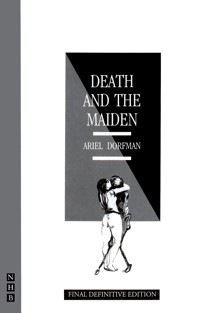
A classic of 20th-century theatre, Ariel Dorfman's Death and the Maiden ran for a year in the West End, was a hit on Broadway and was filmed by Roman Polanski starring Ben Kingsley and Sigourney Weaver. A woman seeks revenge when the man she believes to have been her torturer happens to re-enter her life. Death and the Maiden was given a first reading at the Institute for Contemporary Art in London in November 1990. After a workshop production staged in Santiago, Chile, in March 1991, the play had its world premiere at the Royal Court Upstairs, London, in July 1991, transferring to the Main Stage at the Royal Court in October. The play then transferred to the West End, at the Duke of York's Theatre, in February 1992. Death and the Maiden won the 1992 Olivier Award for Best New Play.
Sie lesen das E-Book in den Legimi-Apps auf:
Seitenzahl: 96
Veröffentlichungsjahr: 2013
Das E-Book (TTS) können Sie hören im Abo „Legimi Premium” in Legimi-Apps auf:
Ähnliche











DEATH AND THE MAIDEN
a play in three acts by
Ariel Dorfman
translated from the Spanish originalLA MUERTE Y LA DONCELLAby Ariel Dorfman
NICK HERN BOOKS Londonwww.nickhernbooks.co.uk
Contents
Title Page
Dedication
Production History
Characters
Act One
Act Two
Act Three
Afterword
About the Author
This play is for
Harold Pinter
Death and the Maiden was given a first reading at the Institute for Contemporary Art in London on 30 November 1990, with:
PAULINA
Penelope Wilton
GERARDO
Michael Maloney
ROBERTO
Jonathan Hyde
Director
Peter James
A workshop production was staged in Santiago, Chile, on 10 March 1991, with:
PAULINA
Maria Elena Duvauchelle
GERARDO
Hugo Medina
ROBERTO
Tito Bustamente
Director
Ana Reeves
Death and the Maiden had its world premiere at the Royal Court Theatre Upstairs, on 4 July 1991, and moved to the main stage at the Royal Court on 31 October 1991, with the same cast and director:
PAULINA
Juliet Stevenson
GERARDO
Bill Paterson
ROBERTO
Michael Byrne
Director
Lindsay Posner
The production then transferred on 11 February 1992 with the same cast to the Duke of York’s Theatre in the West End.
On 20 April 1992 the cast at the Duke of York’s Theatre changed to:
PAULINA
Geraldine James
GERARDO
Paul Freeman
ROBERTO
Michael Byrne
On 10 August 1992 there was a further change of cast to:
PAULINA
Penny Downie
GERARDO
Danny Webb
ROBERTO
Hugh Ross
Director
Lindsay Posner
Associate Director
Brian Stirner
Death and the Maiden received its North American premiere at the Brooks Atkinson Theater, New York, on 17 March 1992, with the following cast:
PAULINA
Glenn Close
GERARDO
Richard Dreyfuss
ROBERTO
Gene Hackman
Director
Mike Nichols
Sets
Tony Walton
Lighting
Jules Fisher
Costumes
Ann Roth
Producers
Roger Berlind, Gladys Nederlander and Frederick Zollo, in association with Thom Mount and Bonnie Timmermann
Death and the Maiden was released as a feature film in 1994, with a screenplay by Rafael Yglesias and Ariel Dorfman, and the following cast:
PAULINA
Sigourney Weaver
GERARDO
Stuart Wilson
ROBERTO
Ben Kingsley
Director
Roman Polanski
Death and the Maiden was revived at the Harold Pinter Theatre, London (the first production there after its name was changed from the Comedy Theatre) on 24 October 2011 with the following cast:
PAULINA
Thandie Newton
GERARDO
Tom Goodman-Hill
ROBERTO
Anthony Calf
Director
Jeremy Herrin
Designer
Peter McKintosh
Lighting
Neil Austin
Music
Stephen Warbeck
Sound
Fergus O’Hare
Producers
Creative Management & Productions Lyndi Adler and Act Productions Celia Atkin
Cast of Characters
PAULINA SALAS, around forty years old
GERARDO ESCOBAR, her husband, a lawyer, around forty-five
ROBERTO MIRANDA, a doctor, around fifty
The time is the present and the place, a country that is probably Chile but could be any country that has given itself a democratic government just after a long period of dictatorship.
ACT ONE
Scene One
Sounds of the sea. After midnight. The Escobars’s beach house. A terrace and an ample living/dining room where dinner is laid out on a table with two chairs. On a sideboard is a cassette recorder and a lamp. Window walls between the terrace and the front room, with curtains blowing in the wind. A door from the terrace leading to a bedroom. PAULINA Salas is seated in a chair on the terrace, as if she were drinking in the light of the moon. The sound of a faraway car can be heard. She hurriedly stands up, goes to the other room, looks out the window. The car brakes, its motor still running, the lights blasting her. She goes to the sideboard, takes out a gun, stops when the motor is turned off and she hears GERARDO’s voice.
GERARDO (voice off). You sure you don’t want to come in? Just one for the road (Muffled reply.) . . . Right then, we’ll get together before I leave. I’ve gotta be back by . . . Monday. How about Sunday? (Muffled reply.) . . . My wife makes a margarita that will make your hair stand on end . . . I really want you to know how much I appreciate . . . (Muffled reply.) See you on Sunday then. (He laughs.)
PAULINA hides the gun away. She stands behind the curtains. The car drives off, the lights sweeping the room again. GERARDO enters.
GERARDO. Paulie? Paulina?
He sees PAULINA hidden behind the curtains. He switches on a light. She slowly comes out from the curtains.
Is that . . . ? What’re you doing there like that? Sorry that I took this long to . . . I . . .
PAULINA (trying not to seem agitated). And who was that?
GERARDO. It’s just that I . . .
PAULINA. Who was it?
GERARDO. . . . had an – no, don’t worry, it wasn’t anything serious. It’s just that the car – luckily a man stopped – just a flat tyre. Paulina, I can’t see a thing without . . .
He puts on another lamp and sees the table set.
Poor little love. It must’ve got cold, right, the –
PAULINA (very calm, till the end of the scene). We can heat it up. As long as we’ve got something to celebrate, that is.
Brief pause.
You do have something to celebrate, Gerardo, don’t you?
GERARDO. That depends on you.
Pause. He takes an enormous nail out of his jacket pocket.
You know what this is? This is the son of a bitch that gave me a flat. And do you know what any normal man does when he gets a flat? He goes to the trunk and he gets out the spare. If the spare isn’t flat too, that is. If his wife happened to remember to fix the spare, right?
PAULINA. His wife. Always got to be the wife who has to fix everything. You were supposed to fix the spare.
GERARDO. I’m really not in the mood for arguing, but we had agreed that . . .
PAULINA. You were supposed to do it. I take care of the house and you take care of –
GERARDO. You don’t want help but afterwards you . . .
PAULINA. – the car at least.
GERARDO. . . . afterwards you complain.
PAULINA. I never complain.
GERARDO. This is an absurd discussion. What’re we fighting about? I’ve already forgotten what we . . .
PAULINA. We’re not fighting, darling. You accused me of not fixing your spare . . .
GERARDO. My spare?
PAULINA. – and I told you quite reasonably that I –
GERARDO. Hold it right there. Let’s clear this thing up here and now. That you didn’t fix the spare, our spare, that’s open to discussion, but there is another little matter. The jack.
PAULINA. What jack?
GERARDO. Right. What jack? Where did you put the car jack? You know, to jack the –
PAULINA. You need a jack to hold up the car?
He embraces her.
GERARDO. Now. What the hell did you do with the jack?
PAULINA. I gave it to mother.
GERARDO (letting go of her). To your mother? You gave it to your mother?
PAULINA. Loaned it. Yes.
GERARDO. And may I ask why?
PAULINA. You may. Because she needed it.
GERARDO. Whereas I, of course, we . . . You just can’t – baby, you simply cannot do this sort of thing.
PAULINA. Mom was driving down south and really needed it, while you . . .
GERARDO. While I can go fuck myself.
PAULINA. No.
GERARDO. Yes. I get a telegram and I have to leave for the city immediately to see the president in what is the most important meeting of my whole life and –
PAULINA. And?
GERARDO. . . . and this son of a bitch of a nail is lying in wait for me, fortunately not on my way there that – and there I was, without a spare and without a jack on the goddamn road.
PAULINA. I knew that you’d find someone to help you out. Was she pretty at least? Sexy?
GERARDO. I already said it was a man.
PAULINA. You said nothing of the kind.
GERARDO. Why do you always have to suppose there’s a woman . . .
PAULINA. Why indeed? I just can’t imagine why.
Brief pause.
Nice? The man who . . .?
GERARDO. Great guy. It’s lucky for me that he . . .
PAULINA. You see? I don’t know how you do it, but you always manage to fix things up so that everything turns out right for you . . . While mom, you can be sure that if she had a hat some weird person was going to stop and – you know how mom attracts the craziest sort of –
GERARDO. You can’t imagine how ecstatic it makes me to think of your mother exploring the south with my jack, free of all worries, while I had to stand there for hours –
PAULINA. No exaggerating now. . .
GERARDO. Forty-five minutes. Exactly forty-five. The cars passed by as if I didn’t exist. You know what I began to do? I began to move my arms around like a windmill to see if that way – we’ve forgotten what solidarity is in this country? Lucky for me, this man – Roberto Miranda – I invited him over for a –
PAULINA. I heard you.
GERARDO. How’s Sunday?
PAULINA. Sunday’s fine.
Brief pause.
GERARDO. As we’re going back Monday. At least I am. And I thought you might want to come with me, shorten these holidays . . .
PAULINA. So the president named you?
Brief pause .
GERARDO. He named me.
PAULINA. The peak of your career.
GERARDO. I wouldn’t call it the peak. I am, after all, the youngest of those he named, right?
PAULINA. Right. When you’re minister of justice in a few years’ time, that’ll be the peak, huh?
GERARDO. That certainly doesn’t depend on me.
PAULINA. Did you tell him that?
GERARDO. Who?
PAULINA. Your good Samaritan.
GERARDO. You mean Roberto Miranda? I hardly know the man. Besides, I haven’t decided yet if I should . . .
PAULINA. You’ve decided.
GERARDO. I said I’d answer tomorrow, that I felt extremely honoured but that I needed . . .
PAULINA. The president? You said that to the president?
GERARDO. To the president. That I needed time to think it over.
PAULINA. I don’t see what you have to think over. You’ve made your decision, Gerardo, you know you have. It’s what you’ve been working for all these years, why pretend that . . .
GERARDO. Because first – first you have to say yes.
PAULINA. Well then: yes.
GERARDO. That’s not the yes I need.
PAULINA. It’s the only yes I ’ve got.
GERARDO. I’ve heard others.
Brief pause .
If I were to accept, I must know I can count on you, that you don’t feel. . . if you were to have a relapse, it could leave me . . .
PAULINA. Vulnerable, yes, it could leave you vulnerable. Stripped. You’d have to take care of me all over again.
GERARDO. That’s unfair.
Brief pause.
Are you criticising me because I take care of you?
PAULINA. And that’s what you told the president, that your wife might have problems with . . .
Pause.
GERARDO. He doesn’t know. Nobody knows. Not even your mother knows.
PAULINA. There are people who know.
GERARDO. I’m not talking about those kinds of people. Nobody in the new government knows. I’m talking about the fact that we never made it public, as you never – as we never denounced the things that they – what they . . .
PAULINA. Only if the result was death, huh?
GERARDO. Paulina, I’m sorry, what do you –
PAULINA. This Commission you’re named to. Doesn’t it only investigate cases that ended in death?
GERARDO. It’s appointed to investigate human rights violations that ended in death or the presumption of death, yes.
PAULINA. Only the most serious cases?
GERARDO. The idea is that if we can throw light on the worst crimes, other abuses will also come to light.
PAULINA. Only the most serious?
GERARDO. Let’s say the cases that are beyond – let’s say, repair.




