


15,99 €
Mehr erfahren.
- Herausgeber: John Wiley & Sons
- Kategorie: Fachliteratur
- Sprache: Englisch
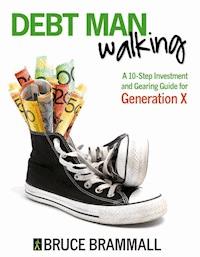
The key to wealth is... a four-letter word. Debt, growth assets and time are the perfect ingredients for Generation X to create real wealth. If you were born in the '60s or '70s, remember Billy Ray Cyrus, BMX Bandits, Sony Walkmans, the fall of the Berlin Wall, 'Who Shot JR?', the dot-eating Pac-Man -- and you're wondering how any of that could improve your financial position -- then this book is wa-a-ay overdue. Debt Man Walking will have you marching to a different financial beat, because Gen X's money needs are distinctive. Inside this book you'll discover: * how to maximise your opportunities using investment debt * that there are actually three types of debt: dumb, okay and great * that your 'relative' youth + diversification = wealth * how you can double your super nest egg in 15 minutes * why life as a Gen Xer is an excellent adventure ... dude.
Sie lesen das E-Book in den Legimi-Apps auf:
Seitenzahl: 436
Veröffentlichungsjahr: 2012
Ähnliche



















Contents
Dedication
Acknowledgements
About the author
Prologue
Introduction
Step 1: Write your own ticket
What’s your dream dollar figure?
‘Can’t Buy Me Love’
No incentive, no point
Write your own ticket
What drives me?
But plans change
‘Money for Nothing’
Step 2: Money’s simple rules
‘Livin’ On the Edge’
Plotting the path for Gen X
Money’s universal rules
Australia’s unique money rules
Insidious inflation
A rule for couples: talk about it
Step 3: Risky business
Dangerous Liaisons
Time — the Oil of Ulan
Gen X: youth is on your side
Short-term targets
Volvo engineer ... or Evel Knievel? Take the test!
Profiler — by the numbers
Understanding your risk profile
Should my risk profile rule all my investment decisions?
Push It’
Avoiding a War of the Roses
‘Highway to the Danger Zone’
Investment insomnia
That’s not an investment!
Step 4: Gen X’s investment edge
An impossibly wide choice
Keep it simple, stupid (KISS)
Gen X and growth assets — the perfect mix
Risk profiles — the practice
Owning small bits of big companies
Sheltering the needy
A home for everybody
A home for everything
Time for a reality check
Riding the cycle
Holding on for a return
Halve your tax
Showdown: shares versus property
Step 5: Home: investment central
A place to stash your stuff
Till death do us part?
Choose your strategy
Introducing Anna Buyer
Being disciplined
Renting is forever
Investment central
I’d buy, but homes are unaffordable!’
Step 6: Investing: the debt mantra
Mission Impossible
Debt — the secret investment ingredient
A world in black and white
‘Mum, where does cash come from?’
Not all debt is bad — the DOG of debt
So, why borrow?
A smooth Gere change
Time and money, money and time
Gen X: we’ve got the time and the money, honey
Shifting up a gear
Positive gearing
Negative gearing
Neutral gearing
Gearing: it’s not just about property
Bob the (investment portfolio) Builder
Maximising investment debt
Know where your brakes are
Little things ...
Step 7: Tax, Santa and other little helpers
Valuing advice
Tax planning 101
Money coach: your financial adviser
Advisers ain’t advisers
How can they help you?
Team building
Step 8: Blockbuster budgeting
‘I have a dream!’
Sooner or later, the goal will be scored
Step 9: Cover your ass(ets)
‘What, me worry?’
How much insurance do I need?
How long do I need it?
Saving bucks with the super credit card
Step 10: Choose your own ... neverending story
‘So Far Away’...
Super made simple
How super is invested
Where’s your super hanging out now?
Self-managed super funds
Geared super (Super Debt Man?)
Conclusion
Appendix A: The X-Flips
Appendix B: 50 investment, gearing and ‘Gen X Rules’ rules
Appendix C: Glossary
Recommend to a friend
Index
First published in 2009 by Wrightbooks
an imprint of John Wiley & Sons Australia, Ltd
42 McDougall St, Milton Qld 4064
Office also in Melbourne
Typeset in 10.5/15pt Syntax LT
© Bruce Brammall 2009
The moral rights of the author have been asserted
National Library of Australia Cataloguing-in-Publication Data
Author: Brammall, Bruce
Title: Debt man walking: a 10-step investment and gearing guide for Generation X / Bruce Brammall.
Publisher: Richmond, Vic.: John Wiley & Sons Australia, 2009.
ISBN: 9780731408351 (pbk.)
Notes: Includes index.
Subjects: Generation X — Finance, Personal.
Financial security.
Saving and investment.
Dewey number: 332.02401
All rights reserved. Except as permitted under the Australian Copyright Act 1968 (for example, a fair dealing for the purposes of study, research, criticism or review), no part of this book may be reproduced, stored in a retrieval system, communicated or transmitted in any form or by any means without prior written permission. All inquiries should be made to the publisher at the address above.
Cover design by Popomo
Cover image © shutterstock images/Timothy Large and © shutterstock images/Robyn Mackenzie
Image on p. 17 © Corbis/Deborah Feingold
Image on p. 33 © Newspix/News Ltd
Image on p. 53 © Corbis/Sygma/Collection Spitzer
Image on p. 75 © Universal/Celandine/Monty Python/The Kobal Collection
Image on p. 107 © Corbis/Neal Preston
Image on p. 123 © Touchstone/Warners/The Kobal Collection
Image on p. 153 © Corbis/Bettman
Image on p. 175 © Universal/Gordon/The Kobal Collection
Image on p. 193 © Corbis/Sunset Boulevard
Image on p. 217 © Constantin-Bavaria-WDR/Warner Bros/The Kobal Collection
Disclaimer
The material in this publication is of the nature of general comment only, and neither purports nor intends to be advice. Readers should not act on the basis of any matter in this publication without considering (and if appropriate, taking) professional advice with due regard to their own particular circumstances. The author and publisher expressly disclaim all and any liability to any person, whether a purchaser of this publication or not, in respect of anything and of the consequences of anything done or omitted to be done by any such person in reliance, whether whole or partial, upon the whole or any part of the contents of this publication.
Dedication
It is possibly the same for other Generation Xers, but every time I hear or read the word ‘dedication’ I can’t stop myself singing Dire Straits’ ‘Walk of Life’.
As the rest of this book is about reliving memories, I might as well open the book by pinching a couple of lines. Next, from the mouth of Renee Zellweger in Jerry Maguire...
To my family — Genevieve, Edward and Amelia — ‘You complete me’.
Acknowledgements
Unlike children, books can’t happen by mere accident. With two of the former and three of the latter (as of 2008), I can speak with some experience there. With a book, you don’t get to wake up one morning, wonder a little, pee on a stick and get confirmation that an end product is coming. The kind of book that goes to the printer is not a random one-in-a-billion event.
Books are not the result of the collaboration of a union with just one other person. I’m pretty sure ‘80s political crusader and morals campaigner Reverend Fred Nile would have had a coronary if the number of people who helped create this book were actually in the same room helping to create a baby. There’s a cast as big as Band Aid singing ‘Do They Know It’s Christmas?’
My darling wife, Genevieve, I’ve been spelling ‘team’ with a ‘u’ in it. This book wouldn’t exist right now were it not for your support. That said ...your lack of ‘80s music knowledge is both funny and incomprehensible. Did you never listen to songs being back-announced on the radio? How does someone get to know everything about the singers, but nothing about the songs they sang?
To my children. To Edward, who was just 16 months old when the manuscript was finished, ‘The Wiggles’ isn’t the answer to every music question Daddy asks (but more useful than most of your Mum’s answers). A helpful answer might have been: ‘Hey, Dad, the blue and purple Wiggles were part of The Cockroaches and they sang ...’. That your fourth ever word was ‘book’ is very encouraging for an author dad. And Amelia, this entire manuscript was written after we knew someone was coming but before we got to meet you, you gorgeous little girl. Thank you so much for not arriving too early.
Years in the thinking, this book probably would have stayed years off being written had it not been for Kristen Hammond, acquisitions editor at Wiley. Kristen chased me with another concept that didn’t grab me at all. But her enthusiasm about my Generation X concept was very encouraging. Kristen, thanks for gritting your teeth, not giving me both barrels and getting through the contract negotiations without your head exploding. Your guidance, encouragement and early editing role were important to the book’s evolution. That we have such similar memories of the ‘80s is freaky.
Thanks to everyone else at Wiley and Wrightbooks, but particularly editor Catherine Spedding, Georgie Way, Katherine Drew and Brooke Lyons.
When it comes to unearthing the memories of my youth, I can’t decide what is more disturbing: what I had personally forgotten about the ‘70s and the ‘80s, or what Gen’s friends and my friends could remember. I’m still searching for laws that would allow me to have my parents retrospectively charged with culinary crimes for apricot chicken casseroles. The memories that weren’t my own came from a treasured list of people — my Gen X brains trust — who contributed with their own memories of growing up.
Naturally, as back then, there is a boys’ team and girls’ team. And judging by their responses, they grew up in parallel universes. My boys’ team was, largely but not solely, connected to the Tossers Indoor Cricket Club. Thanks to Simon Smith, Andrew Probyn, Steff Pettit, Tony Spark, David Pringle, Rob Clancy, Brent McMillan, Brendan Cahill, Jonathon Evans, Rohan Christie and Steve Kerr. The team led by Gen was made up of Felicity Hamilton (I was searching for an idiot and you provided the father of them all — Frank Spencer), Michelle Coffey, Zoe Kanat, Kimberley Clemens, Sophie Paterson, Liz Wilson, Madeleine Seletto, Edwina Webb, Katie Flockart, Celia Purdey and Odette Kerr.
To the technical readers: my cousin, Danny Brammall, for reading the whole thing and only occasionally reminding me that he knows a better way; Mark Longworth for lending his insurance expertise; and superannuation guru and Eureka Report colleague Trish Power for advice with step 10.
Thanks to Max Prisk for his kick-ass contribution to the back cover, Popomo for the cover, Tess McCabe for Debt Man corporate designs, Herald Sun photographer Jay Town for the back cover shot, and Kate Jungwirth and David King from EKM Legal for work on my contract.
Thanks also to my brother-in-law Nick Lally for his Yoda-like timely and sage advice (The answers you seek lie offshore, Debt Man’) that led me to find my ‘Man in Montevideo’, Marcos ‘Mark Skayff’ Scaianschi, who perfected the calculators for the website <www.debtman.com.au> and, as it turns out, ironed out a crease or two in the book.
To the partners — Spiros Livadaras, Peter Mattmann, Leonie Ladgrove and Kostas Livadaras — and the rest of the crew at Stantins, thanks for your ongoing support.
To the celebrities, songwriters, musicians, actors, directors, designers, fashionistas, cartoonists, casting agents, writers, journalists, sportspeople, politicians, toymakers and chefs of the ‘70s, ‘80s and ‘90s, I thank you on behalf of Generation X for our childhood memories. It was a rockin’ time to grow up. First among equals, as far as I’m concerned, is Brian Mannix and The Uncanny X-Men — you typify Generation X in Australia. The songs ... the attitude ... the ‘Party’... the mullets. I’m ashamed to confess, I never bought one of your albums. It still haunts me.
It wouldn’t be right to conclude without mentioning two writers out there in the world of Australian personal finance journalism (who must stay anonymous). The first I want to thank for writing a feature that so abundantly offended my innate beliefs that it required a response. The second’s writing style I have found objectionable on an almost weekly basis for years (and still do). Needless to say, I read you both regularly and that’s what journalism is about. You too may find some of my stuff disagreeable. This book wouldn’t have existed at all (arguably) and certainly not in this form (definitely) if you hadn’t, unknowingly, annoyed me so much. And so damn often. Thank you both.
About the author
The towering figure of Paul Keating casts a long shadow over my life. The Lizard of Oz wasn’t just the Prime Minister of my country, the engineer of my first real economic downturn and the man who took some of the fun out of getting rich by introducing the capital gains tax in 1985. My relationship with PK was far more personal than that. He was my first local MP.
I was born in Bankstown, Sydney, in 1970, the year after Keating was elected to represent Blaxland. Keating didn’t use me to practise his baby kissing. Mum assures me I wasn’t too ugly (my dad vocally disagrees). Perhaps I just didn’t hang around long enough; my parents uprooted me for Canberra when I was six weeks old.
There is, however, video evidence of my time in Bankstown. Grainy footage taken from a shiny new Super 8 camera shows me being carried into the rented family home from hospital, carried by my 22-year-old first-time mum who was wearing a mini-skirt so skimpy it would have made Jean Shrimpton blush (‘Mu-u-um, put some clothes on!’).
I played every type of organised sport I could — cricket, basketball, hockey, tennis, golf and both of the rugby codes. But that was dwarfed by the amount of time I spent playing disorganised sport — street cricket, kick-to-kick, Frisbee golf, marbles, handball, swimming (including Marco Polo), ice-skating, roller-skating, skateboarding, kite-flying, British bulldog, brandings, bike riding ...
This might have been because the Atari 2600 had only just been invented in the US in 1975 and none of my mates had one yet. The Commodore VIC20 was still years away (1980).
I remember furniture that might have been made out of brown velour, the older generation wearing flared pants and winged collars and watching colour television for the first time. I was too young to remember Gough Whitlam getting sacked. But I remember vividly the end of Malcolm Fraser and the start of Bob Hawke, because my dad was the chief political reporter for The Canberra Times. As Hawke’s Treasurer, Keating would occasionally call my dad and give him a roasting, complete with colourful language, over articles he’d written.
It was in about year 10 that I got my first crack at economics and political thinking. Marist College (Pearce) made George Orwell’s Animal Farm compulsory reading. Napoleon and Squealer made me aware that the root of all evil is, actually, the removal of personal incentive. Socialism and I never made friends after that.
My parents’ rule was that in order to drive the family car (a Mitsubishi Magna) I had to have the insurance excess saved in the event that I had a stack. So while everyone else was whining about 20 per cent mortgage rates, I was getting 17 per cent on my savings.
Watching my dad led me into journalism. I think. I might have been enticed by a career that promised lots of free beer. I started at the University of Canberra in 1989 (the year Keating reintroduced university tuition fees in the form of HECS) and earned a BA (Communications), majoring in journalism.
In the middle of Keating’s ‘recession we had to have’, with double-digit unemployment rates, I entered the job market. News organisations, like most industries in 1991–92, were sacking rather than hiring. The newly merged Herald Sun in Melbourne (the butt of Keating’s ‘arse end of the world’) was bucking the trend and I got a cadetship. That year, 1992, was also the year one of Keating’s political babies, compulsory superannuation (designed to make sure Gen X and future generations look after themselves in retirement), started.
Journalism was a perfect industry for someone who wasn’t keen on growing up. And the Herald Sun was certainly a place where I was surrounded by like-minded individuals. There was always a drink to be had and someone was always going to the pub or a club. Reporting eventually led me to business journalism, where I became the deputy editor of the Business section. I also wrote about banks, superannuation, insurance, wealth management and tax. At the same time, I got hooked on property (immediately becoming an investor) and the wider potential for debt-funded investment strategies. I have written two property investment books (The Power of Property in 2006 and Investing in Real Estate For Dummies in 2008).
In 2005 and 2006, I studied for the Advanced Diploma in Financial Services (Financial Planning). I am now an adviser with Stantins Financial Services (licensed with Australian Financial Services) in Hawthorn, Victoria. I still write regularly, as a superannuation and investment columnist for Eureka Report and on property topics for News Limited publications. Oops, there he is again — Keating has just bobbed his head up to criticise Kevin Rudd’s Government for failing on superannuation. I also appear on radio and television programs as an adviser, and media and financial news commentator.
And I’ve left my absolute favourite parts of me, the ‘grousest’ bits, till last. Nothing beats ‘em. I am proudly husband to Genevieve and father to Edward and Amelia.
Prologue
Setting the scene ...
The film clip for The Uncanny X-Men’s ‘Everybody Wants to Work’ starts out with employee Brian Mannix (The X-Men’s lead singer, playing himself) in his office, on the phone. His boss, Mr Thompson (played by the late, great Australian actor and gagster, Maurie Fields), walks into the room. Mannix is on the phone to his lotto agency after he’s had some sort of a win.
Mr Thompson: ‘Mannix, you mongrel! Get back to work!’
Mannix: ‘Yes, Mr Thompson.’
Mannix (on phone): ‘Look, sir, how much have I won?’
Mannix grins from ear to ear.
Mannix: ‘Mr Thompson ... gu-e-e-e-ess what!’
Debt is not a financial death sentence.
Not all debt is evil. Debt does not involve selling your soul to the devil. Debt isn’t the custom-made pair of concrete boots fitted as you’re thrown into the Hudson River. There’s no proven link between debt and cancer. Debt played no part in Princess Diana’s death. Debt doesn’t kill people.
Nor is this book a cheerleader’s chant for debt.
Debt Man Walking (despite what some will inevitably read into the title) does not urge readers to collect loans like Barbie dolls or football cards. It does not blindly promote debt. It does not implore readers to covet credit. It does not decree, Gordon Gekko–like, that all ‘debt is good’ (although some of it is okay).
Don’t believe for a second that this book is going to tell you that you’ll get rich just by backing up your Holden ute to a bank and borrowing until your nose bleeds. If you believe that, you misunderstand how dangerous debt can be. Too much debt, debt used badly, or debt in the hands of the unsophisticated or untrained investor can be devastating. ‘Debt is not the messiah! He can be a very naughty boy!’
Understand this: debt can send you broke. What’s the definition of a bankrupt? According to the Oxford, it’s ‘an insolvent debtor’; that is, someone who can’t repay money they owe others. If you don’t owe others money, you can’t become bankrupt.
So ... what is this book about then?
Lesen Sie weiter in der vollständigen Ausgabe!
Lesen Sie weiter in der vollständigen Ausgabe!
Lesen Sie weiter in der vollständigen Ausgabe!
Lesen Sie weiter in der vollständigen Ausgabe!
Lesen Sie weiter in der vollständigen Ausgabe!
Lesen Sie weiter in der vollständigen Ausgabe!
Lesen Sie weiter in der vollständigen Ausgabe!
Lesen Sie weiter in der vollständigen Ausgabe!
Lesen Sie weiter in der vollständigen Ausgabe!
Lesen Sie weiter in der vollständigen Ausgabe!
Lesen Sie weiter in der vollständigen Ausgabe!
Lesen Sie weiter in der vollständigen Ausgabe!
Lesen Sie weiter in der vollständigen Ausgabe!
Lesen Sie weiter in der vollständigen Ausgabe!
Lesen Sie weiter in der vollständigen Ausgabe!
Lesen Sie weiter in der vollständigen Ausgabe!
Lesen Sie weiter in der vollständigen Ausgabe!




