


70,99 €
Mehr erfahren.
- Herausgeber: John Wiley & Sons
- Kategorie: Fachliteratur
- Serie: Bloomberg Professional
- Sprache: Englisch
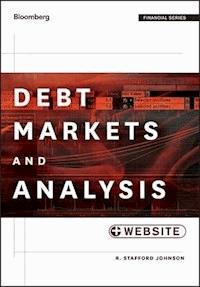
An accessible guide to the essential elements of debt markets and their analysis Debt Markets and Analysis provides professionals and finance students alike with an exposition on debt that will take them from the basic concepts, strategies, and fundamentals to a more detailed understanding of advanced approaches and models. * Strong visual attributes include consistent elements that function as additional learning aids, such as: Key Points, Definitions, Step-by-Step, Do It Yourself, and Bloomberg functionality * Offers a solid foundation in understanding the complexities and subtleties involved in the evaluation, selection, and management of debt * Provides insights on taking the ideas covered and applying them to real-world investment decisions Engaging and informative, Debt Markets and Analysis provides practical guidance to excelling at this difficult endeavor.
Sie lesen das E-Book in den Legimi-Apps auf:
Seitenzahl: 1066
Veröffentlichungsjahr: 2013
Ähnliche
















Contents
Cover
Series
Title Page
Copyright
Dedication
Preface
Acknowledgments
Part I: Bond Evaluation and Selection
Chapter 1: Overview of the Financial System
Real and Financial Assets
Types of Debt Claims
Financial Markets
Types of Financial Markets
Regulations
Efficient Financial Markets
Characteristics of Assets
Conclusion
Website Information
Selected References
Notes
Chapter 2: Overview and Guide to the Bloomberg System
Introduction
Bloomberg System—Bloomberg Keyboard
Accessing Some of the Information Discussed in Chapter 1
Currency
Indexes
Functionality
Screens
Monitor and Portal Screens
Bond Monitors: FIT, WB, RATT, RATC, CSDR, IM, and BTMM
Portfolios and Baskets
Screening and Search Functions
The Bloomberg Excel Add-In: Importing Bloomberg into Excel
Launchpad
Other Bloomberg Functions
Conclusion
Bloomberg Exercises
Chapter 3: Bond Value and Return
Introduction
Bond Valuation
The Yield to Maturity and Other Rates of Return Measures
Rates on Zero-Coupon Bonds
Total Return
Spot Rates and Equilibrium Prices
Geometric Mean
Conclusion
Website Information
Selected References
Bloomberg Exercises
Chapter 4: The Level and Structure of Interest Rates
Introduction
Level of Interest Rates
The Structure of Interest Rates
Term Structure and the Yield Curve
Market Segmentation Theory
Preferred Habitat Theory
Pure Expectation Theory
Liquidity Premium Theory
Constructing the Benchmark Yield Curve
Other Yield Curves
Conclusion
Website Information
Selected References
Bloomberg Exercises
Notes
Chapter 5: Bond Risk
Introduction
Default and Credit Risks
Call Risk
Interest Rate Risk
Duration and Convexity
Conclusion
Website Information
Selected References
Bloomberg Exercises
Notes
Chapter 6: Bond Investment Strategies
Introduction
Active Investment Strategies
High-Yield Bond Funds
Passive Bond Management Strategies
Bond Immunization Strategies
Surplus Management and Duration Gap Analysis
Conclusion
Website Information
Selected References
Bloomberg Exercises
Notes
Part II: Debt Markets and Securities
Chapter 7: Corporate Debt Securities
Introduction
Corporate Bonds
Corporate Bonds with Special Features
Medium-Term Notes
Commercial Paper
Bankruptcy
Preferred Stock
The Markets for Corporate Bonds
Global Bond Investments
Conclusion
Website Information
Selected References
Bloomberg Exercises
Notes
Chapter 8: Government Securities and Markets: Treasury, Agencies, Municipals, and Sovereign Debt Securities
Introduction
Treasury Securities and Markets
Agency Securities and Markets
Municipal Securities and Markets
Sovereign Government Debt
Conclusion
Website Information
Selected References
Bloomberg Exercises
Notes
Chapter 9: Intermediary Debt Securities, Investment Funds, and Markets
Introduction
Commercial Banks: Intermediary Securities
Investment Funds
Insurance Companies, Pension Funds, and Investment Banks
Conclusion
Website Information
Selected References
Bloomberg Exercises
Notes
Chapter 10: Mortgage-Backed and Asset-Backed Securities and Securitization
Introduction
Residential Mortgage Loans
Mortgage Portfolio
Mortgage-Backed Securities
Features of Mortgage-Backed Securities
Collateralized Mortgage Obligations and Strips
Evaluating Mortgage-Backed Securities
Commercial Mortgage-Backed Securities
Asset-Backed Securities
Conclusion
Website Information
Selected References
Bloomberg Exercises
Notes
Part III: Debt Derivatives
Chapter 11: Bond and Interest Rate Futures Contracts
Introduction
The Market and Characteristics of Futures on Debt Securities
The Nature of Futures Trading and the Role of the Clearinghouse and Margins
Futures Hedging
Speculating with Interest Rate Derivatives
Synthetic Debt and Investment Positions
Futures Pricing
Conclusion
Website Information
Selected References
Bloomberg Exercises
Notes
Chapter 12: Bond and Interest Rate Option Contracts
Introduction
Option Terminology
Markets and Types of Interest Rate Options
Option Positions
Hedging Fixed-Income Positions with Options
Option Trading—Microstructure
Interest Rate Calls and Puts, Caps and Floors
Option Price Relationships
Conclusion
Website Information
Selected References
Bloomberg Exercises
Notes
Chapter 13: The Valuation of Bonds with Embedded Options and Debt Options—The Binomial Interest Rate Tree
Introduction
Binomial Interest Rate Model
Convertible Bonds
Valuation of Bond and Interest Rate Options
Estimating the Binomial Tree
Option-Adjusted Spread, Duration, and Convexity
The Black-Scholes and Black Option Pricing Model
Conclusion
Website Information
Selected References
Bloomberg Exercises
Notes
Chapter 14: Interest Rate and Credit Default Swaps
Introduction
Generic Interest Rate Swaps
Swap Market
Swap Valuation
Comparative Advantage and the Hidden Option
Swaps Applications
Credit Risk
Forward Swaps
Hedging a Future Investment
Swaptions
Nongeneric Swaps
Credit Default Swaps
Conclusion
Website Information
Bloomberg Exercises
Selected References
Notes
Appendix A: Primer on Return, Present Value, and Future Value
Holding Period Yield
Annualized HPY
Required Rates of Return and Value for a Single-Period Cash Flow
Future and Present Values
Future Value
Future Value of an Annuity
Present Value
Present Value of an Annuity
Valuing a Bond
Appendix B: Uses of Exponents and Logarithms
Exponential Functions
Logarithms
Rules of Logarithms
Uses of Logarithms
Solving for R
Logarithmic Return
Time
Selected Reference
Appendix C: Directory Listing of Bloomberg Screens by Menu and Function
Index
Since 1996, Bloomberg Press has published books for financial professionals on investing, economics, and policy affecting investors. Titles are written by leading practitioners and authorities, and have been translated into more than 20 languages.
The Bloomberg Financial Series provides both core reference knowledge and actionable information for financial professionals. The books are written by experts familiar with the work flows, challenges, and demands of investment professionals who trade the markets, manage money, and analyze investments in their capacity of growing and protecting wealth, hedging risk, and generating revenue.
For a list of available titles, please visit our website at www.wiley.com/go/bloombergpress.
Cover image: background © Jamie Carroll/iStockphoto; chart courtesy of R. Stafford Johnson Cover design: C. Wallace
Copyright © 2013 by R. Stafford Johnson. All rights reserved.
Published by John Wiley & Sons, Inc., Hoboken, New Jersey. Published simultaneously in Canada.
No part of this publication may be reproduced, stored in a retrieval system, or transmitted in any form or by any means, electronic, mechanical, photocopying, recording, scanning, or otherwise, except as permitted under Section 107 or 108 of the 1976 United States Copyright Act, without either the prior written permission of the Publisher, or authorization through payment of the appropriate per-copy fee to the Copyright Clearance Center, Inc., 222 Rosewood Drive, Danvers, MA 01923, (978) 750-8400, fax (978) 646-8600, or on the Web at www.copyright.com. Requests to the Publisher for permission should be addressed to the Permissions Department, John Wiley & Sons, Inc., 111 River Street, Hoboken, NJ 07030, (201) 748-6011, fax (201) 748-6008, or online at http://www.wiley.com/go/permissions.
Limit of Liability/Disclaimer of Warranty: While the publisher and author have used their best efforts in preparing this book, they make no representations or warranties with respect to the accuracy or completeness of the contents of this book and specifically disclaim any implied warranties of merchantability or fitness for a particular purpose. No warranty may be created or extended by sales representatives or written sales materials. The advice and strategies contained herein may not be suitable for your situation. You should consult with a professional where appropriate. Neither the publisher nor author shall be liable for any loss of profit or any other commercial damages, including but not limited to special, incidental, consequential, or other damages.
All charts reprinted with permission from Bloomberg. Copyright 2012 Bloomberg L.P. All rights reserved.
For general information on our other products and services or for technical support, please contact our Customer Care Department within the United States at (800) 762-2974, outside the United States at (317) 572-3993 or fax (317) 572-4002.
Wiley also publishes its books in a variety of electronic formats. Some content that appears in print may not be available in electronic books. For more information about Wiley products, visit our web site at www.wiley.com.
Library of Congress Cataloging-in-Publication Data: Johnson, R. Stafford. Debt markets and analysis / R. Stafford Johnson. p. cm. – (Bloomberg financial series) Includes index. ISBN 978-1-118-00000-7 (cloth); ISBN 978-1-118-22166-2 (ebk); ISBN 978-1-118-26024-1 (ebk); ISBN 978-1-118-23543-0 (ebk) 1. Fixed-income securities. 2. Debt. 3. Bonds. 4. Securities. I. Title. HG4650.J64 2013 332.63′2044–dc23 2012030691
To my wife, Jan.
Preface
Over the past 20 years, the investment industry has seen stock market and real estate bubbles, the emergence of hedge funds and private equity companies, the globalization of financial markets, the proliferation of derivative securities, and the growth of securitized assets and structured financing. Mirroring these events have been the academic contributions to the investment discipline: the development of capital market theories, the derivation of option pricing models, and the explorations into efficient market theories. The financial events and the academic contributions together point out the challenges in mastering an understanding and developing a knowledge of investments and financial markets. In addition to the innovations in financial instruments, the investment and management of bonds and debt securities by financial and nonfinancial corporations has also experienced significant developments over the past two decades. Bond investors use strategies such as cash-flow matching, immunization, cell matching, contingent immunization, and bond selection based on forecasting yield curve shifts or the narrowing or widening of the quality yield spread. Many corporate borrowers, money managers, intermediaries, and bond portfolio managers have increased their use of futures, options, and swap contracts on debt securities as a hedge against interest rate and credit risk.
Today, managing fixed-income securities in this dynamic and innovative investment environment requires that professionals understand the debt markets and uses for an increasing number of securities, markets, strategies, and methodologies. In this increasingly complex environment, many practitioners manage their securities and portfolios using a Bloomberg terminal. Bloomberg is a computer information and retrieval system providing access to financial and economic data, news, and analytics. Bloomberg terminals are common on most trading floors and are becoming more common in universities where they are used for research, teaching, and managing student investment funds. Bloomberg is also the leader in data and information retrieval and analytical systems applicable to bond investment and management.
The purpose of this book is to provide finance students and professionals with a bond and debt management exposition that will take them from the basic bond investment theories and fundamentals that can be found in many investment books to a more detailed understanding of the markets and strategies. Given the widespread use of the Bloomberg system and its data and analytical systems that can be applied to bonds, this text also includes a detailed description of the Bloomberg system, a listing of many of the analytical functions that can be applied to fixed-income investment and management, and detailed explanations of how Bloomberg information and analytical functions can be applied to the fixed-income and debt market topics covered in the text. It is my hope that the synthesis of fundamental and advanced topics with Bloomberg information and analytics will provide professionals and students of finance with not only a better foundation in understanding the complexities and subtleties of the debt markets, but also with the ability to apply that understanding to real-world investment decisions—to grasp how it is done “on the street.”
The book is written for professionals in the investment industry involved in bond and debt management and MBA, MS, and undergraduate finance students. For professionals, the text can be used as a training and instructional source and as a guide on how to apply Bloomberg to debt markets and analysis. As a debt markets text for students, the book is designed for a one-semester debt markets course. The Bloomberg material is presented in boxes in each chapter, and Chapter 2 provides an overview and guide to the Bloomberg system.
Content
All securities can be evaluated in terms of the characteristics common to all assets: value, return, risk, maturity, marketability, liquidity, and taxability. In Part One, debt securities are analyzed in terms of these characteristics. Chapter 1 presents an overview of the investment environment, examining the nature of financial assets, the types of securities that exist, the nature and types of markets that securities give rise to, and the general characteristics of assets. Chapter 2 presents an overview and guide to the Bloomberg system. With this background, the next four chapters examine bonds in terms of their characteristics, with exhibit boxes included in each chapter that identify how Bloomberg information and analytical screens can be used to evaluate bonds. Chapter 3 looks at how debt instruments are valued and how their rates of return are measured; Chapter 4 examines the level and structure of interest rates and shows how such factors as market expectations, economic conditions, and risk-return preferences are important in determining the level and structure of rates; Chapter 5 describes three types of bond risk—default, call, and market risk—and introduces two measures of bond volatility—duration and convexity. In Chapter 6, bond analysis is extended from evaluation to investment and management by examining a number of active and passive bond management strategies.
Part Two delineates the different debt securities and their markets in terms of the rules, participants, and forces that govern them, as well as investment strategies related to specific securities. Chapter 7 describes the debt claims of businesses; Chapter 8 looks at the types and markets for government securities—Treasury, federal agencies, municipals, and sovereigns; Chapters 9 examines intermediary securities and investment funds; Chapter NaN examines mortgage-backed and asset-backed securities. In each of these chapters, Bloomberg exhibit boxes are included to explain how Bloomberg screens can be used to access information. Part Three consists of four chapters covering bond derivatives. Chapters 11 and 12 provide overviews of the markets, uses, and pricing of bond and interest rate futures and option contracts. Chapter NaN examines embedded options using a binomial interest rate tree; Chapter NaN covers interest rate and credit default swaps.
The book covers most fixed-income security types and markets, the major theories and models, the practical applications of the models, and cases and empirical studies. The text stresses concepts, model construction, numerical examples, and Bloomberg applications and information sources. The text also includes Bloomberg exercises at the end of each of the chapters. These exercises are designed for practitioners who have access to such terminals at their jobs and for students who have access to Bloomberg terminals either at their universities or possibly through internships they may have at financial companies. It is my hope that the Bloomberg exercises will add depth to your understanding of debt markets and management, as well as an appreciation of the breadth of financial information and analytics provided by the Bloomberg system. On an accompanying website, there are end-of-chapter review questions and problems with accompanying solutions that are provided to reinforce concepts. The site also includes links to videos that explain how to work some of the Bloomberg exercises, Excel spreadsheet programs that can be used to solve a number of the problems, key terms, and chapter PowerPoints. The reader can access the text website by going to www.wiley.com/go/debtmarkets (password: johnson).
The book draws material directly from one of my earlier texts published by Wiley: Bond Evaluation, Selection, and Management (Wiley, 2010). The Bloomberg material presented here comes from knowledge picked up from using the terminal (or learned from my students who used Bloomberg) when I was the fund professor for the student equity investment fund and bond investment fund at Xavier University.
Acknowledgments
Many people have contributed to this text. First, I wish to thank Mary Beth Shagena, the O'Conor family, and my other colleagues at Xavier University, who have helped me in many different ways. My appreciation is extended to the editors and staff at John Wiley & Sons, Inc., particularly Bill Falloon, Executive Editor; Steven Kyritz, Senior Production Editor; Judy Howarth, Senior Development Editor; Meg Freeborn, Senior Development Editor; Mary Daniello, Production Manager; and Tiffany Charbonier, who oversaw the book's development and were a continued source of encouragement. My appreciation is also extended to Stephen Isaac, Bloomberg Press, for his support, help, and encouragement on this project.
I also wish to thank my wife Jan, my children, Wendi, Jamey, and Matt, and my grandchildren Bryce, Kendall, and Malin for their support, encouragement, and understanding. I also would like to recognize the pioneers in the development of fixed-income and debt management theory and strategy: Frank Fabozzi, Fischer Black, John Cox, Lawrence Fisher, John Hull, Robert Kolb, Martin Leibowitz, Frederick Macaulay, Robert Merton, Stephen Ross, Mark Rubinstein, and others cited in the pages that follow. Without their contributions, this text could not have been written. Finally, I extend my gratitude to the many people who make up the soul of the Bloomberg system—analysts, programmers, systems experts, reps, and journalists. It is truly a remarkable system.
I encourage you to send your comments and suggestions to me at [email protected].
R. Stafford Johnson Xavier University
PART I
Bond Evaluation and Selection
CHAPTER 1
Overview of the Financial System
Real and Financial Assets
Most new businesses begin when an individual or a group of individuals come up with an idea: manufacturing a new type of cell phone, developing land for a future housing subdivision, launching a new Internet company, or exploring for crude oil. To make the idea a commercial reality, though, requires funds that the individual or group generally lacks or personally does not want to commit. Consequently, the fledgling business sells financial claims or instruments to raise the funds necessary to buy the capital goods (equipment, land, etc.), as well as the human capital (architects, engineers, lawyers, etc.), needed to launch the project. Technically, such instruments are claims against the income of the business represented by a certificate, receipt, or other legal document. In this process of initiating and implementing the idea, both real and financial assets are therefore created. The real assets consist of both the tangible and intangible capital goods, as well as human capital, which are combined with labor to form the business. The business, in turn, transforms the idea into the production and sale of goods or services that will generate a future stream of earnings. The financial assets, however, consist of the financial claims on the earnings. Those individuals or institutions that provided the initial funds and resources hold these assets. Furthermore, if the idea is successful, then the new business may find it advantageous to initiate other new projects that it again may finance through the sale of financial claims. Thus, over time, more real and financial assets are created.
The creation of financial claims, of course, is not limited to the business sector. The federal government's expenditures on national defense, entitlements, and infrastructures, and state governments' expenditures on the construction of highways, for example, represent the creation of real assets that these units of government often finance through the sale of financial claims on either the revenue generated from a particular public sector project or from future tax revenues. Similarly, the purchase of a house or a car by a household often is financed by a loan from a savings and loan or commercial bank. The loan represents a claim by the financial institution on a portion of the borrower's future income, as well as a claim on the ownership of the real asset (house or car) in the event the household defaults on its promise.
Modern economies expend enormous amounts of money on real assets to maintain their standards of living. Such expenditures usually require funds that are beyond the levels a business, household, or unit of government has or wants to commit at a given point in time. As a result, to raise the requisite amounts, economic entities sell financial claims. Those buying the financial claims therefore supply funds to the economic entity in return for promises that the entity will provide them with a future flow of income. As such, financial claims can be described as financial assets.
All financial assets provide a promise of a future return to the owners. Unlike real assets, though, financial assets do not depreciate (since they are in the form of certificates or information in a computer file), and they are fungible, meaning they can be converted into cash or other assets. There are many different types of financial assets. All of them, though, can be divided into two general categories—equity and debt. Common stock is the most popular form of equity claims. It entitles the holder to dividends or shares in the business's residual profit and participation in the management of the firm, usually indirectly through voting rights. The stock market where existing stock shares are traded is the most widely followed market in the world, and it receives considerable focus in many investment and security analysis texts. The focus of this book, though, is on the other general type of financial asset—debt. Businesses finance more of their real assets and operations with debt than equity, whereas governments and households finance their entire real assets and operations with debt. This chapter provides an overview of the types of debt securities and markets, whereas Part Two provides more detailed analyses.
Types of Debt Claims
Debt claims are loans wherein the borrower agrees to pay a fixed income per period, defined as a coupon or interest, and to repay the borrowed funds, defined as the principal (also called redemption value, maturity value, par value, and face value). Within this broad description, debt instruments can take on many different forms. For example, debt can take the form of a loan by a financial institution. In this case, the terms of the agreement and the contract instrument generally are prepared by the lender/creditor, and the instrument often is nonnegotiable, meaning it cannot be sold to another party. A debt instrument also can take the form of a bond or note, whereby the borrower obtains her loan by selling (also referred to as issuing) contracts or IOUs to pay interest and principal to investors/lenders. Many of these claims, in turn, are negotiable, often being sold to other investors before they mature.
Lesen Sie weiter in der vollständigen Ausgabe!
Lesen Sie weiter in der vollständigen Ausgabe!
Lesen Sie weiter in der vollständigen Ausgabe!
Lesen Sie weiter in der vollständigen Ausgabe!
Lesen Sie weiter in der vollständigen Ausgabe!
Lesen Sie weiter in der vollständigen Ausgabe!
Lesen Sie weiter in der vollständigen Ausgabe!
Lesen Sie weiter in der vollständigen Ausgabe!
Lesen Sie weiter in der vollständigen Ausgabe!
Lesen Sie weiter in der vollständigen Ausgabe!
Lesen Sie weiter in der vollständigen Ausgabe!
Lesen Sie weiter in der vollständigen Ausgabe!
Lesen Sie weiter in der vollständigen Ausgabe!
Lesen Sie weiter in der vollständigen Ausgabe!
Lesen Sie weiter in der vollständigen Ausgabe!
Lesen Sie weiter in der vollständigen Ausgabe!
Lesen Sie weiter in der vollständigen Ausgabe!
Lesen Sie weiter in der vollständigen Ausgabe!
Lesen Sie weiter in der vollständigen Ausgabe!




