


104,99 €
Mehr erfahren.
- Herausgeber: John Wiley & Sons
- Kategorie: Fachliteratur
- Serie: Wiley Series in Operations Research and Management Science
- Sprache: Englisch
A multidisciplinary approach to problem-solving in community-based organizations using decision models and operations research applications
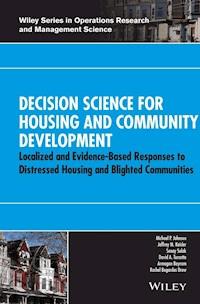
A comprehensive treatment of public-sector operations research and management science, Decision Science for Housing and Community Development: Localized and Evidence-Based Responses to Distressed Housing and Blighted Communities addresses critical problems in urban housing and community development through a diverse set of decision models and applications. The book represents a bridge between theory and practice and is a source of collaboration between decision and data scientists and planners, advocates, and community practitioners.
The book is motivated by the needs of community-based organizations to respond to neighborhood economic and social distress, represented by foreclosed, abandoned, and blighted housing, through community organizing, service provision, and local development. The book emphasizes analytic approaches that increase the ability of local practitioners to act quickly, thoughtfully, and effectively. By doing so, practitioners can design and implement responses that reflect stakeholder values associated with healthy and sustainable communities; that benefit from increased organizational capacity for evidence-based responses; and that result in solutions that represent improvements over the status quo according to multiple social outcome measures. Featuring quantitative and qualitative analytic methods as well as prescriptive and exploratory decision modeling, the book also includes:
- Discussions of the principles of decision theory and descriptive analysis to describe ways to identify and quantify values and objectives for community development
- Mathematical programming applications for real-world problem solving in foreclosed housing acquisition and redevelopment
- Applications of case studies and community-engaged research principles to analytics and decision modeling
Decision Science for Housing and Community Development: Localized and Evidence-Based Responses to Distressed Housing and Blighted Communities is an ideal textbook for upper-undergraduate and graduate-level courses in decision models and applications; humanitarian logistics; nonprofit operations management; urban operations research; public economics; performance management; urban studies; public policy; urban and regional planning; and systems design and optimization. The book is also an excellent reference for academics, researchers, and practitioners in operations research, management science, operations management, systems engineering, policy analysis, city planning, and data analytics.
Sie lesen das E-Book in den Legimi-Apps auf:
Seitenzahl: 619
Veröffentlichungsjahr: 2015
Ähnliche



















TABLE OF CONTENTS
Cover
SERIES PAGE
TITLE PAGE
COPYRIGHT
PREFACE
FOREWORD
REFERENCES
ACKNOWLEDGMENTS
AUTHOR BIOGRAPHIES
LIST OF FIGURES
LIST OF TABLES
CHAPTER 1: INTRODUCTION: COMMUNITY-BASED ORGANIZATIONS, NEIGHBORHOOD-LEVEL DEVELOPMENT, AND DECISION MODELING
1.1 CHALLENGES AND OPPORTUNITIES FOR HOUSING AND COMMUNITY DEVELOPMENT IN THE US
1.2 COMMUNITY DEVELOPMENT IN THE UNITED STATES
1.3 BIG DATA, ANALYTICS AND COMMUNITY DEVELOPMENT
1.4 THE FORECLOSURE CRISIS: PROBLEM, IMPACTS, AND RESPONSES
1.5 COMMUNITY-BASED OPERATIONS RESEARCH: A NOVEL APPROACH TO SUPPORT LOCAL DEVELOPMENT
1.6 WHY THIS BOOK NOW?
1.7 BOOK DESCRIPTION
1.8 CONCLUSION
SECTION 1: POLICY AND PRACTICE IN FORECLOSED HOUSING AND COMMUNITY DEVELOPMENT
CHAPTER 2: Foreclosed Housing Crisis and Policy and Planning Responses
2.1 ROOTS OF THE FORECLOSED HOUSING CRISIS
2.2 IMPACTS OF THE CRISIS
2.3 RESPONSES TO THE CRISIS
2.4 EFFECTIVENESS OF FORECLOSURE RESPONSES
2.5 OPPORTUNITIES FOR DECISION MODELING RESPONSES TO THE FORECLOSED HOUSING CRISIS
CHAPTER 3: COMMUNITY PARTNERS AND NEIGHBORHOOD CHARACTERISTICS
3.1 INTRODUCTION
3.2 METHODOLOGY
3.3 SELECTION OF CASES
3.4 CASE 1: THE NEIGHBORHOOD DEVELOPERS
3.5 CASE 2: COALITION FOR A BETTER ACRE
3.6 CASE 3: CODMAN SQUARE NEIGHBORHOOD DEVELOPMENT CORPORATION
3.7 CASE 4: TWIN CITIES COMMUNITY DEVELOPMENT CORPORATION
3.8 CASE CONTRAST AND DISCUSSION
3.9 CONCLUSION
CHAPTER 4: ANALYTIC APPROACHES TO FORECLOSURE DECISION MODELING
4.1 INTRODUCTION
4.2 ANALYSIS OF COMMUNITY PARTNERS AND THEIR SERVICE AREAS
4.3 LOCALIZED FORECLOSURE RESPONSE
4.4 OPPORTUNITIES FOR RESEARCH-BASED ANALYTIC RESPONSES TO FORECLOSURES
4.5 SOLUTION DESIGN FOR COMMUNITY DEVELOPMENT USING COMMUNITY-BASED OPERATIONS RESEARCH
4.6 WHERE DO WE GO FROM HERE?
SECTION 2: VALUES, METRICS AND IMPACTS FOR DECISION MODELING
CHAPTER 5: VALUE-FOCUSED THINKING: DEFINING, STRUCTURING, AND USING CDC OBJECTIVES IN DECISION MAKING
5.1 INTRODUCTION
5.2 METHODS
5.3 CASES
5.4 COMMON AND CONTINGENT OBJECTIVES FOR CDCs
5.5 LESSONS FOR APPLYING VFT TO CBOs
CHAPTER 6: CHARACTERISTICS OF ACQUISITION OPPORTUNITIES: STRATEGIC VALUE
6.1 INTRODUCTION
6.2 PROBLEM DESCRIPTION
6.3 MODEL DEVELOPMENT
6.4 CASE STUDY: THE NEIGHBORHOOD DEVELOPERS
6.5 DISCUSSION
6.6 CONCLUSION
CHAPTER 7: CHARACTERISTICS OF ACQUISITION OPPORTUNITIES: PROPERTY VALUE
7.1 INTRODUCTION
7.2 PROPERTY VALUE CHANGES AS A SOCIAL IMPACT OF FORECLOSED HOUSING
7.3 A MODEL OF PVI FOR FORECLOSED HOUSING
7.4 THE PVI MODEL
7.5 CASE STUDY: THE NEIGHBORHOOD DEVELOPERS
7.6 DISCUSSION
7.7 MODEL VALIDITY AND LIMITATIONS
7.8 CONCLUSION
SECTION 3: PRESCRIPTIVE ANALYSIS AND FINDINGS
CHAPTER 8: SOCIAL BENEFITS OF DECISION MODELING FOR PROPERTY ACQUISITION
8.1 INTRODUCTION
8.2 CDC PRACTICE IN FORECLOSED HOUSING ACQUISITION
8.3 A MULTIOBJECTIVE MODEL OF FORECLOSED HOUSING ACQUISITION
8.4 MODEL SOLUTIONS
8.5 DISCUSSION
8.6 CONCLUSION AND NEXT STEPS
CHAPTER 9: ACQUIRING AND MANAGING A PORTFOLIO OF PROPERTIES
9.1 INTRODUCTION
9.2 DYNAMIC MODELING OF THE FORECLOSED HOUSING ACQUISITION PROCESS
9.3 MODEL FORMULATION
9.4 POLICY ANALYSIS UNDER DIFFERENT FUND ACCESSIBILITY CASES
9.5 CASE STUDY: CODMAN SQUARE NEIGHBORHOOD DEVELOPMENT CORPORATION
9.6 CONCLUSION
CHAPTER 10: STRATEGIC ACQUISITION INVESTMENTS ACROSS NEIGHBORHOODS
10.1 INTRODUCTION
10.2 GENERAL FRAMEWORK OF FHAP
10.3 MODEL FORMULATION
10.4 CASE STUDY: CODMAN SQUARE NEIGHBORHOOD DEVELOPMENT CORPORATION
10.5 CONCLUSION
CHAPTER 11: CONCLUSION: FINDINGS AND OPPORTUNITIES IN DECISION ANALYTICS FOR FORECLOSURE RESPONSE AND COMMUNITY DEVELOPMENT
11.1 INTRODUCTION
11.2 KEY FINDINGS
11.3 RESEARCH INSIGHTS
11.4 LESSONS LEARNED
11.5 COMMUNITY-BASED OPERATIONS RESEARCH: A REASSESSMENT
11.6 RESEARCH EXTENSIONS
11.7 CONCLUSION
APPENDIX A
APPENDIX B
2.1 MULTIOBJECTIVE DECISION MAKING
2.2 MULTIATTRIBUTE DECISION MODELS
REFERENCES
INDEX
WILEY SERIES
End User License Agreement
Pages
xiii
xiv
xv
xvi
xvii
xviii
xix
xx
xxi
xxiii
xxiv
xxv
xxvi
xxvii
1
2
3
4
5
6
7
8
9
10
11
12
13
14
15
16
17
18
19
20
21
22
23
24
25
27
29
30
31
32
33
34
35
36
37
38
39
40
41
42
43
44
45
46
47
48
49
50
51
52
53
54
55
56
57
58
59
60
61
62
63
64
65
66
67
68
69
70
71
72
73
74
75
76
77
78
79
80
81
82
83
84
85
86
87
88
89
90
91
92
93
94
95
96
97
98
99
100
101
102
103
104
105
107
109
110
111
112
113
114
115
116
117
118
119
120
121
122
123
124
125
126
127
128
129
130
131
132
133
134
135
136
137
138
139
140
141
142
143
144
145
146
147
148
149
150
151
152
153
154
155
156
157
158
159
160
161
162
163
164
165
166
167
168
169
170
171
172
173
174
175
176
177
178
179
180
181
182
183
184
185
186
187
188
189
190
191
192
193
194
195
196
197
198
199
200
201
202
203
204
205
207
208
209
210
211
212
213
214
215
216
217
218
219
220
221
222
223
224
225
226
227
228
229
230
231
232
233
234
235
236
237
238
239
240
241
242
243
244
245
247
248
249
250
251
252
253
254
255
256
257
258
259
260
261
262
263
264
265
266
267
268
269
270
271
273
274
275
276
277
278
279
280
281
282
283
284
285
286
287
288
289
290
291
292
293
294
295
296
297
298
299
300
301
302
303
304
305
307
308
309
310
311
312
313
314
315
316
317
318
319
320
321
323
324
325
326
327
328
329
330
331
332
333
334
335
336
337
363
364
365
366
367
368
369
370
371
372
373
374
Guide
Cover
Table of Contents
Preface
Foreword
Begin Reading
List of Illustrations
CHAPTER 1: INTRODUCTION: COMMUNITY-BASED ORGANIZATIONS, NEIGHBORHOOD-LEVEL DEVELOPMENT, AND DECISION MODELING
Figure 1.1 The process of community-based operations research.
Figure 1.2 Characteristics of community-based organizations.
CHAPTER 2: Foreclosed Housing Crisis and Policy and Planning Responses
Figure 2.1 National homeownership rate, 1900–2013.
Source:
Data from U.S. Census Bureau (2014a,b).
Note:
Prior to 1965, homeownership rates were only available nationally from the Decennial Census every 10 years; the extrapolated homeownership rate is the straight-line estimate of the interdecennial rate. Homeownership rates since 1965 are from the Census' Housing Vacancy Survey, Historical Table 7.
Figure 2.2 Percent of loans in foreclosure at end of quarter, 1998–2014.
Figure 2.3 Percent change in median net wealth, 2007–2011.
CHAPTER 3: COMMUNITY PARTNERS AND NEIGHBORHOOD CHARACTERISTICS
Figure 3.1 Service area: The Neighborhood Developers.
Figure 3.2 Service area: Coalition for a Better Acre.
Figure 3.3 Service area: Codman Square Neighborhood Development Corporation and city of Boston.
Figure 3.4 Service area: Twin Cities Community Development Corporation.
CHAPTER 4: ANALYTIC APPROACHES TO FORECLOSURE DECISION MODELING
Figure 4.1 Foreclosure recovery policy timeline.
Figure 4.2 Characteristics of nonprofit organizations.
Figure 4.3 Neighborhood typology for targeting funds.
Source:
Foreclosure-response.org (2013b). Reproduced with permission of National Housing Conference.
Figure 4.4 Interactions between foreclosure risk and housing market strength, community partner service areas.
Figure 4.5 Market strength and foreclosure risk, Lowell, MA.
Figure 4.9 Market strength and foreclosure risk, Fitchburg and Leominster, MA.
Figure 4.6 Market strength and foreclosure risk, Chelsea and Revere, MA.
Figure 4.7 Market strength and foreclosure risk, Boston, MA.
Figure 4.8 Market strength and foreclosure risk, Roxbury–Dorchester–Mattapan, Boston, MA.
Figure 4.10 Summary of foreclosure response potential by community partner.
Figure 4.11 A framework for strategic change.
Figure 4.12 Characteristics of nonprofit organizations relevant for decision modeling.
CHAPTER 5: VALUE-FOCUSED THINKING: DEFINING, STRUCTURING, AND USING CDC OBJECTIVES IN DECISION MAKING
Figure 5.1 Objectives network: Lowell simulated CDC.
Figure 5.2 Flip-chart notes, CSNDC value-focused thinking session. (a) Morning session. (b) Afternoon session.
Figure 5.3 Transcript excerpt, CSNDC value-focused thinking session.
Figure 5.4 Objectives network: Codman Square Neighborhood Development Corporation.
Figure 5.5 Objectives network: Twin Cities Community Development Corporation.
Figure 5.6 Strategy table, Twin Cities Community Development Corporation, coded by organization purpose/role.
Figure 5.7 Strategy table, Twin Cities Community Development Corporation, coded by type/status of project implementation.
CHAPTER 6: CHARACTERISTICS OF ACQUISITION OPPORTUNITIES: STRATEGIC VALUE
Figure 6.1 Example neighborhood amenities, disamenities, and candidate properties.
Source:
Johnson et al. (2012, Figure 1, p. 198). Reproduced with permission from Elsevier.
Figure 6.2 Map of Chelsea properties and amenities/disamenities. Created using ArcGIS 10 (ESRI, Inc, 2014).
Source:
Johnson et al. (2012, Figure 2, p. 199). Reproduced with permission from Elsevier.
Note:
Arrows are illustrative of the distance calculations made between candidate properties and local amenities/disamenities.
Figure 6.3 Strategic values with CDC frame, CDC-identified features, and base weights. Created using ArcGIS 10 (ESRI, Inc, 2014).
Figure 6.4 Strategic values with resident frame, all features, and alternative weights. Created using ArcGIS 10 (ESRI, Inc, 2014).
CHAPTER 7: CHARACTERISTICS OF ACQUISITION OPPORTUNITIES: PROPERTY VALUE
Figure 7.1 Model of propagation of foreclosure impacts upon property value.
Figure 7.2 Foreclosure stages.
Figure 7.3 Foreclosure state transition diagram.
Figure 7.4 Candidate and proximate properties. Created using ArcGIS 10 (ESRI, Inc 2011).
Figure 7.5 Proximate property value discounts by stage and distance.
Note:
See Appendix B in Johnson et al. (2013) for details of this parameter estimation.
Source:
Johnson et al. (2013, Figure 5, p. 299). Reproduced with permission from Elsevier.
Figure 7.6 Map of expected proximate property value impacts. Created using ArcGIS 10 (ESRI, Inc. 2011).
Figure 7.7 Property impact response curves for multiple foreclosed units within defined distance bands.
Figure 7.8 Clustered foreclosed units; maximum distance between units = 300 ft. Created using ArcGIS 10 (ESRI, Inc 2011).
CHAPTER 8: SOCIAL BENEFITS OF DECISION MODELING FOR PROPERTY ACQUISITION
Figure 8.1 Multiobjective solutions: objective space – constraint on number of properties acquired.
Figure 8.2 Social value associated with solutions to the foreclosure acquisition problem – constraint on the number of properties acquired. †Not shown; no points on the Pareto frontier for this problem instance are Pareto improving.
Figure 8.3 Multiobjective solutions: decision space – constraint on number of properties acquired, model 1. Created using ArcGIS 10 (ESRI, Inc. 2011).
Figure 8.4 Multiobjective solutions: decision space – constraint on number of properties acquired, other models. Created using ArcGIS 10 (ESRI, Inc. 2011).
Figure 8.5 Multiobjective solutions: objective space – budget constraint.
Figure 8.6 Social value associated with solutions to the foreclosure acquisition problem – budget constraint. †, With multiple compromise solutions, choose one closest to midpoint between corner solutions. *, If no Pareto-improving compromise solution, choose farthest-away Pareto-improving corner point.
Figure 8.7 Multiobjective solutions: decision space – budget constraint. Created using ArcGIS 10 (ESRI, Inc. 2011).
CHAPTER 9: ACQUIRING AND MANAGING A PORTFOLIO OF PROPERTIES
Figure 9.1 (a) The change in the expected total PVI as a function of accessible funds for different overbid rates under no fund expiration. (b) The change in the marginal value of accessible funds under no fund expiration.
Figure 9.2 (a) The change in the optimal PVI thresholds as a function of available funds for different overbid rates under no fund expiration. (b) The change in expected total PVI as a function of overbid rate for different funding levels under no fund expiration.
Figure 9.3 (a) The change in expected total PVI over time for different funding levels under fund expiration. (b) The change in the marginal value of accessible funds over time under fund expiration.
Figure 9.4 (a) Optimal PVI thresholds over time for an average availability rate of 2.5 properties/week. (b) Optimal PVI thresholds over time for an average availability rate of 5 properties/week. (c) The change in critical fund level over time for different availability rates.
Figure 9.5 (a) The change in expected total PVI under fund expiration. (b) The change in optimal PVI thresholds under fund expiration.
CHAPTER 10: STRATEGIC ACQUISITION INVESTMENTS ACROSS NEIGHBORHOODS
Figure 10.1 The general decision process for the strategic foreclosed housing acquisition problem.
Figure 10.2 Investment dependent social return function modeling the synergistic effects of property acquisitions in a given neighborhood.
Figure 10.3 Categorization of CDC's service area based on distinct geographical regions. Sample foreclosed property availability information for each region and property category is also shown on the maps.
Figure 10.4 Change in optimal resource allocations and objective function value over different budget levels.
Figure 10.5 Change in optimal resource allocations and objective function value over different values of parameters and .
Figure 10.6 Pareto curves of financial and nonfinancial objectives for base models of FHAP-S and FHAP-G.
Figure 10.7 Pareto curves of equity and utility objectives for base models of FHAP-S and FHAP-G.
Figure 10.8 Trade-off graphs for equity objectives of base models of FHAP-S and FHAP-G.
Figure 10.9 Trade-off graphs for utility objectives of base models of FHAP-S and FHAP-G.
APPENDIX A
Figure A.1 Nondominated region and status quo point.
Figure A.2 Pareto frontier and potential Pareto frontier.
Figure A.3 Pareto frontier and indifference curves.
APPENDIX B
Figure B.1 Decision tree for development application. Computed using PrecisionTree 6 (Palisade, Inc, 2014).
List of Tables
CHAPTER 3: COMMUNITY PARTNERS AND NEIGHBORHOOD CHARACTERISTICS
Table 3.1 Community Characteristics: The Neighborhood Developers and Coalition for a Better Acre
Table 3.2 Community Characteristics: Twin Cities Community Development Corporation and Codman Square Neighborhood Development Corporation
CHAPTER 5: VALUE-FOCUSED THINKING: DEFINING, STRUCTURING, AND USING CDC OBJECTIVES IN DECISION MAKING
Table 5.1 Example of Calculation of Scores for Objectives at Bottom (Decision) Level of Hierarchy: Lowell Simulated CDC
Table 5.2 Sensitivity Test Results: Lowell Simulated CDC
Table 5.3 Sensitivity Test Results: Codman Square Neighborhood Development Corporation
Table 5.4 Common and Contingent Objectives, All Cases
Table 5.5 Drivers of Commonalities in Objectives, All Cases
CHAPTER 6: CHARACTERISTICS OF ACQUISITION OPPORTUNITIES: STRATEGIC VALUE
Table 6.1 Example Distances between Candidate Properties and Amenities/Disamenities
Table 6.2 Example Strategic Value Estimates
Table 6.3 Description of Features (Amenities and Disamenities) Identified
Table 6.4 Amenity and Disamenity Weight Specifications
Table 6.5 Strategic Value Results
Table 6.6 Correlations of Strategic Value Outputs
Table 6.7 Average Strategic Value of Purchased Versus High-Ranking Candidate Properties
CHAPTER 7: CHARACTERISTICS OF ACQUISITION OPPORTUNITIES: PROPERTY VALUE
Table 7.1 Summary Statistics on Candidate Foreclosed Properties
Table 7.2 Transition Probabilities between Foreclosure Stages
Table 7.3 Summary Statistics on Proximate Property Value Impacts
Table 7.4 Proximate Property Value Impacts by Property Type and Foreclosure Status
Table 7.5 Characteristics of Proximate Foreclosed Units to Given Acquisition Candidates, by Distance Band
Table 7.6 Discounting Factors Associated with Foreclosed Units in Rings 1 and 2
Table 7.7 Estimated Clustering Effects, Foreclosed Acquisition Candidates
CHAPTER 8: SOCIAL BENEFITS OF DECISION MODELING FOR PROPERTY ACQUISITION
Table 8.1 Strategic Values, Property Values, and Assessed Values for Foreclosed Housing Acquisition Candidates
Table 8.2 Correlations between Input Parameters
Table 8.3 Trade-Off Values: Constraint on Number of Properties Acquired
Table 8.4 Range of Objective Function Values, Both Models
Table 8.5 Trade-Off Values: Budget Constraint
CHAPTER 10: STRATEGIC ACQUISITION INVESTMENTS ACROSS NEIGHBORHOODS
Table 10.1 Sample Data Representing Possible Stochastic Parameter Realizations for FHAP-S Case 2 × 2
APPENDIX B
Table B.1 Probabilities of Events Associated with Development Application
Table B.2 Costs and Benefits of Various Development Application Actions
DECISION SCIENCE FOR HOUSING AND COMMUNITY DEVELOPMENT
Localized and Evidence-Based Responses to Distressed Housing and Blighted Communities
MICHAEL P. JOHNSON, PhD
University of Massachusetts Boston
JEFFREY M. KEISLER, PhD
University of Massachusetts Boston
SENAY SOLAK, PhD
University of Massachusetts Amherst
DAVID A. TURCOTTE, ScD
University of Massachusetts Lowell
ARMAGAN BAYRAM, PhD
University of Michigan-Dearborn
RACHEL BOGARDUS DREW, PhD
Copyright © 2016 by John Wiley & Sons, Inc. All rights reserved
Published by John Wiley & Sons, Inc., Hoboken, New Jersey
Published simultaneously in Canada
No part of this publication may be reproduced, stored in a retrieval system, or transmitted in any form or by any means, electronic, mechanical, photocopying, recording, scanning, or otherwise, except as permitted under Section 107 or 108 of the 1976 United States Copyright Act, without either the prior written permission of the Publisher, or authorization through payment of the appropriate per-copy fee to the Copyright Clearance Center, Inc., 222 Rosewood Drive, Danvers, MA 01923, (978) 750-8400, fax (978) 750-4470, or on the web at www.copyright.com. Requests to the Publisher for permission should be addressed to the Permissions Department, John Wiley & Sons, Inc., 111 River Street, Hoboken, NJ 07030, (201) 748-6011, fax (201) 748-6008, or online at http://www.wiley.com/go/permissions.
Limit of Liability/Disclaimer of Warranty: While the publisher and author have used their best efforts in preparing this book, they make no representations or warranties with respect to the accuracy or completeness of the contents of this book and specifically disclaim any implied warranties of merchantability or fitness for a particular purpose. No warranty may be created or extended by sales representatives or written sales materials. The advice and strategies contained herein may not be suitable for your situation. You should consult with a professional where appropriate. Neither the publisher nor author shall be liable for any loss of profit or any other commercial damages, including but not limited to special, incidental, consequential, or other damages.
For general information on our other products and services or for technical support, please contact our Customer Care Department within the United States at (800) 762-2974, outside the United States at (317) 572-3993 or fax (317) 572-4002.
Wiley also publishes its books in a variety of electronic formats. Some content that appears in print may not be available in electronic formats. For more information about Wiley products, visit our web site at www.wiley.com.
Library of Congress Cataloging-in-Publication Data:
Decision science for housing and community development : localized and evidence-based responses to distressed housing and blighted communities / Michael P. Johnson, Jeffrey Keisler, Senay Solak, David Turcotte, Armagan Bayram, Rachel Bogardus Drew.
pages cm
Includes bibliographical references and index.
ISBN 978-1-118-97499-5 (cloth)
1. Community development–United States–Decision making. 2. Urban renewal–United States–Decision making. 3. Housing rehabilitation–United States–Decision making. I. Title.
HN90.C6J64 2016
307.1′40973–dc23
2015014609
Cover image courtesy of Nancy Brammer/Getty and Dorann Weber/Getty
PREFACE
This book represents the culmination of an effort to expand the horizons of public sector operations research and management science to address critical problems in urban housing and community development. It is based on a belief that research that is empirical, problem driven, interdisciplinary, and mixed methods in nature can enable mission-driven, not-for-profit community-based organizations (CBOs) improve upon what they do best—solving problems to improve the quality of life in neighborhoods facing challenges of socioeconomic distress and limited technical and financial resources.
Our work on this book originated with, synthesizes and expands upon a multi-year, multi-phase research project to address neighborhood-level effects of the U.S. foreclosed housing crisis. At the time of the project's origin in 2008, when the worldwide Great Financial Crash and the housing market meltdown that was a proximate cause of the crash was peaking in intensity, it seemed that there was an opportunity to design decision models that could speak directly to the needs, capacities, and challenges of CBOs, but through a conceptual framework—community-based operations research (CBOR)—that would allow for flexibility in methodological orientation and analytic methods. In addition, this project offered the possibility of a scholarly response to the reality of community development that did not rely solely on the use of traditional methods in operations research and management science that have had demonstrated success in other aspects of public affairs such as transportation, public safety and emergency response, logistics, and health services delivery. Analytic methods used to address these important problems have tended to emphasize model complexity and analytic sophistication beyond the resources of CBOs. We believe that the problems in housing and economic development and infrastructure design that CBOs routinely address are particularly challenging: they embody multiple competing objectives, multiple stakeholders, and multiple limitations on process activities and resource availability. These problems must be solved in a context of financial and political uncertainty and must accommodate planning horizons that vary from the very short (addressing immediate responses to community concerns) to the very long (designing strategy and initiatives to ensure the social and economic sustainability of neighborhoods in uncertain environments).
By applying principles from CBOR (Johnson, 2012; Johnson and Smilowitz, 2007) and its UK-based antecedent, community operational research (Midgley and Ochoa-Arias, 2004), as well as modeling and analytic methods from diverse sources such as urban operations research (Larson and Odoni, 2007), problem structuring methods (Rosenhead and Mingers, 2001), and public sector operations research broadly considered (Pollock, Rothkopf, and Barnett, 1994), we hope to contribute to the field of OR/MS a suite of successful decision modeling applications for local impact. This effort could in turn inspire researchers and practitioners who seek to address other difficult problems in the urban context in which the needs of socioeconomically diverse communities might have a direct influence on the chosen analytic approach.
Since we began to address local aspects of the foreclosure crisis and housing and community development more generally, our team has expanded from three (Johnson, Turcotte, and then-University of Massachusetts Boston doctoral student Felicia Sullivan) to a team of seven (the six authors of this book plus then-University of Massachusetts Lowell master's student Emily Chaves), augmented by University of Massachusetts Boston doctoral student research assistants Sandeep Jani, Merritt Hughes, Alvine Sangang, and Omobukola (Buki) Usidame, and University of Massachusetts Boston doctoral candidate and editorial assistant Alma Biba. All of the participants in this research enterprise share a commitment to using decision analytics to improve operations of urban CBOs and outcomes for the residents served by these organizations. In particular, we wish to learn how CBOs can address the critical problem of foreclosed housing acquisition and redevelopment for community stabilization and revitalization.
Our work in this area has evolved to address issues of housing policy, community development, policy analysis, and multiple fields within OR/MS. We have produced models, methods, applications, and findings that offer CBOs a rich menu of resources to help them better achieve their objectives. We have found that even small, resource-constrained and mission-driven organizations routinely solve decision problems that are rich and complex. Moreover we have learned that these solutions offer marginalized and economically disadvantaged communities to opportunity to define their own futures and to make progress toward meeting basic needs for good housing, education, employment opportunities, social and physical environments, and human and family services. We have also found, however, that decision analytics and related disciplines offer substantial but largely heretofore untapped opportunities to assist individuals and the local organizations that represent and serve them to achieve even better outcomes.
Though the community development corporations (CDCs) with whom we have collaborated may have different levels of capacity to incorporate decision models into their daily practice, we have learned that the entire OR/MS toolkit has illuminated different aspects of the foreclosed housing acquisition and redevelopment decision problem in different ways, generating a whole suite of insights. We believe that our book's findings represent for our community partners and for the readers of this book a sense that the whole of the array of insights is greater than the sum of their parts. Our decision modeling efforts provide decision makers with a rich set of lenses, each with different frames. Is acquiring a property like a card play in an uncertain game of blackjack, or finding the missing piece of a puzzle? Is it like choosing a dishwasher for a kitchen, or prescribing a treatment for a patient or, simply laying the next brick in a pathway? It is all of the above, and the skilled decision maker can think of using these different frames to connect the formal model-based results with the real-world problems of implementation, community building, and community development.
The structure and form of this book bear some explanation, especially since we have written it with multiple audiences in mind: operations research/management science (which draws researchers and practitioners mostly from business, management, and engineering-related fields), as well as urban and regional planning, community development, public policy, and public administration (and social science disciplines such as economics and sociology that form the basis for these professional domains). We have divided the core of the book into three sections. The first, “Policy and Practice in Foreclosed Housing and Community Development,” puts our research into the context of housing, especially the recent foreclosure crisis, the organizational characteristics and foreclosure response practices of our community partners, and finally multiple traditions in data and decision analytics that are relevant to the models and methods we use in the book. The second, “Values, Metrics and Impacts for Decision Modeling,” uses principles of decision modeling, primarily decision theory and data analytics, to describe ways in which we have identified and quantified values and objectives, the basis of decision models that are relevant to our project. The third, “Prescriptive Analysis and Findings,” contains three contrasting prescriptive decision modeling applications for foreclosure response. Readers trained in OR/MS may wonder why a whole section is needed to set up our problem; readers trained in planning and policy may wonder if the mathematics-oriented material in the last section is really relevant to them.
We believe that this rich detail is essential to engaging fully with a new application in public sector operations research and management science, particularly within a domain we call community-based operations research. The book presents our fullest understanding of practices and methods necessary to meet community-based partner organizations where they are. It also provides us with the opportunity to explore certain problems with which CBOs are quite familiar—but which offer opportunities for improved responses—and which differ in important ways from most applications in the OR/MS literature. Therefore, the book represents an effort to dive deeply into problems and practices within the world of CBOs in order to develop findings and insights that may enable them to better fulfill their missions and, simultaneously, enrich multiple academic disciplines and professional domains.
This book represents one of the very first attempts to apply a fully multimethod, mixed-methods, and multidisciplinary approach, rooted in operations research and management science, to the problems of CBOs, especially CDCs. Our work demonstrates that the entire OR/MS approach fits within our conception of CBOR. Through this book, we hope that practitioners, researchers, and students will be persuaded that our findings, and others like it to follow, hold great promise for nonprofit and government actors to judiciously apply decision and data analytics to better achieve fundamental goals of economic opportunity, resilient communities and social change.
FOREWORD
With all the recent fuss about big data and smart cities, it is not surprising to see a new book about decision sciences applied to housing and community development. The book does indeed use new data and analytics to examine urban planning and revitalization strategies. However, much to my delight, the book is long on problem framing and articulating suitable objectives and indicators, without resorting to unnecessarily complex mathematical formulations. Yes, there are some equations and the book does take advantage of newly available and spatially disaggregated data about land use, property values, and financially troubled properties. Likewise, the book includes constrained optimization formulations of property acquisition and development strategies for community development corporations (CDCs) across their service areas, and dynamic programming formulations of bidding strategies that indicate when a bird in the hand is likely to be better than what is left in the bush. But the focus of the book is less on complex models and “optimal” strategies per se and more on problem formulations that facilitate clear thinking and meaningful comparisons of planning and policy alternatives. This work takes seriously the multidimensional nature of community development impacts; the diverse goals and skill sets of local nonprofits; and the inherent uncertainties about funding availability, political support, and development outcomes.
It may be worth reflecting for a moment on why the use of decision sciences is so much more developed in private-sector business settings than in public-sector domains such as urban planning and community development. During the past few decades, airline scheduling, network routing, online shopping and delivery, taxi hailing services, and many other supply chain and logistics operations have greatly increased the sophistication of the data and algorithms they use to optimize their operations. One obvious, and often cited, reason for the difference is the bottom-line profitability focus of private business. Such use of decision sciences requires significant investment in analysts, data, and information infrastructure. Where the return on investment is clear, and accrues to the same entities that commit the investments, then it is easier to raise the funds and hold the innovators accountable for the performance of the new systems.
Certainly, in some areas of urban service delivery, financing and accountability are fairly well identified and some “smart city” efforts have indeed tapped new data streams and technologies to improve urban logistics. Traffic signaling, snowplow routing, and various online fees and payment systems are notable examples. In community redevelopment and many aspects of urban planning, however, the opportunity to capitalize on “big data” is much less clear. These domains tend to involve “wicked problems1” that are often open ended, multifaceted, and politically controversial. Such problems have complex social choice dimensions for which there is little agreement about values, beliefs, and desirable trade-offs. How much public funding should be invested in revitalizing a neighborhood with high poverty rates? Can such a program be successful for a particular geography and population without addressing broader social policy issues such as unemployment, job training, family responsibility? Suppose, moreover, that a community-based program is “successful” in increasing economic activity and reducing blight and poverty rates. If residents are displaced and the neighborhood is gentrified, can the program still be considered a success? As Schon and Rein (1994) argued in their book, “Frame Reflection: Towards the Resolution of Intractable Policy Controversies,” policy and plan development in such settings is often shaped by “naming and framing” strategies that use diagnostic metaphors to build consensus about problem framing in a way that suggests a particular policy and programmatic choice. Solving problems in housing and community development requires serious assessment of the social impacts of new programs in ways that private-sector program design that may benefit from decision sciences usually do not consider in their business plans. An example of this is the so-called “sharing economy”.
In Decision Science for Housing and Community Development, Johnson and his co-authors do not “solve” community development problems as much as they help professional planners and community-based organizations to frame practical problems about development options and resource allocation in ways that can benefit from new data and decision science tools. It is appropriate, albeit somewhat ironic, that the book focuses on examples where CDCs seek to mitigate the adverse effects of the recent housing foreclosure crisis. In many respects, the scope of the foreclosure crisis was exacerbated by the use of complex private-sector financial instruments that greatly expanded housing loans and optimized bank profits, but also opened the door to fraudulent loans and greatly underestimated the resulting systemic risk. The public was not well served by these private-sector applications of decision sciences, so it would be fitting if decision science can offer some help to the local governments and community organizations who are stuck with cleaning up the mess. Of course, the authors recognize that real, sustainable solutions to problems such as stabilization and revitalization of local housing markets ultimately require action at a higher level in the political economy than the CDCs, which are their focus in this book.
What I particularly like about the book is the extent to which the problem framing portions of the decision science modeling are developed through detailed descriptions of the case study settings and careful articulation of the steps involved in defining multiple objectives and constructing practical measures of effectiveness. An entire chapter (Chapter 5) explains Ralph Keeney's “value-focused thinking” approach to defining objectives and walks the reader through two “real-world” examples in which the authors work with two CDCs to help them articulate their thinking about foreclosure problems and mitigation strategies. Two subsequent chapters (Chapters 6 and 7) examine two particular objectives of property acquisition strategies in detail. Chapter 6 focuses on “strategic value” in order to understand both how a foreclosure acquisition fits into a CDC's broader mission and also the extent to which some properties might have disproportionate impact on a neighborhood depending upon their location and relationship to other properties. Chapter 7 focuses on the “property value” effects of foreclosure and the extent to which any particular foreclosure acquisition might reduce or eliminate any negative effects of a distressed property on property values across the neighborhood. Since these effects can depend on the length and specific stages of a foreclosure process, a Markov chain model is developed both to address the uncertainty of the effects over time and to relate the estimated property value impact of a potential acquisition to the specific status of the property when it is acquired by a CDC. In both chapters, as is customary throughout the book, specific cases are examined in detail so that the reader can see how the models value actual properties and allow one to be explicit about various trade-offs and sensitivities, as well as aspects of the valuation that might be ignored or undervalued. In Chapter 8, the authors formulate and solve a simple bi-objective decision model that integrates the findings of the previous two chapters in order to provide tangible representations of strategy alternatives that trade off impacts associated with property value and strategic value.
By the time the more complex models of foreclosure acquisition strategies are developed in Chapters 9 and 10, the reader has a rich understanding of the context in which CDCs might bid for foreclosed properties as part of their efforts to revitalize neighborhoods by investing in distressed properties. At this point, the mathematical model is less of a black box and more of a shorthand way to capture the relationships among key measures under the (many) assumptions made by the authors as part of the modeling process. In this way, the model solutions are more readily seen as “optimal” for a somewhat simplified problem and best utilized as quantitative measures of key relationships, guidelines, and trade-offs that are too complex to sort out without careful articulation of objectives, values, and real-world interdependencies. Finally, Chapter 11 takes advantage of this careful, case-rich development of concepts, measures, and models to outline useful findings and opportunities regarding the decision science approaches to foreclosure response and community development. The authors use the term “community-based operations research” (CBOR) to represent the analytic approach used throughout this book for neighborhood revitalization, including the problem formulation process and value-focused thinking.
In this age of big data and smart cities, we are still a long way from solving “wicked problems” such as community development and neighborhood revitalization as if they were more straightforward logistics problems associated with urban service delivery. Nevertheless, there are many opportunities to crank up the level of sophistication with which cities and community-based organizations articulate and explore their urban planning options and revitalization strategies. The spatial encoding and standardization of parcel-level databases of land use, ownership, real estate value, and the natural and built environment are greatly improved during the past few decades. Geographic information system technologies and methods have greatly enhanced the value of urban analytics because visualization of trends and urban performance measures at block and building scales help fit modeling and model results into a broader, multiparty discussion about options, trade-offs, impacts, and the like.
As we begin to view the emerging urban information infrastructure as a key to accumulating and maintaining “city knowledge”2 as a public resource, it will become easier for planning agencies and community organizations to implement the form of CBOR that is so extensively illustrated in this book. In the meantime, the book is a must-read not only for professionals concerned with foreclosures and distressed property strategies but also for urban planning students with interests in housing and community economic development. Even for those planning students without sufficient math background to follow all the models, the detailed explanations of value-focused thinking and model formulation, using the detailed case studies of CDC foreclosure acquisition processes, are a great introduction to how urban planners can use decision science methods effectively.
Joseph Ferreira, Jr.3
June, 2015
REFERENCES
Carrera, F., and Ferreira, J. 2007. The Future of Spatial Data Infrastructures: Capacity-Building for the Emergence of Municipal SDIs.
International Journal of Spatial Data Infrastructures Research
,
2
: 54–73.
Churchman, C.W. 1967. “Wicked Problems,” Guest Editorial.
Management Science
,
14
(4): B-141–B-146. Web: 10.1287/mnsc.14.4.B141.
Rittel, H. and Webber, M. 1973. Dilemmas in a General Theory of Planning.
Policy Sciences
,
4
: 155–169. doi: 10.1007/bf01405730.
Schon, D. and Rein, M. 1994.
Frame Reflection: Towards the Resolution of Intractable Policy Controversies
. New York: Basic Books.
1
A term originally used by Churchman (1967) and Rittel and Webber (1973) when debating the applicability of management science methods to urban planning problems that typically involve complex social choices.
2
See, for example, Carrera and Ferreira (2007) for an expanded discussion of accumulating city knowledge.
3
Professor of Urban Planning and Operations Research, Department of Urban Studies and Planning, Massachusetts Institute of Technology,
.
ACKNOWLEDGMENTS
This book is based upon work supported by the following sources: National Science Foundation, Grant No. 1024968, “Collaborative Proposal: Decision Models for Foreclosed Housing Acquisition and Redevelopment”; Joseph P. Healey Grant Program, University of Massachusetts Boston, Grant No. 51216, “Decision Modeling for Foreclosed Housing Acquisition in a Large Urban Area”; and Joseph P. Healey Grant Program, University of Massachusetts Amherst, Grant No. P1FRG0000000109, “Centralized Decision Making in Societal Response to Foreclosures.” This book has its roots in research previously completed under the National Science Foundation Faculty Early Career Development (CAREER) Program, “CAREER: Public-Sector Decision Modeling for Facility Location and Service Delivery.”
The authors would like to thank their respective institutions and departments for their support of the research, teaching, service, and mentoring activities associated with the development of this book: Department of Public Policy and Public Affairs, University of Massachusetts Boston (Johnson and Drew); College of Management, University of Massachusetts Boston (Keisler); Isenberg School of Management, University of Massachusetts Amherst (Solak and Bayram); and Department of Economics, Center for Community Research and Engagement, and Institute for Housing Sustainability, University of Massachusetts Lowell (Turcotte). We are grateful for the expert support of research assistants Emily Chaves, Merritt Hughes, Sandeep Jani, Alvine Sangang, Felicia Sullivan, and Omobukola (Buki) Usidame and editorial assistant Alma H. Biba.
Our research is inspired by the commitment and professionalism of community-based organizations engaged in housing and community development. This book was made possible through the cooperation of our community partners: Coalition for a Better Acre (Lowell, MA), Codman Square Neighborhood Development Corporation (Boston, MA), The Neighborhood Developers (Chelsea and Revere, MA), and Twin Cities Community Development Corporation (Fitchburg and Leominster, MA). We thank them for their willingness to collaborate with us to uncover new ways to fulfill their missions.
This book benefitted from the ongoing encouragement of James Cochran. We are grateful to Phillip L. Clay and Joseph Ferreira for their comments and suggestions. The book has improved greatly from a review provided by an anonymous colleague.
The authors are deeply grateful to their families and friends for their understanding, encouragement, and patience.
Michael thanks his co-authors for their outstanding contributions to the book and the research and their professionalism and friendship that made the book a reality.
AUTHOR BIOGRAPHIES
Dr. Armagan Bayram is an assistant professor in the Department of Industrial and Manufacturing Systems Engineering at University of Michigan –Dearborn. She was previously a postdoctoral fellow in the Department of Industrial Engineering and Management Sciences at Northwestern University. She received her Ph.D. in management science from the University of Massachusetts Amherst and M.S. and B.S. degrees in industrial engineering from Istanbul Technical University.
Lesen Sie weiter in der vollständigen Ausgabe!
Lesen Sie weiter in der vollständigen Ausgabe!
Lesen Sie weiter in der vollständigen Ausgabe!
Lesen Sie weiter in der vollständigen Ausgabe!
Lesen Sie weiter in der vollständigen Ausgabe!
Lesen Sie weiter in der vollständigen Ausgabe!
Lesen Sie weiter in der vollständigen Ausgabe!
Lesen Sie weiter in der vollständigen Ausgabe!
Lesen Sie weiter in der vollständigen Ausgabe!
Lesen Sie weiter in der vollständigen Ausgabe!
Lesen Sie weiter in der vollständigen Ausgabe!
Lesen Sie weiter in der vollständigen Ausgabe!
Lesen Sie weiter in der vollständigen Ausgabe!
Lesen Sie weiter in der vollständigen Ausgabe!
Lesen Sie weiter in der vollständigen Ausgabe!
Lesen Sie weiter in der vollständigen Ausgabe!
Lesen Sie weiter in der vollständigen Ausgabe!
Lesen Sie weiter in der vollständigen Ausgabe!
Lesen Sie weiter in der vollständigen Ausgabe!
Lesen Sie weiter in der vollständigen Ausgabe!
Lesen Sie weiter in der vollständigen Ausgabe!
Lesen Sie weiter in der vollständigen Ausgabe!




