


3,49 €
Niedrigster Preis in 30 Tagen: 3,49 €
Niedrigster Preis in 30 Tagen: 3,49 €
Mehr erfahren.
- Herausgeber: SMOwnPublishing
- Kategorie: Geisteswissenschaft
- Sprache: Englisch
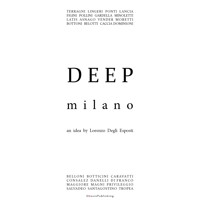
The analysis of 11 precedents of Milanese modern architecture by Terragni, Ponti, Moretti, and other masters, gives rise to 11 proposals of resistant urban architecture, developed by 11 teams (each comprised of 3 students and a mentor) in the workshop DEEPmilano conceived by Lorenzo Degli Esposti.
Das E-Book können Sie in Legimi-Apps oder einer beliebigen App lesen, die das folgende Format unterstützen:
Veröffentlichungsjahr: 2016
Ähnliche




















Lorenzo Degli Esposti
DEEP Milano
Contents
Sprezzatura - Lorenzo Degli Esposti
Team 1 - Casa Rustici by P. Lingeri e G. Terragni
Team 2 - Torre Rasini and residential building by E. Lancia and G. Ponti
Team 3 - Residential building in via Broletto by Figini and Pollini
Team 4 - Casa ai Giardini d’Ercole by A. Castelli Ferrieri, I. Gardella, R. Menghi
Team 5 - Casa del Cedro by G. Minoletti
Team 6 - Residential building in via Lanzone by G. and V. Latis
Team 7 - Condominio XXI Aprile by Asnago and Vender
Team 8 - Residential, office, commercial, and garage complex in Corso Italia by L. Moretti
Team 9 - Palazzo INA by P. Bottoni
Team 10 - Residential building in via Canova by G. Belotti
Team 11 - Residential building in via Nievo 28/A by L. Caccia Dominioni
Final critique
Logbook
StudioMarinoni
SMownPublishing
© Copyright 2016
by StudioMarinoni OwnPublishing
Corso Sempione 36
20154 Milano
www.smownpublishing.com
UNIVERSITY PRESS Series
Editor Giuseppe Marinoni
Advisory board
Annegret Burg, Giovanni Chiaramonte, Alessandra Coppa, Kurt W. Forster, Luigi Mazza,
Giuseppe Marinoni, Luis Raúl Moysén Mason, João Nunes Ferreira,
Santiago Quesada, Pierluigi Salvadeo
DEEPmilano
This book presents the results of the international architectural composition workshop DEEPmilano 2013 conceived by Lorenzo Degli Esposti and offered by the School of Architecture and Society at Politecnico of Milan and the Architectural & Urban Forum - Milan, held at the Politecnico di Milano in July / September 2013.
Editor
Lorenzo Degli Esposti
Translated by
Stephanie Carwin, Lorenzo Degli Esposti
Transcriptions and organization of materials
Francesco Degli Esposti, Giulia Ragnoli
Editing and graphics
Maurizio Petronio
with Silvia Binetti, Andrea Bonatti, and Gaia D’Alpaos
Cover graphics
Lorenzo Degli Esposti
with Silvia Binetti and Gaia D’Alpaos
Photographs by
Maurizio Petronio, Daniele Zerbi
Ebook coordination
Vilma Cernikyte
With the support of
Scuola di Architettura e Società, Politecnico di Milano,
Architectural & Urban Forum, Milan
Acknowledgments
We would like to acknowledge:
All the teachers and members of the reviews for their voluntary participation; Mr. Maurizio Petronio and Mr. Daniele Zerbi for their photographs; The staff of the Politecnico for their help, above all Mrs. Efisia Cipolloni; The archives and foundations which provided us with the copies of the original drawings to be used for educational purposes; Mr. Aldo for his artistic sabotage.
ISBN 978-88-99165-31-4
UNIVERSITY PRESS / 5
Sprezzatura - Lorenzo Degli Esposti
Understatement used to be considered the character of Milan, a discrete modality of expression, consistent with the title of moral capital of Italy, which from time to time is dusted off for this city. This character has been recently ascribed to Italian architecture as well, by Pierluigi Nicolin in his book in 2012, paired with a precise behavior taken from Baldesar Castiglione’s : sprezzatura. This was later proposed again by Cino Zucchi, in the prologue of the catalogue of the Padiglione Italia curated by him in 2014, part of the 14 Venice Architecture Biennale, for which Rem Koolhaas asked the curators of national pavilions to interpret the misleading theme . Both Nicolin and Zucchi use this term to designate an attitude of some of the best Italian architects, during the twentieth century and through to today, which consists in achieving elegance and grace, albeit in limited and normative conditions, by actually adapting to the latter without apparent effort. Nicolin mentions indeed the “lightness and of this ‘practical aesthetics’ of the Italian tradition” (Nicolin, 2012), and affirms that, “At a minimum level, this practical aesthetics is expressed then by a manual of good education, an etiquette of good manners, according to an easily reachable measure” (Nicolin, 2012). For his part, Zucchi says that, “There is no doubt that this particular aspect of behavior ‘in society’, which presupposes an awareness of current aesthetic rules, but also the capacity to express oneself in different manners according to these rules, implicitly revealing their ‘conventional’ nature, is a particular effective key to reading many of the best of Italian projects” (Zucchi, 2014). Zucchi connects with , the latter being “synonymous with ‘politeness’ or ‘good manners’. Living together, working on constructing a city, means accepting the limits of individual power given by custom, ways of life, that dense network of unwritten codes enabling us to live with others” (Zucchi, 2014). Both these positions refer to another compulsion, typically Italian and especially Milanese, which has diluted the lessons of Ernesto Rogers and the further developments by his disciples, Vittorio Gregotti and Aldo Rossi, into an often vague concern for the context, for pre-existing conditions to be mystically interpreted, for materials to be alchemically used. Again, Cino Zucchi is giving us a recent interpretation of that, in his vision of architecture, considered as an agronomic technique or even gardening: “The Italian Pavilion at the 2014 Venice Biennale is based on a simple concept: the observation of a country in which each new project has to come to terms with such an urbanised territory, such a stratified use of the city, that it is almost impossible to conceive a building as an autonomous object. While the Functionalism of the last century sought a ‘degree zero’ and the security of an elementary lexicon in its anxiety to re-invent a new order, contemporary thinking seeks new goals and values through a metamorphosis of existing structures” (Zucchi, 2014). The focus on the relationship between the work of architecture and the city has been becoming more and more equivocal, maybe perverse, over-stressing the importance of the building’s reliance on, or even worse its being determined by, the city.
Lesen Sie weiter in der vollständigen Ausgabe!
Lesen Sie weiter in der vollständigen Ausgabe!
Lesen Sie weiter in der vollständigen Ausgabe!
Lesen Sie weiter in der vollständigen Ausgabe!
Lesen Sie weiter in der vollständigen Ausgabe!
Lesen Sie weiter in der vollständigen Ausgabe!
Lesen Sie weiter in der vollständigen Ausgabe!
Lesen Sie weiter in der vollständigen Ausgabe!
Lesen Sie weiter in der vollständigen Ausgabe!
Lesen Sie weiter in der vollständigen Ausgabe!
Lesen Sie weiter in der vollständigen Ausgabe!
Lesen Sie weiter in der vollständigen Ausgabe!
Lesen Sie weiter in der vollständigen Ausgabe!
Lesen Sie weiter in der vollständigen Ausgabe!




