


Erhalten Sie Zugang zu diesem und mehr als 300000 Büchern ab EUR 5,99 monatlich.
- Herausgeber: Luath Press
- Kategorie: Geisteswissenschaft
- Sprache: Englisch
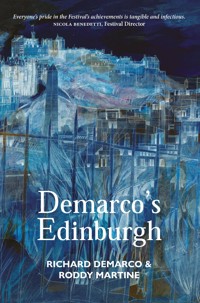
The Edinburgh Festival of those days was a much more accessible village... The ground rules were well enough understood. Everything about it was containable. The Fringe was the seed bed for talent and ran happily in step with its established elders and betters. They both knew their place. But then something equally remarkable was about to take place in the New Town of the city I knew and loved... The same year, Roddy Martine is born. In 1963 when, at the age of sixteen, he interviewed Sir Yehudi Menuhin and David Frost for an Edinburgh Festival magazine he edited and the following year, met Marlene Dietrich. Both Richard and Roddy have unique perspectives on the most remarkable international festival of the arts the world has ever known. They have witnessed its evolution over the years and are passionate believers in the power of creativity within everyone. In this fascinating book, Richard – the 2013 UK recipient of the Citizen of Europe medal – explores the original world vision of Sir John Falconer and Rudolph Bing and, with Roddy, recalls the highs and lows of The Edinburgh International Festival, The Fringe, Art, Book, Jazz and Television Festivals, and The Royal Edinburgh Military Tattoo. Now in its eighth decade, can the Edinburgh Festival survive? Where do we go from here?
Sie lesen das E-Book in den Legimi-Apps auf:
Seitenzahl: 416
Veröffentlichungsjahr: 2023
Das E-Book (TTS) können Sie hören im Abo „Legimi Premium” in Legimi-Apps auf:
Ähnliche



















RICHARD DEMARCO has personally experienced every Edinburgh Festival since its inception in 1947, as well as contributing to its history and innumerable manifestations of the visual and performing arts, plus conferences, symposia and master classes, to underline the importance of introducing an academic dimension into official International and Fringe programmes so that they integrate completely and significantly as they did in the ’40s, ’50s, ’60s and into the ’70s.
The Eighties began with an inevitable confrontation between the ethos of The Demarco Gallery and the ethos of the Scottish Arts Council. Joseph Beuys believed that ‘everyone is an artist’. Did that include those criminals serving life imprisonment? The Scottish Arts Council believed that art was firmly controlled by the concept of an art industry, that, indeed, art was part of a leisure industry and that the Minister of Culture was also the Minister for Tourism.
Richard Demarco has always believed that art and education are two sides of the same coin and that is why the Arts Council of Scotland came to the conclusion, in 1980, that Richard Demarco had ‘brought dishonour to the meaning of art, brought dishonour to the meaning of art in Scotland, and brought dishonour to The Demarco Gallery’ and, for that reason, he did not deserve to be supported by annual central government funding.
Richard Demarco has also always believed, from his ten years of experience as a primary and secondary school teacher (1957–1967), that the use of the language of all the arts expresses the incontrovertible fact that, as Joseph Beuys maintained, every human being possesses a birthright to be creative.
All expressions of art, particularly on the highest level, are a gift and, indeed, ascend to the condition of prayer, in gratitude for the gift of Life. As a gift, it cannot be attached to a price tag. He acknowledges the fact that his experience of the Edinburgh Festival, from his boyhood to this troubled computerised world of the Third Millennium, is a blessing upon his life and, indeed, a blessing upon Edinburgh as the city of his birth.
The Edinburgh Festival came into being against all the odds when the pain endured by humanity in the aftermath of World War II seemed insufferable. A small group of friends were eager to support Rudolf Bing’s belief that Edinburgh could become an ideal British version of Austria’s pre-war Salzburg Festival. They took the language of art most seriously as the one language given to human beings which could begin the process of healing the wounds of global conflict. Ironically, therefore, without the suffering caused by the Second World War, the Edinburgh Festival could not have come into being. According to the Lord Provost, John Falconer, as the first Chairman in 1947, the Edinburgh Festival was an expression of ‘the flowering of the human spirit’ and therefore ‘it was in no way a commercial venture’.
When Richard Demarco asked Joseph Beuys to explain the quintessential nature of his art, Joseph Beuys replied succinctly ‘my art is my teaching’. In 1972, The Demarco Gallery’s experiment in education through all the arts was entitled with the use of two words – EDINBURGH ARTS. It was inspired by Black Mountain College, the American equivalent of the Bauhaus, and by Edinburgh as the world capital of all the arts.
From 1957 to 1967, Richard Demarco was the Art Master of Edinburgh’s Scotus Academy and worked closely with his colleague, Arthur Oldham, who was the Academy’s Music Master. Together, they firmly believed that every Scotus Academy boy was born to be creative. Richard Demarco extended his Scotus Academy art room to be identified with the Paperback Bookshop created by Jim Haynes in the late 1950s and early 1960s. From the year 1963 to 1967, Richard Demarco became the Vice-Chairman of what was in fact a slight enlargement of the Paperback Bookshop.
This came to be known as the Traverse Theatre Club and was housed in an 18th-century eight-storey tenement in Edinburgh’s Lawnmarket in close proximity to Edinburgh Castle on the historic Royal Mile. It was also, under Richard Demarco’s directorship, Scotland’s first art gallery focused completely on the international art world and the need for a powerful dialogue between Scotland and the European art world on both sides of the Iron Curtain.
As such, the Traverse Theatre Club established an international reputation for both the visual and performing arts. However, when Jim Haynes moved his concept of the Traverse to London, the Traverse spirit of internationalism continued to shine bright within the Edinburgh New Town house of what was to be known as The Richard Demarco Gallery. It was actually the Edinburgh version of Roland Penrose’s London-based Institute of Contemporary Art. It seemed inevitable that, in 1972, The Demarco Gallery should become a ‘university of all the arts’ in collaboration with Edinburgh University’s Schools of Scottish Studies and Extra-Mural Studies.
In 2013, Richard Demarco was invited to the European Parliament in Brussels. There, Martin Schulz, as President of the Parliament, awarded him a medal as a European Citizen of the Year. His European citizenship is well defined in the publication entitled Demarco 2020 as a celebration of his 90th birthday.
The Demarco Archive is a large-scale collaborative work of art – a unique Gesamtkunstwerk. It exists predominantly in nature. It could, therefore, be compared to Ian Hamilton Finlay’s Gesamtkunstwerk of Little Sparta. It exists in a farmscape known as ‘Stonypath’ in the landscape of Lanarkshire.
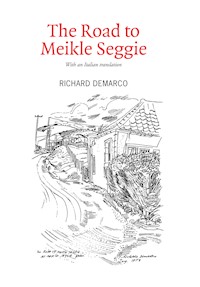
EDINBURGH ARTS linked the Edinburgh cityscape with the farmscape of Kinross-shire. Meikle Seggie is a working farm. It is a point of departure which leads to a journey through time and space to the Apennine farmscapes of Richard Demarco’s Roman ancestors around the town of Picinisco, near to the Abbey of Monte Cassino and the city of Cassino.
Picinisco existed in Roman times, close to the villa of Cicero. The citizens of this village are known as ‘Ciceroni’ – the children of Cicero. They have become famous as artists’ models as a direct result of their lifestyle as farmers and shepherds. In this world, mankind has related to the extreme forces of nature from pre-historic times. As proof of this thought-provoking fact, there exists pre-historic rock carvings of shepherds and their sheep in the mountainous wilderness around Picinisco.
By focusing on The Road to Meikle Seggie, Richard Demarco is responding to a need to celebrate his Roman forebears who once regarded Scotland as the north-western frontier of the Roman Empire. Richard Demarco regards himself as a teacher, mainly on primary and secondary levels, using the language of all the arts. This provides proof positive that Scotland remains, from its earliest history, a unique and important manifestation of the cultural heritage of Europe.
RODDY MARTINE was born in South East Asia but brought home to Scotland by his parents to be educated at Edinburgh Academy. From launching an Edinburgh Festival magazine in his schooldays, he has followed the progress of the Edinburgh International Festival, Edinburgh Fringe Festival and Edinburgh Military Tattoo for over 60 years. For four years, he was co-opted as a judge for the Edinburgh Festivals’ Cavalcade.
As a columnist with five major newspapers during the 1990s, and editor of a succession of Scottish lifestyle magazines, he has always regarded Edinburgh as his home and has published 30 books largely relating to Scottish lifestyle topics – history, biography, interiors, Scotch whisky, tartan and the supernatural. For his involvement in the Scotch Whisky Industry, he was made a Keeper of the Quaich in 1996, and a Master of the Quaich in 2006.
He was a Trustee of the Edinburgh International Festival during the 1970s, and served as a Trustee of The 369 Gallery of Contemporary Art throughout the 1980s. As a writer and photo journalist, he has attended The Grandfather Mountain Highland Games in North Carolina, and Tartan Week in New York and Washington, USA; the International Gathering of the Clans in Nova Scotia, and, in 2003, he was honoured as the Scottish Australian Heritage Council’s Guest from Scotland for Sydney Scottish Week.
He was an early supporter of the Traverse Theatre in the Lawnmarket and subsequently in the Grassmarket where, although almost 20 years younger than its founder members, he knew them well. He was a cheerleader for The Demarco Gallery from the moment it first opened its doors in its original manifestation in Melville Crescent.
For Roddy Martine, with all the personalities he befriended, and all of the comings and goings he has witnessed over the years, the enduring and challenging world of Demarco’s Edinburgh has always embodied the uplifting spirit of the Edinburgh Festivals.
DR CHARLIE ELLIS is a researcher and EFL teacher who writes on culture education and politics. He is a regular contributor to The Scottish Review and Modern English Teacher. He has authored several academic articles on politics and public intellectuals and is currently working on a book for Edinburgh University Press on British conservatism and culture.
TERRY ANN NEWMAN is an artist born in Wiltshire in 1944 and educated in Southampton, gaining a Diploma in Fine Art from the College of Art in 1987. Since meeting Richard Demarco in 1983, she has travelled extensively in Europe, particularly in Eastern Europe during the 1980s and 1990s with The Demarco Gallery’s EDINBURGH ARTS; she has been a director of the Demarco European Art Foundation since 1992, and deputy to Richard Demarco since 2000. Her art works are in private and public collections, including the National Galleries of Lithuania and Hungary.
First published 2023
ISBN: 978-1-80425-117-1
The authors’ right to be identified as authors of this book under the Copyright, Designs and Patents Act 1988 has been asserted.
Typeset in 11.5 point Sabon LT
by Main Point Books, Edinburgh
© Richard Demarco and Roddy Martine 2023
In Memory of Hugo Burge of Marchmont, Greenlaw, Berwickshire
Contents
Preface
RODDY MARTINE
Introduction: Requiem for the Unknown Artist
TERRY ANN NEWMAN
Taking the Long View: What drives Richard Demarco’s relentless search for truth and beauty?
DR CHARLIE ELLIS
PART ONE: RICHARD DEMARCO’S EDINBURGH FESTIVAL
1 My Pilgrimage
2 The Challenge of a Festival in Europe
3 Let Us Consider the Romans in Scotland as Pagans and Christians in Peace and War
4 Maison Demarco
5 Festival of the Arts 1955–1958
6 The Forrest Hill Poorhouse
7 A Visual Explosion
8 Edinburgh in Relation to Scotland and Europe
9 Strategy: Get Arts
10 Edinburgh Arts – Summer Schools and Journeys
11 PENTAGONALE
12 The Edinburgh Festival is Not Interested in the Visual Arts
PART TWO: RODDY MARTINE’S EDINBURGH FESTIVAL
1 A Winner on All Fronts
2 Paying the Piper
3 The Spirit of Krashny – the Festival Spoof That Took on a Life of Its Own
4 Edinburgh’s 369 Gallery and Movement
5 What Is It about the Scottish Play?
6 Le Bourgeois Gentilhomme
7 Déjeuner sur l’herbe
8 By Waverley Station I Sat Down and Wept
9 Freedom For Ukraine
Appendix 1
The Demarco Archive
RICHARD DEMARCO
Appendix 2
Richard Demarco and Glenalmond College
EDWARD SCHNEIDER
Appendix 3
Demarco’s Edinburgh Year By Year (with a running commentary from the man himself)
Bibliography
Endnotes: Taking the Long View
Edinburgh is too large to know what it fundamentally thinks about anything; and the people who want something livelier of their Festival (are The Fantastic Symphony or The Beggar’s Opera so deadly?) really mean different. Dankworth instead of Debussy, Acker Bilk rather than Bach, Brubeck and not Britten.
The 7th Earl of Harewood, Artistic Director of the Edinburgh Festival 1961–1964, Lens Magazine, 1963
Preface
AS AN IMPECUNIOUS teenager, suspiciously alien, albeit exotic from having been born on the island of Borneo, Demarco’s Edinburgh was, and remains for me, MY Edinburgh. More importantly, Demarco’s Edinburgh embodies the Edinburgh Festival that both Richard and I, 18 years apart in age, discovered for ourselves as schoolboys.
Gallery Director, Artist and Teacher Richard Demarco was aged 17 in August 1947, and he was in at the very start of it. How I envy him. Kathleen Ferrier, Bruno Walter, the Vienna Philharmonic, Edinburgh Castle floodlit for the first time since before World War II. I wish I had been there. Born at the very beginning of that same year, my involvement began as late as 1963 when, at the age of 16, I edited an Edinburgh Festival magazine called Lens – A Youthful Focus on the Edinburgh Festival.
During the 1960s, The Demarco Gallery in Edinburgh’s Melville Crescent, and thereafter in its several re-locations – Blackfriars Street, the Forrest Hill Poorhouse, St Mary’s School in Albany Street, Skateraw, Craigcrook Castle, Summerhall, and now Milkhall – was a beacon of excitement. It was where Edinburgh’s permanent and perhaps scornful and alarmed residents were invited to embrace bohemia. It was where the Georgian grandeur of Edinburgh’s New Town spilled effortlessly and mischievously into suburbia, and far beyond. The Demarco Gallery was the meeting place for all of the arts in Scotland, be they high or low in affectation, be they parochial or worldly wise or just simply inspirational. The Demarco Gallery was where the Enlightenment and those who aspired to a better world found enlightenment. And it was always international.
Despite a Haddington-shire ancestry stretching back into the somewhat dimmed mists of time, the reign of King David to be precise, I saw my first light of day in Sarawak. However, like the Edinburgh-born Italo-Scot Richard Demarco, I consider myself, first and foremost, a Scot. At the same time, we are both non-political Europeans or, rather more pretentiously, Citizens of the World. My parents were multilingual, my mother fluent in French; my father, in German, various Chinese dialects and Malay (not languages much called upon in Corstorphine where they latterly lived). Even so, it was through such versatility of mind that they sent me to summer schools in Switzerland and France.
For nine years, I commuted to work in Glasgow (as Editor of Scottish Field) and probably this is why I have never been susceptible to the propriety of Middle Class Edinburgh, so spectacularly out of kilter with its dazzling annual international festival of music, theatre and, until the 1990s, the visual arts.
Like Richard Demarco, I have embraced the concept of The Road to Meikle Seggie: that all roads throughout the world lead finally to the centre of Scotland, and that all roads from Meikle Seggie connect to Infinity. Both of us mourn the absence of global visual art, traditional and contemporary, in the official Festival programme, and the international vision that this embraced.
However, those who seek a definitive and forensic history of the Edinburgh International Festival must turn to David Pollock’s masterly Edinburgh’s Festivals: A Biography. In contrast, Demarco’s Edinburgh is a deeply alternative personal read.
In Demarco’s Edinburgh, Richard and I have set out, warts and all, to explain in two sections, his and mine, our individual observations on how Scotland’s Capital City came to showcase its greatest 20th-century achievement and how this has impacted upon our lives. Not as a gateway for Scottish tourism. Not as a hub for financial expertise. Not for Scotland’s devolved United Kingdom legislature, but for hosting 76 years of an extraordinary, fantastic and breathtakingly innovatory International Festival, unlike any other, anywhere else.
These are Richard Demarco’s memories coupled with mine, his mainstream and mine slipstream, but held together by a cast of characters far beyond your wildest imagination, and who must never ever be forgotten. This is Demarco’s Edinburgh.
Roddy Martine, July 2023
Introduction
Requiem for the Unknown Artist
THIS IS THE TITLE which Joseph Beuys gave to his significant art work in 1970 as part of the Edinburgh International Festival’s programme of artists from Düsseldorf devised by Richard Demarco and presented by The Richard Demarco Gallery in the setting of Edinburgh College of Art and entitled Strategy: Get Arts. It could also be the title of the great art work that Richard has created over the decades in which he places the ‘unknown artist’ into the international public domain of the Edinburgh Festival. Richard is an artist, both as a painter and as an instigator and challenger, who causes new insights into the creativity of his friends.
As co-creator of the Traverse Theatre Club, The Richard Demarco Gallery and The Demarco European Art Foundation, Richard has brought thousands of artists together, through the years, in order to maintain the excitement of the early days of the Edinburgh International Festival. Together with his friends who were saddened when ‘the circus left town’, he presented Edinburgh with the possibility of enjoying exciting new experiences for 52 weeks of the year. Without this stimulation and challenge, Richard would not have remained in Edinburgh; it is entirely due to the founding principles of the 1947 Festival that Edinburgh has benefited from the years of his strenuous endeavours.
I came to Edinburgh in 1986 to The Demarco Gallery as it moved into the exciting location of Blackfriars Church and helped to prepare it for the great opening of Polish art. Having met Richard in 1983, I recognised the international understanding of art that Richard championed and which could be found on the Continent of Europe and in the world of Christendom. Richard Demarco epitomises this understanding. He takes risks for the best possible reasons with so very many actually succeeding due to his determination to enable artists to flourish.
Demarco’s Edinburgh carefully expresses this sensibility.
The world of Richard Demarco was, and is, such a very exciting, constantly evolving, expression of a journey, a journey through landscape with friends and into the history of ideas. This is the journey that he has named The Road to Meikle Seggie.
It is this sense of a journey that runs throughout Richard’s work for the Edinburgh Festival, from his first experience as a schoolboy in 1947, right up to this year, his 94th! There is no sense of his stopping, of resting on his laurels. This would be simply impossible.
Terry Ann Newman, July 2023
Taking the Long View: What drives Richard Demarco’s relentless search for truth and beauty?
Dr Charlie Ellis
RICHARD DEMARCO’S RELENTLESS, unremitting energy and passion for new projects are frequently mentioned in profiles of him. Now aged 93, this proselytising passion for art still burns as he rages against the dying of the light. Every conversation sees his interlocutors probed and prodded and ambitious new collaborations mooted. Animated recollections and connections are stimulated by every piece of art or photo he encounters.
So, where does this energy come from? What is fuelling his impassioned pleas? Throughout Demarco’s public pronouncements and cultural interventions, certain themes are returned to time and time again. They reveal the wellspring of his cultural vision and why he remains so zealous about it. This chapter identifies and contextualises the abiding themes of Demarco the public intellectual, sometimes masked by Demarco the hyperbolic showman. The discussion here draws on Demarco’s recent public pronouncements, as well as private discussions.1 In particular, those relating to the 75th anniversary of the Edinburgh Festival, marked and celebrated in 2022, and Marco Federici’s film Rico: The Richard Demarco Story. Demarco used these events to outline his central mission and the values which inspire it.
As a totality, Demarco offers a unique perspective as a public intellectual. However, Demarco also echoes the thoughts of a number of leading figures in the sphere of cultural politics. A number of Demarco’s abiding themes are also highly relevant to a series of still-smouldering debates in the sphere of culture and in relation to the Edinburgh Festival and Fringe. We can crystallise Demarco’s singular vision by comparing and contrasting him with them. Doing so helps explain why Demarco, despite his huge influence, remains something of an outsider without a natural set of allies or supportive institutions. The temporary, uncertain status of his Gesamtkunstwerk manifests the imperilled character of the cultural vision expressed through it.
A Healing Balm
Demarco is rarely seen without a camera or sketchbook2 in his hand. At any cultural event or conversation, he will be snapping away, keen to capture the moment. Disconcertingly, he even takes photos of his interviewers while he is being interviewed! As he relates, ‘I’ve been taking photos since I was a child’, and isn’t likely to stop now. This ‘genre’ of art, which Demarco defines as ‘Event Photography’, seeks to use the camera to document and amplify the work of other artists. Telling cultural history through photography.3 As a result, there are about two million photographs in his vast archive. Only a portion (around 15,000 images) have been digitised so far – by Dundee University.
From this vast number, Demarco highlights the significance of a photo of the German artist Joseph Beuys reverently surveying the names inscribed on the war memorial at Edinburgh University. Demarco collaborated with Beuys many times4 and considers him to be ‘the most important artist of the second half of the 20th century’. Demarco reflects that Beuys spent five years in a Nazi uniform, ‘fighting people such as these’. Beuys himself, Demarco believes, died early due to his war wounds, suffered in a near-fatal plane crash in the Crimea in 1943. Trauma and repair would become key themes of Beuys’ art.5
Beuys’ eight visits to Edinburgh and participation in ‘Strategy: Get Arts’ were part of the healing process. That 1970 event, dominated by artists based in Düsseldorf, expressed that ‘Germany was no longer our enemy’.
That these artists were so warmly received in a country where ‘German’ had been ‘a swear word’ only 25 years before was evidence of some degree of amelioration. The photo of Beuys at the war memorial manifests Demarco’s faith in art as a unifying force, and as ‘a healing balm for the pain the human race has suffered’.
The photo also demonstrates how deeply woven Demarco’s cultural life is into much wider, geopolitical change. In short, the post-war reconstruction of Europe, the cultural revolution of the 1960s, the Cold War and, more recently, the apparent ‘backslide’ towards national populism.6 Demarco has not been a passive observer of these shifts but intimately involved in them, promoting some and vigorously opposing others. He has done so using art as a language that forms bonds and connections across borders and social divides.
Demarco’s numerous engagements with artists in Eastern Europe exemplify this in the fullest. Those behind the Iron Curtain had been in ‘the largest prison in the world’, with very few in the art world prepared to try and connect to it. He took around 60 trips to Eastern Europe in that period to help ‘maintain a cultural lifeline’.7 He brought many of them to Edinburgh, which he considered a form of ‘universal space’. What seemed to propel him was Camus’ view that ‘tyrants know that the work of art is an emancipatory force’.8
For Demarco, the apparent shifts towards national populism that we see today9 in Europe and further afield (Bolsonaro, Trump, Modi) is a great threat. It threatens to undo the partial reunification of Europe that occurred at the end of the Cold War ‘emerging from the debris of the Berlin Wall’.10
For Demarco, this trend was typified by Brexit, something which ‘appals’ him (‘what a madness!’). Demarco had hoped that we were finally ‘putting the 20th century behind us’, but this has not happened. History has bitten back. This all leaves Demarco fearing that we might be nearing a third world war. The brave Ukrainian soldiers are, Demarco believes, ‘fighting for our freedom’. He holds that, ‘if they lose, this will put European culture in serious jeopardy’. We are, Demarco believes, ‘living not in interesting times but times of chaos, where everything’s falling apart’.
The photo of Beuys highlights the centrality of World War II to Demarco’s cultural perspective. The Festival was, in Demarco’s view, ‘born out of the horror of World War II’. The war is therefore ‘embedded’ in the history of the Festival. This drives Demarco’s abiding internationalism and his faith in art. Art gave him a tool for promoting a very different perspective, focusing on the fundamental commonalities between people across borders. The Festival had revealed that ‘that which contains darkness also contains the prospect of light’. Something wondrous was created in a time of general scarcity with many European cities flattened.
One of the worst affected cities in the UK was Coventry. Its post-war rebirth was led by Basil Spence who, like Demarco, studied at Edinburgh College of Art. Spence was inspired to design a cathedral by the destruction he witnessed in Normandy. In many ways, the cathedral he designed was primarily a work of art rather than a practical building. For Spence, art was an essential component of architecture.11 Coventry Cathedral subsequently became home of The Centre for the Study of Forgiveness and Reconciliation and regularly hosts cultural events. Those involved in the design and building of the ‘Phoenix at Coventry’ were not defeated by the destruction but inspired towards rebirth.12 Their faith was tested but not extinguished. Demarco has a similar belief in art’s ability to reconcile. For both Demarco and Spence, it was World War II which inspired them to their greatest achievements.
What had caused the conflagration was nationalism. What lay behind this was an ‘othering’ and demonisation of certain groups. Demarco himself felt that from an early age, vilified as a ‘wop’,13 and bullied and ostracised by classmates as ‘an alien child’. As both Italian and Roman Catholic he was ‘deeply questionable’. Demarco saw how quickly this xenophobia could quickly transmogrify into aggressive and violent nationalism. During the war he was evacuated to Largs, thought to be safer than Edinburgh. He arrived just in time to witness some of the heaviest bombardments of the conflict. From the tenement he was staying in he saw ’the sky light up’ and heard the sounds of the destructive ‘blitz’ on Clydebank of March 1941. Through his first experience of the Festival (in 1947), he saw a way that such fissures could be overcome. This helps explain the zeal with which he promotes art and the Festival.
Elitist or Egalitarian?
Demarco’s urgent energy came across in spades in his various public performances during the 2022 Festival. Though he can’t stand the form, Demarco’s ‘performance’ at the Quaker Meeting House owed something to stand-up comedy.14 Prowling across the stage he delved into his memories, his sometimes halting voice suddenly sweeping into fervent crescendos. At times, he stepped into the audience, clasping the hands of some, grasping the shoulders of others, so keen was he to get across his message.
As part of a new collaboration with the Signet Library, Demarco and his team displayed a ‘tiny smidgen’ of his archive, chronicling the evolution of the Edinburgh Festival and his involvement with it. Again, Demarco implored visitors to take the original vision of the Edinburgh Festival seriously; ‘I’m not messing around.’ Those in Edinburgh during August should not act merely as ‘cultural tourists’, passively encountering the Festival. The challenge Demarco makes to those who attend the contemporary Festival is simply ‘Are you serious?’ Rather than cultural tourists, Demarco wishes to see committed ‘artistic explorers’.
Demarco’s forthright critique of the contemporary Edinburgh Fringe might invite charges of golden-ageism and cultural elitism. When sharing memories of past Festivals it’s typical for him to utter ‘there was a time when’ before bemoaning an aspect of the Festival now absent. He also talks of ‘the Festival that I knew’ as something entirely different, and superior, to its current form. He sees the Festival as it is now as ‘symbolic of a cultural decline’. Declinist narratives certainly populate much of our public discourse. They are very prominent in cultural debates and those concerning the built environment. Those areas of the internet devoted to Edinburgh’s past are awash with them. A pervasive sense of a city in decline, ‘not what it used to be’.
This charge of being a conservative figure, livid with nostalgia, has been levelled at the likes of Richard Hoggart. He was a central figure in the evolution of cultural studies as an academic discipline but is sometimes dismissed as a figure primarily of the past.15 Between 1992 and 2000, Demarco held the position of Professor of European Cultural Studies at the University of Kingston. Some might see Demarco’s disenchantment with the present state of the Festival in similar fashion. His public pronouncements, perhaps inevitably at 93, tend to be backward looking. This perhaps makes communicating the relevance of his archive difficult. Nostalgia is widely seen, as Samuel puts it, not primarily about the past ‘but about felt absences or “lack” in the present’.16 Certainly, Demarco sees much lacking in the contemporary Festival. When comparing it with the programme of The Demarco Gallery (when based in Blackfriars Street) in 1992, he finds it hard not to see it as unrivalled within the contemporary scene.
His narrative of dilution and decline might be dismissed as typical of the Jeremias expressed by cultural figures uneasy about contemporary trends.17 From this perspective, the history of the Festival and Fringe, as charted by David Pollock, is one of evolution not decline.18 The Fringe has certainly grown massively in recent decades and is considered a major success story by many. It could be seen as a story of cultural democratisation. That, what was performed and enjoyed by an incestuously small group in the early decades of the Festival and Fringe is now enjoyed by many multiples more. To paraphrase Kingsley Amis, more need not mean worse. Are Demarco’s criticisms of the contemporary Fringe the product of cultural elitism?
How could Demarco counter such changes? Highly relevant to Demarco are the cultural writings of Russell Keat.19 He drew a distinction between ‘elitism of access’ (which could be translated as, good culture ‘is only for the likes of us’) and ‘elitism of judgement’ (that good culture ‘is what we few who can judge these matters say it is’).20 These are themes which David Hume wrestled with in his essay ‘On the Standard of Taste’. Keat also echoes Richard Hoggart who believed that ‘saying that some things are better than others’ was something which should be encouraged if based on judgements which you are prepared to substantiate’.21 In his Reith Lectures, Hoggart spoke of ‘powerful resistance within British culture as a whole to making distinctions, recognising different standards’.22
Demarco has no such reticence to making distinctions when discussing culture. The Festival should be, in his view, about bringing the best art to Edinburgh from around the world, as judged by ‘the highest standards’. While showing people around his archive, judgements come thick and fast: ‘Why am I the only person who can explain why this is a work of genius?!’ These judgements are, however, borne of his long involvement in the artistic sphere. If he isn’t qualified to make such judgements, then who is? Though Demarco might continually repeat Beuys’ view that ‘everyone is an artist’, this is not the same as saying that ‘everyone is a good artist’.
There are certainly a number of links between Demarco and ‘left culturalist’ thinkers such as Hoggart, a near contemporary of Demarco. According to this view, ‘everyone should have the opportunity to share the good things that the upper classes had customarily enjoyed’. In short, ‘serious’ culture need not be the sole property of a ‘leisured elite’.23 Hoggart embodied a broadening of British cultural life in the 1950s and 1960s which drew in many from working-class backgrounds. Though he became an influential figure within British cultural institutions, Hoggart always felt like an outsider, caught ‘between two worlds’.24 This parallels Demarco’s sense of never feeling fully at home in Scotland. As a natural outsider, he has held an inherent sympathy for the marginalised.
This egalitarian, democratic desire to see the world of art opened up is illustrated in Demarco’s involvement with the Craigmillar Festival.25 Here he collaborated with its founder Helen Crummy, whose son Andrew has subsequently made an impact through works such as the Great Tapestry of Scotland. From his years as a school teacher, Demarco became aware that artistic potential could be found in all corners of society. At the time Craigmillar was dismissed by many as a ‘scheme’ riven by irresolvable social problems. Craigmillar was peripheral geographically and also considered so culturally. The idea that artistic ability was in plentiful supply in Craigmillar went against the snobbery embedded in Edinburgh society.
Local engagement, led by members of the community, was far more likely to discover artistic potential than ‘outreach’ work by national cultural institutions. The Craigmillar Festival has inspired similar events in areas such as Easterhouse in Glasgow.
One of the major works produced for the Craigmillar Festival was The Gentle Giant (aka Gulliver) sculpture by Jimmy Boyle. This was the centrepiece of the 1976 event. Demarco was involved, alongside Joseph Beuys, with Jimmy Boyle and the Special Unit at ‘Britain’s worst prison’, Barlinnie. The principle that ‘everyone was an artist’, included convicted criminals behind bars. This was Demarco’s most high profile involvement with marginalised groups. It also caused a great deal of consternation and led to Demarco coming into conflict with the established arts institutions.
He was condemned for having, in a statement much quoted by Demarco, ‘brought dishonour to the world of art’. His involvement with the Special Unit again emphasised Demarco’s belief in the power of art as a healing balm. It sought to embrace those ‘cut off’ from society, to whom art was ‘so alien’.26 It was borne of a love of art which ‘knew no bounds’.27 Demarco’s sense of being an outsider was accentuated by this controversy – but also the sense that he enjoys being on the edge and getting ‘up the noses’ of those in the ‘cosy little world’ of the arts institutions.
In No Way a Commercial Venture
In relation to the Edinburgh Festival, what drives him is a sense that something magnificent was achieved but that this legacy is being squandered. This helps explain the restless, discontented character of many of his public interventions. One aspect of this is his view that art ‘should not be aligned with tourism and market forces’. Becoming profit driven has, in Demarco’s eyes, eroded the true meaning of the Festival. Demarco often quotes John Falconer, the Festival’s patron in 1947, who proclaimed the event to be about the ‘flourishing of the human spirit’ and ‘in no way a commercial venture’. Demarco now sees the Fringe as a ‘money-making machine’, largely controlled by the major venues.
In seeing commercial forces as the chief source of decline, he again links to cultural critics such as Hoggart and Jim McGuigan. They see cultural populism as the inevitable result of a cultural sphere in which commercial values dominate.28 Though this position is contested, such as in the work of the economist and long-time Edinburgh resident Alan Peacock29, this ‘market scepticism’ is widely held. It connects to the idea that there exists a fundamental ‘contradiction’ between the values of the market and those of art.30 In Demarco’s case, it has been the idea of art as a commodity which has been so insidious. He believes that ‘art has been commodified so that unless it is about profit it is not taken seriously by our local or national government masters’. In short, a commercial view of art has permeated many cultural institutions, who are increasingly ‘controlled by the power of mammon’. In relation to the Fringe, this commercialisation is manifested in the move away from the visual arts towards comedy.
Demarco’s vision of the Festival and Fringe unites the two aspects of Ancient Greek performance: Comedy and Tragedy. It should aim to strike ‘the perfect balance between tragedy and laughter’. For Demarco, the wholesale embrace of comedy and entertainment has undermined the cultural significance of the Festival and Fringe. He pleads with those running the Fringe not to ‘turn everything into a circus’. That Fringe performances are now usually one-hour long is seen by Demarco as symbolic of this cultural shallowing. He contends, ‘How can you do anything serious in one hour?’
In ‘Richard Demarco’s Edinburgh’ map (of 1994), he charts the places he took Joseph Beuys. It included the Pleasance as one of the key Fringe venues. The original Pleasance is now known as the Pleasance Courtyard, illustrating the way the Pleasance (and the other big venues, such as Underbelly) have spread their tentacles out across the city. Some have resisted this takeover by the ‘Big Four’. The Free Fringe (in both the PBH and Laughing Horse variants) has, since 1996, helped many performers access the Fringe. They have also made the Fringe more accessible to those on a limited budget. There are some similarities between Demarco and the central figure of the Free Fringe, Peter Buckley Hill.31 Seen as disputatious troublemakers, both have regularly clashed with the leadership of the official Festival and Fringe. Both have also attracted a loyal band of followers and collaborators, which have kept their projects alive during tough times.
The Free Fringe has constantly been looking to carve out new venues and performance spaces. Places such as the Banshee Labyrinth, Liquid Rooms and Cabaret Voltaire have quickly become acclaimed venues. This follows in the footsteps of Demarco, who created fascinating venues in unpromising places such as the Forrest Hill Poorhouse and Gladstone’s Court. He preferred this to the ‘safety of an art gallery with clean white walls’.
However, most of the new venues unearthed by the Free Fringe have been in the heart of the Old Town; in the Cowgate and its ‘environs’. This has made the Cowgate area even more difficult to navigate during August. Free Fringe venues a bit further out (such as the Omni Centre) have not been particularly successful.
While the Free Fringe offers a range of shows (spoken word, theatre, magic, etc), comedy tends to dominate. This is where parallels between Buckley Hill and Demarco end. There is no comparison in terms of cultural ambition. Buckley Hill has laudably striven to open up the Fringe; Demarco has constantly sought to raise the sights of those involved. The Free Fringe has accentuated existing trends. For example, the rise of the Free Fringe has accelerated the long-term trend towards comedy. Increasingly the Fringe is seen as synonymous with comedy, especially stand-up comedy.32
That such a view is also held by some who organise the Fringe indicated to Demarco of ‘a loss of memory’. In short, a total lack of awareness of the history of the Festival. Demarco sees evidence of this around the city. Jim Haynes’ path-breaking Paperback Bookshop was on Charles Street, next to Bristo Square.33 Demarco sees the sweeping away of the original street as typifying a cultural negligence. That Edinburgh University’s Informatics Building now occupies the site of the bookshop is, for Demarco, evidence of a general shift away from the arts. For him, a ‘proper education takes into account every aspect of culture’. Demarco sees his archive as one antidote to this deficiency, so is saddened that the University has no interest in acquiring his archive.
The rise of stand-up comedy has inevitably shifted the focus of the Fringe to the ‘anglosphere’, away from Europe. Christian Schulte-Loh (Germany) and Sofie Hagen (Denmark) are very rare instances of European stand-ups and they have to use English when in Edinburgh. Because of the ‘infestation’ of stand-up comedians the Fringe is now, Demarco suggests, ‘fully rooted in English’. In contrast, a musician, visual artist, dancer can use ‘the language of the arts’ to communicate. For Demarco, ‘no language is more important than the language of art’.
Demarco’s very first experience at the Festival (in 1947) was watching the theatre of Molière – in French. For Demarco, the Festival and Fringe’s loss of its international, multilingual aspect and its ability to truly ‘challenge the audience’; have been key elements of its decline since the 1980s. The rise and rise of comedy has, in Demarco’s eyes gone hand in hand with a commercialisation. Commercialisation has, Demarco believes, led to a cultural narrowing. The Festival and culture more generally ‘have been absorbed into the world of entertainment’.
Demarco’s concerns about commercialisation raises the interesting question of where he believes the funding of arts should come from. Again, a comparison with Richard Hoggart is illustrative. Hoggart in ways embodied the ‘cultural consensus’34 of the post-war era. This was a general political agreement that the public funding of the arts was efficacious.
There was ‘general agreement among politicians of all parties that public subsidy should be continued’, on the ‘guiding principle of “the Best for Most”’.35 In short, that high culture ‘could be taken to deprived areas to widen horizons and cultivate souls’.36 This consensus was manifested in CEMA (Council for the Encouragement of Music and the Art), established in 1940, and later the Arts Council.
For Hoggart and his ilk, public funding increased access to culture and led to cultural democratisation. Similarly, the BBC’S protected position (through the Licence Fee) was seen as a way to ensure that it could look beyond. For Hoggart and others, the 1960s (under the Director-Generalship of Hugh Carleton Greene) saw the BBC make a significant contribution to British cultural life, through high profile documentary series by David Attenborough, Kenneth Clark, John Berger, and television dramas by the likes of Dennis Potter. For many, it is considered a neo-Reithian golden age.37 For others, it is a golden age that never was.38
This parallels Demarco’s sense that the 1960s and 1970s were something of a golden era for the Festival and Fringe. In visual arts, it was a period when Edinburgh had ‘real significance’, exemplified by Strategy: Get Arts. For him, what was put on in that era set a benchmark that has rarely, if ever, been met since. However, Demarco is keen to emphasise that memories of Strategy: Get Arts not be ‘possessed of any trace of nostalgia’. Instead, though more than 50-years-old, it was ‘more relevant, more alive’, than most of the contemporary art world.
Demarco has continually crossed swords with the public funding bodies and now seems entirely alienated from them. His public talks are peppered with derogatory remarks about bodies such as Creative Scotland and the National Galleries. A severing of ties has forced him to depend on private patronage as a source of funding for his archive and other projects. ‘I’m not able to get funding from the normal sources’. It’s not always clear in Demarco’s case whether this embrace of private patronage is one of necessity and principle. Certainly, there are many who are sceptical about public patronage. They fear that public bodies are often conditioned by ‘groupthink’, which can lead to a narrowing of vision in terms of what cultural activities are worthy of support. From Demarco’s perspective, the advantage of private patronage is a degree of freedom, of not being beholden to institutional edict.
The downside of private patronage is a constant sense of uncertainty. This is evident in the peripatetic character of Demarco’s cultural life and the sense of never having a secure base (‘I’ve never owned a gallery’). The Traverse and The Demarco Gallery both had many locations. The archive has also lacked secure anchorage, being stored in a variety of places over the years. The ‘biggest problem’ with archives being simply ‘where to put them’.39 That it currently has some degree of security (if not true accessibility) is due to the support he gets from a key patron, Robert McDowell at Summerhall.
Demarco knows this cannot continue indefinitely, but he remains unsure as to the degree he wants the National Galleries of Scotland to be involved with his archive in the long term. ‘I’m not sure if I should end up in the arms of the National Galleries’. This sense of alienation has become a dominant theme of Demarco’s pronouncements. He has had a profound loss of faith in cultural institutions and now believes that ‘the art world is not the right place for art’.
A Bloody Archive
This sense of alienation bleeds into his fluctuating feelings about his archive. Demarco switches between proclaiming the deep historical and artistic significance of his archive and threatening to burn it down due to the indifference it is shown.40 For Demarco, this indifference reflects a failure to understand the true cultural enormity of the Edinburgh Festival and Fringe. Plans for the archive to have a long-term home in Granton (as part of ‘The Art Works at Granton Waterfront’) have taken many years to finalise.41
As of spring 2023, ‘the ground has yet to be broken’. Demarco has accepted that he is unlikely to see this come to fruition in his lifetime (‘at my age, you can’t have a five-year plan’). What fuels his current efforts is a deep desire to ensure that the archive remains intact, and that a team is created to administer and care for it in perpetuity. But why does he care so much?
Demarco rejects many of the labels ascribed to him and his contribution. He ‘hates’ to be described, as he often is, as an arts impresario (‘impresarios make money!’). Though the material he has collated is defined as the Demarco Archive, he abhors the idea of it as an inaccessible collection gathering dust and mould. ‘I’ve not spent the whole of my life creating a bloody archive – my collection of boxes.’ Indeed, he even rejects the very idea of an archive: ‘My archive is not an archive but a homage to the Edinburgh Festival and the tribute to those I have worked with – many no longer with us.’ He wanted to ‘question to its very depth the idea of an archive’. In short, he does not want it to be a dormant collection of documents and pieces of art.
He much prefers to use the German word Gesamtkunstwerk, to express the collaborative, universal character of the project. A true Gesamtkunstwerk should, according to Hans Ulrich Obrist, not demonstrate its curator’s ‘own theory’ but should be formed from conversations and collaborations.42 Though certainly imprinted with his own vision, Demarco’s Archive does seem to fit this definition, through the numerous collaborations and cross-pollinations it manifests.
Embodied in this is the idea of an archive that is living and breathing. They are not merely anthologies of the past but continue to evolve and develop. Though often considered an ordered, logical world, archives are much more organic than that. We regularly hear stories of documents turning up in archives, found due to a stroke of luck. Most archives contain treasures waiting to be unearthed. They are pregnant with potential.
We might compare the Demarco collection with archives such as the John Rylands Research Institute and Library in Manchester. Opened in 1900, the ‘foundational collection’ comprised two large collections, one of printed books and another of historic manuscripts. The assemblage has grown in subsequent years and now constitutes one of the finest collections of arts and humanities materials in the UK. Its core mission is to help researchers, curators, conservators and imaging specialists to ‘define the human experience over five millennia and up to the current day’. Any visitor to John Rylands soon feels the crackle of intellectual activity that it helps to engender.
Demarco sees his own vast artistic archive as something which will inspire and enthral well into the future. His strongest desire is that it is used by pupils and students as a ‘unique academic resource’, telling the story of the Edinburgh Festival. Though he hasn’t taught in a school for many decades, Demarco still sees himself fundamentally as a teacher. He hopes that the archive will be educating long after he has gone, much as the Festival had acted as a university for him. He wants to see ‘students from around the world come and study it and use it’. He intends that a programme of scholarships will assist those using it. Precisely how it is used is something he can’t decide. All that he hopes is that it will be used and appreciated.
Demarco knows that, as at John Rylands and other comparable archives and libraries, ensuring that the collection is accessible is absolutely essential. Hence his frustration that it is currently in stasis, with only parts of it ‘get-at-able’. This includes the large section purchased by the National Galleries of Scotland in 1995 and which has since been through a process of sorting and cataloguing.43 Demarco believes that the large part currently at Summerhall is the more important section. It remains largely behind locked doors and has yet to be properly catalogued. This can only happen when it gets moved to a proper research centre.
While having a place where it can be stored safely will be a major step, it’s not enough. The small team he currently has which help him maintain and organise the archive will, when it moves, need to be supplemented by teams working on specific aspects of the archive. They will also play a role in continually adding to it, as more material relating to the Festival becomes available. It will become a living resource. Only then can it fulfil its fundamental role, which is to inspire and encourage artistic endeavour among future generations. What really concerns Demarco is the amount that still needs to be done. ‘I’ve hardly begun’ – I am still in the foothills… I cannot leave it unfinished.’ Hence why communicating the significance of his archive is his current preoccupation. As is fundraising to help him pay his storage costs. Otherwise, some of the artwork will need to be auctioned off.
This pains him as he accepts that coherence will be lost if parts of the archive are lost. Trying to secure a proper future for the archive is something Demarco has committed to as long as he ‘remains compos mentis’.
A New Enlightenment
Demarco has always felt uncomfortable in the world of Scottish art. For him, the character of the arts in Scotland has been parochial, insufficiently outward looking. There is, he holds, ‘no such thing as Scottish art, only art in Scotland which is part of a European tradition’. Demarco sees the period between the Enlightenment and the arrival of the Festival as something of a dark age culturally.
Demarco’s recent collaboration with the Signet Library, as part of its New Enlightenment project, manifested this. The forerunner of the National Library of Scotland, this institution was, as a place for intellectual exchange, right at the heart of the Enlightenment. At this time, Edinburgh was a world-leading place in fields such as medicine, political philosophy and economics.44




